Matthew 13 is the chapter where Jesus stops explaining and starts telling stories — and then, halfway through, walks out on the crowd. It is also the chapter that quotes the Greek Old Testament at two wildly different depths in the space of twenty verses: twenty-four consecutive words of Isaiah 6:10, matched by nothing else in the Old Testament, and six consecutive words of Psalm 78:2 followed by a sentence that matches neither the Greek psalm nor the Hebrew one. This study measures both, prints the connections that came back small alongside the ones that came back large, and traces the shape of a discourse that changes its audience at verse 36. See the method →
Matthew 13:1–58
Greek New Testament (SBLGNT, via MorphGNT) · ESV⚠️ THE OFFSET REACHES THIS PAGE ANYWAY, THROUGH THE TWO QUOTATIONS. Verses 14–15 quote Isaiah 6:9–10, where Hebrew, Greek and English chapter numbering agree — no conversion needed. Verse 35 quotes Psalm 78:2 in the ESV and the Hebrew, which is Psalm 77:2 in the Septuagint: the Greek psalter runs one number behind from 9/10 through 147. This page writes that reference as Psalm 78:2 · LXX 77:2 every time it appears. Inside the psalm the verse number does not move — the Greek folds the superscription into verse 1, as the English does.
Greek: SBLGNT as digitized by MorphGNT, pulled at build time from the files on disk; nothing on this page is hand-typed Greek. English: ESV. Longer units carry an ellipsis where the middle repeats what the opening has already established; the chapter runs 58 verses in full.
The Shape of the Passage
Frame, panels and a hinge — not a chiasm1. The house frame. οἰκία occurs exactly three times in Matthew 13 — v.1, v.36, v.57 — and nowhere else in the chapter. He leaves a house, he enters a house, and the chapter ends at a house that takes offence at him. 2. The beach frame. αἰγιαλός occurs six times in the whole Greek New Testament, and two of the six are in this chapter — v.2, where the crowd stands on it, and v.48, where the net is dragged onto it and sorted. 3. The ears frame. ὁ ἔχων ὦτα ἀκουέτω occurs three times in the whole Greek New Testament (Mt 11:15; 13:9; 13:43) — two of the three here, bracketing everything from the sower to the shining of the righteous.
The hinge is v.36, and it is the plainest thing on the page: he leaves the crowds and goes indoors. Four parables are told outside, three inside; each of the two explained parables is explained on the private side of its own telling. Counted honestly: seven parables if you stop at the dragnet, eight if you count the householder-scribe of v.52, who is given the same ὅμοιός ἐστιν formula — but applied to a man rather than to the kingdom.
Who wrote this, to whom, in what situation? Matthew 13 is the third of the Gospel’s five great discourses, and it is the one where the audience physically splits in half.
Author
Church tradition from Papias (early 2nd c.) onward names Matthew the tax collector (Matt 9:9; 10:3). His Gospel is built around five great discourses — chs. 5–7, 10, 13, 18, 23–25 — and he marks the end of each with one sentence. The phrase ὅτε ἐτέλεσεν ὁ Ἰησοῦς occurs five times in the whole Greek New Testament, and all five are in Matthew: 7:28, 11:1, 13:53, 19:1, 26:1. Chapter 13 closes on the third of the five.
He also tells you, twice, that he is quoting. The two Old Testament citations in this chapter both carry a formula — ἀναπληροῦται αὐτοῖς (“is fulfilled in them”) at v.14, and ὅπως πληρωθῇ τὸ ῥηθὲν (“so that what was spoken… might be fulfilled”) at v.35. Everything measured on this page follows from taking those two announcements at face value and then checking them against the Greek Old Testament on disk.
Audience
A largely Jewish-Christian community (often located at Antioch, writing c. 60s–80s AD), living through the painful parting from the synagogue and asking the obvious question: if the kingdom has come, why does the world look exactly the same, and why has most of Israel not received it? Matthew 13 is the chapter that answers it.
Inside the story the audience is doubled, and then divided. The crowds are on the beach (v.2). The disciples come and ask a question (v.10). Four parables are told with the crowds present; then at v.36 he leaves the crowds and goes into the house, and the last three parables and both explanations are given to the disciples only. The chapter is not just about hearing — it stages a separation of hearers in its own blocking.
And it ends by naming the cost. The last scene (vv.54–58) is his home town: “Is not this the carpenter’s son?” They know his family, his mother, his brothers, his sisters — and they take offence. The chapter that began by explaining why some do not understand ends by showing you a whole village that does not.
Get oriented: parable, kingdom of heaven, mystery, and the hardening of Isaiah 6.
Search by reference and by topic: parable, kingdom of God/heaven, mystery, hardening, harvest, end of the age, darnel, pearl.
Which articles are relevant?
- Dictionary of Jesus and the Gospels (IVP) — “Parable,” “Kingdom of God,” “Mystery,” “Hardness of Heart,” “Apocalyptic Teaching.”
- Anchor Bible Dictionary — “Parable,” “Kingdom of God,” “Mystery (NT),” “Agriculture” and “Fishing” for the working world of the images.
- NIDNTTE — παραβολή, μυστήριον, ζιζάνιον, σαγήνη, συντέλεια, σκάνδαλον.
- Dictionary of New Testament Background (IVP) — “Apocalypticism,” “Qumran: Pesharim,” “Agriculture and Fishing,” for the Second-Temple frame of “mystery” and “the end of the age.”
- Anchor Bible Dictionary — “Isaiah, Book of” and any treatment of Isa 6:9–10, the single most-reused hardening text in the New Testament.
Bibliography surfaced:
- W. D. Davies & Dale Allison, Matthew 8–18 (ICC) — the fullest technical treatment of the discourse and its citation formulas.
- R. T. France, The Gospel of Matthew (NICNT); Craig Keener, The Gospel of Matthew; John Nolland (NIGTC); Ulrich Luz, Matthew 8–20 (Hermeneia).
- C. H. Dodd, The Parables of the Kingdom; Joachim Jeremias, The Parables of Jesus; Klyne Snodgrass, Stories with Intent.
- Craig Blomberg, Interpreting the Parables; Richard Beaton, Isaiah’s Christ in Matthew’s Gospel; Maarten Menken, Matthew’s Bible (on the form of the citations).
- None of these was consulted for any number on this page. Every figure below was derived from the text files named in the footer.
Darnel, mustard, a woman’s enormous baking, and a seine net worked from a boat.
Every image in this chapter is a working object from first-century Galilee. Find out what the object actually did before deciding what the parable means.
What are these things, in the world of the hearers?
The weeds are darnel, and the whole point is that you cannot tell. ζιζάνιον is generally identified with Lolium temulentum, bearded darnel — a grass that is nearly indistinguishable from wheat until both head out, and whose seed is commonly infested with a fungus that makes it sickening to eat. That is what “let both grow together until the harvest” is doing: it is not tolerance as a principle, it is an agronomist’s answer to a real problem — the roots interlace, and weeding early costs you the crop (v.29).
Sowing weeds in a rival’s field was a recognised act of malice. The standard commentaries cite a provision of Roman law (the Digest, on damage to crops) contemplating exactly this offence. Stated honestly: we have not read the Digest here, and we are reporting a citation rather than a text we have checked. What can be said from the text itself is that the servants treat it as a crime with a perpetrator — “an enemy has done this” — not as bad luck.
The mustard seed is the proverbial smallest thing, not a botanical claim. Rabbinic texts use a grain of mustard as the standard unit of the negligibly small (e.g. m. Niddah 5:2; m. Toharot 8:8), and Jesus uses it that way twice more (Mt 17:20; Lk 17:6). The comparison “smallest of all seeds” is a proverb being quoted, not a botany lecture being given; orchids have smaller seeds and no Galilean farmer sowed them.
Three σάτα of flour is an enormous baking. A σάτον is roughly a third of an ephah; three of them come to something on the order of forty litres of flour — bread for a village, not for a family. The same quantity turns up in Genesis 18:6, where Abraham tells Sarah to make cakes for the three visitors. Measured, not assumed: Septuagint Genesis 18:6 reads τρία μέτρα σεμιδάλεως — “three measures of fine flour” — and shares exactly one consecutive word with Matthew 13:33 (τρία). The parallel is a parallel of quantity, not of wording, and this page will not dress it as more.
The σαγήνη is a seine. Not a cast-net (ἀμφίβληστρον, the net of Mt 4:18) but a long weighted dragnet worked out from a boat in a curve and then hauled in to the shore, where the catch is sorted on the sand. Verse 48 says exactly that: they drew it up onto the αἰγιαλός, sat down, and sorted. In the Greek Old Testament held here the word occurs seven times; at Habakkuk 1:15–16 it is the net in which a conqueror gathers men, and sacrifices to the net that filled his table.
Pearls were the top of the Roman luxury market. Pliny devotes much of Natural History book 9 to them and complains about their price; a single great pearl was a plausible object for a merchant to liquidate an entire portfolio to obtain. The parable is not exaggerating for effect — it is describing a transaction its hearers could have named a price for.
Four of these objects have almost no Greek Old Testament behind them at all, and that is a countable fact, not an impression. ζιζάνιον (darnel): 8 occurrences in the whole Greek New Testament, all eight in this chapter; 0 in the 30,637 Greek Old Testament verse units held here. σίναπι (mustard): 5 in the New Testament, 0 in the Greek Old Testament held here. μαργαρίτης (pearl): 9 in the New Testament, 0 in the Greek Old Testament held here. σάτον: 2 in the New Testament, 2 in the Greek Old Testament held here (both in Haggai 2:16). What that does and does not mean: it does not mean these things are un-Jewish or late. It means the parables of Matthew 13 are furnished out of daily Galilean life rather than out of the Septuagint’s vocabulary — which makes the two places where the chapter does speak Septuagint Greek, vv.14–15 and v.35, stand out all the more sharply.
The chapter’s vocabulary, counted rather than characterised.
Every count below was produced by an exhaustive search of the MorphGNT Greek New Testament (7,927 verses) and the CATSS Greek Old Testament files held here (30,637 verse units), on normalised word forms: lowercased, accents and breathings dropped, final sigma folded. Word forms, never lemmas — so these are counts of what is actually written.
“A setting-beside.” The word occurs 50 times in the Greek New Testament and 17 in Matthew — and 12 of Matthew’s 17 are in this one chapter (vv.3, 10, 13, 18, 24, 31, 33, 34 twice, 35, 36, 53). In the Greek Old Testament it renders מָשָׁל, which covers proverb, taunt, riddle and oracle — Balaam’s oracles are παραβολαί and so is Job’s lament.
“The mysteries of the kingdom.” μυστήριον occurs 26 times in the Greek New Testament and exactly three times in the four Gospels — Mt 13:11, Mk 4:11, Lk 8:10 — all three in the same reply to the same question. Its densest home in the Greek Old Testament is Daniel 2, where the word stands in seven verses of each of the two Greek Daniels (eight occurrences apiece, because 2:47 carries it twice) for the king’s dream that only God discloses.
“Sowed on top of.” A hostile prefix on an ordinary verb. One occurrence in the whole Greek New Testament, and none in the Greek Old Testament held here. The enemy does not sow a rival field; he sows over the top of yours.
“Let both grow up together.” Also one occurrence in the whole Greek New Testament and no occurrence of this form in the Greek Old Testament held here — though the verb itself is there twice, in the present stem συναύξω (2 Macc 4:4; 4 Macc 13:27). The command is not “ignore the weeds” but “grow them together” — a deliberate, dated, temporary arrangement with a harvest at the end of it.
“I will pour out.” The only form of this verb in the Greek New Testament. In the Greek Old Testament files on this disk the simple verb appears six times — 1 Macc 3:4, Leviticus 11:10, Psalm 18:3, Amos 3:4, Amos 3:8, Hosea 11:10 — and its commonest subject is a lion: λέων ἐρεύξεται, καὶ τίς οὐ φοβηθήσεται; (Amos 3:8; cf. Amos 3:4; Hos 11:10), and once the day (Ps 18:3 LXX = Ps 19:2 ESV, “day to day pours out speech” — the heavens are the subject of a different verb one verse earlier).
“From the foundation.” 11 occurrences in the Greek New Testament; exactly one in the Greek Old Testament held here (2 Macc 2:29). Nine of the eleven read καταβολῆς κόσμου; two do not — Matthew 13:35, where some manuscripts fill κόσμου in, and Hebrews 11:11, εἰς καταβολὴν σπέρματος, which is a different sense of the noun altogether.
“All causes of stumbling.” A concrete noun made abstract: the trigger-stick of a trap. The angels gather out of the kingdom the things that trip people and the people who do lawlessness — and four verses later the villagers of Nazareth are ἐσκανδαλίζοντο, tripped, by him (v.57).
“They will shine out.” The only occurrence of this verb in the Greek New Testament. In the Greek Old Testament held here it occurs seven times, of which exactly one is in Daniel — Theodotion Daniel 12:3. The Old Greek of the same verse does not have it at all; it reads φανοῦσιν ὡς φωστῆρες.
The sowing vocabulary, in one place
Three related stems carry the chapter: σπειρ- (to sow), σπαρ- (its aorist-passive stem, “sown”), and σπέρμα (seed). Counted off disk, Matthew 13 holds 10 + 5 + 5 = 20 forms from those three stems. Four of them are the same participle, σπαρείς, at vv.19, 20, 22 and 23 — and this is where the parable of the sower quietly changes what it is about.
The explanation does not say “this is the seed sown on the path.” It says “this is the one sown along the path.” οὗτός ἐστιν ὁ παρὰ τὴν ὁδὸν σπαρείς — a masculine participle agreeing with a person, not a neuter agreeing with the seed. In vv.3–8 the four things sown are seeds; in vv.19–23 the four things sown are people. That shift is a fact of the grammar, and it is what lets vv.24–30 say without further explanation that the good seed is the sons of the kingdom (v.38).
And the hiding vocabulary answers the quotation. κρυπτ- forms appear four times in the chapter: the woman hid the leaven (v.33), the prophet’s word is things hidden from the foundation (v.35), the treasure is hidden in a field, and the man who found it hid it again (v.44). The word Matthew puts in the psalm citation is the same word he then puts into two parables.
ὁμοία ἐστὶν ἡ βασιλεία τῶν οὐρανῶν — “the kingdom of heaven is like” — occurs five times in the whole Greek New Testament, and all five are in Matthew 13: vv.31, 33, 44, 45, 47. The phrase ἡ βασιλεία τῶν οὐρανῶν in that exact form occurs 17 times, all in Matthew, six of them here. The odd one out is v.24, which opens the weeds with a different verb: ὡμοιώθη, aorist passive — “the kingdom of heaven has been likened to…” — a form that occurs three times in the New Testament — Mt 13:24, 18:23, 22:2 — and once here. Two parables in this chapter are explained; one of them is the one that opens with the odd verb.
The two quotations, measured — and the identical-verse census of the Greek New Testament.
Greek against Greek. Every verse of Matthew 13 was screened against all 30,637 Greek Old Testament verse units held here, and separately against all 6,859 Greek New Testament verses outside Matthew. A run is a count of consecutive normalised word forms. The tie band is how many target verses reach the same maximum, the best one included — so a band of 1 means nothing else in the target corpus reaches that depth. A run without its band is not reportable.
Matthew 13 against the whole Greek Old Testament
The distribution. Across the 58 verses of Matthew 13 screened against the whole Greek Old Testament held here: all 58 reach two, 49 reach three, 22 reach four, 6 reach five, 3 reach six, 2 reach 13, 1 reaches 24, and nothing reaches 25.
| verse | run | band | where | the shared words |
|---|---|---|---|---|
| 13:15 | 24 | 1 | Isaiah 6:10 | βαρέως ἤκουσαν…καὶ ἰάσομαι αὐτούς |
| 13:14 | 13 | 1 | Isaiah 6:9 | ἀκοῇ ἀκούσετε…καὶ οὐ μὴ ἴδητε |
| 13:35 | 6 | 1 | Psalm 78:2 · LXX 77:2 | ἀνοίξω ἐν παραβολαῖς τὸ στόμα μου |
| 13:32 | 5 | 11 | Ezekiel 31:6 and ten others | τὰ πετεινὰ τοῦ οὐρανοῦ καὶ |
| 13:42 & 13:50 | 5 | 8 | Daniel 3:6, 3:11, 3:15, 3:20 — in both Greek Daniels | εἰς τὴν κάμινον τοῦ πυρός |
Read the two halves of that table together. Exactly three verses of this chapter run deeper than five against the Greek Old Testament, and all three are inside the chapter’s two announced citations. Every other verse tops out at five — and both of the fives carry a tie band of eight or eleven, which means they are stock phrases, not contact with a particular verse. “The birds of heaven” and “into the furnace of fire” are the Greek Old Testament’s ordinary way of saying those things; the second one repeats four times inside Daniel 3 alone.
The Isaiah quotation: 35 words, one difference
Set Septuagint Isaiah 6:10 beside Matthew 13:15 word for word, on normalised forms, and the whole verse aligns except for a single pronoun.
LXX Isaiah 6:10 ἐπαχύνθη γὰρ ἡ καρδία τοῦ λαοῦ τούτου καὶ τοῖς ὠσὶν αὐτῶν βαρέως…
Matthew 13:15 ἐπαχύνθη γὰρ ἡ καρδία τοῦ λαοῦ τούτου, καὶ τοῖς ὠσὶν βαρέως…
The Greek Old Testament reads καὶ τοῖς ὠσὶν αὐτῶν βαρέως ἤκουσαν; Matthew has the same clause without αὐτῶν. That one word is the only difference across the whole verse — and it is exactly what caps the measured run at 24 instead of 34. Ten identical words, one gap, then twenty-four identical words — thirty-four in Matthew, thirty-five in the Greek Isaiah.
And the same gap, in the same place, is in Acts 28:27. The two New Testament verses are not merely similar. Screened on normalised forms they are the same 34 words in the same order.
We screened all 7,927 verses of the Greek New Testament for verses of eight words or more that are word-for-word identical after normalisation. There are 19 such groups. Two facts about them put Matthew 13 at both ends of the table:
1. The deepest group in the whole New Testament is Matthew 13:15 = Acts 28:27, at 34 words. The next deepest is Matthew 25:21 = 25:23 at 25, then Matthew 12:41 = Luke 11:32 at 24.
2. Only two of the 19 groups are a pair lying inside one chapter: Matthew 25:21/23 (the two servants, 25 words) and Matthew 13:42 = 13:50 (the furnace, 17 words). One further group is not a pair at all and should be named here: Revelation 2:29 = 3:6 = 3:13 = 3:22, ten words, three of whose four members sit inside Revelation 3.
Stated with the care this shelf owes: identity is not derivation. This measurement says nothing whatever about who wrote which first, or about whether one author had the other in front of him. It says only that these two verses, and those two, are the same words. What it does establish is that the chapter’s two most exact repetitions — the Isaiah citation and the furnace sentence — are exact in a way that almost nothing else in the New Testament is.
The Psalm quotation: six words, and then a different sentence
The other citation behaves in the opposite way. Matthew 13:35 announces a fulfilment and then quotes the psalm for six consecutive words before parting from it completely.
LXX Psalm 77:2 (= ESV/MT 78:2) ἀνοίξω ἐν παραβολαῖς τὸ στόμα μου φθέγξομαι προβλήματα ἀπ' ἀρχῆς
Matthew 13:35b Ἀνοίξω ἐν παραβολαῖς τὸ στόμα μου, ἐρεύξομαι κεκρυμμένα ἀπὸ καταβολῆς
First colon: six words, identical, tie band 1 — nothing else in the Greek Old Testament held here reaches that depth against this verse. Second colon: three content words, and all three are different. The Greek psalm has φθέγξομαι προβλήματα ἀπ᾽ ἀρχῆς; Matthew has ἐρεύξομαι κεκρυμμένα ἀπὸ καταβολῆς. The only word the second halves share is ἀπό.
The Hebrew does not account for the difference either. Masoretic Psalm 78:2b reads אַבִּיעָה חִידוֹת מִנִּי־קֶדֶם — “I will pour out riddles from of old” — which is what the Septuagint’s προβλήματα ἀπ᾽ ἀρχῆς renders. Matthew’s “hidden things” and “from the foundation” match neither column we hold. We do not know why, and we will not manufacture a reason.
What can be measured is the vocabulary swap, and it is striking in both directions. πρόβλημα, the word the psalm uses, occurs 19 times in the CATSS Greek Old Testament files on this disk — fifteen of the nineteen in Samson’s riddle at Judges 14, counted across both Greek Judges — and zero times in the entire Greek New Testament. καταβολή, the word Matthew uses, occurs once in the Greek Old Testament held here and eleven times in the New Testament. Each text is using the word its own corpus uses.
Which parts of this chapter stand alone?
Screening every verse of Matthew 13 against the other 6,859 Greek New Testament verses gives a second, quite different picture — and it divides the chapter cleanly.
| unit | deepest runs, verse by verse | band |
|---|---|---|
| The sower, told and explained (vv.3–23) | 4, 6, 7, 8, 7, 7, 3, 3, 7, 8, 3, 13, 34, 3, 11, 2, 4, 3, 7, 5, 3 | mostly 1 |
| The weeds (vv.24–30, 36–43) | 2, 3, 3, 3, 4, 2, 3 · 4, 5, 3, 3, 3, 4, 9, 4 | 1–390 |
| Treasure and pearl (vv.44–46) | 4, 4, 3 | 1 |
| The dragnet (vv.47–50) | 4, 3, 3, 9 | 1–4 |
| Nazareth (vv.54–58) | 4, 4, 3, 9, 4 | 1–5 |
The result, stated plainly. Every verse of the four parables that appear only in Matthew — the weeds, the treasure, the pearl, the dragnet — measures four or less against the rest of the Greek New Testament, with three exceptions. Two of them are the same stock sentence: ἐκεῖ ἔσται ὁ κλαυθμὸς καὶ ὁ βρυγμὸς τῶν ὀδόντων, nine words, which occurs seven times in the New Testament (six in Matthew, once at Luke 13:28). The third is v.37, which runs 5 with a band of 1 against Mark 2:28 — ἐστὶν ὁ υἱὸς τοῦ ἀνθρώπου, a title rather than a parable. Meanwhile inside the sower and its explanation nine verses besides the two citation verses reach five or more with a tie band of 1 — vv.5 (7), 6 (8), 7 (7), 8 (7), 11 (7), 12 (8), 17 (11), 21 (7) and 22 (5) — each matching a single verse of Mark 4, Luke 8 or Luke 10 and nothing else. The Nazareth scene likewise runs 9 with a band of 1, against Mark 6:4.
What this is not. It is not a source-critical claim. This shelf does not assert direction of influence, and nothing here tells you who wrote what first. It is a description of texture: two kinds of material sit side by side in one chapter, one of them with close verbal neighbours elsewhere in the New Testament and one of them without.
Cross-references worth following
- Isaiah 6:9–10 — quoted or alluded to at Mt 13:14–15; Mk 4:12; Lk 8:10; Jn 12:40; Ac 28:26–27; and behind Rom 11:8. Only Matthew and Acts give it in the full Septuagint form; the others compress it. Numbering: Hebrew, Greek and English agree here, so “Isaiah 6:9” means the same verse in all three columns.
- Psalm 78 · LXX 77 — a psalm of Asaph that recites Israel’s history as a lesson the fathers failed to learn. Its opening two verses are the ones Matthew quotes; the other 70 are a catalogue of a people who saw the works and did not understand. Numbering: the Septuagint calls this psalm 77, one behind the Hebrew and the English.
- Daniel 2:18–30, 47 — the densest Old Testament cluster of μυστήριον (μυστήριον stands in seven verses of Daniel 2 in the Old Greek and in the same seven in Theodotion, which adds one more at 4:9), where the mystery is a thing God discloses to some and not to others. Matthew 13:11 is the only Gospel verse in Matthew that uses that noun.
- Theodotion Daniel 12:3 — behind Mt 13:43. See the counter-example section: the measured contact is two words.
- Ezekiel 17:22–24; 31:3–9; Daniel 4:10–12, 20–22 — the great-tree oracles usually placed under the mustard seed. Also measured below, and also smaller than expected.
- Habakkuk 1:14–17 — the only Old Testament passage held here where a σαγήνη gathers men and the fisherman then worships his net. (Ecclesiastes 7:26 also has a σαγήνη catch a man, but figuratively — the woman whose heart is nets — and no one sacrifices to it.)
- Matthew 7:15–20 — the same test by fruit, six chapters earlier, and the same insistence that you can only sort at the end.
- Matthew 18:15–20 — the church’s actual, limited authority to act now, set against 13:29’s refusal to let servants pull weeds.
What we read, what we did not read, what we could not check, and where this page is weakest.
This is the section that makes the shelf trustworthy. Name the limits before someone else does.
Commentaries & studies (named, not consulted for the numbers):
- Davies & Allison, Matthew 8–18 (ICC); Ulrich Luz, Matthew 8–20 (Hermeneia); R. T. France (NICNT); John Nolland (NIGTC); Craig Keener.
- C. H. Dodd, The Parables of the Kingdom; Joachim Jeremias, The Parables of Jesus; Klyne Snodgrass, Stories with Intent; Craig Blomberg, Interpreting the Parables.
- Maarten Menken, Matthew’s Bible: The Old Testament Text of the Evangelist; Richard Beaton, Isaiah’s Christ in Matthew’s Gospel; Craig Evans, To See and Not Perceive: Isaiah 6.9–10 in Early Jewish and Christian Interpretation.
- Classic: Chrysostom, Homilies on Matthew 44–48; Augustine, Quaestiones Evangeliorum I; Irenaeus, Against Heresies 4.26 on the treasure in the field.
- None of these was consulted for any figure on this page. The measurements were run on the text files named in the footer, and the works above are listed so a reader can go and check us.
What this page could NOT check
- No critical apparatus was consulted, on any side. Every Greek reading here is the SBLGNT as digitized by MorphGNT, or the CATSS digitization of Rahlfs. Where manuscripts differ we say so from general knowledge and mark it as such — we did not open an apparatus.
- The “Septuagint” here is one edition, digitized. The screens above ran against 64 CATSS files, 30,637 verse units under 59 book-tags — which is effectively the whole of Rahlfs, deuterocanonical books included, and with the doublets (both Greek Daniels, both Joshuas, both Judges, both Tobits) counted separately. What that is not: it is not a critical text with an apparatus, it carries no Hexaplaric material, and it is one editorial reconstruction rather than any manuscript. A zero in a Greek Old Testament count on this page means zero in the CATSS files on this disk, and nothing more; the page says “held here” everywhere it reports one.
- The Roman-law parallel for sowing weeds is a citation we repeat, not a text we read. Stage 2 says so in place.
- We did not check the rabbinic mustard-seed references in the Mishnah itself. They are given from the standard commentary tradition.
- The identification of ζιζάνιον with Lolium temulentum is the consensus of lexicons, not a botanical determination we made.
- Nothing here settles the synoptic question. Matthew 13:1–23 has close verbal neighbours in Mark 4 and Luke 8; Matthew 13:31–33 has them in Luke 13. This page reports run depths and tie bands. It never says who wrote first.
- No ESV file for Matthew is held on this disk. The English column was set by hand against the printed ESV rather than pulled from a file, so it cannot be verified mechanically the way the Greek can.
Where this page is weakest
Weak point one: the structure. The three lexical frames (house, beach, ears) and the hinge at v.36 are checkable and we have shown the counts. But the arrangement of the parables themselves is descriptive: four outside, three inside, with the two explained parables each explained privately. Many writers have proposed a chiasm for Matthew 13. We do not print one, because we could not derive a mirrored sequence from the text that we would be willing to defend, and a fabricated chiasm is worse than no diagram.
Weak point two: the second half of verse 35. We can measure that Matthew’s second colon matches neither the Septuagint psalm nor the Masoretic Hebrew. We cannot tell you why. Proposals in the literature include an independent rendering of the Hebrew, a Greek text of the psalter we no longer possess, and deliberate reshaping by the evangelist. We hold no evidence that decides between them, and the page says so rather than picking the tidiest.
Weak point three: the textual note at v.35. A significant group of witnesses reads “through Isaiah the prophet” where the SBLGNT prints simply “through the prophet” — even though the quotation is from a psalm of Asaph, whom 2 Chronicles 29:30 calls a seer in the Hebrew and the ESV — where the Septuagint held here reads τοῦ προφήτου, “the prophet.” This is a real and much-discussed variant. We report its existence from general knowledge and did not verify it against manuscripts or an apparatus. The measurement above is unaffected either way: it compares words of the quotation, not the name in the formula.
Weak point four: what a run does not prove. A run of 24 with a band of 1 is extraordinarily strong evidence of verbatim contact. It is not evidence about direction, date, or intention. And a run of two — as at Daniel 12:3 — is not evidence that there is no allusion. Verbal measurement finds one thing and misses another; this page tries to be exact about which is which.
From the measurement to Monday.
Name what you learned, why it matters, and one concrete response.
What should we carry away — and do?
- The chapter answers a pastoral question, not a speculative one. Why does the kingdom look so unimpressive, so mixed, so slow? Because it is sown, not installed. Four grounds, two crops in one field, a seed you would overlook, leaven you cannot see working, a net that gathers everything and sorts later.
- The refusal to pull the weeds is a command, not a shrug. ἄφετε συναυξάνεσθαι — and the reason given is that you would uproot the wheat with them. It is a statement about the limits of our discernment and about a harvest that will not be early. It is not a statement that the sorting will not happen; vv.41–42 and 49–50 say the same 17 words twice over.
- Understanding is a gift and a responsibility at once. “To you it has been given” (v.11) and “Have you understood all these things?” (v.51) are in the same chapter, spoken to the same people. The disciples are not congratulated for insight; they are given it, and then asked whether they took it.
- The last word of the discourse is a scribe. Verse 52 is Matthew’s self-portrait and his charge to any teacher: a householder who brings out of his store new things and old. Not the new instead of the old, and not the old instead of the new.
- And the chapter ends where it is hardest. Nazareth knew him best and received him least. Familiarity is one of the four grounds.
Step in response: read Matthew 13 straight through in one sitting and mark two things only — every time the audience changes, and every time someone is said to understand or not understand. You will have the chapter’s argument in your hand. Then take one field in your own life where you have been trying to pull weeds early, and ask honestly whether you can tell the wheat from the darnel yet.
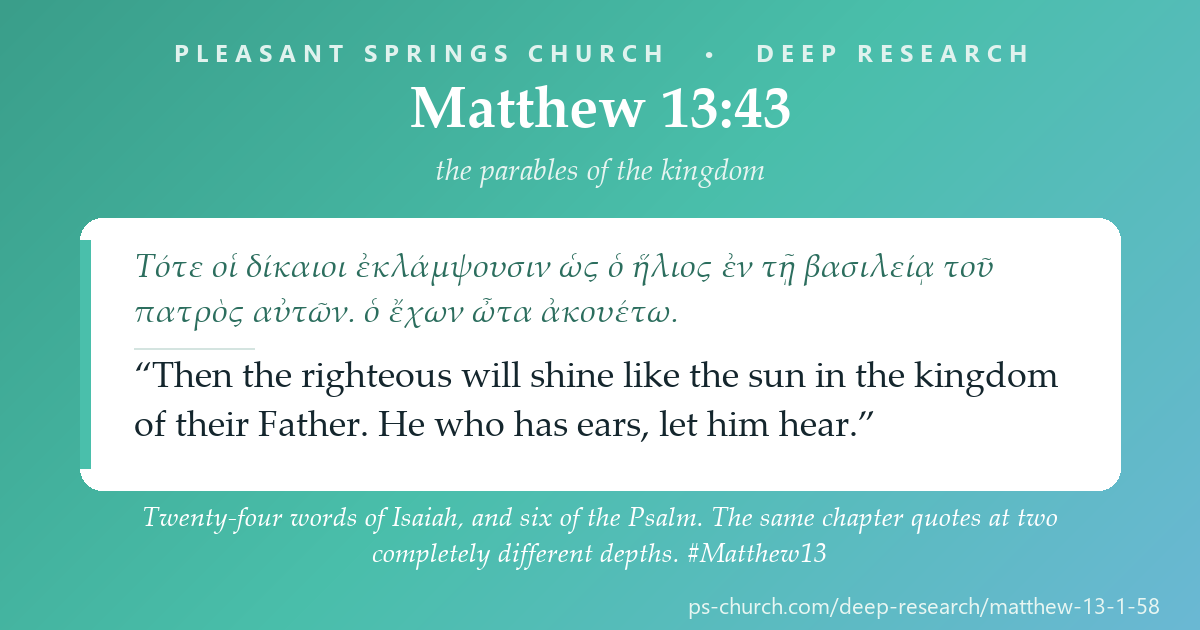
Matthew 13:43 · to share
Greek New Testament · ESVA page that only prints its wins is advertising. These are the measurements that came back small, including on the connections this chapter is most famous for.
“The righteous will shine like the sun” — Daniel 12:3 measures two
Almost every treatment of Matthew 13:43 sends you to Daniel 12:3. Measured on normalised word forms, the contact is two consecutive words against Theodotion, and one against the Old Greek.
Matthew 13:43 Τότε οἱ δίκαιοι ἐκλάμψουσιν ὡς ὁ ἥλιος ἐν τῇ βασιλείᾳ τοῦ πατρὸς
Theodotion Daniel 12:3 καὶ οἱ συνιέντες ἐκλάμψουσιν ὡς ἡ λαμπρότης τοῦ στερεώματος
Old Greek Daniel 12:3 καὶ οἱ συνιέντες φανοῦσιν ὡς φωστῆρες τοῦ οὐρανοῦ
The shared pair is ἐκλάμψουσιν ὡς — and it is worth two words rather than none only because Theodotion has that verb at all. The Old Greek reads φανοῦσιν ὡς φωστῆρες, “they will appear like luminaries,” and shares no two consecutive words with Matthew at all — only the isolated οἱ, ὡς and τοῦ. Beyond the verb, everything differs: Daniel’s subject is the wise, Matthew’s is the righteous; Daniel’s comparison is the brightness of the firmament, Matthew’s is the sun.
So is there an allusion? Very probably — and this is exactly the case the shelf’s second rule exists for. ἐκλάμπω is a rare verb: one occurrence in the whole Greek New Testament (this one) and seven in the CATSS files on this disk, of which the only one in Daniel is Theodotion 12:3. A rare word landing on a matching image is a real signal. But it is a lexical signal, not a run, and the honest number to print beside it is two.
The mustard tree — the verse everyone cites measures one
The standard parallel for the birds nesting in the branches (13:32) is Ezekiel 17:23. Measured against Septuagint Ezekiel 17:23, Matthew 13:32 shares no two consecutive words at all; the whole overlap is isolated function words — καί, ἐν, τά, τοῦ, αὐτοῦ. The Greek Ezekiel there has no birds nesting at all — it has πᾶν πετεινὸν resting under the shade.
| candidate | run vs Mt 13:32 | the shared words |
|---|---|---|
| LXX Ezekiel 31:6 | 5 (band 11) | τὰ πετεινὰ τοῦ οὐρανοῦ καὶ |
| Theodotion Daniel 4:12 / 4:21 | 4 | ἐν τοῖς κλάδοις αὐτοῦ |
| Old Greek Daniel 4:12 | 4 | τὰ πετεινὰ τοῦ οὐρανοῦ |
| LXX Ezekiel 17:23 | 1 | no two-word run — isolated καί, ἐν, τά, τοῦ, αὐτοῦ |
And the deepest of them, the five from Ezekiel 31:6, carries a tie band of 11 — ten other Old Testament verses reach the same depth with the same phrase. “The birds of heaven” is not a quotation of anything. It is how Greek says birds.
Three measures of flour — the Abraham parallel measures one
Genesis 18:6 is regularly set beside the leaven parable, and the quantity really is the same. But the words are not: Septuagint Genesis 18:6 has τρία μέτρα σεμιδάλεως, Matthew has ἀλεύρου σάτα τρία, and the measured run between the two verses is one — τρία. A parallel of quantity is a real observation; calling it a verbal echo would not be.
The furnace — a run of five that means nothing
Matthew 13:42 and 13:50 share five consecutive words with Daniel 3 — εἰς τὴν κάμινον τοῦ πυρός, into the furnace of fire. The tie band is 8, and all eight are Daniel 3 — verses 6, 11, 15 and 20, each of them present twice because this disk holds both the Old Greek and Theodotion. Inside Daniel 3 the phrase is a refrain. This is a formula, not contact with a particular verse — and it belongs on the page precisely so the 24 and the 13 above are not read as though every number here were equally strong.
Every Deep Research page traces its passage across the whole sweep — the Old Testament, the Second-Temple world between the testaments (historical witnesses, not Scripture), and the New Testament. Follow the thread:
Pleasant Springs Church — Deep Research
Research method after Michael S. Heiser’s Bible Research Method (examine dictionaries → ancient literature → important words → textual connections → academic publications → share), with the Pleasant Springs “Author & Audience” foundation. Scripture set in the Hebrew, the Greek editions named on each page and the ESV (Old Testament), and the Greek New Testament and the ESV (New Testament), per the practice of Pleasant Springs Church. Matthew 13:1–58. Every number on this page was derived here. Greek New Testament: the SBL Greek New Testament as digitized by MorphGNT, 7,927 verses, normalised word column. Greek Old Testament: Rahlfs’ Septuaginta as digitized by CATSS, 64 files and 30,637 verse units on this disk under 59 book-tags, deuterocanonical books and doublets included. Hebrew: the Masoretic text as printed in Sefaria’s Miqra according to the Masorah. Runs are counts of consecutive normalised word forms — lowercased, accents and breathings dropped, final sigma folded, filtered to Greek letters, the same filter on both corpora — and every run is reported with its tie band. No critical apparatus was consulted on any side, and no commentary was used to produce any figure. ⚠️ VERSE NUMBERING — Matthew is a New Testament book, so there is no Masoretic or Septuagint column and no offset to state for the passage itself. Counted anyway, because this shelf states it everywhere: SBLGNT Matthew 13 and a public-domain English text held on disk both run 58 verses with no gaps, so every reference here means the same verse in the Greek and in the English. Across the whole book the SBLGNT carries 1,068 verses rather than 1,071, lacking 17:21, 18:11 and 23:14 — none of them in chapter 13. The offset does bear on this page through its quotations: Isaiah 6:9–10 is numbered alike in Hebrew, Greek and English, but the psalm quoted at 13:35 is Psalm 78:2 in the Hebrew and the ESV and Psalm 77:2 in the Septuagint, because the Greek psalter runs one number behind from 9/10 through 147. Every reference to it on this page is written ‘Psalm 78:2 · LXX 77:2’.
Scripture quotations marked ESV are from the ESV® Bible (The Holy Bible, English Standard Version®), © 2001 by Crossway, a publishing ministry of Good News Publishers. ESV Text Edition: 2016. Used by permission. All rights reserved. The ESV text may not be quoted in any publication made available to the public by a Creative Commons license, and the ESV may not be translated in whole or in part into any other language. www.esv.org
|
Did this study bless you today? 💚 Give to Support PS Church100% of gifts go to the General Fund — thank you. |