The man who pointed at Jesus and said “behold the Lamb of God” is now in a cell, and he sends to ask whether he was right. What comes back is not reassurance but a list. Then Jesus turns to the crowd, quotes a prophet, denounces three towns by name, prays out loud, and ends by offering a yoke — the only yoke in the New Testament anybody is told to pick up. This study takes Matthew 11 all the way down, and it is built on one measurement: “it is written” at verse 10 is followed by nine consecutive words that match Exodus 23:20, not the Malachi your margin names. See the method →
Matthew 11:1–30
Greek NT · ESVThe Shape of the Passage
A sequence in eight movements — not a chiasmWho wrote this, to whom, in what situation? Matthew 11 opens the section between the second and third discourses, and it is the chapter in which the man who announced Jesus asks, from a cell, whether he got it right.
Author
Church tradition from Papias (early 2nd c.) onward names Matthew the tax collector (Matt 9:9; 10:3). His Gospel is built around five discourses (chs. 5–7, 10, 13, 18, 23–25), each sealed with the same formula. 11:1 is one of those five seals, and the seal is not approximate: the opening six words are identical at 7:28, 11:1, 13:53, 19:1 and 26:1 — καὶ ἐγένετο ὅτε ἐτέλεσεν ὁ Ἰησοῦς. That was checked here, word for word, against the Greek text on disk.
Matthew is also the evangelist who quotes. His Gospel carries the fulfilment-formula citations that give the book its shape — τὸ ῥηθέν … πληρωθῇ (with ἵνα, ὅπως or τότε ἐπληρώθη in front of it), “what was spoken … might be fulfilled,” which stands at exactly ten places: 1:22, 2:15, 2:17, 2:23, 4:14, 8:17, 12:17, 13:35, 21:4 and 27:9. That list was counted off disk. 11:10 is not one of them — it carries a plainer formula, and one that does not say “fulfilled” at all: περὶ οὗ γέγραπται, “of whom it is written.” What follows that formula is the one place in this chapter where the measurement has something unambiguous to say — see Stage 4.
Audience
A largely Jewish-Christian community (often located at Antioch, writing c. 60s–80s AD), for whom the question “was John right about him?” was not academic. John still had disciples of his own decades later (Acts 18:25; 19:1–7). A church reading this chapter is being told how to hold two things at once: no one born of women is greater than John, and the least in the kingdom is greater than he.
The audience inside the story is triple, and the chapter addresses each in turn: John’s disciples (vv. 2–6), the crowds (vv. 7–19), and the towns around the lake (vv. 20–24). Then, at v. 25, Jesus stops addressing anyone on earth and speaks to the Father — and the invitation at v. 28 comes out of that prayer, not out of the argument.
Start with the reference works — and settle the numbering before anything else.
Search by reference and by topic: John the Baptist, Elijah redivivus, Chorazin, Bethsaida, Capernaum, yoke, Q, Messianic secret. Then write down the versification situation, because a page that follows a phrase out of the Gospel and into the Greek Old Testament has left a book with no offset for books that have one.
Settle the numbering first — and note what is different about a New Testament page
Every page on this shelf states its versification offset, including the pages where the answer is that there is none. On a New Testament page the answer is stronger than that: there is no second column to be offset from. Matthew was written in Greek. There is no Masoretic Matthew and no Septuagint Matthew, so the two columns above are Greek New Testament and English, and every chapter-and-verse number on this page means the same verse in both.
| Matthew 11 | Matthew, whole book | |
|---|---|---|
| SBLGNT (MorphGNT) | 30 verses | 1,068 verse units |
| ESV | 30 verses | 1,071 verses |
| Public-domain English text (on disk) | 30 verses | 1,071 verses |
The SBLGNT row was counted off disk. The small whole-book difference is not a chapter offset and it does not touch chapter 11. Comparing the verse numbers present on disk against the printed chapter shape, chapter by chapter, the SBLGNT holds no text at exactly three numbers the English editions still carry as bracketed or footnoted lines: 17:21, 18:11 and 23:14. Chapter 11 has thirty verses in every column on this page.
But the offset problem is in the room the moment this chapter quotes. Follow one phrase from 11:29 into the Greek Old Testament and you land in Jeremiah, whose Greek and Hebrew chapter numbers part company from chapter 25 onward. The three-word sequence ταῖς ψυχαῖς ὑμῶν occurs in exactly two of the 30,637 Greek Old Testament verse units held here, and both are Jeremiah: Jeremiah 6:16, which carries the same number in both traditions, and Greek Jeremiah 44:9, which is Jeremiah 37:9 in the Hebrew and in your English Bible. A page that wrote “Jeremiah 44:9” without saying which column it meant would be pointing at the wrong chapter by seven.
Two more, both used below: Greek Psalm 33:9 is Psalm 34:8 in English, Greek Psalm 99:5 is Psalm 100:5, Greek Psalm 144:9 is Psalm 145:9 — the Septuagint runs one behind through most of the Psalter — and Greek Jeremiah 40:11 is Jeremiah 33:11.
Which articles are relevant?
- Dictionary of Jesus and the Gospels (IVP) — “John the Baptist,” “Elijah,” “Kingdom of God,” “Rest,” “Wisdom,” “Woe.”
- Anchor Bible Dictionary — “Chorazin,” “Bethsaida,” “Capernaum,” “Machaerus,” “Yoke.”
- NIDNTTE — ζυγός, φορτίον, ἀνάπαυσις, χρηστός, πραΰς, σκανδαλίζω, βιάζομαι.
- Dictionary of New Testament Background (IVP) — “Josephus,” “Rabbinic Literature,” “Wisdom of Ben Sira,” “Dead Sea Scrolls: Messianism.”
- The three towns are archaeology, not metaphor. Capernaum and Bethsaida (et-Tell / el-Araj, still argued) have been excavated; Chorazin (Khirbet Karraza) preserves a basalt synagogue. All three sit within a few miles of one another on the north end of the lake. The reference works are worth reading here because the geography makes v. 20 concrete: these are the towns where he did the most work.
Bibliography surfaced:
- W. D. Davies & Dale Allison, Matthew 8–18 (ICC) — the fullest technical treatment of 11:10, 11:12 and 11:28–30.
- R. T. France, The Gospel of Matthew (NICNT); Craig Keener, The Gospel of Matthew; John Nolland (NIGTC); Ulrich Luz, Matthew 8–20 (Hermeneia).
- Richard Bauckham, Jesus and the Eyewitnesses (on the Palestinian setting and the naming of Gospel figures); Joel Marcus, John the Baptist in History and Theology.
- Maarten Menken, Matthew’s Bible; Richard Beaton, Isaiah’s Christ in Matthew’s Gospel — both on how this Gospel handles its Old Testament text.
- These were not consulted for the measurements in Stage 4. Those were run on the text files named in the footer.
A yoke you are told to take, a game children played in the market, and a prison with a name.
Set each element of the chapter beside its Second-Temple and Jewish neighbours, and mark honestly which of those neighbours we hold in a searchable corpus and which we are citing from the printed editions.
Which parallels shed light on religion and worldview?
The yoke was already a religious word, and the invitation already had a form. Ben Sira ends his book with a summons that has the same three moves as Matthew 11:28–30 — come, take the yoke, find rest: ἐγγίσατε πρός με ἀπαίδευτοι, “draw near to me, you unlearned” (Sir 51:23); τὸν τράχηλον ὑμῶν ὑπόθετε ὑπὸ ζυγόν, “put your neck under the yoke” (51:26); and εὗρον ἐμαυτῷ πολλὴν ἀνάπαυσιν, “I found for myself much rest” (51:27). Sirach 6:24–30 works the same image at length: put your feet in Wisdom’s fetters and your neck in her collar, and at the last you will find her rest (εὑρήσεις τὴν ἀνάπαυσιν αὐτῆς, 6:28). Sirach is held here in the CATSS Greek and was searched — as a witness, not Scripture, which is what this shelf calls every deuterocanonical book on it; what the search found is reported in Stage 4, and it is not what a reader of the two passages side by side would expect.
In the rabbinic sources the yoke is a technical term. To recite the Shema is to “receive upon oneself the yoke of the kingdom of heaven” (m. Berakhot 2:2), and m. Avot 3:5 sets the yoke of Torah against the yoke of the kingdom and the yoke of worldly care. Read this carefully: the Mishnah was compiled around AD 200 and is not held here in any searchable form — it is cited from the printed editions. It is evidence that the idiom belonged to Jewish religious speech, not evidence of what Jesus read.
4Q521, the “Messianic Apocalypse” from Qumran, is the closest known parallel to 11:5. Its surviving lines list what happens when the Lord’s anointed comes: the blind see, the bent are raised, the wounded healed, the dead made alive, and the poor are given good news — a list with the same unusual last item as Matthew’s. That combination matters because no single Isaiah passage contains it. We do not hold 4Q521 in a searchable corpus; it is cited from the published editions and nothing on this page is measured against it.
The children’s game in vv. 16–17 is street furniture. The ἀγορά was where children played, and the two halves of the taunt name the two occasions a village hired musicians — a wedding, with the flute and dancing, and a funeral, with the dirge and beating the breast. Flute-players at funerals appear again at Matt 9:23. The complaint is not that the children would not play; it is that they would not play either game.
The prison had a name. Josephus (Antiquities 18.116–119) reports that Herod Antipas held and executed John at the fortress of Machaerus, east of the Dead Sea, and gives a political motive alongside the Gospels’ domestic one. Josephus is not held here in a searchable corpus and is cited from the standard editions. Matthew’s word in v. 2 is δεσμωτήριον — a place of chains, the word the Greek Genesis uses for the house where Joseph was kept (Gen 39:22; 40:5).
In every one of these settings the yoke belongs to something impersonal — the Torah, Wisdom, the kingdom, a foreign empire. You submit to it. What has no ancient parallel we can point to is the possessive: my yoke, offered by a person who is standing there, with the reason given not as a doctrine but as a disposition — ὅτι πραΰς εἰμι καὶ ταπεινὸς τῇ καρδίᾳ, because I am gentle and lowly in heart. Ben Sira offers the yoke of Wisdom and points to the result. Matthew 11:29 offers a yoke and points to the character of the one wearing the other end.
Eight words, four of them counted off disk rather than looked up.
Where a claim about a word is a claim about a count — how many times it occurs, and where — take the count from the corpus by lemma rather than from a concordance entry, and print the list.
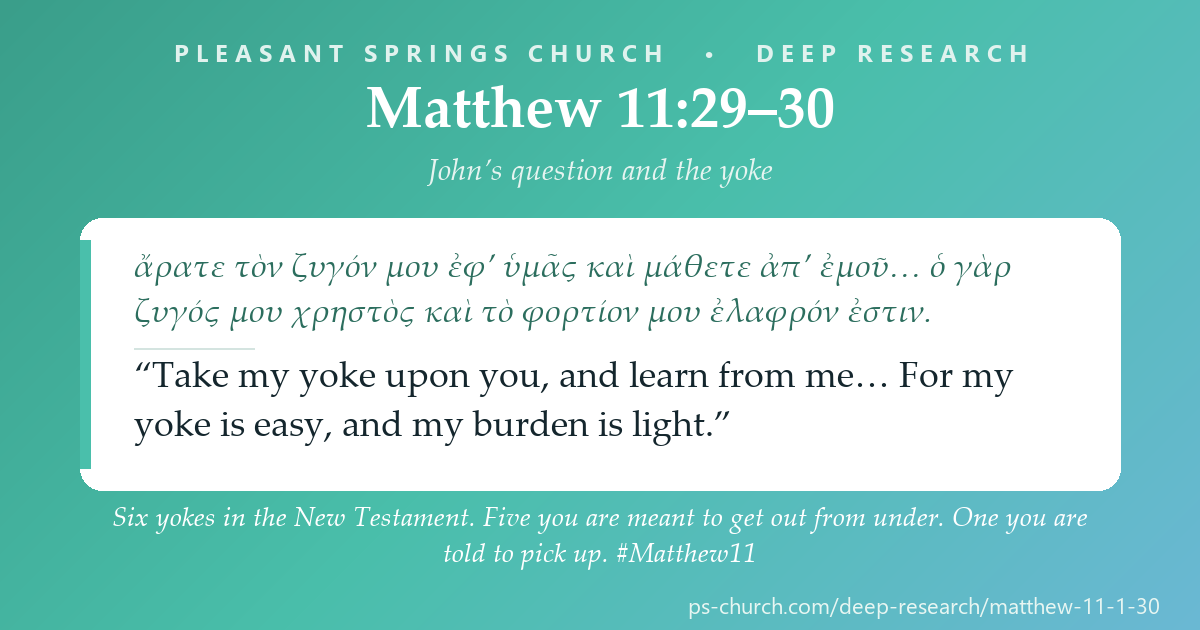
The beam across two animals’ necks. It occurs six times in the Greek New Testament — Matt 11:29, 11:30, Acts 15:10, Gal 5:1, 1 Tim 6:1, Rev 6:5 — and that count was taken off disk by lemma. In every occurrence outside this chapter it is a yoke someone wants off, or a balance-beam in a famine. These two verses are the only place in the New Testament anyone is told to pick one up.
A load, a cargo. Matthew uses it twice: here, ἐλαφρόν, light; and at 23:4, where the scribes “tie up heavy burdens” (φορτία βαρέα) and will not lift a finger. Same noun, opposite adjective, same Gospel.
Usually rendered “easy,” but the word means good, kind, serviceable — of a yoke, one that has been fitted so it does not gall. This is the only occurrence of χρηστός in Matthew. In the Greek Old Testament it is a refrain about God. The exact pair χρηστὸς κύριος stands in four of the 30,637 verse units held here — Nahum 1:7, LXX Ps 99:5 (Ps 100:5), LXX Ps 144:9 (Ps 145:9), and Greek Jeremiah 40:11, which is Jeremiah 33:11 in your English Bible — while two rows have it with the article, χρηστὸς ὁ κύριος — LXX Ps 33:9 (Ps 34:8), and Psalms of Solomon 2:36, which this shelf holds as a witness, not Scripture. Counted off disk across all 30,637 verse units, 30 August 2026.
Gentle; not weak but unforced. The adjective occurs four times in the New Testament, and three of them are Matthew: 5:5 (the meek inherit the earth), here, and 21:5 (the king comes πραΰς, quoting Zech 9:9). The fourth is 1 Pet 3:4. Counted off disk by lemma.
Rest — the noun in v. 29 answering the verb ἀναπαύσω in v. 28. Note the two halves: in v. 28 rest is given to those who come; in v. 29 rest is found by those who take the yoke. The gift and the finding are not the same clause.
“Is not made to stumble.” The beatitude that closes the answer to John is a negative one, and it is aimed at a man in a cell who had every reason to be scandalised. Matthew uses this verb fourteen times — more than any other book.
The hardest word in the chapter. The form is ambiguous between middle (“the kingdom presses forward”) and passive (“the kingdom suffers violence”), and the noun beside it is rare to the point of isolation: βιασταί occurs once in the Greek New Testament — here — and not at all in the 64 Greek Old Testament files held here, which was checked. The verb itself occurs twice in the New Testament, here and at Luke 16:16. The ESV takes the passive; other translations take the middle. See Stage 5 — this one is genuinely unsettled.
“More bearable” — a comparative, twice, in the identical clause. The judgment is not being described as uniform. Degrees are being asserted, and the more light a town had, the heavier its account.
What the counts actually show
The yoke count is the one to keep. Six occurrences of ζυγός in the New Testament, and the other four are: Peter at the Jerusalem council calling the law “a yoke on the neck of the disciples that neither our fathers nor we have been able to bear” (Acts 15:10); Paul warning the Galatians not to be held again in a yoke of slavery (Gal 5:1); slaves under a yoke (1 Tim 6:1); and the third horseman holding a ζυγός — a pair of scales — over a famine (Rev 6:5). Set Acts 15:10 beside Matthew 11:30 and the New Testament has said two things with one word: a yoke that could not be borne, and a yoke that is χρηστός.
And the χρηστός count carries a second point. The word is used once in this Gospel, and in the Septuagint its standing companion is κύριος — “the Lord is good” (Nahum 1:7), “taste and see that the Lord is good” (LXX Ps 33:9 = Ps 34:8). Counted, not asserted: the adjective stands 41 times in the 64 Greek Old Testament files held here, and 25 of those are said of God — of the Lord himself, or of his name, his mercy, his judgments. The other 16 are ordinary: fine bronze (1 Esdras 8:56), gold (Daniel 2:32), good stones (Ezekiel 27:22), good figs (Jeremiah 24:2–5), a good man (LXX Ps 111:5 = Ps 112:5). So the word is not held back for God — but it is the word the Greek Bible says of God more often than of anyone or anything else, and it is the word Jesus applies, in this verse, to his own yoke.
Verse 28 is unconditional: come, and I will give you rest. Verse 29 is not: take the yoke, learn from me — and you will find rest. The first is a gift to the exhausted; the second is what happens to a person who then walks under the beam. Matthew has put a giving and a finding in successive verses and used the same root for both. Whatever the yoke is, it is not the thing the tired person has to do before Jesus will help.
The chapter measured, verse by verse, against 30,637 verse units of the Greek Old Testament.
Screen every verse of the chapter against every Greek Old Testament verse held here and record the longest contiguous run of identical word forms, with its tie band — the number of target verses that reach the same maximum. Both sides are lowercased, accents and breathings dropped, final sigma folded, then filtered to Greek letters. Contiguous runs of whole word FORMS, never lemmas. Exhaustive and deterministic; nothing is sampled, so no seed applies. One convention to read the tables below by: a screen runs one verse against a whole corpus and therefore has a tie band — how many target verses reached the same maximum — and every screen figure here is printed with it. A pair comparison runs one named verse against one named verse; there is no band to report, because there is only one target, and those rows show a dash.
What the screen returned
Source: the thirty verses of Matthew 11, SBLGNT via MorphGNT, normalised column. Target: 30,637 verse units across the 64 CATSS Greek Old Testament files held here. Convention: the Greek-side convention with unigram fallback, so a row that shares only isolated words would report 1 and a row reporting 0 would share no word at all. No row of Matthew 11 reports either.
| longest run | rows reaching exactly it | rows reaching at least it |
|---|---|---|
| 9 words | 1 | 1 |
| 6–8 words | 0 | 1 |
| 5 words | 1 | 2 |
| 4 words | 8 | 10 |
| 3 words | 14 | 24 |
| 2 words | 6 | 30 |
Read the gap. The deepest run in the chapter is nine words. The second deepest is five. Nothing at all lies between them. On a chapter where ten separate verses have a named Old Testament source in the commentaries, exactly one row rises above the noise — and the tie band on that one row is 1.
The nine words, and which book they are in
Matthew 11:10 introduces its quotation with περὶ οὗ γέγραπται, “of whom it is written.” Every reference Bible on the shelf prints Malachi 3:1 in the margin. Here is what the measurement says:
| Matthew 11:10 against | longest run | tie band | the shared words |
|---|---|---|---|
| LXX Exodus 23:20 | 9 | 1 | ἰδοὺ ἐγὼ ἀποστέλλω τὸν ἄγγελόν μου πρὸ προσώπου σου |
| LXX Malachi 3:1 | 3 | — | τὸν ἄγγελόν μου |
The nine-word run against Exodus 23:20 is the deepest measurement anywhere in the chapter, and it stands alone: one verse in 30,637 reaches it. Against Malachi 3:1, the verse the margin names, the longest run is three.
Look at where each Greek text goes after those words.
Matthew 11:10 ἰδοὺ ἐγὼ ἀποστέλλω τὸν ἄγγελόν μου πρὸ προσώπου σου, ὃς κατασκευάσει τὴν ὁδόν σου
LXX Exodus 23:20 καὶ ἰδοὺ ἐγὼ ἀποστέλλω τὸν ἄγγελόν μου πρὸ προσώπου σου, ἵνα φυλάξῃ σε ἐν τῇ ὁδῷ
LXX Malachi 3:1 ἰδοὺ ἐγὼ ἐξαποστέλλω τὸν ἄγγελόν μου καὶ ἐπιβλέψεται ὁδὸν πρὸ προσώπου μου
Two differences do the work. The Greek Malachi has ἐξαποστέλλω where Matthew and Exodus have ἀποστέλλω, which cuts the run at the third word; and Malachi’s messenger goes before my face, while Matthew’s and Exodus’ go before your face. That is not a Septuagint quirk. The Hebrew agrees: Exodus 23:20 reads לְפָנֶיךָ, before you; Malachi 3:1 reads לְפָנָי, before me. In both languages the pronoun in Matthew 11:10 is Exodus’.
And the second half belongs to neither. ὃς κατασκευάσει τὴν ὁδόν σου, “who will prepare your way,” matches the Greek Exodus nowhere and the Greek Malachi nowhere — but the idea is Malachi’s Hebrew, וּפִנָּה דֶרֶךְ, “and he shall clear a road,” which the Septuagint rendered instead as ἐπιβλέψεται ὁδόν, “he will survey a way.”
What is measured: nine consecutive identical word forms shared with the Greek Exodus 23:20, tie band 1; three shared with the Greek Malachi 3:1; and a closing clause that matches neither Greek text while carrying the sense of the Hebrew Malachi. Those are facts about the files.
What we will not say: that Matthew “really meant Exodus,” that he “misattributed,” that a source “conflated” two texts, or that any of the three texts influenced another. This shelf does not assert direction of influence, and a nine-word run does not establish one. The honest description is that the citation formula at 11:10 is followed by wording that no one Old Testament verse in our files supplies on its own — and that a reader who looks up only Malachi 3:1 will not find nine of the words in front of him.
The counter-example this page has to print: verse 5
Matthew 11:5 is the verse everyone identifies. The commentaries name a catena from Isaiah — 35:5–6 (blind eyes opened, the lame leaping), 26:19 (the dead rise), 29:18 (the deaf hear), and 61:1 (good news to the poor). We agree that Isaiah is audible here. Now here is the measurement:
| Matthew 11:5 against | longest run |
|---|---|
| LXX Isaiah 35:5 | 1 |
| LXX Isaiah 35:6 | 1 |
| LXX Isaiah 26:19 | 1 |
| LXX Isaiah 29:18 | 1 |
| LXX Isaiah 61:1 | 1 |
| its best match in all 30,637 rows | 2, tie band 5 |
A 1 on this convention means shares an isolated word and no two-word sequence; in all five of those cases the shared word is καί, and in two of them there is a second one — LXX Isaiah 26:19 also shares νεκροί and LXX Isaiah 29:18 also shares κωφοί, isolated words both and not sequences. And the five verses that tie for the best score of 2 are 2 Kingdoms 5:8, LXX Isaiah 42:19, 43:8 and 44:11, and Theodotion Daniel 5:23 — three of them Isaiah, none of them the Isaiah the commentaries name, and the shared pairs are καὶ χωλοί at 2 Kingdoms 5:8, καὶ κωφοί at all three Isaiah rows, and ἀκούουσιν καί at Theodotion Daniel 5:23, which contains neither the lame nor the deaf.
This is the limit of the method, printed on purpose. The run engine finds verbatim contact. It does not find allusion. Matthew 11:5 is saturated with Isaiah — the blind, the lame, the deaf, the dead, and the poor being evangelised are Isaiah’s five categories — and it does not share two consecutive words with any of the passages. The reason is grammatical: Isaiah puts the afflicted in oblique cases governed by other nouns (ὀφθαλμοὶ τυφλῶν, eyes of the blind), while Matthew makes them nominative subjects of active and passive verbs. Same content; no shared surface. If this page reported only its deepest runs, verse 5 would look like the emptiest verse in the chapter, and it is one of the fullest.
The yoke, measured — and a second counter-example
The parallel every commentary prints beside Matthew 11:28–30 is Sirach 51:23–27. Sirach is held here in the CATSS Greek, so it was screened. It is held as a witness, not as Scripture — the same standing this shelf gives Judith, Tobit, Wisdom, Baruch, 1–4 Maccabees, the Psalms of Solomon, Psalm 151 and Jubilees, all of which were on this disk when the chapter was screened on 30 August 2026. The result:
| pair | longest run | note |
|---|---|---|
| Matt 11:28 ↔ Sir 51:23 | 2 | πρός με |
| Matt 11:29 ↔ Sir 51:26 (“put your neck under the yoke”) | 1 | τόν |
| Matt 11:29 ↔ Sir 51:27 (“I found much rest”) | 1 | καί |
| Matt 11:29 ↔ Sir 6:25 | 1 | τόν |
| Matt 11:30 ↔ Sir 28:20 | 3 | tie band 1 — ὁ γὰρ ζυγός |
Read that last row before you use it. The only three-word match for “for my yoke…” anywhere in the 30,637 verse units held here is Sirach 28:20 — a witness, not Scripture — and Sirach 28:20 is about the tongue: ὁ γὰρ ζυγὸς αὐτῆς ζυγὸς σιδηροῦς, “for her yoke is a yoke of iron.” It is a deep-sounding run with a band of 1, and it is a coincidence of a common opening formula. We print it because leaving it out would let the other numbers on this page look better than they are.
So the honest report on the yoke passage is this: the parallel the commentaries name measures 1, and the deepest match measures 3 and means nothing. Sirach 51 and Matthew 11 share a shape — come, take, find rest — and almost no vocabulary. That is worth knowing in both directions: it is real evidence that Matthew is not copying Ben Sira, and it is no evidence at all against the two belonging to one stream of Jewish invitation-language.
Rest for your souls: where the Greek and the Hebrew part
The last clause of 11:29 is the one place in this chapter where the measurement lands on a real textual divergence. Set the three texts side by side:
Matthew 11:29 καὶ εὑρήσετε ἀνάπαυσιν ταῖς ψυχαῖς ὑμῶν
LXX Jeremiah 6:16 καὶ εὑρήσετε ἁγνισμὸν ταῖς ψυχαῖς ὑμῶν
MT Jeremiah 6:16 וּמִצְאוּ מַרְגּוֹעַ לְנַפְשְׁכֶם
Five of the six Greek words are identical between Matthew and the Septuagint. The word that is not identical is the noun in the middle — and it is the same noun on which the Septuagint departs from the Hebrew. מַרְגּוֹעַ (margoaʿ) is a resting-place; the Septuagint rendered it ἁγνισμόν, purification. Matthew’s ἀνάπαυσιν is rest.
Two supporting counts, both exhaustive over the files held here. The three-word sequence ταῖς ψυχαῖς ὑμῶν occurs in two of 30,637 verse units, and both are Jeremiah — 6:16, and Greek 44:9 (= Hebrew 37:9). So this is a rare sequence, not a formula. And the two-word sequence εὑρήσετε ἀνάπαυσιν occurs zero times in the Greek Old Testament held here. Matthew’s exact phrase is not lifted from any Greek text on this disk.
The measured statement is: Matthew 11:29 shares five of its six words with the Septuagint of Jeremiah 6:16, and the one word it does not share is the word where the Septuagint and the Hebrew disagree — with Matthew’s word matching the Hebrew’s sense.
We are not saying Matthew translated the Hebrew, nor that he used a Greek text different from ours, nor that the Septuagint translator erred. Any of those could produce this pattern, and the files cannot decide between them. What the page can say is that a reader who checks only the Septuagint of Jeremiah 6:16 will not find the word rest there, and a reader who checks only the Hebrew will not see why the surrounding four words in Matthew look Greek.
Which cross-references matter?
- The citation travels better between Gospels than between testaments. Measured Greek against Greek: Matt 11:10 shares 14 consecutive identical word forms with Luke 7:27 and 12 with Mark 1:2. The deepest run it shares with any Greek Old Testament verse is 9. The wording of this citation is transmitted more exactly inside the New Testament than it corresponds to anything outside it. (Mark 1:2 introduces the same words with “as it is written in Isaiah the prophet” and continues into Isaiah 40:3 — a detail worth knowing before anyone argues from Matthew’s attribution.)
- The thanksgiving and Luke. Matt 11:25 ↔ Luke 10:21 measures 11; 11:26 ↔ Luke 10:21 measures 9; 11:27 ↔ Luke 10:22 measures 11. But Matt 11:28–30 has no Lukan parallel at all — measured against Luke 10:22 it returns 1. The invitation to the yoke is in Matthew only.
- Matthew 11:23 and Isaiah 14. “Will you be exalted to heaven? You will go down to Hades” measures 2 against LXX Isaiah 14:15 — ᾅδου καταβήσῃ, exactly the Septuagint’s two words. Against Isaiah 14:13 (“I will ascend to heaven”) it measures 1, because the Septuagint there reads εἰς τὸν οὐρανὸν ἀναβήσομαι where Matthew has ἕως οὐρανοῦ ὑψωθήσῃ. Two words is thin; we report it because it is the taunt-song against the king of Babylon and the parallel is a commonplace of the commentaries, and a reader deserves the number.
- Sodom. The comparison in vv. 23–24 reaches Genesis 19. The chapter’s own screen picked up the four-word run τὰς πόλεις ἐν αἷς at Matt 11:20 against Genesis 19:29, tie band 1 — and Genesis 19:29 is the verse about the destruction of the cities of the plain. We flag it as interesting and we do not build on it: four words with a band of 1 is not a citation.
- “The one who is to come.” John’s ὁ ἐρχόμενος (11:3) measures 2 against LXX Psalm 117:26 (= Psalm 118:26), ὁ ἐρχόμενος — the line the crowds shout at the triumphal entry (Matt 21:9). Two words, and the phrase is a participle in common use. Reported as an observation, not an argument.
- Elijah — and a reordering worth knowing about. 11:14 sends the reader to Malachi 4:5–6, and the three traditions do not agree on where those verses sit. The English has four chapters; the Hebrew has three and numbers them 3:22–24; and the Greek Malachi held here puts them in a different order. Hebrew 3:22 (English 4:4), “remember the law of Moses my servant,” is the last verse of the Greek book, Malachi 3:24 — while the Elijah promise, Hebrew 3:23–24 (English 4:5–6), stands earlier at Greek 3:22–23. So the Twelve Prophets end on Elijah in your Bible and on Moses in the Septuagint. The Greek also names him differently: Ἠλίαν τὸν Θεσβίτην, Elijah the Tishbite, where the Hebrew reads אֵלִיָּה הַנָּבִיא, Elijah the prophet. Both facts were read off the files here.
- And the Elijah link does not measure. Matthew 11:14 returns a run of 1 against every one of the three Greek Malachi verses, and so does Matt 17:10–12. The connection is by name and by content, not by wording — a third counter-example on one page. The nearest thing to contact is a single identical word form, ἀποκαταστήσει, standing in both LXX Malachi 3:23 and Matt 17:11 (“Elijah does come, and he will restore all things”) — an isolated word, not part of any shared sequence.
- The other yoke. Matthew 18 and Matt 23:4 are the same Gospel’s frame for this one: burdens tied on other people’s shoulders (23:4) against a burden called light (11:30), and a Lord who is πραΰς at 11:29 and again at 21:5.
The commentaries, the three unsettled cruxes, and what this page could not check.
Read the technical literature after the text and after the measurement, not before — then say plainly which questions the literature has not closed, and which parts of this page are the weakest.
Commentaries & studies:
- Davies & Allison, Matthew 8–18 (ICC) — the standard technical treatment; excursus on 11:12 and on the Sirach parallel.
- R. T. France (NICNT); Craig Keener; John Nolland (NIGTC); Ulrich Luz, Matthew 8–20 (Hermeneia); D. A. Carson (EBC).
- Maarten Menken, Matthew’s Bible: The Old Testament Text of the Evangelist — the book to read on how Matthew’s quotations relate to the Septuagint.
- Celia Deutsch, Hidden Wisdom and the Easy Yoke — the monograph on 11:25–30 as wisdom material.
- Classic: Chrysostom, Homilies on Matthew 36–38 (Homily 36 opens at 11:1, Homily 37 at 11:7 and Homily 38 at 11:25; Homily 39 has already moved on to Matthew 12); and, on 11:28–30 devotionally, Thomas Goodwin, The Heart of Christ in Heaven Towards Sinners on Earth.
Three cruxes nobody has settled:
- 11:12, βιάζεται. Middle or passive? Read as a middle, the kingdom “presses forward” or “acts powerfully” and βιασταί are eager people laying hold of it; read as a passive, the kingdom “suffers violence” and the βιασταί are its enemies — with John in a cell as exhibit A. The parallel at Luke 16:16 uses the verb differently again. The ESV printed above takes the negative reading; we are not claiming the question is closed, and the Greek form alone cannot close it.
- 11:19, ἔργων or τέκνων? The text printed above reads “wisdom is justified by her works”; a substantial body of witnesses reads “by her children,” which is what Luke 7:35 has. The variant is old and the decision is a genuine judgment call. If “works” is right, v. 19 closes back on v. 2 — John heard the works of the Christ — and that inclusion is one reason editors prefer it. That is an argument, not a proof.
- 11:23, καταβήσῃ or καταβιβασθήσῃ? The Greek printed on this page reads the first — you will go down — matching the Septuagint of Isaiah 14:15 word for word. The English column reads a passive, you will be brought down, which is what the Hebrew of Isaiah 14:15 has and what the Byzantine reading καταβιβασθήσῃ says. Our own two columns do not agree on this verb, and we are pointing at it rather than smoothing it. Whether the ESV’s passive reflects the variant or is an idiomatic rendering of the middle, this page does not claim to know.
- 11:2, διὰ τῶν μαθητῶν or δύο τῶν μαθητῶν? “By his disciples” or “two of his disciples” — two letters apart in Greek. Nothing theological turns on it, but the SBLGNT marks it, and a page that prints the Greek should say so.
What this page did not check, and where it is weakest:
- The Old Testament target is the files on this disk, not the Septuagint. The screen ran against 30,637 verse units in 64 CATSS files. That is a very large slice of the Greek Old Testament but it is not the whole tradition: the CATSS text is a Rahlfs-based diplomatic transcription, not the Göttingen critical editions, and its variant apparatus was not consulted. A run reported here is a run against these files.
- No critical apparatus was used on the New Testament side either, beyond the SBLGNT’s own variant markers, which were stripped before printing. We did not collate manuscripts; the textual notes above are drawn from the standard printed discussions.
- 4Q521 was not measured. It is the single most-cited parallel to 11:5 and we do not hold it in a searchable corpus. Everything said about it in Stage 2 is from the published editions, and no number on this page depends on it. If one text could change how verse 5 reads, it is this one, and we could not screen it.
- The corpus this chapter was screened against, stated once. 64 CATSS files, 30,637 verse units, as of 30 August 2026 — Greek Exodus, Leviticus, Numbers and Joshua and the whole deuterocanon came onto the shelf that day, and the nine-word Exodus 23:20 run that this page is built on could not have been measured before it. Every figure here was taken after that date; none is inherited from the smaller 44-file shelf.
- The Mishnah and Josephus were not measured and are not held here. The yoke-of-the-kingdom material and the Machaerus identification are cited, not verified.
- No lexicon was consulted for the gloss lines in Stage 3. The counts in Stage 3 are counts we took off disk by lemma and can be reproduced; the one-line meanings beside them are ordinary dictionary sense and should be checked against BDAG or NIDNTTE before anyone leans on a nuance.
- The ESV column was typed from the printed edition. No ESV Matthew file is held here, so unlike the Greek, the English was not generated from a corpus. It has been proofread but not machine-checked.
- The weakest paragraph on this page is the Isaiah 14 cross-reference. Two shared words is thin evidence, and we have said so where it stands. The second weakest is the Genesis 19:29 four-word run, which we flag as a coincidence and decline to use.
- What the measurement cannot do at all: it finds verbatim contact between word forms. It cannot see a paraphrase, a translation from Aramaic, a shared idiom, or a memory. Verse 5 is the proof of that, and it is printed above rather than buried.
From a cell and a yoke to Monday.
Name what you learned, why it matters, and one concrete response.
What should we carry away — and do?
- Jesus does not rebuke the question. The greatest man born of women asks, from prison, whether he backed the right one — and the answer is not “how dare you,” it is a list of things being done and a beatitude for people who do not give up on him. Doubt asked to his face gets an answer.
- The answer he sends is not an argument. It is a report of what is happening to the blind, the lame, the deaf, the dead and the poor. John is asked to weigh evidence he cannot see from inside a cell — which is what faith mostly is.
- The generation that refused John and refused Jesus refused them for opposite reasons. Too austere; too sociable. When both sides of a contradiction are used against a message, the objection was never about the message.
- The yoke is not the opposite of rest. Verse 28 gives rest to those who come. Verse 29 says rest is found under the beam, by people learning from someone gentle. The New Testament’s other yokes are all things to escape; this is the one you are told to pick up.
Step in response: write down the one thing about Jesus you are having trouble with right now — the actual sentence, not a tidied version of it. Then read Matthew 11:2–6 and notice who asked first, and what he got back. And this week, find the heaviest thing you are carrying that Jesus never asked you to carry, and put it down.
Matthew 11:28–30 · to share
Greek NT + ESVEvery Deep Research page traces its passage across the whole sweep — the Old Testament, the Second-Temple world between the testaments (historical witnesses, not Scripture), and the New Testament. Follow the thread:
Pleasant Springs Church — Deep Research
Research method after Michael S. Heiser’s Bible Research Method (examine dictionaries → ancient literature → important words → textual connections → academic publications → share), with the Pleasant Springs “Author & Audience” foundation. Scripture set in the Hebrew, the Greek editions named on each page and the ESV (Old Testament), and the Greek New Testament and the ESV (New Testament), per the practice of Pleasant Springs Church. Matthew 11:1–30 research grounded in Davies–Allison, France, Keener, Nolland, Luz, Menken and Deutsch. All run figures on this page were measured here: the Greek New Testament is the SBLGNT via MorphGNT, and the Greek Old Testament target is 30,637 verse units across the 64 CATSS files held locally. Sirach was screened; 4Q521, the Mishnah and Josephus were not, and are cited from their published editions. Runs are contiguous sequences of identical word forms, never lemmas, and every run on this page is reported with its tie band.
Scripture quotations marked ESV are from the ESV® Bible (The Holy Bible, English Standard Version®), © 2001 by Crossway, a publishing ministry of Good News Publishers. ESV Text Edition: 2016. Used by permission. All rights reserved. The ESV text may not be quoted in any publication made available to the public by a Creative Commons license, and the ESV may not be translated in whole or in part into any other language. www.esv.org
|
Did this study bless you today? 💚 Give to Support PS Church100% of gifts go to the General Fund — thank you. |