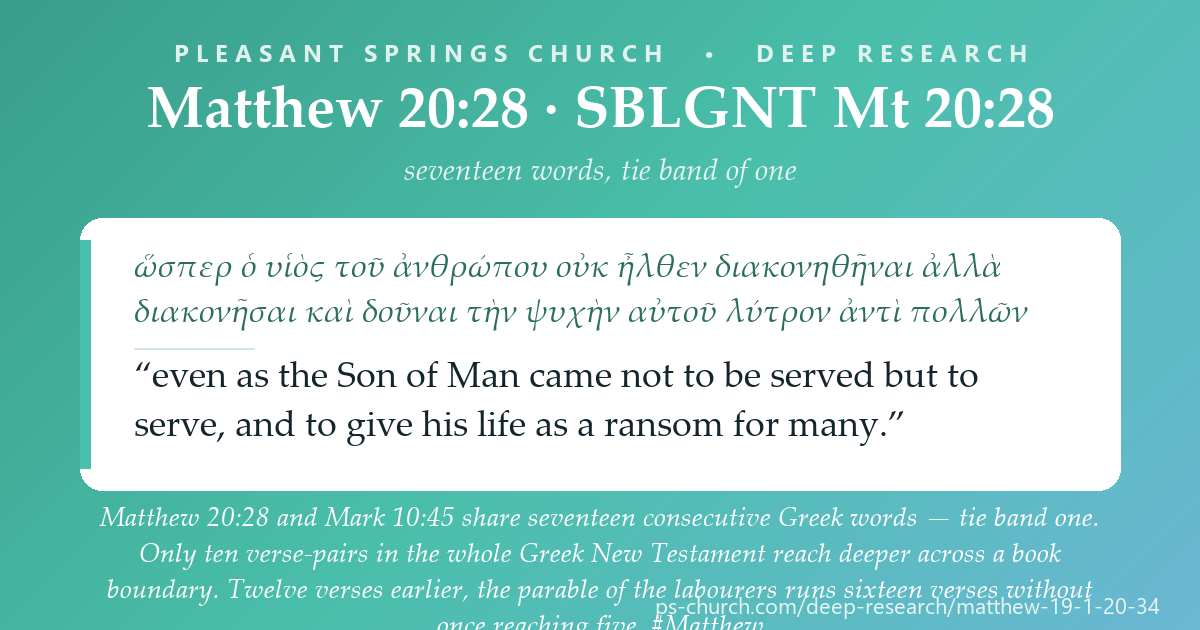
Matthew 20:28 and Mark 10:45 share seventeen consecutive Greek words, identical after normalisation, with a tie band of one. Screened across all 7,927 verses of the Greek New Testament, only ten verse-pairs anywhere reach deeper across a book boundary, and three other pairs tie at seventeen. The two sentences differ in one place: Matthew opens ὥσπερ, Mark καὶ γάρ. Everything after that is the same. The parable of the labourers in the vineyard, which ends twelve verses earlier, runs sixteen verses without once reaching five — its deepest contact with anything outside Matthew is four words, and its central complaint, 20:12, reaches two, in a tie band of 101. The loudest row and the quietest row in this passage sit sixteen verses apart, and the quiet one is the passage everybody knows. Between them stands a sentence Matthew says twice with the terms swapped — first will be last at 19:30, the last will be first at 20:16 — a frame the parable sits inside, which the run engine registers as a contact of two. None of this says who read whom, and neither does this page. See the method →
Matthew 19:1–20:34 (selections)
Greek New Testament (SBLGNT, via MorphGNT) · ESV★ And sixteen verses separate the loudest row on this page from the quietest. Matthew 20:28 shares seventeen consecutive words with Mark 10:45 at a tie band of one. Matthew 20:12, inside the parable, shares two with anything outside Matthew, in a tie band of 101. Stage 4 gives both distributions, the tie bands, and the counter-examples.
The Shape of the Passage
A sequence — with one frame the words really mark, and it is invertedThe book never names its author and never addresses a reader. The title ΚΑΤΑ ΜΑΘΘΑΙΟΝ is a manuscript heading, not a line of the text; no manuscript on this disk was consulted for it. What the two chapters do carry, measurably, is a set of habits — and habits are what this section reports.
Author
Whoever wrote these chapters wrote the rest of the book. Five times the narrative closes a block of teaching with καὶ ἐγένετο ὅτε ἐτέλεσεν ὁ Ἰησοῦς — 7:28, 11:1, 13:53, 19:1, 26:1. Screened across all 7,927 verses of the Greek New Testament, the phrase ὅτε ἐτέλεσεν ὁ Ἰησοῦς occurs five times and all five are in Matthew. Matthew 19:1 is the fourth. That is a compositional signature, and it is countable.
Two more habits show up in this passage. Where Mark 10:46 has one blind man and gives his name, Matthew 20:30 has δύο τυφλοί — a phrase that occurs twice in the Greek New Testament, both in Matthew (9:27; 20:30). And where Mark 10:35 has the two sons of Zebedee ask for the thrones, Matthew 20:20 has their mother ask. The page reports the differences; it does not say which account is prior, because the measurement cannot tell.
And a preference the engine can see. At 19:14 Matthew writes ἡ βασιλεία τῶν οὐρανῶν where Mark 10:14 and Luke 18:16 write ἡ βασιλεία τοῦ θεοῦ — and the six-word run between the three stops at exactly that word. But ten verses later, at 19:24, Matthew writes the kingdom of God himself. The habit is strong and it is not absolute, and a page that reported only the first half of that would be misleading.
Audience
Readers who are expected to know the Law without being told what it is. 19:18 lists four commandments with no source given. 19:19 appends Leviticus 19:18 with no source given. 19:7 says βιβλίον ἀποστασίου — a certificate of divorce — and expects the phrase to land; it is Deuteronomy 24:1 and 24:3 in the Greek held here, and the run is 3. The text argues from Genesis 1:27 and 2:24 against Deuteronomy 24 without ever explaining either.
Readers who work for wages. The parable at 20:1–16 is priced: a δηνάριον for the day, agreed by contract (συμφωνήσας, 20:2, and συνεφώνησας, 20:13), men standing idle in the marketplace at the third hour and still there at the eleventh, a steward paying out in reverse order, and a complaint about τὸ βάρος τῆς ἡμέρας καὶ τὸν καύσωνα. None of that needs explaining to the audience either.
Readers for whom the divorce question was a live legal dispute. The question at 19:3 is asked κατὰ πᾶσαν αἰτίαν — for any cause. Mark 10:2 asks simply whether it is lawful. Matthew’s three extra words turn a general question into a school question, and the answer at 19:9 carries an exception clause — one of exactly two divorce sayings in the New Testament that do, and both of them are Matthew’s (5:32; 19:9).
Orient on Matthew’s fourth discourse-seam, on first-century divorce law, on the denarius, and on the ransom saying — before touching a number.
Search by topic: Matthew, Gospel of; divorce; certificate of divorce; porneia; eunuch; wealth in the Gospels; denarius; day labourer; ransom (lytron); Son of Man; regeneration / palingenesia; Synoptic problem.
Which articles are relevant?
- Anchor Bible Dictionary — “Matthew, Gospel of,” “Divorce,” “Marriage,” “Eunuch,” “Wages,” “Ransom.”
- Dictionary of Jesus and the Gospels (IVP) — “Divorce,” “Rich and Poor,” “Kingdom of God/Heaven,” “Ransom Saying,” “Son of Man.”
- New International Dictionary of NT Theology & Exegesis — πορνεία, ἀπολύω, εὐνοῦχος, λύτρον, παλιγγενεσία, μισθός.
- Commentary on the New Testament Use of the Old Testament, ed. G. K. Beale and D. A. Carson (Baker, 2007) — the Matthew chapter, where the Genesis 1:27 / 2:24 argument and the Decalogue list at 19:18–19 are treated at length.
- None of these were consulted for the measurements below. The measurements were run on the text files named in the footer.
Settle the numbering first — and note what is different about a New Testament page
Every page on this shelf states its versification offset, including where the answer is that there is none. On a New Testament book the answer is stronger than that: there is no second column to be offset from.
| Matthew 19 | Matthew 20 | this passage | |
|---|---|---|---|
| SBLGNT (MorphGNT) | 30 | 34 | 64 |
| Public-domain English edition (counted off disk; a numbering source consulted, not a column printed) | 30 | 34 | 64 |
| ESV | 30 | 34 | 64 |
The first two rows were counted off disk; the ESV row is the printed edition’s shape, because no ESV Matthew file is held here to count. The English column this page prints is the ESV, and the ESV alone. There is no Masoretic Matthew and no Septuagint Matthew, so the columns on this page are Greek New Testament and English, and every chapter-and-verse number means the same verse in all of them.
But the offset problem is in the room anyway, because Matthew 19 quotes books that have one. The Masoretic text carries the sixth to ninth commandments inside a single verse — Exodus 20:13 and Deuteronomy 5:17 — in the order murder, adultery, theft, false witness. The Greek held here splits them into four verses, and the two Greek Decalogues do not even agree with each other: CATSS Deuteronomy 5:17–20 runs adultery, murder, theft, false witness, while CATSS Exodus 20:13–16 runs adultery, theft, murder, false witness. A page that wrote ‘Deuteronomy 5:17’ without saying which column it meant would be naming two different commandments at once. Matthew 19:18 gives the Masoretic order; Luke 18:20 gives the Greek Deuteronomy’s.
A certificate of divorce, a denarius a day, and a word for ransom that the Greek Old Testament uses freely and the New Testament almost never.
“A certificate of divorce” — what the phrase points at, and how shallow the verbal contact is
Matthew 19:7 has the questioners answer with βιβλίον ἀποστασίου. The Greek Deuteronomy held here has the same phrase at 24:1 and 24:3.
| text | the clause | run with Mt 19:7 |
|---|---|---|
| CATSS Deuteronomy 24:1 | καὶ γράψει αὐτῇ βιβλίον ἀποστασίου καὶ δώσει εἰς τὰς χεῖρας αὐτῆς | 3 |
| CATSS Deuteronomy 24:3 | the same phrase, of the second husband | 3 |
| Matthew 5:31 | δότω αὐτῇ ἀποστάσιον — the noun alone, without βιβλίον | — |
The word group ἀποστασ- occurs five times in the Greek New Testament: Matthew 5:31, Matthew 19:7, Mark 10:4 — all three of divorce — and Acts 21:21 and 2 Thessalonians 2:3, where it means apostasy. The certificate and the falling-away are the same word.
⚠️ What was not checked. The rabbinic material on divorce — Mishnah Gittin, the Hillel/Shammai dispute over עֶרְוַת דָּבָר in Deuteronomy 24:1, which is the dispute for any cause at 19:3 is usually read against — is not held on this disk and was not consulted. Neither were the Elephantine or Judaean Desert divorce documents. That reading is reported here as background from the reference works, not measured. What was measured is the three-word contact with the Greek Deuteronomy and the five occurrences of the word group.
A denarius a day, and a working day that ends at the twelfth hour
The parable prices itself. A δηνάριον is agreed for the day at 20:2; men hired at the third, sixth, ninth and eleventh hours are paid the same at 20:9–10; the reckoning happens ὀψίας δὲ γενομένης, when evening comes, and it is paid out ἀρξάμενος ἀπὸ τῶν ἐσχάτων ἕως τῶν πρώτων — beginning with the last, up to the first. The reversal that the frame sentences announce is enacted by a payroll procedure.
Two of the words are as rare as the parable is famous. μισθόομαι, to hire, occurs twice in the whole Greek New Testament and both are here (20:1, 20:7). καύσων, the scorching heat, occurs three times — 20:12, Luke 12:55 and James 1:11.
⚠️ What was not checked. That a denarius was a normal day’s wage for an agricultural labourer is reported from the reference works. No papyri, ostraca or inscriptions are held on this disk, and no wage data was measured here.
λύτρον — common in the Greek Old Testament, almost absent from the New
Matthew 20:28 and Mark 10:45 are the only two verses in the Greek New Testament that contain the noun λύτρον.
The wider group is barely commoner: λυτρ- in any form stands nine times in the whole Greek New Testament — the two λύτρονs here, λύτρωσις at Luke 1:68, Luke 2:38 and Hebrews 9:12, λυτροῦσθαι at Luke 24:21, λυτρωτής at Acts 7:35, λυτρώσηται at Titus 2:14 and ἐλυτρώθητε at 1 Peter 1:18. The compound ἀντίλυτρον occurs once, at 1 Timothy 2:6 — which shares a run of 1 with Matthew 20:28.
What that does and does not license. In the Greek Old Testament the λυτρ- group is ordinary vocabulary — redemption of land, of the firstborn, of a life. That background is real and this page does not measure it into the verse: Matthew 20:28’s deepest contact with the whole Greek Old Testament held here is a run of 3 in a tie band of 40, which is nothing. The saying’s only measurable partner is Mark 10:45. Whether it reaches back to Isaiah 53, which a great deal of scholarship argues, the run engine cannot say — and the Greek Isaiah, now held here, gives this row no run above three either.
Five words that carry the two chapters, and how rare each one actually is.
Matthew 20:28 and Mark 10:45, and nowhere else in the Greek New Testament. The two verses share seventeen consecutive words, tie band 1. The compound ἀντίλυτρον stands once (1 Timothy 2:6) and measures 1 against this row; Luke’s form of the servant saying (Luke 22:27) also measures 1.
Matthew 19:28 and Titus 3:5, and those are the only two. Here it is a state of the world — the ESV’s the new world — and in Titus it is a washing. The page counts the two and does not harmonise them.
Eight occurrences of the noun in the Greek New Testament, and five of the verb-and-noun group in Matthew 19:12 alone. Three εὐνοῦχοι and two forms of εὐνουχίζω stand in that one verse; εὐνουχίζω occurs nowhere else in the New Testament. The other five occurrences of the noun are all one man, the Ethiopian of Acts 8:27–39.
Matthew 20:1 and Matthew 20:7 — twice in the New Testament, both inside this parable. The related μισθός, wage, is common (29 times, ten of them in Matthew), and ἐργάτης, labourer, stands sixteen times, six in Matthew, three of them in these sixteen verses (20:1, 20:2, 20:8).
Twenty-five occurrences in the Greek New Testament; exactly two stand in a divorce saying, and both are Matthew’s — 5:32 and 19:9. Mark 10:11–12 and Luke 16:18 have no exception clause. The two Matthean verses word the exception differently from each other (παρεκτὸς λόγου πορνείας against μὴ ἐπὶ πορνείᾳ) and share a run of only 3.
The two chapters counted, word by word
64 verses; 1,075 words in the MorphGNT text of Matthew 19–20.
| word or phrase | in the whole Greek NT | here |
|---|---|---|
| λύτρον | 2 | 20:28 (the other is Mark 10:45) |
| παλιγγενεσία | 2 | 19:28 (the other is Titus 3:5) |
| μισθόομαι | 2 | 20:1 and 20:7 — both |
| εὐνουχίζω | 2 | 19:12 twice — both |
| τρύπημα | 1 | 19:24 — a hapax |
| συζεύγνυμι | 2 | 19:6 (the other is Mark 10:9) |
| δύο τυφλοί | 2 | 20:30 (the other is Matthew 9:27) |
| ὅτε ἐτέλεσεν ὁ Ἰησοῦς | 5 | 19:1 — all five are in Matthew |
| οἰκοδεσπότης | 12 | 20:1, 20:11 — seven of the twelve are in Matthew |
| σπλαγχνίζομαι | 11 | 20:34 — all eleven are in the Synoptics, five in Matthew |
| χωρέω (make room for) | 10 | 19:11 and 19:12 twice — three of the ten in two verses |
One sound to notice and not to over-read: 19:6 ends ἄνθρωπος μὴ χωριζέτω, let no man separate, and five verses later 19:11–12 turns three times on χωροῦσιν / χωρεῖν / χωρείτω, make room for. They are two different verbs — χωρίζω and χωρέω — and the MorphGNT lemma column keeps them apart. The page notes that they sound alike in one paragraph and claims nothing more than that.
A seventeen-word row, a sixteen-verse silence, and four results in the same tables that show why neither can be read on its own.
The measurement
All 64 verses of Matthew 19–20 were screened twice: once against the 6,859 non-Matthean verses of the Greek New Testament, once against the 30,637 verse units of the Greek Old Testament held on this disk. Contiguous runs of whole word forms, never lemmas, with the tie band beside every run.
Against the non-Matthean New Testament, across the 64 rows: all 64 reach two, 59 reach three, 39 reach four, 23 reach five, 18 reach six, 11 reach seven, 9 reach eight, 7 reach nine, 5 reach ten, 2 reach thirteen, 1 reaches seventeen, and nothing reaches eighteen. Against the Greek Old Testament: all 64 reach two, 51 reach three, 16 reach four, 4 reach five, 2 reach seven, 1 reaches eight, and nothing reaches nine.
| row | deepest partner outside Matthew | run | band | deepest partner in the Greek OT held here | run | band |
|---|---|---|---|---|---|---|
| Matthew 20:28 | Mark 10:45 | 17 | 1 | nothing above three | 3 | 40 |
| Matthew 20:18 | Mark 10:33 | 13 | 1 | Isaiah 7:5 | 4 | 1 |
| Matthew 19:5 | Ephesians 5:31 | 10 | 1 | Genesis 2:24 | 8 | 1 |
| Matthew 19:21 | Luke 18:22 | 10 | 1 | Genesis 36:6 · Genesis 47:18 | 3 | 2 |
| Matthew 20:22 | Mark 10:38 | 10 | 1 | Daniel 2:5 · Daniel 2:26 · … | 3 | 4 |
| Matthew 20:23 | Mark 10:40 | 9 | 1 | Ezekiel 21:21 | 4 | 2 |
| Matthew 20:27 | Mark 10:44 | 9 | 1 | 1 Macc 1:50 · Deuteronomy 18:20 · … | 3 | 14 |
| Matthew 19:24 | Luke 18:25 | 8 | 1 | 1 Esdras 8:21 · Daniel(Th) 11:9 | 4 | 2 |
| Matthew 19:6 | Mark 10:9 | 8 | 1 | nothing above two | 2 | 1,474 |
| Matthew 19:19 | Eph 5:31 · Mk 12:31 · Ro 13:9 · Ga 5:14 · Jas 2:8 | 6 | 5 | Leviticus 19:18 | 7 | 1 |
| Matthew 19:18 | Mk 9:23 · Mk 10:18 · … | 4 | 11 | the Decalogue — see below | 2 | 351 |
| Matthew 20:12 | Lk 24:44 · Ac 16:17 · Ro 11:24 · … | 2 | 101 | Genesis 1:16 | 4 | 1 |
| Matthew 20:34 | Mk 9:25 · Mk 10:14 · Lk 5:22 · … | 3 | 18 | 1 Macc 11:14 · … | 2 | 1,090 |
✅ Greek Leviticus reached this shelf on 30 August 2026, and the seven in that table can now be set beside the other five New Testament verses that carry the same sentence. Leviticus, Exodus, Numbers, both Joshua recensions and the deuterocanon took the Greek Old Testament here from 44 CATSS files and 23,061 verse units to 64 files and 30,637. Six New Testament verses carry you shall love your neighbour as yourself. Measured verse against verse into Greek Leviticus 19:18, five of them reach six words and one reaches seven.
| verse | run into Greek Leviticus 19:18 | the shared words |
|---|---|---|
| Matthew 19:19 | 7 | καὶ ἀγαπήσεις τὸν πλησίον σου ὡς σεαυτόν |
| Matthew 22:39 · Mark 12:31 · Romans 13:9 · Galatians 5:14 · James 2:8 | 6 | ἀγαπήσεις τὸν πλησίον σου ὡς σεαυτόν |
The whole of the difference is one word, and it is the first one. Greek Leviticus 19:18 runs καὶ οὐ μηνιεῖς τοῖς υἱοῖς τοῦ λαοῦ σου καὶ ἀγαπήσεις…, and Matthew is the only one of the six who keeps the Septuagint’s connective — because Matthew is the only one appending the line to a list rather than quoting it as a free-standing commandment. A run of seven against a run of six, and the extra word is syntax, not theology. This comparison could not be made on this shelf until 30 August 2026, because Greek Leviticus was not held.
The two figures in the small table are pair runs against one named verse, so neither carries a tie band. The banded figure is the one in the big table: Matthew 19:19’s deepest partner in the whole Greek Old Testament is Leviticus 19:18, a run of 7 in a tie band of 1, re-run against all 30,637 verse units.
Thirty-four of the 64 rows find their deepest partner outside Matthew in Mark 10. That is the shape of these two chapters: a long stretch of near-verbatim agreement with one chapter of one other book, and a sixteen-verse block in the middle of it that agrees with nothing.
Seventeen words, and where that sits in the New Testament
Every verse of the Greek New Testament was screened against every verse outside its own book. Of 7,927 verses, 244 reach a cross-book run of ten or more, 36 reach sixteen, 28 reach seventeen, and 20 reach eighteen. Matthew 20:28 and Mark 10:45 are one of the fourteen pairs at seventeen or deeper, and only ten pairs are deeper than they are.
| run | the pair |
|---|---|
| 34 | Matthew 13:15 ↔ Acts 28:27 — both quoting Isaiah 6:9–10 |
| 26 | Matthew 6:24 ↔ Luke 16:13 |
| 24 | Matthew 8:20 ↔ Luke 9:58 · Matthew 12:41 ↔ Luke 11:32 |
| 23 | Matthew 8:9 ↔ Luke 7:8 · Matthew 26:24 ↔ Mark 14:21 |
| 22 | Matthew 3:9 ↔ Luke 3:8 |
| 20 | Matthew 3:10 ↔ Luke 3:9 |
| 19 | Matthew 22:44 ↔ Mark 12:36 |
| 18 | Mark 10:15 ↔ Luke 18:17 |
| 17 | Matthew 20:28 ↔ Mark 10:45 · Matthew 24:50 ↔ Luke 12:46 · Mark 1:24 ↔ Luke 4:34 · Ephesians 6:22 ↔ Colossians 4:8 |
⚠️ Read the top row before reading the others. The deepest cross-book agreement in the New Testament, at 34 words, is two books quoting the same Old Testament passage. Depth of run does not tell you what kind of relationship you are looking at. This table also ignores everything inside a book: Matthew’s own doublets are excluded by construction, so the figures say ‘across a book boundary’ and nothing wider.
Sixteen verses that touch nothing
Matthew 20:1–16 is the parable of the labourers in the vineyard. It is unique to Matthew, and the measurement shows what that means.
| verse | deepest run outside Matthew | band | deepest run outside Matthew 20 (Matthew included) | band |
|---|---|---|---|---|
| 20:1 | 4 | 1 | 6 — Matthew 13:45 | 1 |
| 20:4 · 20:7 | 4 | 1 | 4 — John 4:38 | 1 |
| 20:8 | 4 | 3 | 4 — Matthew 21:40 · Mark 12:9 · Luke 20:13, 15 | 4 |
| 20:5 | 2 | 106 | 2 | 164 |
| 20:12 | 2 | 101 | 2 | 117 |
| 20:15 | 3 | 2 | 4 — Matthew 6:22 · Matthew 6:23 | 2 |
| 20:16 | 3 | 3 | 3 — Mark 10:31 · … | 3 |
Against the 6,859 verses of the New Testament outside Matthew, the whole sixteen-verse block tops out at four. Let Matthew back in and it reaches six — and that six is 20:1 against Matthew 13:45, which is the kingdom of heaven is like a man, a merchant, seeking fine pearls — Matthew’s own parable-opening formula, not a contact with another book.
⚠️ And here is the caution that belongs with it. A low run does not mean a passage is unconnected to anything; it means no other verse in the corpus repeats its wording. The vineyard is Isaiah 5 and the wage is Leviticus 19:13 and Deuteronomy 24:15 in every commentary ever written on this parable — and none of that is verbatim, so none of it is visible to this screen. What the numbers establish is narrower and firmer: nobody else in the New Testament tells this story in these words.
The two quotations, and what happens at Genesis 2:24
Matthew 19:5 quotes Genesis 2:24. So does Ephesians 5:31. The two New Testament verses agree with each other past the point where both leave the Greek Genesis.
| text | the clause | run with Mt 19:5 |
|---|---|---|
| CATSS Genesis 2:24 | καταλείψει ἄνθρωπος τὸν πατέρα αὐτοῦ καὶ τὴν μητέρα αὐτοῦ καὶ προσκολληθήσεται πρὸς τὴν γυναῖκα αὐτοῦ καὶ ἔσονται οἱ δύο εἰς σάρκα μίαν | 8 |
| Matthew 19:5 | καταλείψει ἄνθρωπος τὸν πατέρα καὶ τὴν μητέρα καὶ κολληθήσεται τῇ γυναικὶ αὐτοῦ καὶ ἔσονται οἱ δύο εἰς σάρκα μίαν | — |
| Ephesians 5:31 | καταλείψει ἄνθρωπος τὸν πατέρα καὶ τὴν μητέρα καὶ προσκολληθήσεται τῇ γυναικὶ αὐτοῦ καὶ ἔσονται οἱ δύο εἰς σάρκα μίαν | 10 |
| Mark 10:7–8 | the quotation split across two verses, and 10:7 keeps πρὸς τὴν γυναῖκα αὐτοῦ | 5 · 7 |
| 1 Corinthians 6:16 | ἔσονται… οἱ δύο εἰς σάρκα μίαν | 5 |
Two divergences from the Greek Genesis, and Matthew and Ephesians are on the same side of both: the two αὐτοῦ after father and mother are gone, and πρὸς τὴν γυναῖκα has become the dative τῇ γυναικί. They are not on the same side of a third: Ephesians keeps the Septuagint’s compound προσκολληθήσεται and Matthew writes the simplex κολληθήσεται — which is why the shared run of ten begins after the verb rather than before it.
The other quotation is Leviticus 19:18, and Matthew is the only one of the three who has it here. 19:19 shares seven consecutive words with Septuagint Leviticus 19:18, tie band 1. Mark 10:19 and Luke 18:20 stop the commandment list at honour your father and mother. In the New Testament the same six words stand five more times (Matthew 22:39, Mark 12:31, Romans 13:9, Galatians 5:14, James 2:8). Screened outside Matthew the figure is a run of 6 in a tie band of 5 — four of those verses, and Ephesians 5:31, which ties on τὸν πατέρα καὶ τὴν μητέρα καί instead — a formula, and the page prints it beside its deep results for exactly that reason.
⚠️ What the page will not say. Not that Matthew is using Ephesians, nor Ephesians Matthew, nor either of them a common source. Direction of influence is never asserted on this shelf. What is measured is that the agreement between the two New Testament verses is longer than the agreement of either with the Greek Genesis they are both quoting, and that the surplus falls precisely where the New Testament wording parts from the Septuagint.
The counter-examples, printed in the same section
1. Matthew 19:18 — the strongest agreement on this page measures 2.
Matthew writes the four commandments as οὐ φονεύσεις, οὐ μοιχεύσεις, οὐ κλέψεις, οὐ ψευδομαρτυρήσεις — οὐ with the future indicative, which is the form both Greek Decalogues on this disk use, and which neither Mark nor Luke uses. Mark 10:19 and Luke 18:20 both write μή with the aorist subjunctive. That is a real and pointed agreement with the Septuagint, and the run engine scores this row 2 against the Greek Decalogue, in a tie band of 351, because every commandment is two words long and the runs break at each one. The screen counts contiguous words. It does not count grammar, and it cannot see this at all.
2. Matthew 19:9 and Matthew 5:32 measure 3 against each other.
The two verses that carry the New Testament’s only divorce exception are further apart, word for word (3), than 19:9 is from Mark 10:11 (6) or 5:32 is from Luke 16:18 (6). The two verses that share a doctrine share barely any words; the pairs that share words disagree about the doctrine. No amount of counting will sort that out.
3. Matthew 19:30 and Matthew 20:16 measure 2 against each other.
They are the same sentence with the clauses swapped. A contiguous-run screen cannot see an inversion, and reports the frame that holds this whole passage together as a two-word coincidence. The page reads the frame off the vocabulary instead, and says which one it is doing.
4. The tie band of 1,090.
Matthew 20:34 — and Jesus in pity touched their eyes — reaches a run of 2 against the Greek Old Testament, and 1,090 verse units tie at it. That is what a number looks like when it means nothing whatever, and it is printed here so that the seventeen at 20:28 is read against something.
Where this page is weakest, what it could not reach, and what would break it.
The largest hole: the page measures word-runs and the questions here are not about words
Matthew 19–20 is one of the most contested passages in the New Testament for reasons this method cannot touch.
What the exception clause at 19:9 means — whether πορνεία is adultery, incest within prohibited degrees, unlawful marriage, or premarital unfaithfulness; whether the saying permits remarriage; whether Matthew is reporting a qualification or adding one — is not a question about how many consecutive words two verses share, and nothing on this page settles any part of it. The same goes for the eunuch saying at 19:12, for whether παλιγγενεσία at 19:28 names the same thing as Titus 3:5, and for what λύτρον ἀντὶ πολλῶν asserts about the atonement. The measurement is a floor for those arguments to stand on, not a verdict in them.
And the Synoptic question is untouched. Seventeen identical words between Matthew 20:28 and Mark 10:45 is a fact about two printed texts. It is compatible with Matthew using Mark, with Mark using Matthew, with both using a third thing, and with a fixed oral form behind both. This page names none of those, and the top row of its own table — 34 words between Matthew 13:15 and Acts 28:27, where the explanation is simply that both are quoting Isaiah — is there to show why depth alone decides nothing.
What the headline numbers depend on, and how they could be wrong
One printed edition on each side, with no apparatus. The New Testament figures are the SBL Greek New Testament as digitised by MorphGNT; the Greek Old Testament figures are Rahlfs’ Septuaginta as digitised by CATSS. Neither carries a critical apparatus on this disk, and no papyrus, uncial or minuscule was consulted for any figure here. Matthew 19–20 has well-known variation: the Byzantine text adds for many are called, but few chosen at 20:16 and a baptism clause at 20:22–23, and 19:9 is transmitted in several forms. The column printed here has none of those additions, and the page says which column it is counting rather than which reading is older.
The runs depend on a decision about what a ‘word’ is. Both sides are lowercased, accents and breathings dropped, final sigma folded, then filtered to Greek letters; the comparison is of word forms, never lemmas, and the cross-corpus screen folds the editions’ own spelling equivalences (οὐ/οὐκ/οὐχ, ἐκ/ἐξ, the movable nu). The seventeen at 20:28 does not depend on that fold — both printed texts read οὐκ ἦλθεν at the same point, and Matthew 20:28 and Mark 10:45 measure 17 on the raw surface forms as well. Other figures here do rest on the normalisation, and the reader should know that a lemma-based screen would move every figure on this page.
The cross-book table is a coarse instrument. “Only ten pairs are deeper” counts each verse’s best partner in a different book. It therefore ignores within-book repetition entirely, it cannot distinguish a citation from a parallel from an accident, and it is computed over the SBLGNT alone. A different edition would produce a different ranking, probably not a very different one.
What could not be checked at all
No Greek critical apparatus, no papyri, no patristic citations. No rabbinic material — which matters more here than on most pages, because the Hillel and Shammai dispute over Deuteronomy 24:1 is the standard frame for 19:3–9 and this page could not verify a word of it. No Judaean Desert or Elephantine divorce deeds. No papyri or ostraca on wages, so the denarius is reported and not measured. No Qumran material on the two by two reading of Genesis 1:27 in CD 4:20–21, which is regularly cited beside 19:4. No Syriac, Latin or Coptic versions, and no commentary on Matthew was read for any figure on this page.
One claim on this page is more fragile than it looks. “The parable touches nothing” is a statement about verbatim contact inside one corpus. Isaiah 5:1–7, Leviticus 19:13 and Deuteronomy 24:14–15 are all relevant to it and none of them is verbatim, so the screen sees none of them — and the page would be misread if the low numbers were taken to mean the parable stands outside Scripture’s vocabulary. It does not. It means no other verse repeats its words.
And one that is easy to overstate in the other direction. Thirty-four of the 64 rows find their deepest non-Matthean partner in Mark 10. That is a striking figure and it is also partly an artefact of how the screen works: a row whose best run is a common four-word phrase will still be assigned to whichever verse holds it, and Mark 10 covers most of the same narrative. The figure is worth reporting; it is not worth building an argument on.
Reading list
- W. D. Davies and Dale C. Allison Jr., A Critical and Exegetical Commentary on the Gospel according to Saint Matthew, vol. 3 (ICC, 1997) — the standard technical treatment of these two chapters.
- Ulrich Luz, Matthew 8–20 (Hermeneia, 2001).
- R. T. France, The Gospel of Matthew (NICNT, 2007).
- Craig S. Keener, …And Marries Another: Divorce and Remarriage in the Teaching of the New Testament (1991) — on the exception clause.
- David Instone-Brewer, Divorce and Remarriage in the Bible (2002) — the rabbinic and documentary material this page could not consult.
- Morna D. Hooker, Jesus and the Servant (1959), and the long argument since about whether Mark 10:45 / Matthew 20:28 reaches back to Isaiah 53.
- None of these were consulted for the measurements on this page, which were run on the text files named in the footer.
The loudest verse and the quietest one, sixteen verses apart.
Seventeen, and two
Matthew 20:28 says what Mark 10:45 says, in the same seventeen words, in the same order, with one connective changed. Almost nothing in the New Testament agrees with anything else that exactly across a book boundary. Sixteen verses before it stands Matthew 20:12 — these last worked only one hour, and you have made them equal to us — whose deepest agreement with the 6,859 verses outside this Gospel is two words, tied with a hundred other verses. Nobody else in the New Testament tells that story, and nobody else uses those words.
Between the two Matthew says one sentence twice, and turns it round in between: many who are first will be last, and the last first at 19:30, and after the parable so the last will be first, and the first last at 20:16. The measurement can see the sentence and cannot see the frame — the two verses share a run of 2, because inverting a clause is the one change that a contiguous-word screen registers as silence.
Which is the honest summary of what this page is for. The engine found the seventeen and would never have found the frame; a reader found the frame and could not have found the seventeen. Both are in the text. The page prints the numbers, the tie bands, and the four places where the numbers mislead, and leaves the reading to you.
The chapters begin with a question about who may be sent away and end with two men nobody would name being asked what they want. In between, a man with many possessions goes away sorrowful, and men who worked one hour are paid for a day. Is your eye evil because I am good?
Every Deep Research page traces its passage across the whole sweep — the Old Testament, the Second-Temple world between the testaments (historical witnesses, not Scripture), and the New Testament. Follow the thread:
Pleasant Springs Church — Deep Research
Research method after Michael S. Heiser’s Bible Research Method (examine dictionaries → ancient literature → important words → textual connections → academic publications → share), with the Pleasant Springs “Author & Audience” foundation. Scripture set in the Hebrew, the Greek editions named on each page and the ESV (Old Testament), and the Greek New Testament and the ESV (New Testament), per the practice of Pleasant Springs Church. Matthew research grounded in Davies–Allison (ICC), Luz (Hermeneia), France (NICNT), Keener and Instone-Brewer — none of which were consulted for any number on this page. Text: Greek New Testament from the SBL edition as digitized by MorphGNT; Greek Old Testament from Rahlfs’ Septuaginta as digitized by CATSS; Hebrew from the Masoretic text as printed in Sefaria’s Miqra according to the Masorah. No critical apparatus was consulted on any side. ⚠️ VERSE NUMBERING — Matthew is a New Testament book, so there is no Masoretic or Septuagint column and no offset to state. Counted off disk anyway: SBLGNT Matthew and the public-domain English edition kept here as a numbering source both run chapter 19 = 30 verses and chapter 20 = 34 verses, and the ESV — the one English column on this page — prints the same shape, reported from the printed edition because no ESV Matthew file is held here to count. Stated because this shelf states it everywhere, including where there is nothing to convert. The offset does bear on one row: the Masoretic text carries the sixth to ninth commandments inside one verse (Exodus 20:13; Deuteronomy 5:17) with murder first, CATSS Deuteronomy splits them into 5:17–20 with adultery first, and CATSS Exodus splits them into 20:13–16 in the order adultery, theft, murder. Matthew 19:18 gives the Masoretic order and the Septuagint’s grammatical form; Luke 18:20 gives the Greek Deuteronomy’s order. ⚠️ The measurement, in full. Greek against Greek. MorphGNT field 6, the normalised word (the column that already resolves elision and the movable nu); CATSS FORM column (cols 0–24), beta-code transliterated first. Both sides lowercased, accents and breathings dropped, final sigma folded, then filtered to Greek letters — the same filter applied to both corpora, together with the editions’ own spelling equivalences (οὐ/οὐκ/οὐχ, ἐκ/ἐξ, the movable nu). Contiguous runs of whole word FORMS, never lemmas. Corpus: the 64 MorphGNT rows of Matthew 19–20 against the 6,859 non-Matthean verses of the Greek New Testament, and against 30,637 verse units across the CATSS files held here. The cross-book ranking screened all 7,927 Greek New Testament verses, each against every verse outside its own book. Exhaustive and deterministic; nothing sampled, so no seed applies. The tie band — how many target verses reach the same maximum — is printed beside every run on this page. ⚠️ What was NOT measurable. No rabbinic material, no Judaean Desert or Elephantine divorce deeds, no wage papyri, no Qumran text, no versions, no patristic citations, no apparatus. The Hillel/Shammai frame for ‘for any cause’ is reported from the reference works and was not verified here. Allusions that are not verbatim — Isaiah 5 behind the vineyard, Isaiah 53 behind the ransom — are invisible to this screen, and their absence from the numbers is not evidence against them. ⚠️ Direction of influence is never asserted. Nothing here says Matthew is reading Mark, that Mark is reading Matthew, that Matthew 19:5 is reading Ephesians 5:31 or the reverse, or that any of them draws on a common source. The page reports the runs, the tie bands and the counter-examples, and stops. Typology is handled per the house position: what the text says, what the New Testament itself draws, and what we see from this side of the cross — with the seeing left to the reader.
Scripture quotations marked ESV are from the ESV® Bible (The Holy Bible, English Standard Version®), © 2001 by Crossway, a publishing ministry of Good News Publishers. ESV Text Edition: 2016. Used by permission. All rights reserved. The ESV text may not be quoted in any publication made available to the public by a Creative Commons license, and the ESV may not be translated in whole or in part into any other language. www.esv.org
|
Did this study bless you today? 💚 Give to Support PS Church100% of gifts go to the General Fund — thank you. |