Ask anyone for the deepest verbatim link between Mark 10 and another book of the New Testament and you will be told about the ransom saying — the Son of Man came not to be served but to serve — which shares seventeen consecutive Greek words with Matthew 20:28. It is the second deepest row in these two chapters. Thirty verses earlier, Mark 10:15 shares eighteen with Luke 18:17, tie band one — and eighteen is the entire verse, on both sides, with not one word left over on either. Truly, I say to you, whoever does not receive the kingdom of God like a child shall not enter it. Screened across all 7,927 verses of the Greek New Testament, exactly ten verse-pairs share eighteen or more consecutive words across a book boundary, and this is one of them; the ransom saying is not — two opening words, καὶ γάρ against ὥσπερ, are the whole difference. At the other end of the passage stands a sentence nobody else in the New Testament says at all — Mark 11:16, that he would not let anyone carry a vessel through the temple — whose deepest contact with anything outside this Gospel is two words, in a tie band of 236. None of this says who read whom, and neither does this page. See the method →
Mark 10:1–11:33 (selections)
Greek New Testament (SBLGNT, via MorphGNT) · ESV① Mark 11 has no verse 26. Counted off disk: SBLGNT Mark 11 runs 1–25 and then 27–33 — 32 verses in a chapter numbered to 33. The ESV prints 11:25 and then 11:27 with a footnote. The King James tradition has a verse there. This page prints which printed edition it is counting and does not call either reading early or late.
② The Psalm the crowd quotes is numbered differently in the two Bibles. The six words Mark 11:9 shares with the Greek Psalter sit at Septuagint Psalm 117:26, which is Psalm 118:26 in the Masoretic text and in the ESV. The Greek Psalter runs one chapter behind the Hebrew from Psalm 9/10 through Psalm 147. A page that wrote ‘Psalm 117:26’ without saying which column it meant would be naming the wrong psalm.
★ And the loudest row here is not the one you would guess. Mark 10:45, the ransom saying, shares seventeen consecutive words with Matthew 20:28. Thirty verses earlier, Mark 10:15 shares eighteen with Luke 18:17 — the whole verse, both sides, nothing left over. Stage 4 gives the distributions, the tie bands, and the four places where the numbers mislead.
The Shape of the Passage
A sequence on a road — with one frame inside it that the words really mark11:12–25 is a different thing, and it is measurable. The temple scene is set inside a story that is cut in half around it. συκῆ, the fig tree, occurs four times in Mark — three of the four are in 11:13, 11:20 and 11:21, on either side of the temple, and the fourth is at 13:28. The seam between the first panel and the temple scene turns on one verb, twice: 11:14 ends καὶ ἤκουον οἱ μαθηταὶ αὐτοῦ, and 11:18 begins καὶ ἤκουσαν οἱ ἀρχιερεῖς. That is a frame the words mark, not one an outline imposes — and it is labelled a frame, with the temple at its centre, rather than dressed up as a chiasm over two whole chapters, which the vocabulary does not support.
The book never names its author and never addresses a reader. The title ΚΑΤΑ ΜΑΡΚΟΝ is a manuscript heading, not a line of the text, and no manuscript on this disk was consulted for it. What these two chapters do carry, measurably, is a set of habits — and habits are what this section reports.
Author
Whoever wrote these chapters wrote the rest of the book, and he is in a hurry. The word εὐθύς, immediately, counted as that exact form, occurs 51 times in the whole Greek New Testament and 41 of them are in Mark — counted off disk. Three of the 41 are here: 10:52, 11:2, 11:3. That is a compositional signature, and it is countable. (The MorphGNT lemma εὐθύς covers eight further occurrences of εὐθεῖα, straight, which are not counted here.)
He translates for his reader, and he does it inside the sentence. 10:46: ὁ υἱὸς Τιμαίου Βαρτιμαῖος — the son of Timaeus, Bartimaeus — which is the Aramaic name and its meaning laid side by side. Five verses later the blind man says ραββουνι, a word that stands twice in the Greek New Testament: here and John 20:16, where the narrator stops to translate it. Mark does not translate this one, and the page reports the inconsistency rather than smoothing it.
And a narrator’s eye that keeps reporting the crowd’s emotions. In 10:24 the disciples are ἐθαμβοῦντο, amazed; in 10:26 they are ἐξεπλήσσοντο, astounded; in 10:32 they are amazed again and the followers are ἐφοβοῦντο, afraid. θαμβέομαι occurs three times in the Greek New Testament and all three are in Mark — 1:27, 10:24, 10:32 — so two of the three are in this passage. The verb περιβλέπομαι, to look round at, occurs seven times: six in Mark, of which two are here — 10:23 and 11:11, where he looks round at everything in the temple and then leaves.
Audience
Readers who need Aramaic explained and Jewish law assumed. The same writer who glosses Bartimaeus quotes four commandments at 10:19 with no source given, and expects βιβλίον ἀποστασίου at 10:4 — a certificate of divorce, which stands at Deuteronomy 24:1 and 24:3, and at Jeremiah 3:8, in the Greek held here — to land without explanation. Explain the language; assume the Law.
Readers for whom persecution is a present category. 10:30 promises the hundredfold μετὰ διωγμῶν, with persecutions — two words that stand in neither Matthew 19:29 nor Luke 18:30. The promise in this Gospel arrives with a cost attached, and the cost is in the sentence, not in a commentary.
Readers who are not in Jerusalem. 11:16 assumes a reader who knows that people carried things across the temple courts — and 11:17 keeps three words that Matthew and Luke both drop: πᾶσιν τοῖς ἔθνεσιν, for all the nations. Measured, that clause is the difference between a run of 8 and a run of 5 against the Greek Isaiah. The page reports the difference; it does not use it to date or locate the book, which the measurement cannot do.
Orient on the road to Jerusalem, on first-century divorce law, on the temple courts, on Hosanna and on the ransom saying — before touching a number.
Search by topic: Mark, Gospel of; divorce; certificate of divorce; wealth in the Gospels; ransom (lytron); Son of Man; Jericho; Bartimaeus; triumphal entry; Hosanna; Hallel psalms; temple, Herodian; money changers; fig tree; cursing; authority; Synoptic problem.
Which articles are relevant?
- Anchor Bible Dictionary — “Mark, Gospel of,” “Divorce,” “Ransom,” “Temple, Jerusalem,” “Jericho,” “Hosanna.”
- Dictionary of Jesus and the Gospels (IVP) — “Triumphal Entry,” “Temple Cleansing,” “Ransom Saying,” “Rich and Poor,” “Discipleship.”
- New International Dictionary of NT Theology & Exegesis — λύτρον, ἀποστερέω, ὁδός, ἐξουσία, σκεῦος, ὡσαννά.
- Commentary on the New Testament Use of the Old Testament, ed. G. K. Beale and D. A. Carson (Baker, 2007) — the Mark chapter, where the Genesis 1:27 / 2:24 argument, the Decalogue list at 10:19, Psalm 118 at 11:9 and the Isaiah 56 / Jeremiah 7 pair at 11:17 are all treated at length.
- None of these were consulted for the measurements below. The measurements were run on the text files named in the footer.
Settle the numbering first — and note what is different about a New Testament page
Every page on this shelf states its versification offset, including where the answer is that there is none. On a New Testament book there is no second scripture column to be offset from — and on this passage the numbering still bites twice.
| Mark 10 | Mark 11 | this passage | |
|---|---|---|---|
| SBLGNT (MorphGNT) | 52 | 32 (numbered 1–25, 27–33) | 84 |
| ESV | 52 | 32 (11:26 in a footnote) | 84 |
The SBLGNT row was counted off disk; the ESV row is the printed edition’s shape, because no ESV Mark file is held here to count. Both run 1–25 and then 27–33. The King James tradition prints a verse 26 — but if ye do not forgive, neither will your Father which is in heaven forgive your trespasses — which is close to, but not the same sentence as, Matthew 6:15, where the SBLGNT reads ἐὰν δὲ μὴ ἀφῆτε τοῖς ἀνθρώποις, οὐδὲ ὁ πατὴρ ὑμῶν ἀφήσει τὰ παραπτώματα ὑμῶν — without which is in heaven, and with an object Mark’s verse 26 does not carry. This page reports which printed edition it is counting and does not call either reading early or late. No critical apparatus was consulted.
And the second numbering fact is a genuine Septuagint offset, reached sideways. Mark 11:9 shares six consecutive words with the Greek Psalter. Those words sit at Septuagint Psalm 117:26 and at Psalm 118:26 in the Masoretic text and in every English Bible, because the Greek Psalter runs one chapter behind the Hebrew from Psalm 9/10 through Psalm 147. Written without its column label, ‘Psalm 117:26’ names the wrong psalm to an English reader and ‘Psalm 118:26’ names the wrong psalm to the file this page measured. Both are printed, every time.
A road that goes up, a colt nobody has ridden, a courtyard people carried things across, and a fig tree out of season.
Going up to Jerusalem — and what the road does in this Gospel
Mark 10:32 says ἀναβαίνοντες εἰς Ἱεροσόλυμα, going up to Jerusalem, and 10:33 repeats it. The pilgrim idiom is standard and this page does not need a reference work to see what Mark does with it.
| verse | the road | who is on it |
|---|---|---|
| 10:17 | ἐκπορευομένου αὐτοῦ εἰς ὁδόν | a man runs up and kneels |
| 10:32 | ἦσαν… ἐν τῇ ὁδῷ ἀναβαίνοντες | the twelve, amazed and afraid |
| 10:46 | ἐκάθητο παρὰ τὴν ὁδόν | a blind beggar, sitting |
| 10:52 | ἠκολούθει αὐτῷ ἐν τῇ ὁδῷ | the same man, following |
Counted off disk: ὁδός occurs sixteen times in Mark, and four of the sixteen are in this chapter. The first is at 1:2–3, where a messenger prepares one. The one man in chapter 10 who ends up on the road is the one who began beside it.
⚠️ What was not checked. That going up is pilgrimage language, that the Jericho road climbs roughly a kilometre in twenty-seven, and that Passover crowds swelled the city, are all reported from the reference works. No Josephus, no Mishnah, no itinerary and no archaeological report is held on this disk. What was measured is the word count.
The colt, and the prophecy Mark does not quote
All four Gospels have the colt. πῶλος occurs twelve times in the Greek New Testament and every one of the twelve is in an entry narrative.
| text | run with Septuagint Zechariah 9:9 |
|---|---|
| Matthew 21:5 — which marks it as prophecy fulfilled, though 21:4 says only διὰ τοῦ προφήτου and never names Zechariah | 6 |
| Mark 11:2 — which marks nothing | 1 |
Mark’s entry narrative carries no measurable contact with Zechariah 9:9 at all. It may still be shaped by it — a great deal of scholarship says so, and a contiguous-run screen would not see that shaping. The page reports the 1 and refuses to convert it into an argument in either direction. One place where the geography does touch the Greek Old Testament: the phrase τὸ ὄρος τῶν ἐλαιῶν, the Mount of Olives, stands in that exact form six times in the Greek New Testament (Matthew 21:1; 26:30; Mark 11:1; 13:3; 14:26; Luke 22:39), twice more in the genitive ὄρους τῶν ἐλαιῶν (Matthew 24:3; Luke 19:37), and in exactly one verse of the whole Greek Old Testament held here — Zechariah 14:4, which uses it twice.
A vessel carried through the temple, and a fig tree out of season
Two details in Mark 11 that no other Gospel reports, and that this page can count but cannot explain.
11:16: καὶ οὐκ ἤφιεν ἵνα τις διενέγκῃ σκεῦος διὰ τοῦ ἱεροῦ — and he would not allow anyone to carry a vessel through the temple. σκεῦος stands 23 times in the Greek New Testament and means anything from a household jar to a ship’s gear. The verse’s deepest contact with the 7,254 non-Markan verses of the Greek New Testament is two words, tie band 236. Whether the sentence describes a halt to a shortcut across the courts, a halt to the trade, or something else, is exactly the kind of question this disk cannot answer: the Mishnah tractate Berakhot 9:5, which is always cited here, is not held.
11:13: ὁ γὰρ καιρὸς οὐκ ἦν σύκων — for it was not the season for figs. Mark writes the difficulty into his own sentence; Matthew 21:19, telling the same story, does not have the clause. The two verses share a run of 3. The withering measures even less: Mark 11:20 against Matthew 21:19 is a run of 1. Two Gospels report the same tree and share almost no words about it.
⚠️ What was not checked. Fig phenology, Passover dating, the layout of the Herodian courts, and the whole rabbinic discussion of carrying through the temple mount. None of it is on this disk and none of it was measured.
Six words that carry the two chapters, and how rare each one actually is.
Mark 10:45 and Matthew 20:28, and nowhere else in the Greek New Testament. The two verses share seventeen consecutive words, tie band 1. The compound ἀντίλυτρον stands once (1 Timothy 2:6) and measures 1 against this row; so does Luke’s form of the servant saying at 22:27.
Six occurrences in the Greek New Testament, in three books — and zero in the 30,637 verse units of the Greek Old Testament held here. Matthew 21:9 (twice), 21:15, Mark 11:9, 11:10, John 12:13. Luke does not use it. Septuagint Psalm 117:25, the verse behind the cry, reads ὦ κύριε σῶσον δή, and Mark 11:9 measures 0 against it.
Five occurrences in the Greek New Testament. One is in a Decalogue list that does not contain it; the other four are all in the letters (1 Corinthians 6:7, 6:8, 7:5; 1 Timothy 6:5). Mark 10:19 puts μὴ ἀποστερήσῃς among the commandments; neither Greek Decalogue on this disk has it, and neither Matthew 19:18 nor Luke 18:20 has it either.
Once in the Greek New Testament, and this is it. Matthew 19:24 writes τρύπημα (also once), Luke 18:25 τρῆμα (also once). The needle is ῥαφίς in Mark and Matthew, βελόνη in Luke (once). Five words for one image, four of them hapaxes.
Sixteen occurrences in Mark; four of them in chapter 10. 10:17, 10:32, 10:46, 10:52 — into the road, on the road, beside the road, on the road. The word opens the Gospel at 1:2–3 and it is the last word of the Bartimaeus story.
Ten occurrences in Mark. Four of the ten are in the last seven verses of this passage (11:28 twice, 11:29, 11:33). The first is at 1:22, where the narrator says he taught ὡς ἐξουσίαν ἔχων. The question asked in 11:28 comes back unanswered in 11:33, in the same four words.
Every count here is a count of word FORMS on this disk, not of meanings. Lexeme counts are taken from the MorphGNT lemma column; run lengths are computed on the normalised form column. Where a page says ‘occurs once’, it means once in the SBL edition as digitized by MorphGNT. A different printed edition would give a slightly different count.
Eighty-four verses screened against 7,254 non-Markan verses of the Greek New Testament and 30,637 verse units of the Greek Old Testament. The tie band is printed beside every run.
The distribution — what eighty-four verses actually reach
Every verse of Mark 10–11 against every verse of the Greek New Testament outside Mark. Exhaustive; nothing sampled.
| deepest run | how many of the 84 rows |
|---|---|
| 18 | 1 — 10:15 |
| 17 | 1 — 10:45 |
| 13 | 1 — 10:33 |
| 11 | 3 — 10:14, 10:18, 10:23 |
| 10 | 2 — 10:38, 11:33 |
| 9 | 3 |
| 8 | 4 |
| 7 | 11 |
| 6 | 12 |
| 5 | 11 |
| 4 | 13 |
| 3 | 19 |
| 2 | 3 — 11:16, 11:4, 11:20 |
Thirty-eight of the 84 rows reach six or more; twenty-two reach three or less. The passage is not uniformly ‘parallel’ to anything: it is loud in places and silent in others, and the silences are as informative as the runs.
Eighteen, and the ten pairs in the New Testament that reach it
Indexing every 18-word sequence in all 7,927 verses of the Greek New Testament and asking which sequences appear in two different books gives exactly ten verse-pairs.
| pair | what it is |
|---|---|
| Matthew 13:15 · Acts 28:27 | 34 words, whole verse both sides — both quoting Isaiah 6 |
| Matthew 12:41 · Luke 11:32 | 24 words, whole verse both sides — the men of Nineveh |
| Mark 10:15 · Luke 18:17 | 18 words, whole verse both sides — this page |
| Matthew 6:24 · Luke 16:13 | God and money |
| Matthew 3:9 · Luke 3:8 | stones into children of Abraham |
| Matthew 3:10 · Luke 3:9 | the axe at the root |
| Matthew 8:9 · Luke 7:8 | the centurion |
| Matthew 8:20 · Luke 9:58 | nowhere to lay his head |
| Matthew 22:44 · Mark 12:36 | Psalm 110:1 (Septuagint 109:1) quoted |
| Matthew 26:24 · Mark 14:21 | woe to that man |
Lower the threshold to seventeen and four more pairs join, one of which is Mark 10:45 · Matthew 20:28. Lower it to sixteen and there are eighteen pairs; to fifteen, twenty-three. Three of the ten at eighteen are whole verses identical end to end, and Mark 10:15 / Luke 18:17 is the shortest and least famous of the three. Nothing in this table says which book wrote a sentence first, and this page does not say it either.
Against the Greek Old Testament — nine rows, and what each is worth
| row | partner | run | tie band | what it is |
|---|---|---|---|---|
| 10:7 | Genesis 2:24 | 10 | 1 | a quotation; deeper than Matthew’s 8 or Ephesians’ 8 |
| 11:17 | Isaiah 56:7 | 8 | 1 | a quotation, named as scripture in the verse |
| 10:8 | Genesis 2:24 | 7 | 1 | the same quotation continued |
| 10:19 | Deuteronomy 5:16 · Exodus 20:12 | 7 | 2 | honour your father and mother — identical in both Decalogues |
| 11:9 | Psalm 117:26 (ESV 118:26) | 6 | 1 | a quotation, unnamed |
| 10:6 | Genesis 1:27 · Genesis 5:2 | 5 | 2 | male and female he made them |
| 11:27 | 2 Chronicles 19:11 | 5 | 1 | an accident — a list of temple officers |
| 11:23 | Exodus 14:28, Isaiah 42:10, Jonah 1:4… | 4 | 16 | a formula: into the sea |
| 10:45 | Isaiah 53:11 · 53:12 | 1 | — | the reading the screen cannot see |
Two rows in that table are printed against the page’s own argument. Mark 11:27 shares five consecutive words with a list of temple officials in 2 Chronicles 19:11, and it means nothing — the five are καὶ οἱ γραμματεῖς καὶ οἱ, the middle of Mark’s chief priests and scribes and elders, which is what such a list looks like in Greek. Mark 11:23 shares four with Jonah, Exodus and Isaiah at a tie band of sixteen, which is what a formula looks like. And the row everyone wants to connect to Isaiah 53 measures one.
Three counter-examples this page prints against itself
① The commandment list: same four, same order, same scene, zero shared words.
| text | form | order | run with Mark 10:19 |
|---|---|---|---|
| Mark 10:19 | μή + aorist subjunctive | murder, adultery, theft, false witness, defraud | — |
| Matthew 19:18 | οὐ + future indicative | murder, adultery, theft, false witness | 0 |
| Matthew 19:18–19 together | as above, plus honour | as above | 3 |
| Luke 18:20 | μή + aorist subjunctive | adultery, murder, theft, false witness | 7 |
| Ephesians 6:2 | — | honour your father and mother only | 7 |
Mark and Matthew agree about the order and share nothing; Mark and Luke disagree about the order and share seven. A screen that measured only agreement of sequence and a screen that measured only agreement of wording would give opposite answers about which two Gospels are close here. This page runs the second kind and says so out loud. And the same seven words that Mark shares with Luke he also shares with Ephesians, which is not telling this story at all — the run is a Decalogue formula, not a Synoptic relationship.
② The prayer saying finds the wrong partner. Mark 11:25 — and whenever you stand praying, forgive — is normally read beside Matthew 6:14–15, the coda to the Lord’s Prayer. Measured, it reaches 4 against Matthew 6:14 and 3 against 6:15. Its deepest partner in the whole New Testament outside Mark is Matthew 7:11 at a run of 7, a verse about fathers who give good gifts — because both contain the phrase ὁ πατὴρ ὑμῶν ὁ ἐν τοῖς οὐρανοῖς. The engine found a formula and called it a maximum. That is what the tie band and this paragraph are for.
③ The distribution of partners is partly an artefact. Counting the books that appear among the deepest partners of the 84 rows: Matthew 54, Luke 48, then Acts 18 and John 14. Of the rows that have a single deepest partner, 24 are in Matthew and 18 in Luke. That looks like a finding and is mostly a consequence of Matthew and Luke covering the same narrative: a row whose best run is a common four-word phrase is still assigned to whichever verse holds it. The figure is worth reporting; it is not worth building an argument on.
Where this page is weakest, what was never consulted, and which of its own claims are the most fragile.
What the measurement is, exactly — and what it is not
Every number on this page is a count of contiguous runs of whole word forms after one normalisation: lowercased, accents and breathings dropped, final sigma folded, filtered to Greek letters, with the editions’ own spelling equivalences applied (οὐ/οὐκ/οὐχ, ἐκ/ἐξ, the movable nu). Never lemmas. Two verses that say the same thing in different inflections measure low; two verses that share a stock phrase measure high. The screen finds verbatim contact. It does not find allusion, and it cannot tell a citation from a parallel from an accident.
The corpus is the SBL edition as digitized by MorphGNT and the CATSS files held on this disk. A different printed edition would produce a different ranking — probably not a very different one, but this page cannot prove that either, because no second edition is held.
What could not be checked at all
No Greek critical apparatus, no papyri, no patristic citations, no versions (Syriac, Latin, Coptic). No rabbinic material — which matters more here than on most pages, because the standard reading of Mark 11:16 depends on Mishnah Berakhot 9:5, and this page could not verify a word of it. No Josephus, so nothing about the Herodian courts, the money trade or Passover crowds was measured. No archaeology. No Qumran material on Genesis 1:27 behind 10:6. No commentary on Mark was read for any figure on this page.
Three claims on this page are more fragile than they look.
① “Mark 11:16 touches nothing” is a statement about verbatim contact inside one corpus. It means no other verse repeats its words. It does not mean the sentence stands outside Scripture’s vocabulary, and it certainly does not mean the incident is unattested — only that no other New Testament verse says it. A page read carelessly would turn a low number into a historical claim.
② “Eighteen is the deepest” is a claim about the SBLGNT and about book boundaries. The screen deliberately ignores within-book repetition, so a sentence Mark says twice is invisible to it. And the eighteen-word figure would move if the edition printed ἐάν for ἄν at Mark 10:15 — a variant the SBLGNT marks in its apparatus and this page did not consult. The finding is stated as a fact about a file, because that is what it is.
③ The Isaiah 53 silence is the page’s biggest known blind spot. Mark 10:45 measures 1 against Septuagint Isaiah 53:11 and 1 against 53:12. A very large literature argues that the ransom saying reaches back to the Servant Song, sometimes through a Hebrew or Aramaic route the Greek would not preserve. The run engine has nothing to say about that argument in either direction, and a reader who took the 1 as a refutation would be misusing this page.
Reading list
- R. T. France, The Gospel of Mark (NIGTC, 2002) — the standard technical treatment of these two chapters.
- Joel Marcus, Mark 8–16 (Anchor Yale Bible, 2009).
- Adela Yarbro Collins, Mark (Hermeneia, 2007).
- Morna D. Hooker, Jesus and the Servant (1959), and the long argument since about whether Mark 10:45 reaches back to Isaiah 53.
- Rikki E. Watts, Isaiah’s New Exodus in Mark (1997) — on the road, the way, and Isaiah in this Gospel; the reading this page’s screen is least able to test.
- David Instone-Brewer, Divorce and Remarriage in the Bible (2002) — the rabbinic and documentary material behind 10:2–12 that this page could not consult.
- None of these were consulted for the measurements on this page, which were run on the text files named in the footer.
The loudest verse in these two chapters is not the one anybody quotes.
Eighteen, and two
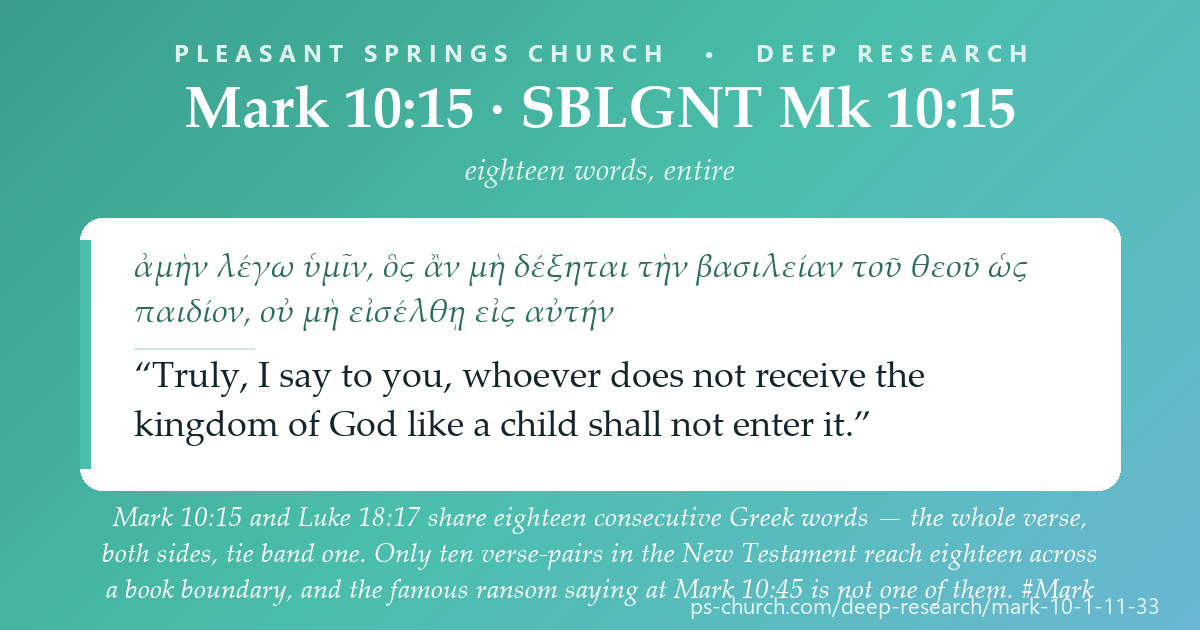
Mark 10:15 and Luke 18:17 are the same eighteen words in the same order, and eighteen words is the whole of each verse. Only ten verse-pairs in the entire Greek New Testament share that much across a book boundary, and only three of the ten are complete verses on both sides. The other two are Isaiah 6 quoted in two books, and a saying about Nineveh. Truly, I say to you, whoever does not receive the kingdom of God like a child shall not enter it.
Thirty verses later comes the sentence everybody knows — the Son of Man came not to be served but to serve, and to give his life as a ransom for many — and it measures one word less, because Mark opens it καὶ γάρ and Matthew opens it ὥσπερ. Two connectives are the whole difference between the most-quoted verse in Mark 10 and the most-shared one.
And at the far end of the passage, in a temple courtyard, stands a single line that no other book in the New Testament repeats in any measure worth the name: he would not let anyone carry a vessel through. Ten words, a deepest run of two, and a tie band of 236. One Gospel saw it, wrote it down, and nobody copied it.
Which is the honest summary of what this page is for. The engine found the eighteen and would never have found the fig tree wrapped around the temple; a reader found the frame and could not have found the eighteen. Both are in the text. The page prints the numbers, the tie bands, and the places where the numbers mislead, and leaves the reading to you.
The passage begins with a question about what a man may lawfully send away, and ends with a question about authority that nobody will answer. In between, a rich man goes away sorrowful and a blind beggar throws off his cloak and follows on the road.
Every Deep Research page traces its passage across the whole sweep — the Old Testament, the Second-Temple world between the testaments (historical witnesses, not Scripture), and the New Testament. Follow the thread:
Pleasant Springs Church — Deep Research
Research method after Michael S. Heiser’s Bible Research Method (examine dictionaries → ancient literature → important words → textual connections → academic publications → share), with the Pleasant Springs “Author & Audience” foundation. Scripture set in the Hebrew, the Greek editions named on each page and the ESV (Old Testament), and the Greek New Testament and the ESV (New Testament), per the practice of Pleasant Springs Church. Mark research grounded in France (NIGTC), Marcus (Anchor Yale), Yarbro Collins (Hermeneia), Hooker and Watts — none of which were consulted for any number on this page. Text: Greek New Testament from the SBL edition as digitized by MorphGNT; Greek Old Testament from Rahlfs’ Septuaginta as digitized by CATSS; Hebrew from the Masoretic text as printed in Sefaria’s Miqra according to the Masorah. No critical apparatus was consulted on any side. ⚠️ VERSE NUMBERING — Mark is a New Testament book, so there is no Masoretic or Septuagint column and no offset between scripture columns to state. Two numbering facts still apply. First, counted off disk: SBLGNT Mark 10 has 52 verses and Mark 11 has 32 verses numbered 1–25 and 27–33 — there is no 11:26 in the SBLGNT, and the ESV prints it only in a footnote, while the King James tradition has a verse there. No ESV Mark file is held here to count, so the ESV row is the printed edition’s shape. Second, the six words Mark 11:9 shares with the Greek Psalter stand at Septuagint Psalm 117:26 = Masoretic and ESV Psalm 118:26; the Greek Psalter runs one chapter behind the Hebrew from Psalm 9/10 through Psalm 147, and this page prints both numbers every time. ⚠️ The measurement, in full. Greek against Greek. MorphGNT field 6, the normalised word (the column that already resolves elision and the movable nu); CATSS FORM column (cols 0–24), beta-code transliterated first. Both sides lowercased, accents and breathings dropped, final sigma folded, then filtered to Greek letters — the same filter applied to both corpora, together with the editions’ own spelling equivalences (οὐ/οὐκ/οὐχ, ἐκ/ἐξ, the movable nu). Contiguous runs of whole word FORMS, never lemmas. Corpus: the 84 MorphGNT rows of Mark 10–11 against the 7,254 non-Markan verses of the Greek New Testament, and against 30,637 verse units across the CATSS files held here. The ten-pairs-at-eighteen table was built by indexing every 18-word sequence in all 7,927 Greek New Testament verses and keeping the sequences that occur in more than one book. Exhaustive and deterministic; nothing sampled, so no seed applies. The tie band — how many target verses reach the same maximum — is printed beside every run on this page. ⚠️ What was NOT measurable. No rabbinic material — including Mishnah Berakhot 9:5, on which the standard reading of Mark 11:16 depends — no Josephus, no papyri, no archaeological report, no Qumran text, no versions, no patristic citations, no apparatus. Allusions that are not verbatim are invisible to this screen: Isaiah 53 behind the ransom saying measures 1, Zechariah 9:9 behind the entry measures 1, and the absence of those readings from the numbers is not evidence against them. ⚠️ Direction of influence is never asserted. Nothing here says Mark is reading Luke, that Luke is reading Mark, that either is reading Matthew, or that any of them draws on a common source. The page reports the runs, the tie bands and the counter-examples, and stops. Typology is handled per the house position: what the text says, what the New Testament itself draws, and what we see from this side of the cross — with the seeing left to the reader.
Scripture quotations marked ESV are from the ESV® Bible (The Holy Bible, English Standard Version®), © 2001 by Crossway, a publishing ministry of Good News Publishers. ESV Text Edition: 2016. Used by permission. All rights reserved. The ESV text may not be quoted in any publication made available to the public by a Creative Commons license, and the ESV may not be translated in whole or in part into any other language. www.esv.org
|
Did this study bless you today? 💚 Give to Support PS Church100% of gifts go to the General Fund — thank you. |