Four men sit on a hill and ask for a date. What they get is the longest speech in the shortest Gospel, four warnings, and a doorkeeper. Mark 13 is called the little apocalypse and is read everywhere as the Gospel’s Daniel chapter — so we screened all thirty-seven verses against the whole Greek Old Testament on our disk, 30,637 verse units, tie bands reported. The deepest verbatim contact in the chapter is six consecutive words, tie band one — and it is Isaiah 13:10, not Daniel. The Son of Man sentence at 13:26 measures one against Daniel 7:13 in both Greek versions; the same saying at the trial one chapter later measures five. And “let the reader understand” sits over a run of four that matches the Old Greek of Daniel and not the Theodotion the churches read. See the method →
Mark 13:1–37
Greek NT · ESVThe Shape of the Passage
A sequence hung on four imperatives — with one bracket you can countWho wrote this, to whom, in what situation? Mark 13 is the longest uninterrupted block of teaching in the shortest Gospel. It is spoken to four men, sitting down, looking at a building that is still standing.
Author
Church tradition from Papias (preserved in Eusebius, Hist. eccl. 3.39.15) names John Mark, “Peter’s interpreter,” who wrote down what he remembered “accurately, though not in order.” Whatever weight one gives that, the Gospel itself is fast, physical and short on speeches — which makes chapter 13 conspicuous. It is by a long way the longest unbroken block of teaching in Mark — 13:5–37 runs thirty-three verses with no narrative break, where the parable chapter (4:1–34) is broken seven times, and it is placed immediately before the passion.
Placement is the first piece of evidence. Mark 13 is bracketed by the temple (11:11–12:44 in front of it, the trial and the torn curtain behind it) and it ends with a parable about a householder who goes away and a doorkeeper told to stay awake. The very next scene is the plot to kill him (14:1), and one chapter later three of those four sit in a garden and fall asleep. Mark has arranged the discourse so that its final imperative fails within the same night.
Audience
A Gentile-facing church under pressure — traditionally Rome, in the 60s, though Syria and a date after AD 70 are both seriously argued. Mark explains Aramaic words (5:41; 7:34), explains Jewish handwashing (7:3–4), and converts money into Roman coinage (12:42). His readers needed that; they also, on the evidence of 13:9–13, needed to be told what to do when they were dragged in front of councils and governors.
Inside the story the audience is four men, named. Peter, James, John and Andrew — the first four called in 1:16–20, now the only four listening. Outside this scene Mark names all four together only at 1:29 — Simon and Andrew’s house, “with James and John” — and at the head of the list of the Twelve (3:16–18). And the discourse is not addressed to a crowd: it is κατ’ ἰδίαν, privately, on the Mount of Olives, opposite the building they had just admired.
The pressure the chapter answers is a pastoral one, not a speculative one. Every imperative in it is defensive — do not be led astray, do not be alarmed, do not worry beforehand, do not believe it, be on guard, stay awake. There is no instruction anywhere in the chapter to calculate anything. What the disciples ask for is a timetable and a sign (v.4); what they are given is four warnings and a doorkeeper.
Orient on the temple, the discourse genre, the abomination, and the Son of Man.
Search by reference and by topic: Olivet Discourse, apocalyptic, temple (Herodian), abomination of desolation, tribulation, Son of Man, elect, parousia, watchfulness.
Which articles are relevant?
- Dictionary of Jesus and the Gospels (IVP) — “Apocalyptic Teaching,” “Destruction of Jerusalem,” “Eschatology,” “Olivet Discourse,” “Son of Man,” “Temple,” “Persecution.”
- Anchor Bible Dictionary — “Abomination of Desolation,” “Temple, Jerusalem,” “Son of Man,” “Apocalypticism,” “Daniel, Book of” (including the Old Greek / Theodotion problem).
- NIDNTTE — βλέπω, γρηγορέω, ἐκλεκτός, θλῖψις, βδέλυγμα, ἐρήμωσις, ὠδίν, γενεά.
- Dictionary of New Testament Background (IVP) — “Apocalyptic Literature,” “Antiochus IV Epiphanes,” “Destruction of Jerusalem,” “Testament Literature” (for the farewell-discourse genre).
Bibliography surfaced:
- R. T. France, The Gospel of Mark (NIGTC) — the fullest defence of reading most of the chapter of AD 70; Adela Yarbro Collins, Mark (Hermeneia); Joel Marcus, Mark 8–16 (AYB); Robert Guelich / Craig Evans (WBC); William Lane (NICNT).
- George R. Beasley-Murray, Jesus and the Last Days: The Interpretation of the Olivet Discourse — a full history of interpretation of this chapter alone.
- Timothy J. Geddert, Watchwords: Mark 13 in Markan Eschatology; Morna Hooker, The Son of Man in Mark.
- On the Greek Daniel: Alexander Di Lella and Louis Hartman, Daniel (AB); T. McLay, The OG and Th Versions of Daniel.
A building worth admiring, an altar that had already been defiled once, and a night divided into four.
Set each element beside its Second-Temple and Greco-Roman neighbours, then ask what is being kept and what is being turned.
Which parallels shed light on religion and worldview?
The disciple in v.1 is not being naive. Herod’s temple platform was one of the largest building projects in the ancient world. Josephus describes stones “forty-five cubits in length, five in height, six in breadth” (War 5.184–227; cf. Antiquities 15.392–402, which gives smaller figures for the sanctuary stones), and the rabbinic saying ran that whoever had not seen Herod’s building had never seen a beautiful building (b. Bava Batra 4a). The Greek ποταποὶ λίθοι — “what sort of stones!” — is the reaction the architecture was built to produce.
The “abomination of desolation” had a history before Mark, and it was not a prediction — it was a memory. In 167 BC Antiochus IV Epiphanes had a pagan altar set on the altar of burnt offering. 1 Maccabees 1:54 reports it in Greek that our screen can read: ᾠκοδόμησεν βδέλυγμα ἐρημώσεως ἐπὶ τὸ θυσιαστήριον — “he built an abomination of desolation upon the altar.” The book of Daniel names the same thing in three places (9:27; 11:31; 12:11). So when Mark 13:14 says the abomination of desolation, the phrase is already a technical term with a date attached to it.
Josephus supplies two candidates for a first-century recurrence, and neither settles the verse. In AD 40 Caligula ordered his statue erected in the temple; only his death prevented it (Antiquities 18.261–309; Philo, Legatio 188, 207–348). And during the revolt Josephus says the Zealots installed a clown of a high priest and filled the sanctuary with bloodshed, which he himself calls the fulfilment of an ancient oracle about the city being taken when its own people defiled the sanctuary (War 4.147–157, 388). Mark says only ὅπου οὐ δεῖ, “where it ought not to be,” and uses a masculine participle for a neuter noun. He is being less specific than his sources, not more.
The farewell discourse was a recognised literary form. Jacob in Genesis 49, Moses in Deuteronomy 31–33, Joshua in Joshua 23–24, and the whole genre of the Testaments of the Twelve Patriarchs: a leader about to die gathers his own, predicts a time of trouble, warns of deceivers, and issues commands. Mark 13 sits in that form exactly — which is worth saying, because it means the chapter’s first job is not to inform but to fortify.
The four watches in v.35 are Roman, not Jewish. Jewish reckoning divided the night into three watches (Judg 7:19; Lam 2:19); the Roman army divided it into four. Mark names all four — ὀψέ, μεσονύκτιον, ἀλεκτοροφωνία, πρωΐ — and elsewhere uses the Roman scheme too (6:48, “about the fourth watch”). For a Gentile congregation that is simply the way you say “at any hour of the night.”
The chapter takes the standard furniture of apocalyptic — cosmic signs, a tribulation, a gathering of the elect, a coming figure — and refuses the one thing the genre exists to supply. Apocalypses give you a countdown. Mark 13 gives you v.32: περὶ δὲ τῆς ἡμέρας ἐκείνης… οὐδεὶς οἶδεν, and then a doorkeeper. The signs in vv.6–8 are explicitly not the end (οὔπω τὸ τέλος), and the fig tree in v.28 teaches that summer is near — not what day it starts.
Four imperatives, three words that occur nowhere else in the New Testament, and one noun Mark keeps for this chapter alone.
Counts below are exhaustive over the SBLGNT held here (7,927 verses) and the CATSS Greek Old Testament files held here (30,637 verse units in 64 files). Lemma counts are taken from the MorphGNT lemma column; run lengths are word FORMS, never lemmas. Where a count is a negative, it is a negative on that corpus, and we say so.
“Watch out.” Four imperatives, and they are the discourse’s joints. βλέπω occurs five times in Mark 13 — the fifth is v.2, Βλέπεις, an indicative question about buildings — out of fifteen occurrences, in fourteen verses, in the whole of Mark (4:12 carries two). Exactly a third of Mark’s uses of the verb stand in this one chapter.
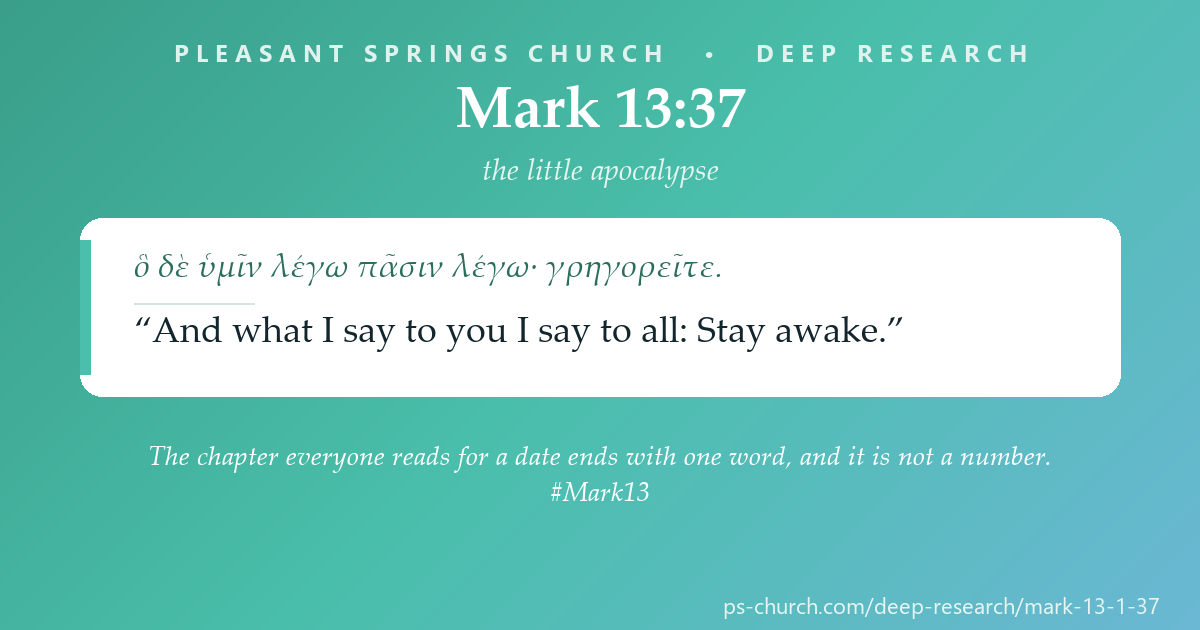
“Stay awake.” The verb occurs exactly six times in Mark, and they fall in two clusters of three: 13:34, 35, 37 — and then 14:34, 37, 38, in Gethsemane. The last word of the discourse is γρηγορεῖτε; the next time the word appears, Jesus is asking Peter why he could not do it for one hour.
“Chosen, elect.” Three occurrences in the whole of Mark and all three are in this chapter — the days are cut short for them (v.20), the deceivers aim at them (v.22), and they are gathered from the four winds (v.27). Mark uses the word nowhere else.
“The abomination of desolation.” βδέλυγμα occurs six times in the Greek New Testament — Matt 24:15; Mark 13:14; Luke 16:15; Rev 17:4, 17:5, 21:27. See Stage 4: the articled phrase Mark uses occurs in exactly one verse of the Greek Old Testament held here, and it is the Old Greek of Daniel 12:11.
“Radiance, beam.” The moon’s light. It occurs three times in the Greek New Testament — Matt 24:29, Mark 13:24, Luke 11:33 — and in 24 verse units of the Greek Old Testament held here. The Greek of Isaiah 13:10, which this verse tracks for six consecutive words, uses φῶς at exactly this point; φέγγος is the word the Greek of Joel uses (2:10; 4:15 LXX = ESV 3:15). See Stage 4.
“Cockcrow.” A New Testament hapax legomenon — this verse and no other, in 7,927 verses. The cognate noun ἀλέκτωρ then occurs four times in Mark, all in chapter 14 — vv.30, 68 and 72, and v.72 carries it twice.
“Away on a journey.” Also a New Testament hapax. The householder is not coming back on a schedule; the adjective is the whole point of the parable.
“Worry beforehand.” The third New Testament hapax in this chapter. Mark 13 has three words that occur nowhere else in the Greek New Testament, and two of them are about time — the hour you cannot prepare for and the hour you cannot predict.
“Doorkeeper.” Four occurrences in the Greek New Testament: Mark 13:34 and then John 10:3; 18:16; 18:17. In the parable the doorkeeper is the one servant given no work except to stay awake.
“Be sleepless, keep vigil.” Four occurrences in the Greek New Testament — Mark 13:33; Luke 21:36; Ephesians 6:18; Hebrews 13:17. Paired here with βλέπετε, it makes v.33 the only one of the four warnings that carries a second imperative.
“These things.” The word the disciples put in the question and the word Jesus hands back. Twice in v.4 with πάντα, and once more with πάντα in v.30 — the bracket in the structure diagram.
“Generation.” Mark uses it five times in four verses — 8:12 (twice), 8:38, 9:19, 13:30. Every earlier use carries a demonstrative, and two of the three carry an explicit judgement: τῇ γενεᾷ ταύτῃ τῇ μοιχαλίδι καὶ ἁμαρτωλῷ (8:38) and ὦ γενεὰ ἄπιστος (9:19); 8:12 has only ἡ γενεὰ αὕτη, in a rebuke about sign-seeking. That is data for reading v.30; it is not a solution to it. See Stage 5.
What the word counts actually show
The chapter is organised by a verb of perception, and it never becomes a verb of calculation. Four times — vv.5, 9, 23, 33 — the discourse stops and says βλέπετε. Not reckon, not watch the sky: look out for yourselves. The one indicative use, v.2, is Jesus asking whether they see the buildings; the four imperatives are all about not being taken in. In a chapter that everyone reads for a timetable, that is a striking distribution.
Three New Testament hapax legomena in thirty-seven verses is a high density, and all three sit in the same semantic field: προμεριμνάω (do not rehearse your defence), ἀπόδημος (the master is away, indefinitely), ἀλεκτοροφωνία (one of four unpredictable hours). Mark reached for unusual words precisely where the subject is time you do not control.
And ἐκλεκτός is this chapter’s private property. Mark uses it three times and nowhere else. It matters that all three uses are protective rather than triumphal: the days are shortened for them, the deceivers aim at them, and they are collected from the four winds. Mark never defines who they are and the chapter never tells anyone to check whether they are on the list.
ἡ γενεὰ αὕτη in v.30. The measurable facts are these and only these: Mark uses γενεά five times, and of the four earlier uses (8:12 twice; 8:38; 9:19) two carry an explicit pejorative — μοιχαλίδι καὶ ἁμαρτωλῷ at 8:38, ἄπιστος at 9:19 — while the two in 8:12 carry only the demonstrative, in a rebuke about sign-seeking. That is a real pattern and it counts for something. It does not decide whether v.30 means the contemporaries of Jesus, the Jewish people, the human race, or the generation that sees the events of vv.14–23 begin. Nothing in the Greek of Mark 13 decides among them, and a page that pretended otherwise would be selling a reading as a measurement. Stage 5 lists this as the chapter’s hardest crux and leaves it open.
The chapter called Daniel's chapter, measured against every Greek Old Testament verse we hold.
Method: every verse of Mark 13 was screened for its longest run of consecutive shared word forms against the CATSS Greek Old Testament held here — 30,637 verse units in 64 files, which is every canonical book plus the deuterocanon, and which holds both ancient Greek forms of Daniel, Judges, Joshua, Susanna, Bel and Tobit — using the shelf’s frozen normaliser (accents, breathings and final sigma folded; word order not) together with the cross-edition spelling fold the shelf applies to every CATSS-against-MorphGNT screen (οὐκ/οὐχ to οὐ, ἐξ to ἐκ, and the movable nu). That fold is load-bearing in exactly one number below: without it the run from 13:19 to the Old Greek of Daniel 12:1 would be 1, not 2. The tie band is the number of target verses reaching the same depth, and it is printed every time. A run without its band is misleading, so we do not print one.
What the screen returned
The distribution first, because it is the finding. Across the 37 verses of Mark 13 screened against the whole Greek Old Testament: 36 of 37 reach two, 28 reach three, 17 reach four, 2 reach five, 1 reaches six — and nothing reaches seven. For comparison, on this shelf’s Matthew 22 page a single verse reached fourteen; on the Matthew 13 page, twenty-four. Mark 13 has no citation formula anywhere in it, and the numbers agree: the chapter’s ceiling is six.
| In Mark 13 | Deepest match in the Greek OT | Run | Tie band | What the number means |
|---|---|---|---|---|
| v.24 sun and moon | Isaiah 13:10 | 6 | 1 | The deepest contact in the chapter. Nothing else in 30,637 verse units reaches it. |
| v.31 heaven and earth | Genesis 2:1 · Joel 4:16 LXX (ESV 3:16) · 1 Macc 2:37 | 5 | 3 | “The heaven and the earth” is a formula. Three verses tie; none is a citation. |
| v.3 the Mount of Olives | Zechariah 14:4 | 4 | 1 | The phrase occurs in one verse of the whole Greek OT. It is a setting, not a quotation. |
| v.14 the abomination | Daniel 12:11 (Old Greek) · 2 Macc 1:10 | 4 | 2 | Against Theodotion Daniel 12:11 the same run is 1. The tying verse is an accident. |
| v.27 the four winds | Zechariah 2:10 LXX (ESV 2:6) | 4 | 1 | Four words. Against Deuteronomy 30:4, the verse usually cited here, the run is 2. |
| v.19 unequalled tribulation | Daniel 12:1 (Theodotion) | 4 | 3 | Against the Old Greek of the same verse the run is 2. The mirror image of v.14. |
| v.26 the Son of Man | 1 Macc 9:60 · 1 Macc 12:42 · Isaiah 36:2 | 4 | 3 | “With a great force.” Against Daniel 7:13, both Greek versions, the run is 1. |
Now the part that is genuinely surprising. Mark 13 is called the little apocalypse and is read everywhere as the Gospel’s Daniel chapter. But the deepest verbal contact any verse of it makes with the Greek Old Testament is Isaiah 13:10, at six words, tie band 1 — καὶ ἡ σελήνη οὐ δώσει τὸ — and after that the chapter simply stops going deeper.
Put the whole Gospel behind it and the contrast sharpens. We ran the same screen over all 673 verses of Mark. Its deepest Old Testament contacts are 12:30 at 21 words (Deuteronomy 6:5), 12:36 at 14 (Psalm 109:1 LXX = ESV/MT 110:1), 1:3 at 13 (Isaiah 40:3), then 12:10–11 at 10 apiece (Psalm 117:22–23 LXX = ESV 118:22–23) and 10:7 at 10 (Genesis 2:24). Not one of Mark’s fifteen deepest Old Testament contacts is in chapter 13. Chapter 13’s ceiling of six is beaten by chapters 1, 3, 7, 10, 11 and 12, matched by 2, 5 and 14, and beaten downward by 4, 6, 8, 9, 15 and 16 — so it is not the shallowest chapter in Mark. What the number says is that a chapter everyone reads as saturated with scripture measures like Mark’s ordinary narrative, because it alludes constantly and quotes never.
Which is exactly the limit this method has, and it is worth stating in the strongest form. The screen finds verbatim contact. It does not find allusion. Nobody reading Mark 13:26 doubts that it is Daniel 7:13. The measurement says 1.
Daniel in two Greek versions — and Mark 13 touching one in one verse and the other in another
Daniel is the one Old Testament book that survives in two substantially different ancient Greek translations: the Old Greek and the version attributed to Theodotion, which is the form that displaced the Old Greek in Christian manuscripts almost completely. We hold both, as separate files. That makes a question askable here that a single-text screen cannot ask.
- Mark 13:14 matches the Old Greek and not Theodotion. The articled phrase τὸ βδέλυγμα τῆς ἐρημώσεως occurs in exactly one verse of the entire Greek Old Testament held here — Daniel 12:11, Old Greek. Theodotion at 12:11 reads βδέλυγμα ἐρημώσεως without the articles, and the measured run from Mark drops from 4 to 1. The articleless form does occur elsewhere — Old Greek Daniel 11:31, Theodotion Daniel 12:11, and 1 Maccabees 1:54 — and Daniel 9:27 in both versions has the plural, βδέλυγμα τῶν ἐρημώσεων.
- Mark 13:19 matches Theodotion and not the Old Greek. θλῖψις οἵα οὐ γέγονεν runs 4 against Theodotion Daniel 12:1, whose Greek reads ἔσται καιρὸς θλίψεως θλῖψις οἵα οὐ γέγονεν. The Old Greek of the same verse reads ἐκείνη ἡ ἡμέρα θλίψεως οἵα οὐκ ἐγενήθη, and the run drops to 2.
- Mark 13:26 matches neither. Against Daniel 7:13 the run is 1 in the Old Greek and 1 in Theodotion. Mark writes τὸν υἱὸν τοῦ ἀνθρώπου ἐρχόμενον ἐν νεφέλαις; both Greek Daniels write ὡς υἱὸς ἀνθρώπου without articles and τῶν νεφελῶν τοῦ οὐρανοῦ in the genitive plural. Every content word is cognate. Not two of them are consecutive and identical.
Two verses of one chapter, four words each, pointing at two different Greek forms of the same book. We are not asserting a direction of influence and we are not proposing a source theory. We do not claim Mark had a scroll, or which scroll, or that either Greek Daniel we hold is the form that existed in the 60s AD — the textual history of Greek Daniel in the first century is genuinely unsettled, and the Old Greek survives in very few witnesses. What is measured, and re-derivable, is only this: on the two Greek Daniels on our disk, the run from Mark 13:14 is 4 against the Old Greek and 1 against Theodotion; the run from Mark 13:19 is 4 against Theodotion and 2 against the Old Greek. Neither text accounts for both verses. Anyone who tells you Mark quotes ‘the Greek Daniel’ has not said which one.
Two counter-examples, printed against our own case
A page that prints only the numbers supporting its thesis is not measuring anything. Here are two results from the same screen that cut the other way.
- The Son of Man verse’s deepest match is a battle report. Mark 13:26 — the most obviously Danielic sentence in the chapter — returns a maximum of 4 with a tie band of 3, and the three verses are 1 Maccabees 9:60, 1 Maccabees 12:42 and Isaiah 36:2. The shared four words are μετὰ δυνάμεως πολλῆς καί, “with a great force and…” — in 1 Maccabees, Bacchides marching on Israel and Tryphon marching on Scythopolis; in Isaiah, the Rabshakeh arriving at Jerusalem. Nobody thinks Mark is quoting a Seleucid troop movement. The phrase is ordinary military Greek that happens to sit next to a genuine allusion the screen cannot see.
- A tie band of one does not mean a connection. Mark 13:17 — “alas for those who are pregnant and nursing in those days” — returns a run of 4 with a band of 1, which looks like a find until you read the match. It is Judith 8:1, and the shared words are ἐν ἐκείναις ταῖς ἡμέραις, the commonest time-marker in Greek scripture, which happens to be uniquely spelled that way in that one verse of the corpus. Uniqueness is a property of the corpus searched, not of an author.
And one observation offered as nothing more than an observation. Mark 13:3 sets the discourse εἰς τὸ Ὄρος τῶν Ἐλαιῶν κατέναντι τοῦ ἱεροῦ. The phrase τὸ ὄρος τῶν ἐλαιῶν occurs in exactly one verse of the whole Greek Old Testament held here — Zechariah 14:4, where the LORD’s feet stand on it and it splits in two — and Zechariah’s next word is τὸ κατέναντι, “the one opposite.” Mark’s next word is κατέναντι. The run stops at four because of one definite article. We are not claiming Mark is alluding to Zechariah 14 here; the Mount of Olives is a real hill east of a real temple and there is nowhere else to sit and see it, and the same phrase occurs in eight New Testament verses as plain geography. It is noted so a reader can weigh it, not lean on it.
The chapter against the rest of the New Testament
The same 37 verses were then screened against the whole Greek New Testament outside Mark — 7,254 verses. Here the numbers are much larger, as they must be, because the synoptic parallels are not allusions.
And the two deepest are not where anyone would look for them.
- Mark 13:13 — run of 16, tie band 1 — against Matthew 10:22. That is the entire verse. καὶ ἔσεσθε μισούμενοι ὑπὸ πάντων διὰ τὸ ὄνομά μου. ὁ δὲ ὑπομείνας εἰς τέλος οὗτος σωθήσεται stands word for word in both, and Matthew 10 is the mission discourse, not the Olivet discourse.
- Mark 13:12 — run of 15, tie band 1 — against Matthew 10:21. Again the whole verse, differing only in the opening conjunction (καὶ παραδώσει against παραδώσει δέ).
- Matthew has the same material in his own chapter 24, but split and modified: 24:9 carries the first half of Mark 13:13 with τῶν ἐθνῶν added, and 24:13 carries the second half verbatim. So the two deepest matches Mark 13 makes in the New Testament are with Matthew 10, and its Matthew 24 counterparts are shallower.
- The rest of the top band is where one would expect: 13:17 = 13 (Matt 24:19); 13:31 = 13 (Luke 21:33); 13:28 = 12 (Matt 24:32); 13:24 = 11 (Matt 24:29); 13:29 = 11 (Luke 21:31); 13:30 = 10, band 2 (Matt 24:34 and Luke 21:32). All tie bands as stated.
It shows that the material in Mark 13:9–13 circulated attached to two different settings in the tradition as we have it — a mission and an end — and that where Matthew places it beside the sending of the Twelve, the wording is closer to Mark’s than where he places it in his own Olivet discourse. It does not show who copied whom. Synoptic priority is not a question a run-length screen can answer, and this page does not pretend to answer it.
The literature, four cruxes we will not smooth over, and an honest list of this page's weak points.
France, Marcus, Yarbro Collins and Beasley-Murray for the spade-work. Then the limits — because a page that only reports what it found is not reporting.
Commentaries & studies:
- R. T. France, The Gospel of Mark (NIGTC); Joel Marcus, Mark 8–16 (Anchor Yale); Adela Yarbro Collins, Mark (Hermeneia); William Lane (NICNT); Craig Evans, Mark 8:27–16:20 (WBC); Morna Hooker (BNTC).
- George R. Beasley-Murray, Jesus and the Last Days — a full history of the interpretation of Mark 13, including the “little apocalypse” source hypothesis of Timothée Colani and his successors, and its critics.
- Timothy J. Geddert, Watchwords: Mark 13 in Markan Eschatology; Rikki Watts, Isaiah’s New Exodus in Mark — relevant to this page’s Isaiah result, though Watts’ argument is thematic rather than verbatim.
- Josephus, Jewish War 4.147–157, 388 and 6.249–270; Antiquities 15.392–402 and 18.261–309; Philo, Legatio ad Gaium 188, 207–348 — the primary sources behind Stage 2.
- Classic: Chrysostom, Homilies on Matthew 75–77 (on the parallel); Augustine, Letter 199 (De fine saeculi), which turns on the saying in Mark 13:32 and on Acts 1:7; Calvin, Harmony of the Evangelists.
Genuine cruxes, not smoothed over:
- What is “this generation” (v.30)? The major options are the contemporaries of Jesus (with the temple’s fall in AD 70 as the referent of ταῦτα πάντα), the Jewish people as a people, the human race, or the generation that sees vv.14–23 begin. Preterist and futurist readings divide here, and so do serious commentators. Stage 3 gives the only measured datum we have — two of Mark’s four earlier uses of γενεά carry an explicit pejorative, and all four stand in a rebuke — and it does not settle the question.
- Does the discourse answer one question or two? The disciples ask when and what sign; France argues vv.5–31 concern the temple and vv.32–37 the parousia; others read a single fused horizon throughout. The chapter marks a break at v.32 with περὶ δέ, which is real Greek evidence but not decisive — the same construction elsewhere marks a new topic without changing the referent.
- “Nor the Son” (v.32). The clause is textually secure in Mark and has been theologically uncomfortable since at least the fourth century. It says the Son does not know the day. It does not say why, and this page will not manufacture an answer; the classical discussions (Athanasius, Orations against the Arians 3.42–50; Augustine, Letter 199) are worth reading in full rather than in summary.
- The masculine participle in v.14. βδέλυγμα is neuter; Mark writes ἑστηκότα, a masculine accusative singular, which many read as pointing to a person rather than an object. Matthew 24:15 uses the neuter ἑστός. This is a real grammatical fact and it does not, by itself, identify anybody. Note also that the SBLGNT flags a variant at that very word.
- The date of Mark. Whether the chapter was written before or after AD 70 changes how one reads “let the reader understand,” and it cannot be settled from the chapter. Notably, the flight in v.14 is to the mountains, which is not what happened in the siege, and Luke 21:20 replaces the abomination with armies encircling the city. Both facts are used on both sides of the argument.
What this page could not check — and where it is weakest
- No Hebrew screen was run for this page. Every measurement above is Greek against Greek. The Hebrew of Isaiah 13:10, Joel 2:10 and Daniel 12:1 is relevant to the Stage 4 argument about φέγγος and we quote it in the next section, but Mark 13 was not screened against the Masoretic corpus and no run length on this page rests on Hebrew wording.
- We hold one Greek Old Testament text per book, not a manuscript tradition. The screen runs against the CATSS/Rahlfs files on disk. Daniel is the one place where that limitation is partly lifted, because we hold two versions — and Stage 4 leans on precisely that. But we cannot check the witnesses behind either. The Old Greek of Daniel survives in a very small number of witnesses (essentially Papyrus 967 and the Syro-Hexapla tradition), which means the single most striking result on this page rests on the thinnest textual base on this page. We flag it rather than burying it.
- We did not consult a critical apparatus for Mark. The SBLGNT on our disk carries its editor’s variant markers — the chapter carries 49 of them, counted here — but we hold the markers, not the apparatus. Two of them bear on things said above: the participle at v.14, and the word order at v.25. Anyone building on those two sentences should open an apparatus, and we did not.
- The Isaiah 13:10 result is a run of six, and six is not a lot. It is the deepest in the chapter, and its tie band is 1, and both of those are real. But this page is not claiming that Mark 13:24 is a citation of Isaiah 13:10, because six words with no citation formula does not establish that. What it establishes is a ranking: within this chapter, the Isaiah contact is the deepest one there is.
- The tie band is a property of the corpus searched, not of the ancient world. A band of one over 30,637 verse units is not a claim about every Greek text that existed. The deuterocanonical books are included in the count; so are both Greek Daniels, both Greek Judges and both Greek Joshuas — and both forms of Susanna, Bel and Tobit — which is why some tie bands here are larger than they would be on a canon-only screen.
- We did not read the rabbinic sources in the original. The reference to b. Bava Batra 4a in Stage 2 comes from standard secondary discussion and postdates Mark by centuries in its compiled form.
- Nothing here establishes direction of influence, and the page never asserts one. That Mark 13:13 stands verbatim in Matthew 10:22 is a measured fact about two texts. Which way the material travelled, or whether both drew on a common form, is a synoptic question a run-length screen cannot decide.
- What we deliberately did not do: we did not date the chapter, we did not identify the abomination with a historical figure, and we did not build a timeline. Those are the three things readers most want from Mark 13 and they are the three things the measurement cannot supply.
From the numbers to Monday.
Name what you learned, why it matters, and one concrete response.
What should we carry away — and do?
- The chapter is not a timetable, and its own vocabulary says so. Four imperatives, and every one of them is βλέπετε — watch out, not work it out. The one thing the disciples asked for, a sign and a date, is the one thing v.32 says nobody has.
- The deepest Old Testament contact in the chapter is six words, and it is Isaiah. That is a measured fact, not a devotional flourish. Mark 13 alludes constantly and quotes never — which is why it feels saturated with scripture and measures shallow. Both things are true at once, and holding them together is what honest reading looks like.
- “Let the reader understand” is the only time the discourse turns and speaks to you. Not to Peter, James, John and Andrew — to whoever is holding the scroll. Mark thought his readers would need to recognise something, and he did not spell out what.
- The elect are never told to identify themselves. All three occurrences of ἐκλεκτός in Mark are here, and all three are protective: the days are shortened for them, the deceivers aim at them, they are gathered from the four winds. No one in this chapter is invited to audit the list.
- The last word is γρηγορεῖτε, and it is broken by morning. Mark uses the verb six times: three at the end of this chapter, three in Gethsemane. The men told to stay awake are the men who fall asleep, and Mark puts the two scenes one chapter apart on purpose. Whatever this discourse is asking for, three of the four men who first heard it could not do it.
Step in response: read Mark 13:32–37 and Mark 14:32–42 back to back, out loud, in one sitting. Then ask what you have been calculating that you were told instead to watch.
Mark 13:37 · to share
Greek NT + ESVThe deepest run in the chapter is six words long and it is stopped at the back by a single noun. That noun turns out to belong to a different prophet. This section looks at exactly where the contact starts and where it stops, because that is where the textual information lives.
Where the six words begin and end
Set the two texts side by side. Septuagint Isaiah 13:10 (no offset — Hebrew, Greek and English agree on the number):
… καὶ σκοτισθήσεται τοῦ ἡλίου ἀνατέλλοντος καὶ ἡ σελήνη οὐ δώσει τὸ φῶς αὐτῆς
Mark 13:24:
… ὁ ἥλιος σκοτισθήσεται, καὶ ἡ σελήνη οὐ δώσει τὸ φέγγος αὐτῆς
The shared run is καὶ ἡ σελήνη οὐ δώσει τὸ — six forms, tie band 1 over 30,637 verse units. It is stopped at the front because Isaiah has the sun in a genitive absolute (τοῦ ἡλίου ἀνατέλλοντος, “as the sun rises”) while Mark makes ὁ ἥλιος the subject of the same verb. And it is stopped at the back by one noun.
The word that stops it belongs to Joel
Isaiah’s Greek reads τὸ φῶς αὐτῆς. Mark reads τὸ φέγγος αὐτῆς. Both mean the moon’s light; they are different words.
Where does φέγγος live? In the Greek Old Testament held here it occurs in 24 verse units, 25 times (Ezekiel 1:4 has it twice). Two of them are in Joel, and both are about the same event:
- Joel 2:10 LXX — ὁ ἥλιος καὶ ἡ σελήνη συσκοτάσουσιν καὶ τὰ ἄστρα δύσουσιν τὸ φέγγος αὐτῶν — “the sun and the moon will be darkened and the stars will withdraw their radiance.” (No offset here: LXX/MT/ESV all number this 2:10.)
- Joel 4:15 LXX = ESV Joel 3:15 — ὁ ἥλιος καὶ ἡ σελήνη συσκοτάσουσιν καὶ οἱ ἀστέρες δύσουσιν φέγγος αὐτῶν. Hebrew and Greek Joel have four chapters, English has three, so this verse is Joel 3:15 in an English Bible.
- The measured runs from Mark 13:24 to those verses are 3 in each case (καὶ ἡ σελήνη). By the numbers, Joel is a shallow contact and Isaiah is the deep one.
So the sentence is Isaiah’s clause carrying Joel’s noun — and we want to be exact about what that is and is not. It is not proof that Mark spliced two scrolls. Two prophets describing the same darkened sky in similar Greek is not a surprising thing to find, and φέγγος is a perfectly ordinary word that also appears in Job, Ezekiel and Habakkuk. What is measurable, and re-derivable, is the shape of the overlap: six consecutive words shared with one verse and no other, broken at precisely the point where Mark uses the other prophet’s vocabulary for the same object. That is the whole finding, and it is worth exactly that much.
A note on the Hebrew, since we did not screen it: Isaiah 13:10 has the moon not causing its ’or to shine, while Joel 2:10 has the stars withdrawing their nogah. The Greek distinction between φῶς and φέγγος tracks a distinction that is already there in the Hebrew. We state that as background, not as a measurement — no Hebrew screen was run for this page.
The Son of Man verse, and the one a chapter later
This is the sharpest thing the screen found, and it is worth its own paragraph.
Mark 13:26 — καὶ τότε ὄψονται τὸν υἱὸν τοῦ ἀνθρώπου ἐρχόμενον ἐν νεφέλαις μετὰ δυνάμεως πολλῆς καὶ δόξης. Against Daniel 7:13 the run is 1, in the Old Greek and in Theodotion alike.
Mark 14:62, the same speaker, one chapter later, answering the high priest — ὄψεσθε τὸν υἱὸν τοῦ ἀνθρώπου ἐκ δεξιῶν καθήμενον τῆς δυνάμεως καὶ ἐρχόμενον μετὰ τῶν νεφελῶν τοῦ οὐρανοῦ. Against Theodotion Daniel 7:13 the run is 5, tie band 1 — μετὰ τῶν νεφελῶν τοῦ οὐρανοῦ — and against the Old Greek it is 4, because the Old Greek reads ἐπὶ τῶν νεφελῶν. We screened Mark 14:62 against the whole Greek Old Testament: Theodotion Daniel 7:13 is that verse’s single deepest contact in all 30,637 verse units.
So: one chapter apart in the same Gospel, on the same subject, one sentence touches the Greek Daniel and the other does not. The difference is one preposition and one article-plus-genitive: ἐν νεφέλαις against μετὰ τῶν νεφελῶν τοῦ οὐρανοῦ.
Because it is the cleanest demonstration on this shelf of what the method can and cannot see. Mark 13:26 is Daniel 7:13. Every commentator says so, every cross-reference column prints it, and they are right. The measurement says 1. If you were reading run lengths as a detector of dependence, you would conclude that Mark 13:26 has nothing to do with Daniel, and you would be badly wrong. The screen finds verbatim contact. Allusion — the deliberate evocation of a text in different words — is invisible to it, and the whole of Mark 13 is a demonstration of that fact. The right conclusion is not that the chapter is un-Danielic. It is that the numbers on this page describe a surface, and the surface is not the depth.
Every Deep Research page traces its passage across the whole sweep — the Old Testament, the Second-Temple world between the testaments (historical witnesses, not Scripture), and the New Testament. Follow the thread:
Pleasant Springs Church — Deep Research
Research method after Michael S. Heiser’s Bible Research Method (examine dictionaries → ancient literature → important words → textual connections → academic publications → share), with the Pleasant Springs “Author & Audience” foundation. Scripture set in the Hebrew, the Greek editions named on each page and the ESV (Old Testament), and the Greek New Testament and the ESV (New Testament), per the practice of Pleasant Springs Church. Mark 13:1–37 research grounded in France (NIGTC), Marcus (Anchor Yale), Yarbro Collins (Hermeneia), Lane and Beasley-Murray; the temple stones per Josephus, Antiquities 15.392–402, the Caligula crisis per Antiquities 18.261–309 and Philo, Legatio 188, and the Zealot desecration per War 4.147–157. All run lengths, tie bands and word counts on this page were produced by the shelf’s own measurement substrate against the SBLGNT (MorphGNT) and the CATSS Greek Old Testament files held locally — including both the Old Greek and Theodotion forms of Daniel — and are re-derivable; the frozen normaliser folds accents, breathings and final sigma, and the cross-edition fold resolves οὐκ/οὐχ, ἐξ/ἐκ and the movable nu.
Scripture quotations marked ESV are from the ESV® Bible (The Holy Bible, English Standard Version®), © 2001 by Crossway, a publishing ministry of Good News Publishers. ESV Text Edition: 2016. Used by permission. All rights reserved. The ESV text may not be quoted in any publication made available to the public by a Creative Commons license, and the ESV may not be translated in whole or in part into any other language. www.esv.org
|
Did this study bless you today? 💚 Give to Support PS Church100% of gifts go to the General Fund — thank you. |