First Maccabees begins with a king who has something built on the altar in Jerusalem, and ends its fourth chapter with the altar rebuilt and an eight-day feast. Two New Testament phrases stand close to those two things. Matthew and Mark speak of τὸ βδέλυγμα τῆς ἐρημώσεως as something still to come in Jesus’ discourse, and Matthew says it was spoken of through Daniel; John names a winter feast, τὰ ἐγκαίνια, on the usual reading the feast of 4:59. Measured, 1 Maccabees carries neither Greek phrase. At 1:54 it writes the abomination without its two articles, and against Matthew 24:15 the verse shares no two consecutive words; the Gospels’ four words stand in exactly one of the 30,348 Greek Old Testament units screened here — the Old Greek of Daniel 12:11. At 4:59 it calls the feast αἱ ἡμέραι τοῦ ἐγκαινισμοῦ τοῦ θυσιαστηρίου, the days of the dedication of the altar — six words found together nowhere else screened, whose last three stand, in the accusative, in Numbers 7 and 2 Chronicles 7:9 — and John’s noun does not occur anywhere in the book. What follows is four chapters about a desecrated altar and the family that rebuilt it: a decree, a killing at Modein, a deathbed roll-call of eleven names, four battles, and a date kept to the day. It is not Scripture for us: it is filed with the Apocrypha, and nothing taught here rests on it. There is no Hebrew 1 Maccabees on this disk and no licensed modern English; the English is the King James Apocrypha of 1769, quoted verbatim, and the page says plainly what that costs. See the method →
1 Maccabees is a Second-Temple Jewish history of the revolt against Antiochus IV and of the family of Mattathias that led it, told in sixteen chapters through Judas, Jonathan and Simon. It is canonical in the Roman Catholic and Orthodox churches, was printed among the Apocrypha in the Protestant Bibles of the Reformation era, and is absent from the Hebrew Bible. It is not Scripture for us. We read it as a witness — a window onto the generation that made the feast John 10:22 is usually read as naming, and onto the crisis Daniel’s readers are commonly read as having in mind.
Jerome put the older church’s practice in one sentence, prefacing the books of Solomon: Sicut ergo Iudith et Tobi et Macchabeorum libros legit quidem Ecclesia, sed inter canonicas scripturas non recipit, sic et haec duo volumina legat ad aedificationem plebis, non ad auctoritatem ecclesiasticorum dogmatum confirmandam. — “As, then, the Church reads Judith, Tobit, and the books of Maccabees, but does not admit them among the canonical Scriptures, so let it read these two volumes for the edification of the people, not to give authority to doctrines of the Church.” (Latin: The Latin Library; English: NPNF II/6, via CCEL.) We read it the same way: gratefully, critically, and tested by the canon.
⚠️ What this page can and cannot measure — read this first.
HELD: the Greek of 1 Maccabees in full (CATSS 1Macc.mlxx, 924 verse rows in sixteen chapters, every label numeric; this study’s four chapters are 255 rows and 4,432 Greek words); the King James Apocrypha’s 1 Maccabees (924 verses); the Clementine Vulgate’s (929 rows); the Greek New Testament (7,927 SBLGNT verses); the Greek Old Testament files (30,348 verse units screened, of 30,637 held — the Odes are held and not screened); the Masoretic text for the canonical comparisons (Daniel). Also held, and used as measured witnesses: the Greek of Josephus’s Antiquities (Niese’s text, Perseus digitisation, 7,376 sections), fetched to this disk on 9 October 2026 for the neighbouring study of 1 Maccabees 9–11; and, fetched for this study the same day, Jerome’s prefaces in Latin (The Latin Library) and English (NPNF, via CCEL) and Eusebius’s Church History book 6 in English (NPNF, via New Advent). The fetched pages are held under .firecrawl/witnesses/ with their addresses and checksums.
NOT HELD: any Hebrew 1 Maccabees. None is on this disk, and the page cites no scholarship that reports one; Jerome says he found one (Stage 2). No critical edition — Kappler’s Göttingen text and its apparatus are not here, so no manuscript variant is checked. No Old Latin, no Syriac, no Dead Sea Scrolls corpus, no rabbinic literature, and no licensed modern English translation of this book.
CONSEQUENCE: the Hebrew-side screens this shelf owns cannot be run on 1 Maccabees at all, and every statement on this page about a Semitic original is ancient testimony or outside scholarship, reported and labelled, never measured.
1 Maccabees 1:1–4:61 — eleven verses
Greek: CATSS 1 Maccabees (Rahlfs) · English: KJV Apocrypha (1769 standard text, public domain) · Latin: Clementine VulgateThe book’s own clock. Every date in these four chapters is read here as a year of what this verse calls βασιλείας Ἑλλήνων, the kingdom of the Greeks: 137 here, then 143 (1:20), 145 (1:54), 146 (2:70), 147 (3:37) and 148 (4:52). Their conversion to dates BC is reported in Stage 2 and is not measured. The Latin numbers this verse 1:11.
VULGATE 1:11 Et exiit ex eis radix peccatrix, Antiochus illustris, filius Antiochi regis, qui fuerat Romæ obses : et regnavit in anno centesimo trigesimo septimo regni Græcorum.
The bolded two words stand together in three of the 30,348 screened Greek Old Testament units — here, Daniel 11:31 in the Old Greek, and Daniel 12:11 in Theodotion — and in no verse of the Greek New Testament. The Greek verb ᾠκοδόμησεν is singular and names no subject; the KJV reads they set up; the Latin, numbered 1:57, reads ædificavit rex Antiochus abominandum idolum desolationis. Three witnesses, three subjects for one verb.
VULGATE 1:57 Die quintadecima mensis Casleu, quinto et quadragesimo et centesimo anno, ædificavit rex Antiochus abominandum idolum desolationis super altare Dei, et per universas civitates Juda in circuitu ædificaverunt aras :
Two altars in one clause. ἐπὶ τὸν βωμόν ὃς ἦν ἐπὶ τοῦ θυσιαστηρίου — a βωμόν standing on the θυσιαστηρίου. And the first six bolded words, on the twenty-fifth of the month, stand in exactly two screened Greek Old Testament units: this verse and 4:52. The KJV reads the idol altar, which was upon the altar of God; the Latin (1:62) reads sacrificabant super aram, quæ erat contra altare.
VULGATE 1:62 Et quinta et vigesima die mensis sacrificabant super aram, quæ erat contra altare.
The killing at Modein, told as the text tells it. The man is a fellow Jew (2:23), and the Greek puts the act ἐπὶ τὸν βωμόν — at the βωμόν built for the king’s sacrifice, not the altar of the temple. The KJV’s “upon the altar” does not show the difference; the Greek keeps the two words for two different altars in every verse of chapters 1–4 (Stage 3).
VULGATE 2:24 et vidit Mathathias, et doluit, et contremuerunt renes ejus, et accensus est furor ejus secundum judicium legis, et insiliens trucidavit eum super aram :
Phinehas and Zimri, named. Zimri’s father is Σαλωμ here and Σαλω in the Greek of Numbers 25:14; the KJV prints Salom, the Latin Salomi. Against the whole of Greek Numbers 25 this verse’s longest shared run is two words.
VULGATE 2:26 et zelatus est legem, sicut fecit Phinees Zamri filio Salomi.
Two phrases joined, each rare. ἐν πειρασμῷ εὑρέθη πιστός stands in one other screened Greek Old Testament unit, Sirach 44:20. καὶ ἐλογίσθη αὐτῷ εἰς δικαιοσύνην stands in two others: Genesis 15:6, of Abraham, and Psalm 105:31 (Greek numbering), of Phinehas.
VULGATE 2:52 Abraham nonne in tentatione inventus est fidelis, et reputatum est ei ad justitiam ?
The deepest New Testament contact in the four chapters: six words with Acts 13:36, where they are said of David — tie band 1 among the 7,927 New Testament verses. From the other side, Acts 13:36 reaches six against two Greek Old Testament units, this verse and Bel (Theodotion) 1:1. A death formula; see Stage 4.
VULGATE 2:69 Et benedixit eos, et appositus est ad patres suos.
Six words — σῴζειν ἐν πολλοῖς ἢ ἐν ὀλίγοις — stand in two screened Greek Old Testament units: here and 1 Samuel 14:6, Jonathan to his armour-bearer. Judas does not name Jonathan here; in the next chapter, at 4:30, Judas’s prayer names Jonathan and his armour-bearer.
VULGATE 3:18 Et ait Judas : Facile est concludi multos in manus paucorum : et non est differentia in conspectu Dei cæli liberare in multis, et in paucis :
The same six words as 1:59. By the text’s own count, three years on: 145 at 1:54, 148 here. The Latin numbers chapters 2–4 as the Greek does.
VULGATE 4:52 Et ante matutinum surrexerunt quinta et vigesima die mensis noni (hic est mensis Casleu) centesimi quadragesimi octavi anni :
The text itself makes the anniversary: at what time and what day the heathen had profaned it (KJV). The verb ἐνεκαινίσθη carries an augment, so a search on the dictionary spelling of the prefix does not find it (Stage 3).
VULGATE 4:54 Secundum tempus et secundum diem in qua contaminaverunt illud gentes, in ipsa renovatum est in canticis, et citharis, et cinyris, et in cymbalis.
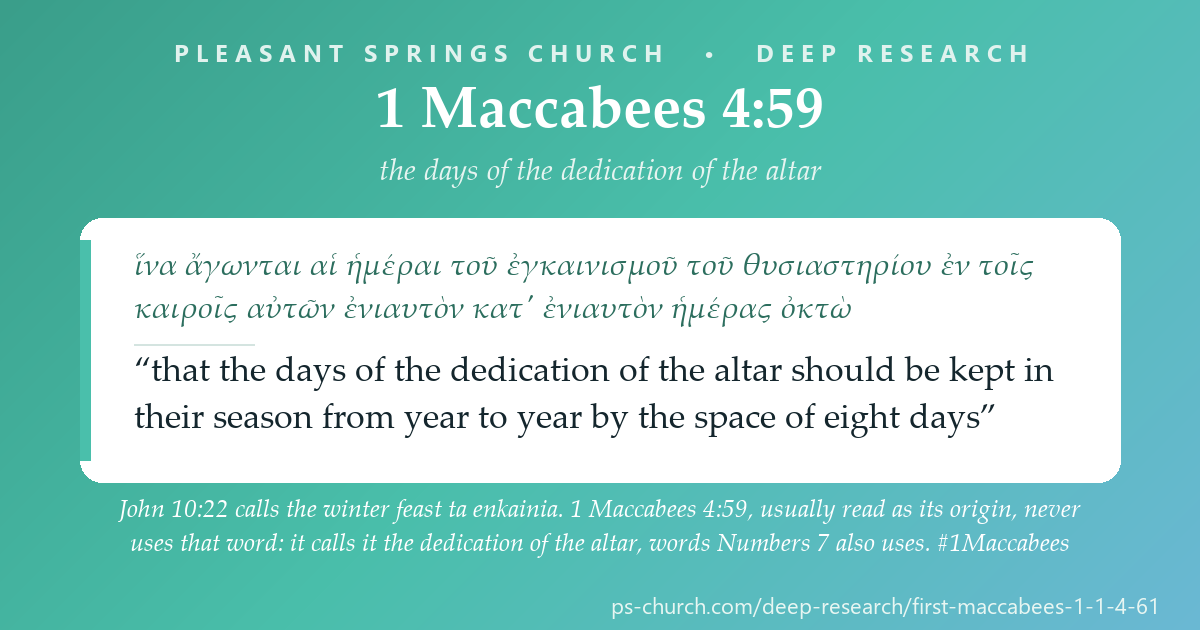
The feast instituted. Its name here is αἱ ἡμέραι τοῦ ἐγκαινισμοῦ τοῦ θυσιαστηρίου — six words found together in no other of the 30,348 screened Greek Old Testament units. Its last three, in the accusative as at 4:56, stand in Numbers 7:10–11 and 2 Chronicles 7:9. John 10:22’s τὰ ἐγκαίνια does not occur anywhere in 1 Maccabees.
VULGATE 4:59 Et statuit Judas, et fratres ejus, et universa ecclesia Israël, ut agatur dies dedicationis altaris in temporibus suis ab anno in annum per dies octo a quinta et vigesima die mensis Casleu, cum lætitia et gaudio.
⚠️ And the two places where these chapters stand closest to a New Testament phrase are the two places where this book’s Greek is not the New Testament’s. 1:54 against Matthew 24:15: a longest shared run of one word (both nouns are shared, never side by side). 4:59 against John 10:22: a longest shared run of two words, and they are in the. Stage 4 has the numbers from both sides.
On the columns. The Greek is the CATSS morphological Septuagint (Rahlfs’s text), quoted at verse level with attribution, as on every page of this shelf. The English is the King James Version Apocrypha, 1769 standard text, public domain, quoted verbatim from the verse-per-line edition held on this disk, KJV spelling and all; it is the English of 1611 in its 1769 standard text, quoted, not measured against the Greek. The Latin is the Clementine Vulgate, a fourth witness with its own verse division in chapter 1, printed under its own numbers and never used as a source for the English. There is no Hebrew column, because there is no Hebrew 1 Maccabees on this disk. English in italics in the prose is our own literal gloss of the Greek unless it is marked KJV or ESV.
Versification — stated, as on every page here, in a third state: no Masoretic text, no licensed modern English. There is no Hebrew–Greek offset to report because there is no Hebrew.
• Greek. 1:1–4:61 is 64 + 70 + 60 + 61 = 255 rows, every label a plain number, no lettered or verse-only labels; the whole book is 924 rows in sixteen chapters.
• Greek against the King James Apocrypha: no offset. The KJV counts 64, 70, 60, 61 — and 924 over the book, chapter for chapter the Greek’s shape. Aligned by content, not by label: twenty proper names (Mattathias, Chislev, Phinehas, Apollonius, Seron, Gorgias, Emmaus, Modein, Alexander, Abraham, Daniel, Elijah, Beth-horon, Beth-zur, Joseph, Caleb, Idumea, Egypt, Nicanor, Ptolemy) fall on the same verse labels in both texts, every one. Two do not, in one direction only: the KJV names Lysias at 4:28 and Antiochus at 1:41, where the Greek says he or the king.
• Greek against the Clementine Vulgate: +3 by the end of chapter 1, none after. The Latin’s chapter 1 has 67 verses. Measured by content: Greek 1:7 is Latin 1:8, 1:10 is 1:11, 1:20 is 1:21, 1:41 is 1:43, 1:54 is 1:57, 1:59 is 1:62, and 1:64 is 1:67. Chapters 2, 3 and 4 have the Greek’s counts (70, 60, 61) and the names fall on the same labels — except that the Latin’s 4:29 reads Judæam and Bethoron where the Greek reads Idumea and Beth-zur. (Over the whole book the Latin also runs one long in chapters 12 and 13: 929 rows.)
• Josephus is cited by Niese’s section numbers (Ant. 12.253), the numbering the provenance file for that text records the Loeb as also using.
The Shape of the Passage
Inclusio (measured) around a sequence of two generationsThis is NOT offered as a chiasm. Chapters 2 and 3 do not mirror each other; they follow each other, father then son. The page claims the frame it can count and the sequence it can read, and nothing between.
⚠️ Where this page sits. 1 Maccabees is canonical in the Roman Catholic and Orthodox churches, was printed among the Apocrypha in the Protestant Bibles of the Reformation era, and is absent from the Hebrew Bible. This library reads it as a Second-Temple witness and files it under Apocrypha / Deuterocanon. Nothing taught at Pleasant Springs rests on it.
Author
Anonymous, and writing as the historian of one family. The book names no author. It keeps a calendar — six dated years in four chapters, read here as all counted from what 1:10 calls the kingdom of the Greeks — and it tells the revolt as the story of Mattathias and his sons.
Its Greek sits nearer Greek 1 Samuel than 2 Maccabees — measured. In these four chapters 190 of 255 verses open with and (74.5%), and the word is 611 of 4,432 Greek words (13.8%). In 2 Maccabees the figures are 76 of 555 verses (13.7%) and 6.1% of words; in Greek 1 Samuel, a translation from Hebrew, 697 of 773 (90.2%) and 12.8%; in the Wisdom of Solomon, 42 of 435 (9.7%) and 6.7%. Jerome says the first book of Maccabees was Hebrew and the second Greek, “as can be proved from the very style” (Stage 2). The count is consistent with what he says. A count cannot prove a lost original, and this page does not say it does.
And it cites nothing by formula. In 1:1–4:61 no verse introduces a text with “as it is written”; the verb write occurs twice, both times of the king’s decrees (1:41, 1:51). Mattathias names eleven of the fathers (2:52–60) and cites none of their books.
Audience
Readers who knew how it ended. The book is commonly dated to the late second century BC, in the generation after the events, when the family of Mattathias held the high priesthood — a commonly given dating, not measured here and not checked against any commentary (Stage 5).
People keeping a feast. 4:59 does not only report a dedication; it institutes an observance, from year to year, eight days from the twenty-fifth of Chislev. The audience is anyone who kept those days and wanted to know why.
And people who had to decide what faithfulness costs. Chapter 1 comes to those who, in the KJV’s words, chose rather to die (1:63); chapter 2 to a thousand who would not defend themselves on the sabbath (2:38) and the decision that followed (2:41). The book records both answers and which one its heroes took.
Orient on the book, the crisis, and the two Greek texts of Daniel the crisis is read through.
Search by topic: Maccabees, Books of; Hasmoneans; Antiochus IV Epiphanes; abomination of desolation; Hanukkah / Dedication, Feast of; Seleucid era; Modein; Hasideans; Daniel, Old Greek and Theodotion.
Which articles are relevant?
- Anchor Bible Dictionary — “Maccabees, Books of,” “Hasmonean Dynasty,” “Antiochus,” “Abomination of Desolation,” “Dedication, Feast of.”
- Eerdmans Dictionary of Early Judaism — “1 Maccabees,” “Hasmoneans,” “Hanukkah.”
- Dictionary of New Testament Background (IVP) — “Maccabean Literature,” “Hanukkah,” “Antiochus IV Epiphanes.”
- On the Greek of Daniel — any article that keeps the Old Greek and Theodotion apart. For this book that is not a nicety: Stage 4 shows that the two Greek Daniels do not carry the phrase of 1:54 at the same verse.
Bibliography surfaced (not consulted for this page — see Stage 5):
- Jonathan A. Goldstein, I Maccabees (Anchor Bible 41, 1976).
- John R. Bartlett, 1 Maccabees (Guides to Apocrypha and Pseudepigrapha, Sheffield, 1998).
- Robert Doran, “The First Book of Maccabees”, in The New Interpreter’s Bible, vol. IV.
- Werner Kappler, Maccabaeorum liber I (Göttingen Septuagint IX,1) — the critical edition, with the apparatus this page does not have.
- Elias Bickerman, The God of the Maccabees.
Josephus and 2 Maccabees tell the same events, Jerome says where the book came from — and each narrative names the feast differently.
Four ancient witnesses stand beside 1 Maccabees 1–4 on this disk, and the page measures what it can of each rather than summarising them.
Josephus, Antiquities 12.237–326 — the same events, measured:
Josephus covers this ground in ninety sections of Antiquities 12, from the high priesthood under Antiochus (12.237) to Beth-zur fortified (12.326); he is commonly read as paraphrasing 1 Maccabees here. Measured against those ninety sections, the 255 rows of 1 Maccabees 1–4 reach two words at 199 rows, three at 44, four at 12, five at 6, eight at 2, and eleven at 1. The deepest runs are lists: eleven words at 3:38 ↔ 12.298 (the names of Lysias’s generals), eight at 4:15 ↔ 12.308 (place names), five at 1:54 ↔ 12.321 (a year). Where Josephus and 1 Maccabees agree at length, it is on names and numbers; below five words the overlap is ordinary phrasing. 56 of the 255 rows share no two consecutive words with the ninety sections.
What Josephus says that 1 Maccabees does not, quoted from the Greek on this disk:
- The altar upon the altar, explicit. ἐποικοδομήσας δὲ καὶ τῷ θυσιαστηρίῳ βωμὸν ὁ βασιλεὺς σύας ἐπʼ αὐτοῦ κατέσφαξε, — and having built upon the altar [θυσιαστηρίῳ] an altar [βωμὸν], the king slaughtered swine on it (12.253; gloss ours). The same two words, the same order of things, as 1:59 — and here the king is named as the builder.
- Daniel, named. τὴν δʼ ἐρήμωσιν τοῦ ναοῦ συνέβη γενέσθαι κατὰ τὴν Δανιήλου προφητείαν — the desolation of the temple came to pass according to the prophecy of Daniel (12.322; gloss ours). In 1:1–4:61, 1 Maccabees does not make that connection: Daniel is named once, at 2:60, for the lions.
- The feast, named “Lights”. τὴν ἑορτὴν ἄγομεν καλοῦντες αὐτὴν φῶτα — we keep the feast, calling it Lights (12.325; gloss ours).
- Measured over all twenty books of Antiquities (7,376 sections): the word βδέλυγμα occurs 0 times; no form of the dedication word of 4:56 and 4:59 occurs at all; the noun desolation occurs once, at 12.322. Josephus calls the month Ἐξελέου where 1 Maccabees writes Χασελευ.
- The deathbed speech, without the roll-call. Josephus gives Mattathias a farewell (12.279–284) and names none of the eleven figures of 1 Maccabees 2:52–60 in 12.279–285; at Modein he names the king’s officer, Apelles (12.270), whom 1 Maccabees leaves unnamed.
2 Maccabees, Daniel, and the later tradition:
- 2 Maccabees (a second Second-Temple witness, not Scripture) tells the rededication again at 10:1–8 and opens with letters about the feast. Its names for it, measured: τὰς ἡμέρας τῆς σκηνοπηγίας τοῦ Χασελευ μηνός — the days of the booths of the month Chislev (1:9; gloss ours); the purification, of the feast at 1:18 and 2:16 and of the event at 2:19 and 10:5 (1:36 uses the same noun to interpret nephthar, a name in the story of the fire); and at 2:19 τὸν τοῦ βωμοῦ ἐγκαινισμὸν, the dedication of the altar, with 1 Maccabees’ noun but the word 1 Maccabees 1–4 keeps for the king’s altars (Stage 3). It keeps the eight days (10:6, where it also has in the manner of booths). The two words of 4:56 and 4:59 for the eight days, in that order and case, are in three screened Greek Old Testament units, all Maccabean: 1 Maccabees 4:56 and 4:59, 2 Maccabees 10:6. Side by side in another case or order they stand at 2 Chronicles 29:17 (Hezekiah’s purifying of the temple), 2 Maccabees 2:12 (Solomon) and Genesis 17:12.
- Daniel (canonical) — the book in which the same two Greek words stand elsewhere (Old Greek 11:31, Theodotion 12:11). It survives in two Greek texts on this disk, Old Greek and Theodotion, and they do not place the phrase at the same verse (Stage 4).
- The month. Χασελευ stands in seven screened Greek Old Testament units: 1 Maccabees 1:54, 4:52, 4:59; 2 Maccabees 1:9, 1:18, 10:5; and Zechariah 7:1. Nehemiah 1:1 (2 Esdras 11:1 in the Greek) spells it differently.
- The oil. The story of a single jar of oil that burned eight days belongs to the later rabbinic tradition (Babylonian Talmud, Shabbat 21b) — not held here, not checked. Measured on what is held: no word for oil occurs in 1 Maccabees 1–4, in 2 Maccabees 10:1–8, or in Antiquities 12.316–326. The lamps are lit at 4:50; nothing is said about what fed them.
- The dates in years BC. The usual conversion treats the book’s years as the Seleucid era, which puts year 145 in 167 BC and year 148 in 164 BC; the era’s starting point for 1 Maccabees is commonly given as either autumn 312 or spring 311 BC, which can move a date by a year. Commonly reported; not checked against any commentary here (Stage 5) and not measured. Josephus double-dates the same events by Olympiad (153rd and 154th, 12.248 and 12.321).
Jerome, prefacing his Latin Samuel and Kings: Macchabeorum primum librum hebraicum repperi, secundus graecus est, quod et ex ipsa frasin probari potest. — “The first book of Maccabees I have found to be Hebrew, the second is Greek, as can be proved from the very style.” (Latin: The Latin Library; English: NPNF II/6, via CCEL.)
Origen, as Eusebius preserves his list of the books of the Hebrews: “And besides these there are the Maccabees, which are entitled Sarbeth Sabanaiel.” (Church History 6.25, McGiffert’s translation, NPNF II/1, via New Advent; the Greek of Eusebius is not held.)
What this disk can check: nothing about the original. No Hebrew text of 1 Maccabees is held. The two testimonies are reported; the verse-opening count in Author & Audience is consistent with them; and no number on this page rests on a Hebrew original having existed.
An abomination with no article, a feast with two names, two altars, and a chapter of zeal.
Every count below is over the Greek Old Testament files held on this disk — 30,348 verse units screened, the Odes excluded — and the 7,927 verses of the Greek New Testament, and it says which. It is not a count over “the Septuagint.” A word family is counted on its normalised forms (accents and breathings off), and where a prefix search would miss forms the page says how many.
Two words, no article. In the 30,348 screened Greek Old Testament units they stand together three times — 1 Maccabees 1:54, Daniel 11:31 in the Old Greek, Daniel 12:11 in Theodotion — and in the 7,927 verses of the Greek New Testament not once. The New Testament’s form, τὸ βδέλυγμα τῆς ἐρημώσεως, has both articles and stands in one Greek Old Testament unit only. Stage 4 sets all nine Daniel forms side by side.
The word family counted in full: 34 tokens in 32 of the 30,348 screened Greek Old Testament units; 3 in the Greek New Testament. 1 Maccabees 4 carries five — ἐγκαινίσαι (4:36), ἐνεκαινίσθη (4:54), ἐγκαινισμὸν (4:56), ἐνεκαίνισαν (4:57), ἐγκαινισμοῦ (4:59) — more than any other chapter screened; Numbers 7, the dedication of the tabernacle altar, has four. ⚠️ A prefix search undercounts. The augmented forms begin with a different letter-string: a search on the unaugmented prefix finds 26 of the 34 in the Greek Old Testament, 3 of the 5 in this chapter, and 1 of the 3 in the New Testament, where it misses ἐγκεκαίνισται· (Hebrews 9:18) and ἐνεκαίνισεν (Hebrews 10:20).
John’s noun is a different word from 1 Maccabees’. In the 30,348 screened Greek Old Testament units its forms occur five times in four units: the dedication of the rebuilt temple (Ezra 6:16, 6:17 — 2 Esdras in the Greek), of the wall (Nehemiah 12:27, twice), and, in Theodotion’s Daniel 3:2, of Nebuchadnezzar’s image. It occurs in 1 Maccabees zero times, in 2 Maccabees zero times, and in the Greek New Testament once, here. That John means the feast of 1 Maccabees 4:59 is the usual reading; the word he uses is not that book’s word.
Two Greek words, never the same altar in these chapters. θυσιαστηρίου and its forms: 12 times, always an altar of the temple (1:21, 1:54, 1:59, then 4:38–59 nine times) — the golden altar at 1:21 and the altar of incense at 4:49–50 among them. βωμόν and its forms: 7 times, always an altar of the king’s worship (1:47, 1:54, 1:59, 2:23, 2:24, 2:25, 2:45). They stand in the same verse twice, 1:54 and 1:59 — the abomination built on the one, the other standing on it. The KJV writes “altar” for both, adding “idol” at 1:54 and 1:59 only.
Chapter 2 is the zeal chapter, measured. Forms of the zēl- word group, augmented forms included, occur 8 times in it (2:24, 2:26, 2:27, 2:50, 2:54 twice, 2:58 twice) — more than in any other chapter of the 30,348 screened units except Numbers 5, the ordeal of jealousy, which has 10. Numbers 25, the chapter 2:26 names, has 4. The three words ἐν τῷ ζηλῶσαι stand in six screened Greek Old Testament units — 1 Maccabees 2:54 and 2:58, Numbers 25:11, 2 Kingdoms 21:2 (Saul), 4 Kingdoms 10:16 (Jehu), Sirach 45:23 — and in no verse of the Greek New Testament.
Counted here, not assumed:
- 255 Greek rows, 4,432 words (1:1–4:61): 64, 70, 60, 61 by chapter.
- Six dated years in four chapters — 137 (1:10), 143 (1:20), 145 (1:54), 146 (2:70), 147 (3:37), 148 (4:52) — and the month named three times, 1:54, 4:52, 4:59.
- The desolation words. Forms of the ἠρημώθη family — verb and noun, so the wilderness uses at the second 1:39, 2:29, 2:31 and 3:45 are counted — stand at 1:39 (twice), 1:54, 2:12, 2:29, 2:31, 3:45 and 4:38: her sanctuary was laid waste at 1:39, and at 4:38 they see τὸ ἁγίασμα ἠρημωμένον.
- Antiochus by name. The Greek names an Antiochus in five verses of these chapters (1:10, 1:16, 1:20, 3:27, and 3:33, where it is the king’s son); the KJV in six (adding 1:41); the Latin in sixteen. The Latin names him where the Greek has only the king or no subject at all — at the abomination itself (Latin 1:57) among them.
The two nearest New Testament phrases share runs of one and two words. The deepest New Testament run is a death formula.
Every one of the 255 Greek rows screened against all 7,927 verses of the Greek New Testament, and against the 29,424 other screened Greek Old Testament units (the 30,348 less 1 Maccabees itself). Contiguous runs of whole word forms; the tie band — how many verses reach the same depth — is printed beside every run, from both sides. A run of 1 means the two share single words and no two in a row.
The distribution against the New Testament:
1 Maccabees 1:1–4:61, 255 rows against the 7,927 verses of the Greek New Testament: 250 reach two, 175 reach three, 50 reach four, 7 reach five, 1 reaches six, and nothing reaches seven. Five rows — 1:27, 1:46, 2:59, 3:57, 4:42 — share no two consecutive words with any New Testament verse. By chapter the ceilings are 4, 6, 4 and 5.
The wider screen, in the same breath: over the whole book, 924 rows, three reach six and one reaches nine — 11:1 against Hebrews 11:12, as the sand by the seashore, outside this study. The four chapters’ six is not the book’s ceiling.
The seven rows that reach five or more, each with both bands:
| Row | Run | Shared words | NT verses at that depth | From the NT side: that verse’s best Greek OT run |
|---|---|---|---|---|
| 2:69 | 6 | καὶ προσετέθη πρὸς τοὺς πατέρας αὐτοῦ | Acts 13:36 (band 1) | 6, band 2: 1 Maccabees 2:69 and Bel (Theodotion) 1:1 |
| 2:18 | 5 | πάντα τὰ ἔθνη καὶ οἱ | Revelation 18:3 (band 1) | 5, band 1: 1 Maccabees 2:18 |
| 2:32 | 5 | ἐν τῇ ἡμέρᾳ τῶν σαββάτων | Luke 4:16 (band 1) | 5, band 7: 1 Maccabees 2:32, Jeremiah 17:21, 22, 24, 27, Ezekiel 46:4, 12 |
| 2:20 | 5 | μου καὶ οἱ ἀδελφοί μου | Matthew 12:49, Mark 3:34 (band 2) | Matthew 12:49: 5, band 3; Mark 3:34: 5, band 2 (both with Genesis 47:1; Matthew’s third is Genesis 8:9, a different five words) |
| 4:59 | 5 | καὶ οἱ ἀδελφοὶ αὐτοῦ καὶ | Mark 3:31, Luke 8:19 (band 2) | Mark 3:31: 6, band 1, with 1 Maccabees 16:21; Luke 8:19: 5, band 11 |
| 2:52 | 5 | καὶ ἐλογίσθη αὐτῷ εἰς δικαιοσύνην | Romans 4:3, Galatians 3:6, James 2:23 (band 3) | 7, band 1, every one: Genesis 15:6 |
| 2:37 | 5 | ὁ οὐρανὸς καὶ ἡ γῆ | Matthew 5:18, 24:35, Mark 13:31, Luke 21:33 (band 4) | 5, band 3: 1 Maccabees 2:37, Genesis 2:1, Joel 4:16 (ESV 3:16) |
Not one of the seven reads as a quotation of 1 Maccabees. 2:18 against Revelation 18:3 is all the nations and the, band 1 on both sides and an accident of common words. 2:32 against Luke 4:16 is on the sabbath day: band 1 from 1 Maccabees’ side, band 7 from Luke’s — a formula of Jeremiah 17 and Ezekiel 46. 2:52 against Romans, Galatians and James is Genesis 15:6, which all three reach at seven. And the deepest of all, 2:69 against Acts 13:36, and was added to his fathers, is matched at the same depth from Acts’ side by Theodotion’s Bel 1:1, the death of Astyages. The six-word sequence with its opening and stands in one Greek Old Testament unit, 1 Maccabees 2:69; without the and, in two. A burial formula, said in Acts of David, unique at six only because of a conjunction.
The abomination — 1:54 against Matthew 24:15 and Mark 13:14
1:54 against Matthew 24:15: a run of 1. Against Mark 13:14: a run of 1. They share both words and not the sequence, because the Gospels have an article between the two words and 1:54 does not.
From the Gospels’ side: Matthew 24:15’s deepest run against the 30,348 screened Greek Old Testament units is 4, band 1 — Daniel 12:11 in the Old Greek. Mark 13:14 reaches 4 against two units: the same Daniel verse, and 2 Maccabees 1:10 by way of those in Judea. And Matthew says whose words they are: τὸ ῥηθὲν διὰ Δανιὴλ τοῦ προφήτου — spoken through Daniel the prophet. Mark carries the phrase without the naming. This shelf’s Matthew 24 and Mark 13 studies measured the Gospel side first; this page measures it from 1 Maccabees.
Every form on this disk, side by side — bold where the sequence recurs elsewhere in the table:
| Witness | Reference | Form | Article before abomination? |
|---|---|---|---|
| Hebrew (MAM) | Daniel 9:27 | שִׁקּוּצִים מְשֹׁמֵם | no (plural noun) |
| Old Greek | Daniel 9:27 | βδέλυγμα τῶν ἐρημώσεων | no |
| Theodotion | Daniel 9:27 | βδέλυγμα τῶν ἐρημώσεων | no |
| Hebrew (MAM) | Daniel 11:31 | הַשִּׁקּוּץ מְשֹׁמֵם | yes |
| Old Greek | Daniel 11:31 | βδέλυγμα ἐρημώσεως | no |
| Theodotion | Daniel 11:31 | βδέλυγμα ἠφανισμένον | no |
| Hebrew (MAM) | Daniel 12:11 | שִׁקּוּץ שֹׁמֵם | no |
| Old Greek | Daniel 12:11 | τὸ βδέλυγμα τῆς ἐρημώσεως | yes |
| Theodotion | Daniel 12:11 | βδέλυγμα ἐρημώσεως | no |
| 1 Maccabees | 1:54 | βδέλυγμα ἐρημώσεως | no |
| Matthew | 24:15 | τὸ βδέλυγμα τῆς ἐρημώσεως | yes |
| Mark | 13:14 | τὸ βδέλυγμα τῆς ἐρημώσεως | yes |
Counted over the 30,348 screened Greek Old Testament units and the 7,927 New Testament verses: the two-word form without articles, 3 and 0; the four-word form with them, 1 and 2; the plural of 9:27, 2 and 0; Theodotion’s 11:31 wording, 1 and 0. Before the noun abomination the Hebrew has the article only at 11:31, the Old Greek only at 12:11, and Theodotion nowhere. The page reports what each column carries and does not say which text anyone had in front of them, except where Matthew says so himself.
No ESV is cached on this disk for Daniel, Matthew or Mark, so these verses are printed in Hebrew and Greek only; the glosses on this page are ours.
The Dedication — 4:59 against John 10:22
4:59 against John 10:22: a run of 2, and the two words are ἐν τοῖς, in the. 4:56 against John 10:22: 0 — not a single shared word. From John’s side, John 10:22’s deepest run against the screened Greek Old Testament is 2, and 681 units reach it: the screen cannot single out any one.
The reason is the noun. Ἐγένετο τότε τὰ ἐγκαίνια ἐν τοῖς Ἱεροσολύμοις· — John’s τὰ ἐγκαίνια is the word that stands in Ezra 6:16–17 and Nehemiah 12:27, and it does not occur in 1 Maccabees. 1 Maccabees’ own pairing, a dedication noun followed by of the altar, stands in seven screened units, in four forms: the accusative at Numbers 7:10, 7:11, 2 Chronicles 7:9 and 1 Maccabees 4:56; the nominative at Numbers 7:84; a sister noun, ἐγκαίνωσις, at Numbers 7:88; and the genitive at 1 Maccabees 4:59 alone. Solomon’s dedication of the altar, 2 Chronicles 7:9, lasts seven days; this one lasts eight.
The roll-call of 2:51–60 — against Sirach 44–50 and Hebrews 11
Mattathias names eleven of the fathers in nine verses. Two other ancient lists of the fathers are held on this disk: Ben Sira’s praise of the fathers (Sirach 44–50, 164 Greek rows) and the list of the faithful in Hebrews 11 (40 verses). Measured on the names (capitalised proper-name forms only, so that Elijah is not confused with the sun):
| Name | 1 Maccabees 2 | Sirach 44–50 | Hebrews 11 | Josephus Ant. 12.279–285 |
|---|---|---|---|---|
| Abraham | 2:52 | 44:19, 44:22 | 11:8, 11:17 | — |
| Joseph | 2:53 | 49:15 | 11:21, 11:22 | — |
| Phinehas | 2:54 | 45:23 | — | — |
| Joshua | 2:55 | 46:1 | — | — |
| Caleb | 2:56 | 46:7, 46:9 | — | — |
| David | 2:57 | 45:25, 47:1, 47:2, 47:22, 48:16, 48:22, 49:4 | 11:32 | — |
| Elijah | 2:58 | 48:1, 48:4, 48:12 | — | — |
| Hananiah, Azariah, Mishael | 2:59 | — | — | — |
| Daniel | 2:60 | — | — | — |
Sirach 44–50 names seven of the eleven; Hebrews 11 names three; Josephus’s version of the same deathbed names none. The four Sirach lacks are the four from the book of Daniel. (Sirach’s other two men called Ἰησοῦς in these chapters — Jeshua son of Jozadak at 49:12 and Ben Sira himself at 50:27 — are not counted as Joshua.)
And the wording, measured. Against all 164 Sirach rows the testament (2:49–68) reaches 4 once — 2:52 against Sirach 44:20, ἐν πειρασμῷ εὑρέθη πιστός, found faithful in testing, a sequence found in these two screened units and no other, and in no New Testament verse — and 3 twice (2:54 and 2:58 against Sirach 45:23, in being zealous). Against Hebrews 11 it never reaches 3; across the name verses 2:52–60 it never reaches 2. Hebrews 11:33–34 — blocked mouths of lions, extinguished the force of fire — against 2:60 and 2:59 measures 1 and 0: Hebrews writes mouths in the plural, and shares no word at all with 2:59. (Hebrews glossed by us; no ESV for Hebrews is cached on this disk.)
One more join, inside 2:52 itself. καὶ ἐλογίσθη αὐτῷ εἰς δικαιοσύνην is the clause of Genesis 15:6 (Abraham) and of Psalm 105:31 in the Greek numbering — which the ESV, at Psalm 106:31, renders “And that was counted to him as righteousness from generation to generation forever.” The psalm says it of Phinehas. So the Abraham line of the roll-call carries the same clause the Psalter uses of the man whose line comes two verses later.
Phinehas, named — 2:24–26 and 2:54 against Numbers 25
1 Maccabees names Phinehas and Zimri outright (2:26) and gives Phinehas a line of the testament (2:54). Against the eighteen rows of Greek Numbers 25, the deepest run from any of those four verses is 3 — 2:54 against 25:11, ἐν τῷ ζηλῶσαι — and 2:24, 2:25 and 2:26 reach 2. 2:26’s deepest run against all 29,424 other screened units is 2, with a band of 37. A named precedent that shares almost none of its precedent’s wording: the covenant of 2:54 is a ἱερωσύνης where Numbers 25:13 has ἱερατείας. This shelf’s Numbers 25 study reads the same verses from the other end.
Against the Greek Old Testament — deeper, and mostly formula:
255 rows against the 29,424 other screened units: all 255 reach two, 236 reach three, 153 four, 65 five, 20 six, 11 seven, 4 nine, 3 reach ten, and nothing reaches eleven. Eleven rows run deeper than the New Testament ceiling of six, the deepest by four words. The deepest are inventories and family formulas: 1:21 ↔ Exodus 35:14, 10 (the lampstand of the light and all its vessels); 2:30 ↔ Theodotion Daniel 6:25 (ESV 6:24), 10 (they and their sons and their wives); 2:38 ↔ Judith 7:14, 10; 1:23 ↔ 1 Esdras 8:59, 9. Each is band 1.
- 3:18 ↔ 1 Samuel 14:6 — 6, band 1. The same six words, spoken by Jonathan there and by Judas here: σῴζειν ἐν πολλοῖς ἢ ἐν ὀλίγοις. Two screened units, no New Testament verse.
- 4:55 ↔ 3 Kingdoms 18:39 — 7, band 1. And all the people fell on their faces: at the new altar, and at Elijah’s on Carmel.
- 4:40 ↔ Sirach 50:17 — 7, band 1. And they fell on their faces on the earth — at the ruined sanctuary, and at the high priest Simon’s service in Ben Sira.
- 3:55 ↔ Exodus 18:21, 18:25, Deuteronomy 1:15 — 7, band 3. Judas appoints officers of thousands, hundreds, fifties and tens: the list of Exodus 18 and Deuteronomy 1, word for word.
- 4:24 ↔ the psalm refrain — 7, band 45. because his mercy endureth forever (KJV); the ESV’s Psalm 136:1, “Give thanks to the Lord, for he is good, for his steadfast love endures forever.” Band 45: a liturgical formula, not a source.
⚠️ The page’s own counter-examples:
- The flight to the mountains. After the abomination in Mark 13:14, and after Jerusalem’s desolation in Luke 21:20–21, the Gospels say flee to the mountains; after Modein, Mattathias and his sons ἔφυγεν εἰς τὰ ὄρη (2:28). Measured: 3 against Mark 13:14, 4 against Luke 21:21, 2 against Matthew 24:16 (which writes upon the mountains). The three words stand in four screened Greek Old Testament units and two New Testament verses; 2:28’s band at four is 2, and the other verse is John 4:12, and his sons. It looks like the find of the page. It is three ordinary words, and the screen cannot tell a memory from a coincidence.
- The feasts turned to mourning. 1:39 — αἱ ἑορταὶ αὐτῆς ἐστράφησαν εἰς πένθος — says what Amos 8:10 says, feasts turned to mourning, a line Tobit 2:6 attributes to Amos by name. Measured: 2 against Amos 8:10, 2 against Tobit 2:6 in both its Greek forms. Whatever lies behind it, the run screen cannot see a likeness worded with a different verb.
- Abraham tested. James 2:21–23 sets the offering of Isaac beside Genesis 15:6, as 2:52 sets testing beside it. 2:52 against James 2:21: 1. Against Hebrews 11:17: 1. The same pairing of ideas; one shared word, the name.
On this screen, no New Testament verse reads as a quotation of 1 Maccabees 1–4. The deepest contact is a burial formula; every run of five is a formula, a coincidence of common words, or Genesis; and the two New Testament phrases nearest these chapters are exactly where the wording parts.
It does not settle that the book was unknown. A screen for verbatim contact cannot see a feast kept in winter in the temple (John 10:22–23), or whether a desolation spoken of under Daniel’s name has these events anywhere in view. The honest sentence is the narrow one: on this corpus, with this screen, the New Testament’s Greek for the abomination matches Daniel’s Old Greek at 12:11 word for word, and its Greek for the feast is not 1 Maccabees’.
What this page could not check, a search trap it nearly fell into, and where it is weakest.
This is the section that makes the shelf trustworthy. It is long because a book with no Hebrew text and no licensed English leaves more unchecked than usual.
⚠️ A search trap, found while building this page:
A prefix search for the dedication word undercounts it, and would have changed a headline. The augmented past forms begin with a different letter-string from the dictionary form. Searched on the unaugmented prefix, the family returns 26 of its 34 occurrences in the screened Greek Old Testament, 3 of the 5 in 1 Maccabees 4 — missing 4:54 and 4:57 — and 1 of the 3 in the New Testament, missing both verses of Hebrews. Searched that way, 1 Maccabees 4 would have trailed Numbers 7, three to four, rather than led it, and the New Testament would have seemed to know the word only in John. The counts on this page take the augmented and reduplicated spellings together; a regression check in the self-check holds both figures.
⚠️ What this page could NOT check:
- Anything Hebrew or Aramaic about the book. No Hebrew 1 Maccabees is held; the acrostic and Hebrew-parallel screens cannot run. Jerome’s and Origen’s testimony is reported, not tested.
- The manuscripts. The Greek here is CATSS’s digitisation of Rahlfs, not Kappler’s Göttingen edition; no variant reading is checked, including whether any witness reads a plural verb at 1:54.
- Whether John 10:22 means this feast. That is the usual reading and nothing here contradicts it; the screen measures words, and the words differ.
- The dates BC. The conversions in Stage 2 are commonly given and were not checked against any commentary; the page measures only the book’s own years.
- The rabbinic sources — the Talmud’s story of the oil, Megillat Antiochus, and later Hanukkah tradition — are not held; what is said of them is reported.
- The fetched pages. Jerome’s and Eusebius’s sentences come from web pages downloaded on 9 October 2026 and held with their checksums; the self-check binds the quotations to those files, not to a critical edition of either author. The spelling of the Latin is The Latin Library’s transcription.
⚠️ Where this page is weakest:
- The English column is a 1611 translation, quoted, not measured. The KJV Apocrypha is the public-domain English this shelf holds for the book; it is aligned here by content and marked where it reads differently from the Greek, but it is not a parallel the run screen can measure.
- Two of the page’s comparisons are boundaries the page chose. “Sirach 44–50” and “Antiquities 12.237–326” are ranges set by reading; a wider or narrower window would move the counts, though not the deepest runs reported.
- The verse-opening count is a style measure, not a source measure. It shows 1 Maccabees reading nearer Greek 1 Samuel, and 2 Maccabees nearer Wisdom, on one measure. A writer can imitate a style, and the measure is coarse: on the same count Judith opens 227 of its 340 verses with and (66.8%) and 1 Esdras 241 of 434 (55.5%), between the two ends. It separates the extremes, not the middle.
- The structure diagram claims only what it counts: the altar word’s distribution and one six-word date phrase. The sequence between is read, and it is expressly not offered as a chiasm.
- The run screen finds verbatim contact, not allusion. 1:39 and Amos 8:10 measure 2 and say the same thing in different words; 2:69 and Acts 13:36 measure 6 and share only a formula. The number never makes the judgement.
Commentaries & studies:
- Jonathan A. Goldstein, I Maccabees (Anchor Bible 41, 1976) — not consulted.
- John R. Bartlett, 1 Maccabees (Sheffield, 1998) — not consulted.
- Robert Doran, “The First Book of Maccabees” (New Interpreter’s Bible IV) — not consulted.
- Werner Kappler, Maccabaeorum liber I (Göttingen Septuagint IX,1) — not held.
- Josephus, Jewish Antiquities, Greek text of B. Niese (1885–1890), Perseus Digital Library digitisation (CC BY-SA 4.0) — held and measured.
- Jerome, prefaces to the Vulgate (Latin, The Latin Library; English, NPNF II/6) and Eusebius, Church History 6 (English, NPNF II/1) — fetched for this study and held.
A feast kept to the day, and two names the New Testament gives in Greek this book does not use.
Name what you learned, why it matters, and one concrete response.
What should we carry away — and do?
- Names travel; wording does not always travel with them. The abomination of 1:54 and the feast of 4:59 are the two places these chapters stand closest to a New Testament phrase, and in both the New Testament’s Greek is not this book’s. When someone says a verse “quotes” another, it is fair to ask whether anyone has counted.
- The book keeps a calendar, and 4:59 makes a day to keep. 15 Chislev 145, the twenty-fifth, and 25 Chislev 148. The rebuilding is dated, by the book itself (4:54), to the day of the desecration.
- Zeal is the book’s word, and it needs reading with care. Chapter 2 uses it eight times and begins it with a killing at an altar. The page reports that as the book tells it. This church’s reading: it is a witness to how people under persecution understood Phinehas, not a pattern for believers.
- Faithfulness has a roll-call. Mattathias gives his sons eleven names, and the last four are men who were faithful under a foreign king. Ben Sira’s list does not have them; Hebrews 11:33–34 is commonly read as pointing to them, without names.
- One concrete response. John 10:22–23 places Jesus in the temple at the Dedication, usually read as this feast, in winter, walking in Solomon’s portico. Read John 10:22–39 this week, knowing what the feast remembered — an altar defiled and an altar rebuilt.
1 Maccabees 4:59 · to share
Greek (CATSS) · KJV Apocrypha (1769) · LatinVULGATE 4:59 Et statuit Judas, et fratres ejus, et universa ecclesia Israël, ut agatur dies dedicationis altaris in temporibus suis ab anno in annum per dies octo a quinta et vigesima die mensis Casleu, cum lætitia et gaudio.
Every Deep Research page traces its passage across the whole sweep — the Old Testament, the Second-Temple world between the testaments (historical witnesses, not Scripture), and the New Testament. Follow the thread:
Pleasant Springs Church — Deep Research
Research method after Michael S. Heiser’s Bible Research Method (examine dictionaries → ancient literature → important words → textual connections → academic publications → share), with the Pleasant Springs “Author & Audience” foundation. Scripture set in the Hebrew, the Greek editions named on each page and the ESV (Old Testament), and the Greek New Testament and the ESV (New Testament), per the practice of Pleasant Springs Church. ⚠️ Status: 1 Maccabees is not part of the Protestant canon. It is canonical in the Roman Catholic and Orthodox churches, was printed among the Apocrypha in the Reformation-era Protestant Bibles, and is absent from the Hebrew Bible. This study is filed under Apocrypha / Deuterocanon and nothing taught at Pleasant Springs rests on it. Greek text: the CATSS morphologically analysed Septuagint (Rahlfs), quoted at verse level with attribution; every row count, phrase count, run depth and tie band was re-derived from the corpus files for this study. English: the King James Version Apocrypha, 1769 standard text, public domain (the verse-per-line edition held on this disk), quoted verbatim; the page’s self-check compares every English line with that file. Latin: the Clementine Vulgate (public domain), a fourth witness with its own numbering in chapter 1, never a source for the English. Josephus: Greek text of B. Niese (1885–1890), Perseus Digital Library digitisation, CC BY-SA 4.0, quoted at section level. Jerome and Eusebius: The Latin Library; NPNF II/1 and II/6 via New Advent and CCEL; fetched 9 October 2026. ⚠️ NOT HELD: any Hebrew 1 Maccabees, any critical apparatus, any rabbinic text. Canonical comparison verses are printed in Hebrew and Greek with our own glosses where no ESV is cached on this disk. Direction of influence is nowhere asserted.
Scripture quotations marked ESV are from the ESV® Bible (The Holy Bible, English Standard Version®), © 2001 by Crossway, a publishing ministry of Good News Publishers. ESV Text Edition: 2016. Used by permission. All rights reserved. The ESV text may not be quoted in any publication made available to the public by a Creative Commons license, and the ESV may not be translated in whole or in part into any other language. www.esv.org
|
Did this study bless you today? 💚 Give to Support PS Church100% of gifts go to the General Fund — thank you. |