Two Greek books tell the same years. 1 Maccabees and 2 Maccabees both narrate Judas’ campaigns beyond the Jordan, the death of Antiochus IV in the east, the boy-king’s invasion, the high priest Alcimus, and the defeat of Nicanor on the thirteenth of Adar. Measured word for word in Greek, their two long accounts of the king’s death, 1 Maccabees 6 and 2 Maccabees 9, share no three consecutive words (a short third, in a letter at 2 Maccabees 1:13–16, shares three), and across all five episodes the deepest shared run is five words from two different scenes. For scale: the two Greek accounts of Saul’s death, in 1 Kingdoms and 1 Chronicles, share twelve. In the same four chapters, the one verse the book introduces as words already written outside its own story (7:16–17) runs five words with Psalm 79, and no other screened Greek Old Testament unit reaches five with it. What follows is a book of war — towns burned, an elephant, a broken oath, a general’s head — read as a Second-Temple witness, not as Scripture. There is no Hebrew 1 Maccabees and no ESV of it on this disk; the English is the King James Apocrypha of 1769, quoted from the file, and the page says plainly where it and the Greek part company. See the method →
1 Maccabees is a history of the Jewish revolt against the Seleucid kings and of the family that led it, from Mattathias to John Hyrcanus. It is canonical in the Roman Catholic and Orthodox churches, was printed among the Apocrypha in the Protestant Bibles of the Reformation era — the King James quoted on this page is one of them — and is absent from the Hebrew Bible. It is not Scripture for us. We read it as a Second-Temple witness: a primary window onto the years that gave rise to the feast John 10:22 calls the Dedication, and onto how a Jewish historian of the period told his people’s wars. We read it critically, and we test everything by the canon. Chapters 5 to 8 are war narrative. Towns are burned with their people, males are killed, a general’s head is displayed. The page reports what the text says, in the text’s own vocabulary, and neither commends it nor softens it.
⚠️ What this page can and cannot measure — read this first.
HELD: the CATSS Greek of 1 Maccabees (924 rows) and of 2 Maccabees (555 rows); the whole Greek Old Testament screen (30,348 units screened; the 289 rows of the Odes are held and excluded); the Greek New Testament (7,927 verses); the King James Apocrypha of 1769 (1 Maccabees, 924 verses); the Clementine Vulgate’s 1 Maccabees (929 rows); and, consulted only at named places and never measured, Swete’s text of 1 Maccabees (Codex Alexandrinus, with his corrections); and, held but not measured for this page, the Greek of Josephus’ Jewish Antiquities (Niese).
NOT HELD: any Hebrew 1 Maccabees — none is on this disk, and the Jewish Encyclopedia (1906) reports that “the Greek only has survived,” though Jerome says he found the book in Hebrew; an ESV of this book — there is none here, and the page quotes none; a critical apparatus for the Greek — so where the witnesses disagree, the page can show the disagreement but cannot weigh the manuscripts.
CONSEQUENCE: every Hebrew-side screen on this shelf cannot be run on 1 Maccabees at all; the only Hebrew printed here is Psalm 79, a canonical parallel.
1 Maccabees 5:1–8:32 — eleven verses, three witnesses
Greek: CATSS (Rahlfs) · English: King James Apocrypha (1769 standard text, public domain) · Latin: Clementine VulgateSix towns, reported in one breath. The Greek then reaches every one of the six by name in 5:28–44: Βοσορρα at 5:28, Αλεμα at 5:35, Χασφω Μακεδ καὶ Βοσορ at 5:36, Καρναιν at 5:43. Only Bosor is out of order — second in the report, fifth on the march. Whether the English and the Latin close the same circle is another answer: see Stage 3.
VULGATE 5:26 et quia multi ex eis comprehensi sunt in Barasa, et Bosor, et in Alimis, et in Casphor, et Mageth, et Carnaim : hæ omnes civitates munitæ et magnæ.
The witnesses do not agree which town this is. The Greek column reads Αλεμα, one of the six of 5:26. The King James reads Maspha, the Latin reads Maspha, and Swete’s Alexandrinus-based text on this disk reads Μααφὰ. In the English and the Latin a seventh name enters here, and the Alema of 5:26 is never reached.
VULGATE 5:35 Et divertit Judas in Maspha, et expugnavit, et cepit eam : et occidit omnem masculum ejus, et sumpsit spolia ejus, et succendit eam igni.
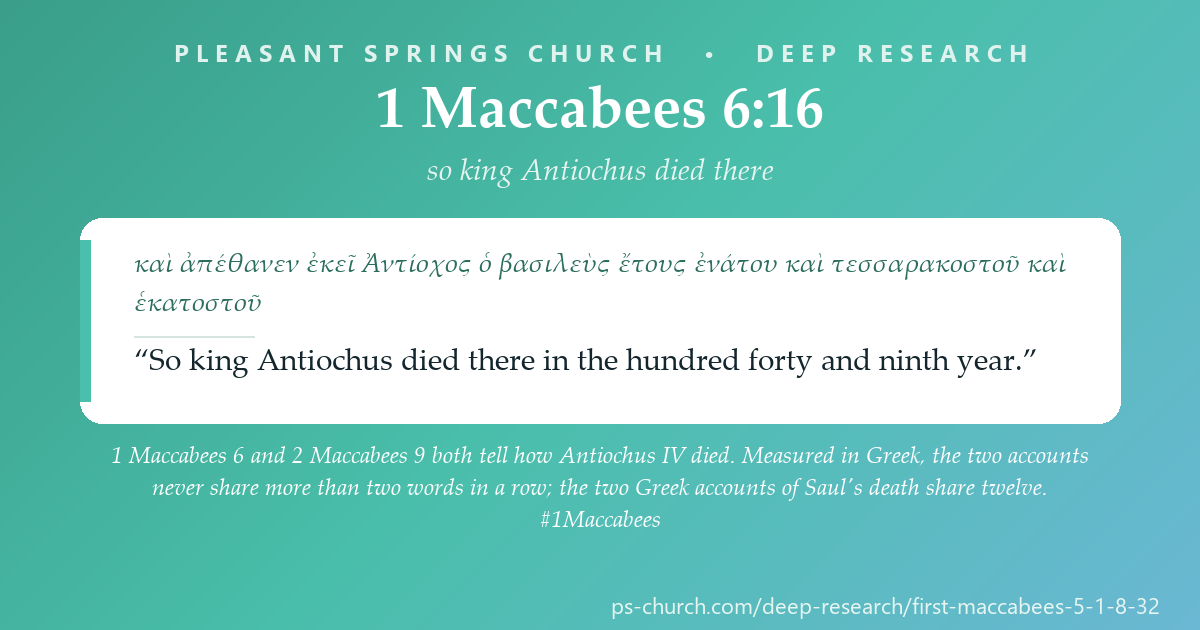
Year 149 — and the same three words as Eleazar’s death thirty verses later. καὶ ἀπέθανεν ἐκεῖ, and he died there, is said of the king here and of Eleazar under the elephant at 6:46; it stands in twelve units of the screened Greek Old Testament in all. 2 Maccabees 9, which tells this death in twenty-nine verses, gives no year.
VULGATE 6:16 Et mortuus est illic Antiochus rex anno centesimo quadragesimo nono.
Four men on each elephant, or thirty-two? The Greek column reads τέσσαρες, four. The King James reads two and thirty, the Latin triginta duo, and Swete’s text δύο καὶ τριάκοντα. Three witnesses against one — every one of the four an edited text, and the one is Rahlfs’, the text this shelf measures. Stage 5 says what can and cannot be said about that.
VULGATE 6:37 Sed et turres ligneæ super eos firmæ protegentes super singulas bestias : et super eas machinæ : et super singulas viri virtutis triginta duo, qui pugnabant desuper : et Indus magister bestiæ.
One man, four witnesses, and three of them spell his name differently at 2:5 and here. The Greek column calls him Ελεαζαρος ὁ Αυαραν here and Αυαραν at 2:5 — the same both times, and those are its only two occurrences in the 30,348 screened units. The King James has Savaran here and Avaran at 2:5; the Latin has filius Saura, ‘son of Saura’, here and Abaron at 2:5; Swete’s text has Σαυαρὰν here and Αὑαράν at 2:5.
VULGATE 6:43 Et vidit Eleazar filius Saura unam de bestiis loricatam loricis regis : et erat eminens super ceteras bestias, et visum est ei quod in ea esset rex :
He dies under the animal he killed. At 6:43 it is ἓν τῶν θηρίων, one of the beasts; only here is it τὸν ἐλέφαντα. Counter-example, printed on purpose: this verse’s deepest contact with the New Testament is four words, ἔπεσεν ἐπὶ τὴν γῆν, with Matthew 13:8 — tie band 1, and from Matthew’s side band 4 (2 Kingdoms 1:2 and Theodotion’s Daniel 8:10 carry the same four words, Zechariah 2:16 a different four) — where seed falls on good ground. A band of one is not a link.
VULGATE 6:46 Et ivit sub pedes elephantis, et supposuit se ei, et occidit eum : et cecidit in terram super ipsum, et mortuus est illic.
The one formula in these chapters that points outside the story to something already written. κατὰ τὸν λόγον ὃν ἔγραψεν αὐτόν — according to the word which he wrote. The formula occurs once in the 30,348 screened Greek Old Testament units: here. It names no writer and no book. Swete’s text reads the plural, κατὰ τοὺς λόγους οὓς ἔγραψεν, which is what the King James translates (the words which he wrote); the Latin has a passive, quod scriptum est, which is written.
VULGATE 7:16 Et crediderunt ei : et comprehendit ex eis sexaginta viros, et occidit eos in una die, secundum verbum quod scriptum est :
Fifteen Greek words, and twelve of them stand in order in Psalm 78:2–3 of the Greek Psalter (Hebrew and English Psalm 79:2–3). The longest unbroken run is five, κύκλῳ Ιερουσαλημ καὶ οὐκ ἦν, and of the 30,347 other screened Greek Old Testament units, Psalm 78:3 is the only one that reaches five with this verse — and from the psalm’s side the band is 2, since Psalms of Solomon 2:27 also reaches five with Psalm 78:3, by a different five. The run breaks at the next word: 1 Maccabees has αὐτοῖς ὁ θάπτων, and the psalm has ὁ θάπτων without it. See Stage 4.
VULGATE 7:17 Carnes sanctorum tuorum, et sanguinem ipsorum effuderunt in circuitu Jerusalem, et non erat qui sepeliret.
The Greek names no king. οἱ παρὰ τοῦ βασιλέως, those from the king. The King James reads the king of the Assyrians; the Latin reads Sennacherib. What identifies the story in the Greek is the number, ἑκατὸν ὀγδοήκοντα πέντε χιλιάδας, which stands in four screened units: here, 2 Maccabees 15:22, 4 Kingdoms (2 Kings) 19:35 and Isaiah 37:36. 2 Maccabees 15:22 names Εζεκιου and Σενναχηριμ; 1 Maccabees names neither, anywhere in its sixteen chapters.
VULGATE 7:41 Qui missi erant a rege Sennacherib, Domine, quia blasphemaverunt te, exiit angelus, et percussit ex eis centum octoginta quinque millia :
The treaty opens on sea and land, and the Roman letter closes on sea and land — in different words. καλῶς γένοιτο and ἐν τῇ θαλάσσῃ καὶ ἐπὶ τῆς ξηρᾶς here; διὰ τῆς θαλάσσης καὶ διὰ τῆς ξηρᾶς at 8:32. Each of those three phrases occurs once in the 30,348 screened units, and not at all in the Greek New Testament.
VULGATE 8:23 Bene sit Romanis, et genti Judæorum, in mari et in terra in æternum : gladiusque et hostis procul sit ab eis.
καὶ οὐ μετὰ δόλου — and not with deceit. Chapter 7 has μετὰ δόλου, with deceit, three times (7:10, 7:27, 7:30), of the high priest’s party and of Nicanor. The negative form occurs once in the screened Greek Old Testament: here, in the treaty.
VULGATE 8:28 et adjuvantibus non dabitur triticum, arma, pecunia, naves, sicut placuit Romanis : et custodient mandata eorum absque dolo :
⚠️ The English column does not translate the Greek column. At 5:66, 6:37, 6:43, 7:16 and 7:32 the King James reads with Swete’s Alexandrinus-based text against the CATSS Greek, and at 5:35 it reads with the Latin against both; the lines and Stage 5 say so each time. Read every English line as a witness beside the Greek, not as a gloss on it. In the prose, an italic English phrase set beside a Greek one is our own literal gloss of that Greek, unless the sentence names the King James, in which case it is the King James verbatim; italic Latin is the Clementine.
Versification — stated, as on every page here, and here it is a third state: no Masoretic text and no ESV exist for this book, so there is no Hebrew/Greek/English offset to report. The offsets that do exist are between the witnesses printed, and they were measured:
• Greek (CATSS). 1 Maccabees runs to 924 rows in sixteen chapters. This study covers 213 rows — 68, 63, 50 and 32 in chapters 5 to 8 — and 4,459 Greek words. Every label is a plain chapter:verse; none is lettered, conflated or unnumbered.
• English (KJV 1769). The same counts, 68, 63, 50 and 32, and 924 verses in the book. Equal counts are not equal divisions: aligned by content, the English cuts two Greek verse-pairs in a different place. Greek 8:1 ends with καὶ ὅτι εἰσὶ δυνατοὶ ἰσχύι, and that they are mighty in strength; the King James opens its 8:2 with that clause (And that they were men of great valour). Greek 8:11 ends with μετὰ δὲ τῶν φίλων αὐτῶν…, Rome keeping friendship with its friends; the King James opens its 8:12 with it (But with their friends). At every other label in the range, the content lines up.
• Latin (Clementine). The same counts again — 68, 63, 50, 32 — though the book runs to 929 rows (chapters 1, 12 and 13 are longer than the Greek). Read against the Greek verse by verse, the Latin divides differently at seven seams: 5:21–22, 5:47–48, 5:60–61, 7:8–9, 8:3–4, 8:9–10 and 8:11–12. Found by reading, not by an algorithm — the self-check re-tests the words at each seam.
• Swete’s text (Codex Alexandrinus with his corrections), held on this disk, has the same 68/63/50/32. Every reference on this page is therefore valid in all four witnesses, except where a line says otherwise.
The Shape of the Passage
Sequence on a dated spine — not a chiasmThis is NOT offered as a chiasm. Wars, a death, a siege, two betrayals and a treaty is the order of a chronicle, and a chronicle’s order is what the dates show. The diagram claims the sequence, the dates and the one counted thread — nothing more.
⚠️ Where this page sits. Filed under Apocrypha / Deuterocanon. A witness, not Scripture; nothing taught at Pleasant Springs rests on it.
Author
Anonymous, and his deepest runs are formulae of Israel’s narrative books. Measured against every screened Greek Old Testament unit outside 1 Maccabees, the four deepest runs these chapters make are all narrative formulae of Exodus, Deuteronomy, the books of Kingdoms and Chronicles — καὶ ἐγένετο ὡς ἤκουσεν ὁ βασιλεὺς τοὺς λόγους, and it came to pass when the king heard the words, is one of them — and he closes an episode with the rest-formula of Judges, καὶ ἡσύχασεν ἡ γῆ (7:50).
Jerome says he found the book in Hebrew. In his preface to Samuel and Kings: “The first book of Maccabees I have found to be Hebrew, the second is Greek, as can be proved from the very style.” No Hebrew text is held here, and the Jewish Encyclopedia (1906) reports that “the Greek only has survived.” Every word measured on this page is Greek.
At 7:16 he names no prophet and no book — though elsewhere the book names Elijah and Daniel (2:58–60) and the books of the law (1:56). The one formula in these chapters that points outside the story to something already written (7:16) says only he wrote.
Audience
Judaeans who owed their freedom to one family — and the book says so. When two commanders left at home try to win a name of their own and are routed (5:55–62), the narrator explains: they were not of the seed of those men οἷς ἐδόθη σωτηρία Ισραηλ διὰ χειρὸς αὐτῶν — by whose hand deliverance was given unto Israel.
Readers for whom Rome was a friend. Chapter 8 admires the Romans at length; the Jewish Encyclopedia (1906) uses the book’s tone — “the Romans are throughout spoken of in terms of respect and friendliness” — as evidence for its date. Reported, not tested here.
People for whom a broken oath was the measure of an enemy. Of the five times swore stands in these chapters, four belong to two oaths that are broken — the king’s (6:61–62) and the high priest’s (7:15, 7:18) — and the fifth is Nicanor’s oath to burn the temple (7:35). The narrator records the people’s verdict at 7:18: There is neither truth nor righteousness in them.
Orient on the book, on the Seleucid kings, and on the two books that tell these years.
Search by topic: Maccabees, Books of; Judas Maccabeus; Antiochus IV Epiphanes; Antiochus V Eupator; Demetrius I; Alcimus; Nicanor; Hasideans; Elephants in war; Rome and the Jews.
Which articles are relevant?
- Anchor Bible Dictionary — “Maccabees, Books of,” “Antiochus,” “Judas Maccabeus,” “Alcimus,” “Nicanor,” “Hasideans.”
- Eerdmans Dictionary of Early Judaism — “1 Maccabees,” “2 Maccabees,” “Hasmoneans,” “Seleucids.”
- Dictionary of New Testament Background (IVP) — “Maccabean Literature,” “Hasmoneans,” “Rome.”
- The Catholic Encyclopedia (1910), “The Books of Machabees” (F. Bechtel), and The Jewish Encyclopedia (1906), “Maccabees, Books of” — both public domain, both read online for this page, and both quoted in Stage 2 because they answer different questions about the same two books.
Bibliography surfaced:
- Jonathan A. Goldstein, I Maccabees (Anchor Bible 41, 1976), and II Maccabees (Anchor Bible 41A, 1983).
- John R. Bartlett, The First and Second Books of the Maccabees (Cambridge Bible Commentary, 1973).
- Bezalel Bar-Kochva, Judas Maccabaeus: The Jewish Struggle against the Seleucids (Cambridge, 1989) — on the battles, Beth-zechariah and its elephants included.
- Daniel R. Schwartz, 2 Maccabees (Commentaries on Early Jewish Literature, 2008).
- Werner Kappler, Maccabaeorum liber I (Septuaginta: Vetus Testamentum Graecum IX/1, Göttingen) — the critical edition, with the apparatus this page does not hold.
- NETS (A New English Translation of the Septuagint) — named because it is a modern English made from the Greek; not quoted here.
One king’s death in four ancient accounts, a feast day shared with Esther, and a treaty in the language of Greek diplomacy.
Read the accounts side by side before reading what anyone has written about them. Every place name below was counted in both books.
How many ways did Antiochus IV die?
Four accounts are set out below: three held on this disk in Greek, and a fourth read online. A fifth, Josephus, Jewish Antiquities 12.354–361, is also held here in Greek and was not measured for this page. The four agree that the king went east for money, met resistance, and died there. They do not agree on the city, the cause, or the place of death:
| account | where it happens | what kills him | where he dies |
|---|---|---|---|
| 1 Maccabees 6:1–16 CATSS Greek | Ἐλυμαὶ̈ς (6:1), a city with a rich temple; repulsed, he withdraws toward Babylon (6:4) | news of defeat in Judaea, grief, sickness; now I remember the evils that I did in Jerusalem (6:12) | there, in the 149th year (6:16) |
| 2 Maccabees 9:1–29 CATSS Greek | Περσέπολιν (9:2); the news reaches him at Ἐκβάτανα (9:3) | a blow from God, a pain of the bowels (9:5), σκώληκας, worms (9:9) | ἐν τοῖς ὄρεσιν, in the mountains of a foreign land (9:28); no year; Φίλιππος carries the body (9:29) |
| 2 Maccabees 1:13–16 in the letter that begins at 2 Maccabees 1:10; it names only ‘Antiochus’ (1:14–15), and that he is Antiochus IV is a reader’s identification, which this table follows | the temple of Ναναίας in Persia (1:13) | the temple’s priests, with stones from a hidden door in the ceiling (1:16) | in the temple precinct |
| Polybius, Histories 31.9 Loeb (1927), read online; not held | an expedition against the sanctuary of Artemis in Elymais | “smitten with madness, as some people say” | at Tabae in Persia |
Measured on the two Greek books: the name Elymais stands in 1 Maccabees once (6:1) and in 2 Maccabees never; Persepolis, Ecbatana and Nanaia stand in 2 Maccabees and never in 1 Maccabees. Polybius agrees with 1 Maccabees on Elymais, and names a town of death, Tabae, that neither book names.
F. Bechtel, in the Catholic Encyclopedia (1910): “The two accounts of the death of Antiochus Epiphanes differ, it is true, but they fit very well into one another.” The Jewish Encyclopedia (1906): 2 Maccabees was “written quite independently of I Maccabees,” a book which, it says, the author of II Maccabees “most probably did not know.”
What the shelf can add is a measurement, not a verdict. Stage 4 shows that the two long Greek accounts (1 Maccabees 6, 2 Maccabees 9) share no run of three consecutive words. That is what one would expect if neither writer had seen the other’s book — and it is also what one would expect if one of them knew the other’s book well and retold the story in his own Greek. A screen for verbatim contact cannot tell those apart, and the page does not pretend to.
What else in the ancient world sheds light on these chapters?
- The thirteenth of Adar → Esther 9. 1 Maccabees fixes Nicanor’s defeat on τῇ τρισκαιδεκάτῃ τοῦ μηνὸς Αδαρ (7:43) and makes the day an annual feast: τῇ τρισκαιδεκάτῃ τοῦ Αδαρ (7:49). Those four words stand in two screened units: 1 Maccabees 7:49 and Esther 9:16, the day the Jews of the provinces defended themselves. 1 Maccabees never names Mordecai. 2 Maccabees does — at 15:36 the day is πρὸ μιᾶς ἡμέρας τῆς Μαρδοχαϊκῆς ἡμέρας, ‘the day before Mordecai’s day’.
- Hezekiah’s deliverance → 1 Maccabees 7:41. Judas’ prayer recalls an angel who struck one hundred eighty-five thousand. The Greek of 1 Maccabees never names Assyria, Sennacherib or Hezekiah; the Greek identifies the story only by the number.
- Roman diplomatic form → 1 Maccabees 8:22–32. The treaty is introduced as a copy of a letter written δέλτοις χαλκαῖς, on bronze tablets, a phrase that occurs four times in the screened Greek Old Testament, all in 1 Maccabees. Its distinctive phrases occur nowhere outside 1 Maccabees: καλῶς γένοιτο once, ὡς ἔδοξεν Ῥώμῃ twice (8:26, 8:28), φιλίαν καὶ συμμαχίαν four times, all in this book. One clause also stands outside the book: and they shall keep the charges (8:26, 8:28) shares four words with Leviticus 22:9, where they are the priests’ duty.
- The Roman constitution as chapter 8 describes it — a council of τριακόσιοι καὶ εἴκοσι, three hundred and twenty, deliberating daily (8:15), and one man, ἑνὶ ἀνθρώπῳ, entrusted with rule each year (8:16). Bechtel (1910) reports the charge that the author is “inexact in several particulars regarding the Romans” (viii, 1 sq.), and answers that he “cannot be charged with whatever inaccuracies or exaggerations may be contained in viii, 1-16,” since there he “merely sets down the reports” that had reached Judas. This page prints what the Greek says and does not test it against Roman history, which no corpus here holds.
Chapter 5 narrates its campaigns in the language of Joshua and Judges, and the page says so plainly. At 5:5 Judas ἀνεθεμάτισεν the sons of Baean — the verb of the ban. This form of it, he devoted, stands in three screened units (Numbers 21:3, Joshua 6:21 in the B text, and here); the verb in any form stands in fifteen. At 5:28 and 5:51 every male is killed ἐν στόματι ῥομφαίας, by the mouth of the sword, a phrase that stands in twenty-four screened units, sixteen of them in the two Greek texts of Judges. The page reports that a Jewish historian of the Second-Temple period described his people’s wars in the words of the conquest. It draws no lesson from that for any later war, and it does not soften what the text says was done.
An elephant, deceit, a name, a man spelled six ways, and the six towns of 5:26.
Counts are over the 30,348 screened Greek Old Testament units (the Odes excluded) and the 7,927 verses of the Greek New Testament, by normalised word form. They are not counts over ‘the Septuagint’, which no disk holds.
Twenty occurrences in the screened Greek Old Testament, and nineteen are in the books of Maccabees, where the word is the animal — eight in 3 Maccabees, seven in 1 Maccabees, four in 2 Maccabees. The twentieth is Ezekiel 27:6, where it is ivory. In these four chapters it stands five times (6:30, 6:34, 6:35, 6:46, 8:6), and between 6:35 and 6:43 the animals are called θηρία, the beasts, six times instead. The Greek New Testament never names the animal; its one related word is ivory (Revelation 18:12).
Ten units of the screened Greek Old Testament carry the phrase, and five are 1 Maccabees: 7:10, 7:27, 7:30, 8:28 and 16:15. The other five are Genesis 27:35 and 34:13 (Jacob, and Jacob’s sons), two rows of Proverbs, and Psalms of Solomon 4:8. Four of the book’s five stand in these chapters, and the fourth is the treaty’s negative. The Greek New Testament: none.
Seven times in the range, and the first four make an argument. At 5:57 Joseph and Azariah say ποιήσωμεν καὶ αὐτοὶ ἑαυτοῖς ὄνομα, let us also make ourselves a name — and are routed. At 5:63 the name of Judas and his brothers is heard among the nations. At 6:17 Lysias names the boy-king Eupator. At 6:44 Eleazar gives himself τοῦ σῶσαι τὸν λαὸν αὐτοῦ and to win ὄνομα αἰώνιον, an everlasting name. Who gets a name in this book, and how, is not a neutral question.
Two occurrences in the 30,348 screened units: 1 Maccabees 2:5 and 6:43, the CATSS Greek spelling him the same both times. Each of the other three witnesses printed here spells him two ways — the King James Avaran and Savaran, the Latin Abaron and filius Saura, Swete’s text with and without an initial sigma. The only consistent witness is Rahlfs’ edited text; Swete’s and the Clementine are edited texts too, and the King James is a translation.
Four screened units: 1 Maccabees 7:17, Psalm 78:3, and Jeremiah 39:44 and 40:13 (Hebrew and English Jeremiah 32:44 and 33:13). The same count the Psalms 79–83 page reports, re-derived here. The phrase alone does not make 7:17 a psalm; the twelve words in order do.
Once in the range, at 5:62, and it is the narrator’s comment on a defeat: deliverance was given to Israel by the hand of those men, Judas and his brothers, and not by two commanders who wanted a name. The one place these chapters use the word, they use it to say whose it was.
The itinerary of chapter 5, measured — does the circle close?
At 5:26 the Nabataeans tell Judas that Jews are shut up in six towns. The narrative then marches through them. In the Greek column every one of the six is reached by name. In the two other witnesses, it is not:
| # | reported at 5:26 Greek · KJV · Latin | reached | Greek | KJV | Latin |
|---|---|---|---|---|---|
| 1 | Βοσορρα Bosora · Barasa | 5:28 | Βοσορρα | Bosora | Bosor — Barasa never recurs |
| 2 | Βοσορ Bosor · Bosor | 5:36 | Βοσορ | Bosor | Bosor |
| 3 | Αλεμοις Alema · Alimis | 5:35 | Αλεμα | Maspha — Alema never recurs | Maspha — Alimis never recurs |
| 4 | Χασφω Casphor · Casphor | 5:36 | Χασφω | Casphon — respelled | Casbon — respelled |
| 5 | Μακεδ Maked · Mageth | 5:36 | Μακεδ | Maged — respelled | Mageth |
| 6 | Καρναιν Carnaim · Carnaim | 5:43 | Καρναιν | Carnaim | Carnaim |
Tally. Greek: six of six reached by name. King James: three reached with the same spelling, two respelled within ten verses, and one replaced — Maspha stands where the Greek has Alema. Latin: three reached with the same spelling, one respelled, and two that never recur. Three witnesses, three itineraries.
And three of the six names stand nowhere else. By exact spelling, Αλεμα, Χασφω and Μακεδ occur in the screened Greek Old Testament only in these verses of chapter 5. Bosorra elsewhere is a city of the kings of Edom (Genesis 36:33, 1 Chronicles 1:44, and Job 42:17c, in the Greek Job’s closing addition), and Karnain elsewhere is Genesis 14:5.
Counted here, not assumed:
- 213 rows, 4,459 Greek words — 1,448 in chapter 5, 1,314 in chapter 6, 984 in chapter 7, 713 in chapter 8.
- Three dated rows, three consecutive years: 6:16 (149), 6:20 (150), 7:1 (151).
- The word group peace sixteen times; swore five times; deceit four times — and every one of the four is in chapters 7 and 8.
- Joseph son of Zacharias is spelled two ways in the Greek of one chapter: Ιωσηπον at 5:18 and Ιωσηπος at 5:60, but Ιωσηφ at 5:56. The King James calls him Joseph all three times.
- The King James at 5:3 reads Gael where the Greek reads Ισραηλ and the Latin Israëlitas. Printed as the file has it; the page offers no explanation it cannot check.
Five episodes told twice, and two books that never share more than five words in a row.
Contiguous runs of whole normalised Greek word forms, never lemmas; every run printed with its tie band — how many target units reach the same depth — and, for the New Testament, the band from the other side as well. The screen finds verbatim contact. It does not find paraphrase or allusion.
1 and 2 Maccabees, episode by episode — the page’s finding:
2 Maccabees says of itself that it condenses into one book the five books of Ἰάσωνος τοῦ Κυρηναίου, Jason of Cyrene (2:23). It tells the same five episodes as chapters 5 to 7. Each 1 Maccabees block was screened against the 2 Maccabees block that tells the same events, paired by the names both carry:
| episode | 1 Maccabees | 2 Maccabees | longest shared run | where, and what it is |
|---|---|---|---|---|
| Campaigns beyond the Jordan | 5:1–68 68 rows, 1,448 words | 10:14–38 + 12:1–45 70 rows, 1,530 words | 5 | 5:13 ↔ 12:21, καὶ τὰ τέκνα καὶ τὴν, and the children and the [baggage] — band 1. Two different scenes: Jewish captives in 1 Maccabees, the women and children Timothy sends ahead with the baggage in 2 Maccabees (12:21). |
| The death of Antiochus IV | 6:1–17 17 rows, 376 words | 9:1–29 29 rows, 663 words | 2 | ten rows tie at two, most of them pairs like and the, into the, the son; the shared pairs also include the Persis (6:5 ↔ 9:1, 9:21), the city (6:3 ↔ 9:2) and the upper [regions] (6:1 ↔ 9:25). Nothing reaches three. |
| …the letter’s account | 6:1–17 | 1:11–17 7 rows, 130 words | 3 | 6:5 ↔ 1:13, εἰς τὴν Περσίδα, into Persia |
| Antiochus V and Lysias in Judaea | 6:18–63 46 rows, 938 words | 13:1–26 26 rows, 535 words | 4 | 6:48 ↔ 13:13, into Judaea and |
| Demetrius and Alcimus | 7:1–25 25 rows, 493 words | 14:1–11 11 rows, 230 words | 3 | four rows; three of them are to the king |
| Nicanor and the thirteenth of Adar | 7:26–50 25 rows, 491 words | 14:12–15:37 72 rows, 1,529 words | 4 | 7:41 ↔ 15:22, ἑκατὸν ὀγδοήκοντα πέντε χιλιάδας — a number both share with 4 Kingdoms 19:35 and Isaiah 37:36. Even the date shares only month Adar. |
| For scale — a canonical pair. The death of Saul in Greek, 1 Kingdoms 31:1–13 (13 rows, 329 words) against 1 Chronicles 10:1–12 (12 rows, 298 words): longest shared run twelve, καὶ ἐμπαίξωσίν μοι καὶ οὐκ ἐβούλετο ὁ αἴρων τὰ σκεύη αὐτοῦ ὅτι (31:4 ↔ 10:4); eight of the thirteen rows reach five, and the median row reaches five. | ||||
Across five paired episodes and 3,746 words of 1 Maccabees, the two books never share more than five consecutive Greek words, and the five come from two different scenes. The two long accounts of the king’s death, 1 Maccabees 6 and 2 Maccabees 9, share no three consecutive words at all; the short account in the letter of 2 Maccabees 1 shares three, into Persia. Joined end to end as continuous text, so that a run could cross a verse boundary, they still share only two.
Is two simply what any two chapters share? Yes — and that is the point. 1 Maccabees 6:1–17 was screened against each of the fifteen chapters of 2 Maccabees in turn. Against eleven of them, chapter 9 included, the longest run is two; against chapters 1, 3, 8 and 15 it is three. The chapter that tells the same death shares no more consecutive wording with it than the chapter of the seven martyred brothers (2 Maccabees 7) does, and less than the chapter about the temple treasury (2 Maccabees 3).
And it is not what two Greek accounts of one death must look like. Saul’s death in 1 Kingdoms 31 and 1 Chronicles 10 shares a run of twelve.
None of this says who knew whom. A writer who retells a story in his own Greek leaves no runs behind; a writer who never heard it leaves none either. See Stage 2 for the two named views.
The one verse its own text marks as written outside the story — 7:16–17 and Psalm 79:
1 Maccabees 7:16 says the sixty were killed in one day κατὰ τὸν λόγον ὃν ἔγραψεν αὐτόν, according to the word which he wrote, and 7:17 gives the words. The formula licenses one statement and no more: the book presents 7:17 as the words of a writer. It names no writer and no book. That the writing is Psalm 79 is a reader’s identification, made on the wording — and the wording supports it: fifteen words, twelve of them in the order of the Greek Psalm 78:2–3, and a five-word run that no other screened unit reaches.
The formula itself is unique. According to the word which he wrote stands once in the 30,348 screened units. Its core, ὃν ἔγραψεν, which he wrote, stands in two — here and Joshua 9:2c (Greek B text) — and once in the Greek New Testament, at John 1:45, where the writer is named: him of whom Moses wrote.
1 Maccabees 7:17 beside Psalm 79:2–3
1 Maccabees: CATSS Greek + KJV 1769 · Psalm: Hebrew (MAM) + Greek (Rahlfs 78) + ESVWhat the formula does not license. It does not say which Psalter’s wording was in view — a Hebrew one or a Greek one — and it does not make the Greek of 7:17 a copy of the Greek of Psalm 78. The differences above are exactly what two independent renderings of one Hebrew verse could produce, and exactly what a loose quotation of one Greek verse could produce. The page reports both columns and chooses neither. And the psalm’s own closing words, καὶ οὐκ ἦν ὁ θάπτων, and there was none to bury, stand in one other screened unit: Psalms of Solomon 2:27. So, from the psalm’s side, the five-word contact is band 2 — 1 Maccabees 7:17 and Psalms of Solomon 2:27 each reach five with Psalm 78:3 — where from 7:17’s side it is band 1. The Psalms of Solomon run is not in 1 Maccabees, whose αὐτοῖς breaks them.
Against the Greek New Testament — the distribution, and every run of five:
Across the 213 rows against 7,927 verses of the Greek New Testament: 212 reach two, 161 reach three, 48 reach four, 9 reach five, and nothing reaches six. For the whole book the deepest contact lies outside this range: 11:1 and Hebrews 11:12, nine words, band 1.
| 1 Maccabees | NT verse | run | band (NT verses at that depth) | the NT verse’s own deepest Greek OT run | what it is |
|---|---|---|---|---|---|
| 5:10 · 7:10 · 7:27 | Matthew 1:2 | 5 | 1, each | 5, band 3 — and the three are these three rows | Ιουδαν καὶ τοὺς ἀδελφοὺς αὐτοῦ, Judas and his brothers. Different men: Judas Maccabeus here, the patriarch Judah in Matthew. |
| 5:65 · 8:20 | Mark 3:31 · Luke 8:19 | 5 | 2 | Mark 3:31: 6, band 1 (1 Maccabees 16:21); Luke 8:19: 5, band 11 | and his brothers and |
| 6:10 | Luke 8:22 | 5 | 1 | 5, band 2 (1 Maccabees 6:10; 4 Kingdoms 6:11) | αὐτοῦ καὶ εἶπεν πρὸς αὐτούς, …and he said to them |
| 6:17 | Matthew 1:25 | 5 | 1 | 7, band 6 (Genesis 38:3, 4, 5; 1 Kingdoms 1:20; 2 Kingdoms 12:24; 1 Chronicles 7:23) | καὶ ἐκάλεσεν τὸ ὄνομα αὐτοῦ, and he called his name — a naming formula |
| 8:21 | Acts 6:5 | 5 | 1 | 5, band 1 — this row | καὶ ἤρεσεν ὁ λόγος ἐνώπιον, and the word pleased before… |
| 8:30 | Luke 9:28 | 5 | 1 | 5, band 1 — this row | δὲ μετὰ τοὺς λόγους τούτους, and after these words |
Seven New Testament verses tie at the deepest contact these four chapters make, five words, and Matthew 1:2 is the one reached by the most rows: three rows of 1 Maccabees each share five words with it, band 1 each — and from Matthew’s side the genealogy’s deepest Greek Old Testament contact is those same three rows. It looks like the find of the page. It is a name. Matthew’s Judah is Jacob’s son; 1 Maccabees’ Judas is Mattathias’. In the screened Greek Old Testament, the nominative Judas and his brothers stands six times in 1 Maccabees and once in Genesis 44:14, where it is the patriarch again.
Two runs are band 1 from both sides and still formulae. After these words is how Luke dates the Transfiguration and how the treaty introduces its amendment clause; the word pleased is how Acts reports the choosing of the Seven and how the Romans receive the embassy. Mutual rarity is not contact.
And the verse a reader might reach for measures three. Eleazar gives himself τοῦ σῶσαι τὸν λαὸν αὐτοῦ, to save his people (6:44). Its deepest New Testament run is the three words τὸν λαὸν αὐτοῦ, his people, band 5 — Matthew 1:21, Luke 7:16, Romans 11:1, 11:2, Hebrews 10:30. The page draws no line from Eleazar to anyone. The text draws none, and a shared possessive is not one.
The one row that shares no two consecutive words with the New Testament is 7:12 — συναγωγὴ γραμματέων, an assembly of scribes. Both nouns occur in the New Testament as single words; the pair never does.
Against the rest of the Greek Old Testament — where the deep runs really are:
Against the 29,424 screened units outside 1 Maccabees: all 213 rows reach two, 209 reach three, 139 four, 48 five, 16 six, 9 seven, 4 eight, and nothing reaches nine. Depth is not rarity, and it is not citation: the four eights are war and court formulae, and 7:17, the one row the text marks as words written outside its story, sits at five.
| 1 Maccabees | run | band | where | what it is |
|---|---|---|---|---|
| 5:45 | 8 | 1 | Deuteronomy 2:34 | …and their wives and their children — a war formula |
| 5:50 | 8 | 2 | Exodus 10:13; 1 Kingdoms 19:24 | all that day and all the night |
| 6:8 | 8 | 2 | 4 Kingdoms 22:11; 2 Chronicles 34:19 | and it came to pass, when the king heard the words — Josiah hearing the law; Antiochus hearing of his defeat |
| 6:60 | 8 | 1 | 2 Chronicles 30:4 | and the word pleased the king and… |
| 7:17 | 5 | 1 | Psalm 78:3 (Hebrew 79:3) | the only row in this table its own text marks as words written outside its story |
| 7:49 | 4 | 1 | Esther 9:16 | the thirteenth of Adar |
| 7:41 | 4 | 8 | 2 Maccabees 15:22; 4 Kingdoms 19:35; Isaiah 37:36; and five others | the number is three of the eight; the other five are those from the king (1 Esdras 1:15) and and he struck among them (four times) |
| 7:50 | 4 | 9 | Judges (both Greek texts) 3:11, 3:30, 5:31, 8:28; 2 Chronicles 13:23 | and the land rested — for forty years, or eighty, in Judges (and for fifty at 3:11 in one of its two Greek texts, forty in the other); ten years in 2 Chronicles; ἡμέρας ὀλίγας, a few days, here |
| 8:26 · 8:28 | 4 | 1 | Leviticus 22:9 | and they shall keep the charges — priestly duty in Leviticus, treaty terms here |
| 5:48 | 4 | 8 | Deuteronomy 2:27; Numbers 20:17, 21:22; Judges (A) 11:17, 11:19; and three others | διὰ τῆς γῆς σου, through your land — the request Israel made of Edom and Sihon, made here of Ephron |
What this page could not check, where the witnesses disagree, and where it is weakest.
This is the section that makes the shelf trustworthy. Read it before quoting any number above.
⚠️ Where the Greek column stands alone — and what was checked outside the disk:
At six places the CATSS Greek and at least one other printed witness part company.
- 6:37 — four men, or thirty-two. CATSS τέσσαρες; the King James, the Latin and Swete’s text thirty-two. Checked online: the New Revised Standard Version Updated Edition prints four and marks it as a correction (“Cn”), noting that “ancient authorities read thirty or thirty-two”. So the four is an editor’s reading, not a manuscript’s, on that edition’s own account; this disk has no apparatus to say more.
- 7:32 — five hundred, or five thousand. CATSS πεντακόσιοι, five hundred; the King James five thousand, the Latin quinque millia, Swete’s text πεντακισχίλιοι.
- 5:35 and 5:66 — which town. CATSS Αλεμα and Μαρισαν; the King James Maspha and Samaria, the Latin Maspha and Samariam; Swete Μααφὰ and Σαμαρίαν. Checked online: the NRSV Updated Edition footnotes both (“Other ancient authorities read Alema”; “Other ancient authorities read Samaria”) — and prints a different town from CATSS at 5:35. Editors divide here; the page does not.
- 6:43 and 7:16 — the name Avaran/Savaran and the singular word against the plural words: see the codex lines.
⚠️ Swete’s file is a transcription, and it has slips. In the rows read for this page it writes Ἐλεαὰρ at 2:5, the name Eleazar without its zeta, and Ἰοδαίᾳ at 5:3, where every other witness has Idumea. Its readings are printed beside the other witnesses and never alone as evidence; at 5:35 its spelling matches no other witness printed here. Its base is named on its own preface’s word: for the books of Maccabees, “since the Codex Alexandrinus is the only early Uncial which contains them all, the text of that MS. has been adopted throughout” (Swete, The Old Testament in Greek, vol. III, p. vi; the paragraph and its footnote are transcribed on this disk). His own footnote qualifies it: “the copy which the scribe of A follows was so carelessly written that it has been found necessary to admit a considerable number of corrections from the other MSS.”, and “a conjecture has been allowed to take a provisional place in the text” where all the uncials fail. So a reading quoted here as Swete’s is Swete’s printed text, not a verified reading of the codex; his notes, which record the rejected readings, were not consulted.
⚠️ What this page could NOT check:
- Any Hebrew 1 Maccabees. None is held. Jerome, quoted in Author & Audience, says he found the book in Hebrew; the Jewish Encyclopedia reports that the Greek only has survived; no Hebrew text is quoted here. The acrostic and Hebrew-parallel screens cannot run on this book; there is no result to report, not even a null one.
- The critical apparatus. Kappler’s Göttingen edition is named in Stage 1 and was not consulted. Every variant above is reported from the witnesses held and from one modern translation’s footnotes, not weighed.
- Josephus. His retelling of these years (Jewish Antiquities book 12; the king’s death at 12.354–361) is held on this disk in Greek (Niese, Perseus) but was not measured for this page, so the page does not say how a third ancient Greek writer worded them.
- Polybius was read online at one passage (31.9, Loeb edition of 1927, on the LacusCurtius site). It is not on this disk, and no run was measured against it.
- The commentaries named in Stage 1 were not read for this page. Where the page quotes a view, it quotes a named public-domain source — Jerome, Polybius, two encyclopedias, Swete’s preface — and names it.
- Whether either Maccabean writer knew the other. Not measurable. See Stage 4.
⚠️ Where this page is weakest:
- The episode pairing is the page’s own. The 2 Maccabees blocks were chosen by the names both books carry (Timothy, Carnaim, Ephron, Antiochus, Lysias, Alcimus, Nicanor). Drawn wider, a block has more chances to share a run; the whole of 2 Maccabees against these 213 rows reaches five and no further, at the same 5:13 and at 8:20, a name formula.
- The screen measures word forms in a row. Two writers who say the same thing with a different case ending score as strangers. Low runs are evidence of different wording; they are not evidence of independent knowledge.
- The English column follows a different Greek at five places or more, and the Latin parts from the CATSS Greek at most of the same places. The page flags each one it found; a reader comparing the columns elsewhere should assume nothing.
- The Latin’s seven division seams were found by reading. The self-check re-tests the words at each seam, but no algorithm searched for more.
- Dates are the book’s. 149, 150, 151 are years of the Seleucid era as the Greek gives them; the page does not convert them to years BC, because the conversion is a matter of scholarly argument this page has not checked.
Commentaries & studies:
- Jonathan A. Goldstein, I Maccabees (Anchor Bible 41, 1976).
- John R. Bartlett, The First and Second Books of the Maccabees (CBC, 1973).
- Bezalel Bar-Kochva, Judas Maccabaeus (Cambridge, 1989).
- Daniel R. Schwartz, 2 Maccabees (CEJL, 2008).
- Werner Kappler, Maccabaeorum liber I (Göttingen Septuagint IX/1). Not held.
- H. B. Swete, The Old Testament in Greek according to the Septuagint, vol. III — the Alexandrinus-based text held on this disk.
Two books, one king, and how little wording they share.
Name what you learned, why it matters, and one concrete response.
What should we carry away — and do?
- Two witnesses can agree on the event and share almost no words. 1 Maccabees 6 and 2 Maccabees 9 both say Antiochus IV died in the east after failing to plunder a city with a rich temple; their Greek never runs three words together. Agreement of substance and agreement of wording are different things, and both are worth knowing.
- Count before you connect. The deepest New Testament contact these chapters make, five words, is reached seven ways, and the one reached most often is a name — Judas and his brothers — that belongs to two different men. The one place the text itself marks as words written outside its story is also the one that measures five with Psalm 79 — naming Psalm 79 is the reader’s step, not the text’s.
- Notice who keeps faith. Every oath in these chapters is sworn by the other side, and the king’s and the high priest’s are broken; the one document that promises not with deceit is a treaty with a foreign power. The book’s heroes are not described as perfect — two of their commanders lose two thousand men chasing a name — but its enemies are described as faithless.
- Remember the grave. The words 1 Maccabees sets beside its sixty dead are a lament: blood poured round about Jerusalem, and there was none to bury them. One concrete response: read Psalm 79 aloud this week, slowly, as the prayer of people who could not bury their own.
- Read on. 1 Maccabees 1:1–4:61 · 1 Maccabees 9:1–11:74.
1 Maccabees 6:16 · to share
CATSS Greek · KJV 1769 · Clementine VulgateVULGATE 6:16 Et mortuus est illic Antiochus rex anno centesimo quadragesimo nono.
Every Deep Research page traces its passage across the whole sweep — the Old Testament, the Second-Temple world between the testaments (historical witnesses, not Scripture), and the New Testament. Follow the thread:
Pleasant Springs Church — Deep Research
Research method after Michael S. Heiser’s Bible Research Method (examine dictionaries → ancient literature → important words → textual connections → academic publications → share), with the Pleasant Springs “Author & Audience” foundation. Scripture set in the Hebrew, the Greek editions named on each page and the ESV (Old Testament), and the Greek New Testament and the ESV (New Testament), per the practice of Pleasant Springs Church. ⚠️ Status: 1 Maccabees is not part of the Protestant canon. It is canonical in the Roman Catholic and Orthodox churches, was printed among the Apocrypha in the Reformation-era Protestant Bibles, and is absent from the Hebrew Bible. This study is filed under Apocrypha / Deuterocanon and nothing taught at Pleasant Springs rests on it. Greek text: the CATSS morphologically analysed Septuagint (Rahlfs), quoted at verse level with attribution; 1 Maccabees and 2 Maccabees are separate files and every count was re-derived from them for this study. English: the King James Apocrypha, standardised 1769 text, public domain (the verse-per-line edition from eBible.org, held here with its provenance), quoted verbatim; there is no ESV of 1 Maccabees and none is quoted. The ESV appears on this page only for Psalm 79. Latin: the Clementine Vulgate (public domain), a witness, never a source for the English. Swete’s text (Codex Alexandrinus with his corrections) is quoted at named places only and never measured. Read online, not held: Polybius 31.9 (LacusCurtius), the Catholic Encyclopedia (1910) and Jewish Encyclopedia (1906) articles on Maccabees, and the NRSV Updated Edition’s footnotes at 5:35, 5:66 and 6:37. Held on this disk and quoted at sentence level: Jerome’s preface to Samuel and Kings (NPNF² 6) and the Maccabees paragraph of Swete’s preface to vol. III, with its footnote. Held and not measured: the Greek of Josephus, Jewish Antiquities (Niese, Perseus Digital Library). Direction of influence is nowhere asserted.
Scripture quotations marked ESV are from the ESV® Bible (The Holy Bible, English Standard Version®), © 2001 by Crossway, a publishing ministry of Good News Publishers. ESV Text Edition: 2016. Used by permission. All rights reserved. The ESV text may not be quoted in any publication made available to the public by a Creative Commons license, and the ESV may not be translated in whole or in part into any other language. www.esv.org
|
Did this study bless you today? 💚 Give to Support PS Church100% of gifts go to the General Fund — thank you. |