Psalm 83 is the last of the twelve psalms of Asaph, and it closes the stretch of the Psalter where God stands where the divine name stands everywhere else. But the hardest verbal tie in these five psalms does not run between any two of them. Psalm 79:4 and Psalm 44:13 share five consecutive words that are identical down to the vowel points and the cantillation accents — and those five words stand nowhere else in the Hebrew Bible. Of the 11,175 possible pairs of psalms, twenty share a run of five words or more, and only three share a single run of body text found nowhere else: Psalms 42 and 43, which are one poem, Psalms 96 and 98, and these two — which are thirty-five psalms apart in different books under different headings and share nothing else at even three words. The identity stands in neither the Greek nor the English. Along the way: a Greek heading that names Assyria where the Hebrew names nothing, a refrain whose body changes exactly once, an assembly of El that the Greek reads as an assembly of gods, and a measured verdict that these five psalms are not a lexically cohesive block at all. See the method →
Psalms 79–83 (selections), with Psalm 44:13
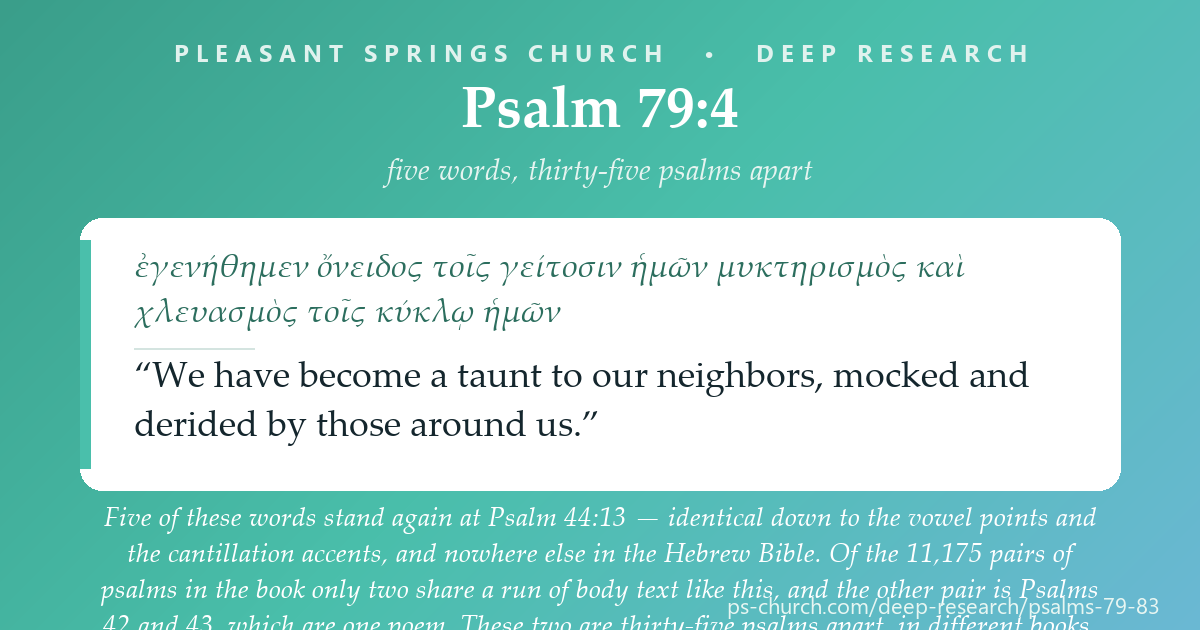
Hebrew · Greek (Rahlfs’ Psalter) · ESVPsalm 79:4 and Psalm 44:13 share five consecutive words — printed in full in the two codex lines above — and they are identical not only in consonants but in vowel points and cantillation accents. Only the first word of each verse differs: Psalm 44 has you have made us, Psalm 79 has we have become.
Those five words stand nowhere else in the Hebrew Bible. Across the thirty-nine books, the run occurs twice — and so does every part of it down to two words. Two of the five words, scorn and those around us, occur only twice in the whole Hebrew Bible, both times in these two verses. It is not a stock phrase.
⚠️ And a census of the whole Psalter says how unusual that is. Of the 11,175 possible pairs of psalms, twenty share a run of five words or more. Six of the twenty share two or more distinct runs — a block, not a single line. Eight share one run that also stands elsewhere in the Hebrew Bible. Three share only a superscription. That leaves three pairs that share a single run of body text found nowhere else: Psalms 42 and 43, Psalms 96 and 98, and Psalms 44 and 79. Psalms 42 and 43 are adjacent, Psalm 43 has no heading of its own, and their shared run is fourteen words — this library treats them as one poem. Psalms 96 and 98 stand two apart in the same group of enthronement psalms, and their shared run is eight words. Psalm 44 and Psalm 79 are the only one of the three that crosses both a book boundary and a collection boundary. They stand thirty-five psalms apart, under different headings — לִבְנֵי־קֹרַח and לְאָסָף — and they share nothing else at even three words.
⚠️ The identity does not stand in the other two columns. Rahlfs 43:14 and 78:4 run identically for four words, ὄνειδος τοῖς γείτοσιν ἡμῶν, and then part: καταγέλωτα at Psalm 44, χλευασμός at Psalm 79. ESV gives the same five Hebrew words different English in the two places — the derision and scorn at 44:13, mocked and derided at 79:4. So the one place the two psalms are word for word is the Hebrew, and a reader in Greek or English cannot see it. This page reports the overlap and its distribution. Which psalm stood first, whether either knew the other, and how the identity arose are not decidable from the texts on this page, and nothing here is offered as an explanation.
The Shape of the Passage
Sequence — the last five psalms of AsaphRanked against all 146 adjacent five-psalm windows in the Psalter for shared vocabulary, Psalms 79–83 come 132nd once common words are set aside. On distinctive vocabulary — forms occurring eight times or fewer in the whole book — these five psalms are less connected to each other than a typical run of five neighbours. The mild score they get on a raw count comes from words the whole Elohistic Psalter shares. The same test finds real blocks where they exist: run on the same measure it puts Psalms 96–100 first of 146, so the negative here is not the measure failing.
⚠️ And the seam at the end is not marked either. Psalm 83 closes the twelve psalms of Asaph and closes the Elohistic Psalter, where אלהים outnumbers the divine name. Tested against all 141 boundaries in the book, the 83/84 seam ranks 122nd on distinctive vocabulary — among the least marked in the Psalter. On that same band the seam at the other end of the collection, 41/42, ranks fifth of 141. The Elohistic Psalter has a sharp opening edge and a blurred closing one.
These are the last five of the twelve psalms headed לְאָסָף — Psalm 50 and Psalms 73–83, derived from the text rather than taken on trust: the name stands in those twelve headings and nowhere else in the book. Two of the five carry a Greek heading element with no Hebrew counterpart — Psalm 80 and Psalm 81.
Author
The Asaph guild, by the headings, and this is where it stops. Twelve psalms carry the name and Psalm 83 is the last of them. Nothing in the Hebrew marks the ending — the psalm simply finishes, and Psalm 84 begins under a different name.
Someone writing after a catastrophe, in at least one of them. They have defiled your holy temple; they have laid Jerusalem in ruins. Psalm 79 speaks of a sanctuary already destroyed, and this page does not date it — the psalm names no year, no king and no army.
And someone who knew a psalm from an earlier book, or shared a source with it. Five words of Psalm 79:4 stand in Psalm 44:13 exactly. Which way that ran, if it ran at all, is not decidable from the two texts.
Audience
People who could see the damage. We have become a taunt to our neighbors, mocked and derided by those around us. The complaint is not only loss but humiliation — what the neighbours are saying.
People who sang a refrain back. Restore us, O God; let your face shine, that we may be saved! Three times in Psalm 80, and the divine name grows by one word each time.
And people expected to know a list of neighbours by name. Edom and the Ishmaelites, Moab and the Hagrites, Gebal and Ammon and Amalek, Philistia with the inhabitants of Tyre; Asshur also has joined them. Ten peoples in three verses, and both texts have all ten.
Orient on the Asaph collection, the Elohistic Psalter, and the divine council.
Search by topic: Asaph; the Elohistic Psalter; communal lament; the divine council; Shiloh and the temple; the Songs of Zion.
Which articles are relevant?
- Anchor Bible Dictionary — “Asaph,” “Psalms, Book of,” “Council, Divine,” “Elohistic Psalter.”
- Dictionary of the OT: Wisdom, Poetry & Writings (IVP) — “Lament, Psalms of,” “Asaph,” “Divine Council,” “Imprecation.”
- NIDOTTE / TDOT — חֶרְפָּה (ḥerpāh, reproach), עֵדָה (ʿēḏāh, assembly), כֶּסֶא (keseʾ, full moon).
- On the Greek — the NETS Psalms introduction, with Rahlfs 79:1 and 82:2 read beside the Hebrew.
- On Book III — Gerald H. Wilson, The Editing of the Hebrew Psalter, for the Asaph collection and the book seams.
Bibliography surfaced:
- John Goldingay, Psalms 42–89; Robert Alter, The Book of Psalms.
- Frank-Lothar Hossfeld and Erich Zenger, Psalms 2 (Hermeneia) — covers Psalms 51–100.
- Gerald H. Wilson, The Editing of the Hebrew Psalter.
- 1 Maccabees — read here in Greek; see Stage 4.
An overlap measured, not dated — and two claims that do not survive.
Read 1 Maccabees 7:16–17 beside Psalm 79:2–3 before reading anything written about either.
Which parallels shed light on these psalms?
1 Maccabees 7:17 sets down words that also stand at Psalm 79:2–3, and the overlap is larger than any between this unit and the New Testament. The Greek of 1 Maccabees 7:17 runs fifteen words; twelve of them stand, in order, in the two verses of Rahlfs 78:2–3. Its longest unbroken run with the psalm is five words — κύκλῳ Ιερουσαλημ καὶ οὐκ ἦν.
Run length alone would not be worth printing, so two harder tests were run. Scored for how much of itself aligns in order with any psalm verse or verse-pair, 1 Maccabees 7:17 ranks first of the 684 verses in the book at least as long as it is, and more than five standard deviations clear of the mean — first on every length cutoff tested.
⚠️ A second claim stood here and it does not survive the corpus this shelf now holds. The page prints what it said, on what corpus, and what it says now. It read: the two-word phrase κύκλῳ Ιερουσαλημ occurs exactly twice in all 341,000 words of Greek Old Testament this library holds — here and at Psalm 79:3. That was true of a twenty-five file shelf. It is not true now. The phrase stands in FOUR verses of the 64 CATSS files held here as of 30 August 2026 — a shelf of 30,637 verse units and 623,684 word tokens, of which 30,348 units and 619,497 tokens are screened, the difference being the 289 rows of the Odes, which stay on disk and are out of every count on this page: 1 Maccabees 7:17 and Rahlfs Psalm 78:3, and also Jeremiah 39:44 and Jeremiah 40:13 — MT and English Jeremiah 32:44 and 33:13, the promised repurchase of fields round about Jerusalem. Those two were already on this disk when the claim was last printed: the Greek Jeremiah arrived on 19 August 2026 and this line was not re-run then. It has been re-run now. The overlap between 1 Maccabees 7:17 and Psalm 79 stands on the first-of-684 ranking, which is unaffected; the uniqueness argument is withdrawn. A phrase in four verses across two books is a good deal weaker than a phrase in two, and the page will not keep the stronger word for it.
1 Maccabees 7:16 introduces the words with a formula — and the formula names nobody. It reads κατὰ τὸν λόγον ὃν ἔγραψεν, according to the word which he wrote, with no subject expressed. The form is not alone in carrying no subject — four other places in the book do the same. What is unusual is not the missing subject but the missing source: 1 Maccabees never names a scriptural source anywhere in its sixteen chapters. What is measured and what is not. The measurement is of overlap and distribution. It does not date either text, does not establish which stood first, and no published apparatus for the Greek Psalter would permit a reading to be called early or late. This page therefore does not call this a citation of Psalm 79 by 1 Maccabees, and does not call it pre-Christian evidence for anything.
- 1 Maccabees 7:16–17 → Psalm 79:2–3 · Rahlfs 78:2–3. Twelve of fifteen words in order; first of 684.
- Psalm 44:13 · Hebrew 44:14 · Rahlfs 43:14 → Psalm 79:4. Five words, identical to the accent.
- 4 Kingdoms 9:7 → Psalm 79:10 · Revelation 19:2. See the panel below.
- Isaiah 5:1–7 ↔ Psalm 80:8–16 · Rahlfs 79:9–17. ⚠️ This page used to say the comparison was impossible because the Greek Isaiah was not on the shelf. It is on the shelf, and here is the number. Across all nine vine verses of the psalm against all seven verses of the vineyard song, the deepest run is TWO — τὸν φραγμόν, the hedge, at Rahlfs 79:13 against Isaiah 5:5, tie band 1. Every other verse of the psalm reaches one word against every verse of Isaiah 5, and the word is καί. The two most famous vine passages in the Old Testament share one content word. And the reason is visible once the columns are set together: Isaiah 5 says ἀμπελὼν, a vineyard, masculine, seven times in seven verses; the psalm says ἄμπελον, a vine, feminine. Isaiah’s owner says I will take away ITS hedge, ἀφελῶ τὸν φραγμὸν αὐτοῦ; the psalm asks God why have you broken down HER hedge, ἵνα τί καθεῖλες τὸν φραγμὸν αὐτῆς. Different verb, different gender, and the run is cut at the pronoun. The screen finds no borrowing; the image is plainly shared, and the page says both and asserts no direction.
- Numbers 6:24–26 → Psalm 80:3, 80:7, 80:19. The refrain asks for the face to shine, which is the second line of the Aaronic blessing — cross-linked to Psalms 65–67, where the whole blessing is turned outward. ⚠️ That relation was asserted here and could not be measured; the Greek Numbers was not on this shelf. It arrived 30 August 2026 and the measurement has been run. All three refrain verses — Rahlfs 79:4, 79:8 and 79:20 — reach 2 against Numbers 6:25, and the two words are τὸ πρόσωπον. The run stops there because the verb changes person. Numbers 6:25 has ἐπιφάναι κύριος τὸ πρόσωπον αὐτοῦ ἐπὶ σέ — may the Lord make HIS face shine upon YOU, a third-person blessing spoken over somebody. The psalm has ἐπίφανον τὸ πρόσωπόν σου — make YOUR face shine, an imperative addressed to God himself. Same idiom, same two nouns, and every word that carries the grammar re-inflected: a benediction turned into a demand. The screen finds two words; reading the two lines finds the rest, and the page reports both.
“The suspended ʿayin at Psalm 80:13 marks the middle letter of the Psalter.” Counted straight through all 150 psalms, the Masoretic Psalter runs to 78,851 letters on the written basis and 78,843 on the read basis. The midpoint falls at Psalm 77:1. The raised ʿayin of Psalm 80:13 stands about 3,800 letters later. The claim fails on either counting basis, and both put the midpoint in the same psalm. The rabbinic tradition that assigns the Psalter a middle verse is working with a verse total far larger than the 2,527 of the text this library holds, so it is not counting this text. The letter is real; what it marks is not settled here.
“Psalm 83 is a prophecy of a future war, and its ten nations are modern states.” The psalm’s verbs for the coalition are past-tense: they have conspired, they have joined. And of the ten peoples named, Amalek and the Hagrites have no successor polity of any kind, and Gebal is a single city. The page reports the ten names and declines the identification.
⚠️ And what this page does with the vengeance and the ten names. Psalm 79 asks that the avenging of spilled blood be made known and that the neighbours be repaid sevenfold; Psalm 83 names ten peoples and asks that they be made like whirling dust. Every request in both psalms is addressed to God, and neither psalm proposes that anyone do anything. Psalm 79 asks in the same breath that God not remember our former iniquities and atone for our sins — the speaker is not standing outside the judgment he asks for. And Psalm 83 states its own purpose twice, in its last three verses: that they may seek your name, O Lord… that they may know that you alone, whose name is the Lord, are the Most High over all the earth. The last word of the psalm is not the curse. This page reports what the two psalms ask for and where the words stand. It does not identify the ten peoples with any modern state or people, and it does not lend the imprecation to anyone.
Five shared words, a singular name read as a plural, and one nation nobody finds.
Every count below was made on the texts named at the foot of this page, and every one can be repeated.
Counted here, not assumed:
- Verse counts, identical in both texts across all five. 13 / 20 / 17 / 8 / 19 in Hebrew and in Rahlfs. In Greek numbering these are Psalms 78–82.
- The English offset is not uniform within the unit. Psalm 79 = 0, Psalm 80 = 1, Psalm 81 = 1, Psalm 82 = 0, Psalm 83 = 1 — derived per chapter from a printed ESV.
- Two Greek heading elements with no Hebrew counterpart. Rahlfs 79:1 ὑπὲρ τοῦ Ἀσσυρίου, and Rahlfs 80:1 ψαλμός. Psalms 79, 82 and 83 have none.
- Five words shared by Psalm 44:13 and Psalm 79:4, identical to the accent. The run occurs twice in the thirty-nine books, and so does every part of it down to two words.
- Twenty of the Psalter’s 11,175 psalm pairs share a run of five words or more. Three of the twenty share a single run of body text found nowhere else — 42 with 43 (fourteen words), 96 with 98 (eight), and 44 with 79 (five). Only the last crosses a book boundary.
- The unit’s only ketiv/qere is at Psalm 79:10. The Greek fits both readings and cannot decide between them.
- Two of the Psalter’s three specially-formed letters are in Psalm 80 — the raised ʿayin at 80:13 and the enlarged kaph at 80:15; the third is the enlarged qoph at Psalm 84:3. These are one printed edition’s representation of the Masorah, and manuscripts differ about which letters are marked.
- Selah: 71 times in 39 psalms of the Hebrew Psalter. Two of the 71 are joined to the previous word by maqqef — Psalm 62:4 and Psalm 82:2 — so a scan that splits on spaces alone reports 69. Half the evidence for the rule is in this unit.
- Assyria: once in 150 psalms. Psalm 83:8, joined by maqqef.
- Ten named peoples in Psalm 83:6–8, and both texts have all ten.
- The Elohistic Psalter, measured. Across Psalms 42–83, bare forms only: 38 occurrences of the divine name against 172 of אלהים. In Book I the proportion runs the other way, 241 to 13.
- No acrostic anywhere in the unit. Longest run of consecutive alphabetic verse-openings = 2, against 16 in Psalm 34.
“Reproach, taunt.” The first of the five words Psalm 79:4 and Psalm 44:13 hold in common. Rahlfs answers with ὄνειδος at both places.
“And derision.” This form occurs twice in the whole Hebrew Bible — Psalm 44:13 and Psalm 79:4, and nowhere else in the thirty-nine books. The identity does not stand in Rahlfs: καταγέλωτα at Psalm 44, χλευασμός at Psalm 79.
“God” — the singular divine name, in the phrase the assembly of El. Rahlfs 81:1 reads ἐν συναγωγῇ θεῶν, an assembly of gods, plural. The same two Hebrew letters stand one psalm later at 83:1 and Rahlfs answers there with the singular ὁ θεός. Screened by pointing across the whole Psalter: 47 divine, 97 the negative particle, 80 the preposition.
“Full moon.” ESV reads at the full moon; Rahlfs reads ἐν εὐσήμῳ ἡμέρᾳ, on a notable day — a day marked out, with no moon in it. The adjective is dative and stands before its noun.
“Assyria.” Named once in all 150 psalms, here. A maqqef joins it to the word before it, so a scan that splits on spaces alone returns nothing and the tenth nation of the list disappears. Rahlfs 82:9 reads Ασσουρ, and the same Greek Psalter carries ὑπὲρ τοῦ Ἀσσυρίου in the heading of Psalm 80 and πρὸς τὸν Ἀσσύριον in the heading of Psalm 76.
“Interlude” — the Greek Psalter’s word where the Hebrew has Selah. Selah stands 71 times in 39 psalms of the Hebrew Psalter; Rahlfs has 72 of this word. The near-match hides real disagreement — Hebrew Psalm 80 has none at all, and Rahlfs 79:8 has one, on the middle refrain.
One verbatim citation, and several that route somewhere else.
Every measurement below was made against the SBL Greek New Testament, token by token, with accents normalised and punctuation excluded.
Which cross-references matter?
Psalm 82:6 is quoted in John 10:34, and it is the only verbatim New Testament citation in these five psalms. Rahlfs 81:6 opens ἐγὼ εἶπα θεοί ἐστε; John 10:34 reads ὅτι Ἐγὼ εἶπα Θεοί ἐστε — four words exact, and John stops at the colon break, leaving καὶ υἱοὶ ὑψίστου πάντες unquoted. John introduces it as something written in your Law — and that is not unique to this place: John 15:25 does the same for a psalm, and John 12:34 appeals to the law for a claim about the Christ.
⚠️ Psalm 80 carries the two links from this unit that are quoted most often, and it is the one psalm here with no shared run of four words or more with any New Testament verse. Swept against all 7,927 verses of the SBL Greek New Testament, Rahlfs 79 — our Psalm 80 — produces no shared run of four words with any verse. Its longest runs are three words and every one of them is stock phrasing.
The son of man of Psalm 80:17 stands in Greek as ἐπὶ υἱὸν ἀνθρώπου, without the article, at Rahlfs 79:16 and 79:18. The Gospel title is articular — ὁ υἱὸς τοῦ ἀνθρώπου, 81 times in the SBL text. The article-less form occurs four times in the New Testament, and only two of them are in the same case as the psalm. The vine out of Egypt of Psalm 80:8 shares with John 15:1 one common noun and no two-word run. Neither is a citation, and this page says so with a measurement rather than an impression.
- John 10:34 → Psalm 82:6 · Rahlfs 81:6. Four words, exact. The unit’s only verbatim citation.
- Revelation 16:6 → Psalm 79:3 · Rahlfs 78:3. The exact form ἐξέχεαν stands in only two verses of the Greek Psalter, and once in the whole New Testament. An allusion with a real lexical hook, not a quotation.
- Revelation 19:2 → Psalm 79:10 · Rahlfs 78:10. The standard attribution is too confident. Revelation’s ἐκ χειρός has no counterpart in the psalm and an exact one in 4 Kingdoms 9:7, which also has the finite verb; the psalm has a noun.
- Revelation 6:10 → Psalm 79:5. ἕως πότε stands 14 times across 12 verses in 11 psalms — three of them in this very unit. A genre marker, not a fingerprint.
- Romans 1:24 → Psalm 81:12 · Rahlfs 80:13. Three words, τῶν καρδιῶν αὐτῶν, and they happen to be a one-off in both corpora — but the verb and the governing noun both differ.
- ⚠️ Two traps. A raw word-run sweep flags Hebrews 1:8 against Psalm 83:17 and Acts 4:26 against Psalm 83:5. Both route through other psalms — Hebrews 1:8 is quoting Psalm 45:6, and Acts 4:26 is quoting Psalm 2:2, and each has the shared words there. Psalm 83 receives no citation of four words or more anywhere in the SBL Greek New Testament — its four-word runs are stock phrasing or route through other psalms.
Psalm 80 is usually described as having a threefold escalating refrain. Set the three side by side and the escalation is in the name only.
80:3 — אֱלֹהִים · one word · restore us, and let your face shine, that we may be saved
80:7 — אֱלֹהִים צְבָאוֹת · two words · the same body, letter for letter
80:19 — יְהֹוָה אֱלֹהִים צְבָאוֹת · three words · and the body changes
The bodies of the first two are identical, including the pointing and the accents. The third is not: the conjunction on and let…shine is absent. So the Hebrew has three forms of the name and two forms of the body — a name that grows one, two, three, against a body that changes exactly once, at the end.
⚠️ In Rahlfs the count is different again. The Greek has two forms of the name — ὁ θεός at 79:4, and κύριε ὁ θεὸς τῶν δυνάμεων at both 79:8 and 79:20 — and one body, the same nine words all three times. Rahlfs 79:8 and 79:20 are identical apart from a trailing διάψαλμα at the first. Three name-forms and two bodies in the one text; two name-forms and one body in the other. The page prints both counts and draws no conclusion about how the difference arose.
Five things this page reports as unsettled.
Goldingay and Alter for the Hebrew; Wilson for Book III; the ESV footnotes for where the versions themselves hesitate.
Commentaries & studies:
- John Goldingay, Psalms 42–89; Robert Alter, The Book of Psalms.
- Frank-Lothar Hossfeld and Erich Zenger, Psalms 2 (Hermeneia).
- Gerald H. Wilson, The Editing of the Hebrew Psalter.
- NETS Psalms, with Rahlfs.
Five things reported as unsettled:
- How Psalm 44:13 and Psalm 79:4 came to hold five words in common. The identity is exact and the distribution is measurable; the history is not. Nothing on this page bears on which psalm stood first or whether either knew the other.
- What the raised ʿayin at Psalm 80:13 marks. It is not the middle letter of this Psalter, and this library cannot say what it is.
- Whether אֵל at Psalm 82:1 heads a singular or a plural. The Hebrew has the singular divine name; Rahlfs has a plural; ESV prints the divine council, which commits to neither. This page adopts no reading.
- What כֶּסֶא is at Psalm 81:3. ESV reads full moon; Rahlfs reads a notable day. The word is rare and the two readings do not overlap.
- What the relationship between 1 Maccabees 7:17 and Psalm 79:2–3 is. The overlap is first of 684 — but 1 Maccabees names no source, and nothing on disk dates either text. ⚠️ This line used to add and the key phrase is unique in the Greek Old Testament held here. That is withdrawn. Re-run on 30 August 2026 over 64 CATSS files, κύκλῳ Ιερουσαλημ stands in four verses, not two: it is also at Jeremiah 39:44 and 40:13. The overlap itself is unaffected; the uniqueness argument for it is gone, and stage 2 prints the history. ⚠️ Re-run once more on 2026-08-30 when the Odes were taken out of the screening corpus: still four, and none of the four is a canticle. This page loses nothing to that change and the fact is worth printing anyway, because a count that does not move under a corpus correction is evidence about the count.
The tie that runs outward.
Name what you learned, why it matters, and one concrete response.
What should we carry away — and do?
- The collection ends, and its hardest verbal link points out of it. Five words shared with a Korahite psalm thirty-five psalms earlier, in a different book of the Psalter. These five psalms are held together by a heading, not by their vocabulary — and that was measured, not assumed.
- The complaint is about being watched. We have become a taunt to our neighbors, mocked and derided by those around us. Two psalms, generations apart in the book, reach for exactly the same words for it.
- The prayer does not change; the name does. Restore us… Restore us, O God of hosts… Restore us, O Lord God of hosts. The request stays the same length and the address grows.
- One concrete response. Let your face shine, that we may be saved. Someone you know is saying the same sentence for the third time and adding to the address rather than changing the request. That is not a failure of prayer; Psalm 80 does it on purpose.
Psalm 79:4 · to share
Hebrew + Greek (Rahlfs) + ESVEvery Deep Research page traces its passage across the whole sweep — the Old Testament, the Second-Temple world between the testaments (historical witnesses, not Scripture), and the New Testament. Follow the thread:
Pleasant Springs Church — Deep Research
Research method after Michael S. Heiser’s Bible Research Method (examine dictionaries → ancient literature → important words → textual connections → academic publications → share), with the Pleasant Springs “Author & Audience” foundation. Scripture set in the Hebrew, the Greek editions named on each page and the ESV (Old Testament), and the Greek New Testament and the ESV (New Testament), per the practice of Pleasant Springs Church. Psalms 79–83 research grounded in Goldingay (Psalms 42–89) and Alter, with Wilson (The Editing of the Hebrew Psalter) for Book III and the Asaph collection. Text: Hebrew from the Masoretic text as printed in the editions consulted — Sefaria’s Miqra according to the Masorah; no critical apparatus was consulted for the Hebrew, the paseq is not reproduced in the codex lines, and where the Masoretic text carries a ketiv/qere the codex prints the qere — in this unit that is Psalm 79:10 alone. Greek from Rahlfs’ Greek Psalter, 1 Maccabees and 4 Kingdoms (CATSS digitizations); Greek New Testament from the SBL edition. The standing caution for this shelf applies: these pages say “Rahlfs’ Greek Psalter reads…” and never call a Greek reading early or late. ⚠️ The five-word identity, stated so it can be repeated. Hebrew 44:14 and 79:4 were compared as raw strings from the source file: they are byte-identical from the second word to the end of the verse, a run of 64 characters, pointing and cantillation included. Neither verse carries a maqqef, a paseq or a ketiv/qere, so the run survives every tokenisation this library uses. The whole-Bible search was run over the thirty-nine books of the same edition, on consonantal skeletons, with prefixes allowed. ⚠️ The psalm-pair census. Every n-gram of every psalm was indexed and all 11,175 pairs compared; twenty share a run of five words or more. The four classes are: pairs sharing two or more distinct maximal runs (six), pairs whose single run also stands elsewhere in the Hebrew Bible (eight), pairs sharing only a superscription (three), and pairs sharing one run of body text found nowhere else (three). ⚠️ Hebrew word counts on this page split on whitespace, maqqef and paseq, exclude Masoretic section markers, count a ketiv/qere pair once, and require a token to carry at least one Hebrew letter (the Psalter = 19,586) — the same rule used on every Psalms page in this library. Selah is counted on the same rule, giving 71 occurrences in 39 psalms; splitting on spaces alone gives 69, and the two that vanish are Psalm 62:4 and Psalm 82:2. ⚠️ The cohesion and seam tests. Both are length-normalised similarity on consonantal type-sets with common words removed, and both were validated on positive controls before use: the same measure puts Psalms 96–100 first of 146 adjacent five-psalm windows. The Songs of Ascents are the weaker control and are reported as they come: the fifteen psalms 120–134 rank first of 136 adjacent fifteen-psalm blocks on raw vocabulary but 28th on the distinctive band. Psalms 79–83 rank 132nd of 146 on distinctive vocabulary. The seam test scores each of the Psalter’s 141 boundaries by cross-boundary similarity against within-window similarity; 83/84 ranks 122nd, and 41/42 ranks fifth on the same band, and first on the wider bands, where 83/84 comes 36th and 41st. ⚠️ Claims this page declines to make. That 1 Maccabees 7:17 is a pre-Christian citation of Psalm 79 — the overlap is measured and reported, but nothing on disk dates either text. That Psalm 80’s heading element naming Assyria is unique — Psalm 76’s Greek heading carries one too. That the divine-name pattern breaks at any particular psalm — the streak length moves with the counting convention and is not significant under one of them. And that Psalms 79 and 83 being the only two psalms with the two divine designations tied means anything — under a reshuffle null two such psalms arise seven times in ten. ⚠️ Absolute negatives on this page are scoped to what is on disk, and the disk has grown twice since this page was published. Hebrew claims were checked across all thirty-nine books of the same edition. Greek claims used to be scoped to the twenty-two Greek Old Testament books available here (in twenty-five CATSS files, Genesis, Psalms and Judges each standing in two), and this note used to add that Isaiah, Jeremiah, Ezekiel and Exodus are not among them — so no comparison with Isaiah 5 was possible for Psalm 80’s vine, and none is claimed. Every one of those four books is on this shelf now: Isaiah, Jeremiah and Ezekiel arrived 19 August 2026 and Exodus on 30 August 2026, with the shelf going 44 files and 23,061 verse units, then 64 files and 30,637 verse units — 623,684 word tokens. ⚠️ Greek claims on this page are scoped to what is SCREENED, which is 30,348 verse units and 619,497 word tokens. The 289-row difference is the Odes, the liturgical canticles bound after the Greek Psalter. They stay on disk and came off the screening corpus on 2026-08-30 for two independent reasons: two of them are New Testament text — Ode 9 is Luke 1 and Ode 13 is Luke 2, so a screen that keeps them can hand back a Gospel matching itself and call it an Old Testament parallel — and ten more are second copies of passages already in the corpus, which doubles any tie band that touches a canticle. Every Greek figure on this page was re-run on the screened corpus on 2026-08-30 and none of them moved: κύκλῳ Ιερουσαλημ still stands in four verses, and the Psalm 80 / Isaiah 5 comparison still tops out at two — the latter worth naming, since Ode 10 is Isaiah 5 and a screen carrying it would have shown the vineyard song twice. Two consequences, both acted on rather than noted: the uniqueness claim for κύκλῳ Ιερουσαλημ is withdrawn in stage 2, and the Isaiah 5 comparison this note declined has been run — see stage 2. Twenty of the sixty-four files are deuterocanonical: Judith, Tobit, Wisdom, Baruch, the Epistle of Jeremiah, the books of Maccabees, Odes, the Psalms of Solomon, Bel and Susanna. They are measurement witnesses, not Scripture, and this shelf labels them so every time it names one. ⚠️ What was not consulted. No Qumran Psalms scroll, no Cairo Geniza fragment, no Syriac, no Vulgate or Gallican Psalter, no Aquila, Symmachus or Theodotion, and no critical apparatus for either text. Every “unsettled” verdict on this page is only as strong as that list. Verse counts verified in both columns (13, 20, 17, 8, 19). Typology is handled per the house position: what the text says, what the New Testament itself draws, and what we see from this side of the cross — with the seeing left to the reader.
Scripture quotations marked ESV are from the ESV® Bible (The Holy Bible, English Standard Version®), © 2001 by Crossway, a publishing ministry of Good News Publishers. ESV Text Edition: 2016. Used by permission. All rights reserved. The ESV text may not be quoted in any publication made available to the public by a Creative Commons license, and the ESV may not be translated in whole or in part into any other language. www.esv.org
|
Did this study bless you today? 💚 Give to Support PS Church100% of gifts go to the General Fund — thank you. |