The Hebrew heading of Psalm 65 is four words: to the choirmaster, a psalm, of David, a song. The Greek keeps all four and adds eleven more — "of Jeremiah and Ezekiel, from the account of the sojourning, when they were about to go out." A psalm of David acquires a second setting four centuries later, and David is not removed. The next psalm's Greek heading adds a single word instead, and it is one that stands nowhere else in the Greek Psalter: anastaseōs, of rising. What that settles is carefully limited — the word covers standing up and restoration as readily as resurrection, and a heading gives no context to choose. Then Psalm 65:7, where the two texts say opposite things: the Hebrew has God stilling the roaring sea, the Greek has him stirring it up. And Psalm 67 takes the priestly blessing of Numbers 6, turns every you into us, and gives it a purpose the blessing never had — that the nations would hear. See the method →
Psalms 65:1–67:5 (selections)
Hebrew · Greek (Rahlfs’ Psalter) · ESVThe Hebrew heading is four words: to the choirmaster, a psalm, of David, a song. Rahlfs answers all four elements and then adds eleven words — Ιερεμιου καὶ Ιεζεκιηλ ἐκ τοῦ λόγου τῆς παροικίας ὅτε ἔμελλον ἐκπορεύεσθαι, of Jeremiah and Ezekiel, from the account of the sojourning, when they were about to go out. The psalm is left attributed to David and given a second setting in the exile.
⚠️ And the heading of Psalm 66 adds a single word that stands nowhere else in the Greek Psalter. Rahlfs 65:1 reads ᾠδὴ ψαλμοῦ ἀναστάσεως — a song of a psalm, of rising. Searched across all 150 psalms: ἀνάστασις occurs once, here.
What that word does and does not settle. ἀνάστασις is the noun the New Testament uses for resurrection, and it is also the ordinary Greek word for standing up, rising, and for a people’s restoration. The heading gives no context to decide between those, and no apparatus for the Greek Psalter can date it. The word is worth knowing and it is not a proof-text; this page reports it and stops.
⚠️ At Psalm 65:7 the sea does the opposite thing in the two languages. The Hebrew participle is maśbîaḥ, from a root meaning to still, to soothe: God quiets the roaring sea and the tumult of the peoples. Rahlfs has ὁ συνταράσσων — the one who throws into confusion — and finishes the verse ταραχθήσονται τὰ ἔθνη, the nations shall be troubled. One text has God calming the sea; the other has him stirring it. Which reading stood first is not decidable here, and neither is preferred.
⚠️ Psalm 65:1 turns on a word this shelf met two studies ago. דּוּמִיָּה is rare: four occurrences in the whole Psalter — Psalms 22:2, 39:2, 62:1 and here. Rahlfs gives it a different sense almost every time: at Psalm 22 εἰς ἄνοιαν, unto folly; at Psalm 39 ἐταπεινώθην, I was brought low; at Psalm 62 ὑποταγήσεται, shall be subject; and here πρέπει, is fitting. ESV footnotes this very verse “Or Praise waits for you in silence” — which is the reading the Greek does not take.
The Shape of the Passage
Three psalms about the nations, and one refrain printed twiceThey also share a subject that is unusual for this part of the book. Psalm 65 has all flesh coming and the farthest seas hoping; Psalm 66 opens all the earth and tells the nations to bless God; Psalm 67 asks for blessing so that your way may be known on earth, your saving power among all nations. The psalms immediately before them are about being hunted.
And Psalm 67 keeps its refrain steady where its neighbours do not. This shelf has now watched five refrains. At Psalms 42–43 the Hebrew varied and the Greek carried less of the variation but not none. At Psalm 49 the Hebrew varied and the Greek did not, apart from one leading καί. At Psalm 57, and at Psalm 59’s dog-refrain, the same. At Psalm 62 the Greek varied more than the Hebrew. Here both are identical. Four different behaviours across five studies is exactly why this library reports them and claims no rule.
Only Psalm 65 names David; Psalms 66 and 67 name nobody. They are the last psalms before the long Psalm 68, and all three sit in the Elohistic collection (Psalms 42–83).
Author
David in the Hebrew heading, and two prophets added in the Greek. Jeremiah and Ezekiel, from the account of the sojourning. The Greek does not remove David; it puts the exile beside him.
Someone who knew what a good harvest looked like. You visit the earth and water it… you crown the year with your bounty. Psalm 65 spends its last five verses on rain, furrows, pastures and grain.
And someone who kept a vow made under pressure. I will come into your house with burnt offerings… that which my lips uttered and my mouth promised when I was in trouble. Psalm 66 names the moment the promise was made.
Audience
All flesh, in Psalm 65. O you who hear prayer, to you shall all flesh come. The address is wider than Israel from the second verse on.
The nations, in Psalm 66. Bless our God, O peoples; let the sound of his praise be heard. Outsiders are told to do the blessing.
And in Psalm 67, God — about the nations. Let the peoples praise you… let all the ends of the earth fear him. The whole psalm is a request made on somebody else’s behalf.
Orient on psalm superscriptions, on the Aaronic blessing, and on harvest.
Search by topic: psalm superscriptions; the Septuagint titles; Aaronic benediction; firstfruits and harvest; the nations in the Psalter.
Which articles are relevant?
- Anchor Bible Dictionary — “Psalms, Book of,” “Blessing,” “Agriculture,” “Nations.”
- Dictionary of the OT: Wisdom, Poetry & Writings (IVP) — “Psalms: Titles,” “Worship,” “Creation Theology,” “Nations.”
- NIDOTTE / TDOT — דּוּמִיָּה (dûmiyyāh, silence), שָׁבַח (šāḇaḥ, to still), יְבוּל (yəḇûl, produce), כָּפַר (kāpar, to atone).
- On the Greek — the NETS Psalms introduction on the Greek superscriptions, and Rahlfs’ titles at Psalms 64 and 65, which carry both of this page’s pluses.
- On the blessing — Numbers 6:22–27, read straight through beside Psalm 67:1.
Bibliography surfaced:
- John Goldingay, Psalms 42–89; Robert Alter, The Book of Psalms.
- Frank-Lothar Hossfeld and Erich Zenger, Psalms 2 (Hermeneia) — covers Psalms 51–100.
- Gerald H. Wilson, The Editing of the Hebrew Psalter — on the headings and their growth.
A heading that grew, a benediction turned outward, and a claim about counting.
Psalm 67:1 and Numbers 6:24–26 should be read side by side. Note which of the blessing’s words the psalm takes and which it leaves.
Which parallels shed light on these psalms?
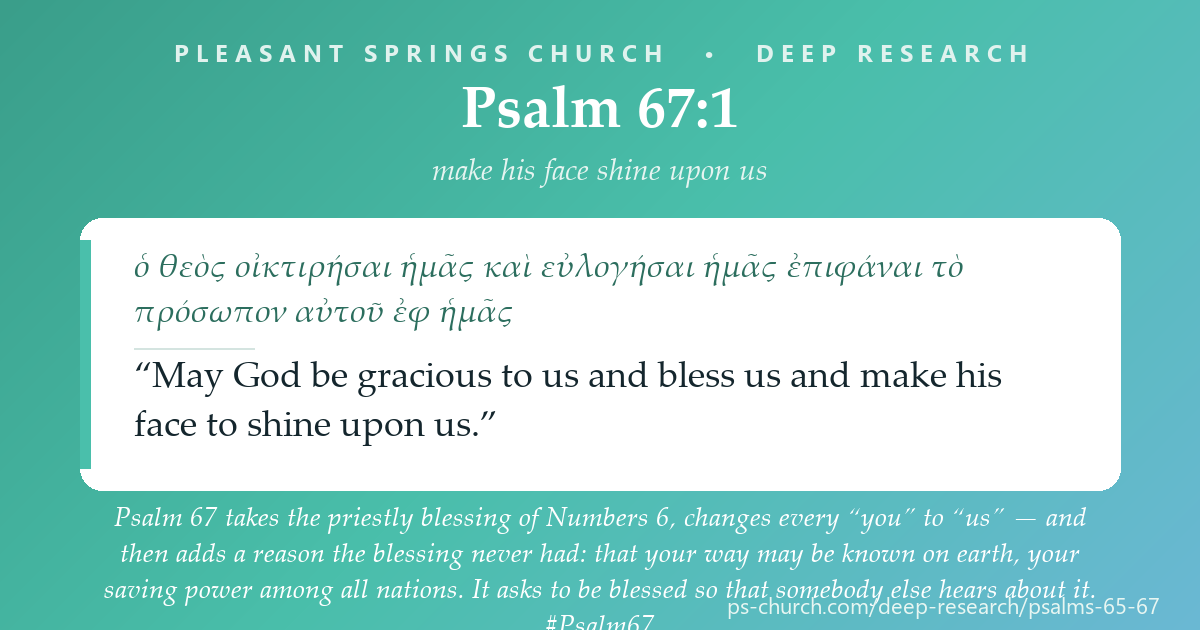
Psalm 67 is the priestly blessing turned outward. Numbers 6:24–26 has six verbs: bless you, keep you, make his face shine on you, be gracious to you, lift up his countenance, give you peace. Psalm 67:1 takes three of them — gracious, bless, make his face shine — and changes every you to us. It leaves keep, lift up and peace where they were. Then it gives the blessing a purpose the blessing itself does not state: that your way may be known on earth, your saving power among all nations. A blessing spoken over Israel becomes a blessing asked for so that outsiders will hear of it.
Greek psalm headings sometimes carry information the Hebrew ones do not, and Psalm 65 is the largest example on this shelf. This library has logged calendar notes (Psalms 24 and 48), occasions (Psalms 27 and 144), an author where the Hebrew has no title at all (Psalm 33), and prophets’ names here. What none of them can be given is a date. No published apparatus for the Greek Psalter permits a reading to be called early or late, so the honest description is that the Greek tradition carries these and the Hebrew does not.
One claim about Psalm 67 circulates widely and needs a qualifier. It is often said that the psalm has exactly 49 words — seven sevens — matching the days counted between Passover and Pentecost, which is why it is read during that count. Counted here: the psalm’s body runs to 49 Hebrew words only if you exclude the heading, treat maqqef as a word separator, and count both occurrences of Selah. Drop the two Selahs and it is 47; treat maqqef as a joiner and it is 44, or 42 without them. The number is real under one convention and not under the others, and the liturgical use of the psalm during the Omer does not depend on it.
- Numbers 6:22–27 → Psalm 67:1. Three of the blessing’s six verbs, with you changed to us.
- Exodus 14:21–22; Joshua 3 → Psalm 66:6. He turned the sea into dry land; they passed through the river on foot — the two crossings named in one verse.
- Psalm 46:4 → Psalm 65:9. The river of God — the same word this library met at Psalms 45–46, where Jerusalem is given a river it does not have.
- Psalm 22:2; 39:2; 62:1 → Psalm 65:1. The four places the Psalter uses דּוּמִיָּה — see Psalms 61–64.
- Psalm 68 → Psalms 65–67. The fourth psalm of the heading block, and the next study on this shelf.
• Psalm 65: eleven added words, two prophets.
Rahlfs 64:1 keeps the Hebrew’s four elements and continues: Ιερεμιου καὶ Ιεζεκιηλ ἐκ τοῦ λόγου τῆς παροικίας ὅτε ἔμελλον ἐκπορεύεσθαι. The psalm keeps David and acquires a second setting — the exile, and a moment just before a departure.
• Psalm 66: one added word, and it occurs nowhere else in the Psalter.
Rahlfs 65:1 reads ᾠδὴ ψαλμοῦ ἀναστάσεως. Scanned across all 150 psalms in Greek, ἀνάστασις stands once.
What must not be concluded. The word is the New Testament’s ordinary noun for resurrection, and it is also ordinary Greek for standing up, for rising, and for the restoration of a people. A psalm heading gives no context to choose between those senses, and no apparatus for the Greek Psalter lets anyone say when the heading entered the tradition. Psalm 66 is a psalm about being brought through fire and water and out again, so a reading in terms of restoration is natural; the page notes the word, notes its range, and leaves the seeing to the reader.
• And Psalm 65:1 gains a place-name. Rahlfs adds ἐν Ιερουσαλημ to the end of the verse, where the Hebrew has nothing. Zion in the first colon, Jerusalem in the second.
A word rendered four ways, a sea that goes both directions, and a count that depends on how you count.
Two of this page’s counts turn on tokenisation. Both are stated with the convention that produced them.
Counted here, not assumed:
- Verse counts and offsets, all three. Hebrew and Rahlfs give 14, 20 and 8; English gives 13, 20 and 7. Psalms 65 and 67 are offset by one because their headings are whole verses; Psalm 66 has no offset at all, because its heading shares verse 1 with the first line of the psalm. In Greek numbering these are Psalms 64 to 66.
- Two Greek title-pluses, both large. Psalm 65 gains eleven words naming Jeremiah and Ezekiel; Psalm 66 gains ἀναστάσεως. Psalm 67’s heading is answered element for element with nothing added.
- ἀνάστασις occurs exactly once in the Greek Psalter — Rahlfs 65:1.
- דּוּמִיָּה occurs in four Psalter verses — 22:2, 39:2, 62:1, 65:1 in English — and Rahlfs renders no two of them the same way.
- אֱלֹהִים stands six times in Psalm 67, not seven. Once each at Hebrew 67:2, 67:4, 67:6 and 67:8, and twice at 67:7 (God, our God). ⚠️ A scan that does not split on the paseq returns four, because two of the six are separated from it only by a thin space in the digital source.
- Psalm 67’s much-repeated “49 words” holds under exactly one convention. Body only, maqqef as a separator, both Selahs counted: 49. Without the Selahs, 47; with maqqef as a joiner, 44, or 42 without them; with the heading, 53.
- Psalm 67’s refrain is identical in both languages. Hebrew 67:4 and 67:6 are the same string; Rahlfs 66:4 and 66:6 are the same string.
- Fourteen psalms carry both מִזְמוֹר and שִׁיר in their opening verse — 30, 48, 65, 66, 67, 68, 75, 76, 83, 87, 88, 92, 98, 108 — and 65 to 68 is the longest consecutive block.
- None of the three is quoted in the New Testament. Swept verse by verse against all 7,927 verses of the Greek New Testament using the punctuation-free field; the longest shared run is four words, there are eight of them, and every one is stock phrasing.
“Silence.” Four occurrences in the whole Psalter — Psalms 22:2, 39:2, 62:1 and here — and Rahlfs gives it a different sense almost every time. Here it is πρέπει, is fitting; at Psalm 62 ὑποταγήσεται, shall be subject; at Psalm 22 εἰς ἄνοιαν, unto folly. ESV footnotes this verse with the silence reading.
“Stilling, soothing.” Rahlfs reads the opposite: ὁ συνταράσσων, the one who throws into confusion. And the verse’s last clause follows suit — the Hebrew has God quieting the tumult of the peoples; the Greek has the nations shall be troubled. Direction unsettled.
“A rising.” Added to the heading of Psalm 66, and the only occurrence in the Greek Psalter. The word carries resurrection, standing up, and the restoration of a people, and a heading supplies no context to choose. Reported, not adjudicated.
“To atone, to cover.” A harvest psalm puts atonement in its third verse: you atone for our transgressions. Rahlfs has σὺ ἱλάσῃ — the verb behind the ἐξίλασμα this library met at Psalm 49:7, where the price could not be paid.
“Produce, yield.” The one concrete noun in Psalm 67 — the earth has yielded its increase — and the hinge of the psalm’s argument: a harvest has come in, so bless us again, so that the nations hear of it.
A blessing that changes person, and a river met before.
Psalm 67 is the clearest case on this shelf of one text being deliberately rewritten inside another.
Which cross-references matter?
- Numbers 6:24–26 → Psalm 67:1. Three of six verbs, and every you becomes us.
- Exodus 14; Joshua 3 → Psalm 66:6. Sea and river in one line.
- Psalm 46:4 → Psalm 65:9. The river of God — see Psalms 45–46.
- Psalm 49:7 → Psalm 65:3. The atonement verb, and the noun built from it — see Psalms 49–50.
- Psalm 62:1 → Psalm 65:1. The same rare word, two different Greek senses — see Psalms 61–64.
- Acts 14:17 → Psalm 65:9–13. He did good by giving you rains from heaven and fruitful seasons — the same argument from harvest to the nations. Stated; the seeing is left to the reader, and no citation is claimed.
Three open questions.
Goldingay and Alter for the Hebrew; the two title-pluses are read straight off Rahlfs.
Commentaries & studies:
- John Goldingay, Psalms 42–89; Robert Alter, The Book of Psalms.
- Frank-Lothar Hossfeld and Erich Zenger, Psalms 2 (Hermeneia).
- Gerald H. Wilson, The Editing of the Hebrew Psalter.
- NETS Psalms, with Rahlfs — for the Greek superscriptions.
Three things reported as unsettled:
- What ἀναστάσεως means in the heading of Psalm 66. The word covers rising, standing up and restoration as well as resurrection, and a heading supplies no context.
- Whether Psalm 65:7 has God stilling the sea or stirring it. The Hebrew and the Greek say opposite things and both are grammatical.
- How the Jeremiah and Ezekiel heading arose. It is in the Greek tradition and not in the Hebrew, and that is the whole of what can be said — no apparatus for this book permits a date.
A blessing asked for so that somebody else hears.
Name what you learned, why it matters, and one concrete response.
What should we carry away — and do?
- Psalm 67 asks for the priestly blessing and gives it a reason. Three of the six verbs of Numbers 6, every you turned into us, and then a purpose clause the blessing itself never had — that your way may be known on earth.
- The Greek heading of Psalm 65 puts two exilic prophets beside David. Eleven words the Hebrew does not have. What that tells us about the psalm is nothing; what it tells us about how the book was read is worth knowing.
- At Psalm 65:7 the two texts disagree about what God does with a storm. One has him quieting the sea, the other stirring it. Both are in front of us and this page chooses neither.
- One concrete response. Psalm 67 wants the blessing so that outsiders hear about it. Name one good thing you have received this year, and tell one person who does not share your faith. That is the psalm’s own request, carried out.
Psalm 67:1–2 · to share
Hebrew + Greek (Rahlfs) + ESVEvery Deep Research page traces its passage across the whole sweep — the Old Testament, the Second-Temple world between the testaments (historical witnesses, not Scripture), and the New Testament. Follow the thread:
Pleasant Springs Church — Deep Research
Research method after Michael S. Heiser’s Bible Research Method (examine dictionaries → ancient literature → important words → textual connections → academic publications → share), with the Pleasant Springs “Author & Audience” foundation. Scripture set in the Hebrew, the Greek editions named on each page and the ESV (Old Testament), and the Greek New Testament and the ESV (New Testament), per the practice of Pleasant Springs Church. Psalms 65–67 research grounded in Goldingay (Psalms 42–89), Alter and Wilson. Text: Hebrew from the Masoretic text as printed in the editions consulted — Sefaria’s Miqra according to the Masorah; no critical apparatus was consulted for the Hebrew. Greek from Rahlfs’ Greek Psalter (CATSS digitization of Rahlfs 1931). The standing caution for this shelf applies: these pages say “Rahlfs’ Greek Psalter reads…” and never call a Greek reading early or late — which is why the two title-pluses on this page are described and not dated. ⚠️ Five counts were made on the whole Psalter: (1) ἀνάστασις once, at Rahlfs 65:1; (2) דּוּמִיָּה in four verses (English 22:2, 39:2, 62:1, 65:1), no two rendered alike; (3) אֱלֹהִים six times in Psalm 67; (4) fourteen psalms carrying both מִזְמוֹר and שִׁיר in verse 1, with 65–68 the longest consecutive block; (5) all three psalms swept verse by verse against all 7,927 verses of the Greek New Testament using the punctuation-free field, longest shared run four words. ⚠️ Two counts are stated with their tokenisation because it changes them. The Psalm 67 אֱלֹהִים count requires splitting on the paseq as well as the maqqef — without it a scan returns four, since two of the six are printed against a paseq with no space. And the widely-repeated “49 words” for Psalm 67 holds only for the body, with maqqef as a separator and both Selahs counted; other conventions give 47, 44, 42 or 53. ⚠️ The ἀναστάσεως heading is reported without a doctrinal conclusion: the noun covers rising, standing up and national restoration as well as resurrection, the heading gives no context, and no apparatus permits a date — so the page names the word, names its range, and leaves the seeing to the reader. The Psalm 65:7 divergence is reported in both directions and adjudicated in neither. Verse counts verified in all three columns (Hebrew and Rahlfs 14/20/8; English 13/20/7 — Psalm 66 has no offset). Typology is handled per the house position: what the text says, what the New Testament itself draws, and what we see from this side of the cross — with the seeing left to the reader.
Scripture quotations marked ESV are from the ESV® Bible (The Holy Bible, English Standard Version®), © 2001 by Crossway, a publishing ministry of Good News Publishers. ESV Text Edition: 2016. Used by permission. All rights reserved. The ESV text may not be quoted in any publication made available to the public by a Creative Commons license, and the ESV may not be translated in whole or in part into any other language. www.esv.org
|
Did this study bless you today? 💚 Give to Support PS Church100% of gifts go to the General Fund — thank you. |