Two studies on this shelf have reported that the Greek Psalter will not call God a rock, a stronghold or a fortress — it answers those three Hebrew words with helpers and places of flight instead. Psalm 61:2 shows what the rule actually is. Here the same Hebrew noun ṣûr means an actual rock the psalmist wants to be led to, and Rahlfs writes petra without hesitation. One psalm later, at Psalm 62:2, the same noun is a name for God — and he writes my God. The line falls between the epithet and the word, and these two psalms hold both cases side by side; what produced that split is not decidable from the wording. Then the details: Psalm 62 says one small word six times, every time at the head of a verse, more than any other psalm in the book; its two refrains behave in opposite directions, and the Greek follows neither. And at Psalm 63:2 the looking reverses — the Hebrew gazes on God in the sanctuary, the Greek is seen by him there. See the method →
Psalms 61:2–64:7 (selections)
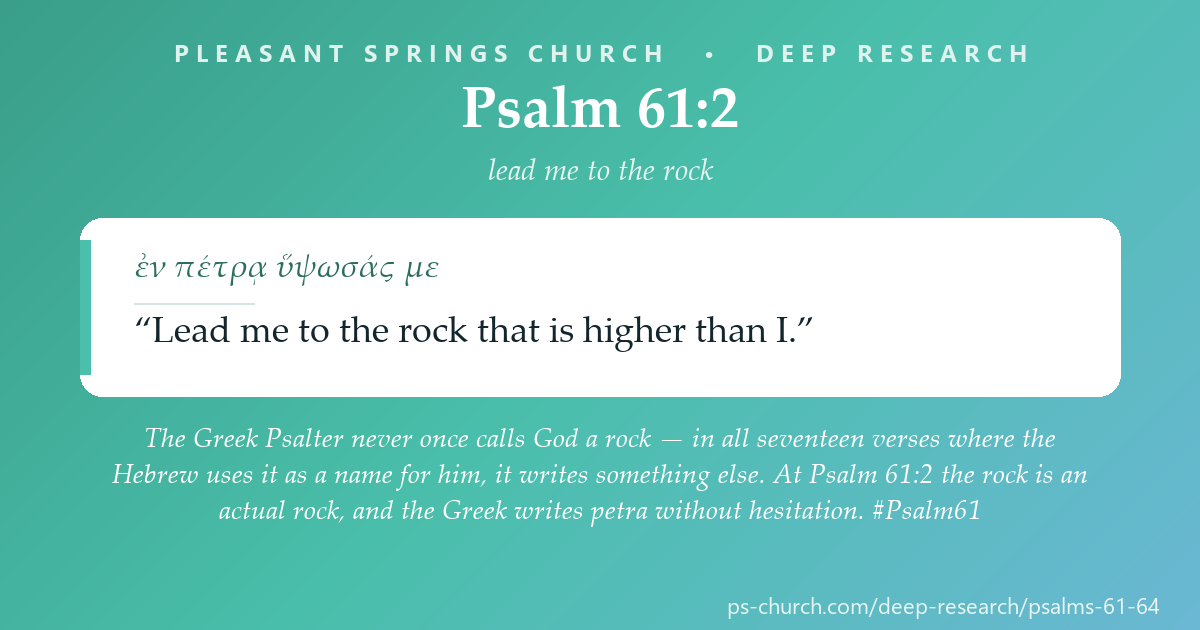
Hebrew · Greek (Rahlfs’ Psalter) · ESVAt Psalms 47–48 and Psalms 52–55 this library reported that צוּר, מִשְׂגָּב and מָעוֹז are answered by helpers and places of flight rather than by masonry. Here the same word צוּר is rendered πέτρα without hesitation. The difference is what the word is doing: at Psalm 62:2 it is a name for God, and Rahlfs gives θεός μου; at Psalm 61:2 it is an actual rock the psalmist wants to be led to, and Rahlfs gives ἐν πέτρᾳ.
Both stand in this study, one psalm apart and at the same verse number. The line falls between the epithet and the word — and the verse above is the cleanest place in the Psalter to see it. What produced that split — a different Hebrew text, an inherited idiom, or a choice — is not decidable from the wording.
The same verse also changes the mood, and the next one changes it back. Hebrew 61:3 ends with an imperative — lead me to the rock. Rahlfs ends the verse with an aorist indicative, ὕψωσάς με, you exalted me, and opens the next verse with another, ὡδήγησάς με, you led me. A request becomes a report — the same shape this library met at Psalm 58:6. Which text stood first is not decidable here.
⚠️ And Psalm 61:3 keeps one shelter-word and drops the other. In a single verse the Hebrew calls God a refuge and a strong tower. Rahlfs turns the refuge into ἐλπίς μου, my hope, and leaves the tower standing: πύργος ἰσχύος. Checked across the whole Psalter, מִגְדָּל is used of God in this one verse and no other — and there the Greek builds it.
⚠️ At Psalm 63:2 the looking goes the other way. The Hebrew is ḥăzîṯḵā, I have gazed on you. Rahlfs has ὤφθην σοι — I was seen by you, or I appeared before you. Same sanctuary, same power and glory in the second half of the verse, and the subject of the seeing has swapped ends.
The Shape of the Passage
Four Davidic psalms; Psalm 62 built on a single wordAnd Psalm 62’s two refrains behave in opposite ways, which is worth seeing together. The first pair — Hebrew 62:2 and 62:6 — differ in four of seven words: a different preposition, a noun against an imperative, an added כִּי, and my salvation against my hope. The second pair — Hebrew 62:3 and 62:7 — are identical but for one extra word, רַבָּה, greatly, which ESV keeps.
The Greek follows the first pattern and reverses the second. Where the Hebrew’s first pair is loose, Rahlfs is also loose; where the Hebrew’s second pair differs by a single word, Rahlfs differs in three. That is worth stating plainly, because two studies earlier on this shelf found the Greek carrying less variation than the Hebrew. Here it carries more. Neither observation supports a rule about what the Greek does; both are reported and nothing is inferred from them.
All four are Davidic and all four sit in the Elohistic collection (Psalms 42–83). They follow the five miktams of Psalms 56–60 and the four maskils of Psalms 52–55 — and unlike both of those runs, these four share no heading word at all.
Author
Someone a long way from the sanctuary who wants to be in it. From the end of the earth I call to you… let me dwell in your tent forever. Psalm 61 is a prayer about distance.
Someone who says the same word six times. Only… only… only. Psalm 62 argues by repetition rather than by development, and its argument is that one thing is worth waiting for and the rest weighs nothing.
And someone in a dry place remembering a wet one. My flesh faints for you, as in a dry and weary land where there is no water… so I have looked upon you in the sanctuary. Psalm 63 is the only one of the four with an occasion attached.
Audience
The king, at the end of Psalm 61. Prolong the life of the king; may his years endure to all generations. A private prayer that closes on a public one.
Everybody, in Psalm 62. Trust in him at all times, O people; pour out your heart before him. The psalm turns outward at verse 8 and addresses the whole congregation.
And people being talked about behind their backs. Who whet their tongues like swords… they talk of laying snares secretly. Psalm 64 is about words used as weapons, and it is the one of the four with no comfort in it until the last four verses.
Orient on rock and refuge language, on Jeduthun, and on the wilderness of Judah.
Search by topic: rock (divine epithet); refuge; Jeduthun; wilderness of Judah; the tongue as a weapon; retribution.
Which articles are relevant?
- Anchor Bible Dictionary — “Rock,” “Refuge,” “Jeduthun,” “Judah, Wilderness of.”
- Dictionary of the OT: Wisdom, Poetry & Writings (IVP) — “God,” “Refuge,” “Trust,” “Retribution.”
- NIDOTTE / TDOT — צוּר (ṣûr, rock), מִגְדָּל (migḏāl, tower), אַךְ (ʾaḵ, only / surely), סֵתֶר (sēṯer, a hiding place).
- On the Greek — the NETS Psalms introduction, and Rahlfs’ Psalms 60–63 read against the Hebrew for the mood-shifts at 60:3–4 and 63:8.
- On Romans 2:6 — Beale and Carson, and Proverbs 24:12 in Greek beside Psalm 62:12, which is the whole of the question.
Bibliography surfaced:
- John Goldingay, Psalms 42–89; Robert Alter, The Book of Psalms.
- Frank-Lothar Hossfeld and Erich Zenger, Psalms 2 (Hermeneia) — covers Psalms 51–100.
- Beale and Carson, Commentary on the NT Use of the OT — for Romans 2:6.
What the rock rule actually is, and a psalm that argues by repeating one word.
Read Psalm 61:2 and Psalm 62:2 together. Same Hebrew noun, two different jobs, two different Greek words.
Which parallels shed light on these psalms?
The specific epithet Rock for a personal god is concentrated in Israelite texts. The nearest neighbouring analogue is mountain rather than stone: Enlil and Ashur are each titled “the Great Mountain” (ANET 50 and 298). The Hebrew Bible uses צוּר as a divine title dozens of times, and the Song of Moses uses it like a proper name — Deuteronomy 32:4, 15, 18, 30, 31 and 37. The Greek Psalter does not carry that usage into Greek, and Psalm 61:2 shows the decision was about the epithet and not about the vocabulary: where the rock is a rock, πέτρα is what he writes.
Psalm 62 belongs with the wisdom material rather than with the laments around it. Those of low estate are but a breath; those of high estate are a delusion; in the balances they go up. The weighing image, the breath word, and the numerical saying at the end — once God has spoken; twice have I heard this — all belong to the idiom of Proverbs and Job. The breath is הֶבֶל, the word Ecclesiastes repeats from beginning to end.
And Psalm 63’s heading puts David in a place the Gospels also name. Rahlfs’ superscription reads ἐν τῇ ἐρήμῳ τῆς Ιουδαίας, in the wilderness of Judaea — which is, word for word, where Matthew 3:1 puts John the Baptist. That is a shared geographical phrase and not a quotation, and it is the whole of the overlap.
- Deuteronomy 32:4, 15, 18, 30, 31, 37 → Psalm 62:2. The Rock as a name — and see this library’s Deuteronomy 32 study.
- Proverbs 24:12 → Psalm 62:12. Two verses that end the same way, and the reason Romans 2:6 cannot be assigned to one of them.
- Ecclesiastes 1:2 → Psalm 62:9. The הֶבֶל that men weigh out to be.
- 1 Samuel 23:14–15; 24:1 → Psalm 63 heading. David in the Judean wilderness — Ziph, then Engedi.
- Psalms 17:8; 36:7; 57:1 → Psalms 61:4 and 63:7. The phrase, five times in the Psalter — see Psalms 15–17 and Psalms 56–60.
• What this shelf has actually found about צוּר.
Not that the Greek Psalter avoids πέτρα. It uses it — wherever the Hebrew means a literal rock, at Rahlfs 26:5, 60:3, 77:15, 77:20, 80:17, 104:41 and 113:8, seven verses in all.
What it never does is use it for the epithet. In the seventeen verses where צוּר is a title for God, Rahlfs never once writes πέτρα — the word itself is answered by θεός twelve times, βοηθός four and ἀντιλήμπτωρ once, and those verses reach for ὑπερασπιστής, καταφυγή and στερέωμα for the stronghold-words standing beside it. Psalms 61 and 62 put both cases one psalm apart, at the same verse number.
And the boundary is narrower than “architecture”. Psalm 61:3 calls God מִגְדַּל־עֹז, a strong tower, and Rahlfs writes πύργος ἰσχύος — a tower. Checked across the whole Psalter, that is the only verse in which מִגְדָּל is used of God. Three specific words go one way; this one does not.
• Romans 2:6 shares exactly five words with two different verses.
Paul writes ὃς ἀποδώσει ἑκάστῳ κατὰ τὰ ἔργα αὐτοῦ.
Rahlfs’ Psalm 61:13 — our 62:12 — ends σὺ ἀποδώσεις ἑκάστῳ κατὰ τὰ ἔργα αὐτοῦ.
Greek Proverbs 24:12 ends ὃς ἀποδίδωσιν ἑκάστῳ κατὰ τὰ ἔργα αὐτοῦ.
The longest run Paul shares with each is the same five words — ἑκάστῳ κατὰ τὰ ἔργα αὐτοῦ. Proverbs supplies his relative pronoun and the Psalm does not; the Psalm differs from Paul in person, where Proverbs differs in tense — Paul and the Psalm are future, Proverbs is present. Romans 2:6 is regularly printed with Psalm 62:12 beside it, and on the wording alone that attribution cannot be made. The thought is common to both, and it is older than either.
One noun, two jobs; one word, six times; and a verb that changes voice.
Every count on this page was made against all 150 psalms, word by word, with maqqef treated as a separator.
Counted here, not assumed:
- Verse counts and offsets, all four. Hebrew and Rahlfs give 9, 13, 12 and 11; English gives 8, 12, 11 and 10. The offset is one in each, and it is the title. In Greek numbering these are Psalms 60 to 63.
- None of the four carries a Greek title-plus. Every Hebrew heading element is answered and nothing is added.
- אַךְ stands six times in Psalm 62, and six times it is the first word of a verse. Counted across all 150 psalms, the next highest is Psalm 39 with four.
- Psalm 62 has two refrain pairs that behave in opposite directions. Hebrew 62:2 and 62:6 differ in four of seven words; Hebrew 62:3 and 62:7 differ by one word (רַבָּה). In Rahlfs the first pair is likewise loose and the second differs in three places — so here the Greek carries more variation than the Hebrew, the reverse of what this shelf found at Psalm 49 and Psalms 57 and 59. Reported; nothing inferred.
- מִגְדָּל is used of God in exactly one verse of the Psalter (61:3), and Rahlfs renders it πύργος — which bounds this shelf’s fortress finding to צוּר, מִשְׂגָּב and מָעוֹז rather than to architecture in general.
- The phrase in the shadow of your wings stands in five verses — 17:8, 36:7, 57:1, 61:4 and 63:7 in English; Psalm 91:4 shelters under God’s wings in different words. Four of the five say in the shadow; Psalm 61:4 alone says in the hiding-place — and Rahlfs answers four of the five with σκέπη whichever Hebrew word stands there (Rahlfs 16:8, 35:8, 60:5, and 62:8 with the article), leaving only Psalm 57 with ἐν τῇ σκιᾷ.
- None of the four is quoted in the New Testament. Swept verse by verse against all 7,927 verses of the Greek New Testament using the punctuation-free field; the longest shared run is five words, and there are five such runs, every one of them a stock phrase — including the Romans 2:6 case below and the wilderness-of-Judaea heading that Matthew 3:1 also uses.
“Rock.” The same noun in both psalms, doing two different jobs. At 61:2 it is a physical rock and Rahlfs writes ἐν πέτρᾳ; at 62:2 it is a name for God and he writes θεός μου. In all seventeen verses where it is a divine title the Greek never uses πέτρα — and where the rock is a rock, he does.
“A strong tower.” The one verse in the Psalter that calls God a migḏāl, and Rahlfs builds it: πύργος ἰσχύος. In the same breath he turns מַחְסֶה, a refuge, into ἐλπίς μου, my hope. One shelter kept, one dissolved.
“Only, surely, nothing but.” Six occurrences in Psalm 62, every one of them the first word of its verse (Hebrew 62:2, 3, 5, 6, 7, 10). No other psalm has more than four. ESV renders it alone, only and but; Rahlfs answers the six with four different words — οὐχί, καὶ γάρ, πλήν and ὅτι.
“Silence” — the waiting that gives Psalm 62 its English title. Rahlfs reads ὑποταγήσεται, shall be subject, and turns the line into a question with οὐχί. A statement about waiting becomes a question about submission. Direction unsettled.
“To gaze on.” The Hebrew has the worshipper looking at God. Rahlfs has ὤφθην σοι, a passive: I was seen by you. The rest of the verse is the same in both — the sanctuary, the power, the glory — and only the direction of the looking has moved.
A verse with two possible homes, and the rock that keeps its name.
Where two Old Testament verses end alike, name both rather than choosing.
Which cross-references matter?
- Romans 2:6 → Psalm 62:12 and Proverbs 24:12. Five shared words with each, and no more with either. Proverbs supplies Paul’s relative pronoun; the Psalm differs in person, and Proverbs in tense.
- Psalm 61:2 → Psalms 47–48, 52–55. The verse that shows what the Greek Psalter’s split actually falls between — see Psalms 47–48 and Psalms 52–55.
- Deuteronomy 32 → Psalm 62:2. The Rock as a name for God. Stated; the seeing is left to the reader.
- Matthew 3:1 → Psalm 63 heading. The same five Greek words for the same wilderness — a shared place-name, not a citation.
- Psalm 58:6 → Psalm 61:2. A second case of a Hebrew imperative answered by a Greek aorist indicative — see Psalms 56–60.
- Psalms 15–17 → Psalms 61 and 63. The wings — see Psalms 15–17.
Three open questions.
Goldingay and Alter for the Hebrew; the Greek readings here are all checked against Rahlfs directly.
Commentaries & studies:
- John Goldingay, Psalms 42–89; Robert Alter, The Book of Psalms.
- Frank-Lothar Hossfeld and Erich Zenger, Psalms 2 (Hermeneia).
- Beale and Carson, Commentary on the NT Use of the OT — Romans 2.
- NETS Psalms, with Rahlfs.
Three things reported as unsettled:
- Which verse Romans 2:6 has in view. Psalm 62:12 and Proverbs 24:12 share the same five words with Paul. The wording does not decide it, and this page does not.
- Why Psalm 61:2’s imperative is an indicative in Greek. A different Hebrew text and a rendering decision would look the same from here.
- What אַךְ is doing six times in Psalm 62. Whether it restricts, affirms, or contrasts is decided differently in almost every verse, by translators who all have the same consonants.
A rock that is a rock, and a word said six times.
Name what you learned, why it matters, and one concrete response.
What should we carry away — and do?
- The Greek Psalter’s split is precise. Where צוּר names God, it is never πέτρα; where the rock is a rock, it is. Psalms 61 and 62 hold both cases one psalm apart, at the same verse number.
- Psalm 62 makes its case by saying one word six times. Only God. Only he. Only breath. The psalm never argues; it narrows.
- At Psalm 63:2 the Greek has the worshipper being seen rather than seeing. The Hebrew looks at God in the sanctuary; the Greek is looked at there. Both are worth sitting with, and the page does not choose between them.
- One concrete response. Psalm 62 tells you to pour out your heart before him and then says everything else weighs less than a breath. Name the one thing you are actually waiting on, and say out loud whether you are waiting on God for it or on something else.
Psalm 61:2 · to share
Hebrew + Greek (Rahlfs) + ESVEvery Deep Research page traces its passage across the whole sweep — the Old Testament, the Second-Temple world between the testaments (historical witnesses, not Scripture), and the New Testament. Follow the thread:
Pleasant Springs Church — Deep Research
Research method after Michael S. Heiser’s Bible Research Method (examine dictionaries → ancient literature → important words → textual connections → academic publications → share), with the Pleasant Springs “Author & Audience” foundation. Scripture set in the Hebrew, the Greek editions named on each page and the ESV (Old Testament), and the Greek New Testament and the ESV (New Testament), per the practice of Pleasant Springs Church. Psalms 61–64 research grounded in Goldingay (Psalms 42–89) and Alter, with Beale and Carson for Romans 2. Text: Hebrew from the Masoretic text as printed in the editions consulted — Sefaria’s Miqra according to the Masorah; no critical apparatus was consulted for the Hebrew. Greek from Rahlfs’ Greek Psalter (CATSS digitization of Rahlfs 1931), and Greek Proverbs from the same corpus. The standing caution for this shelf applies: these pages say “Rahlfs’ Greek Psalter reads…” and never call a Greek reading early or late. ⚠️ This page states the shelf’s fortress finding in its corrected form. The Greek Psalter does use πέτρα for צוּר in seven verses — Rahlfs 26:5, 60:3, 77:15, 77:20, 80:17, 104:41 and 113:8, all of them literal rocks. What it never does is use it for צוּר as a divine title, in any of the seventeen verses where the Hebrew does. Psalm 61:3 bounds the finding further: it is the only verse in the Psalter that calls God מִגְדָּל, and Rahlfs renders it πύργος ἰσχύος — so the pattern belongs to three specific words and not to architectural language as such. ⚠️ Four counts were made on the whole Psalter: (1) אַךְ six times in Psalm 62, all verse-initial, against a maximum of four elsewhere (Psalm 39); (2) מִגְדָּל of God in one verse only; (3) the wings image in five verses, four with צֵל and Psalm 61:4 alone with סֵתֶר; (4) all four psalms swept verse by verse against all 7,927 verses of the Greek New Testament using the punctuation-free field, longest shared run five words. ⚠️ Romans 2:6 is reported as undecidable on the wording: Paul's ὃς ἀποδώσει ἑκάστῳ κατὰ τὰ ἔργα αὐτοῦ shares the same five-word run with Rahlfs’ Psalm 61:13 and with Greek Proverbs 24:12, and matches neither in full — Proverbs supplies the relative pronoun, the Psalm differs in person, while Proverbs differs in tense. The two refrain observations are reported without inference, since Psalm 62 has the Greek carrying more variation than the Hebrew while Psalms 49, 57 and 59 had it carrying less; no rule is claimed from either. Verse counts verified in all three columns (Hebrew and Rahlfs 9/13/12/11; English 8/12/11/10). None of the four carries a Greek title-plus. Typology is handled per the house position: what the text says, what the New Testament itself draws, and what we see from this side of the cross — with the seeing left to the reader.
Scripture quotations marked ESV are from the ESV® Bible (The Holy Bible, English Standard Version®), © 2001 by Crossway, a publishing ministry of Good News Publishers. ESV Text Edition: 2016. Used by permission. All rights reserved. The ESV text may not be quoted in any publication made available to the public by a Creative Commons license, and the ESV may not be translated in whole or in part into any other language. www.esv.org
|
Did this study bless you today? 💚 Give to Support PS Church100% of gifts go to the General Fund — thank you. |