Romans 3:10–18 is almost always credited to "Psalm 14:1–3; 53:1–3" — the psalm and its doublet together. Set Paul's Greek beside the Greek of both and the two psalms are not close to level. With Psalm 14 his text runs in a single unbroken match of sixty-three consecutive words. With Psalm 53 the longest run is ten. The break is one word — Psalm 53 says doing good where Psalm 14 and Paul say doing kindness, though the Hebrew of both psalms is identical there, so the parting is inside the Greek — and after it the whole of Romans 3:13–18 stands inside Psalm 14's Greek and is completely absent from Psalm 53. The other received line about these psalms fails too: Psalm 53 is not Psalm 14 with Elohim swapped in. There are three divine-name swaps and at least seven further differences, plus one verse replaced outright. Then Psalm 52, whose Greek heading names a different priest than the Hebrew does, and Psalm 55, where cast your burden became cast your anxieties on the way into 1 Peter. See the method →
Psalms 52:1–55:22 (selections)
Hebrew · Greek (Rahlfs’ Psalter) · ESVPaul’s catena was set word by word against Rahlfs’ Psalm 13 (our 14) and Rahlfs’ Psalm 52 (our 53). With Psalm 14 it agrees in a single unbroken run of sixty-three consecutive words, from ἐκζητῶν τὸν θεόν straight through to the end of Romans 3:18. With Psalm 53 the longest run is ten.
Two things cause the gap, and both are visible above. Where Psalm 14 and Paul read ποιῶν χρηστότητα, doing kindness, Psalm 53 reads ποιῶν ἀγαθόν, doing good. The Hebrew of the two psalms is identical at that point — both read עֹשֵׂה־טוֹב — so the parting of the ways is inside the Greek, and nothing here says which Greek rendering came first. And the whole of Romans 3:13–18 — the open grave, the asps, the swift feet, the fear of God — stands inside Rahlfs’ Psalm 13:3 and is completely absent from Psalm 53. That block is the subject of this library’s Psalms 11–14 study.
One more thing Paul did that is worth naming. Hebrew and Greek alike put Psalm 14:2 as a question: God looks down to see whether there is anyone who understands or seeks God. Romans 3:11 states it as a finding: there is none who understands, none who seeks God. The psalm answers its own question two lines later in the same words Paul is quoting; he moves the answer forward.
⚠️ And the received line about Psalm 53 does not survive either. It is often said that Psalm 53 is Psalm 14 with Elohim written in for the divine name. Set side by side, consonant by consonant: the divine name is indeed swapped three times in the lines the two psalms share, and a fourth time inside the line Psalm 53 replaces outright — and there are at least seven further differences besides, plus that one whole line that is not a variation of anything. Psalm 14:5–6 has God is with the generation of the righteous and the Lord is his refuge; Psalm 53:5 has God scatters the bones of him who encamps against you. That is not a substitution. It is a different verse.
⚠️ The superscription of Psalm 52 names a different priest in Greek. The Hebrew heading says David came to the house of Ahimelech, which is what 1 Samuel 21–22 says. Rahlfs reads Αβιμελεχ. This library met a second Abimelech problem in the heading of Psalm 34 — where Hebrew and Greek both read Abimelech and 1 Samuel 21 reads Achish, so the difficulty is inside the Hebrew rather than between the languages. Two headings, two name problems of different kinds, and no way from here to say how either arose.
The Shape of the Passage
Four consecutive maskils — the longest such run in the PsalterTwo of the four carry historical headings, and both are about being informed on. Psalm 52 has Doeg the Edomite telling Saul where David went; Psalm 54 has the Ziphites telling Saul where David is hiding. The two psalms in between and after have no occasion at all — and Psalm 55, the one about betrayal by a friend, is the one the headings leave unexplained.
Psalm 53 is placed here as the hinge because it is the one everybody thinks they know. It sits between two psalms about informers, it repeats a psalm from Book I, and it is the psalm most often named as the source of Romans 3. On the evidence below, it is not.
All four psalms sit inside the Elohistic collection (Psalms 42–83), where Elohim does most of the work that the divine name does elsewhere — which is exactly what makes Psalm 53 look like a simple substitution, and exactly why it needs checking rather than assuming.
Author
Four maskils of David, two with a date attached. Psalm 52 names Doeg the Edomite; Psalm 54 names the Ziphites. Both headings describe the same kind of event — somebody telling Saul where David is.
Psalm 55 is written by someone who has been betrayed by a friend and says so twice. It is not an enemy who taunts me — then I could bear it… but it is you, a man, my equal. He specifies that they had worshipped together.
And Psalm 53 has an author problem the others do not. It exists twice in the Psalter. Whoever placed it here placed a poem that stands in the book twice.
Audience
One man, in Psalm 52. Why do you boast… your tongue plots destruction… God will break you down forever. It speaks to him in the second person singular for five of its nine verses; after that the righteous speak about him in the third person, and the psalmist speaks about himself.
Everybody, in Psalm 53. There is none who does good, not even one. The psalm makes no exceptions and names no group.
And in Psalm 55, somebody who is carrying something. Cast your burden on the Lord, and he will sustain you. The last instruction in the psalm is addressed outward, to a reader.
Orient on the Elohistic Psalter, on doublets, and on the historical superscriptions.
Search by topic: Elohistic Psalter; psalm doublets; historical superscriptions; maskil; Doeg the Edomite; the Ziphites; Ahithophel.
Which articles are relevant?
- Anchor Bible Dictionary — “Psalms, Book of,” “Doeg,” “Ziph,” “Ahimelech,” “Ahithophel.”
- Dictionary of the OT: Wisdom, Poetry & Writings (IVP) — “Editorial Criticism,” “Psalms: Titles,” “Lament,” “Enemies.”
- NIDOTTE / TDOT — מָעוֹז (māʿōz, stronghold), מַשְׂכִּיל (maśkîl), יְהָב (yəhāḇ, a burden — a word that occurs only here in the Hebrew Bible), חֶסֶד (ḥesed).
- On the Greek — the NETS Psalms introduction, and Rahlfs’ Psalms 13 and 52 read side by side, which is where the Romans 3 question is settled.
- On the catena — Romans 3:10–18, and this library’s Psalms 11–14 study of the long Greek plus that carries most of it.
Bibliography surfaced:
- John Goldingay, Psalms 42–89; Robert Alter, The Book of Psalms.
- Frank-Lothar Hossfeld and Erich Zenger, Psalms 2 (Hermeneia) — this volume covers Psalms 51–100, so all four of these psalms are inside it.
- Beale and Carson, Commentary on the NT Use of the OT — for Romans 3 and 1 Peter 5.
- Gerald H. Wilson, The Editing of the Hebrew Psalter — on doublets and placement.
Two informers, one betrayal, and a poem that is in the book twice.
Read Psalm 14 and Psalm 53 in Hebrew with the vowels covered. The differences are not where the summaries say they are.
Which parallels shed light on these psalms?
Two of the four headings describe informers, and both episodes are in 1 Samuel. Doeg the Edomite watched David take bread and a sword from the priest at Nob and reported it to Saul, and eighty-five priests died for it in the Hebrew of 1 Samuel 22:18 — the Greek of 1 Kingdoms reads three hundred and five, and calls Doeg a Syrian rather than an Edomite. The Ziphites twice went to Saul to tell him where David was hiding (1 Samuel 23 and 26). Psalm 52 and Psalm 54 are the two psalms in this group with an occasion, and the occasion is the same crime.
Psalm 55’s betrayal has been attached to Ahithophel since antiquity, and the psalm does not name him. Ahithophel was David’s counsellor and went over to Absalom (2 Samuel 15–17). The psalm says only a man, my equal, my companion, my familiar friend, and that they had gone to God’s house together. The identification is a reader’s inference, and a reasonable one; it is not in the text.
And a poem stands in the Psalter twice. Psalm 14 is in Book I; Psalm 53 is in Book II, inside the collection that prefers Elohim. That is the standard explanation for the divine-name difference and it is a good one — but it accounts for three of the differences and not for the rest. Psalm 53 is not a copy with the names changed; the two are separate editions of one poem.
- 1 Samuel 21:1–9; 22:6–23 → Psalm 52. Doeg, and the priest Ahimelech — the name the Greek heading gives differently.
- 1 Samuel 23:19; 26:1 → Psalm 54. The Ziphites.
- 2 Samuel 15–17 → Psalm 55:12–14. Ahithophel — traditionally read here, and not named by the psalm.
- Psalm 14 → Psalm 53. The doublet — see Psalms 11–14.
- Psalm 41:9 → Psalm 55:12–14. The other betrayed-friend psalm, and the one the New Testament actually quotes (John 13:18) — see Psalms 38–41.
This is the page’s main finding, and anyone can repeat it.
Romans 3:10–18 was taken as one continuous string of Greek and compared, word by word with accents normalised, against two continuous strings: Rahlfs’ Psalm 13 (our Psalm 14) and Rahlfs’ Psalm 52 (our Psalm 53).
• Against Psalm 14: one matching run of sixty-three consecutive words. It begins at ἐκζητῶν τὸν θεόν in Romans 3:11 and does not break until the end of Romans 3:18.
• Against Psalm 53: the longest run is ten. Then it stops, at ποιῶν.
The break is a single word. Psalm 14 and Paul both read ποιῶν χρηστότητα; Psalm 53 reads ποιῶν ἀγαθόν. After that the two psalms diverge completely, because Rahlfs’ Psalm 13:3 runs on for another forty-eight words — the open grave, the deceitful tongues, the asps, the cursing, the swift feet, the ruin, the unknown way of peace, the missing fear of God — and Psalm 52 simply has none of it.
So Romans 3:13–18 cannot have come from Psalm 53 in any form we can inspect. Where that long block itself came from is a separate and genuinely open question, worked on this library’s Psalms 11–14 page.
⚠️ What may not be concluded. None of this dates anything or says which psalm is older. It says which text Paul’s wording tracks, and it says so with a number. The usual formula — Romans 3:10–12 = Psalm 14:1–3; 53:1–3 — puts two psalms where the evidence supports one.
A stronghold that is never built, a hapax, and a word used twice in the Greek Bible.
The Psalm 53 comparison below was made on consonants only, which is the only fair way to count differences between two forms of the same poem.
Counted here, not assumed:
- Verse counts, all four. Psalm 52: Hebrew and Rahlfs 11, English 9 — an offset of two, because its heading is two whole verses. Psalm 53: 7 and 6. Psalm 54: 9 and 7 — two again. Psalm 55: 24 and 23. In Greek numbering these are Psalms 51 to 54.
- Romans 3:10–18 against the Greek of both psalms: sixty-three consecutive words with Psalm 14, ten with Psalm 53.
- “Psalm 53 is Psalm 14 with Elohim for the divine name” does not survive a consonantal comparison. Three divine-name swaps, and at least seven further differences besides — a heading that adds עַל־מָחֲלַת, an added conjunction, עֲלִילָה against עָוֶל, הַכֹּל against כֻּלּוֹ, סָר against סָג, a dropped כָּל, a singular against a plural at the last verse — and Psalm 14:5–6 replaced wholesale by a different line at Psalm 53:5.
- מָעוֹז stands in nine verses of the Psalter and is never rendered by a word for a built defence. This is the third such word — after צוּר, which stands in seventeen verses as a title for God and is never once rendered πέτρα in any of them, and מִשְׂגָּב, never a tower in twelve verses. Where a psalm means an actual rock the Greek does use πέτρα — Rahlfs 26:5, 60:3, 77:15, 77:20, 80:17, 104:41 and 113:8, seven verses in all. The line falls between the epithet and the word.
- ἰσόψυχος: once in the Greek Psalter (54:14) and once in the New Testament (Philippians 2:20). Checked across the Psalter and across all 27 books.
- Psalms 54 and 55 have identical Hebrew titles, and identical Greek ones.
- Psalms 52 to 55 are the longest run of consecutive maskil headings in the book. The thirteen are 32, 42, 44, 45, 52, 53, 54, 55, 74, 78, 88, 89 and 142.
- Apart from Psalm 53’s share of the Romans 3 catena, none of these four psalms is quoted in the New Testament. Swept verse by verse against all 7,927 verses of the Greek New Testament, the longest shared run is five words — εἰς τὸν αἰῶνα τοῦ αἰῶνος, which Rahlfs 51:10 shares with Hebrews 1:8 — and every run of four or more is ordinary liturgical phrasing.
“A stronghold.” It stands in nine verses of the Psalter, and the Greek builds nothing with any of them — ὑπερασπιστής (a shield-bearer), κραταίωμα and κραταίωσις (strength), ἀντίλημψις (help), and here βοηθός, a helper. That is the third fortress-word this shelf has traced, after צוּר and מִשְׂגָּב — see Psalms 47–48.
“The steadfast love of God.” In Hebrew this is the answer to the boast — you brag all day; God’s love lasts all day. Rahlfs has ἀνομίαν, lawlessness, so that the line continues the accusation instead of answering it — and the word for God disappears from the verse.
A heading word nobody can define. It stands in thirteen psalm titles, and Psalms 52 to 55 are the only four in a row. ESV leaves it untranslated and footnotes it “probably a musical or liturgical term” (plural at Psalm 53, where the note also covers Mahalath); Rahlfs commits every time to a noun of understanding — συνέσεως in ten of the thirteen, εἰς σύνεσιν in the other three.
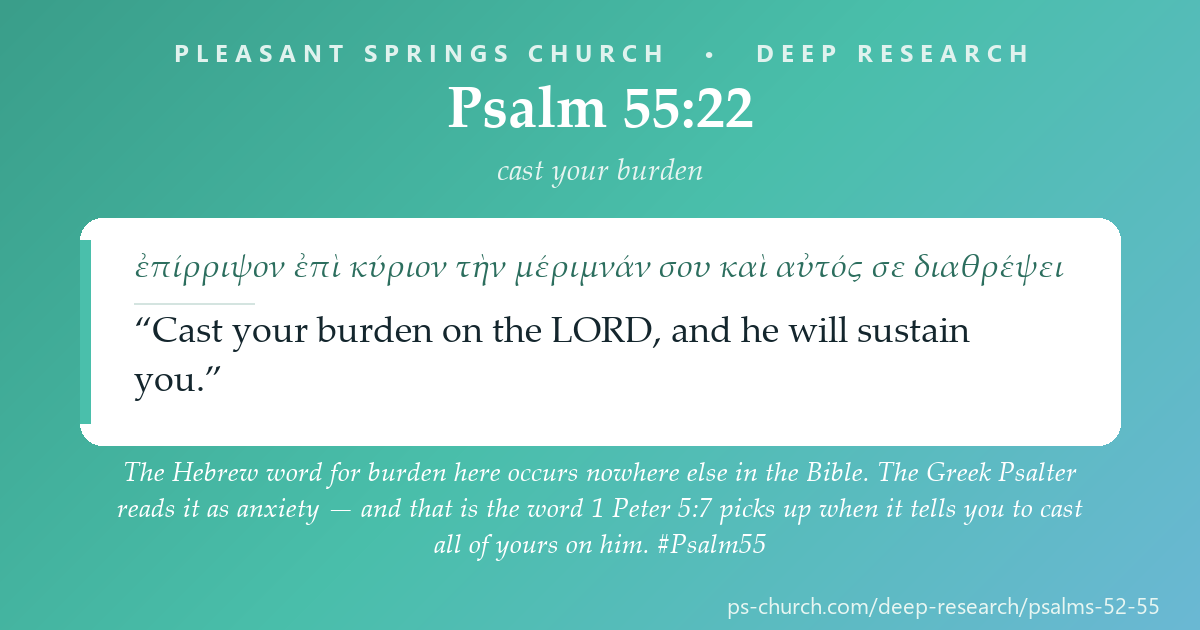
“Your burden” — a noun that occurs nowhere else in the Hebrew Bible. Rahlfs reads it τὴν μέριμνάν σου, your anxiety. 1 Peter 5:7 has πᾶσαν τὴν μέριμναν ὑμῶν ἐπιρίψαντες — the two decisive words of the Greek Psalter’s line, and no more of it than that. The English “cast your cares” comes through the Greek; ESV keeps the Hebrew’s burden.
“Equal-souled.” Rahlfs’ rendering of ʾĕnōš kəʿerkî, a man of my own valuation. The word stands once in the Greek Psalter and once in the New Testament — Philippians 2:20, where Paul says he has nobody else like Timothy. A rarity worth noticing. No allusion is claimed, and none is needed.
One number that settles a citation, and one that does not make an allusion.
Where a link is real but not a quotation, this page says which words are shared and how many.
Which cross-references matter?
- Romans 3:10–18 → Psalm 14, not Psalm 53. Sixty-three consecutive words against ten. See Psalms 11–14 for the long Greek block that carries Romans 3:13–18.
- 1 Peter 5:7 → Psalm 55:22. Two decisive words shared with Rahlfs — μέριμνα and ἐπιρίπτω — and no run of four. Peter turns the psalm’s imperative into a participle and its upon the Lord into upon him. A genuine use of the psalm’s line, not a citation of it.
- 1 Samuel 21–22 → Psalm 52 heading. Ahimelech in the Hebrew, Abimelech in the Greek.
- Psalm 34 heading → Psalm 52 heading. A second Abimelech problem, of a different kind — there the Hebrew and the Greek agree with each other and differ from 1 Samuel — see Psalms 32–34.
- Psalm 41:9; John 13:18 → Psalm 55:12–14. Psalm 55 is the more famous betrayal and Psalm 41 is the one the Gospel quotes — see Psalms 38–41. Stated; the seeing is left to the reader.
- Psalm 51 → Psalm 52. The psalm immediately before this run, and the first of Book II’s Davidic headings with an occasion attached — see Psalm 51.
Three open questions.
Goldingay and Alter for the Hebrew; Hossfeld and Zenger cover all four of these psalms.
Commentaries & studies:
- John Goldingay, Psalms 42–89; Robert Alter, The Book of Psalms.
- Frank-Lothar Hossfeld and Erich Zenger, Psalms 2 (Hermeneia).
- Beale and Carson, Commentary on the NT Use of the OT — Romans 3, 1 Peter 5.
- NETS Psalms, with Rahlfs.
Three things reported as unsettled:
- Which of Psalm 14 and Psalm 53 came first. Nothing on this page bears on it. The comparison establishes that they differ in more than the divine name, not which is prior.
- How the Greek heading of Psalm 52 came to read Abimelech. The Hebrew and 1 Samuel agree on Ahimelech. Two priestly names that differ by one consonant, in a heading, in two languages — and no apparatus for the Greek Psalter permits a judgement about when the reading arose.
- Who the friend in Psalm 55 is. Ahithophel is the traditional answer and the psalm does not say.
A number instead of an assumption.
Name what you learned, why it matters, and one concrete response.
What should we carry away — and do?
- Romans 3 quotes Psalm 14, and the number is sixty-three. Sixty-three consecutive words shared with the Greek of Psalm 14; ten with the Greek of Psalm 53. The familiar reference that lists both psalms is doing Psalm 53 a courtesy the text does not support.
- Paul turned a question into a verdict. The psalm has God looking down to see whether anyone understands. Romans 3:11 says there is none. That is the argument of Romans 1–3 in one grammatical change.
- The Greek Psalter will not call God a fortress — three words in, now. Rock, stronghold, and now this one. Every time, the Greek gives a person who helps rather than a structure that stands.
- One concrete response. Psalm 55 ends by telling somebody else to cast your burden on the Lord, and the Hebrew word for that burden occurs nowhere else in the Bible. Name yours specifically, out loud, once. A burden with no name does not get put down.
Psalm 55:22 · to share
Hebrew + Greek (Rahlfs) + ESVEvery Deep Research page traces its passage across the whole sweep — the Old Testament, the Second-Temple world between the testaments (historical witnesses, not Scripture), and the New Testament. Follow the thread:
Pleasant Springs Church — Deep Research
Research method after Michael S. Heiser’s Bible Research Method (examine dictionaries → ancient literature → important words → textual connections → academic publications → share), with the Pleasant Springs “Author & Audience” foundation. Scripture set in the Hebrew, the Greek editions named on each page and the ESV (Old Testament), and the Greek New Testament and the ESV (New Testament), per the practice of Pleasant Springs Church. Psalms 52–55 research grounded in Goldingay (Psalms 42–89), Alter, and Hossfeld and Zenger (Psalms 2, Hermeneia), with Beale and Carson for Romans 3 and 1 Peter 5. Text: Hebrew from the Masoretic text as printed in the editions consulted — Sefaria’s Miqra according to the Masorah; no critical apparatus was consulted for the Hebrew. Greek from Rahlfs’ Greek Psalter (CATSS digitization of Rahlfs 1931). The standing caution for this shelf applies: these pages say “Rahlfs’ Greek Psalter reads…” and never call a Greek reading early or late. ⚠️ The Romans 3 measurement, stated so it can be repeated. Romans 3:10–18 was taken from the SBL Greek New Testament as one continuous string and aligned, accents normalised and punctuation stripped, against Rahlfs’ Psalm 13:1–3 and against Rahlfs’ Psalm 52:1–4. Longest common run: 63 words with Psalm 13, 10 words with Psalm 52. Editions that print the article at Romans 3:12 (Nestle 1904 and Tischendorf; NA brackets it) split the longer run into nine words and fifty-three; the comparison with Psalm 52 is unchanged either way. The break is ποιῶν χρηστότητα against ποιῶν ἀγαθόν, and Romans 3:13–18 has no counterpart in Psalm 52 at all. No claim is made about which psalm is older or about how the long block entered the Greek of Psalm 13 — that question belongs to the Psalms 11–14 page. ⚠️ The Psalm 14 / Psalm 53 comparison was made on consonants only, allowing for the fact that Psalm 14 folds its heading into verse 1 while Psalm 53 counts it as a separate verse; three divine-name swaps and at least seven further differences were found, with Psalm 14:5–6 replaced by a different line at Psalm 53:5. ⚠️ Three further counts were made on the whole Psalter: (1) מָעוֹז occurs in nine verses and is rendered ὑπερασπιστής, κραταίωμα, κραταίωσις, ἀντίλημψις or βοηθός — never a word for a built defence; (2) ἰσόψυχος occurs once in the Greek Psalter and once in the New Testament; (3) מַשְׂכִּיל heads thirteen psalms and 52–55 is the only run of four. 1 Peter 5:7 is reported as a use rather than a citation, sharing two decisive words with Rahlfs 54:23 and no run of four. Verse counts verified in all three columns (Hebrew and Rahlfs 11/7/9/24; English 9/6/7/23). None of the four carries a Greek title-plus. Typology is handled per the house position: what the text says, what the New Testament itself draws, and what we see from this side of the cross — with the seeing left to the reader.
Scripture quotations marked ESV are from the ESV® Bible (The Holy Bible, English Standard Version®), © 2001 by Crossway, a publishing ministry of Good News Publishers. ESV Text Edition: 2016. Used by permission. All rights reserved. The ESV text may not be quoted in any publication made available to the public by a Creative Commons license, and the ESV may not be translated in whole or in part into any other language. www.esv.org
|
Did this study bless you today? 💚 Give to Support PS Church100% of gifts go to the General Fund — thank you. |