Psalm 33 has exactly twenty-two verses — the number of letters in the Hebrew alphabet — and it is not an acrostic. Checked: its verse-initial letters run resh, he, shin, kaph, aleph, beth… with no order at all. The length matches; nothing else does. Whether that is a deliberate gesture — the completeness an acrostic claims, without the constraint — or simply a convenient length, cannot be recovered, and this page doesn't guess. It has a second oddity too: no title in Hebrew, and Rahlfs supplies one — of David. That is now the fifth such addition this shelf has verified, alongside Psalms 24, 27, 29 and 144, and the pattern is clear enough to name: where the Hebrew leaves a psalm bare, the Greek tradition tends to supply something — an author, an occasion, a festival, a day of the week. Either side stand two of the most-quoted psalms in the New Testament: Psalm 32, which Paul uses to prove that God credits righteousness rather than owing it, and Psalm 34, quoted at the cross. See the method →
Psalms 32:1–34:22 (selections)
Hebrew · Greek (Rahlfs’ Psalter) · ESVVerified: its verse-initial letters run reš, he, šin, kap, ʾalep, bet… — no order at all. The length matches the alphabet; nothing else does. Psalm 103 does the same thing, also at twenty-two verses and also not acrostic.
What to make of that is genuinely open. Some read it as a deliberate gesture — the completeness an acrostic claims, without the constraint. Others regard twenty-two as a natural length for a poem in a tradition that counted by letters, and the correspondence as coincidence. This page reports the count and the absence of a scheme, and does not decide. Compare the four genuine acrostics this shelf has worked — 119, 145, 9–10 and 25.
⚠️ And Psalm 33 has no title in Hebrew, while the Greek gives it one. The Hebrew opens straight into the poem: “Shout for joy in the Lord, O you righteous.” Rahlfs prefixes τῷ Δαυιδ — “Of David.”
That is the fifth title-plus this shelf has met, after Psalm 24, Psalm 27, Psalm 29 and Psalm 144 — and the pattern is now clear enough to state plainly: where the Hebrew leaves a psalm bare, the Greek tradition tends to supply something — an author, an occasion, or a place in the calendar.
The two psalms either side are among the most quoted in the New Testament.
• Psalm 32:1–2 is Paul’s proof text in Romans 4:7–8, where he argues that God credits righteousness apart from works. He quotes the Greek exactly. And the psalm’s own word is startling: kəsûy, covered — the sin is not undone but put out of sight.
• Psalm 34:20 is quoted at the crucifixion — not one of them is broken (John 19:36). ⚠️ And here the Greek differs from the Hebrew in a way worth noticing: the Hebrew has his bones, singular; Rahlfs has their bones, plural — generalising it to the righteous as a class. John quotes it in the singular, which is the Hebrew’s number rather than Rahlfs’. Reported; nothing built on it.
The Shape of the Passage
SequencePsalm 33 is the odd one out and repays the attention. No title, no acrostic, twenty-two verses. Its subject is the dependability of what God says — the word of the Lord is upright… he spoke, and it came to be — and its practical conclusion is military scepticism: the king is not saved by his great army; the war horse is a false hope for salvation.
And Psalm 34 does something the Psalter rarely does: it changes audience mid-psalm. Ten verses addressed to God and the congregation, and then verse 11: “Come, O children, listen to me; I will teach you the fear of the Lord.” Thanksgiving turns into a lesson, and what follows is close to Proverbs in both vocabulary and form.
Psalm 34’s acrostic was analysed for the Psalms 24–25 study, where it pairs with Psalm 25. The findings are used here rather than repeated.
Author
He describes guilt as a medical condition. My bones wasted away; my strength was dried up. Psalm 32 does not moralise about silence — it reports what silence did to his body.
He is unimpressed by cavalry. The war horse is a false hope. Psalm 33 rests everything on the reliability of what God said and nothing on equipment — the same argument as Psalm 20:7.
And in Psalm 34 he stops praying and starts teaching. Come, O children, listen to me. The psalm turns into a lesson halfway through, and the second half sounds like Proverbs.
Audience
People who were keeping something quiet. Psalm 32 is addressed to them very precisely, and its argument is practical before it is theological: concealment is expensive to maintain.
People tempted to count troops. Psalm 33 names the temptation and dismisses it twice.
And the young. Come, O children — Psalm 34\u2019s second half is a teaching text, and the New Testament picks it up as one (1 Peter 3:10–12 quotes the lesson at length).
Orient on forgiveness vocabulary, on maskil, and on the word of creation.
Search by topic: forgiveness and atonement vocabulary; maskil; new song; creation by word; acrostic psalms; taste and see.
Which articles are relevant?
- Anchor Bible Dictionary — “Forgiveness,” “Sin, Sinners,” “Psalm Titles,” “Creation.”
- Dictionary of the OT: Wisdom, Poetry & Writings (IVP) — “Penitential Psalms,” “Wisdom Psalms,” “Hymns,” “Acrostic.”
- NIDOTTE / TDOT — כָּסָה (kāsāh, to cover), חָשַׁב (ḥāšaḇ, to reckon / credit), מַשְׂכִּיל (maśkîl), טָעַם (ṭāʿam, to taste).
- On the Greek — the NETS Psalms introduction, and Romans 4:7–8, where Paul quotes Psalm 32 in the Greek. See the reference page.
Bibliography surfaced:
- John Goldingay, Psalms 1–41; Robert Alter, The Book of Psalms.
- Beale and Carson, Commentary on the NT Use of the OT — for Romans 4, 1 Peter 2 and 3, and John 19:36.
- Gerald H. Wilson, The Editing of the Hebrew Psalter — on untitled psalms and their placement.
Bookkeeping words for sin, and a length without a scheme.
The Psalm 33 observation is a counting one; the Psalm 32 material is lexical.
Which parallels shed light on these psalms?
Psalm 32 uses three different words for wrongdoing and three for its removal, and they are not interchangeable. Transgression is lifted (nāśûy, carried away); sin is covered (kəsûy, put out of sight); and iniquity is not reckoned (lōʾ yaḥšōḇ). The third is an accounting term — the verb for entering something in a ledger — and it is the word Paul builds the whole argument of Romans 4 on.
Psalm 33’s creation theology is by speech alone. By the word of the Lord the heavens were made… he spoke, and it came to be. No conflict, no combat with a sea monster — which is how neighbouring cosmologies told it — just an utterance. The psalm then applies that directly to politics: what God says stands, and what nations plan does not.
And a poem of twenty-two verses in a twenty-two-letter alphabet invites a question the text does not answer. Psalms 33, 38 and 103 are all this length without being acrostics. The observation is old; the explanation is not agreed.
- Romans 4:7–8 → Psalm 32:1–2. Paul’s proof that God credits righteousness apart from works, quoted from the Greek. See the reference page.
- 1 Peter 2:3 → Psalm 34:8. You have tasted that the Lord is good. The Greek word for good here is χρηστός — a syllable away from Χριστός, and ancient readers noticed.
- 1 Peter 3:10–12 → Psalm 34:12–16. Five verses quoted at length — the teaching half of the psalm, used as teaching.
- John 19:36 → Psalm 34:20. Not one of his bones will be broken. Note the number: the Hebrew has his, Rahlfs has their, and John has his.
- Psalm 33:6 → Genesis 1. Creation by speech, stated as doctrine rather than narrated.
- Psalm 34 heading → 1 Samuel 21:10–15. The title names Abimelech; the narrative names Achish. The discrepancy is real and long noticed; reported here, not resolved.
Two independent oddities meet in Psalm 33, and both are checkable in a minute.
• It has exactly twenty-two verses, the number of letters in the Hebrew alphabet — and it is not an acrostic. Verified: the verse-initial letters run reš, he, šin, kap, ʾalep, bet, kap, yod… with no scheme at all. Psalm 103 is the same length and equally unalphabetical.
Some read this as an intentional gesture — the completeness an acrostic claims without the constraint it imposes — and some regard twenty-two as simply a convenient length. The page reports the count and declines the explanation.
• It has no title in Hebrew, and Rahlfs supplies one. The Hebrew begins the poem immediately; the Greek prefixes τῷ Δαυιδ, “Of David.”
⚠️ That is now the fifth such addition this shelf has verified, and together they make a pattern worth naming:
• Psalm 24 — for the first day of the week (a place in the calendar)
• Psalm 27 — before he was anointed (an occasion)
• Psalm 29 — for the closing of Booths (a festival)
• Psalm 144 — against Goliath (an occasion)
• Psalm 33 — of David (an author)
Where the Hebrew leaves a psalm bare, the Greek tradition tends to supply something. None of these additions changes a line of the poem; all of them change how a reader approaches it. Whether they preserve genuine older tradition or represent later liturgical tidying cannot be determined from the Greek Psalter — and this shelf, as always, reports what the edition prints without dating it.
Three pictures of forgiveness, and one word from a ledger.
Read Psalm 32:1–2 slowly. It uses three different verbs, and they are three different images.
Counted here, not assumed:
- Psalm 33 has 22 verses and is not an acrostic. Verified: the verse-initial letters follow no order. Psalm 103 is the same length and equally unalphabetical.
- Psalm 33 has no title in Hebrew; Rahlfs prefixes of David. Verified by direct comparison of verse 1 in both columns.
- That is the fifth Greek title-plus verified on this shelf — with Psalms 24, 27, 29 and 144. Author, occasion, festival or calendar day, where the Hebrew has nothing.
- At 34:20 the Hebrew has his bones and Rahlfs has their bones. John 19:36 quotes it in the singular.
- Psalm 34’s acrostic lacks waw and appends an extra pe verse — matching Psalm 25, and both extra verses begin with the root redeem. Established on the Psalms 24–25 page.
- Hebrew and Rahlfs give Psalms 32, 33 and 34 eleven, twenty-two and twenty-three verses. English differs at 32 and 34, where titles are counted.
“Covered.” Not erased, not undone — put out of sight. The root is the ordinary one for covering something with a cloth or a lid, and it is the same root behind the atonement vocabulary. Paul quotes the Greek ἐπεκαλύφθησαν at Romans 4:7. The psalm’s three verbs for removal — lifted, covered, not reckoned — are three different pictures, not one repeated.
“Does not reckon, does not credit to the account.” A bookkeeping verb — the word for entering an item in a ledger. This is the term Paul builds Romans 4 on, pairing it with Genesis 15:6, where the same root is used of Abraham’s faith being credited to him. Rahlfs has λογίσηται, from the same commercial world.
Another unknown heading, on thirteen psalms. Likely connected with the root for insight or skill — so “a contemplative poem” or “a skilful composition”. Rahlfs renders it συνέσεως, of understanding — which takes the first option. Compare his two strategies at Psalms 6 and 7, where one unknown is translated literally and another dropped.
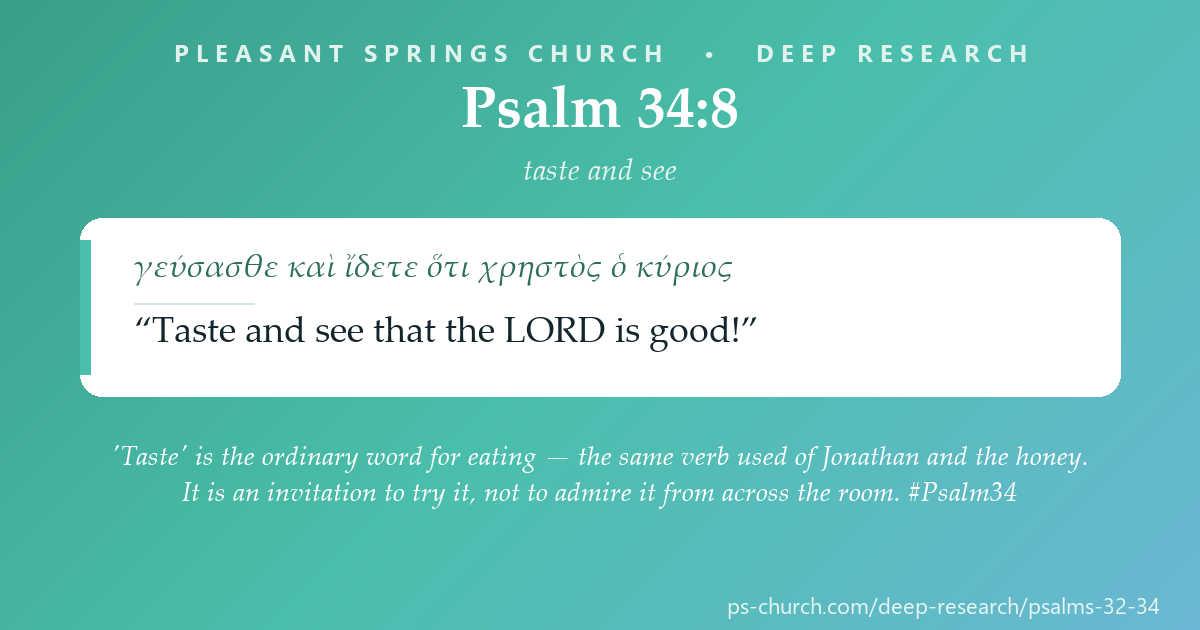
“Taste and see.” The verb is literal — it is used of eating, and of Jonathan tasting the honey. The invitation is to test by experience rather than assess from a distance. Rahlfs has γεύσασθε, and renders good as χρηστός — which differs from Χριστός by one letter, a resemblance early Christian readers remarked on.
“His bones” — singular possessor. Rahlfs reads αὐτῶν, their bones, generalising the promise to the righteous as a class. John 19:36 quotes it in the singular, matching the Hebrew’s number rather than Rahlfs’ — and the wording there also recalls the Passover regulation that no bone of the lamb be broken (Exodus 12:46). Reported; the seeing is left to the reader.
A ledger in Romans, and a bone at the cross.
Read Romans 4:1–8 with Psalm 32:1–2 and Genesis 15:6 side by side.
Which cross-references matter?
- Romans 4:7–8 → Psalm 32:1–2. Paul’s second witness, after Genesis 15:6, that righteousness is credited rather than earned. Both texts turn on the same accounting verb.
- Genesis 15:6 → Psalm 32:2. The same root for reckoned.
- 1 Peter 2:3 and 3:10–12 → Psalm 34:8, 12–16. Peter quotes this psalm twice, including five consecutive verses of its teaching section.
- John 19:36 and Exodus 12:46 → Psalm 34:20. The unbroken bone — the psalm and the Passover regulation both stand behind the citation. Stated; the seeing is left to the reader.
- Psalm 20:7 → Psalm 33:16–17. The uselessness of cavalry, twice — see Psalms 19–21.
- Psalm 34 title → 1 Samuel 21:10–15. The heading says Abimelech; the story says Achish. A real discrepancy, reported and not explained away.
Three open questions.
Beale and Carson for the three New Testament uses; Wilson on untitled psalms.
Commentaries & studies:
- John Goldingay, Psalms 1–41; Robert Alter, The Book of Psalms.
- Beale and Carson, Commentary on the NT Use of the OT — Romans 4, 1 Peter 2–3, John 19.
- Gerald H. Wilson, The Editing of the Hebrew Psalter — on untitled psalms.
- NETS Psalms, with Rahlfs — for the supplied title and 34:20.
Three things reported as unsettled:
- Whether Psalm 33’s twenty-two verses are deliberate. The count is a fact; the intention is not recoverable.
- Whether the Greek titles preserve older tradition or reflect later liturgical practice. Five instances are now verified on this shelf, and the Greek Psalter offers no apparatus for dating any of them.
- Why Psalm 34’s title names Abimelech where 1 Samuel names Achish. Proposals include a dynastic title rather than a personal name. Unresolved.
Three verbs for one mercy.
Name what you learned, why it matters, and one concrete response.
What should we carry away — and do?
- Psalm 32 gives three different pictures, not one. Transgression lifted and carried off; sin covered over; iniquity not entered in the ledger. The third is a bookkeeping word, and it is the one Paul builds Romans 4 on.
- The cost described is physical. While I kept silent, my bones wasted away. The psalm’s argument against concealment is not that it is wrong but that it is exhausting.
- “Taste and see” is an invitation to test, not to admire. The verb is the ordinary one for eating. You are being asked to try it, not to evaluate it from across the room.
- One concrete response. Psalm 33 rests everything on the reliability of what God said and nothing on equipment — the war horse is a false hope. Name the thing you are actually counting on this week. It is probably a horse.
Psalm 34:8 · to share
Hebrew + Greek (Rahlfs) + ESVEvery Deep Research page traces its passage across the whole sweep — the Old Testament, the Second-Temple world between the testaments (historical witnesses, not Scripture), and the New Testament. Follow the thread:
Pleasant Springs Church — Deep Research
Research method after Michael S. Heiser’s Bible Research Method (examine dictionaries → ancient literature → important words → textual connections → academic publications → share), with the Pleasant Springs “Author & Audience” foundation. Scripture set in the Hebrew, the Greek editions named on each page and the ESV (Old Testament), and the Greek New Testament and the ESV (New Testament), per the practice of Pleasant Springs Church. Psalms 32–34 research grounded in Goldingay (Psalms 1–41), Alter and Wilson, with Beale and Carson for the three New Testament citations. Text: Hebrew from the Masoretic text as printed in the editions consulted — Sefaria’s Miqra according to the Masorah; no critical apparatus was consulted for the Hebrew. Greek from Rahlfs’ Greek Psalter (CATSS digitization of Rahlfs 1931). The standing caution for this shelf applies: these pages say “Rahlfs’ Greek Psalter reads…” and never call a Greek reading early or late. ⚠️ Both Psalm 33 observations were computed. Its 22-verse length was confirmed and its verse-initial letters listed to establish that it is not acrostic (reš, he, šin, kap, ʾalep, bet…); Psalms 38 and 103 were checked the same way, 103 confirming the same length-without-scheme profile. Whether the count is intentional is explicitly left open. The absence of a Hebrew title at 33:1 and Rahlfs’ supplied τῷ Δαυιδ were verified by direct comparison of verse 1 in both columns — an earlier automated survey of untitled psalms returned an obviously false result against pointed text and was discarded rather than relied on. The title-plus pattern is now stated as a five-instance generalisation (Psalms 24, 27, 29, 33, 144), with the question of whether these preserve older tradition or reflect later liturgical practice named as undecidable from this edition. The 34:20 number difference — Hebrew his bones, Rahlfs their — was verified, and it is noted that John 19:36 follows the singular, with the Exodus 12:46 Passover regulation mentioned as also standing behind the citation and nothing built on either. Psalm 34’s acrostic profile is carried over from the Psalms 24–25 page rather than re-derived. The Abimelech/Achish discrepancy in the Psalm 34 heading is reported as a real difficulty and not explained away. Typology is handled per the house position: what the text says, what the New Testament itself draws, and what we see from this side of the cross — with the seeing left to the reader.
Scripture quotations marked ESV are from the ESV® Bible (The Holy Bible, English Standard Version®), © 2001 by Crossway, a publishing ministry of Good News Publishers. ESV Text Edition: 2016. Used by permission. All rights reserved. The ESV text may not be quoted in any publication made available to the public by a Creative Commons license, and the ESV may not be translated in whole or in part into any other language. www.esv.org
|
Did this study bless you today? 💚 Give to Support PS Church100% of gifts go to the General Fund — thank you. |