This is one of the psalms that asks God to hurt people, and there is no point pretending otherwise. Let them be like chaff… let ruin come upon him unawares… let the net he hid ensnare him. But its centre is the opposite of its edges — and it is the verse where the Hebrew and the Greek disagree. The Hebrew says when they were sick, and describes the speaker putting on sackcloth, fasting, and going about bowed down as one who laments his mother — for the people now hunting him. Rahlfs reads it as when they were troubling me: piety under attack rather than intercession at a sickbed. English Bibles follow the Hebrew, and the Hebrew is the harder reading — not because it is more comfortable, but because it makes the curses cost something. There is a second surprise here too: the angel of the LORD appears twice in this psalm, and only three times in the entire Psalter — verified across all 150. The other is next door, in Psalm 34, where he encamps around the faithful. Here he drives and pursues. Same figure, adjacent psalms, opposite jobs. See the method →
Psalm 35:1–28 (selections)
Hebrew · Greek (Rahlfs’ Psalter) · ESV⚠️ But the centre of the psalm is the opposite, and it is the verse where the Hebrew and the Greek disagree.
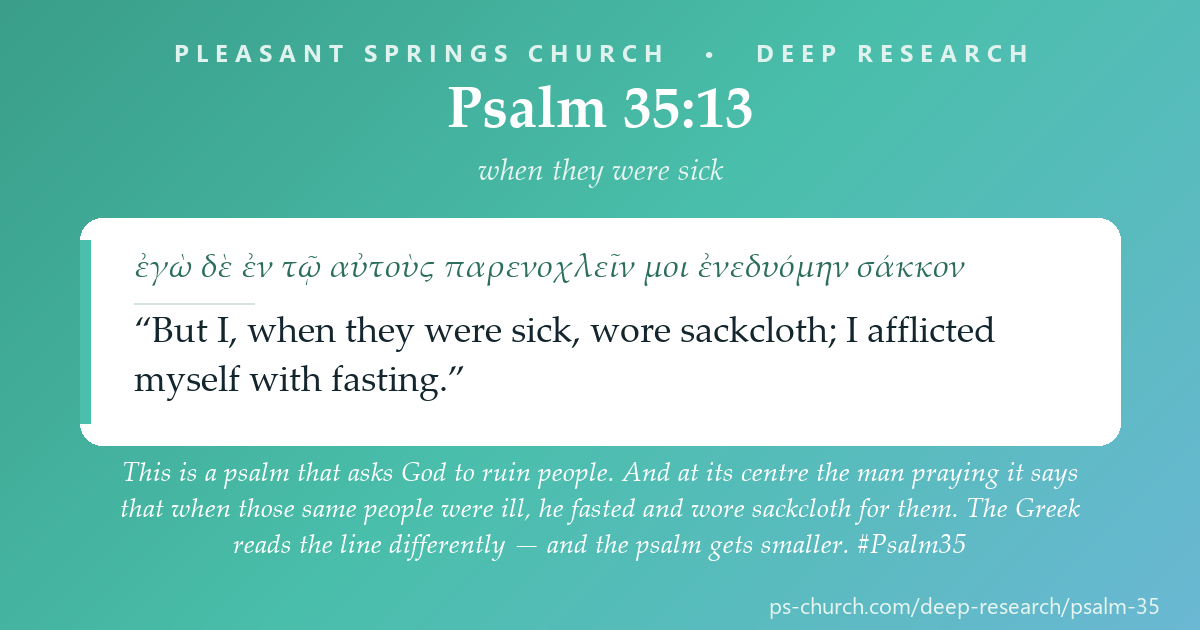
The Hebrew of verse 13 reads baḥălōṯām — “when they were sick.” The speaker is saying that when the people now hunting him were ill, he put on sackcloth and fasted for them, and went about as though mourning a mother.
Rahlfs reads it differently: ἐν τῷ αὐτοὺς παρενοχλεῖν μοι — “when they were troubling me.” On that reading the fasting is self-defence during harassment rather than intercession during their illness.
The difference matters more than most. The Hebrew gives the psalm a moral centre: the man asking for his enemies’ ruin is the same man who fasted at their sickbeds. The Greek removes that, and the psalm becomes simpler and smaller. Both readings are reported here; the Hebrew is the one the ESV and most English versions follow.
⚠️ And the angel of the Lord appears here twice — which is remarkable, because he barely appears in the Psalter at all.
Verified across all one hundred and fifty psalms: the phrase malʾaḵ YHWH occurs exactly three times in the entire book — once at Psalm 34:7, and twice here at 35:5 and 35:6. Two adjacent psalms hold all three, and the rest of the Psalter has none.
And the two psalms give him opposite jobs.
• Psalm 34:7 — the angel of the Lord encamps around those who fear him, and delivers them. A guard.
• Psalm 35:5–6 — the angel of the Lord drives them like chaff and pursues them down a dark and slippery road. A pursuer.
The same figure, in consecutive psalms, standing between the speaker and his enemies and facing in both directions. Whether the placement is deliberate cannot be shown; the count can.
The Shape of the Passage
SequenceThree things are worth holding alongside that, and none of them explains it away.
First, the psalm asks God to act and never proposes acting itself. Every verb of harm is addressed to God as a request. The speaker is handing the matter over, not taking it up — which is a different act from revenge, whatever else is said about it.
Second, the language is legal before it is military. Verse 1 uses rîḇ, the word for a lawsuit, and the psalm ends asking God to vindicate — to give a verdict. What is being requested is a hearing with a finding, and the finding has consequences.
Third, and least expected: the man praying this fasted for these people when they were ill. Verses 13–14 are in the same psalm as verses 4–8. He is not describing strangers.
A solo study. Psalm 35 is one of the imprecatory psalms, and this page reads it without softening the requests or pretending the difficulty is a mistranslation.
Author
He asks God to pick up weapons. Take hold of shield and buckler… draw the spear. And in the same breath asks for one sentence: say to my soul, I am your salvation. Armament and reassurance, in four verses.
He had mourned for the people now hunting him. When they were sick… as one who laments his mother. That is the detail that makes the psalm hard rather than simple.
And he never proposes doing anything himself. Every request for harm is addressed to God. The psalm is a handover, not a plan.
Audience
People being lied about in public. Malicious witnesses rise up; they ask me of things I do not know. The setting is a hearing where the charges are invented.
People who had been generous to the wrong people. Verses 13–14 assume a reader who has done that — and the psalm does not tell them it was a mistake.
And people who needed the psalm to end somewhere else. It does: the LORD, who delights in the welfare of his servant. The last word is not the curse.
Orient on imprecation, on the angel of the LORD, and on false witness.
Search by topic: imprecatory psalms; cursing; angel of the LORD; false witness; lawsuit (rib); vindication.
Which articles are relevant?
- Anchor Bible Dictionary — “Curse,” “Angel of the Lord,” “Witness,” “Law, Legal Procedure.”
- Dictionary of the OT: Wisdom, Poetry & Writings (IVP) — “Imprecation,” “Enemies,” “Lament,” “Vengeance.”
- NIDOTTE / TDOT — רִיב (rîḇ, lawsuit), חִנָּם (ḥinnām, without cause), מַלְאָךְ (malʾāḵ, messenger), חָלָה (ḥālāh, to be sick).
- On the Greek — the NETS Psalms introduction, and verse 13, where the Greek reads a different situation from the Hebrew.
Bibliography surfaced:
- John Goldingay, Psalms 1–41; Robert Alter, The Book of Psalms.
- C. S. Lewis, Reflections on the Psalms — the best-known attempt to read the cursing psalms honestly, and worth engaging even where one disagrees.
- Erich Zenger, A God of Vengeance? — a full-length defence of the imprecatory psalms as prayer.
A lawsuit, a courier who works both sides, and a verse the versions split on.
The verse 13 divergence is the substance of this page; the angel count is the surprise.
Which parallels shed light on this psalm?
The psalm opens as a lawsuit, not a battle. Rîḇ is the standard word for a legal dispute — the prophets use it when God brings a case against Israel — and the psalm ends by asking for a verdict (vindicate me, verse 24). The military language in between sits inside that frame: the request is for a judge who enforces his own judgments.
“Hating without cause” is a legal charge, not a mood. Ḥinnām means gratuitously, for nothing — the same word used of working without wages. The complaint is that no offence has been established, which is why it belongs in a psalm about a rigged hearing.
And the angel of the Lord is a border figure. Across the Old Testament he appears where God is acting directly in the world — at Hagar’s well, at the burning bush, before Balaam with a drawn sword, at the threshing floor with a plague. He protects and he destroys, depending on which side of him you are standing — which is exactly what Psalms 34 and 35 do with him.
- Psalm 34:7 → Psalm 35:5–6. The Psalter’s only three occurrences of the angel of the Lord, in adjacent psalms, encamping around the faithful and driving the enemy. See Psalms 32–34.
- Numbers 22:22–35 and 2 Samuel 24:16 → Psalm 35:5. The angel with a drawn sword, and the angel at the threshing floor. Both faces of the same figure.
- John 15:25 → Psalm 35:19 or Psalm 69:4. They hated me without a cause. ⚠️ Both psalms carry the phrase, in Hebrew and in Greek — verified — and John does not say which he means. The page reports both and chooses neither.
- Psalm 69 → Psalm 35. The other great psalm of unjust hostility, and it shares this one’s vocabulary. It is on this library’s list for a solo study.
- Job 30:25 → Psalm 35:13–14. Did I not weep for him whose day was hard? The same protest — I grieved for these people — and see the library’s Job studies.
- Romans 12:19 → Psalm 35. Never avenge yourselves… leave it to the wrath of God. Whatever else is said about the imprecatory psalms, this is what they do — they hand it over.
This is the moral hinge of the psalm, and the two traditions do not agree about what it says.
The Hebrew reads waʾănî baḥălōṯām — “but I, when they were sick…” from ḥālāh, to be ill. What follows is a list of mourning behaviours performed on their behalf: sackcloth, fasting, prayer, walking about bowed down as one who laments his mother.
Rahlfs reads ἐν τῷ αὐτοὺς παρενοχλεῖν μοι — “when they were troubling me…” The illness has gone; harassment has taken its place.
The consequence for the psalm is large.
• On the Hebrew, the speaker is a man who nursed and mourned the people now trying to destroy him. The imprecations are being prayed by someone with a demonstrated record of the opposite behaviour, and that is precisely his complaint: they repay me evil for good.
• On the Greek, he fasted while under attack. That is piety under pressure, which is admirable and much less pointed.
How the difference arose is not recoverable. The Hebrew verb for being ill and several verbs of harassment are not far apart in an unpointed text, and a translator reading a psalm full of hostility might reasonably have expected the second. No apparatus for the Greek Psalter permits calling either reading earlier, and this page does not.
What it does say is that the English Bibles follow the Hebrew here, and that the Hebrew is the harder and better reading — not because it is more comfortable, but because it is what makes verses 4–8 cost something.
A lawsuit, a sickbed, and a wink.
Read verses 11–14 straight through. They are the reason this psalm is difficult rather than merely harsh.
Counted here, not assumed:
- The angel of the Lord occurs exactly three times in the entire Psalter — 34:7, 35:5, 35:6. Verified across all 150 psalms. Two adjacent psalms hold all three, and he protects in one and pursues in the other.
- At 35:13 the Hebrew has when they were sick; Rahlfs has when they were troubling me. Verified in both columns. English versions follow the Hebrew.
- Ḥinnām, without cause, occurs twice in this psalm — verses 7 and 19.
- The phrase those who hate me without cause stands in both Psalm 35:19 and Psalm 69:4, in Hebrew and in Greek — so John 15:25 could be quoting either. Verified in both psalms; the page names both.
- Hebrew, Rahlfs and English all give Psalm 35 twenty-eight verses. No offset; the short title folds into verse 1.
- Every request for harm in the psalm is addressed to God. Checkable in any translation.
“Conduct my lawsuit.” A legal term, not a military one — rîḇ is the word for a formal dispute, and the prophets use it of God bringing a case. The psalm opens in court and asks for a verdict at verse 24. Rahlfs keeps the register with δίκασον, give judgment. The Hebrew line is also a wordplay: rîḇāh ʾeṯ yərîḇay — contend with my contenders.
“When they were sick.” From ḥālāh, to be ill — the ordinary word for sickness. The speaker is describing what he did at his enemies’ bedsides. Rahlfs reads instead when they were troubling me, which removes the illness altogether. English versions follow the Hebrew. This is the verse the psalm’s moral weight rests on.
“The angel of the Lord” — and this phrase occurs exactly three times in the whole Psalter: once at 34:7, where he encamps around those who fear God, and twice here, where he drives and pursues the enemy. Verified across all 150 psalms. Elsewhere in the Old Testament he stands at Hagar’s well, at the bush, before Balaam with a drawn sword.
“Without cause, gratuitously” — the word used of work done for no wages. It occurs twice in this psalm: they hid their net without cause (v.7), and they hate him without cause (v.19). The claim is legal — that no offence has been shown — and Rahlfs uses δωρεάν, which likewise means for nothing, as a gift.
“They wink the eye.” A gesture of conspiratorial malice, and Proverbs uses it of the troublemaker (Proverbs 6:13; 10:10). It is a small, precise, humiliating detail in the middle of a psalm about armies and nets — the enemies are not only dangerous; they are enjoying it. Rahlfs has διανεύοντες ὀφθαλμοῖς.
A sword at a roadside, and a sentence from the upper room.
Read Psalm 35:19 and Psalm 69:4 together, then John 15:25. Two candidates, one quotation.
Which cross-references matter?
- John 15:25 → Psalm 35:19 or Psalm 69:4. They hated me without a cause. Both psalms carry the phrase; John cites “their Law” without naming a psalm. See the reference page.
- Psalm 34:7 → Psalm 35:5–6. The Psalter’s only angel-of-the-LORD verses — see Psalms 32–34.
- Numbers 22:31; 2 Samuel 24:16 → Psalm 35:5. The angel with a sword, and the angel who stops.
- Job 30:25 → Psalm 35:13–14. Did I not weep for him whose day was hard?
- Romans 12:19 → Psalm 35 as a whole. Leave it to the wrath of God. The imprecatory psalms do exactly that — they are addressed to God, not to a mob.
- Proverbs 6:13; 10:10 → Psalm 35:19. Winking the eye as the troublemaker’s signature gesture.
How the cursing psalms are read, and three open questions.
Lewis and Zenger disagree productively; read both.
Commentaries & studies:
- John Goldingay, Psalms 1–41; Robert Alter, The Book of Psalms.
- C. S. Lewis, Reflections on the Psalms — candid about finding these psalms repellent, and unwilling to pretend otherwise.
- Erich Zenger, A God of Vengeance? — argues they are the prayer of the powerless and belong in Christian worship.
- NETS Psalms, with Rahlfs — for verse 13.
Three things reported as unsettled:
- Whether 35:13 means when they were sick or when they harassed me. Hebrew and Greek differ; English follows the Hebrew. Neither can be shown earlier.
- Which psalm John 15:25 quotes. Psalm 35:19 and Psalm 69:4 both have the phrase in both languages. John does not say.
- How the imprecations should be prayed, if at all. The tradition has answered this several incompatible ways, and this page sets out what the psalm does — hands the matter to God, in legal language, from someone who had cared for these people — without prescribing a use.
A hard psalm, read without softening.
Name what you learned, why it matters, and one concrete response.
What should we carry away — and do?
- The psalm hands it over. Every request for harm is addressed to God, and the speaker never proposes doing anything himself. That is not the same as revenge, and Romans 12:19 asks for exactly this transfer.
- It is a lawsuit before it is a battle. The first word is the term for bringing a case, and the psalm ends asking for a verdict. What is wanted is a finding of fact, from a judge who acts on his findings.
- He fasted for these people when they were ill. Verses 13–14 sit in the same psalm as the curses, and they are what make it cost something. The Greek reads that verse differently and the psalm gets smaller.
- One concrete response. The psalm ends on the Lord, who delights in the welfare of his servant. If you are going to pray a psalm like this, pray all twenty-eight verses — the ones about the sickbed and the one about delight, not only the ones about the net.
Psalm 35:13 · to share
Hebrew + Greek (Rahlfs) + ESVEvery Deep Research page traces its passage across the whole sweep — the Old Testament, the Second-Temple world between the testaments (historical witnesses, not Scripture), and the New Testament. Follow the thread:
Pleasant Springs Church — Deep Research
Research method after Michael S. Heiser’s Bible Research Method (examine dictionaries → ancient literature → important words → textual connections → academic publications → share), with the Pleasant Springs “Author & Audience” foundation. Scripture set in the Hebrew, the Greek editions named on each page and the ESV (Old Testament), and the Greek New Testament and the ESV (New Testament), per the practice of Pleasant Springs Church. Psalm 35 research grounded in Goldingay (Psalms 1–41) and Alter, with Lewis (Reflections on the Psalms) and Zenger (A God of Vengeance?) on the imprecations. Text: Hebrew from the Masoretic text as printed in the editions consulted — Sefaria’s Miqra according to the Masorah; no critical apparatus was consulted for the Hebrew. Greek from Rahlfs’ Greek Psalter (CATSS digitization of Rahlfs 1931). The standing caution for this shelf applies: these pages say “Rahlfs’ Greek Psalter reads…” and never call a Greek reading early or late. ⚠️ Two claims were computed across the whole book. (1) malʾaḵ YHWH was searched across all 150 psalms and occurs exactly three times — 34:7, 35:5, 35:6 — with the protective and pursuing roles noted as a genuine contrast between adjacent psalms, and the question of deliberate placement left open. (2) The phrase those who hate me without cause was verified as standing in both Psalm 35:19 and Psalm 69:4, in Hebrew and in Greek — so the page reports that John 15:25 could quote either and declines to choose. ⚠️ The verse 13 divergence was verified in both columns (Hebrew baḥălōṯām, when they were sick, against Rahlfs’ when they were troubling me), its consequence for the psalm’s moral force is set out explicitly, and neither reading is called earlier. The imprecations are neither softened nor explained away; the page states what the psalm does — addresses every request for harm to God, frames the whole in legal language (rîḇ at v.1, vindication at v.24), and places verses 13–14 in the same poem — without prescribing how or whether the psalm should be prayed. Verse counts agree at 28 in all three columns. Typology is handled per the house position: what the text says, what the New Testament itself draws, and what we see from this side of the cross — with the seeing left to the reader.
Scripture quotations marked ESV are from the ESV® Bible (The Holy Bible, English Standard Version®), © 2001 by Crossway, a publishing ministry of Good News Publishers. ESV Text Edition: 2016. Used by permission. All rights reserved. The ESV text may not be quoted in any publication made available to the public by a Creative Commons license, and the ESV may not be translated in whole or in part into any other language. www.esv.org
|
Did this study bless you today? 💚 Give to Support PS Church100% of gifts go to the General Fund — thank you. |