Psalm 36 opens with the word the prophets use for a message from God — and attaches it to sin. Nəʾum is the technical marker of prophetic speech, the term behind declares the LORD, which punctuates Isaiah, Jeremiah and Ezekiel hundreds of times. This psalm begins an oracle of transgression. Sin is given a prophet's credentials: it does not whisper or tempt, it declares — and its message is one sentence, there is no fear of God before his eyes. And the Psalter uses that word exactly twice. Verified across all 150 psalms: here, and at Psalm 110:1 — the oracle of the LORD to my Lord, the most-quoted Old Testament verse in the New. Two oracles in the whole book. One from God, one from sin. The rest of the line is among the hardest in the Psalter, and the difficulty is a single letter: the Masoretic text says the oracle is in my heart, many manuscripts say his, and the Greek has no pronoun there at all. See the method →
Psalm 36:1–12 (selections)
Hebrew · Greek (Rahlfs’ Psalter) · ESVNəʾum is the technical term of prophetic speech — the word behind the formula declares the Lord, which punctuates Isaiah, Jeremiah and Ezekiel hundreds of times. Psalm 36 begins nəʾum-pešaʿ — an oracle of transgression.
Sin is given a prophet’s credentials. It does not tempt or whisper; it declares, in the formula reserved for revelation — and the content of its oracle is stated immediately: there is no fear of God before his eyes.
⚠️ And the Psalter uses that word exactly twice. Verified across all one hundred and fifty psalms: nəʾum occurs here, and at Psalm 110:1 — and nowhere else in the book.
• Psalm 110:1 — nəʾum YHWH laʾdōnî, “the oracle of the Lord to my Lord” — the verse the New Testament quotes more than any other.
• Psalm 36:1 — the oracle of transgression to the wicked.
Two oracles in the Psalter, and they are the only two. One is God addressing a king; the other is sin addressing a man. Whether the pairing is designed cannot be shown — the count can, and it is worth knowing before reading either verse.
⚠️ The rest of the line is one of the hardest in the Psalter, and the difficulty is a single letter.
The Hebrew as pointed reads bəqereḇ libbî — in the midst of my heart. Which makes no obvious sense: the verse is about the wicked man, and then abruptly says the oracle is in my heart. Many Hebrew manuscripts and most modern versions read libbō, his heart — a difference of one letter.
Rahlfs sidesteps it entirely: ἐν ἑαυτῷ, within himself. No first person at all. The page reports the difficulty rather than resolving it — and notes that the harder Hebrew reading, if kept, says something uncomfortable: that the psalmist hears this oracle in his own chest.
⚠️ And the second half of the verse is where Paul ends his case. “There is no fear of God before his eyes” is the last line of the chain in Romans 3:10–18 — and it is also the last line of the long Greek plus at Psalm 14:3. The same sentence closes both.
The Shape of the Passage
ContrastThe four dimensions in verses 5–6 are worth reading as a set. Ḥeseḏ reaches the heavens, faithfulness the clouds, righteousness stands like mountains, and judgements go down to təhōm rabbāh, the great deep — the word for the primeval waters of Genesis 1. Two measurements upward, one of solidity, one downward into the abyss. The psalm is answering the man of verse 1 with scale.
And then it says something the surrounding verses do not prepare you for: man and beast you save. In a psalm about human wickedness and divine love, the animals are included in the rescue in a single clause, with no explanation offered. Rahlfs keeps it exactly — ἀνθρώπους καὶ κτήνη σώσεις.
Psalm 36:1 is one of the six texts embedded in the long Greek plus at Psalm 14:3, and the last line of Paul’s chain in Romans 3. The two pages belong together.
Author
He gives sin a prophet\u2019s formula. N\u0259\u02bcum is the word that introduces divine speech, and he attaches it to transgression. Sin does not whisper here; it issues an oracle.
He describes self-deception as a process. No fear, then flattering himself, then deceitful speech, then plotting in bed, then no longer rejecting evil. Four verses, five stages.
And he changes subject without a hinge. Verse 5 begins the sky with no connective at all. The psalm sets the two things side by side and lets the reader do the work.
Audience
People who had met the man in verses 1\u20134. He flatters himself in his own eyes. The portrait is of someone who has become unable to see his own case, which is a recognisable and unfrightening kind of person until you are on the wrong side of him.
People who needed the scale changed. The answer offered is not an argument but a measurement — heavens, clouds, mountains, the deep.
And people with animals. Man and beast you save. The clause is unexplained and unretracted.
Orient on prophetic formulae, on hesed, and on the great deep.
Search by topic: oracle formulae (neum); prophetic speech; hesed; tehom and the deep; wings of God; fountain of life.
Which articles are relevant?
- Anchor Bible Dictionary — “Prophecy,” “Oracle,” “Deep, The,” “Love (OT).”
- Dictionary of the OT: Wisdom, Poetry & Writings (IVP) — “Wickedness,” “Steadfast Love,” “Creation Theology,” “Imagery: Light.”
- NIDOTTE / TDOT — נְאֻם (nəʾum, oracle), חֶסֶד (ḥeseḏ), תְּהוֹם (təhōm, deep), מָקוֹר (māqōr, spring).
- On the Greek — the NETS Psalms introduction, and Romans 3:10–18, where this verse closes the chain. See Psalms 11–14.
Bibliography surfaced:
- John Goldingay, Psalms 1–41; Robert Alter, The Book of Psalms — both careful about the first line.
- Beale and Carson, Commentary on the NT Use of the OT — for Romans 3:18.
- Emanuel Tov, Textual Criticism of the Hebrew Bible — on one-letter variants of this kind.
A prophetic formula in the wrong mouth, and a one-letter problem.
The nəʾum count is the finding; the pronoun is the difficulty.
Which parallels shed light on this psalm?
The formula is unmistakable and it is being borrowed. Nəʾum YHWH — declares the Lord — appears many hundreds of times in the prophets, marking the boundary between a prophet’s own words and God’s. It is the technical apparatus of revelation. Psalm 36 puts transgression in the slot where the divine name belongs.
Rahlfs does not attempt to reproduce the formula. He has φησίν — says — and makes the lawless man the speaker rather than transgression itself. The oracular framing disappears, and with it the point.
And təhōm rabbāh is deliberately large. Təhōm is the deep of Genesis 1:2 and of the flood — the primeval water, not an ordinary sea. Saying God’s judgements are the great deep puts them beyond sounding. Rahlfs has ἄβυσσος, the abyss, which is the same word the New Testament will use of the bottomless place.
- Psalm 110:1 → Psalm 36:1. The Psalter’s only two uses of nəʾum — God’s oracle to a king, and sin’s oracle to a man. See the Psalm 110 study.
- Romans 3:18 → Psalm 36:1. The last line of Paul’s chain — and the last line of the long Greek plus at Psalm 14:3.
- Genesis 1:2; 7:11 → Psalm 36:6. Təhōm, the deep — the water before creation and the water of the flood.
- Jeremiah 2:13 → Psalm 36:9. They have forsaken me, the fountain of living waters. The same image, used as an accusation.
- Psalm 17:8; Ruth 2:12 → Psalm 36:7. The shadow of the wings — see Psalms 15–17.
- John 1:4–9 → Psalm 36:9. In him was life, and the life was the light of men. Life and light, in that order, in one sentence. Stated; the seeing is left to the reader.
The word nəʾum is not ordinary vocabulary. It is the marker of prophetic speech — the formula that says what follows is not mine. Isaiah, Jeremiah and Ezekiel use it constantly.
⚠️ The book of Psalms uses it twice. Verified across all one hundred and fifty psalms.
• Psalm 110:1 — nəʾum YHWH laʾdōnî, “the oracle of the Lord to my Lord: sit at my right hand…” The single most quoted Old Testament verse in the New Testament.
• Psalm 36:1 — nəʾum-pešaʿ lārāšāʿ, “the oracle of transgression to the wicked.”
Two oracles. One from God, one from sin. And the Psalter contains no others.
What that does to Psalm 36 is considerable. Sin is not depicted as an appetite or a weakness here. It is depicted as a speaker with standing — something that issues declarations, in the register reserved for revelation, and is believed. Its message is a single proposition: there is no fear of God before his eyes.
⚠️ Rahlfs loses this. He reads φησὶν ὁ παράνομος — the lawless man says — making the wicked person the speaker rather than transgression itself. A reasonable simplification of a strange line, and the strangeness was the point.
⚠️ And a one-letter difficulty sits in the same verse. The Masoretic text reads libbî, my heart — which is hard to construe, since the verse is about someone else. Many Hebrew manuscripts read libbō, his heart, and most English versions follow them; Rahlfs avoids the pronoun altogether with within himself. The page reports all three and adopts none — while noting that the harder Masoretic reading, if it stands, has the psalmist hearing this oracle in his own chest.
A prophetic formula, and a pronoun that will not settle.
Read Psalm 36:1 and Psalm 110:1 side by side. They are the Psalter’s only two oracles.
Counted here, not assumed:
- Nəʾum occurs exactly twice in all 150 psalms — Psalm 36:1 and Psalm 110:1. Verified across the whole book. One oracle from God, one from transgression.
- The Masoretic text reads my heart at 36:1; many Hebrew manuscripts read his; Rahlfs has neither, reading within himself. A one-letter difficulty, reported and not resolved.
- Rahlfs makes the lawless man the speaker, where the Hebrew makes transgression the speaker. The oracular framing is lost in Greek.
- 36:1b is the last line of Romans 3:10–18 — and the last line of the long Greek plus at Psalm 14:3. The same sentence closes both chains.
- Ḥeseḏ occurs three times in twelve verses.
- Hebrew and Rahlfs give Psalm 36 thirteen verses; English gives twelve. The title is counted as verse 1.
“Oracle, utterance” — the technical marker of prophetic speech, used hundreds of times in the prophets in the formula declares the Lord. It occurs exactly twice in the Psalter — here, of transgression, and at Psalm 110:1, of God. Verified across all 150 psalms. Rahlfs does not reproduce the formula, reading simply φησίν.
“Steadfast love, covenant loyalty” — three occurrences in this short psalm, and the first is measured against the sky. The word means faithfulness to a commitment freely undertaken, and it is the Old Testament’s central term for how God holds to people. Rahlfs uses ἔλεος, mercy — the standard equivalence, and narrower than the Hebrew.
“The great deep” — not an ordinary sea but the primeval water of Genesis 1:2, and the source of the flood. To say God’s judgements are the great deep is to say they cannot be sounded. Rahlfs has ἄβυσσος, the abyss — the word the New Testament uses of the bottomless place.
“Man and beast.” A single clause, unexplained — “man and beast you save, O Lord.” In a psalm about human wickedness and divine love, the animals are simply included. Rahlfs keeps it exactly: ἀνθρώπους καὶ κτήνη σώσεις. Compare the end of Jonah, where God’s last word is about cattle.
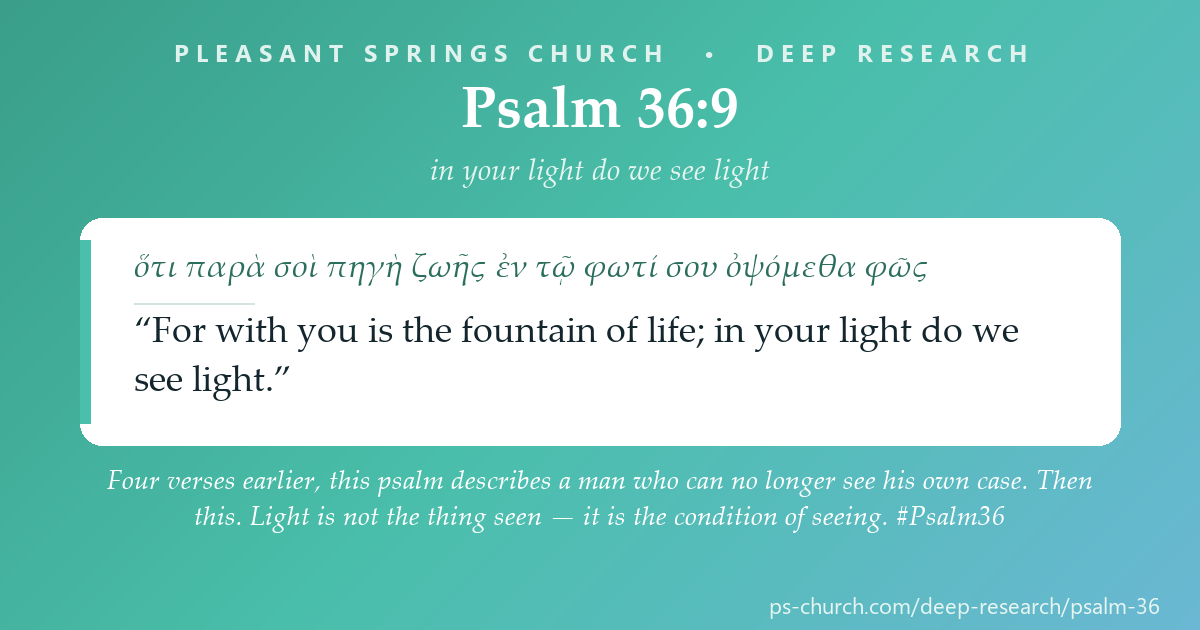
“Fountain of life” — a spring, not a reservoir; the word is used of a source that keeps producing. Jeremiah 2:13 uses the same image as an accusation — they have forsaken me, the fountain of living waters, to dig cisterns. The line that follows is the psalm’s most quoted: in your light do we see light — light is not the thing seen but the condition of seeing.
Two oracles, and the end of a chain.
Read Romans 3:10–18 and note where it stops. That last line is this psalm.
Which cross-references matter?
- Psalm 110:1 → Psalm 36:1. The Psalter’s only two oracles.
- Romans 3:18 → Psalm 36:1. Paul’s closing line — and see Psalms 11–14 for the Greek verse that contains the whole chain.
- Genesis 1:2 → Psalm 36:6. The deep.
- Jeremiah 2:13 → Psalm 36:9. The fountain, as accusation.
- Jonah 4:11 → Psalm 36:6. And also much cattle. God’s concern for animals, stated at the end of a book and in the middle of a psalm.
- John 1:4–9 → Psalm 36:9. Life… light. Stated; the seeing is left to the reader.
Three open questions.
Goldingay and Alter both stop at the first line; so should any careful reader.
Commentaries & studies:
- John Goldingay, Psalms 1–41; Robert Alter, The Book of Psalms.
- Beale and Carson, Commentary on the NT Use of the OT — on Romans 3:18.
- Emanuel Tov, Textual Criticism of the Hebrew Bible.
- NETS Psalms, with Rahlfs — for the reframed first line.
Three things reported as unsettled:
- Whether 36:1 reads my heart or his. The Masoretic text has the first, many manuscripts the second, and Rahlfs neither. One letter.
- Whether the two nəʾum verses are deliberately paired. The count is certain; the design is not demonstrable.
- How the psalm’s two halves relate. There is no connective at verse 5, and proposals range from deliberate juxtaposition to two psalms joined. The text gives no hinge.
Sin with a prophet's credentials.
Name what you learned, why it matters, and one concrete response.
What should we carry away — and do?
- Sin is given a prophet’s formula. The word is the one that introduces declares the Lord, and the Psalter uses it exactly twice — once for God, once for transgression. Sin here is not an appetite. It is a speaker that expects to be believed.
- Its message is a single sentence. There is no fear of God before his eyes. Paul ends his whole case against humanity on that line, and so does the long Greek verse at Psalm 14:3.
- The answer offered is not an argument but a measurement. Heavens, clouds, mountains, the great deep. The psalm does not refute the oracle; it changes the scale.
- One concrete response. In your light do we see light — light is not what is seen but the condition of seeing. The man in verses 1–4 lost the ability to see his own case. Ask to be shown yourself, not just your circumstances.
Psalm 36:9 · to share
Hebrew + Greek (Rahlfs) + ESVEvery Deep Research page traces its passage across the whole sweep — the Old Testament, the Second-Temple world between the testaments (historical witnesses, not Scripture), and the New Testament. Follow the thread:
Pleasant Springs Church — Deep Research
Research method after Michael S. Heiser’s Bible Research Method (examine dictionaries → ancient literature → important words → textual connections → academic publications → share), with the Pleasant Springs “Author & Audience” foundation. Scripture set in the Hebrew, the Greek editions named on each page and the ESV (Old Testament), and the Greek New Testament and the ESV (New Testament), per the practice of Pleasant Springs Church. Psalm 36 research grounded in Goldingay (Psalms 1–41), Alter and Tov, with Beale and Carson for Romans 3:18. Text: Hebrew from the Masoretic text as printed in the editions consulted — Sefaria’s Miqra according to the Masorah; no critical apparatus was consulted for the Hebrew, so the manuscript support for libbō is reported from the commentaries rather than inspected. Greek from Rahlfs’ Greek Psalter (CATSS digitization of Rahlfs 1931). The standing caution for this shelf applies: these pages say “Rahlfs’ Greek Psalter reads…” and never call a Greek reading early or late. ⚠️ The central claim was computed across the whole book: nəʾum was searched in all one hundred and fifty psalms and occurs exactly twice — Psalm 36:1 and Psalm 110:1. The page states the count as certain and the question of deliberate pairing as not demonstrable. The first line’s pronoun difficulty is reported three ways and resolved none: Masoretic libbî (my heart), the widely-attested libbō (his) followed by most English versions, and Rahlfs’ avoidance of the pronoun with ἐν ἑαυτῷ — with the note that the harder Masoretic reading, if it stands, places the oracle in the psalmist’s own chest. Rahlfs’ reassignment of the speaker from transgression to the lawless man was verified in both columns and is described as a reasonable simplification that loses the point. The link to Romans 3:18 is stated together with the observation, established on Psalms 11–14, that the same sentence closes the long Greek plus at Psalm 14:3. Verse counts were checked in all three columns (Hebrew and Rahlfs 13; English 12). Typology is handled per the house position: what the text says, what the New Testament itself draws, and what we see from this side of the cross — with the seeing left to the reader.
Scripture quotations marked ESV are from the ESV® Bible (The Holy Bible, English Standard Version®), © 2001 by Crossway, a publishing ministry of Good News Publishers. ESV Text Edition: 2016. Used by permission. All rights reserved. The ESV text may not be quoted in any publication made available to the public by a Creative Commons license, and the ESV may not be translated in whole or in part into any other language. www.esv.org
|
Did this study bless you today? 💚 Give to Support PS Church100% of gifts go to the General Fund — thank you. |