This is the fifth acrostic this library has worked, and it is built differently from all four of the others. Forty verses for twenty-two letters — the scheme runs roughly two verses to a letter, where Psalms 25, 34 and 145 give one and Psalm 119 gives eight. And it defeated the method that worked on every one of them. A strict first-letter test recovers those four cleanly and returns a mess here, for two reasons that are both checkable: the title occupies the first slot, so the acrostic aleph sits on the second word of verse 1 — and the scheme tolerates a prefixed conjunction, so the taw verse near the end hides its letter behind a waw. The tool has to be adjusted to the poem, and this page says so, because anyone trying the count at home will hit the same wall. Verse 11 is the line Jesus used in the Beatitudes, almost word for word from the Greek. And verse 25 is the sentence readers stumble over — which Job's friends also argue, and which the book of Job does not endorse. Scripture keeps both, and this page does not tidy that up. See the method →
Psalm 37:1–40 (selections)
Hebrew · Greek (Rahlfs’ Psalter) · ESVForty verses for twenty-two letters — which means the scheme runs roughly two verses to a letter: the letter falls on the first verse of each pair, and the second verse is free. Compare the shelf’s others: Psalm 25 and Psalm 34 give one verse per letter, Psalm 145 the same, and Psalm 119 gives eight. Psalm 37 sits between them.
⚠️ And this psalm defeated the method that worked on all the others.
A strict test — take the first letter of each verse and check it against the alphabet — recovered Psalms 119, 145, 25 and 34 cleanly. On Psalm 37 it returns a mess. Two reasons, both verifiable:
• The title occupies the first slot. Verse 1 begins ləDāwiḏ, and the acrostic ʾalep falls on the second word, ʾal. Exactly the arrangement at Psalm 25:1 and Psalm 145.
• The scheme tolerates a prefixed conjunction. The taw verse near the end reads ûṯəšûʿaṯ — the acrostic letter is the second character, sitting behind a waw.
So the tool has to be adjusted to the poem, not the poem to the tool — and this page says so, because a reader trying the count at home will hit exactly the same wall.
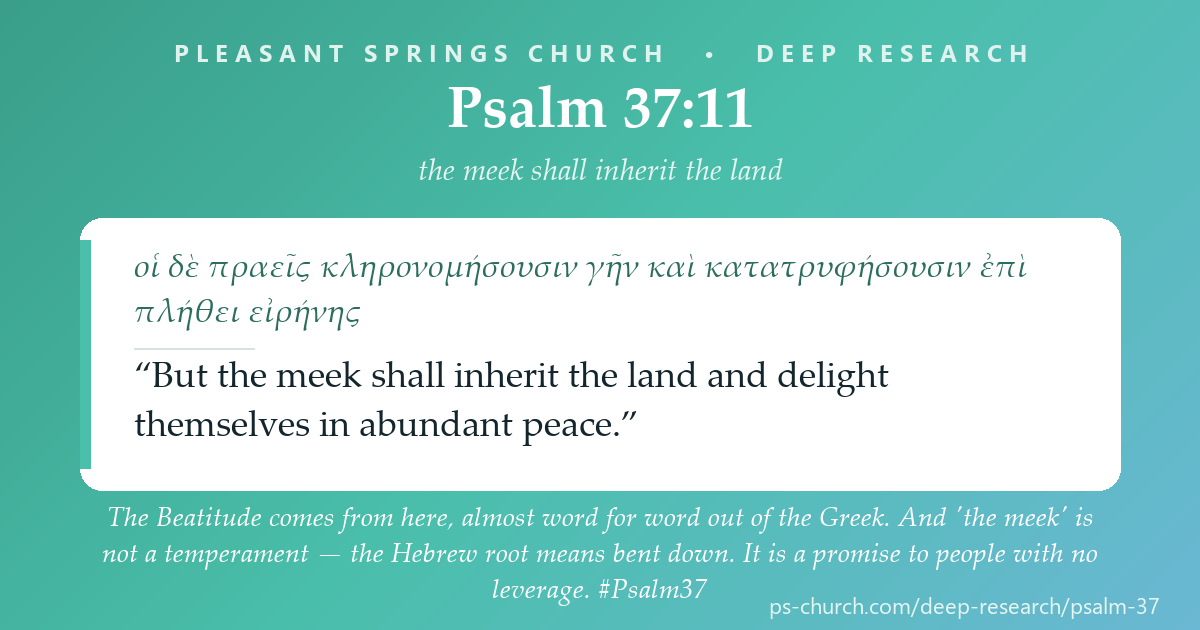
⚠️ Verse 11 is the line Jesus used. “The meek shall inherit the land” — Rahlfs reads οἱ δὲ πραεῖς κληρονομήσουσιν γῆν, and Matthew 5:5 has οἱ πραεῖς… κληρονομήσουσιν τὴν γῆν. Near enough to verbatim.
And the Hebrew word matters: ʾereṣ means land as much as earth — in this psalm it is the promised territory, repeated five times as an inheritance. Whether the Beatitude widens it is a question the psalm does not settle.
The Shape of the Passage
SequenceThe word ʾereṣ — land — runs through it like a refrain, promised to the meek, the blessed, the righteous, those who wait. It is the psalm’s answer to the question of who ends up owning anything.
And the four imperatives of verses 3–7 are worth reading as a sequence. Trust, then delight yourself, then roll your way onto him (the Hebrew verb is roll, as of a weight), then be still and wait. The last is the hardest, and it is the one the psalm keeps returning to.
A solo study, and the shelf’s fifth acrostic. Compare 119 (eight verses a letter), 145 and 25 (one), and this psalm (two).
Author
He is arguing against a feeling, not a doctrine. Fret not… be not envious. The psalm assumes its reader is not doubting God but resenting somebody else\u2019s success.
He answers with time. They will soon fade like the grass… yet a little while, and the wicked will be no more. Nearly every argument in forty verses is about how things look later.
And he offers his own life as evidence. I have been young, and now am old. That is a different kind of claim from the rest of the psalm, and it is the one readers have found hardest.
Audience
People watching the wrong people prosper. The psalm never denies that they are prospering — it disputes how long it lasts.
People without land. ʾEre\u1e63 recurs through the psalm as an inheritance promised to the meek and the waiting. That is a promise aimed at people who own nothing.
And the young, being taught. The psalm is instruction throughout, close to Proverbs in form — and an acrostic is a teaching structure.
Orient on wisdom psalms, on inheritance of the land, and on the meek.
Search by topic: wisdom psalms; acrostic; retribution; inheritance; the meek (ʿănāwîm); Beatitudes.
Which articles are relevant?
- Anchor Bible Dictionary — “Wisdom Literature,” “Retribution,” “Inheritance,” “Poor.”
- Dictionary of the OT: Wisdom, Poetry & Writings (IVP) — “Wisdom Psalms,” “Acrostic,” “Retribution,” “Land.”
- NIDOTTE / TDOT — עָנָו (ʿānāw, meek / humble), אֶרֶץ (ʾereṣ, land / earth), גָּלַל (gālal, to roll), עָנַג (ʿānaģ, to delight).
- On the Greek — the NETS Psalms introduction, and Matthew 5:5, which is close to verbatim from Rahlfs here. See the reference page.
Bibliography surfaced:
- John Goldingay, Psalms 1–41; Robert Alter, The Book of Psalms.
- Beale and Carson, Commentary on the NT Use of the OT — for Matthew 5:5.
- Any treatment of the wisdom psalms’ retribution theology — and read Job alongside it. See the library’s Job studies.
An acrostic built on pairs, and a claim about a lifetime.
The structural finding is method; verse 25 is the one that needs care.
Which parallels shed light on this psalm?
The psalm belongs with Proverbs more than with the laments. Its form is instruction, its subject is the two ways, and it argues from observation. That places it beside Psalm 1 — and, less comfortably, beside the speeches of Job’s friends, who make similar arguments and are not vindicated.
“Roll your way onto the Lord” is a physical image. The verb at verse 5 is gālal, to roll — used of rolling a stone from a well’s mouth. “Commit your way” is a fair translation and a smooth one; the Hebrew pictures shifting a weight off yourself onto someone else.
And the meek are a specific group, not a temperament. ʿ̢ănāwîm are the bent-down — the poor, the afflicted, those without leverage. The same word this library met at Psalms 9–10, where the reading tradition could not decide between afflicted and humble. Rahlfs has πραεῖς, which is the word Matthew 5:5 uses.
- Matthew 5:5 → Psalm 37:11. Close to verbatim from the Greek. See the reference page.
- Psalm 1 → Psalm 37. The two ways, argued at length — see Psalms 1–2.
- Job 4:7; 8:20 → Psalm 37:25. Who ever perished being innocent? Eliphaz and Bildad make the same argument as Psalm 37, and the book of Job does not endorse them. That tension is real and this page does not resolve it.
- Psalm 73 → Psalm 37. The same problem, reached by a different route — and Psalm 73 admits the appearance is genuinely troubling before it answers. It is on this library’s list for a solo study.
- Proverbs 3:5–6 → Psalm 37:5. Trust… and he will make straight your paths.
“I have been young, and now am old, yet I have not seen the righteous forsaken or his children begging for bread.”
This is the sentence in Psalm 37 that readers stumble over, and the stumble is not a misunderstanding. Taken as a universal claim about the world, it is contradicted by ordinary experience — and by other parts of Scripture.
Four things can be said, and none of them dissolves the difficulty.
• It is offered as testimony, not as doctrine. The verse reports what one long-lived person says he has observed. That is a different kind of sentence from “the righteous are never forsaken”, and the psalm does not generalise it into one.
• The Bible itself contains the counter-case, at length. Job’s friends argue almost exactly this (Job 4:7; 8:20) — and the book of Job ends with God telling them they have not spoken rightly. Scripture puts the argument and its refutation in the same collection and does not reconcile them for us.
• Psalm 73 reopens the question honestly. “I was envious of the arrogant when I saw the prosperity of the wicked… all in vain have I kept my heart clean.” That psalm concedes what Psalm 37 does not.
• And the psalm’s own frame is long. Its argument throughout is about duration — a little while, their day is coming, the future of the wicked shall be cut off. Read inside that frame, verse 25 is a claim about outcomes rather than about any given Tuesday — which is a fair reading and still not a comfortable one.
This page reports the verse, reports the difficulty, and reports that Scripture supplies its own counter-witness. It does not offer a resolution, because the canon does not.
A weight rolled off, and a word for people with no leverage.
Read verses 3–7 as four consecutive imperatives. The fourth is the hard one.
Counted here, not assumed:
- Psalm 37 has 40 verses covering 22 letters — roughly two verses to a letter. A different design from every other acrostic on this shelf.
- The acrostic ʾalep falls on the second word of verse 1, because the title ləDāwiḏ occupies the first slot. The same arrangement as Psalm 25 and Psalm 145.
- The scheme tolerates a prefixed conjunction — the taw verse near the end begins ûṯəšûʿaṯ, with the acrostic letter behind a waw. A strict first-letter test therefore fails on this psalm, though it succeeded on Psalms 119, 145, 25 and 34.
- ʾEreṣ occurs five times as an inheritance.
- 37:11 is close to verbatim in Matthew 5:5, following the Greek.
- Hebrew, Rahlfs and English all give Psalm 37 forty verses. No offset.
“The meek” — and it is a social word before it is a temperamental one. The root means bent down; these are the afflicted, the poor, people without leverage. Rahlfs has πραεῖς — the word Matthew 5:5 uses. Compare Psalms 9–10, where the Masoretic tradition could not settle between this word and its near-twin.
“Land” — or “earth.” It recurs five times in this psalm as an inheritance, promised to those who wait, to the meek, to the blessed, to the righteous. In its own setting the word means the promised territory — and it is the word Matthew 5:5 carries over. Whether the Beatitude widens the sense is not something the psalm decides.
“Roll.” The verb is physical — used of rolling a stone away from a well. “Commit your way to the Lord” is smooth English for “roll your way onto him” — the picture is of shifting a weight off yourself onto somebody stronger. Proverbs 16:3 uses the same verb of works.
“Delight yourself, take exquisite pleasure.” It occurs twice in this psalm and binds its two halves: delight yourself in the Lord (v.4), and the meek shall delight themselves in abundant peace (v.11). Rahlfs keeps the link with κατατρύφησον and κατατρυφήσουσιν — the same verb, imperative then future.
“Do not fret, do not get heated.” Three times in the psalm, and the root carries the sense of burning — a slow, competitive anger. The psalm treats it as the central danger, not the wicked themselves: verse 8 says plainly that fretting tends only to evil.
A Beatitude, and a book that disagrees.
Read Psalm 37:25, then Job 4:7, then Job 42:7. Scripture holds all three.
Which cross-references matter?
- Matthew 5:5 → Psalm 37:11. The meek and the land, taken over almost word for word from the Greek.
- Job 4:7; 8:20 → Psalm 37:25. Job’s friends argue this — and Job 42:7 says they have not spoken rightly. The canon contains both.
- Psalm 73 → Psalm 37. The same question, answered with more admitted difficulty.
- Proverbs 16:3 → Psalm 37:5. The same rolling verb.
- Psalm 1 → Psalm 37. The two ways — see Psalms 1–2.
- Psalm 37:31 → Psalm 40:8; Jeremiah 31:33. The law of his God is in his heart. The internalised law, before Jeremiah promises it.
Three open questions.
Read this psalm with Job and Psalm 73 open. The tension is the subject.
Commentaries & studies:
- John Goldingay, Psalms 1–41; Robert Alter, The Book of Psalms.
- Beale and Carson, Commentary on the NT Use of the OT — for Matthew 5:5.
- The library’s Job studies — where the friends’ version of this argument is worked at length.
Three things reported as unsettled:
- How verse 25 should be read. Testimony or doctrine, immediate or long-range — and Scripture supplies its own counter-witness in Job and Psalm 73. Not resolved here.
- Whether ʾereṣ in Matthew 5:5 means the land or the earth. The psalm means the land; the Beatitude uses the same Greek word, and the question of scope is not settled by either text.
- Why the acrostic slips at several points. The two-verse scheme is clear in outline and irregular in detail, and one letter does not appear cleanly at all.
Forty verses against one feeling.
Name what you learned, why it matters, and one concrete response.
What should we carry away — and do?
- The psalm is arguing with envy, not with doubt. Fret not… be not envious. It never denies that the wicked are doing well — it disputes how long that lasts, and it says fretting tends only to evil.
- “Commit your way” is a weight being rolled. The verb is the one for shifting a stone off a well. Not a mental adjustment — a transfer of load.
- The hardest verse is testimony, and the Bible argues back. I have not seen the righteous forsaken — and Job’s friends say the same thing and are told they spoke wrongly. Scripture keeps both, and this page does not tidy that up.
- One concrete response. Verses 3–7 give four imperatives, and they get harder: trust, delight, roll your way onto him, be still and wait. Most people can manage the first three.
Psalm 37:11 · to share
Hebrew + Greek (Rahlfs) + ESVEvery Deep Research page traces its passage across the whole sweep — the Old Testament, the Second-Temple world between the testaments (historical witnesses, not Scripture), and the New Testament. Follow the thread:
Pleasant Springs Church — Deep Research
Research method after Michael S. Heiser’s Bible Research Method (examine dictionaries → ancient literature → important words → textual connections → academic publications → share), with the Pleasant Springs “Author & Audience” foundation. Scripture set in the Hebrew, the Greek editions named on each page and the ESV (Old Testament), and the Greek New Testament and the ESV (New Testament), per the practice of Pleasant Springs Church. Psalm 37 research grounded in Goldingay (Psalms 1–41) and Alter, with Beale and Carson for Matthew 5:5. Text: Hebrew from the Masoretic text as printed in the editions consulted — Sefaria’s Miqra according to the Masorah; no critical apparatus was consulted for the Hebrew. Greek from Rahlfs’ Greek Psalter (CATSS digitization of Rahlfs 1931). The standing caution for this shelf applies: these pages say “Rahlfs’ Greek Psalter reads…” and never call a Greek reading early or late. ⚠️ The acrostic analysis is reported together with the failure of the method that produced it. The strict verse-initial test used successfully on Psalms 119, 145, 25 and 34 does not recover Psalm 37’s scheme; the page states the two verified reasons — the title occupies verse 1’s first slot so the ʾalep falls on the second word (as at Psalms 25 and 145, both checked), and the scheme tolerates a prefixed waw, verified at the taw verse (ûṯəšûʿaṯ). The two-verse unit is stated as the design in outline, with the irregularity in detail acknowledged and one letter noted as not appearing cleanly. ⚠️ Verse 25 is handled as a difficulty rather than a promise. The page reports it as first-person testimony rather than doctrine, and then sets against it the canon’s own counter-witness — Job 4:7 and 8:20, where the friends argue the same case, together with Job 42:7, where God says they have not spoken rightly; and Psalm 73, which concedes what Psalm 37 does not. No resolution is offered, because the canon does not supply one. Matthew 5:5 is reported as close to verbatim from Rahlfs, with the question of whether ʾereṣ/γῆ means the land or the earth left open. Verse counts agree at 40 in all three columns. Typology is handled per the house position: what the text says, what the New Testament itself draws, and what we see from this side of the cross — with the seeing left to the reader.
Scripture quotations marked ESV are from the ESV® Bible (The Holy Bible, English Standard Version®), © 2001 by Crossway, a publishing ministry of Good News Publishers. ESV Text Edition: 2016. Used by permission. All rights reserved. The ESV text may not be quoted in any publication made available to the public by a Creative Commons license, and the ESV may not be translated in whole or in part into any other language. www.esv.org
|
Did this study bless you today? 💚 Give to Support PS Church100% of gifts go to the General Fund — thank you. |