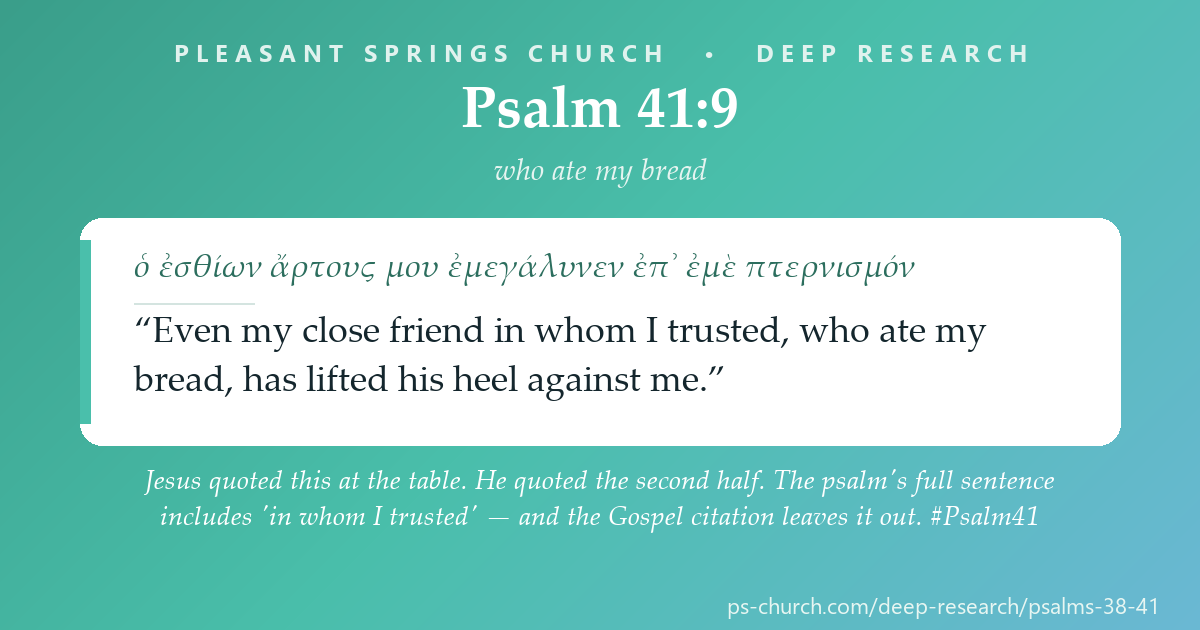
These four psalms close Book I of the Psalter, and the last of them ends with something that is not part of the psalm at all: Blessed be the LORD, the God of Israel, from everlasting to everlasting. Amen and Amen. Four such doxologies divide the book into five — editor's seams, left visible. Psalm 41:9 is the verse Jesus quoted over the table at the Last Supper, and the quotation is shorter than the psalm: the psalmist says my close friend, in whom I trusted, who ate my bread, has lifted his heel against me, and John 13:18 cites only the second half. The omission is certain; what it means is inference, and this page records the one without drawing the other. The Hebrew is more physical than English shows — he has made great against me a heel — and Rahlfs coins a noun for it built on the root behind the name Jacob, the heel-grabber. Psalm 39 supplies something else: two legal words for a foreigner that Peter uses together of Christians. See the method →
Psalms 38:1–41:13 (selections)
Hebrew · Greek (Rahlfs’ Psalter) · ESV⚠️ Psalm 41:9 is the verse Jesus quoted over the table. “Even my close friend, in whom I trusted, who ate my bread, has lifted his heel against me.” At the Last Supper he cites it directly (John 13:18) — and does something worth noticing: he quotes only the second half.
The psalm’s full sentence includes “in whom I trusted”. The Gospel citation omits it. Whether that omission is deliberate is not something the text settles, and it has been much discussed. The page notes the shape of the quotation and leaves the inference alone.
The Hebrew image is physical and slightly odd: higdîl ʿālay ʿāqēḇ — literally he has made great against me a heel. Rahlfs renders it with a coined-sounding noun, πτερνισμόν, a heel-lifting — from the same root as the name Jacob, the heel-grabber.
⚠️ Psalm 39:12 gives two words that Peter uses together. The Hebrew has gēr and tōšāḇ — a resident alien and a temporary guest, the two legal categories for someone living in a country not his own. Rahlfs renders them πάροικος and παρεπίδημος.
1 Peter 2:11 addresses its readers as παροίκους καὶ παρεπιδήμους — the same pair, in the same order. The psalmist says it of himself before God; Peter says it of Christians in the world.
⚠️ And Psalm 40:6 is the verse this library has already corrected the standard account of. “Ears you have dug for me” — Rahlfs reads ὠτία, ears, agreeing with the Hebrew, while Hebrews 10:5 reads a body. The full case is on the New Testament reference page and is not repeated here.
The Shape of the Passage
SequencePsalm 39 is the one worth slowing down for. It begins with a resolution not to speak — I will guard my ways that I may not sin with my tongue — and the silence fails: my heart became hot within me… then I spoke. And what he says, having tried not to, is a request to be told how little time he has.
Its last line is among the strangest in the Psalter: look away from me, that I may smile again, before I depart and am no more. A psalm that ends by asking God to stop looking.
These four close Book I. Psalm 40:6 belongs to the New Testament reference page, where the usual account of Hebrews 10:5 is corrected, and is not re-argued here.
Author
He describes sickness without dignity. Festering wounds, burning loins, failing eyes. Psalm 38 does not make illness noble — and it says the friends stood back.
He fails to keep quiet. Psalm 39 opens with a vow of silence and breaks it within three verses. The psalm reports the failure rather than editing it out.
And he names the betrayer by his intimacy. Not my enemy but the man of my peace, in whom I trusted, who ate my bread. Three descriptions, each one closer than the last.
Audience
People being visited by the wrong sort of well-wisher. He utters empty words while his heart gathers iniquity; when he goes out, he tells it abroad. Psalm 41 knows what a sickroom sounds like.
People aware of how short it is. Behold, you have made my days a few handbreadths. Psalm 39 is a psalm for anyone doing arithmetic on their own lifespan.
And people who owned nothing. A sojourner, a guest, like all my fathers. Peter would address Christians with the same two words.
Orient on the five books, on resident aliens, and on betrayal.
Search by topic: Psalter, five books; doxologies; ger and toshav; resident alien; sickness and lament; table fellowship.
Which articles are relevant?
- Anchor Bible Dictionary — “Psalms, Book of,” “Sojourner,” “Hospitality,” “Sickness and Disease.”
- Dictionary of the OT: Wisdom, Poetry & Writings (IVP) — “Editorial Criticism,” “Lament,” “Enemies,” “Book of Psalms: Structure.”
- NIDOTTE / TDOT — גֵּר (gēr, resident alien), תּוֹשָׁב (tōšāḇ, temporary guest), עָקֵב (ʿāqēḇ, heel), מְגִלָּה (məģillāh, scroll).
- On the Greek — the NETS Psalms introduction, and 1 Peter 2:11, which uses Rahlfs’ pair of words for Psalm 39:12.
Bibliography surfaced:
- Gerald H. Wilson, The Editing of the Hebrew Psalter — on the doxologies that divide the five books.
- John Goldingay, Psalms 1–41; Robert Alter, The Book of Psalms.
- Beale and Carson, Commentary on the NT Use of the OT — for John 13:18 and 1 Peter 2:11.
A bookbinder's seam, two kinds of foreigner, and a shared meal.
The doxology is editorial apparatus; the betrayal verse is the one most readers come for.
Which parallels shed light on these psalms?
The five-book division is marked by doxologies, and they are visible joins. Psalms 41:13, 72:18–19, 89:52 and 106:48 each close a book with a blessing and an Amen; Psalm 150 closes the whole. These are not part of the psalms they attach to — they are the editor’s work, left where the reader can see it. The Psalter does not hide the fact that it was assembled.
“Sojourner” and “guest” are legal categories, not moods. A gēr is a resident alien with defined protections under the law; a tōšāḇ is a temporary resident with fewer. Leviticus 25:23 uses both of Israel before God — the land is mine; you are strangers and sojourners with me — which is exactly the claim Psalm 39 makes personal.
And eating someone’s bread created an obligation. In the ancient Near East a shared meal established a bond that made betrayal a specific category of offence. Psalm 41:9 names the meal precisely because of that — the treachery is worse for having been committed by a guest.
- John 13:18 → Psalm 41:9. Quoted at the table, and the Gospel omits the psalm’s phrase in whom I trusted. The omission is noted and not interpreted here.
- 1 Peter 2:11 → Psalm 39:12. παροίκους καὶ παρεπιδήμους — Rahlfs’ pair, in the same order.
- Leviticus 25:23 → Psalm 39:12. Strangers and sojourners with me. The same two words, said by God of Israel.
- Hebrews 11:13 → Psalm 39:12. Strangers and exiles on the earth.
- Psalm 70 → Psalm 40:13–17. Another of the Psalter’s doublets — compare Psalm 18 // 2 Samuel 22 and Psalm 14 // Psalm 53.
- Hebrews 10:5–7 → Psalm 40:6–8. Worked in full on the reference page, where the usual account is corrected. Not repeated here.
Psalm 41:9 in Hebrew is more physical than English suggests. higdîl ʿālay ʿāqēḇ — literally “he has made great against me a heel.” The gesture is contemptuous and probably means lifting the foot to trample, or turning the heel to walk away.
Rahlfs reaches for an unusual noun: πτερνισμόν, a heel-lifting — built on πτέρνα, heel, the same root behind the Greek form of the name Jacob, the heel-grabber.
⚠️ And the Gospel citation is shorter than the psalm.
• The psalm: “Even the man of my peace, in whom I trusted, who ate my bread, has lifted his heel against me.”
• John 13:18: “He who ate my bread has lifted his heel against me.”
The clause in whom I trusted does not appear in the quotation. Readers have long noticed this and drawn conclusions from it in both directions. This page records the difference and stops there — the shape of a quotation is evidence; what an author meant by shortening it is inference.
What is not in doubt is the setting. A shared meal created an obligation, and the psalm names the bread before it names the injury. The complaint is not that an enemy attacked but that a guest did.
Two words for a foreigner, and one for a heel.
Read Psalm 39:12 and 1 Peter 2:11 side by side in Greek. The pair is identical.
Counted here, not assumed:
- Hebrew and Rahlfs give Psalms 38–41 twenty-three, fourteen, eighteen and fourteen verses. English is one behind in all four — the titles are counted as verse 1.
- Psalm 39:12 pairs gēr and tōšāḇ; Rahlfs pairs πάροικος and παρεπίδημος. 1 Peter 2:11 uses the same two Greek words in the same order.
- John 13:18 omits the psalm’s clause in whom I trusted. The shape of the quotation is recorded; the inference is not drawn.
- Psalm 40:13–17 stands again as Psalm 70 — another Psalter doublet.
- Psalm 41:13 is a book-closing doxology, not part of the psalm. Four such seams divide the Psalter into five.
- At 39:4 the Hebrew asks how fleeting the speaker is; Rahlfs asks what he lacks. Same consonants, different sense.
“Resident alien” and “temporary guest” — two distinct legal categories, not synonyms. A gēr has settled protections under the law; a tōšāḇ is passing through. Leviticus 25:23 uses both of Israel before God. Rahlfs has πάροικος and παρεπίδημος — the pair 1 Peter 2:11 uses of Christians.
“Heel.” The idiom is he made great against me a heel — a gesture of contempt, whether lifting the foot to trample or turning to walk away. Rahlfs coins πτερνισμόν, built on the word for heel — the root behind the name Jacob, who grasped his brother’s heel.
“The scroll of the book.” What document is meant is not stated — proposals include the law, a royal charter, and a heavenly record. Rahlfs has ἐν κεφαλίδι βιβλίου, in the roll of a book — and Hebrews 10:7 quotes that Greek exactly. The referent remains unstated in both languages.
“Indignation” — a strong word, used of God’s public displeasure. Psalm 38 attributes the speaker’s physical condition directly to it, and then attributes it equally to his own sin. Both causes are named in one verse, and the psalm does not choose between them.
“Fleeting, ceasing” — the request is let me know how fleeting I am. Rahlfs reads it as τί ὑστερῶ ἐγώ, what I lack — a different sense from the same consonants. Reported; not resolved.
A table, a scroll, and a seam in the book.
Read Leviticus 25:23 and then Psalm 39:12. The psalm makes a national statement personal.
Which cross-references matter?
- John 13:18 → Psalm 41:9. Quoted at the Last Supper.
- 1 Peter 2:11 and Hebrews 11:13 → Psalm 39:12. Sojourners and guests.
- Leviticus 25:23 → Psalm 39:12. You are strangers and sojourners with me.
- Hebrews 10:5–7 → Psalm 40:6–8. See the reference page — where the standard account is corrected.
- Psalm 70 → Psalm 40:13–17. The doublet.
- Psalms 72:18–19; 89:52; 106:48 → Psalm 41:13. The other book-closing doxologies.
Three open questions.
Wilson on the five-book structure; Beale and Carson on the two New Testament uses.
Commentaries & studies:
- Gerald H. Wilson, The Editing of the Hebrew Psalter — on the doxologies.
- John Goldingay, Psalms 1–41; Robert Alter, The Book of Psalms.
- Beale and Carson, Commentary on the NT Use of the OT.
Three things reported as unsettled:
- What document Psalm 40:7 means by the scroll of the book. Unstated in Hebrew and in Greek.
- Why John 13:18 omits in whom I trusted. The omission is certain; the reason is inference.
- Whether Psalm 40 is one psalm or two joined. Its second half stands separately as Psalm 70, and the turn at verse 13 is abrupt.
A guest at the table, twice over.
Name what you learned, why it matters, and one concrete response.
What should we carry away — and do?
- The betrayal is named by its intimacy, not its damage. The man of my peace, in whom I trusted, who ate my bread. Three descriptions, each closer than the last — and the meal is named before the injury.
- The psalmist calls himself a guest, and Peter calls Christians the same. Gēr and tōšāḇ, πάροικος and παρεπίδημος. Legal categories for people whose stay is temporary and whose protection comes from somebody else.
- Psalm 39 fails to keep its own vow, and says so. I was mute… then I spoke. The psalm reports the failure instead of tidying it away, and what breaks the silence is a question about how long he has.
- One concrete response. Book I ends with an editor’s Amen and Amen stitched onto a psalm about betrayal. The Psalter does not hide its own seams. Read the doxology as what it is — and notice that the book was willing to show its workings.
Psalm 41:9 · to share
Hebrew + Greek (Rahlfs) + ESVEvery Deep Research page traces its passage across the whole sweep — the Old Testament, the Second-Temple world between the testaments (historical witnesses, not Scripture), and the New Testament. Follow the thread:
Pleasant Springs Church — Deep Research
Research method after Michael S. Heiser’s Bible Research Method (examine dictionaries → ancient literature → important words → textual connections → academic publications → share), with the Pleasant Springs “Author & Audience” foundation. Scripture set in the Hebrew, the Greek editions named on each page and the ESV (Old Testament), and the Greek New Testament and the ESV (New Testament), per the practice of Pleasant Springs Church. Psalms 38–41 research grounded in Wilson (The Editing of the Hebrew Psalter, on the book-closing doxologies), Goldingay and Alter, with Beale and Carson for John 13:18 and 1 Peter 2:11. Text: Hebrew from the Masoretic text as printed in the editions consulted — Sefaria’s Miqra according to the Masorah; no critical apparatus was consulted for the Hebrew. Greek from Rahlfs’ Greek Psalter (CATSS digitization of Rahlfs 1931). The standing caution for this shelf applies: these pages say “Rahlfs’ Greek Psalter reads…” and never call a Greek reading early or late. Verse counts were checked in all three columns — Hebrew and Rahlfs 23/14/18/14, with English one behind throughout. ⚠️ The John 13:18 observation is stated as a textual fact and explicitly not interpreted: the psalm’s clause in whom I trusted is absent from the Gospel citation, which readers have taken in both directions; the page records the shape of the quotation and declines the inference. The 1 Peter 2:11 correspondence was verified at the level of the Greek words — Rahlfs’ πάροικος and παρεπίδημος at Psalm 39:12 against Peter’s παροίκους καὶ παρεπιδήμους, the same pair in the same order — with Leviticus 25:23 noted as the source of the idiom. Psalm 40:6 and Hebrews 10:5 are deliberately NOT re-argued here; that case, including the correction of the usual account (Rahlfs reads ears, agreeing with the Hebrew), belongs to the reference page. The doubling of Psalm 40:13–17 as Psalm 70 is noted alongside the Psalter’s other doublets. The 39:4 divergence (Hebrew fleeting against Rahlfs’ what I lack) is reported and not resolved. Typology is handled per the house position: what the text says, what the New Testament itself draws, and what we see from this side of the cross — with the seeing left to the reader.
Scripture quotations marked ESV are from the ESV® Bible (The Holy Bible, English Standard Version®), © 2001 by Crossway, a publishing ministry of Good News Publishers. ESV Text Edition: 2016. Used by permission. All rights reserved. The ESV text may not be quoted in any publication made available to the public by a Creative Commons license, and the ESV may not be translated in whole or in part into any other language. www.esv.org
|
Did this study bless you today? 💚 Give to Support PS Church100% of gifts go to the General Fund — thank you. |