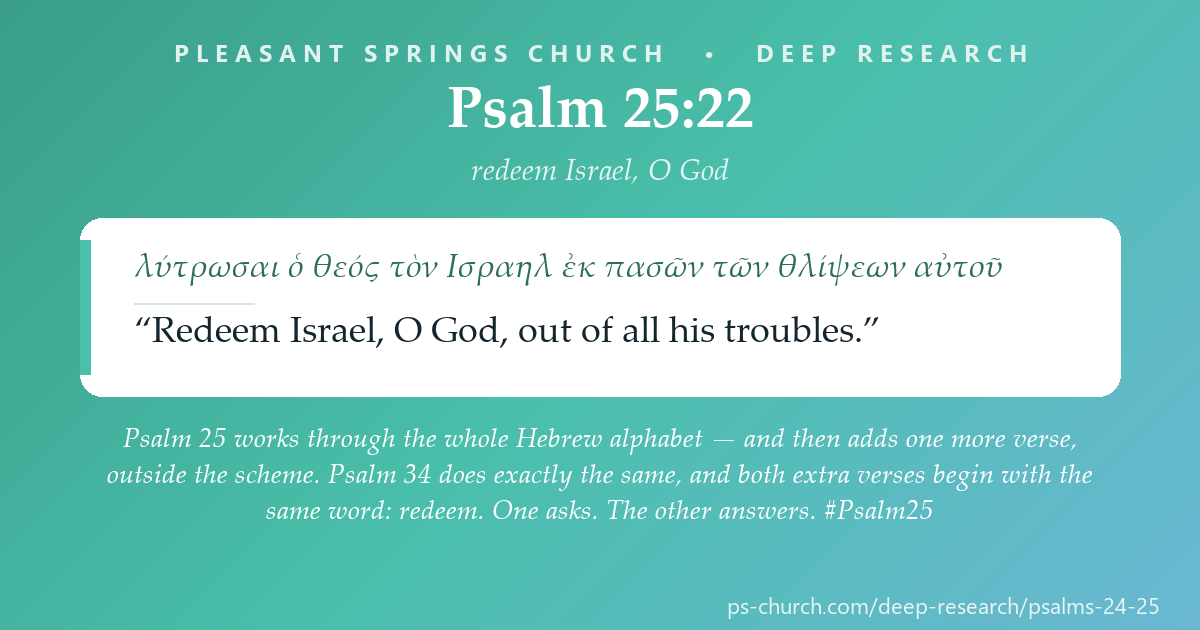
Psalm 25 is an acrostic that finishes the alphabet and then says one more thing. It runs from aleph to taw — and then adds a twenty-second verse beginning with pe, a letter already used. The alphabet has ended and the psalm has not. Checked letter by letter, it is also missing three letters and repeats one. And then the striking part: Psalm 34 does exactly the same thing. It too lacks waw, it too completes the alphabet, and it too appends a final verse beginning with pe — and both extra verses begin with the same Hebrew root: pādāh, redeem. Psalm 25 asks — Redeem Israel, O God — and Psalm 34 declares — the LORD redeems the soul of his servants. Two psalms nine chapters apart, each stepping outside its own alphabet to say the same thing. Psalm 24 has its own surprise: a Greek title assigning it to the first day of the week, with nothing behind it in the Hebrew — a note about how these poems were actually used, preserved inside the text. See the method →
Psalms 24:1–25:22 (selections)
Hebrew · Greek (Rahlfs’ Psalter) · ESVVerified letter by letter: the psalm runs from ʾalep to taw across twenty-two verses — and then adds a twenty-second verse beginning with pe, a letter already used. The alphabet has ended and the psalm has not.
⚠️ And Psalm 34 does exactly the same thing. Checked in both: Psalm 34 also completes its acrostic and appends a supernumerary verse beginning with pe. Both psalms are also missing the same letter — waw is absent from each — and both extra verses begin with the same Hebrew root.
Psalm 25:22 opens pəḏēh — “Redeem!” — an imperative. Psalm 34’s last verse opens pōḏeh — “the Lord redeems” — a participle. The same three consonants, in the same position, doing the same job: one asks for redemption, the other announces it.
That is a real and checkable link between two psalms nine chapters apart, and it is the kind of thing only counting finds. Whether one imitates the other, or both follow a convention now lost to us, cannot be established — and this page does not guess.
It also means this library’s Psalms shelf now has four different acrostics to compare: Psalm 119, flawless across 176 verses; Psalm 145, missing exactly one letter; Psalms 9–10, collapsing for ten verses in the middle; and Psalm 25 here, missing three letters, repeating one, and adding a verse at the end.
⚠️ And Psalm 24 has a Greek title with no Hebrew behind it. Rahlfs reads ψαλμὸς τῷ Δαυιδ τῆς μιᾶς σαββάτων — a psalm of David, for the first day of the week. The Hebrew title is just of David, a psalm.
This is a liturgical rubric that has entered the text — the Greek Psalter assigns certain psalms to days, a practice also recorded in later Jewish sources for the temple service. It is a small window onto how these poems were actually used, sitting inside the transmitted text rather than in a margin.
⚠️ And verse 7 diverges sharply. The Hebrew tells the gates to lift up their heads — the doors are addressed and told to raise themselves. Rahlfs turns it around: ἄρατε πύλας οἱ ἄρχοντες ὑμῶν — lift up the gates, O you rulers. The gates become the object, and a group of rulers is addressed who are nowhere in the Hebrew.
The Shape of the Passage
SequencePsalm 25:11 is worth stopping on, because the logic is not what we would write. For your name’s sake, O Lord, pardon my guilt, for it is great. The size of the sin is offered as a reason for pardon, not an obstacle to it. And the ground of the appeal is God’s reputation rather than the psalmist’s worthiness.
And the final verse changes the speaker’s scope entirely. Twenty-one verses of me, my, I — and then redeem Israel. The extra verse is not merely outside the alphabet; it is outside the psalm’s grammar. Whether it was appended by the poet or added later for congregational use is argued, and cannot be settled from the text.
This page completes the site’s set of four comparable acrostics — 119 flawless, 145 short one letter, 9–10 collapsed, and 25 here.
Author
He asks to be forgiven because the sin is large. Pardon my guilt, for it is great. Not in spite of. Because. And the reason given is God\u2019s name, not his own case.
He finishes the alphabet and then keeps going. The scheme is complete at verse 21; verse 22 is extra. And Psalm 34 does the same thing with the same root.
And in Psalm 24 he writes for more than one voice. Who is this King of glory? is a question with an answer, twice over. The text assumes at least two parties, which is unusual in the Psalter.
Audience
People arriving somewhere. Psalm 24 is built for a procession — gates, doors, a question at the threshold. Whether it accompanied an actual entry is inferred from the form, not documented, and the page says so.
People memorising. Psalm 25 is alphabetical, which is a teaching structure. Its irregularities suggest the scheme served the content rather than the reverse.
And a congregation. The last verse switches from me to Israel. Somebody wanted this private prayer to end with everybody in it.
Orient on processions, on acrostics, and on psalm-day rubrics.
Search by topic: entrance liturgy; processions; ark narratives; acrostic psalms; psalms of the day; Tamid service; forgiveness and the divine name.
Which articles are relevant?
- Anchor Bible Dictionary — “Entrance Liturgy,” “Ark of the Covenant,” “Acrostics,” “Worship, Israelite.”
- Dictionary of the OT: Wisdom, Poetry & Writings (IVP) — “Liturgy,” “Acrostic,” “Forgiveness,” “Kingship of God.”
- NIDOTTE / TDOT — פָּדָה (pāḏāh, to redeem), סָלַח (sālaḥ, to pardon), סוֹד (sōḏ, counsel / intimacy), כָּבוֹד (kāḇōḏ, glory).
- On the Greek — the NETS Psalms introduction, and anything on the psalm-of-the-day rubrics, which are visible in the Greek titles and not in the Hebrew.
Bibliography surfaced:
- John Goldingay, Psalms 1–41; Robert Alter, The Book of Psalms.
- Gerald H. Wilson, The Editing of the Hebrew Psalter — on appended verses and editorial shaping.
- NETS Psalms, with Rahlfs — for the title and for 24:7.
A procession, a weekday rubric, and an alphabet that does not quite obey.
The acrostic comparison is the most useful thing here; the psalm-day title is the most surprising.
Which parallels shed light on these psalms?
Psalm 24 reads like a script. A claim, a question at the gate, a set of requirements, then a command to the doors, a challenge (who is this King of glory?), an answer, and the whole exchange repeated with variation. It is the most clearly antiphonal text in the Psalter — and it has long been associated with the ark being brought into Jerusalem (2 Samuel 6). That connection is an inference from content, not a statement of the text, and this page treats it as such.
The psalm-of-the-day rubric is a genuine glimpse of practice. Rahlfs’ title for Psalm 24 assigns it to the first day of the week, and several other psalms carry similar notes in Greek. Later Jewish sources record a cycle of daily psalms for the temple service, and Psalm 24 is the one they name for the first day. The Greek title and that tradition agree — which is why the rubric is usually taken as preserving real liturgical use.
And acrostics were not always executed strictly. Psalm 25 is missing three letters, uses one twice, and adds a verse at the end; Psalm 34 is missing one and adds a verse; Psalms 9–10 collapse entirely; Psalm 119 is perfect. The form was a resource, not a rule, and the pattern of exceptions is more interesting than the scheme.
- 2 Samuel 6:12–19 → Psalm 24:7–10. The ark brought up to Jerusalem — the usual setting proposed for this psalm, and an inference rather than a statement.
- Psalm 15 → Psalm 24:3–6. The same question in the same form. See Psalms 15–17.
- Psalm 34 → Psalm 25. Both acrostics lack waw; both append an extra verse beginning with pe; and both those verses begin with the root pāḏāh, redeem. Verified in both texts.
- 1 Corinthians 10:26 → Psalm 24:1. The earth is the Lord’s, and the fullness thereof — Paul quotes it to settle a dispute about meat.
- Psalm 25:14 — sōḏ. The counsel of the Lord is for those who fear him — the word means a confidential circle, the inner conversation you are let into.
Psalm 25 has twenty-two verses for twenty-two letters, and does not use them the way you would expect.
Verified letter by letter:
• Three letters are missing entirely — bet, waw and qop.
• One letter, reš, heads two consecutive verses.
• The first letter falls on the second word, because verse 1 begins with the title — the same arrangement as Psalm 145.
• And the last verse begins with pe, a letter already used at verse 16. The alphabet ends at verse 21 with taw; verse 22 is extra.
⚠️ Psalm 34 does the same thing. Checked in the same way: it too lacks waw, it too completes the alphabet, and it too appends a final verse beginning with pe.
⚠️ And the two appended verses begin with the same root.
• Psalm 25:22 — pəḏēh ʾĕlōhîm ʾeṯ-Yiśrāʾēl — “Redeem Israel, O God.”
• Psalm 34’s last verse — pōḏeh YHWH nepeš ʿăḇādāyw — “The Lord redeems the soul of his servants.”
Same three consonants, same position, same job. One is an imperative asking for redemption; the other is a participle declaring it. Two psalms nine chapters apart, each stepping outside its own alphabet to say the same thing.
What that is and is not. It is a real, countable link, and it is the sort of thing only a letter-by-letter check turns up. Whether one psalm imitates the other, whether both follow a convention we no longer have, or whether both endings were added later for congregational use, cannot be determined — and the page reports the pattern without explaining it.
A verb only God performs, and a root that ends two alphabets.
Compare the last verse of Psalm 25 with the last verse of Psalm 34.
Counted here, not assumed:
- Psalm 25 is missing three letters (bet, waw, qop), repeats reš, and its last verse begins with pe — after the alphabet has finished at taw. Verified letter by letter.
- Psalm 34 lacks waw and likewise appends an extra pe verse. Checked the same way.
- Both appended verses begin with the root pāḏāh, redeem — pəḏēh (imperative) and pōḏeh (participle). Verified in both texts.
- Rahlfs’ title to Psalm 24 adds for the first day of the week. No Hebrew counterpart.
- At 24:7 the Hebrew addresses the gates; Rahlfs addresses rulers and makes the gates the object.
- Hebrew, Rahlfs and English agree at ten and twenty-two verses. No offset in either psalm.
“To redeem, ransom” — the commercial word, used of buying back a person or an animal by payment (Exodus 13:13). It is the root that begins the extra verse of both Psalm 25 and Psalm 34 — imperative in one, participle in the other. Rahlfs has λύτρωσαι, from the noun for a ransom price.
“To pardon.” A verb the Hebrew Bible uses only of God — no human being is ever its subject. Forgiveness between people is expressed with other words; this one is reserved. Rahlfs renders it ἱλάσῃ, from the vocabulary of atonement — the family that gives the New Testament its word for the mercy seat.
“Confidential counsel, an inner circle.” The word for a private conversation — used of a council of advisers, and of the heavenly assembly. “The sōḏ of the Lord is for those who fear him” means something closer to he lets them in on it than to he gives them advice. Rahlfs has κραταίωμα, strength — a quite different reading.
“Lift up your heads, O gates.” The gates are addressed and told to raise themselves — an image of doors too low for what is coming through them. Rahlfs restructures it entirely: ἄρατε πύλας οἱ ἄρχοντες ὑμῶν, lift up the gates, O you rulers — the gates become the object, and rulers are addressed who do not appear in the Hebrew at all.
“Of the first day of the week.” A liturgical rubric in the Greek title with no Hebrew counterpart. Later Jewish sources record a cycle of psalms for the days of the temple service, and name Psalm 24 for the first day — which the Greek title independently attests. A note about practice, preserved inside the text.
An ark going up, and a verse Paul used about dinner.
Read Psalm 15 and Psalm 24:3–6 together. They ask the same question twice.
Which cross-references matter?
- Psalm 15 → Psalm 24:3–6. The same gate question — see Psalms 15–17.
- Psalm 34 → Psalm 25. The matching acrostic irregularities and the shared root.
- 2 Samuel 6:12–19 → Psalm 24:7–10. The proposed setting — an inference.
- 1 Corinthians 10:26 → Psalm 24:1. Paul quotes it to settle whether to ask questions about meat in the market. The most concrete possible use of a cosmic claim.
- Exodus 34:6–7 → Psalm 25:6–7. Remember your mercy… according to your steadfast love. The psalm is asking God to be what he said he was.
- Amos 3:7 → Psalm 25:14. The Lord does nothing without revealing his sōḏ to his servants the prophets. The same word for being let in on something.
Three open questions.
Wilson on appended verses; Goldingay on the acrostic.
Commentaries & studies:
- John Goldingay, Psalms 1–41; Robert Alter, The Book of Psalms.
- Gerald H. Wilson, The Editing of the Hebrew Psalter — on editorial additions.
- NETS Psalms, with Rahlfs — for the day-rubric and 24:7.
Three things reported as unsettled:
- Why Psalms 25 and 34 both append a pe verse on the same root. The pattern is verified; the cause is not recoverable. Imitation, a lost convention, and later liturgical addition are all proposed.
- Whether Psalm 24 accompanied an actual procession. Its antiphonal form invites the conclusion; no text states it.
- Whether the Greek day-rubrics go back to the translator. That they record real practice is likely, given the later Jewish evidence; when they entered the text is another question.
One verse past the end of the alphabet.
Name what you learned, why it matters, and one concrete response.
What should we carry away — and do?
- Two psalms finish the alphabet and then say one more thing — the same thing. Redeem. Psalm 25 asks for it; Psalm 34 declares it. Whatever the form demanded, both poets needed a line that would not fit inside it.
- “Pardon my guilt, for it is great” is the wrong way round, on purpose. The size of the debt is offered as the reason to cancel it — and the ground of the appeal is God’s name, not the psalmist’s record.
- The verb for pardon is one God alone performs. Sālaḥ never has a human subject anywhere in the Hebrew Bible. Forgiveness between people is described with other words entirely.
- One concrete response. Psalm 25:14 says the sōḏ of the Lord — his confidential circle — is for those who fear him. That is an offer of being let in on something, not of receiving advice. Ask for the first.
Psalm 25:22 · to share
Hebrew + Greek (Rahlfs) + ESVEvery Deep Research page traces its passage across the whole sweep — the Old Testament, the Second-Temple world between the testaments (historical witnesses, not Scripture), and the New Testament. Follow the thread:
Pleasant Springs Church — Deep Research
Research method after Michael S. Heiser’s Bible Research Method (examine dictionaries → ancient literature → important words → textual connections → academic publications → share), with the Pleasant Springs “Author & Audience” foundation. Scripture set in the Hebrew, the Greek editions named on each page and the ESV (Old Testament), and the Greek New Testament and the ESV (New Testament), per the practice of Pleasant Springs Church. Psalms 24–25 research grounded in Goldingay (Psalms 1–41), Alter and Wilson. Text: Hebrew from the Masoretic text as printed in the editions consulted — Sefaria’s Miqra according to the Masorah; no critical apparatus was consulted for the Hebrew. Greek from Rahlfs’ Greek Psalter (CATSS digitization of Rahlfs 1931). The standing caution for this shelf applies: these pages say “Rahlfs’ Greek Psalter reads…” and never call a Greek reading early or late. ⚠️ The acrostic findings were computed letter by letter in both psalms, not repeated from secondary sources. Psalm 25: 22 verses; bet, waw and qop absent; reš heading two consecutive verses; the first letter falling on the second word because the title occupies the opening slot (as at Psalm 145); and a final verse beginning with pe after the alphabet closes at taw. Psalm 34 was checked the same way and shows the matching profile — waw absent, alphabet complete, extra pe verse appended. The two appended verses were then compared directly and both begin with the root pāḏāh — pəḏēh (imperative) at 25:22 and pōḏeh (participle) at the close of Psalm 34. The cause of the pattern is explicitly left unexplained: imitation, a lost convention and later liturgical addition are all reported as proposals, none adopted. The Greek plus in the Psalm 24 title (tēs mias sabbatōn) was verified as having no Hebrew counterpart, and its agreement with the later Jewish daily-psalm tradition is noted as corroboration of practice rather than proof of date. The 24:7 restructuring — Hebrew addressing the gates, Rahlfs addressing rulers and making the gates the object — was verified in both columns. The 2 Samuel 6 setting is labelled an inference from form, not a statement of the text. Typology is handled per the house position: what the text says, what the New Testament itself draws, and what we see from this side of the cross — with the seeing left to the reader.
Scripture quotations marked ESV are from the ESV® Bible (The Holy Bible, English Standard Version®), © 2001 by Crossway, a publishing ministry of Good News Publishers. ESV Text Edition: 2016. Used by permission. All rights reserved. The ESV text may not be quoted in any publication made available to the public by a Creative Commons license, and the ESV may not be translated in whole or in part into any other language. www.esv.org
|
Did this study bless you today? 💚 Give to Support PS Church100% of gifts go to the General Fund — thank you. |