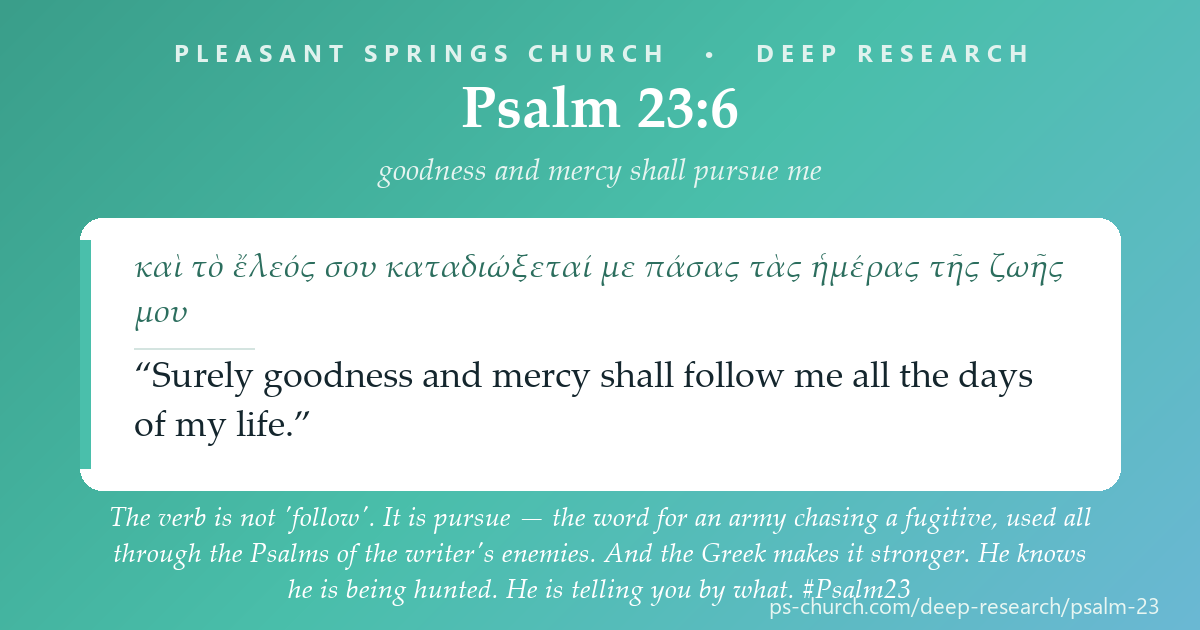
Six verses, and almost everyone who reads English knows them — which is exactly why they repay being read slowly. The last line does not say follow. The Hebrew verb is rādap: pursue, chase, hunt down. It is what Pharaoh's chariots do at the Red Sea, and all through the Psalms it is what the writer's enemies do to him. Here the pursuers are goodness and covenant love. And the Greek keeps the chase — katadiōxetai, from the verb behind persecute. Two traditions, the same picture; English has softened it. The psalm is not a gentle stroll. There is a man walking through a lethal valley with enemies watching him eat — and what comes after him is mercy. Two other things worth seeing: the valley is a valley, not the valley, and whether it means deep darkness or the shadow of death is genuinely open — though the familiar English goes back at least to the Greek. And the psalm switches from talking about God to talking to him in the middle of verse 4, in the valley, and never switches back. See the method →
Psalm 23:1–6 — the whole psalm
Hebrew · Greek (Rahlfs’ Psalter) · ESV⚠️ The last line does not say follow. The Hebrew verb is rāḏap — pursue, chase, hunt down. It is the word for what an army does to a fleeing enemy, and what Pharaoh does at the Red Sea. It is used throughout the Psalter of the psalmist’s persecutors: my enemies pursue me.
Here the pursuers are goodness and covenant love. Surely goodness and ḥeseḏ shall hunt me down all the days of my life. And Rahlfs keeps the chase: καταδιώξεταί με — the verb behind persecute, intensified by a prefix. Both traditions have the same picture, and English has softened it.
The psalm is not about a gentle stroll. It has a man walking through a lethal valley with enemies watching him eat — and what comes after him is mercy.
⚠️ The valley is genuinely uncertain, and both readings are ancient. The Hebrew is ṣalmāweṯ, which as pointed reads as two words joined — ṣēl (shadow) and māweṯ (death). Many modern scholars instead read ṣalmûṯ, deep darkness, from a different root, which fits the other places the word appears (Job uses it repeatedly of blackness).
Rahlfs read it the traditional way: σκιᾶς θανάτου, shadow of death. So the familiar English is not a late invention — it is at least as old as the Greek translation. The page reports both and does not choose. Note too that the Hebrew says a valley of deep shadow, not the valley — it is a description of terrain, not a place-name.
⚠️ And the last verse has a second ambiguity. Wəšaḇtî can be read from šûḇ (I shall return) or from yāšaḇ (I shall dwell). Rahlfs takes dwelling — καὶ τὸ κατοικεῖν με — and most English versions follow. “I shall return to the house of the Lord” is also available from the consonants.
The Shape of the Passage
InclusioIt begins in the third person — he makes me lie down, he leads me, he restores my soul — which is how you talk about somebody. And in the exact middle, in the valley, it switches: for you are with me. From that word to the end, God is addressed directly and never described again.
The psalm gets more intimate as it gets darker, and the turn is placed at the lowest point rather than after it. The distance closes in the valley, not on the far side of it.
And the two halves are two different pictures with the same claim. A shepherd who takes an animal to food and water; a host who sets a table in front of people who want you dead. Both are about being provided for in the open, in front of witnesses. The enemies are never removed from the psalm — they are still present in the last two verses. They are simply no longer the point.
A solo study. Psalm 23 is six verses long and better known than any other passage in the Psalter, which is exactly why it repays being read in the original.
Author
He picks an unflattering comparison for himself. Sheep are not admired animals in the Bible — they are notable for going astray and for being unable to find their way back. The psalm’s confidence rests entirely on the shepherd, not on the sheep.
He does not remove the enemies. They are watching in verse 5 and the psalm ends without dealing with them. What changes is not the situation but the company.
And he chooses a violent verb for mercy. Goodness and covenant love will hunt me down — the word for a pursuing army. He was being chased, and says so; he just names his pursuers differently.
Audience
People who knew what shepherding involved. He makes me lie down is a technical achievement — sheep lie down only when they are not hungry, not thirsty, not frightened and not irritated. The line claims all four conditions at once.
People in danger. A valley of deep shadow, a table set in front of enemies. This is not a psalm for calm weather, and it has been read at gravesides for a very long time for that reason.
And people who needed a shorter psalm. Six verses. Next to Psalm 119\u2019s hundred and seventy-six, it says a comparable amount.
Orient on shepherding, on hospitality, and on the disputed valley.
Search by topic: shepherd; pastoral imagery; hospitality and the host; anointing with oil; tsalmaveth; hesed.
Which articles are relevant?
- Anchor Bible Dictionary — “Shepherd,” “Hospitality,” “Anointing,” “Death, Shadow of.”
- Dictionary of the OT: Wisdom, Poetry & Writings (IVP) — “Imagery: Pastoral,” “Confidence, Psalms of,” “God, Metaphors for.”
- NIDOTTE / TDOT — רָדַף (rāḏap, to pursue), צַלְמָוֶת (ṣalmāweṯ), חֶסֶד (ḥeseḏ), רָבַץ (rāḇaṣ, to lie down).
- On the Greek — the NETS Psalms introduction. Rahlfs supports the traditional reading of the valley, which matters for how old that reading is.
Bibliography surfaced:
- John Goldingay, Psalms 1–41 — careful on verse 6.
- Robert Alter, The Book of Psalms — good on the pronoun shift.
- Beale and Carson, Commentary on the NT Use of the OT — for the shepherd material in John 10.
What shepherds actually did, and what a host was obliged to do.
Two everyday institutions stand behind these six verses, and knowing them changes the reading.
Which parallels shed light on this psalm?
“Shepherd” was a royal title across the ancient Near East. Kings of Mesopotamia and Egypt are called the shepherds of their people, and the word carries responsibility for feeding, defending and judging. So the Lord is my shepherd is not primarily a rustic image but a political one — and it is being claimed in the first person singular, which is unusual: the nation is God’s flock elsewhere, and here it is one person.
The rod and the staff are two different tools. The šēḇeṭ is a club — the word also means a tribe’s sceptre — carried against predators. The mišʿeneṯ is the walking stick used to guide and to lean on. One is for other people; one is for the sheep. Rahlfs keeps both distinct: ῥάβδος and βακτηρία.
And hospitality was a binding obligation. A host who received a guest at his table was responsible for that guest’s safety while the meal lasted — a duty that held even against the guest’s pursuers. That is why the enemies in verse 5 can be present and powerless at once. They are watching a meal they are not permitted to interrupt.
- Ezekiel 34 → Psalm 23. The great shepherd chapter: bad shepherds who feed themselves, and God saying I myself will be the shepherd of my sheep. Compare Psalm 119:176, which asks to be sought.
- John 10:11 → Psalm 23:1. I am the good shepherd. Stated; the seeing is left to the reader.
- Isaiah 40:11; Jeremiah 23:1–4; Micah 7:14. The shepherd image across the prophets, always with responsibility attached.
- Job 3:5; 10:21–22; 38:17 → Psalm 23:4. Job uses ṣalmāweṯ more than any other book, and mostly of darkness — which is the main argument for the ‘deep darkness’ reading.
- Psalm 22 and Psalm 24. This psalm sits between a cry of abandonment and a psalm about who may ascend God’s hill. The order is worth noticing; whether it is deliberate cannot be shown.
English has softened the best line in the psalm.
The Hebrew verb is rāḏap. It means pursue, chase, hunt down. It is what Pharaoh’s chariots do at the Red Sea (Exodus 14:8); what Laban does to Jacob; what an army does to a routed enemy. In the Psalter it is overwhelmingly what the psalmist’s enemies do to him — the wicked pursue the poor; my persecutors pursue me.
⚠️ And Rahlfs keeps it. καταδιώξεταί με — from διώκω, the verb behind persecute, with an intensifying prefix. The Greek is, if anything, stronger. Two traditions, the same chase.
So the sentence is: goodness and covenant love will hunt me down all the days of my life.
That reading fits the psalm rather than straining it. Verse 5 has enemies watching; the whole poem is set in the open with someone in danger. The psalmist is being pursued — he simply names his pursuers. What is chasing him is not the enemies but the two things he has just been given at the table.
One caution, stated plainly. Hebrew verbs are flexible, and rāḏap can be used with a weakened sense closer to attend or accompany. “Follow” is not a mistranslation. But it is the mildest of the available options, and both the Hebrew’s usual force and the Greek’s choice point the other way.
Five words that are stronger in Hebrew than in English.
Read verse 6 aloud with pursue in place of follow. It is a different psalm.
Counted here, not assumed:
- Hebrew, Rahlfs and English all give Psalm 23 six verses. No offset — the short title folds into verse 1. See Psalms 11–14.
- The verb at 23:6 is rāḏap, pursue, and Rahlfs renders it with an intensified form of diōkō, persecute. Both traditions keep the chase.
- Rahlfs supports shadow of death at 23:4. The traditional English is at least as old as the Greek translation, whatever the modern lexical arguments for deep darkness.
- The psalm switches from third person to second person in verse 4 and never switches back. Verified across all six verses. The turn falls in the valley.
- Rahlfs reads your cup and your mercy where the Hebrew has my cup and an unpossessed goodness and mercy.
- Hebrew 23:1 is a noun clause — the Lord [is] my shepherd; Rahlfs makes it a verb — the Lord shepherds me.
“They shall pursue me.” The verb of the chase — Pharaoh’s army at the Red Sea, a posse after a fugitive, and throughout the Psalter what the psalmist’s enemies do to him. Here the subjects are goodness and covenant love. Rahlfs has καταδιώξεται, an intensified form of the verb behind persecute. English “follow” is defensible and it is the gentlest reading on offer.
Either shadow of death or deep darkness, and the question is old. As pointed, the word reads as ṣēl (shadow) + māweṯ (death). Many scholars read ṣalmûṯ, deep darkness, from a separate root — the sense that suits Job’s many uses. Rahlfs read it the traditional way: σκιᾶς θανάτου. So the familiar English goes back at least to the Greek translators. Note also: a valley, not the valley.
“Covenant loyalty, steadfast love” — the central word of the Old Testament’s vocabulary for God’s commitment, and notoriously hard to translate: mercy, lovingkindness, steadfast love are all attempts at it. It means faithfulness to an obligation freely undertaken. Rahlfs has ἔλεος, mercy, and reads it as your mercy — where the Hebrew has no pronoun and pairs it with ṭōḇ, goodness.
“He makes me lie down.” The verb is used of animals resting, and it is causative — the sheep is not lying down of its own accord. A sheep will lie down only when it is not hungry, not thirsty, not frightened and not troubled by pests, so the line quietly claims four things at once. Rahlfs has κατεσκήνωσεν, he made me encamp — a tent word rather than an animal one.
“My cup is saturation” — a noun, not a verb; the line is verbless and means something like my cup: abundance. Rahlfs goes further: τὸ ποτήριόν σου μεθύσκον ὡς κράτιστον — your cup, intoxicating, like the strongest. The Greek cup does not merely overflow; it goes to your head. Note also that Rahlfs makes it your cup where the Hebrew has my.
A shepherd chapter, and a psalm on either side.
Read Ezekiel 34:11–16 beside Psalm 23. The prophet promises what the psalm reports.
Which cross-references matter?
- Ezekiel 34:11–16 → Psalm 23. I myself will be the shepherd of my sheep… I will make them lie down. The same verb for lying down.
- Isaiah 40:11 → Psalm 23:1–2. He will tend his flock like a shepherd.
- John 10:11 → Psalm 23:1. I am the good shepherd. Stated; the seeing is left to the reader.
- Job 10:21–22; 38:17 → Psalm 23:4. The main body of evidence for reading ṣalmāweṯ as deep darkness — the library’s Job studies work that vocabulary at length.
- Psalm 22 → Psalm 23 → Psalm 24. Abandonment, then confidence, then the question of who may ascend the hill. See the Psalm 22 study.
- Psalm 119:176 → Psalm 23. I have gone astray like a lost sheep; seek your servant. The longest psalm ends asking for what this one reports having. See Psalm 119, part 6.
Three open questions in six verses.
Goldingay and Alter are the most useful English treatments of the difficulties.
Commentaries & studies:
- John Goldingay, Psalms 1–41 — careful on return versus dwell at verse 6.
- Robert Alter, The Book of Psalms — on the pronoun shift and on ṣalmāweṯ.
- NETS Psalms, with Rahlfs — for the Greek at verses 4, 5 and 6.
Three things reported as unsettled:
- Whether 23:4 is shadow of death or deep darkness. The pointing supports the first; the word’s usage elsewhere supports the second; Rahlfs supports the first. Not decided here.
- Whether 23:6 is I shall dwell or I shall return. The consonants allow both; Rahlfs takes dwelling.
- How strongly rāḏap should be pressed. Its ordinary force is pursue, and Rahlfs intensifies rather than softens it — but the verb can carry a weaker sense, so “follow” is defensible. The page presents the range.
The best-known six verses in the Bible, read again.
Name what you learned, why it matters, and one concrete response.
What should we carry away — and do?
- Goodness and mercy do not follow. They pursue. Rāḏap is the verb for an army chasing a fugitive, and the Greek makes it stronger still. The psalmist is being hunted — and he names his pursuers. That is a different psalm from the one most people carry in their heads, and it is the one that is written.
- The psalm turns to God in the dark, not after it. Three verses about him, then — in the valley — for you are with me, and it never goes back to the third person. The intimacy arrives at the lowest point.
- The enemies are never removed. They are still watching in verse 5, and the psalm ends without dealing with them. What changes is the company, not the circumstances.
- One concrete response. Say verse 6 out loud with the right verb: surely goodness and mercy will pursue me all the days of my life. Then ask what you have been assuming was chasing you.
Psalm 23:6 · to share
Hebrew + Greek (Rahlfs) + ESVEvery Deep Research page traces its passage across the whole sweep — the Old Testament, the Second-Temple world between the testaments (historical witnesses, not Scripture), and the New Testament. Follow the thread:
Pleasant Springs Church — Deep Research
Research method after Michael S. Heiser’s Bible Research Method (examine dictionaries → ancient literature → important words → textual connections → academic publications → share), with the Pleasant Springs “Author & Audience” foundation. Scripture set in the Hebrew, the Greek editions named on each page and the ESV (Old Testament), and the Greek New Testament and the ESV (New Testament), per the practice of Pleasant Springs Church. Psalm 23 research grounded in Goldingay (Psalms 1–41) and Alter. Text: Hebrew from the Masoretic text as printed in the editions consulted — Sefaria’s Miqra according to the Masorah; no critical apparatus was consulted for the Hebrew. Greek from Rahlfs’ Greek Psalter (CATSS digitization of Rahlfs 1931). The standing caution for this shelf applies: these pages say “Rahlfs’ Greek Psalter reads…” and never call a Greek reading early or late. ⚠️ Every claim on this page was checked in both columns, verse by verse across all six verses. The force of rāḏap at 23:6 is established from its ordinary biblical usage (Exodus 14:8 and its recurring use in the Psalter of the writer’s persecutors) and confirmed by Rahlfs’ intensified καταδιώξεται; the page nonetheless states plainly that the verb can carry a weaker sense and that “follow” is defensible, presenting the range rather than overturning the translation. The ṣalmāweṯ question is reported with both readings and neither adopted — the Masoretic pointing supports shadow of death and Rahlfs agrees, while the word’s usage (heavily in Job) supports deep darkness — and the page notes the Hebrew has a valley, not the valley. The 23:6 dwell/return ambiguity is likewise reported with Rahlfs’ choice noted. The third-to-second-person pivot in verse 4 was verified across the whole psalm, as were the Greek’s pronoun changes (your cup, your mercy) and its rendering of the Hebrew noun clause at 23:1 as a verb. Verse counts agree at six in all three columns, the short title folding into verse 1. Typology is handled per the house position: what the text says, what the New Testament itself draws, and what we see from this side of the cross — with the seeing left to the reader.
Scripture quotations marked ESV are from the ESV® Bible (The Holy Bible, English Standard Version®), © 2001 by Crossway, a publishing ministry of Good News Publishers. ESV Text Edition: 2016. Used by permission. All rights reserved. The ESV text may not be quoted in any publication made available to the public by a Creative Commons license, and the ESV may not be translated in whole or in part into any other language. www.esv.org
|
Did this study bless you today? 💚 Give to Support PS Church100% of gifts go to the General Fund — thank you. |