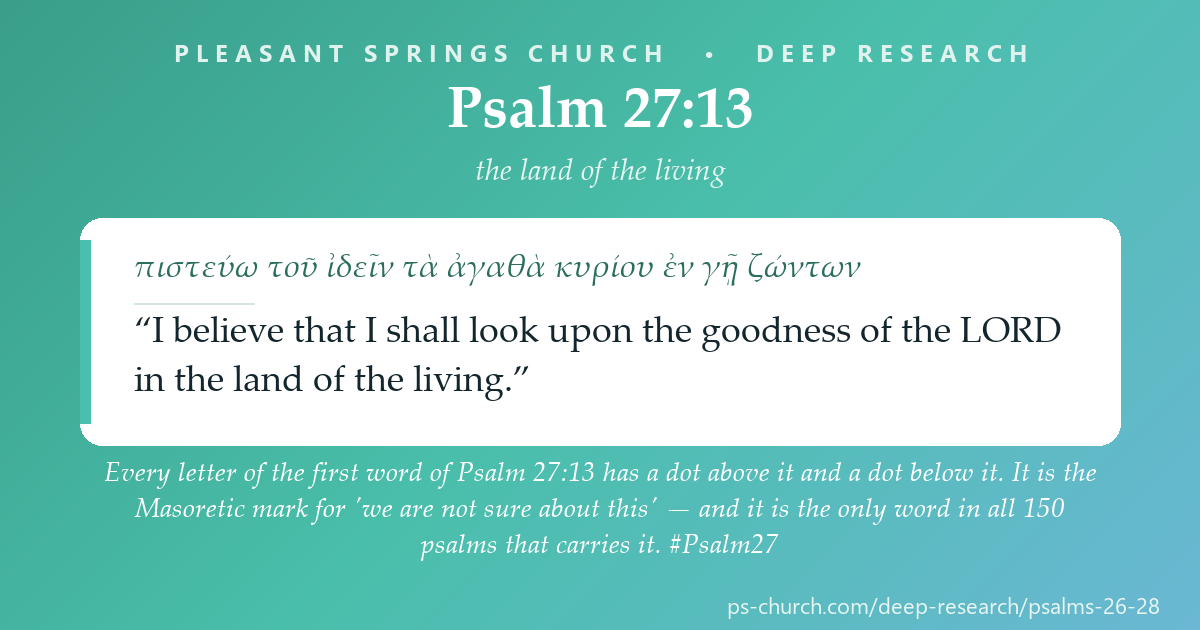
Look closely at the first word of Psalm 27:13 in a Hebrew Bible and you will see something you will not find anywhere else in the book: every one of its four letters carries a dot above it and a dot below it. These are the puncta extraordinaria — the mark Masoretic scribes used, in only about fifteen places in the whole Hebrew Bible, to say we are not certain about this word. Verified here across all 150 psalms: this is the only one. And the difficulty is visible without any Hebrew. The word means unless — it opens a condition — and the consequence never comes. "Unless I had believed that I would see the goodness of the LORD in the land of the living…" and then the psalm changes the subject. Open almost any English Bible and you will find italics there, an honest admission that the translators supplied an ending the Hebrew does not have. Rahlfs solved it by leaving the word out — his verse is a clean, complete affirmation. One tradition kept a word it doubted and published the doubt; the other produced a sentence that reads perfectly. Both were acts of care. See the method →
Psalms 26:1–28:9 (selections)
Hebrew · Greek (Rahlfs’ Psalter) · ESVLook at it closely: לׅׄוּׅׄלֵׅ֗ׄאׅׄ. Every one of its four letters has a dot above it and a dot below it. These are the puncta extraordinaria — the “extraordinary points” — a mark the Masoretic scribes used, in a handful of places across the whole Hebrew Bible, to flag a word they were not certain about.
Verified here across all one hundred and fifty psalms: this is the only occurrence in the book. One word, in one verse, out of the entire Psalter.
And the scribes had good reason to hesitate, because the sentence does not finish. Lûlēʾ means “unless” or “if not” — it opens a condition that requires a consequence. “Unless I had believed that I would see the goodness of the Lord in the land of the living…” — and then nothing. The psalm moves straight on to wait for the Lord.
The consequence is never stated. English versions supply one in italics — I would have despaired, or similar — and the italics are an admission that the words are not there.
⚠️ Rahlfs solves the problem by removing it. His Greek reads simply πιστεύω τοῦ ἰδεῖν τὰ ἀγαθὰ κυρίου — “I believe that I shall see the good things of the Lord.” No unless, no condition, no broken sentence. A clean, confident affirmation.
Which is the more interesting outcome, because the two traditions have done opposite things. The Hebrew scribes kept a word they doubted and marked their doubt on the page for everyone to see. The Greek tradition produced a sentence that reads perfectly. The Hebrew is the harder sentence of the two; the Greek reads without a seam.
⚠️ Psalm 27 has a second Greek plus, in its title. Rahlfs adds πρὸ τοῦ χρισθῆναι — before he was anointed — where the Hebrew title is simply of David. The Greek tradition supplies an occasion, as it does at Psalm 144 (“against Goliath”) and Psalm 24 (“for the first day of the week”).
The Shape of the Passage
SequenceThat closing line is worth noticing for who is speaking to whom. The psalmist has spent thirteen verses talking to God, and finishes by giving orders to himself.
And Psalm 28 does the same thing in miniature. Five verses of urgent petition, and then verse 6: blessed be the Lord, for he has heard the voice of my pleas. The turn is unexplained and unprepared — which is either a change of circumstances the text does not record, or a decision, as at Psalm 13.
This page carries the rarest scribal feature the Psalms shelf has met. The dotted word at 27:13 is the only one of its kind in all 150 psalms — verified across the whole book.
Author
He asks for one thing and it is not rescue. With an army encamped against him, one thing have I asked… that I may dwell in the house of the LORD. He wants an address, not a deliverance.
He leaves a sentence unfinished. Unless I had believed… and then he stops. Whether that is a broken text or a man too shaken to finish the thought cannot be decided — and the scribes who copied it were unsure enough to mark it.
And he ends by talking to himself. Thirteen verses addressed to God, and then: wait for the LORD; be strong. The last words of the psalm are an instruction the psalmist gives his own heart.
Audience
People who needed both halves. Whom shall I fear? and do not forsake me are in the same psalm, fourteen verses apart. Anyone who has held both in one week knows why.
People who wanted to be examined. Psalm 26 invites the test rather than dreading it — refine my kidneys and my heart. That is a strong thing to volunteer for.
And readers of a text that shows its scars. The Masoretes could have quietly smoothed 27:13 and did not. They kept the difficult word and dotted it, so that every later reader would see the difficulty too.
Orient on the Masorah, on scribal marks, and on protestations of innocence.
Search by topic: Masorah; puncta extraordinaria; scribal marks; ketiv and qere; protestations of innocence; refining metaphors; aposiopesis.
Which articles are relevant?
- Anchor Bible Dictionary — “Masoretes,” “Text of the OT,” “Scribes,” “Anointing.”
- Dictionary of the OT: Wisdom, Poetry & Writings (IVP) — “Psalms: Text and Versions,” “Lament,” “Confidence, Psalms of.”
- NIDOTTE / TDOT — לוּלֵא (lûlēʾ, unless), צָרַף (ṣārap, to refine), כְּלָיוֹת (kəlāyōṯ, kidneys), קַוֵּה (qawwēh, wait).
- On the Masorah — any introduction that explains the puncta extraordinaria. They occur in only a handful of places in the whole Hebrew Bible, and this is the Psalter’s one.
Bibliography surfaced:
- Emanuel Tov, Textual Criticism of the Hebrew Bible — the standard account of the extraordinary points and what they signify.
- John Goldingay, Psalms 1–41; Robert Alter, The Book of Psalms — both candid about 27:13.
- NETS Psalms, with Rahlfs — for the title plus and the missing unless.
What a scribe did when he was unsure, and a sentence that stops.
This page is largely about how a text was cared for. The dotted word is the evidence.
Which parallels shed light on these psalms?
The Masoretes had several ways of recording doubt without changing anything. The ketiv/qere system preserves a written form and a read form together — this library met a clean example at Psalm 119:147, and another stands at Psalm 26:2 on this page. The puncta extraordinaria are rarer and blunter: dots placed over (and here also under) letters, marking a word or phrase as questionable. Nothing is removed. The doubt is simply published.
An unfinished conditional is a known rhetorical figure, not necessarily damage. Ancient writers sometimes break off a sentence for effect — the reader supplies what is too obvious or too terrible to say. Whether Psalm 27:13 is that figure or a genuinely broken text is exactly what the scribes could not decide, which is why they dotted it rather than resolving it.
And “kidneys” is not a squeamish translation choice. Psalm 26:2 asks God to refine my kidneys and my heart — in Hebrew physiology the kidneys are the seat of the deepest impulses, the part of a person furthest from public view. Rahlfs keeps the organ: τοὺς νεφρούς μου. English “mind” or “heart” loses the anatomy and the point.
- Genesis 18:9; Numbers 3:39; Isaiah 44:9 (among others). Other places carrying the extraordinary points — the whole set numbers around fifteen in the Hebrew Bible.
- Psalm 26:2 → Jeremiah 17:10. I the Lord search the heart and test the kidneys. God doing unasked what the psalm invites.
- Psalm 27:4 → Psalm 23:6. That I may dwell in the house of the Lord. The same request, and at Psalm 23 the same verb ambiguity between dwell and return.
- Psalm 27:10 — my father and my mother have forsaken me. One of the bleakest lines in the Psalter, sitting eight verses after whom shall I fear?
- Psalm 28:6 → Psalm 13:5. An unexplained turn from petition to praise — see Psalms 11–14.
Psalm 27:13 begins with לׅׄוּׅׄלֵׅ֗ׄאׅׄ, and every letter carries two marks — one above, one below.
Technically these are two Masoretic signs, the upper dot and the lower dot, applied to all four consonants of the word. They are the puncta extraordinaria: the scribal convention for saying we are not sure about this. They occur in roughly fifteen places in the entire Hebrew Bible.
⚠️ Verified for this page across all one hundred and fifty psalms: there is exactly one occurrence in the book, and this is it.
The difficulty they mark is visible without any Hebrew. Lûlēʾ means unless. It opens a condition — unless X, then Y — and the Y never arrives. The verse reads: “Unless I had believed that I would look upon the goodness of the Lord in the land of the living…” and the next verse changes the subject entirely.
Open almost any English Bible and you will find words in italics here — an honest signal that the translators supplied a conclusion the Hebrew does not have.
⚠️ Rahlfs has no unless at all. His verse reads πιστεύω τοῦ ἰδεῖν τὰ ἀγαθὰ κυρίου ἐν γῇ ζώντων — “I believe that I shall see the good things of the Lord in the land of the living.” A complete, confident sentence with no gap in it.
Whether the Greek reflects a text without the word, or a translator smoothing a difficulty, cannot be determined — and, as everywhere on this shelf, no apparatus for the Greek Psalter permits calling either reading earlier.
What is worth carrying away is the contrast in habits. One tradition kept a word it doubted and dotted it so that every reader for the next thousand years would see the doubt. The other produced a verse that reads beautifully. Both were acts of care; they were not the same act.
One word with eight dots on it.
Find Psalm 27:13 in a printed Hebrew Bible and look at the first word. The marks are visible without knowing any Hebrew.
Counted here, not assumed:
- Psalm 27:13 is the only verse in all 150 psalms carrying the puncta extraordinaria. Verified by scanning every verse of the Psalter for the upper and lower dot marks. All four letters of the word are marked, above and below.
- The conditional it opens has no consequence clause. English versions supply one in italics.
- Rahlfs has no equivalent for the word. His verse is a complete affirmation: I believe that I shall see…
- Rahlfs’ title to Psalm 27 adds before he was anointed. No Hebrew counterpart.
- Psalm 26:2 carries a written/read variant on the verb refine.
- Hebrew, Rahlfs and English agree at twelve, fourteen and nine verses. No offset in any of the three — the short titles fold into verse 1.
“Unless, if not” — and it is the only word in the Psalter carrying the puncta extraordinaria, dots above and below every letter. It opens a condition whose consequence never comes, which is why English versions add italic words. Rahlfs has no equivalent at all — his verse begins πιστεύω, I believe, and the difficulty disappears.
“Kidneys” — and the anatomy is the point. In Hebrew physiology the kidneys are the seat of the innermost impulses, the part of a person nobody sees; the heart is nearer to thought and will. “Test my kidneys and my heart” means examine the part of me I cannot show you. Rahlfs keeps the organ: τοὺς νεφρούς μου.
“To refine, smelt.” The metallurgical verb — the same root behind the refined silver of Psalm 12:6. The psalm does not ask to be spared the furnace; it asks for it. Rahlfs renders it πύρωσον, put me through fire — more explicit than the Hebrew, not less. Note also the written/read variant on this word in the Masoretic text.
“One thing I have asked.” The number is emphatic and it is followed by a request for residence rather than rescue — that I may dwell in the house of the Lord all the days of my life, said by a man with an army camped against him. Compare Psalm 23:6, where the same verb carries the same ambiguity between dwelling and returning.
“Before he was anointed” — a historical note in the Greek title with no Hebrew counterpart. The Greek tradition supplies occasions for psalms that lack them, as at Psalm 144 (“against Goliath”) and Psalm 24 (“for the first day of the week”). Reported as a plus; nothing is built on it.
A test invited, and a house asked for.
Read Psalm 26:2 and then Jeremiah 17:10. One asks; the other reports.
Which cross-references matter?
- Jeremiah 17:10 → Psalm 26:2. I search the heart and test the kidneys. The same two organs, in the same order.
- Psalm 23:6 → Psalm 27:4. Dwelling in the house of the Lord — see Psalm 23.
- Psalm 12:6 → Psalm 26:2. Refining as a metaphor for purity — see Psalms 11–14.
- Psalm 13:5 and Psalm 28:6. Two unexplained turns from lament to praise.
- Isaiah 44:9 and Genesis 18:9. Two more places carrying the extraordinary points — the mark is rare enough that the whole set can be listed.
- Psalm 27:10 → Isaiah 49:15. My father and my mother have forsaken me; can a woman forget her nursing child? The psalm reports what the prophet calls unthinkable.
Three open questions, one of them marked on the page by the scribes themselves.
Tov is the reference for the extraordinary points.
Commentaries & studies:
- Emanuel Tov, Textual Criticism of the Hebrew Bible — on the puncta extraordinaria and their likely function.
- John Goldingay, Psalms 1–41; Robert Alter, The Book of Psalms.
- NETS Psalms, with Rahlfs — for 27:13 and the title.
Three things reported as unsettled:
- What the dots at 27:13 were meant to convey. That they mark doubt is agreed; whether the scribes thought the word should be deleted, or simply flagged it as difficult, is argued.
- Whether the unfinished sentence is a rhetorical break or a damaged text. Both are proposed, and the Masoretes’ own uncertainty is part of the evidence.
- Whether Psalm 27 is one psalm or two. The tonal break after verse 6 is real; so are comparable breaks inside psalms that nobody proposes dividing.
A tradition that marked its own uncertainty.
Name what you learned, why it matters, and one concrete response.
What should we carry away — and do?
- The scribes could have tidied this and did not. They kept a word they were unsure of and put dots over and under every letter so that no later reader could miss the difficulty. That is not a text being handled carelessly. It is a text being handled by people who would not pretend.
- The sentence does not finish, and the italics in your Bible are honest about it. Unless I had believed… Whatever follows is supplied by translators — and the Greek solved the problem by removing the word entirely.
- The one thing he asks for is an address. With an army encamped against him, Psalm 27:4 asks to dwell in the house of the Lord all the days of my life. Not deliverance. Residence.
- One concrete response. The psalm ends with the psalmist giving orders to himself — wait for the Lord; be strong, and let your heart take courage. After thirteen verses of talking to God, he talks to himself. Try that order.
Psalm 27:13 · to share
Hebrew + Greek (Rahlfs) + ESVEvery Deep Research page traces its passage across the whole sweep — the Old Testament, the Second-Temple world between the testaments (historical witnesses, not Scripture), and the New Testament. Follow the thread:
Pleasant Springs Church — Deep Research
Research method after Michael S. Heiser’s Bible Research Method (examine dictionaries → ancient literature → important words → textual connections → academic publications → share), with the Pleasant Springs “Author & Audience” foundation. Scripture set in the Hebrew, the Greek editions named on each page and the ESV (Old Testament), and the Greek New Testament and the ESV (New Testament), per the practice of Pleasant Springs Church. Psalms 26–28 research grounded in Tov (Textual Criticism of the Hebrew Bible) for the scribal marks, with Goldingay and Alter on the text. Text: Hebrew from the Masoretic text as printed in the editions consulted — Sefaria’s Miqra according to the Masorah, which preserves the extraordinary points; no critical apparatus was consulted for the Hebrew. Greek from Rahlfs’ Greek Psalter (CATSS digitization of Rahlfs 1931). The standing caution for this shelf applies: these pages say “Rahlfs’ Greek Psalter reads…” and never call a Greek reading early or late. ⚠️ The central claim was computed, not repeated. Every verse of all one hundred and fifty psalms was scanned for the two Masoretic dot marks (the upper dot and the lower dot), and Psalm 27:13 is the sole occurrence in the book; all four consonants of lûlēʾ carry both marks. The wider figure of roughly fifteen occurrences across the Hebrew Bible is reported from the standard literature rather than computed here. The unfinished conditional is described as such, with the italics of English versions noted as an honest signal that the apodosis is supplied; whether the break is rhetorical or the text damaged is left open, and the Masoretes’ own recorded uncertainty is presented as part of the evidence. Rahlfs’ lack of any equivalent for the word was verified directly, and whether that reflects a different text or a translator smoothing a difficulty is explicitly not decided. The Greek title plus (pro tou christhēnai) was verified as having no Hebrew counterpart and is set alongside the comparable pluses at Psalms 24 and 144. Verse counts were checked in all three columns (12/14/9 throughout, no offset). Typology is handled per the house position: what the text says, what the New Testament itself draws, and what we see from this side of the cross — with the seeing left to the reader.
Scripture quotations marked ESV are from the ESV® Bible (The Holy Bible, English Standard Version®), © 2001 by Crossway, a publishing ministry of Good News Publishers. ESV Text Edition: 2016. Used by permission. All rights reserved. The ESV text may not be quoted in any publication made available to the public by a Creative Commons license, and the ESV may not be translated in whole or in part into any other language. www.esv.org
|
Did this study bless you today? 💚 Give to Support PS Church100% of gifts go to the General Fund — thank you. |