Psalm 29 is a thunderstorm built on one phrase repeated exactly seven times: the voice of the LORD. Counted here in both columns — seven in the Hebrew, seven in the Greek. (Verse 4 carries it twice, and one instance is joined by a maqqef, so a careless search finds only five.) The storm moves off the sea, breaks the cedars of Lebanon in the north, shakes the desert in the far south — and the last word of the psalm is peace. Then the first verse holds something stranger. The Hebrew reads bənê ʾēlîm, and the consonants support two quite different meanings: sons of gods — the heavenly court — or sons of rams, young rams for sacrifice. Only the vowels decide, and the vowels were not written. The Greek does not choose. It prints both, one clause after the other: bring to the Lord, O sons of God… bring to the Lord sons of rams. One Hebrew clause, rendered twice, both readings preserved — the same instinct that made the Hebrew scribes put dots on Psalm 27:13 rather than tidy it away. See the method →
Psalms 29:1–31:24 (selections)
Hebrew · Greek (Rahlfs’ Psalter) · ESV⚠️ A note on how that was counted, because it is easy to get wrong. Verse 4 carries the phrase twice, and one of the seven is written with a maqqef — the small joining stroke that fuses two Hebrew words into one. A search that treats the maqqef as a space finds only five. Allowing for it gives seven, and the Greek independently confirms the figure.
The storm moves geographically. It begins over the sea, breaks the cedars of Lebanon, makes the mountains skip, shakes the wilderness of Kadesh in the far south, and ends with everyone in the temple saying Glory! Seven thunderclaps, and a congregation indoors.
⚠️ And the first verse of the Greek preserves two different readings of one Hebrew phrase, side by side.
The Hebrew says bənê ʾēlîm — and the phrase is ambiguous. ʾĒlîm can be the plural of ʾēl, god — giving sons of gods, the divine council — or the plural of ʾayil, ram, giving sons of rams, which is to say young rams for sacrifice. The consonants are the same.
Rahlfs has both. “Bring to the Lord, O sons of God… bring to the Lord sons of rams…” — the same Hebrew clause rendered twice, two different ways, one after the other.
This is a doublet: a place where a translation carries two attempts at the same original. Whether one was a marginal alternative that migrated into the text, or a translator declining to choose, cannot be determined — but the effect is that the Greek verse says something the Hebrew verse does not, and says it because the Hebrew was hard.
⚠️ The Greek title also carries a festival rubric with no Hebrew behind it — ἐξοδίου σκηνῆς, for the closing of the Feast of Booths. That is the third such note this shelf has met, after Psalm 24 and Psalm 27.
The Shape of the Passage
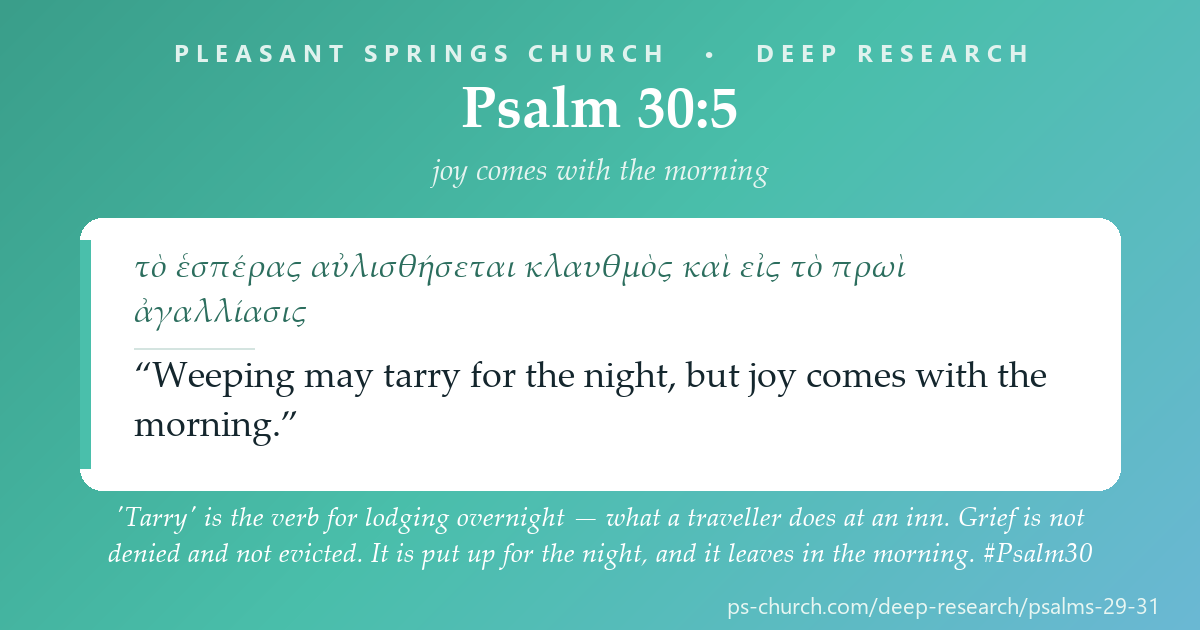
SequencePsalm 30’s famous line is more precise than it sounds in English. “Weeping may lodge for the night” — the verb is lûn, to stay overnight as a guest. Grief is given the status of an overnight visitor: real, accommodated, and leaving in the morning. Rahlfs keeps the lodging image exactly with αὐλισθήσεται, it will camp.
And Psalm 31:5 is the sentence Jesus speaks from the cross (Luke 23:46) — in the Greek wording, with one change. Rahlfs has the future, παραθήσομαι, I shall commit; Luke has the present, παρατίθεμαι, I commit, and adds Father. The psalm looks forward to it; the quotation does it.
Psalm 31:5 is quoted from the cross, and the wording is the Greek Psalter’s — see the reference page for the wider pattern.
Author
He says the same three words seven times. The voice of the LORD… the voice of the LORD… Seven is the number of completeness, and the psalm does not vary the phrase for elegance.
He ends the biggest storm in the Bible by asking for quiet. After cedars snapping and deserts shaking: may he bless his people with peace. The last word of the psalm is shalom.
And he treats grief as a house guest. Weeping lodges for the night — not banished, not denied. Accommodated, and expected to leave.
Audience
People who had watched a storm come in off the sea. Psalm 29 tracks a real weather system from the Mediterranean to the southern desert. The geography is not decorative.
People recovering. Psalm 30 is for someone who nearly died and did not — you have healed me… you restored me to life. It became the psalm for the dedication of the house, according to its own title.
And people at the end of their strength. I have become like a broken vessel. Psalm 31 supplies words for the last moment, and they were used for exactly that.
Orient on storm theophany, on the divine council, and on doublets in translation.
Search by topic: theophany; storm god; divine council (bene elim); Feast of Booths; doublets in the Septuagint; commending the spirit.
Which articles are relevant?
- Anchor Bible Dictionary — “Theophany,” “Sons of God,” “Booths, Feast of,” “Baal.”
- Dictionary of the OT: Wisdom, Poetry & Writings (IVP) — “Divine Council,” “Theophany,” “Thanksgiving Psalms,” “Imagery: Weather.”
- NIDOTTE / TDOT — אֵלִים (ʾēlîm), לוּן (lûn, to lodge), פָּקַד (pāqaḏ, to entrust / deposit), קוֹל (qōl, voice / thunder).
- On the Greek — the NETS Psalms introduction, and anything on doublets — places where a translation carries two renderings of one original. Psalm 29:1 is a clear example.
Bibliography surfaced:
- John Goldingay, Psalms 1–41; Robert Alter, The Book of Psalms.
- Emanuel Tov, Textual Criticism of the Hebrew Bible — on doublets and how they arise.
- Beale and Carson, Commentary on the NT Use of the OT — for Luke 23:46.
A storm that belongs to somebody else's god, and a translation that could not choose.
The doublet at 29:1 is the clearest example of translation technique the shelf has met.
Which parallels shed light on these psalms?
Psalm 29 uses the vocabulary of Canaanite storm poetry and hands it to somebody else. Thunder as a divine voice, mastery over the waters, cedars of Lebanon, a god enthroned above the flood — all of it is at home in texts about Baal, the storm god of the region. The psalm takes the whole apparatus and puts YHWH in it, then ends by asking him to bless his people with peace. Some have argued the psalm is an adapted Canaanite hymn; that goes beyond what can be shown, and the shared vocabulary is not in doubt.
The geography is a real storm track. Verse 3 puts the voice over the sea; verse 5 breaks the cedars of Lebanon in the north; verse 8 shakes the wilderness of Kadesh in the far south. The storm crosses the whole land, north to south.
And a translation carrying two renderings of one phrase is a known phenomenon. A marginal alternative can migrate into the running text; a translator can hedge; two versions can be conflated. The result is a doublet, and Psalm 29:1 in Greek has a textbook one.
- Psalm 89:6–7; Job 1:6; 38:7 → Psalm 29:1. The bənê ʾēlîm / bənê hāʾĕlōhîm language — the library’s Job studies work the same phrase.
- Luke 23:46 → Psalm 31:5. Father, into your hands I commit my spirit. The Greek Psalter’s wording, with the future changed to a present and Father added. See the reference page.
- Acts 7:59 → Psalm 31:5. Lord Jesus, receive my spirit. Stephen says the same thing to a different address. Stated; the seeing is left to the reader.
- Jeremiah 20:10 → Psalm 31:13. Terror on every side — the same distinctive phrase, and Jeremiah uses it repeatedly.
- Psalm 30 title — a song at the dedication of the house. The psalm itself is about personal recovery from illness, which sits oddly with the heading. Reported as a tension the title creates.
The Hebrew of Psalm 29:1 says bənê ʾēlîm, and the second word can be pointed two ways.
• As the plural of ʾēl, god — giving sons of gods, the members of the heavenly court, which is how the psalm is normally read and which fits Psalm 89:6 and Job 1:6.
• As the plural of ʾayil, ram — giving sons of rams, that is young rams, an offering.
The consonants are identical. Only the vowels decide, and the vowels were not written.
⚠️ Rahlfs does not choose. He prints both.
ἐνέγκατε τῷ κυρίῳ υἱοὶ θεοῦ — “bring to the Lord, O sons of God”
ἐνέγκατε τῷ κυρίῳ υἱοὺς κριῶν — “bring to the Lord sons of rams”
One Hebrew clause, two Greek clauses, both renderings preserved. And note that they are not even the same kind of sentence: in the first, the sons of God are being addressed; in the second, rams are being brought.
This is what textual scholars call a doublet. They arise in several ways — a note in a margin copied into the text by a later scribe, a translator recording an alternative, or two Greek versions conflated. Which of those happened here cannot be determined, and no apparatus for the Greek Psalter permits calling either rendering earlier.
What it shows plainly is the translator’s situation. He was working from consonants, facing a phrase that could mean two quite different things, in a verse where both made sense — a summons to the heavenly court, or a call to bring offerings. The Greek text preserves the difficulty instead of hiding it — which is the same instinct, differently expressed, as the dots the Hebrew scribes put on Psalm 27:13.
One phrase seven times, and one phrase twice over.
Count the voice of the Lord yourself — and remember verse 4 has it twice.
Counted here, not assumed:
- Qōl YHWH occurs exactly seven times in Psalm 29, and φωνὴ κυρίου seven times in Rahlfs. Verified in both columns. Verse 4 carries it twice; one instance is maqqef-joined, so a naive search returns five.
- Rahlfs’ Psalm 29:1 renders one Hebrew clause twice — sons of God and sons of rams. A doublet; both readings of an ambiguous Hebrew phrase preserved.
- Rahlfs’ title adds a Feast of Booths rubric with no Hebrew counterpart. The third liturgical title-plus on this shelf.
- Psalm 31:5 (Hebrew 31:6) is quoted at Luke 23:46 in the Greek Psalter’s wording — with the future changed to a present and Father added.
- Hebrew and Rahlfs give Psalms 29, 30 and 31 eleven, thirteen and twenty-five verses; English gives eleven, twelve and twenty-four. Psalm 29 is not offset; 30 and 31 are.
“The voice of the Lord” — and qōl is the ordinary word for both voice and thunder. It occurs exactly seven times in the psalm — verified in both columns; note that verse 4 has it twice and one instance is joined by a maqqef, which defeats a naive search. Rahlfs matches at seven.
“Sons of gods” — or “sons of rams.” The consonants support both: ʾēlîm as the plural of god, or of ram. Rahlfs prints both renderings, one after the other — υἱοὶ θεοῦ and υἱοὺς κριῶν. The divine-council reading is the usual one and matches Psalm 89:6 and Job 1:6.
“It lodges, spends the night” — the verb for staying somewhere as an overnight guest, used of travellers and of Ruth’s where you lodge I will lodge. So “weeping may lodge for the night” treats grief as a visitor who is put up, not turned away. Rahlfs keeps the image with αὐλισθήσεται, it will camp.
“I commit, entrust, deposit” — a word from banking and stewardship: you deposit something valuable with someone for safekeeping, expecting it back. Rahlfs has παραθήσομαι, from the same commercial world. Luke 23:46 uses the identical verb in the present tense — the psalm says I shall deposit; the quotation says I am depositing.
“Of the closing of the Feast of Booths” — a festival rubric in the Greek title with no Hebrew counterpart. The eighth day of Booths was a distinct assembly, and the Greek assigns this psalm to it. The third such rubric on this shelf, after Psalm 24 and Psalm 27.
A heavenly court, and a sentence spoken twice.
Read Psalm 31:5, then Luke 23:46, then Acts 7:59. The same act, three times.
Which cross-references matter?
- Luke 23:46 → Psalm 31:5. The Greek Psalter’s exact wording, with the tense changed. See the reference page.
- Acts 7:59 → Psalm 31:5. Receive my spirit. Stephen, dying, addresses Jesus. Stated; the seeing is left to the reader.
- Psalm 89:6–7; Job 1:6 → Psalm 29:1. The divine council.
- Jeremiah 20:10 → Psalm 31:13. Terror on every side.
- Ruth 1:16 → Psalm 30:5. Where you lodge, I will lodge — the same verb that grief uses here.
- 1 Kings 19:11–12 → Psalm 29. A great wind, an earthquake, a fire — and the Lord in none of them. Psalm 29 insists the storm is his voice; Elijah is told otherwise. Both stand.
Three open questions.
Tov on doublets; Goldingay and Alter on Psalm 29's background.
Commentaries & studies:
- John Goldingay, Psalms 1–41; Robert Alter, The Book of Psalms.
- Emanuel Tov, Textual Criticism of the Hebrew Bible — on doublets.
- Beale and Carson, Commentary on the NT Use of the OT — on Luke 23:46.
- NETS Psalms, with Rahlfs — for 29:1 and the title.
Three things reported as unsettled:
- How the doublet at 29:1 arose. A migrated marginal note, a hedging translator, or two conflated versions are all proposed. Not decidable.
- Whether Psalm 29 adapts a Canaanite hymn. The shared vocabulary is not in dispute; the claim of direct adaptation goes further than the evidence, and this page does not make it.
- Why Psalm 30 carries a temple-dedication title. The psalm is about recovery from personal illness, and the heading fits awkwardly. Reported as a tension.
A storm that ends in peace, and a guest who leaves in the morning.
Name what you learned, why it matters, and one concrete response.
What should we carry away — and do?
- The loudest psalm in the book ends by asking for quiet. Seven thunderclaps, cedars snapping, the desert shaking — and the last word is peace. The point of the storm is not the storm.
- Grief is given lodging, not eviction. Weeping may lodge for the night — the verb for putting a traveller up. The psalm neither denies the weeping nor lets it move in.
- “I commit my spirit” is a banking word. ʾApqîḏ means to deposit for safekeeping, expecting it back. That is what the psalm says, and it is what Jesus said — changing the tense from I shall to I do.
- One concrete response. The Greek translator met a word that could mean two things and wrote down both rather than pretending to know. The Hebrew scribes did the same with dots at Psalm 27:13. When you do not know, say so — and keep working.
Psalm 30:5 · to share
Hebrew + Greek (Rahlfs) + ESVEvery Deep Research page traces its passage across the whole sweep — the Old Testament, the Second-Temple world between the testaments (historical witnesses, not Scripture), and the New Testament. Follow the thread:
Pleasant Springs Church — Deep Research
Research method after Michael S. Heiser’s Bible Research Method (examine dictionaries → ancient literature → important words → textual connections → academic publications → share), with the Pleasant Springs “Author & Audience” foundation. Scripture set in the Hebrew, the Greek editions named on each page and the ESV (Old Testament), and the Greek New Testament and the ESV (New Testament), per the practice of Pleasant Springs Church. Psalms 29–31 research grounded in Goldingay (Psalms 1–41), Alter and Tov, with Beale and Carson for Luke 23:46. Text: Hebrew from the Masoretic text as printed in the editions consulted — Sefaria’s Miqra according to the Masorah; no critical apparatus was consulted for the Hebrew. Greek from Rahlfs’ Greek Psalter (CATSS digitization of Rahlfs 1931). The standing caution for this shelf applies: these pages say “Rahlfs’ Greek Psalter reads…” and never call a Greek reading early or late. ⚠️ The sevenfold count was computed, and corrected mid-check. A first pass treating the maqqef as a word boundary returned five; normalising the maqqef as a joiner returns seven, with verse 4 carrying the phrase twice — and Rahlfs independently yields seven φωνὴ κυρίου, confirming the figure. The method is stated on the page so the trap is visible to readers who try the count themselves. ⚠️ The 29:1 doublet was verified directly: Rahlfs renders one Hebrew clause as both υἱοὶ θεοῦ and υἱοὺς κριῶν, reflecting the genuine ambiguity of ʾēlîm (plural of ʾēl, god, or of ʾayil, ram). How the doublet arose is explicitly left open — migrated marginal note, hedging translator, or conflated versions are all reported as proposals. The Feast of Booths rubric was verified as having no Hebrew counterpart and set alongside the comparable title-pluses at Psalms 24 and 27. Luke 23:46 is reported precisely: the wording is the Greek Psalter’s, with παραθήσομαι (future) becoming παρατίθεμαι (present) and Father added. The claim that Psalm 29 adapts a Canaanite hymn is explicitly declined as going beyond the evidence, while the shared storm vocabulary is affirmed. Verse counts were checked in all three columns (Hebrew and Rahlfs 11/13/25; English 11/12/24). Typology is handled per the house position: what the text says, what the New Testament itself draws, and what we see from this side of the cross — with the seeing left to the reader.
Scripture quotations marked ESV are from the ESV® Bible (The Holy Bible, English Standard Version®), © 2001 by Crossway, a publishing ministry of Good News Publishers. ESV Text Edition: 2016. Used by permission. All rights reserved. The ESV text may not be quoted in any publication made available to the public by a Creative Commons license, and the ESV may not be translated in whole or in part into any other language. www.esv.org
|
Did this study bless you today? 💚 Give to Support PS Church100% of gifts go to the General Fund — thank you. |