The most consequential difference between the Hebrew and Greek of this psalm sits in the one verse Paul quotes — and it moves God from one side of the courtroom to the other. The Hebrew reads "…that you may be right when you speak, clear when you judge" — an active infinitive, God on the bench. Rahlfs reads "…and prevail when you are judged" — a middle-passive infinitive with you as its subject, and a verb meaning to win a lawsuit rather than to be clean. The Hebrew vindicates God as the one passing sentence; the Greek vindicates God as the one on trial. And Romans 3:4 quotes the Greek word for word, in an argument that God wins the case brought against him — which the Hebrew wording will not carry. This page reports the divergence and refuses to call either reading a mistake or to date them. A second correction follows: the Hebrew of verse 5 does not say "conceived" in its first clause — it says brought forth, i.e. born. The conception language is the Greek's. See the method →
Psalm 51:1–19 (selections)
Hebrew · Greek (Rahlfs’ Psalter) · ESVThe Hebrew of verse 4 reads tiṯṣdaq bəḏoḇreḵā, tizkeh ḇəšopṭeḵā — “that you may be in the right when you speak, clear when you judge.” The verb šāpaṭ is an active infinitive with a second-person suffix: when you pass sentence. God is on the bench.
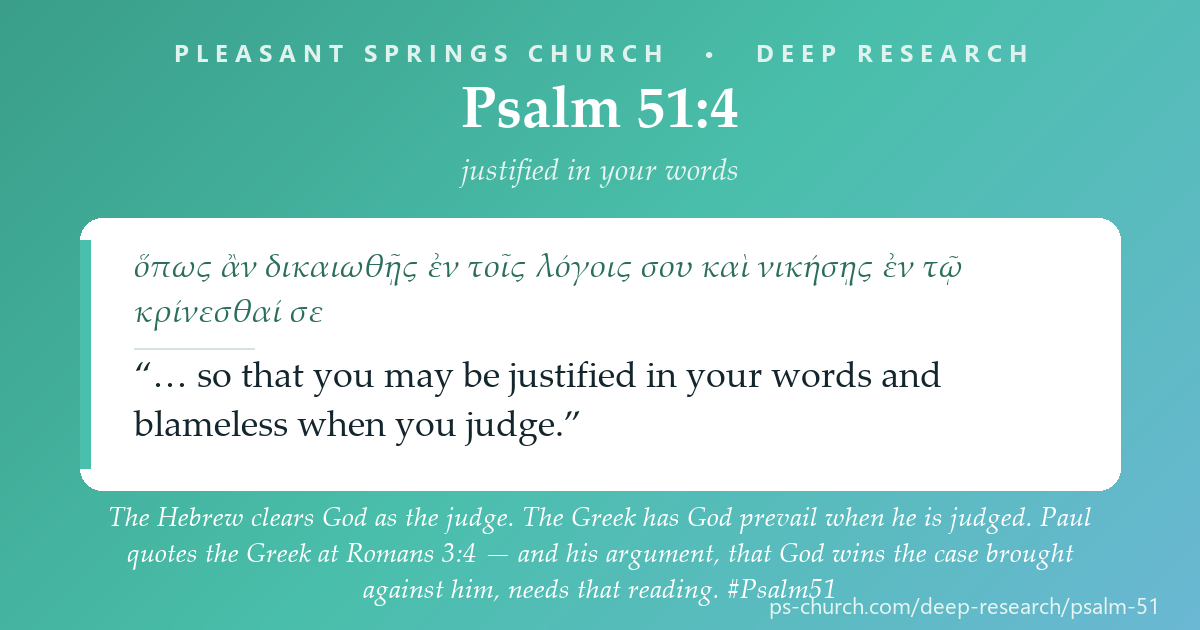
Rahlfs reads ὅπως ἂν δικαιωθῇς ἐν τοῖς λόγοις σου καὶ νικήσῃς ἐν τῷ κρίνεσθαί σε — “that you may be justified in your words and prevail when you are judged.”
Two changes, both checkable in the parsing codes of the Greek text. First, tizkeh (“be clean, be clear”) becomes νικάω — to win a case, a courtroom victory rather than purity. Second, and larger: κρίνεσθαι is middle-passive with σε as its accusative subject — when you are judged.
The Hebrew vindicates God as the one passing sentence. The Greek vindicates God as the one on trial.
⚠️ And Romans 3:4 quotes the Greek, word for word. Paul is arguing that human faithlessness does not cancel God’s faithfulness — that God wins the case brought against him. That argument needs the Greek sense; the Hebrew’s “when you judge” will not carry it.
This page reports the divergence and stops there. It does not say the Greek mistranslated. The Hebrew root carries a “be acquitted, win” sense in later Hebrew and Aramaic, and the infinitive has been argued to bear a middle nuance — and, as everywhere on this shelf, no apparatus for the Greek Psalter permits calling either reading earlier.
⚠️ A second correction, and it touches a doctrine people build on this psalm.
Verse 5 is usually quoted as “in sin did my mother conceive me” and read as a statement about conception. The Hebrew’s first clause does not say that. Ḥōlāltî is from a root meaning to writhe, to bring forth — “I was brought forth in iniquity,” i.e. born — and both Hebrew sin-words are singular.
Rahlfs reads συνελήμφθην, “I was conceived,” and makes both sin-words plural. So the Greek moves the sin back from birth to conception, and doubles it. An argument for sinfulness from the moment of conception is leaning on the Greek here, not the Hebrew — and this page says so rather than letting the reader assume otherwise.
The Shape of the Passage
SequenceVerse 10 asks for something no repair can supply. Create in me a clean heart — and bārāʾ is the Genesis 1 verb, never used in the Hebrew Bible with any subject but God. He is asking to be made, not mended.
And the sacrifice argument is finer than it looks. The psalm does not say sacrifice is worthless; it says you will not delight in it — and then offers a substitute that is also called a sacrifice: the sacrifices of God are a broken spirit. Then verses 18–19 turn round and approve burnt offerings after all. The tension is in the text.
Verse numbering warning for this psalm. Its superscription runs to two full Hebrew verses, so English is offset by two, not one: English 51:1 = Hebrew 51:3. Only four psalms in the book are offset by two.
Author
He asks to be created, not repaired. The verb at verse 10 is the Genesis 1 verb, never used in the Hebrew Bible with any subject but God. There is no human equivalent of what he is requesting.
He uses a breeding word for his own mother. Ye\u1e25\u0115ma\u1e6Fn\u012B is from the root used of Jacob\u2019s flocks in Genesis 30. And the Greek matched the register rather than smoothing it — its verb occurs in the Psalter only here, and elsewhere in the Greek Old Testament almost only of those same flocks.
And he argues with the sacrificial system from inside it. You will not delight in sacrifice — and then he calls a broken spirit a sacrifice. He does not leave the category; he refills it.
Audience
People who had done something that could not be undone. The psalm never proposes restitution — which is realistic, given what the superscription says had happened.
People inside the Elohistic Psalter. The Hebrew of Psalm 51 never uses the divine name YHWH at all — not once in twenty-one verses — a feature of the collection it sits in.
And, eventually, a church. Its place among the seven Penitential Psalms and its Latin name Miserere are ecclesiastical traditions, not features of the Hebrew or Greek text — and this page attributes them as traditions.
Orient on penitence, on creation vocabulary, and on hyssop.
Search by topic: penitential psalms; confession; bara and creation; hyssop; Elohistic Psalter; broken spirit; Nathan and Bathsheba.
Which articles are relevant?
- Anchor Bible Dictionary — “Sin, Sinners,” “Forgiveness,” “Hyssop,” “Sacrifice and Offerings,” “Nathan.”
- Dictionary of the OT: Wisdom, Poetry & Writings (IVP) — “Penitential Psalms,” “Confession,” “Elohistic Psalter,” “Cult.”
- NIDOTTE / TDOT — בָּרָא (bārāʾ, to create), חוּל (ḥûl, to writhe / bring forth), יָחַם (yāḥam, to be in heat), זָכָה (zāḵāh, to be clear).
- On the Greek — the NETS Psalms introduction, and Romans 3:1–8, where Paul’s argument turns on the Greek reading of verse 4. See the reference page.
Bibliography surfaced:
- Hossfeld and Zenger, Psalms 2 (Hermeneia) — this volume begins at Psalm 51, so it is available here for the first time on this shelf.
- John Goldingay, Psalms 42–89; Robert Alter, The Book of Psalms.
- Beale and Carson, Commentary on the NT Use of the OT — for Romans 3:4.
A courtroom, a breeding pen, and a bunch of hyssop.
The Romans 3:4 divergence is the substance. The conception question is the correction.
Which parallels shed light on this psalm?
Hyssop is a specific ritual implement, not a metaphor. It is the bunched plant used to daub blood on the doorposts at Passover (Exodus 12:22), to sprinkle a cleansed leper (Leviticus 14), and to apply the water of purification (Numbers 19:18). The psalm is asking for a specific rite by name. And the Greek noun for it occurs in the whole Greek Psalter only here.
The mother-verb is from the language of livestock. Yeḥĕmaṯnî is from the root used repeatedly in Genesis 30 of Jacob’s flocks breeding at the watering troughs. It is a startling word to use of one’s own conception, and the Greek translator did not soften it — his verb likewise appears in the Psalter only here, and elsewhere in the Greek Old Testament almost only of those same flocks. Two translators, centuries apart, both declining to make the line more respectable.
And “against you only” is a jurisdictional claim. The psalm does not say no one else was hurt. It says the case belongs in God’s court — and it is precisely that legal framing which makes the next clause, about a verdict, follow naturally.
- Romans 3:4 → Psalm 51:4. The only formal New Testament citation of this psalm, and it reproduces Rahlfs word for word. See the reference page.
- 2 Samuel 11–12 → the superscription. Nathan and Bathsheba are named in the Hebrew title and in the Greek — and those two names occur in only this one verse of the entire Greek Psalter.
- Exodus 12:22; Leviticus 14:4–7; Numbers 19:18 → Psalm 51:7. Hyssop as ritual equipment.
- Genesis 30:38–41 → Psalm 51:5. The breeding vocabulary, in both languages.
- Isaiah 63:10–11 → Psalm 51:11. His holy spirit — the phrase appears here and in those two Isaiah verses. The page does not claim the Old Testament has no others, because that was not exhaustively checked.
- Genesis 1:1 → Psalm 51:10. The verb bārāʾ, whose subject in the Hebrew Bible is always God.
Paul quotes this psalm once, and the quotation is the Greek Psalter’s wording without variation.
The Hebrew (51:4): “… so that you may be righteous when you speak, clear when you judge.” The verb is an active infinitive with a second-person suffix. God is the judge, and the psalmist’s confession removes any grounds for appeal against the sentence.
Rahlfs (50:6): ὅπως ἂν δικαιωθῇς ἐν τοῖς λόγοις σου καὶ νικήσῃς ἐν τῷ κρίνεσθαί σε — “… that you may be justified in your words and prevail when you are judged.”
Two verified shifts.
• Tizkeh (“be clean, be clear”) → νικάω, to win a lawsuit. Purity becomes victory.
• When you judge → ἐν τῷ κρίνεσθαί σε, middle-passive infinitive with σε as its subject — “when you are judged.”
⚠️ And Paul needs the second reading. Romans 3:1–8 is about whether human faithlessness nullifies God’s faithfulness — whether God can be held to have failed. Paul’s answer is that God wins the case brought against him, and he cites this clause as proof. The Hebrew’s “clear when you judge” does not make that argument.
What this page will not say. It will not call the Greek a mistranslation. There are respectable defences of both — the Hebrew root carries a “be acquitted, win” sense in later Hebrew and Aramaic, and the infinitive has been argued to bear a middle nuance — and no apparatus for the Greek Psalter permits calling either reading earlier. What can be said is that the two readings put God in different chairs, and that the apostle used one of them.
A courtroom verb, a breeding verb, and a verb only God does.
Read verse 4 in both columns and ask who is on trial.
Counted here, not assumed:
- Hebrew and Rahlfs give Psalm 51 twenty-one verses; English has nineteen. The offset is two — the superscription occupies two full Hebrew verses. Only four psalms in the book are offset by two.
- There is NO Greek title-plus here. The superscription matches the Hebrew element for element — which makes this psalm a counter-example to the pattern recorded at Psalms 24, 27, 29, 33 and 43, and it is reported as such.
- The Hebrew of Psalm 51 never uses the divine name YHWH — not once in 21 verses. It sits inside the Elohistic Psalter. Rahlfs nonetheless has κύριε at 51:18, where the Hebrew has no divine name at all.
- Psalm 51 has zero Selah, and Rahlfs has zero διάψαλμα — while both neighbouring psalms have them.
- Rahlfs’ Greek runs 284 words against the Hebrew’s 153.
- Nathan and Bathsheba are named in only this one verse of the entire Greek Psalter.
“Clear when you judge.” The infinitive is active with a second-person suffix — when you pass sentence. Rahlfs reads νικήσῃς ἐν τῷ κρίνεσθαί σε — “prevail when you are judged”, with a middle-passive infinitive. Romans 3:4 quotes the Greek, and Paul’s argument requires it. Reported; not adjudicated.
“I was brought forth.” From the root meaning to writhe — the word for labour pains. It means born, not conceived. Rahlfs reads συνελήμφθην, I was conceived, and makes both of the Hebrew’s singular sin-words plural. An argument for sin from conception is resting on the Greek.
“She conceived me” — from the root used of livestock in heat, which Genesis 30 uses repeatedly of Jacob’s flocks. A deliberately unlovely word to use of one’s own mother. Rahlfs matched the register: his verb occurs in the whole Greek Psalter only here, and elsewhere in the Greek Old Testament almost only of those same flocks. Neither translator smoothed it.
“Create.” The Genesis 1 verb, and in the Hebrew Bible its subject is always God — no human being ever performs this action. The psalmist is not asking for his heart to be cleaned but for one to be made. Rahlfs has κτίσον, which occurs in the Psalter only here.
“Un-sin me.” Built on the very root that runs through the psalm — the verb form removes what the noun names. The wordplay cannot survive translation. Rahlfs substitutes a ritual verb, ῥαντιεῖς, you will sprinkle — and both that verb and his word for hyssop occur in the entire Greek Psalter only in this one verse.
“Spirit” — four occurrences, and Rahlfs has four, in the same four verses: a steadfast spirit, your holy spirit, a willing spirit, a broken spirit. Verse 11 is the only place in the entire Greek Psalter that reads your holy spirit; the Hebrew phrase also stands at Isaiah 63:10 and 11. At verse 12 the Greek turns the spirit from subject into instrument and makes God the actor.
A prophet at the door, and an argument in Romans.
Read Romans 3:1–8 and ask what Paul needs the psalm to say.
Which cross-references matter?
- Romans 3:4 → Psalm 51:4. Verbatim from Rahlfs, and the argument requires the Greek sense.
- 2 Samuel 11–12 → the superscription. The occasion, named in both columns.
- Genesis 1:1 → Psalm 51:10. The creation verb.
- Genesis 30:38–41 → Psalm 51:5. The flocks.
- Isaiah 63:10–11 → Psalm 51:11. His holy spirit.
- Psalm 32 → Psalm 51. The other great confession psalm, and the one Paul uses in Romans 4 — see Psalms 32–34. Paul quotes one psalm of confession for justification and another for God’s vindication.
Four open questions.
Hermeneia reaches this psalm; Goldingay and Alter for the Hebrew.
Commentaries & studies:
- Hossfeld and Zenger, Psalms 2 (Hermeneia) — the volume begins here.
- John Goldingay, Psalms 42–89; Robert Alter, The Book of Psalms.
- Beale and Carson, Commentary on the NT Use of the OT — for Romans 3:4.
Four things reported as unsettled:
- Whether 51:4 means when you judge or when you are judged. Hebrew and Greek differ; Paul used the Greek. Both have defences, and neither can be shown earlier.
- Whether verse 5 is about birth or conception. The Hebrew first clause says brought forth; the Greek says conceived.
- Whether verses 18–19 are original. They approve the sacrifices verse 16 sets aside, and read like a liturgical extension — but the text gives no signal.
- Whether “a princely spirit” in the Greek borrows a philosophical term. What is verified is only that the word occurs once in the Psalter and once across the Greek books checked. The wider claim is not verified here and is left to the commentaries.
A verse that moves God across the courtroom.
Name what you learned, why it matters, and one concrete response.
What should we carry away — and do?
- Paul quotes this psalm in Greek, and the Greek says something the Hebrew does not. The Hebrew clears God as judge; the Greek has God prevail when he is judged — and Romans 3 needs the second. Neither is called a mistake here.
- The Hebrew does not say “conceived in sin” in its first clause. It says brought forth. The conception language is the Greek’s. A doctrine built on that phrase should know which column it is standing on.
- He asks to be created, not cleaned. Bārāʾ is the Genesis verb, and no human being is ever its subject. There is no self-help version of verse 10.
- One concrete response. The psalm refuses to leave the sacrificial category — it says you will not delight in sacrifice and then calls a broken spirit a sacrifice. Bring something. Bring the thing you actually have.
Psalm 51:4 · to share
Hebrew + Greek (Rahlfs) + ESVEvery Deep Research page traces its passage across the whole sweep — the Old Testament, the Second-Temple world between the testaments (historical witnesses, not Scripture), and the New Testament. Follow the thread:
Pleasant Springs Church — Deep Research
Research method after Michael S. Heiser’s Bible Research Method (examine dictionaries → ancient literature → important words → textual connections → academic publications → share), with the Pleasant Springs “Author & Audience” foundation. Scripture set in the Hebrew, the Greek editions named on each page and the ESV (Old Testament), and the Greek New Testament and the ESV (New Testament), per the practice of Pleasant Springs Church. Psalm 51 research grounded in Hossfeld and Zenger (Psalms 2, Hermeneia — the volume begins at this psalm), Goldingay and Alter, with Beale and Carson for Romans 3:4. Text: Hebrew from the Masoretic text as printed in the editions consulted — Sefaria’s Miqra according to the Masorah; no critical apparatus was consulted for the Hebrew. Greek from Rahlfs’ Greek Psalter (CATSS digitization of Rahlfs 1931), with the file’s own morphological codes used to check parsing. The standing caution for this shelf applies: these pages say “Rahlfs’ Greek Psalter reads…” and never call a Greek reading early or late. ⚠️ The verse 4 divergence was verified from the parsing codes, not inferred: κρίνεσθαι is coded as a middle/passive infinitive with σε as accusative subject, and νικήσῃς is from a verb meaning prevail / win a suit, against Hebrew tizkeh (root be clean) with an active infinitive bəšopṭeḵā. The page states the two readings put God in different chairs, notes that Romans 3 requires the Greek sense, and explicitly declines both to call the Greek a mistranslation and to date either reading — recording that the Hebrew root bears a win / be acquitted sense in later Hebrew and Aramaic. ⚠️ A widely-repeated claim is corrected: the Hebrew of verse 5 reads ḥōlāltî (Polal of ḥûl, brought forth in travail) with both sin-nouns singular, while Rahlfs reads I was conceived with both plural — so arguments for sinfulness from conception rest on the Greek, and the page says so. The animal-breeding register of yeḥĕmaṯnî was confirmed against Genesis 30:38–41 in both languages. Counts verified directly: 21 verses in MT and Rahlfs against 19 in English — an offset of two, the superscription occupying two full Hebrew verses; zero occurrences of the Tetragrammaton in the Hebrew; a bare κύριε plus at Rahlfs 50:20; zero Selah and zero διάψαλμα where both neighbours have them; and no Greek title-plus — explicitly flagged as a counter-example to the pattern recorded elsewhere on this shelf. Sefaria’s English follows Hebrew versification and was therefore not used to derive the offset. The Miserere title and the psalm’s place among the seven Penitential Psalms are attributed as ecclesiastical traditions, not features of either text. Typology is handled per the house position: what the text says, what the New Testament itself draws, and what we see from this side of the cross — with the seeing left to the reader.
Scripture quotations marked ESV are from the ESV® Bible (The Holy Bible, English Standard Version®), © 2001 by Crossway, a publishing ministry of Good News Publishers. ESV Text Edition: 2016. Used by permission. All rights reserved. The ESV text may not be quoted in any publication made available to the public by a Creative Commons license, and the ESV may not be translated in whole or in part into any other language. www.esv.org
|
Did this study bless you today? 💚 Give to Support PS Church100% of gifts go to the General Fund — thank you. |