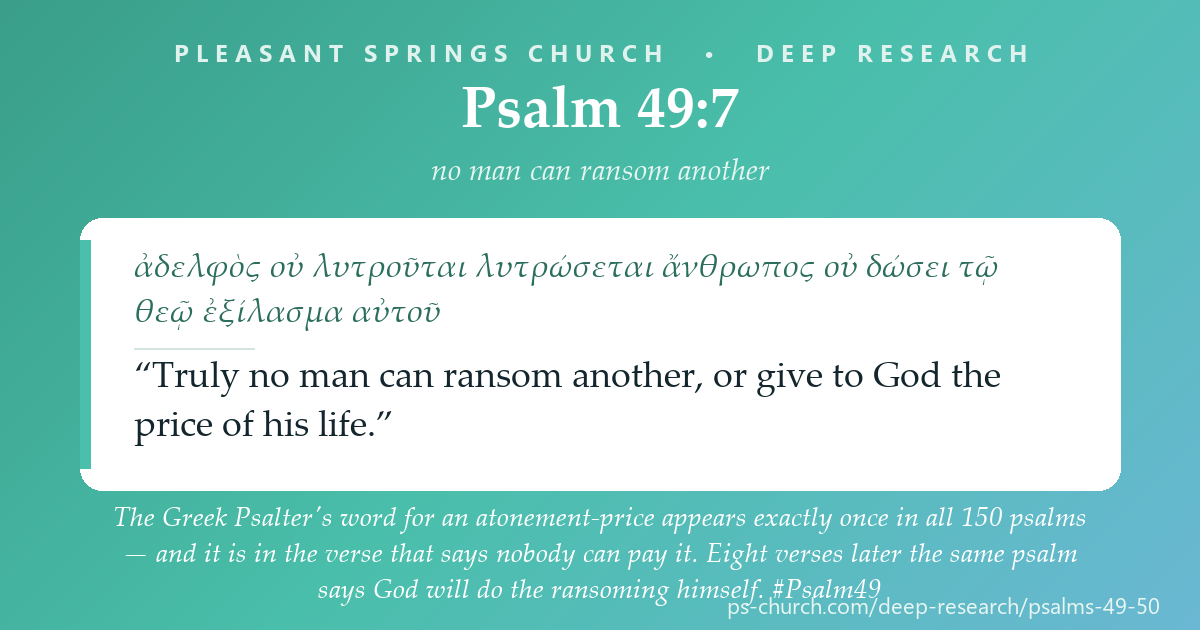
Psalm 49:7 says no one can give God the price of his life. The Greek Psalter renders that price exilasma — an atonement-payment — and searched across all 150 psalms, that word occurs exactly once: here, in the verse that says it cannot be paid. Eight verses later the psalm uses the same ransom verb again, with God as the subject. Then the refrain, which is stranger than it looks: Psalm 49's two closing lines differ in Hebrew — one says a man will not remain, the other that he does not understand, the verbs one consonant apart — and Rahlfs' two lines are word-for-word identical apart from a single leading kai. The Greek carries less variation here than the Hebrew does — as it also does at Psalms 42–43 and Psalm 57 — though which way that ran is not decidable. And in Psalm 50, a line everybody knows turns out to rest on a choice: "the cattle on a thousand hills" has no thousand in the Greek at all, because the same consonants that spell a thousand also spell cattle. One more thing worth knowing: 1 Corinthians 10:26 is not quoting Psalm 50. See the method →
Psalms 49:7–50:14 (selections)
Hebrew · Greek (Rahlfs’ Psalter) · ESVPsalm 49:7 says a man cannot give to God his ransom. Rahlfs renders that ἐξίλασμα — the noun from the verb behind propitiation, a price that covers a wrong. Searched across the whole Greek Psalter: one occurrence, here.
And the verb of the same verse comes back eight verses later with a different subject. 49:7 — οὐ λυτροῦται, a brother does not ransom. 49:15 — πλὴν ὁ θεὸς λυτρώσεται τὴν ψυχήν μου, but God will ransom my soul. The psalm shuts one door and opens another, using the same word for both. The verb Mark 10:45 turns into a noun — λύτρον, a ransom for many — is this family.
⚠️ The refrain differs in Hebrew and is identical in Greek. Psalm 49 closes both halves with the same line, and the two Hebrew forms are not the same. Hebrew 49:13 has bal-yālîn, “will not remain”; Hebrew 49:21 has wəlōʾ yāḇîn, “and does not understand” — the verbs differ by a single consonant. Rahlfs’ two lines are word for word identical apart from one leading καί, reading did not understand in both places.
The same shape turns up elsewhere on this shelf. At Psalms 42–43 Rahlfs’ first and third refrains are identical and his second still differs in one noun form; at Psalm 57 his two are identical where the Hebrew’s differ by an article. Each time the Greek carries less variation than the Hebrew does. Whether a Hebrew text that already read alike stands behind that, or a rendering made it so, is not decidable here — and this page decides neither.
⚠️ And the thousand hills are not in the Greek. Psalm 50:10 in Hebrew is bəharərê ʾālep, “on hills of a thousand”. Rahlfs has ἐν τοῖς ὄρεσιν καὶ βόες — on the mountains, and oxen — with no number anywhere. The same consonants that spell a thousand also spell cattle, and the Greek Psalter demonstrably renders them that way elsewhere: at Psalm 8:7 (Hebrew and Rahlfs 8:8) וַאֲלָפִים becomes βόας, oxen. The famous English line rests on the other reading.
The Shape of the Passage
Refrain-bounded panels, then a courtroom in three speechesPsalm 50 is a courtroom, and the word sacrifice runs through every part of it. The root זבח stands in verse 5 (who made a covenant with me by sacrifice), verse 8 (not for your sacrifices do I rebuke you), verse 14 (offer to God a sacrifice of thanksgiving) and verse 23 (the one who offers thanksgiving as his sacrifice). Summons, charge, charge, verdict — and the same word in all four.
One structural signal exists in Greek and not in Hebrew. Rahlfs closes the first speech with a διάψαλμα at 49:15; the Hebrew of 50:15 has no Selah. The Greek marks the hinge the Hebrew leaves unmarked. Whether that reflects an older reading or a reader’s judgement is not something this page can decide.
Psalm 49 closes the Korahite run that began at Psalm 42 — see Psalms 42–43, Psalm 44, Psalms 45–46 and Psalms 47–48. Psalm 50 is the first psalm of Asaph, and it changes the voice entirely: God does the talking.
Author
A teacher, and he says so before he says anything else. My mouth shall speak wisdom; the meditation of my heart shall be understanding. I will incline my ear to a proverb; I will solve my riddle. Psalm 49 is the Psalter doing what Proverbs and Job do.
Someone who had watched rich men die. For he sees that even the wise die… and leave their wealth to others. The argument is an observation, not a doctrine.
Then Asaph, whose psalm is almost entirely quotation. From verse 5 onward Psalm 50 is God speaking in the first person, and the poet barely returns. He builds a courtroom and then keeps quiet in it.
Audience
Everybody, explicitly. Hear this, all peoples! Give ear, all inhabitants of the world, both low and high, rich and poor together. Psalm 49 addresses the whole world and then tells it that money does not travel.
People who were doing the sacrifices properly. Not for your sacrifices do I rebuke you; your burnt offerings are continually before me. God’s complaint in Psalm 50 is not that the offerings stopped.
And people who could recite the covenant and were living against it. What right have you to recite my statutes or take my covenant on your lips? The second charge is aimed at fluent mouths.
Orient on wisdom psalms, on ransom language, and on the covenant lawsuit.
Search by topic: wisdom psalms; ransom and redemption; Sheol; the covenant lawsuit (rîḇ); thank offering; Asaph; Korah, sons of.
Which articles are relevant?
- Anchor Bible Dictionary — “Redemption,” “Sheol,” “Sacrifice and Sacrificial Offerings,” “Asaph.”
- Dictionary of the OT: Wisdom, Poetry & Writings (IVP) — “Wisdom Psalms,” “Death,” “Retribution,” “Worship.”
- NIDOTTE / TDOT — פָּדָה (pāḏāh, ransom), כֹּפֶר (kōper, a covering-price), תּוֹדָה (tōḏāh, thanksgiving / thank offering), אֶלֶף (ʾelep, a thousand and cattle).
- On the Greek — the NETS Psalms introduction; and for ἐξίλασμα and the λυτρ- family, a Septuagint lexicon rather than a New Testament one.
- On the thank offering — Leviticus 7:11–15, where זֶבַח הַתּוֹדָה is a named class of sacrifice.
Bibliography surfaced:
- John Goldingay, Psalms 42–89; Robert Alter, The Book of Psalms.
- Frank-Lothar Hossfeld and Erich Zenger, Psalms 2 (Hermeneia) — covers Psalms 51–100, so it begins one psalm after this pair.
- Beale and Carson, Commentary on the NT Use of the OT — for Hebrews 13:15 and 1 Corinthians 10:26.
A price the law refuses to take, a God who is not hungry, and a covenant lawsuit.
Read Psalm 49:7 beside Numbers 35:31. The psalm is not being poetic about the limits of money; it is repeating a legal rule.
Which parallels shed light on these psalms?
Psalm 49:7 is using a legal word, and the law it comes from forbids exactly this transaction. A כֹּפֶר is the payment that buys a life out of a penalty — Exodus 21:30 allows one for the owner of a goring ox, and Numbers 35:31 forbids one for a murderer: you shall accept no ransom for the life of a murderer. Psalm 49 extends the refusal to death itself. Nobody has the price, and God is not taking offers.
Psalm 50 answers a religious idea that was everywhere in the ancient world and is nowhere in Israel’s law: that the gods eat. Mesopotamian temple ritual set meals before the god; the flood story in Gilgamesh has the gods gathering over Utnapishtim’s sacrifice like flies (ANET 95), and in Atrahasis — a different text — they are said to have gone hungry while the offerings stopped. Psalm 50 takes that idea up and dismisses it in one line: if I were hungry, I would not tell you. The sacrifices are not cancelled — verse 8 says they are continually before him. What is cancelled is the notion that they feed anybody.
And the psalm is shaped like a lawsuit. Heaven and earth are summoned as witnesses, the plaintiff speaks, and a verdict is given — the same form Isaiah 1 and Micah 6 use, and the same witnesses Deuteronomy 32:1 calls. The defendant is God’s own people, and the charge is brought by the God they are sacrificing to.
- Numbers 35:31; Exodus 21:30 → Psalm 49:7. The kōper, and the one case where the law will not accept it.
- Genesis 5:24 → Psalm 49:15. He was not, for God took him — the same Hebrew verb the psalm uses of itself: for he will take me. Stated; the seeing is left to the reader.
- Deuteronomy 32:1; Isaiah 1:2 → Psalm 50:1–6. Heaven and earth called as witnesses. Micah 6:1–2 brings the same lawsuit form but summons the mountains and the foundations of the earth.
- Leviticus 7:11–15 → Psalm 50:14, 23. The thank offering is a real class of sacrifice, not a metaphor the psalm invented.
- Epic of Gilgamesh XI → Psalm 50:12–13. The gods crowding the sacrifice after the flood. The psalm rules that picture out.
• ἐξίλασμα stands exactly once in all 150 psalms.
Rahlfs uses it at 48:8 — our Psalm 49:7 — for the Hebrew כֹּפֶר. Searched across the whole Greek Psalter, accent-blind: one hit.
The λυτρ- family, by contrast, is common — it appears in thirty verses of the Psalter, three of them in this one psalm. Rahlfs 48:8 (our 49:7) says a brother does not ransom; 48:9 speaks of the price of the ransoming of his soul; 48:16 (our 49:15) says but God will ransom my soul. The same verb, denied and then granted.
What may not be concluded from that. Psalm 49 is not quoted in the New Testament — the sweep below shows no run longer than five words, and both of those are ordinary phrasing — so nothing here says Mark 10:45 or 1 Timothy 2:6 is reaching for this psalm. What can be said is that the vocabulary is the same vocabulary, and that the psalm states the problem those verses answer. The seeing is left to the reader.
• The refrain: Hebrew differs, Greek does not.
Hebrew 49:13 and 49:21 are not the same line. They differ in three places — the opening conjunction, the negative particle (bal against wəlōʾ), and the verb, where yālîn (remain, lodge overnight) and yāḇîn (understand) differ by one consonant.
Rahlfs’ two lines are identical — every word, in order — apart from a single leading καί. He reads did not understand both times. ESV keeps the Hebrew difference: will not remain at verse 12, yet without understanding at verse 20.
The same shape turns up twice more on this shelf. At Psalms 42–43 Rahlfs’ first and third refrains are identical and his second still differs in one noun form; at Psalm 57 his two are identical where the Hebrew’s differ by an article. Each time the Greek carries less variation than the Hebrew does. Whether a Hebrew text that already read alike stands behind that, or a rendering made it so, is not decidable here and no claim is made either way.
A price, a refrain, and two words that are spelled the same.
Three of the five differences on this page turn on unpointed consonants. That is the shelf’s most common single cause of divergence.
Counted here, not assumed:
- Verse counts. Psalm 49: Hebrew and Rahlfs both give twenty-one verses, English twenty — the offset is the title. Psalm 50: Hebrew, Rahlfs and English all give twenty-three — its short title folds into verse 1 in every tradition, so there is no offset at all in Psalm 50. In Greek numbering these are Psalms 48 and 49.
- Neither psalm has a Greek title-plus. Psalm 49’s three Hebrew elements are answered by three Greek ones, and Psalm 50’s two by two. Worth stating, because the previous study found a title-plus at Psalm 48 and this shelf has now logged a dozen of them.
- The verse totals of Psalm 49 match while the verse contents do not. Rahlfs 48:9 carries only the first half of Hebrew 49:9; 48:10 picks up the leftover, adds Hebrew 49:10 and takes the first line of 49:11; 48:11 has what is left. They resync at verse 12. Same words, same total, three verses drawn differently.
- ἐξίλασμα: one occurrence in the whole Greek Psalter (48:8 = our 49:7). The λυτρ- family: thirty verses, three of them in this psalm.
- θυσία αἰνέσεως stands in four verses of the Greek Psalter — 49:14 and 49:23 (our Psalm 50) plus 106:22 and 115:8 (our 107:22 and 116:17). Half of them are here.
- Neither psalm is quoted in the New Testament. Every verse of both was swept against all 7,927 verses of the Greek New Testament; the longest shared run is five words, and there are two of them — the birds of the air and (Rahlfs 49:11 with Matthew 13:32) and O God, your God (Rahlfs 49:7 with Hebrews 1:9).
- Rahlfs has a διάψαλμα at 49:15 where Hebrew 50:15 has no Selah. Compared the same-verse way across the psalms whose numbering aligns, the Greek adds one in six places and lacks one in four — the two markers do not simply correspond. Adjacent-verse placement was not chased, so treat these as counts of same-verse disagreement.
The price that buys a life out of a penalty. Exodus 21:30 permits one; Numbers 35:31 forbids one for a murderer. Rahlfs gives ἐξίλασμα, an atonement-price — the only occurrence of that noun in the whole Greek Psalter. The psalm’s point is that this particular payment cannot be made by anybody.
The refrain’s two Hebrew forms, one consonant apart in the verb. One says a man will not stay the night; the other says he does not understand. Rahlfs reads the second at both (οὐ συνῆκεν), producing two identical lines where the Hebrew has two different ones.
The same letters in a different order. The Masoretic text has qirḇām, their inward thought; the Greek has οἱ τάφοι αὐτῶν, their graves, which answers qiḇrām — the same consonants with the second and third swapped. ESV prints the reading of the Septuagint, Syriac and Targum, and footnotes the Hebrew. Direction unsettled.
Two words spelled alike. It means a thousand, and it also means cattle. English takes the first: the cattle on a thousand hills. Rahlfs takes the second: ἐν τοῖς ὄρεσιν καὶ βόες, on the mountains, and oxen. The Psalter’s Greek does render the word that way elsewhere — at Psalm 8:7 (Hebrew and Rahlfs 8:8) it gives βόας.
“A sacrifice of thanksgiving.” A named class of offering in Leviticus 7:11–15, not a figure of speech. Rahlfs renders it θυσίαν αἰνέσεως at 50:14 and θυσία αἰνέσεως at 50:23 — the first is the exact form Hebrews 13:15 uses. The phrase stands in four verses of the Greek Psalter, and two of them are in this psalm.
A phrase Hebrews uses, and a verse that belongs to a different psalm.
Check the noun before crediting Psalm 50:12 with 1 Corinthians 10:26. Paul’s noun is not the one Psalm 50 uses.
Which cross-references matter?
- Hebrews 13:15 → Psalm 50:14, 23. Hebrews uses the Greek Psalter’s exact two-word phrase, θυσίαν αἰνέσεως. The sweep finds no run longer than those two words, so this is a shared technical phrase rather than a citation — and Hebrews then defines it as the fruit of lips that acknowledge his name.
- Numbers 35:31 → Psalm 49:7. The one ransom the law refuses.
- Genesis 5:24 → Psalm 49:15. The same verb for what God does with a person. Stated; the seeing is left to the reader.
- Deuteronomy 32:1; Isaiah 1:2; Micah 6:1–2 → Psalm 50:1–6. The covenant-lawsuit form — heaven and earth in Deuteronomy and Isaiah, the mountains in Micah; and see this library’s study of the Deuteronomy 32 worldview.
- Psalm 51 → Psalm 50. The next psalm ends where this one does — you will not delight in sacrifice, or I would give it — see Psalm 51.
- Psalm 73 → Psalm 49. The other psalm that watches the rich prosper and works out an answer, and the next Asaph psalm.
1 Corinthians 10:26 is Psalm 24:1, not Psalm 50:12.
Psalm 50:12 ends for the world and its fullness are mine, which in Rahlfs is ἐμὴ γάρ ἐστιν ἡ οἰκουμένη καὶ τὸ πλήρωμα αὐτῆς. Paul writes τοῦ κυρίου γὰρ ἡ γῆ καὶ τὸ πλήρωμα αὐτῆς.
Two things separate them, and both are decisive. Paul’s noun is ἡ γῆ, the earth; Psalm 50 has ἡ οἰκουμένη, the inhabited world. And Paul says the Lord’s, where Psalm 50 has God saying mine.
Rahlfs’ Psalm 23:1 — our Psalm 24:1 — runs τοῦ κυρίου ἡ γῆ καὶ τὸ πλήρωμα αὐτῆς. That is Paul’s sentence, word for word, with only his connecting γάρ added. The only run Psalm 50:12 shares with him is four words long.
Worth noticing which psalm that is. Psalm 24 is the one the Greek Psalter heads on the first day of the week — see the previous study. The two psalms make the same claim about who owns the world, and Paul quotes the other one.
Three open questions.
Goldingay and Alter for the Hebrew; the counts on this page were made directly against Rahlfs.
Commentaries & studies:
- John Goldingay, Psalms 42–89; Robert Alter, The Book of Psalms.
- Beale and Carson, Commentary on the NT Use of the OT — for Hebrews 13:15.
- NETS Psalms, with Rahlfs.
Three things reported as unsettled:
- Which form of Psalm 49’s refrain is original. The Hebrew has two; the Greek has one twice. Levelling is the easier change to explain, but that is an argument, not evidence, and this page does not decide it.
- Whether Psalm 49:11 read their inward thought or their graves. The consonants are the same three letters in two orders. ESV prints one and footnotes the other.
- What Psalm 49:14–15 means. The Hebrew of verse 14 is among the hardest in the Psalter — it carries a marked ketiv-qere and a phrase whose sense is disputed — and verse 15 makes a claim about being taken from Sheol that the psalm does not explain.
A price nobody has, and a God who is not hungry.
Name what you learned, why it matters, and one concrete response.
What should we carry away — and do?
- Rahlfs’ ἐξίλασμα, an atonement-price, appears once in 150 psalms — in the verse that says it cannot be paid. Then the same psalm says God will do the ransoming himself, using the same verb. The psalm states a problem it does not solve.
- God is not hungry. If I were hungry, I would not tell you. Psalm 50 does not abolish the sacrifices — verse 8 says they are continually before him — it abolishes the idea that they supply him with anything.
- The charge in Psalm 50 is brought against people who were doing it right. Reciting the statutes, keeping the covenant on their lips, offering the burnt offerings. The second speech is aimed at fluent mouths and a life that does not match them.
- One concrete response. The psalm’s own answer is a named offering: offer to God a sacrifice of thanksgiving, and perform your vows. Say out loud, to somebody, one specific thing God has done. That is the sacrifice this psalm asks for.
Psalm 49:7 · to share
Hebrew + Greek (Rahlfs) + ESVEvery Deep Research page traces its passage across the whole sweep — the Old Testament, the Second-Temple world between the testaments (historical witnesses, not Scripture), and the New Testament. Follow the thread:
Pleasant Springs Church — Deep Research
Research method after Michael S. Heiser’s Bible Research Method (examine dictionaries → ancient literature → important words → textual connections → academic publications → share), with the Pleasant Springs “Author & Audience” foundation. Scripture set in the Hebrew, the Greek editions named on each page and the ESV (Old Testament), and the Greek New Testament and the ESV (New Testament), per the practice of Pleasant Springs Church. Psalms 49–50 research grounded in Goldingay (Psalms 42–89) and Alter, with Beale and Carson for Hebrews 13:15. Text: Hebrew from the Masoretic text as printed in the editions consulted — Sefaria’s Miqra according to the Masorah; no critical apparatus was consulted for the Hebrew. Greek from Rahlfs’ Greek Psalter (CATSS digitization of Rahlfs 1931). The standing caution for this shelf applies: these pages say “Rahlfs’ Greek Psalter reads…” and never call a Greek reading early or late. ⚠️ Four counts were made directly on the whole Psalter. (1) ἐξίλασμα occurs once, at Rahlfs 48:8 (our 49:7); the λυτρ- family occurs in thirty verses, three of them in this psalm. (2) θυσία αἰνέσεως occurs in four verses — Rahlfs 49:14, 49:23, 106:22 and 115:8. (3) Both psalms were swept verse by verse against all 7,927 verses of the Greek New Testament; the longest shared run is five words, there are two such runs, and both are ordinary phrasing. (4) Selah and διάψαλμα were compared the same-verse way across the psalms whose numbering aligns: the Greek adds one in six places and lacks one in four, including a διάψαλμα at Rahlfs 49:15 where Hebrew 50:15 has no Selah; adjacent-verse placement was not chased. ⚠️ The refrain finding was verified in both directions: Hebrew 49:13 and 49:21 differ in three places, while Rahlfs 48:13 and 48:21 are identical apart from a leading καί. No claim is made about which Hebrew form is older. ⚠️ The ʾelep reading at Psalm 50:10 is reported with its evidence — Rahlfs gives no number there, and the Greek Psalter renders the same consonants βόας at Psalm 8:7 (Hebrew and Rahlfs 8:8) — without asserting what the translator intended. The 1 Corinthians 10:26 link is reported as a trap, with Rahlfs’ Psalm 23:1 (our 24:1) shown to match Paul word for word while Psalm 50:12 differs in its noun, its possessor and all but four consecutive words. Verse counts verified in all three columns (Hebrew and Rahlfs 21/23; English 20/23 — Psalm 50 has no offset). Neither psalm carries a Greek title-plus. Typology is handled per the house position: what the text says, what the New Testament itself draws, and what we see from this side of the cross — with the seeing left to the reader.
Scripture quotations marked ESV are from the ESV® Bible (The Holy Bible, English Standard Version®), © 2001 by Crossway, a publishing ministry of Good News Publishers. ESV Text Edition: 2016. Used by permission. All rights reserved. The ESV text may not be quoted in any publication made available to the public by a Creative Commons license, and the ESV may not be translated in whole or in part into any other language. www.esv.org
|
Did this study bless you today? 💚 Give to Support PS Church100% of gifts go to the General Fund — thank you. |