The Greek Psalter heads Psalm 48 with a day of the week. Its title ends deutera sabbatou — "on the second day of the week" — where the Hebrew title has nothing corresponding. So this page searched the whole Greek Psalter for weekday notes and set them beside the roster the Mishnah preserves of the psalm the Levites sang each day. Five psalms in the Greek carry a day. All five land exactly where the Mishnah puts them, and the two days the Greek leaves unlabelled are the two whose psalms carry no day-note either. Not one mismatch. What that proves is carefully limited — no reading in the Greek Psalter can be dated — but two independent witnesses describing the same practice is worth having. Then Psalm 47:9, where a vowel nobody wrote decides the sentence: two consonants that mean the people of if you point them one way and with if you point them the other. And one more thing worth knowing: the Greek Psalter never once lets God be a fortress — across twelve verses. See the method →
Psalms 47:5–48:14 (selections)
Hebrew · Greek (Rahlfs’ Psalter) · ESVRahlfs’ title at Psalm 47 (our 48) ends δευτέρᾳ σαββάτου, “on the second day of the week”. The Hebrew title has nothing corresponding. So this page checked the whole Greek Psalter for day-labels and set them beside the roster the Mishnah preserves (Tamid 7:4, which opens with the song the Levites used to say in the sanctuary): day one Psalm 24, day two Psalm 48, day three Psalm 82, day four Psalm 94, day five Psalm 81, day six Psalm 93, and Psalm 92 for the Sabbath.
Five psalms in the Greek carry a day-note, and all five land where the Mishnah puts them. Rahlfs 23 (our 24) — τῆς μιᾶς σαββάτων, day one. Rahlfs 47 (our 48) — day two. Rahlfs 93 (our 94) — τετράδι σαββάτων, day four. Rahlfs 92 (our 93) — εἰς τὴν ἡμέραν τοῦ προσαββάτου, the day before the Sabbath, which is day six. Rahlfs 91 (our 92) — the Sabbath itself. The two days the Greek does not label are days three and five — and the psalms the Mishnah assigns to those days, our 82 and 81, carry no day-note in the Greek either. Not one mismatch in either direction.
Four of the five are Greek pluses; one is not. Our Psalm 92 says “A Psalm. A Song for the Sabbath day” in Hebrew, so the Greek there is simply translating. The other four have no Hebrew counterpart at all — and two of them, our 93 and 94, have no Hebrew title whatever.
Which way this ran cannot be settled here, and this page does not try. The agreement is the finding. Whether the Greek titles record a practice the Mishnah later wrote down, or the Mishnah’s roster shaped the titles, or both draw on something older than either — the evidence assembled here does not decide it. This library never calls a Greek reading early or late, because no published apparatus for the Greek Psalter permits it.
⚠️ And at Psalm 47:9 one vowel that was never written decides who is gathering. The Hebrew has two consonants — עם — which pointed one way is ʿam, “the people of”, and pointed the other is ʿim, “with”. The Masoretic pointing takes the first: the princes of the peoples gather as the people of the God of Abraham. Rahlfs reads the second: μετὰ τοῦ θεοῦ Αβρααμ, gathered with the God of Abraham. Same letters. One reading brings the nations into Israel; the other seats them alongside Israel’s God. Which is older is not decidable, and neither is claimed here.
The Shape of the Passage
Two parallel panels; then an inclusio, with a coda outside itPsalm 48 is not a chiasm and this page will not make it one. What it has is an inclusio you can point at: in the city of our God at Hebrew 48:2 and again at Hebrew 48:9, which says in the city twice in one line — and the divine name itself appears in exactly those two verses and nowhere else in the psalm. Psalm 48 sits inside the Elohistic collection, where Elohim does most of the work; the two places it says the Lord are the two ends of that frame.
Then forever hands the psalm to its ending. It enters at Hebrew 48:9 — which God will establish forever — and the last verse takes it up again in ʿōlām wāʿeḏ, forever and ever. The second forever in the English of that verse renders ʿal-mûṯ and follows the Greek. The rest is a walking tour: go round the walls, count the towers, and tell it to the generation that has not seen it.
Both psalms belong to the Korahite collection, like Psalms 42–43, Psalm 44 and Psalms 45–46 immediately before them. Psalm 48 is the second Zion song in three psalms — Psalm 46 was the first.
Author
The sons of Korah again, and this time with a liturgical instruction inside the poem. Psalm 47:7 says sing praises with a maskil — the word that heads thirteen other psalms as a genre label, used here in the middle of a line.
Someone who could say as we have heard, so have we seen. Psalm 48:8 claims an eyewitness confirmation of a story already told. The psalm names no king, no siege and no year.
And someone who expected people to walk the walls. Go around her, number her towers, consider well her ramparts — instructions to a body of people standing outside a real city.
Audience
A congregation with hands and voices. Clap your hands, all peoples! Shout to God with loud songs of joy! Psalm 47 opens on an imperative addressed to everyone, not to Israel alone.
People who had seen an army leave. The kings assembled; they came on together. As soon as they saw it, they were astounded. Psalm 48 describes a rout in which Israel does nothing at all.
And a generation that had not been there. That you may tell the next generation. The walking tour exists so the walls can be described to people who were not.
Orient on Zion theology, on the enthronement psalms, and on the temple’s daily song.
Search by topic: Zion; enthronement psalms; Korahite psalms; Zaphon; the Levitical daily psalm; maskil; Tarshish ships.
Which articles are relevant?
- Anchor Bible Dictionary — “Zion,” “Zaphon,” “Enthronement Festival,” “Tarshish,” “Music and Musical Instruments.”
- Dictionary of the OT: Wisdom, Poetry & Writings (IVP) — “Zion,” “Kingship of God,” “Korah, Sons of,” “Psalms: Titles.”
- NIDOTTE / TDOT — מִשְׂגָּב (miśgāḇ, high stronghold), מַשְׂכִּיל (maśkîl), צָפוֹן (ṣāpōn, north / Zaphon), סָפַר (sāpar, to count / to recount).
- On the Greek — the NETS Psalms introduction, and Rahlfs’ titles to Psalms 23, 47, 91, 92 and 93, which are where the weekday notes stand.
- On the daily psalm — Mishnah Tamid 7:4, which lists the psalm the Levites sang on each day of the week.
Bibliography surfaced:
- John Goldingay, Psalms 42–89; Robert Alter, The Book of Psalms.
- Frank-Lothar Hossfeld and Erich Zenger, Psalms 2 (Hermeneia) — the volume covering Psalms 51–100; the Hermeneia set has no volume on Psalms 1–50.
- Gerald H. Wilson, The Editing of the Hebrew Psalter — on the Korahite collection.
- James B. Pritchard, ed., Ancient Near Eastern Texts — the Ugaritic Baal cycle, ANET 133–142, for Zaphon.
A weekday in a psalm title, a mountain borrowed from Baal, and a city that never fought.
The weekday titles are the finding. Read them beside Tamid 7:4 and count the matches yourself — there are five, and no misses.
Which parallels shed light on these psalms?
The Mishnah preserves a roster of the temple’s daily psalms, and the Greek Psalter carries part of the same roster in its titles. Tamid 7:4 opens, “the song that the Levites used to say in the sanctuary”, and assigns Psalm 24 to the first day, Psalm 48 to the second, 82 to the third, 94 to the fourth, 81 to the fifth, 93 to the sixth, and 92 to the Sabbath. Rahlfs labels five of those seven, and every label agrees. The two he leaves unlabelled are the two the Mishnah assigns to days three and five.
Psalm 48 puts Zion “in the far north” and that is not a compass reading. The Hebrew is yarkəṯê ṣāpōn, the recesses of Zaphon — and in the Ugaritic Baal texts Zaphon is Baal’s mountain, named again and again as “the Fastness of Zaphon” and “Zaphon’s Summit” across ANET 133–142. Jerusalem is not north of anything that matters, and Mount Zion is not high. The psalm is claiming a title, not giving directions. Rahlfs renders it flatly — τὰ πλευρὰ τοῦ βορρᾶ, the sides of the north — and turns the single mountain into ὄρη Σιων, mountains, plural.
And nobody in Psalm 48 fights. The kings assemble, they look, and they are seized with the pains of a woman in labour — the same Greek word, ὠδῖνες, that Rahlfs uses at Psalm 18:4 where the Hebrew has cords. Then a wind breaks the ships of Tarshish, and the psalm moves indoors to the temple. Between the arrival and the rout there is no battle at all.
- Mishnah Tamid 7:4 → Psalm 48. The second day’s psalm, quoted there by its opening words, Great is the Lord and greatly to be praised.
- Ugaritic Baal cycle, ANET 133–142 → Psalm 48:2. Zaphon as the mountain of Baal — “the Fastness of Zaphon,” “Zaphon’s Summit,” “my mount Godly Zaphon.”
- Isaiah 14:13 → Psalm 48:2. I will sit on the mount of assembly in the far reaches of the north — the same phrase, on the lips of the king of Babylon.
- 2 Kings 18–19; Isaiah 36–37 → Psalm 48:4–7. An army that came and did not take the city. The psalm names no siege; the pattern is the one readers reach for.
- 1 Kings 10:22; Jonah 1:3 → Psalm 48:7. Ships of Tarshish — the long-haul vessels, and a byword for reach.
This is the page’s main finding, and it was counted rather than assumed.
The whole Greek Psalter was searched for day-of-the-week language in the titles. Six psalms mention the sabbath at all; five of them name a specific day.
• Rahlfs 23 (our 24) — τῆς μιᾶς σαββάτων, day one. Mishnah: day one.
• Rahlfs 47 (our 48) — δευτέρᾳ σαββάτου, day two. Mishnah: day two.
• Rahlfs 93 (our 94) — τετράδι σαββάτων, day four. Mishnah: day four.
• Rahlfs 92 (our 93) — εἰς τὴν ἡμέραν τοῦ προσαββάτου, the day before the sabbath, which is day six. Mishnah: day six.
• Rahlfs 91 (our 92) — εἰς τὴν ἡμέραν τοῦ σαββάτου, the sabbath. Mishnah: the sabbath.
The sixth, Rahlfs 37 (our 38), reads περὶ σαββάτου, concerning the sabbath, which is not a day of the week and is not in the Mishnah’s list.
Four of the five are pluses. Our Psalm 92 has “a Song for the Sabbath day” in its Hebrew title, so the Greek is translating there. Our 24 and 48 have Hebrew titles with no day in them; our 93 and 94 have no Hebrew title at all.
⚠️ What may not be concluded. Nothing here dates anything. It cannot be said that the Greek titles are early evidence for the Mishnah’s roster, and it cannot be said that the roster produced the titles. No published apparatus for the Greek Psalter lets a reading be called early or late, and this library does not do it. What can be said is that two independent witnesses describe the same practice and do not contradict each other anywhere.
A vowel nobody wrote, a stronghold the Greek refuses to build, and a heading word inside a line.
Read Psalm 47:9 in the ESV and then in Greek. The verbs are the same; the relationship is not.
Counted here, not assumed:
- Verse counts. Psalm 47: Hebrew and Rahlfs both give ten verses, English nine. Psalm 48: Hebrew and Rahlfs both give fifteen, English fourteen. The offset is one in each, and it is the title, which the Hebrew counts as verse 1. In Greek numbering these are Psalms 46 and 47 — the Greek Psalter runs one behind ours through most of the book — from our Psalm 11 through our Psalm 113, and again from 117 to 146.
- Weekday titles in the Greek Psalter: five, and five agreements with Mishnah Tamid 7:4. Rahlfs 23, 47, 91, 92, 93 — our 24, 48, 92, 93, 94. No mismatches, and the two days he does not label are the two whose psalms carry no day-note either.
- מִשְׂגָּב stands in twelve verses of the Psalter and is never rendered by a word for a built defence. No tower, no fortress, no citadel — and in the one place where the psalm is about a fortified city, Psalm 48:3, the noun becomes a verb. This extends what this library already found about צוּר, which the Greek Psalter never renders — as a title for God — πέτρα.
- Neither psalm is quoted anywhere in the New Testament. Every verse of both was swept against all 7,927 verses of the Greek New Testament; the longest shared run is five words, and there are two of them — great over all the earth, which Luke 4:25 uses of a famine, and forever and ever, which Hebrews 1:8 uses while quoting Psalm 45:6. Both are ordinary phrasing.
- βίαιος stands exactly once in the Greek Psalter and exactly once in the New Testament. Psalm 48:7 has ἐν πνεύματι βιαίῳ, by a violent wind, where the Hebrew has רוּחַ קָדִים, an east wind — a divergence in its own right, and which reading stood first is not decidable here. Acts 2:2 has πνοῆς βιαίας. The nouns are different and the sweep finds no shared run. It is a coincidence worth knowing and it is not a quotation.
- The Greek adds κύριε at the end of Psalm 48:11 (Hebrew 48:12), where the Hebrew has nothing, and makes the daughters of Judah the daughters of Judaea.
Two words with the same two letters. ʿam is “people”; ʿim is the preposition “with”. The Masoretes pointed it as the noun — the princes gather as the people of the God of Abraham — and Rahlfs read the preposition, μετὰ τοῦ θεοῦ Αβρααμ. Direction unsettled; both are grammatical.
“A high stronghold.” It stands in twelve verses of the Psalter — thirteen times, since Psalm 9:10 has it twice — and the Greek never once builds anything with it — every one of the twelve verses carries ἀντιλήμπτωρ (one who takes your part), καταφυγή (a place to flee to), or the cognate verb. Here the noun disappears altogether: God is known ὅταν ἀντιλαμβάνηται αὐτῆς, when he comes to her aid.
A psalm-heading word, used inside a line. The consonants stand in seventeen verses of the Psalter — thirteen of them titles, four inside a psalm. In the titles Rahlfs gives a noun, συνέσεως or εἰς σύνεσιν, of understanding — as at Psalm 44 and Psalm 45. Here alone he gives an adverb: συνετῶς, sing intelligently. ESV footnotes the line Hebrew maskil.
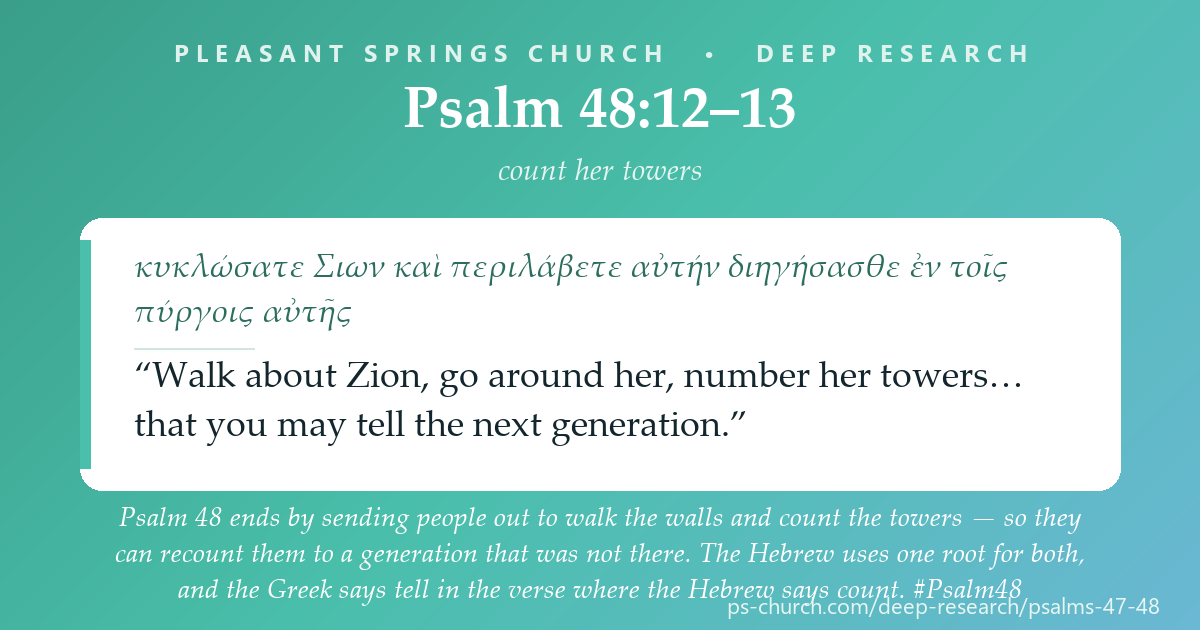
One root, two senses, two lines apart. Hebrew 48:13 says sipərû, count her towers; Hebrew 48:14 says təsappərû, recount it to the next generation. The Greek uses διηγέομαι for both — and so says tell in the verse where the Hebrew says count.
The last two words of the psalm, and nobody is sure of them. Read one way they are “unto death”; divided another way they give a musical term belonging to the next psalm’s heading; read as the Greek reads them they mean “forever”. Rahlfs has εἰς τοὺς αἰῶνας, unto the ages, and turns yənahăģēnû (lead, drive) into ποιμανεῖ, shepherd. ESV follows the Greek in the text and footnotes the alternative.
Two traps, one real allusion, and a city that keeps coming back.
Before linking either psalm to the New Testament, check the Greek. Two of the standard links do not survive it.
Which cross-references matter?
- Matthew 5:35 → Psalm 48:2. The one real New Testament contact, and it is an allusion, not a citation. Rahlfs ends the verse ἡ πόλις τοῦ βασιλέως τοῦ μεγάλου; Matthew has πόλις… τοῦ μεγάλου βασιλέως. The same four words, the order inverted, and not a single three-word sequence in common.
- Hebrews 12:22; Revelation 21:2, 10 → Psalm 48. You have come to Mount Zion… and to the city of the living God — the Zion song’s trajectory. Stated; the seeing is left to the reader.
- Isaiah 14:13 → Psalm 48:2. The far reaches of the north — the same claim, made by somebody else.
- Psalm 46 → Psalm 48. The other Zion song of this group, two psalms earlier — see Psalms 45–46. Both carry מִשְׂגָּב; in Psalm 46 the Greek gives the noun ἀντιλήμπτωρ, and in Psalm 48 the cognate verb ἀντιλαμβάνηται.
- Psalm 24 → Psalm 48. Day one and day two of the Greek Psalter’s weekday titles, and both are studied on this shelf — see Psalms 24–25.
- Psalm 18:4 → Psalm 48:6. Rahlfs uses ὠδῖνες, birth-pangs, in both — see Psalm 18, where the Hebrew has cords instead.
• Acts 4:26 is Psalm 2, not Psalm 48.
Rahlfs at Psalm 47:5 — our 48:4 — reads ὅτι ἰδοὺ οἱ βασιλεῖς συνήχθησαν ἤλθοσαν ἐπὶ τὸ αὐτό, “the kings were gathered, they came on together.” Acts 4:26 reads παρέστησαν οἱ βασιλεῖς τῆς γῆς… συνήχθησαν ἐπὶ τὸ αὐτό. The overlap is striking and the source is not in doubt: Acts 4:25 has just quoted Psalm 2:1 and named David as its speaker, and Acts 4:26 then reproduces Rahlfs’ Psalm 2:2 word for word — every word, in order, apart from the Greek’s closing διάψαλμα. Psalm 48 supplies the same idiom and none of the citation.
• Revelation 19:6 is not Psalm 47:8.
Our Psalm 47:8 reads, in Rahlfs, ἐβασίλευσεν ὁ θεὸς ἐπὶ τὰ ἔθνη, God reigns over the nations; Revelation 19:6 has ἐβασίλευσεν κύριος ὁ θεὸς ὁ παντοκράτωρ. The shared word is a standing formula, and its home is elsewhere: the enthronement psalms open ὁ κύριος ἐβασίλευσεν — Rahlfs 92, 96 and 98, our 93, 97 and 99 — with the Lord as subject, exactly as Revelation has it. Psalm 47 says God.
• And a third, offered honestly rather than pressed.
Psalm 47:5 — God has gone up with a shout, the Lord with the sound of a trumpet — has been read at the Ascension for a very long time, and 1 Thessalonians 4:16 has a cry, an archangel’s voice and a trumpet. The two share φωνή and σάλπιγξ and nothing longer; the sweep finds no run of three words, and Paul names no source. Report the resonance; do not call it a quotation.
Three open questions.
Goldingay and Alter for the Hebrew; the Greek titles are checked against Rahlfs directly.
Commentaries & studies:
- John Goldingay, Psalms 42–89; Robert Alter, The Book of Psalms.
- Frank-Lothar Hossfeld and Erich Zenger, Psalms 2 (Hermeneia) — note that the Hermeneia Psalms set begins at Psalm 51, so it does not cover these two.
- NETS Psalms, with Rahlfs — for the titles.
- James B. Pritchard, ed., Ancient Near Eastern Texts, 133–142 — the Ugaritic Baal cycle and Zaphon.
Three things reported as unsettled:
- Whether Psalm 47:9 says as the people of or with. The consonants carry both; the Masoretic pointing takes one and Rahlfs the other, and no evidence assembled here settles which is older.
- What ʿal-mûṯ means at the end of Psalm 48. Three readings are live — unto death, forever, and a musical term that belongs to the next psalm’s heading. ESV prints one and footnotes another.
- What the weekday titles prove. That two witnesses agree is demonstrable; which depends on which is not. No apparatus for the Greek Psalter permits a reading to be dated, so no dating is offered.
A psalm with a day of the week on it.
Name what you learned, why it matters, and one concrete response.
What should we carry away — and do?
- Psalm 48 was Monday’s psalm. The Greek title says on the second day of the week, and the Mishnah’s roster of the Levites’ daily song puts Psalm 48 on day two. Five psalms in the Greek carry a day; all five agree.
- One vowel that was never written changes the sentence. The princes of the peoples gather as the people of the God of Abraham — or with him. Same two letters. The page reports both and decides neither.
- The Greek Psalter will not let God be a fortress. Twelve times the Hebrew calls him a high stronghold and every time the Greek answers with a helper or a place to run to — and here, in a psalm about a walled city, the noun turns into when he comes to her aid.
- One concrete response. Psalm 48 ends by sending people to walk the walls and count the towers so that they can tell the next generation. Go and look at something God has done, in enough detail that you could describe it to someone who was not there.
Psalm 48:12–14 · to share
Hebrew + Greek (Rahlfs) + ESVEvery Deep Research page traces its passage across the whole sweep — the Old Testament, the Second-Temple world between the testaments (historical witnesses, not Scripture), and the New Testament. Follow the thread:
Pleasant Springs Church — Deep Research
Research method after Michael S. Heiser’s Bible Research Method (examine dictionaries → ancient literature → important words → textual connections → academic publications → share), with the Pleasant Springs “Author & Audience” foundation. Scripture set in the Hebrew, the Greek editions named on each page and the ESV (Old Testament), and the Greek New Testament and the ESV (New Testament), per the practice of Pleasant Springs Church. Psalms 47–48 research grounded in Goldingay (Psalms 42–89), Alter and Wilson, with Pritchard’s Ancient Near Eastern Texts for Zaphon. Text: Hebrew from the Masoretic text as printed in the editions consulted — Sefaria’s Miqra according to the Masorah; no critical apparatus was consulted for the Hebrew. Greek from Rahlfs’ Greek Psalter (CATSS digitization of Rahlfs 1931). The standing caution for this shelf applies: these pages say “Rahlfs’ Greek Psalter reads…” and never call a Greek reading early or late. ⚠️ The weekday finding was computed, not repeated. Every title in the Greek Psalter was searched for sabbath language; six psalms mention it and five name a specific day (Rahlfs 23, 47, 91, 92, 93 = our 24, 48, 92, 93, 94). The sixth, Rahlfs 37 (our 38), reads περὶ σαββάτου and names no day. Mishnah Tamid 7:4 was read directly — Psalms 24, 48, 82, 94, 81, 93 for days one to six and Psalm 92 for the Sabbath — and all five Greek labels agree with it, with the two unlabelled days being the two whose psalms carry no Greek day-note. Four of the five are pluses; our Psalm 92’s day is in the Hebrew title too. No date, priority or direction of influence is claimed. ⚠️ Three further counts were made on the whole Psalter. (1) מִשְׂגָּב stands in twelve verses and every one of them is answered in Greek by ἀντιλήμπτωρ, καταφυγή or the cognate verb — never by a word for a built defence. (2) The consonants משכיל stand in seventeen verses, thirteen of them titles; Psalm 47:8 (Hebrew) is the only place Rahlfs answers with the adverb συνετῶς. (3) Both psalms were swept verse by verse against all 7,927 verses of the Greek New Testament: the longest shared run is five words, there are two such runs, and every such run is ordinary phrasing. Matthew 5:35 is reported as an allusion, not a citation, because the four shared words stand in a different order and no three-word sequence is common to both. The Acts 4:26 and Revelation 19:6 links are reported as traps, with Acts 4:26 shown to reproduce Rahlfs’ Psalm 2:2 word for word. Verse counts verified in all three columns (Hebrew and Rahlfs 10/15; English 9/14). Typology is handled per the house position: what the text says, what the New Testament itself draws, and what we see from this side of the cross — with the seeing left to the reader.
Scripture quotations marked ESV are from the ESV® Bible (The Holy Bible, English Standard Version®), © 2001 by Crossway, a publishing ministry of Good News Publishers. ESV Text Edition: 2016. Used by permission. All rights reserved. The ESV text may not be quoted in any publication made available to the public by a Creative Commons license, and the ESV may not be translated in whole or in part into any other language. www.esv.org
|
Did this study bless you today? 💚 Give to Support PS Church100% of gifts go to the General Fund — thank you. |