Every line of Psalm 108 but two words is drawn from two other psalms. Its first five verses are Psalm 57:7–11 and its remaining eight are Psalm 60:5–12 — two of the five psalms studied here, cut apart and welded together, a prayer of confidence joined to a national lament. Compared letter by letter, three verses of the Psalm 60 half are identical and the rest differ by a word or two, while the Psalm 57 half has no identical verse at all; ESV footnotes the relationship itself, at Psalm 60:8. These five also form the Psalter's only run of five miktams — a heading word nobody can define, which occurs in six psalms and no more. Then the details: the bottle in "put my tears in your bottle" is not in the Greek, and the same verse swaps who is doing the counting. And in Psalm 58, two imperative curses arrive in Greek as flat past-tense reports — God shattered, the Lord crushed — a request turned into a statement. One more thing worth knowing: Hebrews 13:6 is quoting Psalm 118, not Psalm 56. See the method →
Psalms 56:8–60:8 (selections)
Hebrew · Greek (Rahlfs’ Psalter) · ESVPsalm 108 is not an original composition in the ordinary sense. Its first half is Psalm 57:7–11 and its second half is Psalm 60:5–12 — joined at a seam you can put your finger on. And neither half was copied exactly.
Compared consonant by consonant, the Psalm 60 half runs to eight verse-pairs: three are identical (Hebrew 60:8, 60:13, 60:14); 60:7 is identical on the qere, though its ketiv reads וְעַנֵּנוּ where Psalm 108 has וַעֲנֵנִי, a difference ESV carries into its own text (answer us at 60:5 against answer me at 108:6); three differ by a single word — וְלִי against לִי, הִתְרוֹעָעִי against אֶתְרוֹעָע, מָצוֹר against מִבְצָר — and 60:12 differs by two, a dropped אַתָּה and בְּצִבְאוֹתֵינוּ against בְּצִבְאֹתֵינוּ. The Psalm 57 half has no identical verse at all. Among its differences: the doubled my heart is steadfast stands once in Psalm 108, the doubled awake stands once, אֲדֹנָי becomes the divine name, great to the heavens becomes great above the heavens, and the last pair differs by a single ו — 57:12 עַל against 108:6 וְעַל.
ESV records the relationship itself, at the verse above. Its footnote to Psalm 60:8 reads “Revocalization (compare Psalm 108:10); Masoretic Text over me, O Philistia, shout in triumph” — which is the very word my comparison found differing between the two psalms. Which psalm stood first is not something this page can settle, and it does not try.
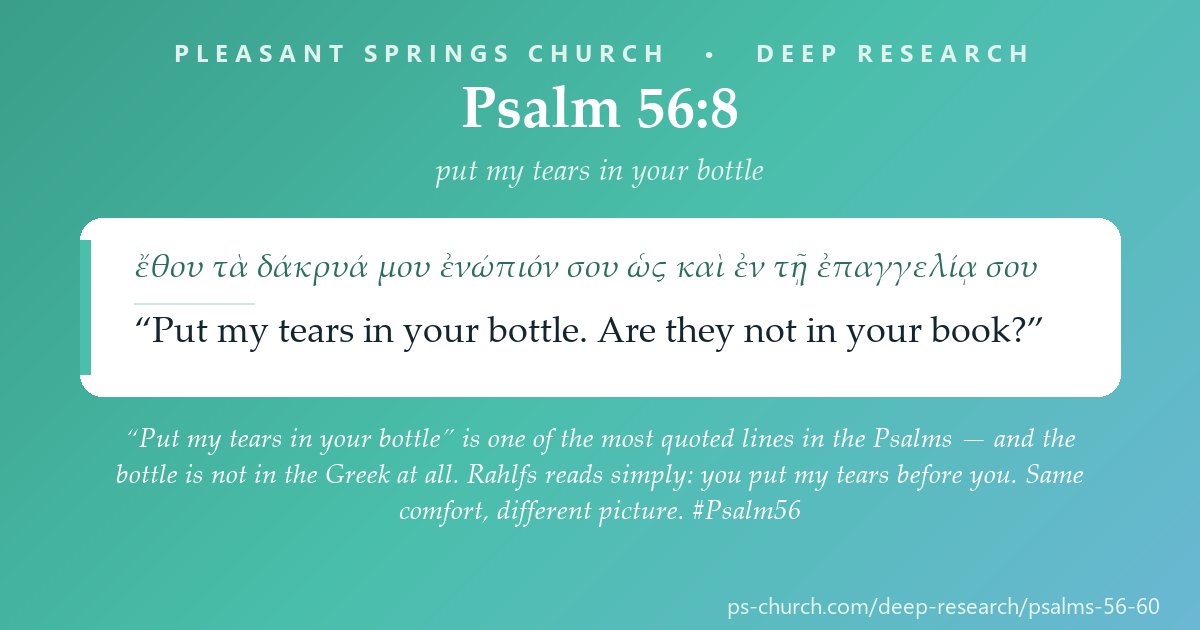
⚠️ The bottle is not in the Greek, and the sentence changes hands. Psalm 56:8 is one of the best-known lines in the Psalter: put my tears in your bottle. The Hebrew word is נֹאד, a skin for holding liquid. Rahlfs has no container at all — he reads ἐνώπιόν σου, before you. And the first half of the verse changes speaker: the Hebrew says you have kept count of my wanderings; Rahlfs reads I declared my life to you. Two different sentences, and the English devotional tradition rests on the first.
⚠️ And Psalm 58’s curses arrive in Greek as reports. Hebrew 58:7 is two imperatives — break their teeth, tear out the fangs. Rahlfs has two aorist indicatives: God shattered, the Lord crushed. The same thing happens at the end of the psalm's neighbour: Hebrew 59:14 has consume them, consume them, and Rahlfs gives a noun phrase — ἐν ὀργῇ συντελείας, in the wrath of consummation, followed by and they shall be no more. A request becomes a statement. Whether that reflects a different Hebrew text or a rendering choice is not decidable here.
The Shape of the Passage
Five miktams — the Psalter’s only run of fiveFour of the five carry a historical occasion, and Psalm 58 does not. Gath, the cave, the watched house, the campaign against Aram and Edom. The psalm left without a setting is the one that asks whether the judges are gods and then asks God to break their teeth. Whether that is design or accident, the headings do not say.
And two of the five were later quarried. Psalm 108 has almost no material of its own: verses 1–5 are Psalm 57:7–11 and verses 6–13 are Psalm 60:5–12. In the Psalm 60 half three verses are word-for-word identical in Hebrew; in the Psalm 57 half none is. That is a fact about how the book was assembled, and it is visible without any apparatus at all.
All five sit inside the Elohistic collection (Psalms 42–83), and all five are miktams of David — the longest run of that heading in the book. Psalms 57 and 59 also share the Do Not Destroy note with Psalm 58, which sits between them; see Psalms 52–55 for the maskil run that immediately precedes this one.
Author
Four of the five headings put David somewhere specific. Seized by the Philistines at Gath; fleeing from Saul into the cave; his house watched so he could be killed; at war with Aram while Joab was in the Valley of Salt. Three of the four are situations of being hunted.
Someone willing to ask God not to kill. Kill them not, lest my people forget. Psalm 59 asks for something slower than death, and gives a reason.
And someone whose work was later taken apart. Half of Psalm 57 and most of Psalm 60 were lifted whole into Psalm 108. Whoever did that treated these poems as material.
Audience
People being hunted, first. All day long an attacker oppresses me… they watch my steps. Psalms 56, 57 and 59 all describe surveillance rather than battle.
Judges, in Psalm 58. Do you indeed decree what is right?… your hands deal out violence on earth. The psalm opens by addressing whoever is doing the judging — and the identity of those addressed is exactly what is disputed.
And a defeated nation, in Psalm 60. O God, you have rejected us, broken our defenses. The only sustained communal lament of the five.
Orient on the miktam headings, on the imprecatory psalms, and on Psalm 108.
Search by topic: miktam; al-tashcheth; imprecatory psalms; the divine council; psalm doublets; Aram-zobah; the Valley of Salt.
Which articles are relevant?
- Anchor Bible Dictionary — “Psalms, Book of,” “Curse,” “Zobah,” “Salt, Valley of,” “Gath.”
- Dictionary of the OT: Wisdom, Poetry & Writings (IVP) — “Imprecation,” “Enemies,” “Psalms: Titles,” “Editorial Criticism.”
- NIDOTTE / TDOT — מִכְתָּם (miḵtām), אֵלֶם (ʾēlem, silence — or, revocalized, ʾēlîm, gods), נֹאד (nōʾḏ, a skin bottle), נֵס (nēs, banner or signal).
- On the Greek — the NETS Psalms introduction, and Rahlfs’ Psalms 55–59, which is where four of the five main findings on this page live.
- On the doublet — Psalm 108 read straight through beside Psalms 57 and 60.
Bibliography surfaced:
- John Goldingay, Psalms 42–89; Robert Alter, The Book of Psalms.
- Frank-Lothar Hossfeld and Erich Zenger, Psalms 2 (Hermeneia) — covers Psalms 51–100, so all five of these are inside it.
- C. S. Lewis, Reflections on the Psalms, and Erich Zenger, A God of Vengeance? — productive opposites on the imprecations, and this library’s standing pair for that question.
- Gerald H. Wilson, The Editing of the Hebrew Psalter — on doublets and placement.
A psalm assembled from two others, judges who may be gods, and how this library reads a curse.
Read Psalm 108 straight through with Psalms 57 and 60 open beside it. The seam falls between Psalm 108:5 and 108:6.
Which parallels shed light on these psalms?
Psalm 108 is the plainest case in the book of a psalm assembled from others. The Psalter has other doublets — Psalm 14 and Psalm 53, Psalm 40:13–17 and Psalm 70, Psalm 31:1–3 and Psalm 71:1–3 — but this is the one built wholly from two. Its thirteen verses are Psalm 57:7–11 followed by Psalm 60:5–12; apart from its own heading and the two words אַף־כְּבוֹדִי at 108:1 (ESV with all my being), every line is in one of those two. The joining is deliberate: a psalm of confidence is welded onto a psalm of national defeat, and the result is given a new heading. In the Psalm 60 half three verses are letter-for-letter identical in Hebrew and the rest differ by one word or two; the Psalm 57 half has no identical verse at all.
Psalm 58 opens on a word nobody can read with confidence. The consonants אלם pointed as the Masoretes point them mean silence; revocalized they give gods or mighty ones, and the psalm becomes an address to beings who judge. ESV prints you gods and footnotes the alternative. Rahlfs renders the word not at all, and makes the sons of men the ones being addressed — so whatever the Hebrew is doing here, the Greek is not doing it. This library has worked the divine-council question elsewhere — see the Deuteronomy 32 study — and the honest position here is that Psalm 58:1 does not settle it.
Psalms 58 and 59 are imprecatory, and this library has a settled way of handling that. It was worked out on Psalm 35 and it is not softened here. State what the psalm does. Every request for harm is addressed to God and none is self-executed. The frame is legal — a request for a verdict, not a licence. And Psalm 59 asks God explicitly not to kill. This page does not prescribe how, or whether, to pray these psalms.
- Psalm 108 → Psalms 57 and 60. The whole of Psalm 108, from two sources.
- 1 Samuel 21:10–15 → Psalm 56 heading. David among the Philistines at Gath.
- 1 Samuel 22:1; 24:1–7 → Psalm 57 heading. The cave.
- 1 Samuel 19:11 → Psalm 59 heading. Saul’s men watching the house.
- 2 Samuel 8:13; 1 Chronicles 18:12 → Psalm 60 heading. The Valley of Salt. The heading’s twelve thousand and the narratives’ figures are not all the same; reported, not reconciled.
- Romans 12:19 → Psalms 58 and 59. Vengeance is mine, I will repay, says the Lord — the New Testament keeps the request with God and takes it out of the petitioner’s hands. Stated; the seeing is left to the reader.
• Hebrews 13:6 is quoting Psalm 118:6, not Psalm 56:11.
Psalm 56:11 in Rahlfs (55:12) reads ἐπὶ τῷ θεῷ ἤλπισα οὐ φοβηθήσομαι τί ποιήσει μοι ἄνθρωπος. Hebrews 13:6 reads κύριος ἐμοὶ βοηθός, οὐ φοβηθήσομαι· τί ποιήσει μοι ἄνθρωπος;
Rahlfs’ Psalm 117:6 — our Psalm 118:6 — reads κύριος ἐμοὶ βοηθός οὐ φοβηθήσομαι τί ποιήσει μοι ἄνθρωπος. That is the whole of what Hebrews quotes, in order, with nothing added. Psalm 56 shares the last six words of it; Psalm 118 supplies all nine. The two psalms end the same way, and only one of them is being quoted.
• The poison of asps in Romans 3:13 is Psalm 140:3, not Psalm 58:4.
Psalm 58:4 does have an asp in Greek — ὡσεὶ ἀσπίδος κωφῆς, like a deaf adder — which is why the link gets made. But Romans 3:13 ends ἰὸς ἀσπίδων ὑπὸ τὰ χείλη αὐτῶν — its opening clause is Rahlfs 5:10 — and that closing clause is Rahlfs’ Psalm 139:4 — our Psalm 140:3 — word for word. Psalm 58 shares the animal and not the sentence.
Neither of these five psalms is quoted in the New Testament. Every verse of Rahlfs 55–59 was swept against all 7,927 verses of the Greek New Testament. The longest shared run is six words — and it is the tail of the Hebrews 13:6 line above, which Psalm 118 supplies whole.
A missing bottle, an unreadable word, and two curses in the wrong mood.
Every count on this page was made against the whole Psalter or the whole Greek New Testament, not against a sample.
Counted here, not assumed:
- Verse counts and offsets, all five. Hebrew and Rahlfs give 14, 12, 12, 18 and 14; English gives 13, 11, 11, 17 and 12. The offset is one in the first four and two in Psalm 60, whose heading runs to two whole verses. In Greek numbering these are Psalms 55 to 59.
- מִכְתָּם stands in exactly six psalm headings — 16, 56, 57, 58, 59, 60 — and these five are the only consecutive run. Rahlfs answers all six with στηλογραφ-, but Psalm 16 gets the nominative and these five get εἰς στηλογραφίαν.
- אַל־תַּשְׁחֵת stands in exactly four psalm headings — 57, 58, 59, 75 — and Rahlfs gives μὴ διαφθείρῃς four times out of four.
- Every line of Psalm 108 but two words comes from elsewhere. Verses 1–5 are Psalm 57:7–11; verses 6–13 are Psalm 60:5–12. Compared consonant by consonant against Psalm 60, three of the eight verse-pairs are identical, a fourth is identical on the qere, three differ by one word and one by two.
- Psalm 57’s refrain is not identical in Hebrew and is identical in Greek. Hebrew 57:6 has הַשָּׁמַיִם with the article; 57:12 has שָׁמַיִם without it. Rahlfs 56:6 and 56:12 are the same string, word for word. The same holds of Psalm 59’s dog-refrain: Hebrew 59:7 and 59:15 differ by a prefixed ו and a vowel letter, and Rahlfs 58:7 and 58:15 are identical. Which way that ran is not decidable, and no claim is made.
- None of the five is quoted in the New Testament. Swept verse by verse against all 7,927 verses of the Greek New Testament — the longest shared run is six words, and it is the tail of a line Psalm 118 supplies in full to Hebrews 13:6.
- Three of the twelve Psalter verses carrying מִשְׂגָּב are in Psalm 59 (59:9, 16, 17 in English), and the Greek answers all three with ἀντιλήμπτωρ — never a built defence, as at Psalms 47–48. Psalm 60:7 adds a מָעוֹז, answered by κραταίωσις.
“A skin bottle.” The container in the most quoted line of Psalm 56, and it is not in the Greek. Rahlfs reads ἐνώπιόν σου, before you. The same verse also changes hands: Hebrew you have counted my wanderings; Greek I declared my life to you.
Pointed as it stands, silence; revocalized, gods. ESV prints you gods and footnotes Or you mighty lords (by revocalization; Hebrew in silence) — so its own alternative is human rulers. Rahlfs renders the word not at all, and makes οἱ υἱοὶ τῶν ἀνθρώπων, the sons of men, the ones addressed. The verse cannot carry the weight of a doctrine on its own.
A heading word of unknown meaning, in six psalms and no more. Psalm 16, and then these five consecutively. ESV leaves it untranslated; Rahlfs answers all six with στηλογραφ-, something written on a pillar — the plain noun at Psalm 16, and εἰς στηλογραφίαν at all five here.
“Do not destroy.” Four psalm headings carry it — 57, 58, 59 and 75, that is Rahlfs 56:1, 57:1, 58:1 and 74:1 — and three of the four are these. Rahlfs gives μὴ διαφθείρῃς every time. Whether it names a tune or quotes a prayer is not recoverable.
Two imperatives — break, tear out. Rahlfs answers both with aorist indicatives: συνέτριψεν, συνέθλασεν — God shattered, the Lord crushed. The request becomes a report. Direction unsettled.
A psalm built from two, and two quotations that belong elsewhere.
Both of this page’s New Testament traps are cases where the psalm shares an image or a clause and another psalm supplies the sentence.
Which cross-references matter?
- Psalm 108 → Psalms 57 and 60. The whole of it. ESV footnotes the relationship at Psalm 60:8.
- Hebrews 13:6 → Psalm 118:6, not Psalm 56:11. Psalm 118 supplies all nine words; Psalm 56 shares the last six.
- Romans 3:13 → Psalm 140:3, not Psalm 58:4. The asp is in both; the sentence is in one.
- Romans 12:19 → Psalms 58 and 59. Vengeance is mine, I will repay — the request stays with God. Stated; the seeing is left to the reader.
- Psalm 35 → Psalms 58 and 59. This library’s treatment of the imprecations — see Psalm 35.
- Psalms 52–55 → Psalms 56–60. Four consecutive maskils followed immediately by five consecutive miktams — see Psalms 52–55. Two runs of an unexplained heading word, back to back.
Three open questions.
Goldingay and Alter for the Hebrew; Lewis and Zenger for what to do with Psalm 58.
Commentaries & studies:
- John Goldingay, Psalms 42–89; Robert Alter, The Book of Psalms.
- Frank-Lothar Hossfeld and Erich Zenger, Psalms 2 (Hermeneia).
- C. S. Lewis, Reflections on the Psalms; Erich Zenger, A God of Vengeance?
- NETS Psalms, with Rahlfs.
Three things reported as unsettled:
- Which came first, Psalm 108 or its two sources. The overlap is demonstrable; the direction is not. The single-word differences run both ways and settle nothing.
- Whether Psalm 58:1 addresses gods or men. The Hebrew consonants carry both and the Greek carries neither. ESV prints one and footnotes the other.
- What a miktam is. Six headings, no definition, and a Greek rendering that may be a guess. An inscription on a pillar is what στηλογραφία means; whether that is what the Hebrew meant is another question.
A bottle, and a prayer that asks God not to kill.
Name what you learned, why it matters, and one concrete response.
What should we carry away — and do?
- Psalm 108 is made of Psalm 57 and Psalm 60. Two prayers written under pressure were later joined into one — a psalm of confidence welded onto a psalm of national defeat. In the Psalm 60 half three verses are identical and the rest differ by a word or two; in the Psalm 57 half none is identical.
- The bottle is in the Hebrew and not in the Greek. Put my tears in your bottle is one of the best-known lines in the Psalter. Rahlfs has God simply keeping them before him, and has the psalmist doing the declaring rather than God doing the counting.
- Psalm 59 asks God not to kill. Kill them not, lest my people forget. The harshest psalms in this group still address every request to God and never take the matter into the petitioner’s hands. That is the shape of the thing, and it is worth noticing before deciding what to do with it.
- One concrete response. Psalm 56 counts what God is said to keep count of: tossings, tears, a book. Write down one thing from this year you assumed nobody was counting.
Psalm 56:8 · to share
Hebrew + Greek (Rahlfs) + ESVEvery Deep Research page traces its passage across the whole sweep — the Old Testament, the Second-Temple world between the testaments (historical witnesses, not Scripture), and the New Testament. Follow the thread:
Pleasant Springs Church — Deep Research
Research method after Michael S. Heiser’s Bible Research Method (examine dictionaries → ancient literature → important words → textual connections → academic publications → share), with the Pleasant Springs “Author & Audience” foundation. Scripture set in the Hebrew, the Greek editions named on each page and the ESV (Old Testament), and the Greek New Testament and the ESV (New Testament), per the practice of Pleasant Springs Church. Psalms 56–60 research grounded in Goldingay (Psalms 42–89) and Alter, with Lewis (Reflections on the Psalms) and Zenger (A God of Vengeance?) as the standing pair on the imprecations. Text: Hebrew from the Masoretic text as printed in the editions consulted — Sefaria’s Miqra according to the Masorah; no critical apparatus was consulted for the Hebrew, and the paseq is not reproduced in the codex lines. Greek from Rahlfs’ Greek Psalter (CATSS digitization of Rahlfs 1931). The standing caution for this shelf applies: these pages say “Rahlfs’ Greek Psalter reads…” and never call a Greek reading early or late. ⚠️ The Psalm 108 comparison was made on consonants only, word by word with maqqef treated as a separator. Of the eight verse-pairs in the Psalm 60 half (Hebrew 60:7–14 against 108:7–14), three are identical (60:8, 60:13, 60:14); 60:7 is identical on the qere and differs on the ketiv; three differ by one word (וְלִי/לִי, הִתְרוֹעָעִי/אֶתְרוֹעָע, מָצוֹר/מִבְצָר); and 60:12 differs by two, a dropped אַתָּה and בְּצִבְאוֹתֵינוּ/בְּצִבְאֹתֵינוּ. In the Psalm 57 half all five pairs differ. No claim is made about which psalm is prior. ⚠️ Four counts were made on the whole Psalter: (1) מִכְתָּם in six headings (16, 56–60), Rahlfs στηλογραφ- six times, nominative at Psalm 16 and εἰς στηλογραφίαν in the other five; (2) אַל־תַּשְׁחֵת in four headings (57, 58, 59, 75), Rahlfs μὴ διαφθείρῃς four times; (3) the Psalm 57 and Psalm 59 refrains compared as strings in both languages; (4) all five psalms swept verse by verse against all 7,927 verses of the Greek New Testament using the punctuation-free field, longest shared run six words. ⚠️ Two New Testament links are reported as traps: Hebrews 13:6 matches Rahlfs’ Psalm 117:6 (our 118:6) in all nine words, where Psalm 56:11 shares only the last six; and Romans 3:13’s ἰὸς ἀσπίδων ὑπὸ τὰ χείλη αὐτῶν matches Rahlfs’ Psalm 139:4 (our 140:3) word for word, while Psalm 58:4 shares only the animal. Verse counts verified in all three columns (Hebrew and Rahlfs 14/12/12/18/14; English 13/11/11/17/12). The imprecatory psalms are handled per this library’s established treatment: state what the psalm does — every request addressed to God, never self-executed; a legal frame; and Psalm 59’s explicit “kill them not” — without softening the text and without prescribing how or whether to pray it. Typology is handled per the house position: what the text says, what the New Testament itself draws, and what we see from this side of the cross — with the seeing left to the reader.
Scripture quotations marked ESV are from the ESV® Bible (The Holy Bible, English Standard Version®), © 2001 by Crossway, a publishing ministry of Good News Publishers. ESV Text Edition: 2016. Used by permission. All rights reserved. The ESV text may not be quoted in any publication made available to the public by a Creative Commons license, and the ESV may not be translated in whole or in part into any other language. www.esv.org
|
Did this study bless you today? 💚 Give to Support PS Church100% of gifts go to the General Fund — thank you. |