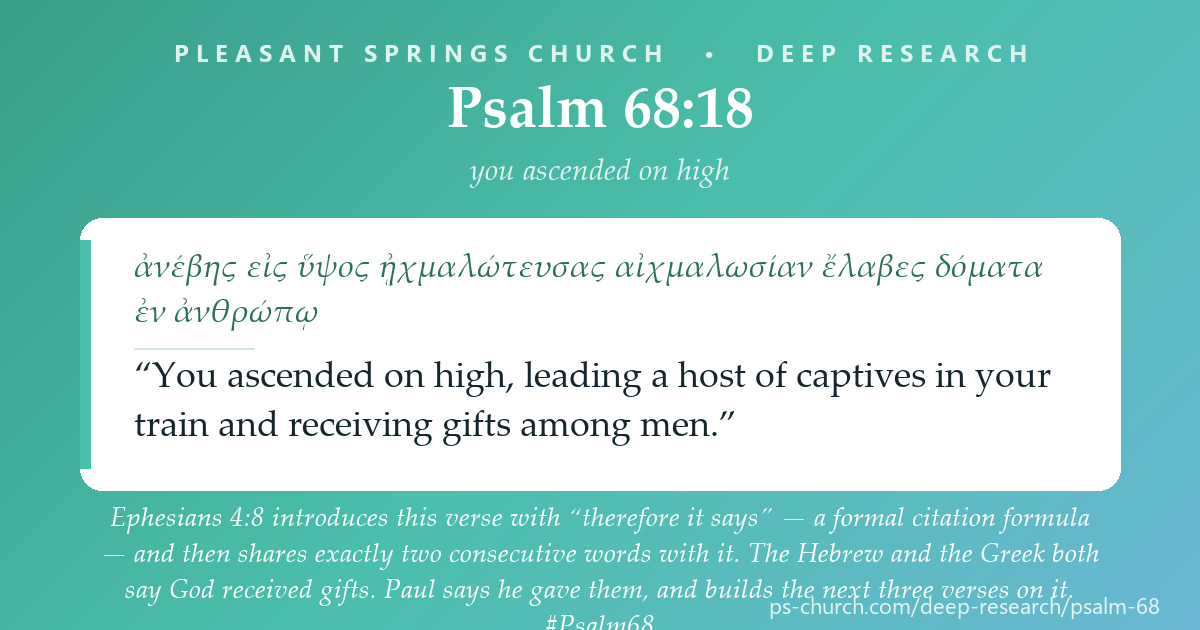
Ephesians 4:8 introduces Psalm 68:18 with dio legei — "therefore it says" — a formal citation formula. Set the two side by side, nine words against nine: four positions agree, five differ, and the longest unbroken run they share is two words. And the word Paul's argument runs on is one of the five. The Hebrew says God received gifts among men; Rahlfs says received; ESV says receiving. Ephesians says he gave — and repeats the verb three lines later when it lists what was given. This page reports that and does not tidy it away: explanations have been offered for centuries, none can be tested from the two texts in front of us, and no apparatus for the Greek Psalter lets a reading be called early or late. Elsewhere the psalm is just as hard. The Greek calls Bashan a mountain curdled like cheese, reads the deserts of 68:4 as the west, and does not carry the gender of the women who announce the victory. And the whole thing opens with the words Moses said whenever the ark set out. See the method →
Psalm 68:1–35 (selections)
Hebrew · Greek (Rahlfs’ Psalter) · ESVPaul introduces the line with διὸ λέγει — therefore it says — which is a formal citation formula. Set his nine words beside Rahlfs’ nine, position by position:
Rahlfs 67:19 — ἀνέβης · εἰς · ὕψος · ᾐχμαλώτευσας · αἰχμαλωσίαν · ἔλαβες · δόματα · ἐν · ἀνθρώπῳ
Ephesians 4:8 — ἀναβάς · εἰς · ὕψος · ᾐχμαλώτευσεν · αἰχμαλωσίαν · ἔδωκεν · δόματα · τοῖς · ἀνθρώποις
Four positions agree, five differ, and the longest unbroken run they share is two words: εἰς ὕψος.
⚠️ And the word the argument runs on is one of the five. The Hebrew has לָקַחְתָּ, you took or received. Rahlfs has ἔλαβες, you received. ESV has receiving gifts among men. Paul has ἔδωκεν — he gave. On the one word that carries his point, he agrees with neither text we have — and three verses later he repeats it: καὶ αὐτὸς ἔδωκεν τοὺς μὲν ἀποστόλους, and he gave the apostles.
What this page does and does not say about that. It reports the measurement. It does not call Paul mistaken, and it does not tidy the difference away. Explanations have been offered for centuries — that he follows a Jewish reading tradition in which a conqueror receives tribute in order to distribute it; that he is expounding rather than reproducing; that a Greek text now lost read gave. None of them can be tested from the two texts on this page, and no apparatus for the Greek Psalter permits a reading to be called early or late. The honest description is that Ephesians and both source texts differ at the verb, and that Paul builds on his own.
⚠️ The psalm opens with words Moses said. Numbers 10:35: Arise, O Lord, and let your enemies be scattered, and let those who hate you flee before you. Psalm 68:1 has the same four verbs in the same order — arise, scatter, flee, hate — with the imperative turned into a statement, the divine name turned into God, and every your turned into his. Moses says it whenever the ark sets out; the psalm says it as something that happens.
⚠️ And where the Hebrew has a many-peaked mountain, the Greek has a curdled one. Hebrew 68:16 calls Bashan har gaḇnunnîm, which ESV renders many-peaked and footnotes hunch-backed. Rahlfs reads ὄρος τετυρωμένον — a mountain curdled like cheese, a rendering usually explained by connecting the word with the root behind גְּבִינָה, curd. Three readings of one word — and the third is a proposal about the root, not something the consonants hand you.
The Shape of the Passage
Sequence — a procession, from Sinai to the sanctuaryTwo verbal anchors are real and worth naming. The first is before him: the psalm says it eight times in Hebrew 68:2–9 — מִפָּנָיו at 68:2, מִפְּנֵי twice at 68:3, לִפְנֵי at 68:4, לְפָנָיו at 68:5, לִפְנֵי at 68:8 and מִפְּנֵי twice at 68:9 — and then the phrase does not occur again. Everything at the start happens in front of a face.
The second is the ascent. The verb עָלָה occurs once in the whole psalm, at Hebrew 68:19 — the verse Ephesians quotes. A psalm about a procession going up uses the word up exactly once, and that is where the New Testament stops.
Psalm 68 is the fourth and longest of the four consecutive psalms whose headings carry both מִזְמוֹר and שִׁיר — see Psalms 65–67. Its Greek heading adds nothing.
Author
Someone quoting Moses in his first line. God shall arise, his enemies shall be scattered. The psalm begins where the ark begins moving.
Someone with a procession in front of him. The singers in front, the musicians last, between them virgins playing tambourines. Psalm 68 describes a liturgy while it is happening.
And someone whose Hebrew is the hardest in the book. Several of its lines have no agreed sense, and ESV footnotes one of them the meaning of the Hebrew verse is uncertain. The Greek disagrees with the Hebrew more often here than in any psalm this shelf has yet worked.
Audience
People who could see the parade. Your procession is seen, O God, the procession of my God, my King, into the sanctuary. The psalm points at something in view.
The tribes, named. There is Benjamin, the least of them, in the lead, the princes of Judah in their throng, the princes of Zebulun, the princes of Naphtali. Two southern tribes and two northern ones.
And the nations, at the end. Nobles shall come from Egypt; Cush shall hasten to stretch out her hands to God. Its last movement turns to Egypt, Cush and the kingdoms of the earth — and then its final verse names Israel twice.
Orient on the ark, on divine-warrior processions, and on Ephesians 4.
Search by topic: ark of the covenant; divine warrior; Zion procession; Bashan; Cush; Ephesians 4:7–11; the descent of Christ.
Which articles are relevant?
- Anchor Bible Dictionary — “Ark of the Covenant,” “Divine Warrior,” “Bashan,” “Cush,” “Zalmon.”
- Dictionary of the OT: Wisdom, Poetry & Writings (IVP) — “Divine Warrior,” “Zion,” “Theophany,” “Ancient Near Eastern Background.”
- NIDOTTE / TDOT — לָקַח (lāqaḥ, to take or receive), עֲרָבוֹת (ʿărāḇōṯ, deserts — or clouds), גַּבְנֻנִּים (gaḇnunnîm), מְבַשְּׂרוֹת (məḇaśśərōṯ, women bringing news).
- On the Greek — the NETS Psalms introduction, and Rahlfs’ Psalm 67:19 read beside Ephesians 4:8, which is the whole of the question.
- On Ephesians — Beale and Carson on Ephesians 4:8, and the commentaries of Hoehner and Thielman, which survey the proposed explanations.
Bibliography surfaced:
- John Goldingay, Psalms 42–89; Robert Alter, The Book of Psalms.
- Frank-Lothar Hossfeld and Erich Zenger, Psalms 2 (Hermeneia) — covers Psalms 51–100.
- Beale and Carson, Commentary on the NT Use of the OT — for Ephesians 4:8.
- James B. Pritchard, ed., Ancient Near Eastern Texts — the Ugaritic Baal cycle, for the cloud-rider epithet.
A rider, an ark, and a verse with three readings.
Read Ephesians 4:7–11 whole. Paul’s argument needs the giving, and he says so twice.
Which parallels shed light on this psalm?
Psalm 68:4 calls God a rider, and the epithet has a neighbour. The Hebrew is lārōkēḇ bāʿărāḇōṯ, which ESVrenders him who rides through the deserts. In the Ugaritic Baal texts the storm-god carries the standing title Rider of the Clouds — it recurs on page after page of the cycle in Pritchard’s collection (ANET 130–142). Some read the psalm’s word as clouds on the strength of it; Rahlfs read it as the west, ἐπὶ δυσμῶν; ESV reads deserts. Two readings off the same consonants, and a third that argues from Ugaritic. What is not in dispute is that the psalm calls God a rider twice — here, and again at 68:33, him who rides in the heavens, the ancient heavens.
The psalm opens with the ark. Numbers 10:35 gives Moses’ words for whenever the ark set out, and Psalm 68:1 reuses them with three changes: the imperative becomes a statement, the divine name becomes God, and the second person becomes the third. Moses asks; the psalm reports. The four verbs and their order are the same.
And the psalm ends where the shelf’s previous study began. Nobles from Egypt, and Cush stretching out her hands to God. Psalms 67 and 68 both turn to the nations before they close — see Psalms 65–67, where Psalm 67 asks for blessing precisely so that outsiders will hear of it. Psalm 68’s own last two verses then turn back: whose majesty is over Israel… the God of Israel.
- Numbers 10:35 → Psalm 68:1. The ark formula, turned from prayer into report.
- Judges 5:4–5 → Psalm 68:7–8. The earth trembled… even Sinai before the Lord — the same march and the same difficult phrase, זֶה סִינַי.
- Ugaritic Baal cycle, ANET 130–142 → Psalm 68:4. Rider of the Clouds.
- Ephesians 4:7–11 → Psalm 68:18. The citation, and what Paul does with it.
- Acts 8:26–39 → Psalm 68:31. Cush shall hasten to stretch out her hands to God. Stated; the seeing is left to the reader, and Acts quotes Isaiah rather than this psalm.
Ephesians 4:8 is introduced as a quotation and shares two consecutive words with the Greek Psalter.
Nine words against nine, aligned position by position: εἰς, ὕψος, αἰχμαλωσίαν and δόματα agree; ἀνέβης/ἀναβάς, ᾐχμαλώτευσας/ᾐχμαλώτευσεν, ἔλαβες/ἔδωκεν, ἐν/τοῖς and ἀνθρώπῳ/ἀνθρώποις differ. Longest unbroken run: εἰς ὕψος.
The differences are not random. Two of the five turn a second-person address into a third-person report — you ascended becomes having ascended, you led captive becomes he led captive. Two more recast the closing phrase: ἐν ἀνθρώπῳ, among man, becomes τοῖς ἀνθρώποις, to men — an article for a preposition, and a plural for a singular. The fifth reverses the direction of the gift.
What may not be concluded. Nothing here says Paul had a different Greek text; nothing here says he did not. No published apparatus for the Greek Psalter permits a reading to be called early or late, so a lost Greek copy reading gave can be neither produced nor excluded from this evidence. What can be said is that the two texts we have both read received, that Paul wrote gave, and that his argument in Ephesians 4:11 requires the word he wrote. This library reports that and leaves the explanation to the commentaries.
One verb, and a psalm whose Hebrew keeps coming apart.
The Ephesians alignment below can be repeated by anyone with the two texts side by side.
Counted here, not assumed:
- Verse counts. Hebrew and Rahlfs both give thirty-six verses; English gives thirty-five. The offset is one, and it is the title. In Greek numbering this is Psalm 67.
- Psalm 68 carries no Greek title-plus. Every element of the Hebrew heading is answered and nothing is added — unlike Psalms 65 and 66 immediately before it, one of which carries the largest title-plus on this shelf and the other a single word.
- Ephesians 4:8 against Rahlfs 67:19: nine words each, four positions agreeing, and a longest unbroken shared run of two. Measured by aligning the two texts token by token with accents normalised.
- The verb עָלָה, to go up, occurs once in the whole psalm — Hebrew 68:19, the verse Ephesians quotes.
- The psalm says before him eight times in Hebrew 68:2–9 — six of them the construct מִפְּנֵי/לִפְנֵי (68:3 twice, 68:4, 68:8, 68:9 twice), two of them the suffixed form (68:2, 68:5) — and then the phrase does not occur again in the remaining twenty-seven verses.
- Psalm 68 is not quoted in the New Testament apart from verse 18. Swept verse by verse against all 7,927 verses of the Greek New Testament using the punctuation-free field, the longest shared run is four words, and both such runs are stock phrasing in the psalm’s last verse. The Ephesians overlap does not reach four.
- ESV footnotes this psalm eight times, four of them appealing explicitly to the Hebrew — including the meaning of the Hebrew verse is uncertain at 68:30, and a departure from the Hebrew at 68:35.
“To take, to receive.” The verb at the centre of the Ephesians question. Rahlfs answers it ἔλαβες, you received; ESV renders receiving gifts among men. Ephesians 4:8 has ἔδωκεν, he gave — and repeats it three verses later.
Three readings of one word. ESV: deserts. Rahlfs: ἐπὶ δυσμῶν, the west. And a long-standing proposal: clouds, on the strength of Baal’s Ugaritic title Rider of the Clouds. Two of the three come straight off the consonants ע־ר־ב; the third rests on equating them with Ugaritic ʿrpt, which has a pe where the Hebrew has a bet. This page adopts none.
“Many-peaked” — or hunch-backed, which ESV footnotes. Rahlfs’ Greek Psalter reads ὄρος τετυρωμένον, a curdled mountain — a rendering usually explained by connecting the Hebrew word with the root behind גְּבִינָה, curd — a mountain curdled like cheese.
“The women who bring the news.” A feminine plural participle: the heralds of the victory are women, and the Hebrew says so grammatically. Rahlfs has τοῖς εὐαγγελιζομένοις — masculine plural, so the feminine of the Hebrew is not carried over. ESVkeeps it: the women who announce the news are a great host.
“Your sanctuaries.” Rahlfs has ἐν τοῖς ἁγίοις αὐτοῦ, in his holy places. ESV prints the Greek reading and footnotes the Hebrew — so on the psalm’s last verse the English follows the Greek, which is worth knowing on a page about a place where it does not.
One quotation, and the places it is not.
Where a New Testament writer differs from both source texts, say so and stop.
Which cross-references matter?
- Ephesians 4:8 → Psalm 68:18. Announced as a quotation; two consecutive words in common; the verb reversed.
- Numbers 10:35 → Psalm 68:1. The ark formula.
- Judges 5:4–5 → Psalm 68:7–8. The same march, and the same phrase nobody can construe.
- Psalms 65–67 → Psalm 68. The fourth of the four consecutive mizmor-shir headings — see Psalms 65–67.
- Psalm 47:5 → Psalm 68:18. God has gone up with a shout — the other ascent psalm on this shelf, see Psalms 47–48. Stated; the seeing is left to the reader.
- Acts 8:26–39 → Psalm 68:31. Cush stretching out her hands — a resonance, not a citation: Acts quotes Isaiah 53.
Three open questions.
Goldingay and Alter for the Hebrew; Beale and Carson for what to do with Ephesians 4.
Commentaries & studies:
- John Goldingay, Psalms 42–89; Robert Alter, The Book of Psalms.
- Frank-Lothar Hossfeld and Erich Zenger, Psalms 2 (Hermeneia).
- Beale and Carson, Commentary on the NT Use of the OT — Ephesians 4:8.
- NETS Psalms, with Rahlfs; Pritchard, ANET 130–142.
Three things reported as unsettled:
- Why Ephesians 4:8 reads gave. Both texts in front of us read received. Several explanations are current and none can be tested from the wording alone.
- What עֲרָבוֹת means at 68:4. Deserts, the west, or clouds — English, Greek, and a proposal from the Ugaritic epithet.
- What several of this psalm’s lines mean at all. ESV says outright that one verse is uncertain, and the Greek departs from the Hebrew more often here than anywhere else this shelf has worked.
A citation formula, and two words.
Name what you learned, why it matters, and one concrete response.
What should we carry away — and do?
- Ephesians 4:8 says therefore it says and then shares two consecutive words with the psalm. Four of nine positions agree; five differ. That is not a reason to distrust either text; it is a reason to look at both.
- The one word Paul’s argument needs is the one he does not share. The psalm has God receiving gifts; Ephesians has him giving them, and repeats the verb three lines later when it lists the gifts. This page reports the difference and does not resolve it.
- The heralds of the victory are women. The Hebrew participle at 68:11 is feminine plural. ESV keeps it; the Greek does not.
- One concrete response. Psalm 68 begins with the words said whenever the ark moved and ends with Egypt and Cush. Take one thing you would only say inside church, and say it once this week to someone outside it.
Psalm 68:18 · to share
Hebrew + Greek (Rahlfs) + ESVEvery Deep Research page traces its passage across the whole sweep — the Old Testament, the Second-Temple world between the testaments (historical witnesses, not Scripture), and the New Testament. Follow the thread:
Pleasant Springs Church — Deep Research
Research method after Michael S. Heiser’s Bible Research Method (examine dictionaries → ancient literature → important words → textual connections → academic publications → share), with the Pleasant Springs “Author & Audience” foundation. Scripture set in the Hebrew, the Greek editions named on each page and the ESV (Old Testament), and the Greek New Testament and the ESV (New Testament), per the practice of Pleasant Springs Church. Psalm 68 research grounded in Goldingay (Psalms 42–89) and Alter, with Beale and Carson for Ephesians 4 and Pritchard’s Ancient Near Eastern Texts for the cloud-rider epithet. Text: Hebrew from the Masoretic text as printed in the editions consulted — Sefaria’s Miqra according to the Masorah; no critical apparatus was consulted for the Hebrew, and the paseq is not reproduced in the codex lines. Greek from Rahlfs’ Greek Psalter (CATSS digitization of Rahlfs 1931); Greek New Testament from the SBL edition. The standing caution for this shelf applies: these pages say “Rahlfs’ Greek Psalter reads…” and never call a Greek reading early or late. ⚠️ The Ephesians measurement, stated so it can be repeated. Ephesians 4:8 (dropping its introductory διὸ λέγει) and Rahlfs 67:19 (its first nine words) were aligned token by token with accents normalised. Agreeing: εἰς, ὕψος, αἰχμαλωσίαν, δόματα. Differing: ἀνέβης/ἀναβάς, ᾐχμαλώτευσας/ᾐχμαλώτευσεν, ἔλαβες/ἔδωκεν, ἐν/τοῖς, ἀνθρώπῳ/ἀνθρώποις. Longest unbroken shared run: two words. No claim is made about why Paul reads gave — the page names the competing explanations, states that none is testable from these two texts, and stops. ⚠️ Three counts were made on the psalm: (1) עָלָה once, at Hebrew 68:19; (2) מִפְּנֵי/לִפְנֵי six times in Hebrew 68:3–9, plus the suffixed form twice at 68:2 and 68:5, and none thereafter; (3) the whole psalm swept verse by verse against all 7,927 verses of the Greek New Testament using the punctuation-free field, longest shared run four words. The Numbers 10:35 comparison was made against the Hebrew of that verse, which shares four verbs in the same order with Psalm 68:1 and differs in person, mood and divine name. The Rider of the Clouds epithet was read in the local ANET, where it recurs through the Ugaritic Baal cycle at pages 130–142; the proposal that Psalm 68:4 means clouds is reported as one of three readings and adopted as none. Verse counts verified in all three columns (Hebrew and Rahlfs 36; English 35). Typology is handled per the house position: what the text says, what the New Testament itself draws, and what we see from this side of the cross — with the seeing left to the reader.
Scripture quotations marked ESV are from the ESV® Bible (The Holy Bible, English Standard Version®), © 2001 by Crossway, a publishing ministry of Good News Publishers. ESV Text Edition: 2016. Used by permission. All rights reserved. The ESV text may not be quoted in any publication made available to the public by a Creative Commons license, and the ESV may not be translated in whole or in part into any other language. www.esv.org
|
Did this study bless you today? 💚 Give to Support PS Church100% of gifts go to the General Fund — thank you. |