Romans 11:9–10 quotes two consecutive verses of Psalm 69 in a single sentence, under a single introduction — and David says — and handles them in two completely different ways. With the first, Paul shares a longest unbroken run of five words out of sixteen. Where the Psalter has a phrase, Romans has none; where the Psalter has none, Romans has one; and the retribution phrase stands in the middle there and at the end here. With the second he shares everything: fourteen Greek words for fourteen, in order, with nothing added and nothing left out. This page measures both and explains neither, because no apparatus for the Greek Psalter lets a reading be called early or late. The rest of the psalm is just as worth the time. Its heading calls a tune Lilies; the Greek reads the same letters as those who will be changed — and does so in all four psalms that carry the word. Five Hebrew words carry the drowning, and every one of them occurs exactly twice: once when the man says he is sinking, once when he asks God not to let it finish. And the gall and the sour wine of 69:21 are each used once in the whole Greek Psalter, in the same verse — the verse the passion narratives circle without ever quoting — John 19:28 invokes "the Scripture" and does not say which. See the method →
Psalm 69:1–35 (selections)
Hebrew · Greek (Rahlfs’ Psalter) · ESVPaul introduces both with καὶ Δαυὶδ λέγει — and David says. Then:
Rahlfs 68:23 — fourteen words. Romans 11:9 — sixteen. Longest unbroken run they share: five (αὐτῶν εἰς παγίδα καὶ εἰς). Where the Psalter has ἐνώπιον αὐτῶν, Romans has nothing; where the Psalter has nothing, Romans has εἰς θήραν; and the retribution phrase stands in the middle in the Psalter (εἰς ἀνταπόδοσιν) and at the end in Romans (εἰς ἀνταπόδομα αὐτοῖς).
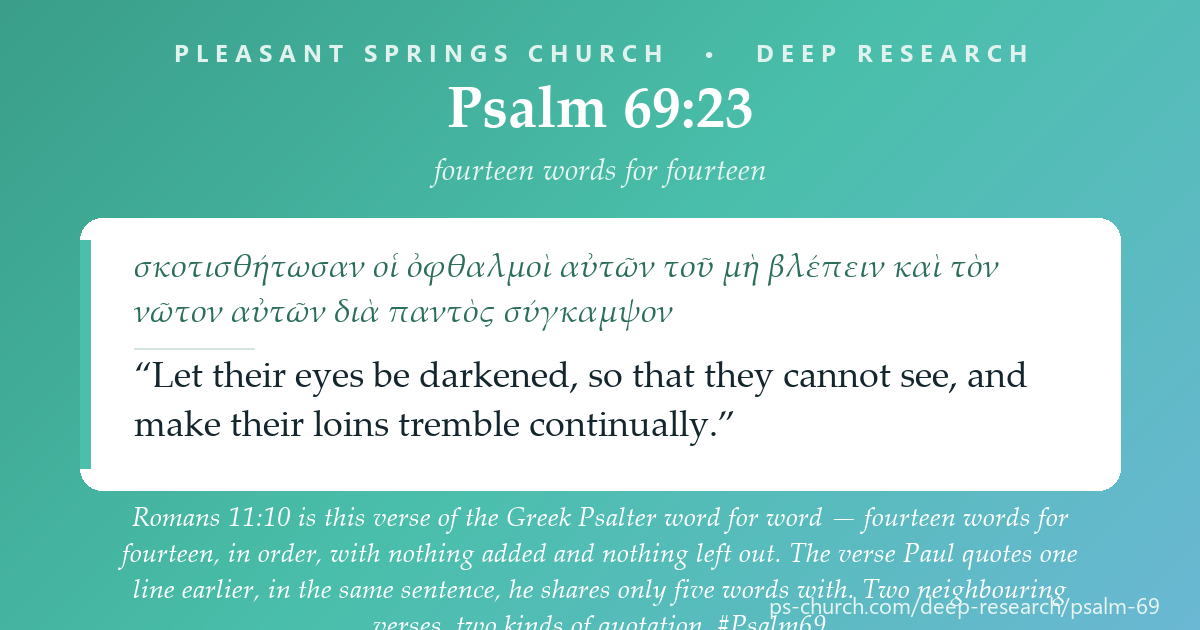
Rahlfs 68:24 — fourteen words. Romans 11:10 — fourteen words. Every one of them the same, in the same order, with nothing added and nothing left out:
σκοτισθήτωσαν οἱ ὀφθαλμοὶ αὐτῶν τοῦ μὴ βλέπειν καὶ τὸν νῶτον αὐτῶν διὰ παντὸς σύγκαμψον
Two adjacent verses, quoted in the same sentence: with one the agreement runs to five words, with the other to all fourteen.
What this page does not conclude from that. It does not say Paul had one Greek text for verse 24 and another for verse 23, and it does not say he did not. No published apparatus for the Greek Psalter permits a reading to be called early or late, so the difference between the two quotations can be measured and cannot be explained from these texts alone.
⚠️ And the verse with the shorter shared run is the verse ESV footnotes a divergence on. Hebrew 69:23 has וְלִשְׁלוֹמִים, and to those at peace. Rahlfs has εἰς ἀνταπόδοσιν, for retribution. ESV prints the Hebrew and footnotes the other reading in so many words — “a slight revocalization yields (compare Septuagint, Syriac, Jerome) a snare, and retribution and a trap.” The consonants are the same; the vowels are not written. Paul’s ἀνταπόδομα stands on the same side as the Greek. This page reports the divergence and adjudicates nothing.
⚠️ The next verse diverges too, and it has to be said plainly, because it is the verse this page is built on. Hebrew 69:24 has וּמָתְנֵיהֶם תָּמִיד הַמְעַד — ESV: make their loins tremble continually. Rahlfs 68:24 has τὸν νῶτον αὐτῶν διὰ παντὸς σύγκαμψον — bend down their back continually. A different part of the body, and a different thing done to it. That is why ESV Psalm 69:23 and ESV Romans 11:10 do not read alike in English: the one renders the Hebrew, the other the Greek. What agrees to the last word here is Romans 11:10 and the Greek Psalter — not Romans 11:10 and the Hebrew. Nothing in either text settles what produced the difference.
⚠️ One verse, two evangelists, one half each. Rahlfs 68:10 runs to seventeen words in two halves. John 2:17 takes the first half — seven words, six of them identical. Romans 15:3 takes the second — eight words, all eight identical. The one word John does not match is the verb: the Psalter reads κατέφαγέν, consumed; the Greek New Testament as printed in the SBL edition reads καταφάγεταί, will consume. The Psalter has the aorist, the SBL edition the future; everything around the verb is the same.
The Shape of the Passage
Parallel panels — the drowning said twiceThe inclusio is the verb save. The root יָשַׁע occurs four times: save me at Hebrew 69:2, your salvation at 69:14 and 69:30, and God will save Zion at 69:36. First word of the prayer, last movement of the psalm. In Greek the frame is the same and one wider: σῶσόν με at Rahlfs 68:2 and again at 68:15, where the Hebrew uses a different verb, and ὁ θεὸς σώσει τὴν Σιων at 68:36.
This is called parallel panels and not a chiasm on purpose. The repeated vocabulary runs forward — A then B then A then B — not inward to a centre and out again. The imprecation and the praise that follow have no partner earlier in the psalm.
Psalm 69’s heading has three elements — a choirmaster, a tune called Lilies, and a name. Three other psalms name the same tune in longer headings — 45, 60 and 80 — which add a genre word, and at 60 and 80 also עֵדוּת. Rahlfs reads the tune-name as a participle in all four: those who will be changed.
Author
Someone who says he is drowning, and says it twice. I sink in deep mire, where there is no foothold. Then, twelve verses later, in the same five words: deliver me from sinking in the mire… let not the flood sweep over me.
Someone whose trouble is religious. For it is for your sake that I have borne reproach… zeal for your house has consumed me. The psalm says plainly why he is hated: he is hated on God’s account.
And someone who admits he is not innocent. More in number than the hairs of my head are those who hate me without cause stands at 69:4 — and the very next verse is O God, you know my folly; the wrongs I have done are not hidden from you. Psalm 69 holds both, back to back, and this page does not smooth either one away.
Audience
People who would be embarrassed by him. Let not those who hope in you be put to shame through me, O Lord God of hosts. He prays that his own disgrace will not contaminate the people praying beside him.
People who could hear the town talking. I am the talk of those who sit in the gate, and the drunkards make songs about me. The gate is where business and judgment happened; the songs are in the tavern.
And, by the last two verses, people with a stake in Judah. God will save Zion and build up the cities of Judah… the offspring of his servants shall inherit it. One man’s drowning ends as a promise about towns.
Orient on lament, imprecation, and the New Testament’s use of this psalm.
Search by topic: individual lament; imprecatory psalms; the book of life; Romans 9–11 and Israel; the passion narrative and the Psalms.
Which articles are relevant?
- Anchor Bible Dictionary — “Lament, Psalms of,” “Curse,” “Book of Life,” “Vinegar,” “Gall.”
- Dictionary of the OT: Wisdom, Poetry & Writings (IVP) — “Imprecation,” “Lament,” “Suffering,” “Psalms in the New Testament.”
- NIDOTTE / TDOT — חֶרְפָּה (ḥerpāh, reproach), טָבַע (ṭābaʿ, to sink), קִנְאָה (qinʾāh, zeal or jealousy), רֹאשׁ (rōʾš, a bitter or poisonous plant).
- On the Greek — the NETS Psalms introduction, and Rahlfs’ Psalm 68:23–24 read beside Romans 11:9–10, which is where this page starts.
- On Romans — Beale and Carson on Romans 11:9–10 and 15:3, and the commentaries of Cranfield, Dunn and Moo on the catena in Romans 11:8–10.
Bibliography surfaced:
- John Goldingay, Psalms 42–89; Robert Alter, The Book of Psalms.
- Frank-Lothar Hossfeld and Erich Zenger, Psalms 2 (Hermeneia) — covers Psalms 51–100.
- Beale and Carson, Commentary on the NT Use of the OT — for Romans 11, Romans 15, John 2 and Acts 1.
- James B. Pritchard, ed., Ancient Near Eastern Texts — for the Mesopotamian Tablet of Destinies, which is not what Psalm 69:28 is talking about.
A register with names in it, and a tablet that is not one.
Read Romans 11:7–10 whole. Paul strings three quotations together, and this psalm supplies the last two.
Which parallels shed light on this psalm?
Psalm 69:28 asks for a name to be scratched out of a book. Let them be blotted out of the book of the living; let them not be enrolled among the righteous. The nearest thing to it in the Old Testament is Moses at Sinai — Exodus 32:32, “if not, please blot me out of your book that you have written,” and the answer in 32:33, “whoever has sinned against me, I will blot out of my book.” Same instrument, same verb, and the psalm asks for what Moses offered to accept.
Mesopotamia has a famous divine document, and it is a different object. In the Babylonian creation epic Tiamat fastens the Tablet of Destinies on Kingu’s breast, and Marduk takes it from him (ANET 63, 67); in the Myth of Zu the bird-god seizes it while Enlil bathes, and with it the rule of the gods (ANET 111–113). That tablet is a charter of authority: whoever holds it commands. Psalm 69’s book is a roll with names written in it, and names can be erased from it. The two are not the same idea, and this page names the difference rather than the resemblance.
The tune-name is a small culture problem of its own. The word behind ESV’s Lilies stands in the headings of exactly four psalms — 45, 60, 69 and 80 — and is generally taken as the name of a melody. It is not spelled the same way in all four: plene שׁוֹשַׁנִּים here, defective שֹׁשַׁנִּים at 45 and 80, and the singular שׁוּשַׁן at 60. Rahlfs answers all four with a participle of the same verb rather than a flower: ὑπὲρ τῶν ἀλλοιωθησομένων, concerning those who will be changed, at Rahlfs 44:1, 68:1 and 79:1, and τοῖς ἀλλοιωθησομένοις at 59:1. One set of consonants; two ways of hearing it.
- Exodus 32:32–33 → Psalm 69:28. The book that can be written in and blotted out of.
- Enuma Elish, ANET 63 and 67; the Myth of Zu, ANET 111–113. The Tablet of Destinies — cited here as a contrast, not a parallel.
- Psalm 35:19 · Rahlfs 34:19 → Psalm 69:4. Those who hate me without cause — the phrase stands in both psalms, in both languages — as a participle, οἱ μισοῦντές με δωρεάν, where John 15:25 has a finite verb, ἐμίσησάν με δωρεάν.
- Romans 11:7–10. Three quotations in four verses; the last two are Psalm 69:22 and 69:23.
- Matthew 27:34, 48 · Mark 15:36 · John 19:28–30 → Psalm 69:21. Gall and sour wine at the cross. Stated; the seeing is left to the reader, and no evangelist quotes the verse.
Romans 11:9 and Romans 11:10 quote Psalm 69:22 and 69:23 — consecutive verses, one introduction, one sentence.
Against Rahlfs 68:23, Paul’s sixteen words share a longest unbroken run of five: αὐτῶν εἰς παγίδα καὶ εἰς. He has no ἐνώπιον αὐτῶν, he has εἰς θήραν where the Psalter has nothing, and where the Psalter has εἰς ἀνταπόδοσιν in the middle he has εἰς ἀνταπόδομα αὐτοῖς at the end.
Against Rahlfs 68:24, Romans 11:10 is fourteen words for fourteen, every one identical, in order, with no introduction, no addition and no omission.
The measurement is repeatable and the explanation is not supplied here. What may not be concluded: nothing on this page says which Greek text Paul had in front of him for either verse, or whether he had one at all for the first. No published apparatus for the Greek Psalter permits a reading to be called early or late, so the difference between the two quotations can be stated exactly and traced to nothing.
⚠️ One further measurement, offered without a theory. Romans 11:8, the quotation immediately before these two, contains the phrase ὀφθαλμοὺς τοῦ μὴ βλέπειν. Rahlfs’ Deuteronomy 29:3 (English 29:4) — the verse usually given as its source, together with Isaiah 29:10 for the spirit of stupor — reads ὀφθαλμοὺς βλέπειν, with the negative carried by the main verb and no τοῦ μή. The construction Paul writes at 11:8 is the one that stands in Psalm 68:24, which he will quote two verses later. That is what the texts show. Why they show it is not decidable from them.
Who ‘they’ are, since this page quotes the curse eight times. In Romans 11 the pronoun is Israel — the rest were hardened (11:7). Paul opens that same chapter with Has God rejected his people? By no means! (11:1) and closes the argument with all Israel will be saved (11:26). The imprecation is quoted inside that frame, not against it. This page reports how the words line up. It does not lend the curse to anyone.
Words that occur twice, and words that occur once in a hundred and fifty psalms.
Every count below was made on the texts named in the method note at the foot of this page, and every one can be repeated.
Counted here, not assumed:
- Verse counts. Hebrew and Rahlfs both give thirty-seven verses; English gives thirty-six. The offset is one, and it is the title. In Greek numbering this is Psalm 68.
- Psalm 69 carries no Greek title-plus. Three elements in the Hebrew heading, three in the Greek, nothing added — though the middle element is read as a participle rather than a flower.
- Romans 11:10 against Rahlfs 68:24: fourteen words each, all fourteen identical, in order. Measured by aligning the two texts token by token with accents normalised and the punctuation-free field used.
- Romans 11:9 against Rahlfs 68:23: sixteen words against fourteen, longest unbroken shared run five. The same method, on the immediately preceding verse.
- Romans 15:3 against Rahlfs 68:10: eight words, all eight identical — the whole second half of the verse, minus its opening καί.
- John 2:17 against the same verse: seven words against the first half’s eight, six identical — the difference is the verb, aorist in the Psalter and future in the SBL Greek New Testament.
- Acts 1:20 against Rahlfs 68:26: twelve words against fourteen, longest unbroken shared run four — and Peter’s αὐτοῦ is singular where the Psalter’s αὐτῶν is plural.
- Five Hebrew drowning words, each occurring exactly twice in the psalm — טָבַע, מְצוּלָה, מַעֲמַקִּים, שִׁבֹּלֶת, שָׁטַף — once in Hebrew 69:3, once in 69:15–16, and nowhere else in thirty-seven verses.
- חֶרְפָּה and its verb: six tokens in five Hebrew verses; ὀνειδισμός and its verb: six tokens in the same five Greek verses.
- συγκάμπτω twice in the whole Greek Psalter, both in this psalm; ἔπαυλις once, in the verse Acts quotes; χολή once and ὄξος once, both in Rahlfs 68:22. Scanned across all 150 psalms by lemma.
“Lilies.” A tune-name, in the headings of Psalms 45, 60, 69 and 80 and nowhere else in the Psalter — plene here, defective at 45 and 80, and singular שׁוּשַׁן at 60. Rahlfs’ Greek Psalter answers all four with a participle of ἀλλοιόω — those who will be changed (ὑπὲρ τῶν ἀλλοιωθησομένων at 44:1, 68:1 and 79:1, τοῖς ἀλλοιωθησομένοις at 59:1) — which reads the same letters as though they came from the root behind change rather than the flower. Consistent across all four; the page reports it and adopts neither reading.
“To sink.” Twice in the psalm and nowhere else in it — I have sunk in deep mire at Hebrew 69:3, and let me not sink at 69:15. Rahlfs uses one verb for both: ἐνεπάγην and ἐμπαγῶ. The second panel is the first panel prayed against.
“Reproach, disgrace” — the noun and its verb. Six times, in five verses. Rahlfs answers with ὀνειδισμός and its verb — six times, in the same five verses. One of the cleanest one-to-one correspondences on this shelf, and two of those six are the words Romans 15:3 puts in Christ’s mouth.
“To bend down, to bow.” Twice in the whole Greek Psalter, and both times in this psalm. At Rahlfs 68:11 the man bows his own soul with fasting; at 68:24 God is asked to bow his enemies’ backs for ever. The Hebrew does not join them: 69:11 is וָאֶבְכֶּה, and I wept — ESV footnotes “Hebrew lacks and humbled” — and 69:24 is a different verb again. Romans 11:10 quotes the second of the two.
“Gall” and “sour wine.” Each occurs exactly once in the whole Greek Psalter, and it is the same verse. The Hebrew behind the first is רֹאשׁ, a bitter or poisonous plant, which ESV renders poison. Both Greek words turn up at the cross — χολή at Matthew 27:34, ὄξος at Matthew 27:48, Mark 15:36, Luke 23:36 and John 19:29–30. No evangelist quotes this verse: set beside Matthew 27:34, the longest run the two share is one word.
“The book of the living.” Rahlfs has ζώντων, a participle — the living ones — and ESV agrees: book of the living. The New Testament’s phrase is not this one: Revelation 3:5, 13:8 and 20:15 read βίβλος or βιβλίον τῆς ζωῆς, and Philippians 4:3 the anarthrous ἐν βίβλῳ ζωῆς — the book of life. The Greek Psalter uses the word book three times in a hundred and fifty psalms — Rahlfs 39:8, 68:29 and 138:16 — and only here is it a register you can be struck out of.
Where the New Testament goes when it comes here.
Where a New Testament writer matches the Greek Psalter exactly, say so. Where he does not, say that too, and stop.
Which cross-references matter?
- Romans 11:9–10 → Psalm 69:22–23. Consecutive verses in one sentence: five words shared with the first, all fourteen with the second.
- Romans 15:3 → Psalm 69:9b · Rahlfs 68:10b. Eight words, verbatim — and Paul puts them in Christ’s mouth: For Christ did not please himself, but as it is written…
- John 2:17 → Psalm 69:9a. The other half of the same verse — remembered by the disciples at the temple; the Psalter has the aorist, the SBL edition the future.
- Acts 1:20 → Psalm 69:25. Peter applies a plural imprecation to one man, and pairs it with Psalm 109:8 · Rahlfs 108:8.
- John 15:25 → Psalm 69:4 or Psalm 35:19 · Rahlfs 34:19. They hated me without a cause. John says only their Law and names no psalm; both psalms carry the words in both languages — as a participle, where John has a finite verb. This page does not choose between them.
- Exodus 32:32–33 → Psalm 69:28. The book, and the blotting out.
- Matthew 27:34, 48 · John 19:28–30 → Psalm 69:21. John says to fulfill the Scripture, ‘I thirst’ and names no scripture at all. The shared words are real; the citation is not made.
- Psalm 68 → Psalm 69. Neighbours, and both quoted in the New Testament with a formula — see Psalm 68, where the quotation shares two consecutive words instead of fourteen.
Three open questions.
Goldingay and Alter for the Hebrew; Beale and Carson for the four New Testament citations; the ESV footnotes for where the two texts part.
Commentaries & studies:
- John Goldingay, Psalms 42–89; Robert Alter, The Book of Psalms.
- Frank-Lothar Hossfeld and Erich Zenger, Psalms 2 (Hermeneia).
- Beale and Carson, Commentary on the NT Use of the OT — Romans 11, Romans 15, John 2, Acts 1.
- NETS Psalms, with Rahlfs; Pritchard, ANET 63, 67, 111–113.
Three things reported as unsettled:
- Why one quotation is exact and the next is not. Romans 11:9 and 11:10 stand in one sentence and treat two consecutive verses completely differently. Several explanations are current — a different Greek copy, a memory quotation, a deliberate conflation with Psalm 35:8 · Rahlfs 34:8, which supplies both παγίς and θήρα — and none can be tested from the wording alone.
- What שְׁלוֹמִים is at 69:22. Those at peace, or retribution — the consonants are identical and the vowels are not written. ESVprints the first and footnotes the second, naming the Greek.
- Which psalm John 15:25 is quoting. Psalm 69:4 and Psalm 35:19 both have those who hate me without cause, in Hebrew and in Greek, and John identifies neither.
Fourteen words, unchanged.
Name what you learned, why it matters, and one concrete response.
What should we carry away — and do?
- Romans 11:10 is Psalm 69:23 in Greek, entire. Fourteen words for fourteen, in order, with nothing added. Whatever lies behind that, the agreement itself is total — which is not the case one line earlier.
- And with the verse immediately before it, in the same sentence, the agreement is partial. Five words in common out of sixteen. That is worth knowing before anyone claims the apostles quote loosely, or that they quote exactly. In four verses of Romans 11 they do both.
- The psalm is honest about the man praying it. O God, you know my folly stands one verse after those who hate me without cause. He does not claim to be innocent in general; he claims not to have earned this.
- One concrete response. I looked for pity, but there was none, and for comforters, but I found none. Someone you know is in the middle of that sentence this week. Be the person who turns up.
Psalm 69:23 · to share
Hebrew + Greek (Rahlfs) + ESVEvery Deep Research page traces its passage across the whole sweep — the Old Testament, the Second-Temple world between the testaments (historical witnesses, not Scripture), and the New Testament. Follow the thread:
Pleasant Springs Church — Deep Research
Research method after Michael S. Heiser’s Bible Research Method (examine dictionaries → ancient literature → important words → textual connections → academic publications → share), with the Pleasant Springs “Author & Audience” foundation. Scripture set in the Hebrew, the Greek editions named on each page and the ESV (Old Testament), and the Greek New Testament and the ESV (New Testament), per the practice of Pleasant Springs Church. Psalm 69 research grounded in Goldingay (Psalms 42–89) and Alter, with Beale and Carson for the four New Testament citations and Pritchard’s Ancient Near Eastern Texts for the Tablet of Destinies, which is cited as a contrast rather than a parallel. Text: Hebrew from the Masoretic text as printed in the editions consulted — Sefaria’s Miqra according to the Masorah; no critical apparatus was consulted for the Hebrew, and the paseq is not reproduced in the codex lines. Greek from Rahlfs’ Greek Psalter (CATSS digitization of Rahlfs 1931); Greek New Testament from the SBL edition. The standing caution for this shelf applies: these pages say “Rahlfs’ Greek Psalter reads…” and never call a Greek reading early or late. ⚠️ The four citation measurements, stated so they can be repeated. Each New Testament quotation was stripped of its introductory formula and aligned token by token against the Greek Psalter verse with accents normalised and the punctuation-free field used. Romans 11:10 vs Rahlfs 68:24: 14 words vs 14, longest unbroken shared run 14. Romans 11:9 vs Rahlfs 68:23: 16 vs 14, longest run 5. Romans 15:3 vs the second half of Rahlfs 68:10: 8 vs 9, longest run 8. John 2:17 vs the first half of the same verse: 7 vs 8, longest run 5, with κατέφαγέν against καταφάγεταί. Acts 1:20’s first citation vs Rahlfs 68:26: 12 vs 14, longest run 4. ⚠️ Five lexical scans were run across all 150 psalms of the Greek Psalter by lemma: συγκάμπτω twice, both in Psalm 68; ἔπαυλις once, at 68:26; χολή once and ὄξος once, both at 68:22; βίβλος and βιβλίον three times in total, at 39:8, 68:29 and 138:16. The Hebrew scans were run word by word with maqqef and paseq treated as word boundaries: five drowning roots each occurring exactly twice (Hebrew 69:3 and 69:15–16); חרפ six tokens in five verses (69:8, 10 twice, 11, 20, 21), matching ὀνειδ- six tokens in the same five Greek verses; ישׁע four times (69:2, 14, 30, 36); and שׁוֹשַׁנִּים-type headings in exactly four psalms — MT 45, 60, 69 and 80 — all four answered by ἀλλοιω- in Rahlfs. The Romans 11:8 observation was checked against Rahlfs’ Deuteronomy 29:3, which is English Deuteronomy 29:4, directly; Isaiah is named only as the standard cross-reference for the spirit of stupor and was not on disk to check. The ANET pages were read in the local copy and are cited by its printed folios — ANET 63 and 67 for Enuma Elish, 111–113 for the Myth of Zu and are cited as a contrast: the Tablet of Destinies is a charter of rule, not a register of names. Verse counts verified in all three columns (Hebrew and Rahlfs 37; English 36). Typology is handled per the house position: what the text says, what the New Testament itself draws, and what we see from this side of the cross — with the seeing left to the reader.
Scripture quotations marked ESV are from the ESV® Bible (The Holy Bible, English Standard Version®), © 2001 by Crossway, a publishing ministry of Good News Publishers. ESV Text Edition: 2016. Used by permission. All rights reserved. The ESV text may not be quoted in any publication made available to the public by a Creative Commons license, and the ESV may not be translated in whole or in part into any other language. www.esv.org
|
Did this study bless you today? 💚 Give to Support PS Church100% of gifts go to the General Fund — thank you. |