Psalm 70 is the last five verses of Psalm 40, standing a second time as a psalm of its own. Put the two in parallel columns and not one of the five paired verses is the same string — two of them share no word at all in the same position. The difference everyone notices is the divine names, and there the usual explanation nearly works: Psalm 40 stands in Book I, where this library counts 241 occurrences of Yhwh against 13 of Elohim, and Psalm 70 in Book II, where the proportion inverts to 26 against 140. Three of the five move that way, one does not move at all, and the fifth — the last divine name in the psalm — runs the other way. The psalm after it does the same thing to Psalm 31, and picks up Psalm 70's own petition at its midpoint; and it is one of only two psalms in Books II–III that the Hebrew leaves without a heading at all, both of which Rahlfs carries one for — Psalm 71's naming the sons of Jonadab and the first people taken captive. Then Book II closes with a prayer for a king that widens until it reaches the ends of the earth, and five Greek words at 72:17 that the Hebrew has nothing for: all the tribes of the earth — the words Greek Genesis uses of Abraham. See the method →
Psalms 70–72 (selections)
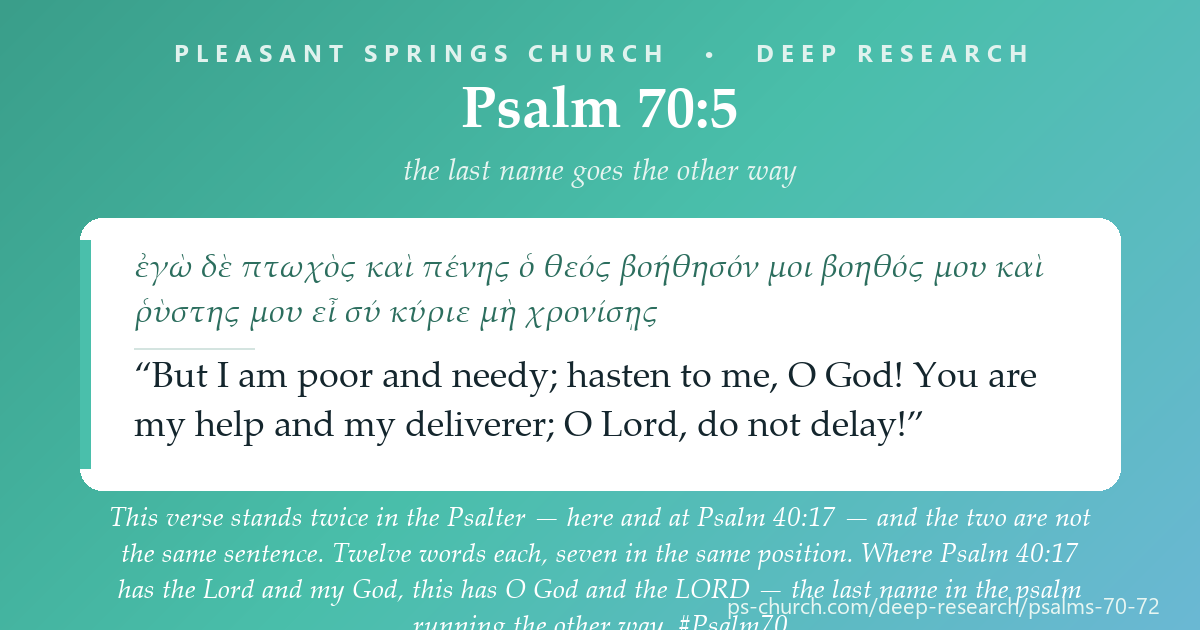
Hebrew · Greek (Rahlfs’ Psalter) · ESVSet them side by side in Hebrew, word position against word position: Psalm 70:1 and Psalm 40:13 agree in none of their words; 70:2 and 40:14 in none; 70:3 and 40:15 in three of seven; 70:4 and 40:16 in eight of eleven; 70:5 and 40:17 in seven of twelve. Every pair differs, and in two of them no word at all falls in the same position — which is what one added or dropped word at the front does to every position after it. Psalm 40 carries words Psalm 70 does not (רְצֵה, יַחַד, לִסְפּוֹתָהּ) and reads a different verb at two places.
⚠️ And the divine names do something worth seeing. Five stand in the paired verses of each psalm. Line them up in order:
Psalm 40 — יְהֹוָה · יְהֹוָה · יְהֹוָה · אֲדֹנָי · אֱלֹהַי
Psalm 70 — אֱלֹהִים · יְהֹוָה · אֱלֹהִים · אֱלֹהִים · יְהֹוָה
At three positions the pair runs one way. At one it does not move. And at the fifth — the last divine name in the psalm — it runs the other way. Rahlfs has the same shape: at Rahlfs 39:18 the names are κύριος then ὁ θεός μου; at Rahlfs 69:6 they are ὁ θεός then κύριε.
What this page does and does not say about that. Which psalm stood first is not decidable from the two texts, and this page does not decide it. What can be counted is the distribution — and the distribution is real: across Book I (Psalms 1–41) this library counts 241 occurrences of יהוה against 13 of אלהים; across Book II (Psalms 42–72), 26 against 140. The proportion inverts. Psalm 40 sits in the first book and Psalm 70 in the second, and four of the five names sit on the right side of that pattern — three by moving, one by not needing to. The fifth runs against it. The substitution pattern that covers the other four does not cover this one; what the standard commentaries make of it was not consulted for this page.
⚠️ The psalm after it does the same thing, to two different psalms. Psalm 71:1–3 stands beside Psalm 31:1–3, and again no verse is reproduced: 71:1 and 31:1 share two words of six and eight; 71:2 and 31:2 share none; 71:3 and 31:3 share none positionally, though 71:3 carries you are my rock and my fortress at the end of the verse where Psalm 31 puts it at the beginning — Hebrew 71:3 draws on Hebrew 31:3 and 31:4 at once, which is why nothing lands in the same place. And the same petition stands at Psalm 71:12 — לְעֶזְרָתִי חוּשָׁה, make haste to help me, with the same written-one-way-read-another caution as at 72:17: Hebrew 71:12 is written חישה and read חוּשָׁה. And the divine name before it differs: Hebrew 70:2 has יְהֹוָה where Hebrew 71:12 has אֱלֹהַי.
⚠️ At 72:17 Rahlfs reads a subject the Hebrew of MT leaves unstated — and it is a phrase that stands in Greek Genesis. Hebrew 72:17 has וְיִתְבָּרְכוּ בוֹ, and they shall bless themselves in him, with no they named. Rahlfs reads καὶ εὐλογηθήσονται ἐν αὐτῷ πᾶσαι αἱ φυλαὶ τῆς γῆς — and in him all the tribes of the earth shall be blessed. Those five Greek words stand nowhere else in the Greek Psalter — and the same five stand in Greek Genesis at 12:3 and 28:14, inside the promise to Abraham that is repeated at Bethel to Jacob: ἐνευλογηθήσονται ἐν σοὶ πᾶσαι αἱ φυλαὶ τῆς γῆς. There the verb and the pronoun differ — Genesis has the compound ἐνευλογηθήσονται and a second-person ἐν σοί where the psalm has the simplex and ἐν αὐτῷ. What the two share is the five-word phrase. In Greek, the psalm about the king closes with the words Genesis uses of Abraham’s line. Whether the Greek renders something MT no longer carries, or reads more than its Hebrew had, is not decidable from the two texts, and this page does not decide it — the same caution it applies to Psalms 40 and 70.
The Shape of the Passage
Sequence — the last three psalms of Book IIThe chain can be drawn. Psalm 40:13–17 stands also as Psalm 70. Psalm 31:1–3 stands also at the head of Psalm 71. And the petition of Psalm 70:1 stands again at Psalm 71:12. In every one of those pairings the words are redistributed and the divine names differ, and in none of them is a single verse reproduced unchanged.
Psalm 72 belongs here by position rather than by vocabulary — it is the psalm the doxology and the colophon are attached to, and the colophon is the only line of its kind in the Psalter’s first two books. Its last three verses do two different jobs: 72:18–19 close the book with a blessing that is not about the king at all, and 72:20 steps outside the poem to say that a collection has ended.
Two of these three psalms carry a Hebrew heading; one carries none. Psalm 70: to the choirmaster, of David, for the memorial offering. Psalm 72: of Solomon. Psalm 71: nothing. Rahlfs answers all three, and for Psalm 71 carries a heading with no Hebrew counterpart at all.
Author
Someone working with words that stand elsewhere in the Psalter. The close of Psalm 40 stands a second time as Psalm 70; the opening of Psalm 31 stands a second time at the head of Psalm 71. Neither pairing is an exact match, and the differences are not confined to the divine names.
Someone old, in the middle psalm. Do not cast me off in the time of old age; forsake me not when my strength is spent… So even to old age and gray hairs, O God, do not forsake me. Psalm 71 is the psalm of a long life still asking.
And someone praying for a king, in the last. Give the king your justice, O God, and your righteousness to the royal son! The Hebrew heading says lishlomoh — which can be read of Solomon or for Solomon, and the page does not choose.
Audience
People who would recognise the overlap. A congregation that did not already know the other psalms in this group would hear nothing unusual in Psalms 70 and 71. The interest of these psalms depends on the hearer having the others by heart.
People who kept books, not just poems. The prayers of David, the son of Jesse, are ended. That sentence is not addressed to God and is not part of the prayer — it is a note to whoever is holding the scroll.
And, by the end, the nations. May all kings fall down before him, all nations serve him… may people be blessed in him. Psalm 72 begins in a throne room and finishes at the ends of the earth.
Orient on the Elohistic Psalter, on doublets, and on the royal psalms.
Search by topic: Elohistic Psalter; doublet psalms; superscriptions; royal psalms; Book divisions of the Psalter; Rechabites.
Which articles are relevant?
- Anchor Bible Dictionary — “Psalms, Book of,” “Elohist,” “Rechabites,” “Solomon.”
- Dictionary of the OT: Wisdom, Poetry & Writings (IVP) — “Editorial Criticism,” “Psalms: Book of,” “Royal Psalms,” “Superscriptions.”
- NIDOTTE / TDOT — זָכַר (zāḵar, to remember — the hiphil behind ləhazkîr), נוּן / יִנּוֹן (the crux at 72:17), סָפַר (sāp̌ar, to count — and סֵפֶר, a book).
- On the Greek — the NETS Psalms introduction, and Rahlfs 70:1 read beside a Hebrew verse that has no heading.
- On the doublet — any critical commentary on Psalm 40 and Psalm 70 printed together; the standard treatments set the two texts in parallel columns, which is what this page does.
Bibliography surfaced:
- John Goldingay, Psalms 42–89; Robert Alter, The Book of Psalms.
- Frank-Lothar Hossfeld and Erich Zenger, Psalms 2 (Hermeneia) — covers Psalms 51–100.
- Gerald H. Wilson, The Editing of the Hebrew Psalter — for the book seams and the colophon at 72:20.
- Babylonian Talmud, Sanhedrin 98b — for the name Yinnon at 72:17.
A colophon, a Greek title nobody in Hebrew wrote, and a name from a Talmudic list.
Read Psalm 40:13–17 and Psalm 70 in parallel columns before reading anything written about them.
Which parallels shed light on these psalms?
Psalm 72:20 is a colophon, and colophons are a scribal habit, not a poetic one. The prayers of David, the son of Jesse, are ended — a note about a collection, written into the collection. Rahlfs reads it ἐξέλιπον οἱ ὕμνοι Δαυιδ, the hymns of David failed, where the Hebrew says prayers. Fourteen psalms after this line the Psalter still attributes psalms to David — Psalm 86 is headed a prayer of David, and Psalms 138–145 carry his name — so the colophon marks the end of a collection rather than the end of the Davidic psalms.
The Greek heading at Psalm 71 names a family the Hebrew never mentions here. Rahlfs 70:1: τῷ Δαυιδ υἱῶν Ιωναδαβ καὶ τῶν πρώτων αἰχμαλωτισθέντων — to David, of the sons of Jonadab and of the first taken captive. Jonadab son of Rechab is the ancestor of the Rechabites, the family Jeremiah 35 sets in the temple with wine before them, who refuse it because their father commanded them not to drink. The heading ties an untitled psalm about old age and long faithfulness to a household remembered for keeping a father’s word across generations, and to the first people taken captive. Nothing in the Hebrew of Psalm 71 says any of this.
And Psalm 72:17 contains a word the rabbis read as a name. The Hebrew is יִנּוֹן — ESV renders the clause his fame continue as long as the sun; Rahlfs reads διαμενεῖ, shall continue. The Babylonian Talmud lists it among proposed names for the Messiah: “The school of Rabbi Yannai says: Yinnon is his name, as it is stated: ‘May his name endure forever; may his name continue [yinnon] as long as the sun; and may men bless themselves by him’ (Psalms 72:17)” — Sanhedrin 98b. The passage is a list of competing proposals, several of them puns on the proposer’s own school, and this page reports it as what it is: a rabbinic discussion of the verse, not a reading the verse requires.
- Psalm 40:13–17 → Psalm 70. Five verses in both, and no verse the same.
- Psalm 31:1–3 → Psalm 71:1–3. The same phenomenon, in the next psalm.
- Psalm 38 → Psalm 70. The only two headings in the Psalter with לְהַזְכִּיר.
- Jeremiah 35 → Rahlfs’ heading to Psalm 71. The Rechabites and the command of Jonadab. Named here because the Greek heading names them; the connection is the heading’s, not the psalm’s.
- Genesis 12:3 and 28:14 → Psalm 72:17. Five Greek words shared with the promise to Abraham — repeated to Jacob at 28:14, and with a different verb and pronoun in Genesis.
- Sanhedrin 98b → Psalm 72:17. Yinnon among the proposed names.
At Psalm 72:17 Rahlfs reads five words with no counterpart in the Hebrew: πᾶσαι αἱ φυλαὶ τῆς γῆς.
Swept by lemma and by form across all 150 psalms, the phrase occurs in the Greek Psalter exactly once — here. Swept across the Greek Genesis on this shelf, it occurs at 12:3 and 28:14, both times in the same sentence: ἐνευλογηθήσονται ἐν σοὶ πᾶσαι αἱ φυλαὶ τῆς γῆς.
⚠️ The same five words also stand twice in the Greek New Testament — and they are doing something else there. Matthew 24:30: καὶ τότε κόψονται πᾶσαι αἱ φυλαὶ τῆς γῆς. Revelation 1:7: καὶ κόψονται ἐπ᾽ αὐτὸν πᾶσαι αἱ φυλαὶ τῆς γῆς. In both the tribes mourn; in Genesis and in the Greek of Psalm 72:17 they are blessed. The verb is not shared, and neither passage names a source.
What may not be concluded from that. Five words in common are not a citation, and this page does not present them as one. The phrase is a stock Greek rendering, and its presence in Matthew and Revelation is standardly traced to Zechariah 12:10–14, where the tribes mourn — a book this library does not have in Greek on disk, so that tracing is reported and not verified here. What is verified is narrower and more interesting: the Greek Psalter uses this phrase once, the Hebrew of the verse has no phrase for it to render, and the words it uses are the words Greek Genesis uses of Abraham.
Two names, a crux, and a colophon.
Every count below was made on the texts named at the foot of this page, and every one can be repeated.
Counted here, not assumed:
- Verse counts, and three different offsets in one unit. Psalm 70: Hebrew and Rahlfs 6, English 5 — the offset is the title. Psalm 71: 24 in all three — the Hebrew has no title, and the Greek title sits inside verse 1. Psalm 72: 20 in all three — the title is inside the first verse. In Greek numbering these are Psalms 69, 70 and 71.
- Psalm 70 against Psalm 40:13–17, in Hebrew, word position by word position: 0 of 5, 0 of 9, 3 of 7, 8 of 11 and 7 of 12 — with the pointing and the cantillation left in place, and Masoretic section markers excluded. No pair is an identical string. Set the accents aside and the middle figures rise: the second pair opens with the same two words, and the third agrees in five of seven.
- The five divine names, in order. Psalm 40: יהוה, יהוה, יהוה, אדני, אלהי. Psalm 70: אלהים, יהוה, אלהים, אלהים, יהוה.
- Book I: 241 יהוה to 13 אלהים. Book II: 26 to 140. Counted word by word across Psalms 1–41 and 42–72 with maqqef and paseq treated as word boundaries; the two names counted only in their bare forms.
- Psalms 43 and 71 are the only psalms in Books II–III (42–89) with no superscription — scanned across all forty-eight — and Rahlfs supplies a heading to both (42:1 ψαλμὸς τῷ Δαυιδ; 70:1 the longer one above).
- לְהַזְכִּיר stands in exactly two superscriptions — Psalm 38 and Psalm 70, scanned across all 150.
- πᾶσαι αἱ φυλαὶ τῆς γῆς occurs once in the Greek Psalter (Rahlfs 71:17), twice in the Greek Genesis on this shelf (12:3, 28:14), and twice in the Greek New Testament (Matthew 24:30, Revelation 1:7).
- Psalm 71:1–3 against Psalm 31:1–3: 2 shared positions of six and eight, then 0 and 0. Again no verse reproduced.
“To bring to remembrance.” In only two superscriptions in the Psalter — Psalm 38 and Psalm 70, scanned across all 150. ESV renders it for the memorial offering, taking it as a liturgical direction; Rahlfs has εἰς ἀνάμνησιν, for a remembrance, which leaves it open.
The two divine names, and the count behind the pattern. Across Book I (Psalms 1–41) this library counts 241 occurrences of יהוה and 13 of אלהים; across Book II (Psalms 42–72), 26 and 140. Psalm 40 sits in the first book and Psalm 70 in the second — and four of their five paired names fit that, while the fifth runs the other way.
“Numbers, reckonings.” ESV: for their number is past my knowledge. Rahlfs reads γραμματείας — letters, or writings: I did not know letters. The consonants ס־פ־ר carry both a verb to count and a noun סֵפֶר, a book — and the two readings take the same three letters different ways.
A crux, written one way and read another. The consonants as written are ינין; the reading tradition has יִנּוֹן. ESV renders the clause his fame continue as long as the sun; Rahlfs has διαμενεῖ, shall continue. The Babylonian Talmud lists Yinnon among proposed names for the Messiah, on the strength of this verse (Sanhedrin 98b) — reported here as a rabbinic proposal, not as what the word means.
“All the tribes of the earth.” Once in the whole Greek Psalter; MT has no counterpart at this point. The same five words stand in Greek Genesis 12:3 and 28:14 — the promise to Abraham, repeated to Jacob — and twice in the Greek New Testament (Matthew 24:30, Revelation 1:7), where the tribes mourn rather than are blessed, and where the standard tracing is to Zechariah 12 rather than to this psalm.
“Prayers.” The second word of the colophon that closes Book II. Rahlfs reads οἱ ὕμνοι, the hymns. The Hebrew colophon calls what has just ended a body of prayer; the Greek calls it a body of song.
A psalm inside a psalm, three times over.
Where two psalms share material, print both and count. Do not say which came first.
Which cross-references matter?
- Psalm 40:13–17 · Heb 40:14–18 · Rahlfs 39:14–18 → Psalm 70. The unit’s central fact.
- Psalm 31:1–3 · Heb 31:2–4 · Rahlfs 30:2–4 → Psalm 71:1–3. The same phenomenon.
- Psalm 70:1 → Psalm 71:12. לְעֶזְרָתִי חוּשָׁה — the petition carried across two psalms, with the divine name different each time.
- Psalm 38 · Rahlfs 37 → Psalm 70. The לְהַזְכִּיר pair.
- Genesis 12:3 and 28:14 → Psalm 72:17 (Greek). Five words, verbatim, in Greek.
- Psalm 43 · Rahlfs 42 → Psalm 71. The other untitled psalm of Books II–III, and the other one Rahlfs names — though Psalm 43’s case is usually explained by its unity with Psalm 42, whose refrain it shares; Psalm 71 has no such explanation. See Psalms 42–43.
- Psalm 86:1 and Psalms 138–145 → Psalm 72:20. Psalms still headed with David’s name after the line that says his prayers are ended. Stated; the colophon marks a collection, not the man.
- Psalm 69 → Psalm 70. Neighbours, and both are about a poor and needy man asking God to hurry — see Psalm 69.
Three open questions.
Goldingay and Alter for the Hebrew; Wilson for the seams; the ESV footnotes for where the two texts part.
Commentaries & studies:
- John Goldingay, Psalms 42–89; Robert Alter, The Book of Psalms.
- Frank-Lothar Hossfeld and Erich Zenger, Psalms 2 (Hermeneia).
- Gerald H. Wilson, The Editing of the Hebrew Psalter — the book seams.
- NETS Psalms, with Rahlfs; Babylonian Talmud, Sanhedrin 98b.
Three things reported as unsettled:
- Which of Psalm 40 and Psalm 70 stood first. The two texts cannot settle it, and the fifth divine name runs against whatever explanation covers the other four.
- What יִנּוֹן is at 72:17. Written one way, read another — ESV takes it as a verb of continuing, Rahlfs likewise, and a rabbinic tradition takes it as a name.
- Where Rahlfs’ heading to Psalm 71 comes from. It names Jonadab’s sons and the first exiles, and the Hebrew of the psalm names neither. No apparatus for the Greek Psalter permits a reading to be called early or late, so nothing here dates it.
Nothing carried over unchanged.
Name what you learned, why it matters, and one concrete response.
What should we carry away — and do?
- Psalm 70 and the last five verses of Psalm 40 are the same five verses twice over, and not one of the pairs is the same string. Two of the five pairs share no word at all in the same position. The same psalm can stand twice in Scripture without standing twice the same way.
- Four of the five divine names run one way and the last runs the other. The tidy explanation covers four fifths of the evidence. Patterns in the Psalter are usually real and usually incomplete, and both halves of that are worth saying.
- Psalm 71 has no heading in Hebrew, and Rahlfs carries one. Of the sons of Jonadab, and of the first taken captive. A prayer about growing old stands in Greek under a heading that names a family remembered for keeping a father’s word across generations, and the first people taken captive. Where that heading comes from is not recoverable from the texts.
- One concrete response. Do not cast me off in the time of old age; forsake me not when my strength is spent. Someone in your congregation is praying Psalm 71 this week and has not said so. Ask an older member what they are still asking God for.
Psalm 70:5 · to share
Hebrew + Greek (Rahlfs) + ESVEvery Deep Research page traces its passage across the whole sweep — the Old Testament, the Second-Temple world between the testaments (historical witnesses, not Scripture), and the New Testament. Follow the thread:
Pleasant Springs Church — Deep Research
Research method after Michael S. Heiser’s Bible Research Method (examine dictionaries → ancient literature → important words → textual connections → academic publications → share), with the Pleasant Springs “Author & Audience” foundation. Scripture set in the Hebrew, the Greek editions named on each page and the ESV (Old Testament), and the Greek New Testament and the ESV (New Testament), per the practice of Pleasant Springs Church. Psalms 70–72 research grounded in Goldingay (Psalms 42–89) and Alter, with Wilson (The Editing of the Hebrew Psalter) for the book seams and the Babylonian Talmud, Sanhedrin 98b, read in the Sefaria text, for the name Yinnon. Text: Hebrew from the Masoretic text as printed in the editions consulted — Sefaria’s Miqra according to the Masorah; no critical apparatus was consulted for the Hebrew, and the paseq is not reproduced in the codex lines. Greek from Rahlfs’ Greek Psalter and Rahlfs’ Genesis (CATSS digitizations); Greek New Testament from the SBL edition. The standing caution for this shelf applies: these pages say “Rahlfs’ Greek Psalter reads…” and never call a Greek reading early or late. ⚠️ The Psalm 40 / Psalm 70 comparison, stated so it can be repeated. The five paired verses (Hebrew 40:14–18 against Hebrew 70:2–6) were aligned word position by word position with maqqef and paseq treated as word boundaries, Masoretic section markers excluded, and the pointing and the cantillation accents left in place. Identical positions: 0 of 5, 0 of 9, 3 of 7, 8 of 11, 7 of 12. No pair is an identical string. Set the accents aside and the same alignment gives 0, 2, 5, 8, 7 — the extra agreements fall on words identical in consonants and vowels that differ only in their accents. In the fifth pair, position six is לִּי against לִי, a dagesh conditioned by the preceding word; counting that as agreement gives eight rather than seven. The same method on Hebrew 31:2–4 against Hebrew 71:1–3 gives 2, 0 and 0 with the accents in place — but Hebrew 71:1 is the first six words of Hebrew 31:2 exactly, apart from the accents, so that first figure is six of six once they are set aside. ⚠️ The divine-name counts were made on bare forms only — יהוה and אלהים as standalone words, excluding suffixed and construct forms such as אלהי and אלהינו; Book I (Psalms 1–41) returns 241 and 13, Book II (Psalms 42–72) returns 26 and 140. The five names inside the paired verses were read individually and include the suffixed אֱלֹהַי at Hebrew 40:18. ⚠️ Four scans across all 150 psalms: psalms with no superscription in Books II–III (43 and 71 only); לְהַזְכִּיר in a superscription (38 and 70 only); πᾶσαι αἱ φυλαὶ τῆς γῆς in the Greek Psalter (Rahlfs 71:17 only); and the same phrase in the Greek Genesis on this shelf (12:3 and 28:14). The Matthew 24:30 and Revelation 1:7 parallel is reported as a shared phrase and explicitly not as a citation — the verb differs, neither passage names a source, and the tracing of both to Zechariah 12 could not be checked because Zechariah is not among the Greek books on this shelf. The Rechabite identification of Jonadab rests on Jeremiah 35, which was not read in Greek here; the heading itself is quoted from Rahlfs. Verse counts verified in all three columns for each psalm (70: Hebrew and Rahlfs 6, English 5; 71: 24 throughout; 72: 20 throughout). Typology is handled per the house position: what the text says, what the New Testament itself draws, and what we see from this side of the cross — with the seeing left to the reader.
Scripture quotations marked ESV are from the ESV® Bible (The Holy Bible, English Standard Version®), © 2001 by Crossway, a publishing ministry of Good News Publishers. ESV Text Edition: 2016. Used by permission. All rights reserved. The ESV text may not be quoted in any publication made available to the public by a Creative Commons license, and the ESV may not be translated in whole or in part into any other language. www.esv.org
|
Did this study bless you today? 💚 Give to Support PS Church100% of gifts go to the General Fund — thank you. |