Psalm 73 says one small Hebrew word three times — ʾak, at verses 1, 13 and 18 — and nowhere else. Read only those three and the psalm is already complete: Truly God is good to Israel… All in vain have I kept my heart clean… Truly you set them in slippery places. Faith, the loss of it, and faith again on the far side. In Greek the pattern is invisible: Rahlfs renders the three with three different words — hōs, ara, plēn — so a reader with only the Greek cannot see that the psalm says one thing three times. The frame is visible in Greek as well: good occurs exactly twice in the psalm's 193 words, at the first verse and the last, with its terms turned round — good to Israel, then good to me. And the psalm ends, in Greek, with six words the Hebrew of this psalm has nothing for — inside a ten-word run that stands word for word in Psalm 9: all your praises in the gates of the daughter of Zion. Along the way it confesses precisely what Psalm 37 forbids, and it is not — measured four different ways — the centre of the Psalter. See the method →
Psalm 73:1–28 (selections)
Hebrew · Greek (Rahlfs’ Psalter) · ESVאַךְ stands at 73:1, 73:13 and 73:18 — and nowhere else in the psalm. Counted across all 150 psalms, the word occurs 24 times; three of those are here. Read the three in order and the argument is complete without anything else:
73:1 — Truly God is good to Israel.
73:13 — All in vain have I kept my heart clean.
73:18 — Truly you set them in slippery places.
The confession, the collapse, and the confession recovered on the other side. ESV keeps two of the three as the same English word.
⚠️ In Greek the pattern cannot be seen at all. Rahlfs renders the three with three different words: ὡς at 72:1, ἄρα at 72:13, πλήν at 72:18 — how, then, nevertheless. A reader with only the Greek has no way of knowing the psalm says one word three times. This page reports the distribution and does not treat either text as the corrected form of the other.
⚠️ And the psalm ends, in Greek, with ten words that stand somewhere else.
Hebrew 73:28 closes לְסַפֵּר כָּל־מַלְאֲכוֹתֶיךָ, that I may tell of all your works, and stops. Rahlfs 72:28 runs on: τοῦ ἐξαγγεῖλαι πάσας τὰς αἰνέσεις σου ἐν ταῖς πύλαις τῆς θυγατρὸς Σιων — that I may declare all your praises in the gates of the daughter of Zion.
The last ten of those words are, word for word and in order, the corresponding stretch of Rahlfs 9:15. And at Psalm 9 the Hebrew has them too: MT 9:15 reads כָּל־תְּהִלָּתֶיךָ בְּשַׁעֲרֵי בַת־צִיּוֹן, all your praises in the gates of the daughter of Zion. So the sentence is not invented anywhere — it stands in both texts of Psalm 9, and in only one text of Psalm 73. Whether the Greek renders a Hebrew copy that carried the line here, or a copyist’s eye moved from one psalm to the other, or something else again, is not decidable from the texts on this page, and no published apparatus for the Greek Psalter permits a reading to be called early or late. What can be shown is the overlap, and its length.
The Shape of the Passage
Frame and turn — one word at each end, one door in the middle73:1 — good · to Israel · God
73:28 — God · to me · good
The psalm opens with what is good for the nation and closes with what is good for one man, and the man is the one who nearly stopped believing the opening line.
⚠️ A structure this page does not print. Psalm 73 is often set out as a chiasm pairing 73:2–3 with 73:18–19 — the psalmist’s feet slipping against the wicked set in slippery places. The thematic symmetry is real; the vocabulary is not shared. 73:2 has נָטָיוּ and שֻׁפְּכוּ of the psalmist’s feet; 73:18 has חֲלָקוֹת and מַשּׁוּאוֹת of the wicked’s ground. Not one word stands in both verses. This library requires a literary structure to rest on shared words rather than shared themes, so the chiasm is named here and not drawn.
Psalm 73 opens Book III, and it is the first of eleven consecutive psalms headed לְאָסָף — Psalms 73–83, with Psalm 50 standing on its own earlier. Rahlfs 72:1 answers the Hebrew heading and adds nothing.
Author
A singer of the Asaph guild, by the heading. A Psalm of Asaph. Chronicles makes the Asaphites Levites, and that matters at the end — the psalm closes by calling God my portion, the very word Deuteronomy uses for the share of land a Levite is denied.
Someone who nearly stopped saying the first line. But as for me, my feet had almost stumbled, my steps had nearly slipped. The psalm is written by the man who lost the argument and then won it back.
And someone who kept quiet at the time. If I had said, “I will speak thus,” I would have betrayed the generation of your children. He did not publish his doubt while he had it. What we have is the account written afterwards.
Audience
People who had heard the first line before. Truly God is good to Israel. It is stated flatly, with no argument attached — the kind of sentence a congregation already agrees with, which is why the next verse lands.
People who could be lost by the wrong word. the generation of your children. The psalmist’s reason for silence is pastoral, not personal.
And people who go to the sanctuary. until I went into the sanctuary of God. The turn does not come from an argument. It comes from a building.
Orient on the problem of the wicked’s prosperity, on Asaph, and on Book III.
Search by topic: theodicy; retribution; Asaph; Book III of the Psalter; wisdom psalms; the afterlife in the Old Testament.
Which articles are relevant?
- Anchor Bible Dictionary — “Theodicy,” “Asaph,” “Retribution,” “Wisdom in the OT.”
- Dictionary of the OT: Wisdom, Poetry & Writings (IVP) — “Theodicy,” “Wisdom Psalms,” “Death and the Afterlife,” “Psalms: Book of.”
- NIDOTTE / TDOT — אַךְ (ʾaḵ, the particle this psalm turns on), קָנָא (qānāʾ, to be envious or zealous), חֵלֶק (ḥēleq, portion), צוּר (ṣûr, rock).
- On the Greek — the NETS Psalms introduction, and Rahlfs 72:28 read beside Rahlfs 9:15, which is where this page’s largest divergence sits.
- On Book III — Gerald H. Wilson, The Editing of the Hebrew Psalter, for the Asaph collection and the book seams.
Bibliography surfaced:
- John Goldingay, Psalms 42–89; Robert Alter, The Book of Psalms.
- Frank-Lothar Hossfeld and Erich Zenger, Psalms 2 (Hermeneia) — covers Psalms 51–100.
- Gerald H. Wilson, The Editing of the Hebrew Psalter.
- James B. Pritchard, ed., Ancient Near Eastern Texts — for the dream-and-waking figure; see the caution in Stage 2.
A complaint with neighbours, and a claim about this psalm that does not survive counting.
Read Psalm 37 and Psalm 49 beside this one before reading anything written about any of them.
Which parallels shed light on this psalm?
Psalm 73:3 confesses in the same words what Psalm 37:1 forbids, and the two verses are joined by a word. The piel of קָנָא governing בְּ and a class of wrongdoers occurs twice in the whole Psalter: Psalm 37:1 אַל־תְּקַנֵּא בְּעֹשֵׂי עַוְלָה, be not envious of wrongdoers, and Psalm 73:3 קִנֵּאתִי בַּהוֹלְלִים, I was envious of the arrogant. One psalm gives the command and the other stands as its confession — which psalm knew the other, if either did, is not decidable from the two texts. The Greek keeps them together independently: forms of ζηλ- in the sense of envying the wicked stand in Rahlfs 36 and at Rahlfs 72:3, and nowhere else in the Psalter. And the link runs through a second word: Psalm 73:2 says אֲשֻׁרָי, my steps, had slipped; Psalm 37:31 says of the righteous man that אֲשֻׁרָיו, his steps, do not slip. The noun occurs six times in the Psalter.
Psalm 49 is the control, and it fails. It treats the same subject and even shares the verb: Psalm 49:15 says God will receive me, יִקָּחֵנִי, as Psalm 73:24 does with תִּקָּחֵנִי. But the two psalms share almost no distinctive vocabulary, and in Greek the verb is not the same form — Rahlfs 48:16 has ὅταν λαμβάνῃ με where Rahlfs 72:24 has προσελάβου με: the same verb λαμβάνω, simplex in the one and compounded with πρός in the other. A thematic twin and a lexical stranger, which is worth knowing before anyone builds on the resemblance.
The dream-and-waking figure at 73:20 has ancient neighbours, and the local collection is thin on them. Pritchard’s ANET prints a Sumerian epic that puts dream, sleep and failure to rise in one breath — it is a dream… it is a sleep… He touches him, he rises not, he speaks to him, he [an]swers not — in Gilgamesh and the Land of the Living (ANET 47–50, the passage at 49, read by its printed folio). The imagery overlaps; the movement does not. There the sleeper is the hero and cannot be woken; here the sleeper wakes, and it is the wicked who turn out to have been the dream. What this library could not consult. The copy of ANET used here stops at about page 327, so the great Mesopotamian discussions of exactly this problem — Ludlul bēl nēmeqi at ANET 434 and the Babylonian Theodicy at 601 — are not in it and were not read. They are the parallels a commentary would reach for first, and this page cannot report them.
- Psalm 37:1 and 37:31 → Psalm 73:2–3. The prohibition and the confession, joined by two words.
- Psalm 49 · Rahlfs 48 → Psalm 73. The same question, and almost none of the same words.
- Rahlfs 9:15 → Rahlfs 72:28. Ten Greek words in common at the psalm’s last line.
- Deuteronomy 10:9; 18:1; 32:9 → Psalm 73:26. In Deuteronomy μερίς is what the Levite does not get — there is no portion or inheritance for the Levites among their brothers; the Lord himself is his inheritance (10:9, and again at 18:1–2, which continues with κλῆρος alone). At 32:9 the word turns round: Israel is the Lord’s μερίς. Psalm 73:26 takes the word the Levite is denied and gives it to God.
- ANET 47–50 → Psalm 73:20. The Sumerian epic Gilgamesh and the Land of the Living, the passage at 49; read in the local copy by its printed folio.
The claim is repeated often enough to be worth testing rather than repeating — but only one version of it is being tested here. Some who call Psalm 73 the centre of the Psalter mean a theological centre: the psalm where the book’s movement from obedience to praise turns. Counting cannot touch that claim, and this page does not try. What can be counted is the arithmetic, and the arithmetic does not land here. This library counted the whole Masoretic Psalter three different ways:
By psalm number — 150 psalms, so the middle falls between Psalm 75 and Psalm 76.
By verse — 2,527 verses, so the middle verse is number 1,264, which falls at Psalm 78:36.
By word — 19,586 words, so the middle word falls inside Psalm 76.
Not one of the three lands on Psalm 73 — and Psalm 73 is the first psalm of Book III, not the middle of it either.
And the near-miss is worth naming too. All three measures fall within a few psalms of one another, inside the Asaph block of Psalms 73–83. That is less impressive than it sounds: the Asaph block of Psalms 73–83 runs to 245 of the Psalter’s 2,527 verses — about a tenth of the book — and they straddle the middle, so any measure of the middle will land in them. The three figures are three correlated ways of measuring one midpoint, not three independent witnesses converging on a point. Psalm 73 is the psalm that opens the block. It is not the arithmetical centre of the book — which is the only sense this page has tested.
A particle, a frame, and a verb that goes its own way.
Every count below was made on the texts named at the foot of this page, and every one can be repeated.
Counted here, not assumed:
- Verse counts. Hebrew 28, Rahlfs 28, English 28 — the heading sits inside verse 1 in the Hebrew, so there is no offset in this psalm. In Greek numbering this is Psalm 72.
- Psalm 73 carries no Greek title-plus. Hebrew מִזְמוֹר לְאָסָף; Rahlfs ψαλμὸς τῷ Ασαφ. Two elements, two elements, nothing added.
- אַךְ three times — 73:1, 73:13, 73:18 — and 24 times across all 150 psalms. Rahlfs answers with three different words.
- טוֹב exactly twice, at 73:1 and 73:28. Both in the frame; the psalm runs to 193 Hebrew words.
- Rahlfs 72:28 shares a run of ten words with Rahlfs 9:15 — πάσας τὰς αἰνέσεις σου ἐν ταῖς πύλαις τῆς θυγατρὸς Σιων, aligned token by token with accents normalised. The last six have no counterpart in Hebrew 73:28; all ten have one in Hebrew 9:15.
- The piel of קָנָא with בְּ and a class of wrongdoers: twice in the Psalter — Psalm 37:1 and Psalm 73:3.
- אֲשֻׁרִים, steps: six times in the Psalter — Hebrew 17:5, 17:11, 37:31, 40:3, 44:19 and 73:2 — English 40:2 and 44:18 for the middle two.
- Three “takings”, three Greek verbs. Genesis 5:24 μετέθηκεν; 4 Kingdoms 2:9–11 ἀναλαμβάνω three times; Rahlfs 72:24 προσελάβου. ★ Counted across the whole Greek Old Testament for the first time on 30 August 2026, when the shelf reached 64 CATSS files and 30,637 verse units — and re-counted the same day, when the Odes came out of the screening corpus and left 30,348. ⚠️ THIS CARD PUBLISHED ‘8, 90 AND 17 VERSES’ AND TWO OF THOSE THREE NUMBERS NEEDED CORRECTING. THE OLD FIGURES ARE PRINTED RATHER THAN SWAPPED. Re-run by the CATSS lemma column — lemma plus its preverb, so that μετέθηκεν is found under tithemi + meta and not filed under bare tithemi — the three families stand in 8, 95 and 16 verses of the 30,348 screened rows (8, 96 and 16 of the 30,637 held; 8, 96 and 17 if occurrences are counted instead of verses, which is where the published 17 came from). (1) The Odes moved exactly one of these numbers, and moved it for the precise reason the Odes were taken out. The one canticle row anywhere in the three families is Ode 2:11, and Ode 2 is Deuteronomy 32 — Deuteronomy 32:11 is already in the list, so that row was one verse counted twice and never a ninety-sixth place. (2) The published 90 for ἀναλαμβάνω could not be reproduced by any method tried, and is withdrawn rather than defended. The 8 reproduces exactly, verse for verse, against the list this card prints; so does the 17 as an occurrence count. That two of the three check out is what says the method is right and the third figure was not. Nothing the card argues turns on it — the point was that ἀναλαμβάνω is common, and ninety-five says that as well as ninety did. The three families stand, then, at 8, 95 and 16. ἀναλαμβάνω is ordinary Greek for picking anything up and carries no weight on its own; the other two are rare, and the rare one used of Enoch is used of Enoch again. μετατίθημι stands of Enoch three times, not once — Genesis 5:24, and then Sirach 44:16 (Ενωχ εὐηρέστησεν κυρίῳ καὶ μετετέθη, which reuses Genesis’ own εὐηρέστησεν) and Wisdom 4:10 (ζῶν μεταξὺ ἁμαρτωλῶν μετετέθη, of a righteous man not named). Sirach and Wisdom are WITNESSES on this shelf and NOT SCRIPTURE, and Wisdom is one of the twenty files that arrived on 30 August 2026 — so this observation could not have been made on this page until that day. And the two verbs cross once: Sirach 49:14 uses Elijah’s verb ἀνελήμφθη of Enoch, while 1 Maccabees 2:58 uses it of Elijah. None of the three ever uses the Psalter’s προσλαμβάνομαι of either man, which is the claim this card makes, and the enlarged corpus leaves it standing.
- The Psalter measured three ways puts its middle at Psalm 75/76, Psalm 76 and Psalm 78:36 — never at Psalm 73. 2,527 verses; 19,586 Hebrew words. This tests the arithmetical claim only.
“Surely, only, nevertheless.” Three times in this psalm and nowhere else in it — 24 occurrences across all 150 psalms. ESV: Truly… All in vain… Truly. Rahlfs: ὡς, ἄρα, πλήν — three different words, so the repetition is not visible in Greek.
“Good.” Exactly twice in the psalm’s 193 words, and both stand in the frame. 73:1 good · to Israel · God; 73:28 God · to me · good. Rahlfs answers both with ἀγαθός, so the frame is visible in Greek even though the threefold אַךְ is not.
“Pangs” or “bonds.” The only occurrence in the Psalter — scanned across all 150 psalms, which is the only Hebrew this library holds; the word does occur elsewhere in the Old Testament. Rahlfs reads ἀνάνευσις, a refusal or a throwing back of the head, the only occurrence in the whole Greek Psalter.
“Sanctuaries” — a plural construct where English and Greek both read a singular. The plural of this noun stands twice in the Psalter — at 68:35 (Hebrew 68:36 · Rahlfs 67:36) and here. Rahlfs reads τὸ ἁγιαστήριον, singular — and at Hebrew 68:36, where the Hebrew is also plural, Rahlfs 67:36 uses a different word again.
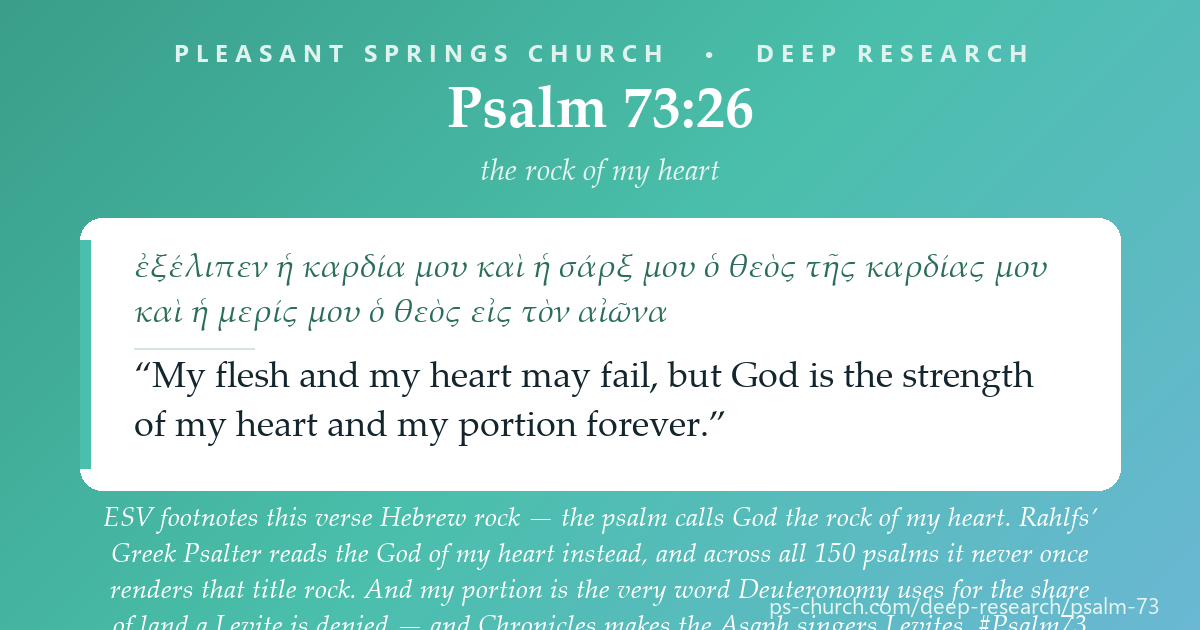
“Rock.” ESV footnotes this verse simply Hebrew rock. Rahlfs reads ὁ θεὸς τῆς καρδίας μου, the God of my heart. Across all 150 psalms the Greek Psalter renders צוּר as πέτρα in none of the verses where it is a title for God — while rendering the literal rock πέτρα every time. See Psalms 61–64.
“To take to oneself, receive.” The Greek Psalter’s verb at the psalm’s most-quoted line. It is not the verb the Greek Old Testament uses of Enoch (μετέθηκεν, Genesis 5:24) or of Elijah (ἀναλαμβάνω, 4 Kingdoms 2:9, 10, 11). Three takings, three different Greek verbs. ★ And the whole Greek Old Testament can now be counted behind that claim. Across 64 CATSS files and 30,348 screened verse units (30,637 are held; the 289 Odes rows are excluded from every screen on this shelf, and no canticle carries this verb, so the count is the same either way) the verb stands in 8 verses: four of them are Psalms — Rahlfs 17:17, 26:10, 64:5 and this one — a fifth is 1 Kingdoms 12:22, and the other three are 2 Maccabees 8:1 and 10:15 and Wisdom 17:10, witnesses on this shelf and not Scripture. It is, in the canonical books, a Psalter word.
The question the reader will ask, and the answer the Greek gives.
Where the New Testament does not take a psalm up, say so with a measurement rather than an impression.
Which cross-references matter?
⚠️ The link most readers will expect runs through the Hebrew of 73:1, and not through the Greek. ESV ends 73:1 to those who are pure in heart, and Matthew 5:8 reads μακάριοι οἱ καθαροὶ τῇ καρδίᾳ, blessed are the pure in heart. But the adjective the Beatitude uses does not stand at Rahlfs 72:1 — it stands at Rahlfs 23:4, which is Psalm 24:4, in the singular: καθαρὸς τῇ καρδίᾳ. Rahlfs 72:1 reads τοῖς εὐθέσι τῇ καρδίᾳ, upright in heart. The Hebrew of the two psalms uses the same word — 73:1 לְבָרֵי לֵבָב in the plural, 24:4 וּבַר־לֵבָב in the singular; the Greek does not. So a reader who hears the Beatitude in Psalm 73:1 is hearing the Hebrew, and the psalm the Beatitude’s Greek matches is Psalm 24. Stated; the seeing is left to the reader, and Matthew names no psalm.
- Psalm 37:1, 37:31 · Rahlfs 36:1, 36:31 → Psalm 73:2–3. The command and the confession.
- Psalm 24:4 · Rahlfs 23:4 · Matthew 5:8 → Psalm 73:1. Same Hebrew phrase; different Greek.
- Genesis 5:24 · 4 Kingdoms 2:9–11 → Psalm 73:24. Three takings, three Greek verbs.
- Hebrews 11:5 · Acts 1:2, 1:11, 1:22 · Mark 16:19 · 1 Timothy 3:16. The New Testament takes up the Greek verbs of the other two and not this one.
- Deuteronomy 10:9; 18:1; 32:9 → Psalm 73:26. The portion a Levite is denied — and at 32:9 the Lord’s own.
- Psalm 9:14 · Hebrew and Rahlfs 9:15 → Rahlfs 72:28. Ten Greek words.
- Psalm 49 · Rahlfs 48 → Psalm 73. The thematic twin that is not a lexical one.
“Afterward you will receive me to glory” is the line this psalm is best known for, and it is regularly read as an Old Testament resurrection text. Two things can be shown, and a third cannot.
What the Hebrew has. Both verbs at 73:24 are prefix-conjugation forms, which English versions render you guide me and you will receive me. The verb is לָקַח, the same verb used of Enoch in Genesis 5:24 and of Elijah in 2 Kings 2.
What the Greek has. Rahlfs renders both with aorists — ὡδήγησάς με… προσελάβου με, you guided me… you received me — so in Greek the receiving reads as something that has already happened. And the Greek verb here is not the Greek verb of the other two takings: Genesis 5:24 has μετέθηκεν; 4 Kingdoms 2 has ἀναλαμβάνω three times in three verses; Psalm 72:24 has προσελάβου.
⚠️ Inside the Greek Psalter, though, that verb is not the odd one out. It stands four times, and in three of them God is the one receiving a person: Rahlfs 17:17 προσελάβετό με, Rahlfs 26:10 ὁ δὲ κύριος προσελάβετό με — my father and my mother forsook me, but the Lord received me — and Rahlfs 64:5 the identical form προσελάβου, of the man God chooses and brings to dwell in his courts. So the measurement below is about the New Testament’s vocabulary, not about the Greek Psalter’s.
⚠️ And the New Testament follows the other two, not this one. Hebrews 11:5 reproduces Genesis 5:24’s clause word for word — μετέθηκεν αὐτὸν ὁ θεός. ἀναλαμβάνω is the verb of the ascension at Acts 1:2, 1:11 and 1:22, at 1 Timothy 3:16, and at Mark 16:19 in the longer ending of Mark. Of the twelve times προσλαμβάνομαι occurs in the Greek New Testament, across eleven verses, not one is of a person being taken up to God — they are taking aside, taking along, taking food, and welcoming; the nearest is Romans 14:3, ὁ θεὸς γὰρ αὐτὸν προσελάβετο — for God has welcomed him, the same subject and the same object relation as the psalm, but of a brother at table.
What follows from that, and what does not. This is a measurement of vocabulary, not a verdict on the doctrine. It does not show that Psalm 73:24 is not about being taken to God; the Hebrew verb and the Enoch and Elijah narratives are there to be read, and Christians have read them together for a very long time. What it shows is that the New Testament, which had the Greek in front of it, drew on the other two passages and left this verb alone. The page reports that and leaves the seeing to the reader.
Four open questions.
Goldingay and Alter for the Hebrew; Wilson for Book III; the ESV footnotes for where the texts part.
Commentaries & studies:
- John Goldingay, Psalms 42–89; Robert Alter, The Book of Psalms.
- Frank-Lothar Hossfeld and Erich Zenger, Psalms 2 (Hermeneia).
- Gerald H. Wilson, The Editing of the Hebrew Psalter.
- NETS Psalms, with Rahlfs; Pritchard, ANET 49.
Four things reported as unsettled:
- Where the ten Greek words at 72:28 come from. They stand in both texts of Psalm 9 and in one text of Psalm 73. No published apparatus for the Greek Psalter permits a reading to be called early or late, so nothing here dates or explains it.
- What ESV’s “probable reading” at 73:10 rests on. ESV prints a line that matches neither the Hebrew it footnotes nor the Greek, and this library has no way to say what it is based on.
- What בָּעִיר is at 73:20. The same consonants and points can be read in the city or as a form of עוּר, to rouse. ESV takes the second (when you rouse yourself); Rahlfs takes the first and reads ἐν τῇ πόλει σου, in your city, with a possessive the Hebrew does not have. This page adopts neither.
- What Psalm 73:4 said. Six Hebrew words, three of them occurring nowhere else in the Psalter, against thirteen Greek words that answer almost none of them.
One word, three times.
Name what you learned, why it matters, and one concrete response.
What should we carry away — and do?
- The psalm says one word three times, and it is the argument. Truly God is good… All in vain have I kept my heart clean… Truly you set them in slippery places. Faith, then the loss of it, then faith again — and the third is not the first repeated, because it is said by a man who has been through the second.
- He did not say the middle one out loud at the time. If I had said, “I will speak thus,” I would have betrayed the generation of your children. The psalm is not a record of doubt kept quiet forever. It is doubt reported afterwards, by someone who had somewhere to take it.
- The turn came in a building, not in an argument. until I went into the sanctuary of God. Nothing in verses 2 to 16 is answered on its own terms. He does not win the argument; he changes where he is standing.
- One concrete response. Whom have I in heaven but you? And there is nothing on earth that I desire besides you. Someone near you is in verse 13 this week and has not said so, for the same reason he did not. Give them somewhere to say it.
Psalm 73:26 · to share
Hebrew + Greek (Rahlfs) + ESVEvery Deep Research page traces its passage across the whole sweep — the Old Testament, the Second-Temple world between the testaments (historical witnesses, not Scripture), and the New Testament. Follow the thread:
Pleasant Springs Church — Deep Research
Research method after Michael S. Heiser’s Bible Research Method (examine dictionaries → ancient literature → important words → textual connections → academic publications → share), with the Pleasant Springs “Author & Audience” foundation. Scripture set in the Hebrew, the Greek editions named on each page and the ESV (Old Testament), and the Greek New Testament and the ESV (New Testament), per the practice of Pleasant Springs Church. Psalm 73 research grounded in Goldingay (Psalms 42–89) and Alter, with Wilson (The Editing of the Hebrew Psalter) for Book III and the Asaph collection. Text: Hebrew from the Masoretic text as printed in the editions consulted — Sefaria’s Miqra according to the Masorah; no critical apparatus was consulted for the Hebrew, the paseq is not reproduced in the codex lines, and where the Masoretic text carries a ketiv/qere the codex prints the qere — in Psalm 73 that is 73:2 twice, 73:10 and 73:16. Greek from Rahlfs’ Greek Psalter, Genesis, Deuteronomy and 4 Kingdoms (CATSS digitizations); Greek New Testament from the SBL edition. ⚠️ The Greek corpus behind the corpus-wide counts on this page is the full CATSS shelf as it stood on 30 August 2026 — 64 files, 30,637 verse units on disk and 30,348 screened, not the four books named above, which are the ones quoted in the columns. The standing caution for this shelf applies: these pages say “Rahlfs’ Greek Psalter reads…” and never call a Greek reading early or late. ⚠️ Hebrew word counts on this page split on whitespace, maqqef and paseq, exclude Masoretic section markers, and count a ketiv/qere pair once (Psalm 73 = 193 words; the Psalter = 19,586). A token must carry at least one Hebrew letter to count, which excludes the inverted nuns at Psalm 107 and two stray brackets in the source. Rahlfs 72 = 354 tokens. ⚠️ The counts, stated so they can be repeated. אַךְ was scanned by consonantal skeleton across all 150 psalms (24 tokens; 73:1, 73:13, 73:18 here). טוֹב likewise (2 tokens in Psalm 73). The Rahlfs 72:28 / 9:15 overlap was measured by aligning the two verses token by token with accents normalised: longest unbroken shared run 10. The קָנָא and אֲשֻׁרִים scans were run word by word with maqqef and paseq as boundaries and a prefix-tolerant pattern. προσλαμβάνομαι, ἀναλαμβάνω and μετατίθημι were counted by lemma across all 27 books of the SBL Greek New Testament using the punctuation-free field. ⚠️ Absolute negatives on this page are scoped to what is on disk. Hebrew claims are scoped to Psalms 1–150, which is the only Hebrew this library holds — חַרְצֻבּוֹת is a Psalter hapax, not a biblical one. ⚠️ This sentence used to carry a Greek scope that is now obsolete, and the page prints the old wording rather than deleting it. It read: “Greek claims are scoped to the twenty-five Greek Old Testament books available here; Isaiah, Jeremiah, Ezekiel, Zechariah and Exodus are not among them.” That was true of a 35-file shelf. Isaiah, Jeremiah, Ezekiel and Zechariah arrived on 19 August 2026; Exodus arrived on 30 August 2026 with Leviticus, Numbers, Joshua and the deuterocanonical books. Greek claims on this page are now scoped to 64 CATSS files, 30,637 verse units held and 30,348 screened — the complete upstream lxxmorph set — and all five named books are held. The deuterocanonical files among them, together with Odes and the Psalms of Solomon, are WITNESSES on this shelf and NOT SCRIPTURE, and are named as such wherever a count on this page includes one. ⚠️ The 289-row difference between held and screened is the Odes, and it is not a rounding. The fourteen canticles bound after the Greek Psalter came off the screening corpus on 2026-08-30 for two independent reasons: two of them are New Testament text — Ode 9 is Luke 1, the Magnificat and the Benedictus, and Ode 13 is Luke 2 — so a screen that keeps them can report a Gospel matching itself as that Gospel’s deepest Old Testament contact; and ten more are second copies of passages already in the corpus, so any count or tie band touching a canticle was silently doubled. This page felt the second of those: Ode 2 is Deuteronomy 32, and Ode 2:11 was inflating the ἀναλαμβάνω count in stage 3 by one. Neither Ode 9 nor Ode 13 ever supplied a figure on this page. ⚠️ What was not consulted. No Qumran Psalms scroll, no Cairo Geniza fragment, no Syriac, no Vulgate or Gallican Psalter, no Aquila, Symmachus or Theodotion, and no critical apparatus for either text. Every “unsettled” verdict on this page is only as strong as that list. ⚠️ The ANET page was read in the local copy by its printed folio, and that copy stops at about page 327, so Ludlul bēl nēmeqi and the Babylonian Theodicy — the closest Mesopotamian parallels to this psalm’s question — are not in it and were not read; the page says so rather than citing them. The chiasm this psalm is often given was tested against shared vocabulary and not printed, because 73:2–3 and 73:18–19 share no word; the structure block prints the טוֹב frame, which does rest on a shared word. Verse counts verified in all three columns (28 throughout). Typology is handled per the house position: what the text says, what the New Testament itself draws, and what we see from this side of the cross — with the seeing left to the reader.
Scripture quotations marked ESV are from the ESV® Bible (The Holy Bible, English Standard Version®), © 2001 by Crossway, a publishing ministry of Good News Publishers. ESV Text Edition: 2016. Used by permission. All rights reserved. The ESV text may not be quoted in any publication made available to the public by a Creative Commons license, and the ESV may not be translated in whole or in part into any other language. www.esv.org
|
Did this study bless you today? 💚 Give to Support PS Church100% of gifts go to the General Fund — thank you. |