Across these four Asaph psalms the covenant name stands once in Psalm 74, once in Psalm 75, once in Psalm 76 — and not at all in Psalm 77. Forms of Elohim carry the rest, fourteen times over, and Psalm 77 reaches for five different ways of naming God without ever using the name itself. Rahlfs' Greek Psalter cannot show you any of this: almost all of it rides on two words, theos and kyrios, and only three of its six kyrios stand opposite the Hebrew name — the others face Elohim, Adonai and the short form Yah. The English marks the distinction exactly four times, once per psalm, in small capitals most readers walk past. Around that sit some of the sharpest divergences on this shelf: a verse that differs four separate ways at once, Leviathan fed to the Ethiopians, ever-flowing rivers turned into a place called Etham, Salem read as peace, and a Greek heading that names Assyria where the Hebrew names nobody. See the method →
Psalms 74–77 (selections)
Hebrew · Greek (Rahlfs’ Psalter) · ESVCounted word by word across all four, with prefixed forms included: יהוה stands once in Psalm 74 (74:18), once in Psalm 75 (75:9), once in Psalm 76 (76:12, and there with a ל prefixed), and not once in Psalm 77. Against that, forms of אֱלֹהִים stand fourteen times — three, two, four and five.
Psalm 77 reaches for every other word instead. It has אֱלֹהִים five times, אֲדֹנָי twice, אֵל twice, עֶלְיוֹן once, and at 77:12 the short form יָהּ. Five different ways of naming God, and the full name none of them.
⚠️ Where the Hebrew of these four psalms uses six different designations, Rahlfs carries almost all of them on two words — and one of the two does not track the Hebrew name.
Across Rahlfs 73–76 the count is θεός twenty-two times, κύριος six, ὕψιστος once, at Rahlfs 76:11. Three of the six κύριος stand opposite the Hebrew covenant name — Rahlfs 73:18, 74:9 and 75:12. The other three stand opposite three different Hebrew words: 76:2 opposite אֱלֹהִים, 76:8 opposite אֲדֹנָי, and 76:12 opposite יָהּ.
So a reader working from the Greek alone cannot tell, at any given κύριος, which Hebrew word is underneath it. This page reports the distribution. It does not say the Greek flattened a distinction it had in front of it, and it does not say the Hebrew sharpened one the Greek did not have. No published apparatus for the Greek Psalter permits a reading to be called early or late, and nothing here dates anything.
⚠️ The English marks the difference exactly four times. ESV prints the small-capital Lord once in each of these four psalms — 74:18, 75:8, 76:11 and 77:11 — and nowhere else in them. At the fourth of those the Hebrew word is not the full name at all, but יָהּ; and at 77:2 and 77:7, where ESV prints an ordinary Lord, the Hebrew is אֲדֹנָי. Three columns, three different amounts of information about which word is on the page.
The Shape of the Passage
Sequence — four Asaph psalms, and one that is sealed off⚠️ What is measurable is the opposite, inside Psalm 74. Its creation hymn at 74:12–17 shares almost no vocabulary with the laments on either side of it: one content word with 74:1–11 and one with 74:18–23, where reshuffling the psalm’s own verses into blocks of the same size predicts about six and about four. The hymn is sealed off from its own psalm.
And the frame that is usually drawn around it is not evidence. The two laments share six content words — אוֹיֵב, אֱלֹהִים, זְכֹר, לָנֶצַח, צֹרְרֶיךָ, שְׁמֶךָ — which is almost exactly what the same reshuffle predicts by chance. So this page prints the hymn’s isolation, which is well outside chance, and not the frame, which is not.
Seven times in those six verses the psalm says you. אַתָּה stands seven times in 74:13–17 and nowhere else in the psalm. The hymn is a list of things God did, and every line begins by naming who did them.
All four are headed לְאָסָף — part of the run of eleven at Psalms 73–83. The English verse offset is not the same across the four: Psalm 74 has none, because its heading sits inside verse 1; Psalms 75, 76 and 77 are each one behind, because their headings are verses of their own.
Author
Someone who has seen the sanctuary burned. They set your sanctuary on fire; they profaned the dwelling place of your name, bringing it down to the ground. Psalm 74 is written after something happened, not before.
Someone who says the prophets have stopped. We do not see our signs; there is no longer any prophet, and there is none among us who knows how long. That is a rare sentence in the Old Testament.
And someone who argues with himself in the fourth psalm. Has his steadfast love forever ceased? Are his promises at an end for all time? Psalm 77 asks six questions in a row and then answers none of them directly — it changes the subject to the sea.
Audience
People who could see the ruins. Direct your steps to the perpetual ruins; the enemy has destroyed everything in the sanctuary! The psalm points at rubble.
People who kept the festivals. at the set time that I appoint — Psalm 75 turns on an appointed time, and Psalm 74 mourns the burning of the places where times were kept.
And people who knew the exodus story by heart. You led your people like a flock by the hand of Moses and Aaron. Psalm 77 ends on that line and stops — no petition, no conclusion, just the name of the man who led them out.
Orient on the Elohistic Psalter, on Asaph, and on the sea-conflict imagery.
Search by topic: Elohistic Psalter; divine names in the Psalms; Asaph; Chaoskampf; Leviathan; communal lament.
Which articles are relevant?
- Anchor Bible Dictionary — “Names of God in the OT,” “Elohist,” “Leviathan,” “Asaph,” “Lament, Psalms of.”
- Dictionary of the OT: Wisdom, Poetry & Writings (IVP) — “God, Names of,” “Chaos and Death,” “Zion,” “Psalms: Book of.”
- NIDOTTE / TDOT — מוֹעֵד (mōʿēḏ, appointed time or meeting place), לִוְיָתָן, אֵיתָן (ʾêṯān), שָׁלֵם.
- On the Greek — the NETS Psalms introduction, and Rahlfs 75:1 read beside its Hebrew heading, which carries a word the Hebrew has no counterpart for.
- On the divine names — any treatment of the Elohistic Psalter, the stretch of Psalms in which אֱלֹהִים dominates.
Bibliography surfaced:
- John Goldingay, Psalms 42–89; Robert Alter, The Book of Psalms.
- Frank-Lothar Hossfeld and Erich Zenger, Psalms 2 (Hermeneia).
- Gerald H. Wilson, The Editing of the Hebrew Psalter.
- James B. Pritchard, ed., Ancient Near Eastern Texts — the Ugaritic Baal cycle, for the sea and the seven-headed serpent.
A sea that fights back, and a heading that names an empire.
Read Psalm 74:12–17 and Psalm 77:16–20 together before reading anything written about either.
Which parallels shed light on these psalms?
Psalm 74:13–14 breaks the heads of the sea-dragons and of Leviathan, and the Ugaritic texts have a creature with the same name. In Pritchard’s collection the goddess Anath says: Crushed I not El’s Belov’d Yamm? Destroyed I not El’s Flood Rabbim? Did I not, pray, muzzle the Dragon? I did crush the crooked serpent, Shalyat the seven-headed (ANET 137). The name behind Leviathan and the name behind that crooked serpent are the same consonants.
What the two texts do not share is as clear as what they do. In the Ugaritic cycle the Sea is a god, and El’s own son; a divine council rules against the champion; the first blow fails and a second weapon is needed (ANET 129–131). Psalm 74:13–17 has one subject and nine second-person verbs. There is no second deity in it, no council, and nothing that fails. What this page does not conclude. It sets the printed texts beside one another and draws no conclusion about which knew the other, or in which direction anything travelled. ANE texts are cited here as witnesses to how the ancient world wrote — not as Scripture, and not as sources the Bible depends on.
And Psalm 76’s Greek heading names an empire the Hebrew does not. Rahlfs 75:1 ends πρὸς τὸν Ἀσσύριον, concerning the Assyrian; the Hebrew heading has nothing for it. Across the whole Asaph collection this is one of only two such notices — the other stands at Rahlfs 79:1, the Greek of Psalm 80. Nothing on this page dates either of them.
- ANET 137 → Psalm 74:14. Anath and the seven-headed serpent — read in the local copy by its printed folio.
- ANET 129–131 → Psalm 74:13–17. Baal and Yamm. Cited for what each text says, not for dependence.
- Rahlfs 75:1 and Rahlfs 79:1. The two Assyrian notices in the Greek headings of the Asaph psalms.
- Psalm 44 · Rahlfs 43 → Psalm 74. A maskil of the sons of Korah, and on shared vocabulary the closest psalm in the Psalter to Psalm 74 — closer than any Asaph psalm.
- Psalm 79 · Rahlfs 78 → Psalm 74. Psalm 74 opens with the sheep of your pasture; Psalm 79 closes with it.
Psalm 74:8 is the single most divergent verse in this unit, and it is worth working slowly.
Hebrew (nine words): אָמְרוּ בְלִבָּם נִינָם יָחַד שָׂרְפוּ כָל־מוֹעֲדֵי־אֵל בָּאָרֶץ
Rahlfs (twenty-two): εἶπαν ἐν τῇ καρδίᾳ αὐτῶν ἡ συγγένεια αὐτῶν ἐπὶ τὸ αὐτό δεῦτε καὶ κατακαύσωμεν πάσας τὰς ἑορτὰς τοῦ θεοῦ ἀπὸ τῆς γῆς
(1) The meeting places are feasts. מוֹעֲדֵי־אֵל faces τὰς ἑορτὰς τοῦ θεοῦ. The Hebrew noun can mean an appointed time or an appointed place, and the Greek takes the first.
(2) The Greek has an invitation the Hebrew does not. δεῦτε καί, come, and…, has no counterpart in the Hebrew verse.
(3) The obscure word becomes a family. נִינָם — which ESV renders we will utterly subdue them — faces ἡ συγγένεια αὐτῶν, their kindred.
(4) And the burning changes person and mood. שָׂרְפוּ is they burned; κατακαύσωμεν is let us burn up.
⚠️ And a popular claim about this verse does not survive. Psalm 74:8 is often called the Old Testament’s only reference to synagogues, on the strength of meeting places. The Hebrew will not carry that weight: the same noun stands at 74:4 of the sanctuary itself, and at 75:2 and elsewhere in the Psalter of an appointed time, which is how Rahlfs takes it in both verses of this psalm. ESV prints meeting places; Rahlfs prints feasts; and a building that did not yet exist cannot be settled by either.
A name that thins out, and four words that carry two readings each.
Every count below was made on the texts named at the foot of this page.
Counted here, not assumed:
- Verse counts, and an offset that changes inside the unit. Psalm 74: 23 verses in all three columns, no English offset. Psalms 75, 76, 77: 11, 13 and 21 in Hebrew and Greek; 10, 12 and 20 in English, because each heading is a verse of its own. In Greek numbering these are Psalms 73–76.
- The covenant name: once in Psalm 74 (74:18), once in Psalm 75 (75:9), once in Psalm 76 (76:12, prefixed), and none in Psalm 77. Scanned word by word with prefixes allowed — without them the Psalm 76 occurrence is missed. The אֱלֹהִים figure below counts bare forms only; allowing prefixes there too would give seventeen.
- Forms of אֱלֹהִים across the four: fourteen — three, two, four and five.
- Rahlfs 73–76 by lemma: θεός 22, κύριος 6, ὕψιστος 1 (76:11). Three of the six κύριος stand opposite the Hebrew covenant name; the other three opposite אֱלֹהִים, אֲדֹנָי and יָהּ.
- ESV prints the small-capital Lord exactly once in each of the four psalms — 74:18, 75:8, 76:11, 77:11 — and at the last of them the Hebrew is יָהּ.
- אַתָּה seven times in Psalm 74:13–17, and nowhere else in the psalm.
- Psalm 74’s hymn shares one content word with each block that flanks it, where a size-matched reshuffle of the psalm’s own verses predicts about six and about four. The isolation is the finding; the frame is not.
- ESV carries nine footnotes across these four psalms — four in Psalm 74, one each in 75 and 76, three in Psalm 77.
The unit’s central count. Forms of אֱלֹהִים stand fourteen times across the four psalms; the covenant name stands once in each of Psalms 74, 75 and 76, and not at all in Psalm 77. These psalms sit inside the stretch of the Psalter where that proportion holds.
“An appointed time” — or an appointed place. The word behind the claim that Psalm 74:8 mentions synagogues. Rahlfs reads ἑορτή, a feast, at both places in this psalm; elsewhere in the Psalter the same Hebrew word faces καιρός, a time.
“Ever-flowing, perennial.” ESV reads it as an adjective describing the streams. Rahlfs reads the same consonants as a proper name and prints Ηθαμ — the rivers of Etham. Two readings off one set of letters, and this page adopts neither.
“Salem” — or peace. ESV prints the place-name; Rahlfs prints ἐν εἰρήνῃ, in peace. The consonants are the ones the word שָׁלוֹם is built from, and Hebrew place-names very often are ordinary words.
“Unmixed, neat.” Of wine. It stands four times across the complete Greek Old Testament as CATSS holds it — 64 files, 30,637 verse units — and once in the whole Greek New Testament: Revelation 14:10, the wine of God’s wrath poured unmixed.
⚠️ THIS ENTRY SAID ONCE AND IT WAS WRONG. THE OLD READING IS PRINTED HERE RATHER THAN QUIETLY REPLACED. When this page went up the shelf held 23 Greek Old Testament books, and in those 23 the word did stand exactly once — here. Two later fetches falsified that and the page did not catch either of them. Isaiah, Jeremiah, Lamentations, Ezekiel and both Greek Daniels arrived on 19 August 2026 and brought a second occurrence with them; the remaining twenty files arrived on 30 August 2026 and brought two more. The line stood unrevised through the first of those and is corrected now at the second. A negative is only ever a negative on the corpus searched, and this shelf publishes the ones it got wrong.
Where it actually stands, on all 64 files: here at Rahlfs 74:9; at Greek Jeremiah 32:15 (MT/ESV Jeremiah 25:15), λαβὲ τὸ ποτήριον τοῦ οἴνου τοῦ ἀκράτου τούτου ἐκ χειρός μου — take the cup of this unmixed wine from my hand; at Psalms of Solomon 8:14 (a witness, not Scripture), ἐπότισεν αὐτοὺς ποτήριον οἴνου ἀκράτου; and at 3 Maccabees 5:2 (a witness, not Scripture), which is not a cup of wrath at all but Ptolemy’s elephants being made drunk on neat wine before he turns them on the Jews.
And the correction improves the finding rather than damaging it. Three of the four Old Testament occurrences, and the New Testament one, are the same image: a cup of unmixed wine, in God’s hand, given to drink as judgement. ⚠️ But the shared image is still not a shared text. This verse and Revelation 14:10 share their longest run of one word, exactly as the page said. Revelation’s deepest contact among the four is with Jeremiah 32:15 and it is three words — τοῦ οἴνου τοῦ. Four texts reaching for one metaphor, and no two of them reaching for the same sentence.
“Concerning the Assyrian.” Four words at the end of Psalm 76’s Greek heading, with nothing in the Hebrew heading for them. One of only two such notices in the Greek headings of the eleven Asaph psalms; the other is ὑπὲρ τοῦ Ἀσσυρίου at Rahlfs 79:1. Where it comes from is not recoverable from the texts.
Where else these psalms have relatives.
Rank parallels by shared vocabulary normalised for length, not by raw counts — raw counts simply rank the longest chapters first.
Which cross-references matter?
- Psalm 44 · Rahlfs 43 → Psalm 74. The closest psalm in the Psalter to Psalm 74 on shared content words — and a Korah maskil, not an Asaph psalm. Both use מַאֲכָל of God giving his own people up as food, and both pair זנח with נצח — cast off forever.
- Psalm 79 · Rahlfs 78 → Psalm 74. צֹאן מַרְעִיתֶךָ, the sheep of your pasture, opens Psalm 74 and closes Psalm 79.
- Revelation 14:10 → Psalm 75:8 · Rahlfs 74:9. The one Greek word they share is ἄκρατος. No phrase is shared and Revelation names no psalm.
- Deuteronomy 34:10 → Psalm 74:9 · Rahlfs 73:9. The two verses of the Greek Old Testament on this shelf that contain ἔτι προφήτης. Two occurrences is a distribution, not a relationship.
- Psalm 77:16–20 → Psalm 74:12–17. Two sea-and-storm passages in one unit — and, measured against every five-verse window in the Psalter, not an especially close pair.
- Psalm 73 → Psalm 74. The psalm before this unit, and the one that opens Book III — see Psalm 73.
Four things reported as unsettled.
Goldingay and Alter for the Hebrew; the ESV footnotes for where the texts part.
Commentaries & studies:
- John Goldingay, Psalms 42–89; Robert Alter, The Book of Psalms.
- Frank-Lothar Hossfeld and Erich Zenger, Psalms 2 (Hermeneia).
- Gerald H. Wilson, The Editing of the Hebrew Psalter.
- NETS Psalms, with Rahlfs; Pritchard, ANET 129–131, 137.
Four things reported as unsettled:
- What מוֹעֲדֵי־אֵל means at 74:8. Meeting places or appointed feasts — ESV takes the first, Rahlfs the second, and the synagogue reading rests on the first alone.
- What אֵיתָן is at 74:15. An adjective or a place-name — Rahlfs prints Ηθαμ.
- What שָׁלֵם is at 76:2. Salem or peace.
- Where Psalm 76’s Greek heading got Assyria. No published apparatus for the Greek Psalter permits a reading to be called early or late, so nothing here dates it.
Which name, and how you would know.
Name what you learned, why it matters, and one concrete response.
What should we carry away — and do?
- Across four psalms the covenant name stands three times. Once, once, once, and then not at all. Psalm 77 names God five different ways and never uses the name.
- The Greek cannot show you which word is underneath. Almost everything rides on θεός and κύριος, and half its κύριος stand opposite something other than the name. The English shows it, four times, with small capitals most readers pass over.
- Psalm 74 buries a creation hymn inside a lament and does not join it up. Seven times you, in six verses, and almost no word shared with the grief on either side. The man who has watched the sanctuary burn recites what God did to the sea, and then goes back to asking how long.
- One concrete response. There is no longer any prophet, and there is none among us who knows how long. Read Psalm 74 and Psalm 77 back to back this week and notice that neither one ends with an answer. Both end by remembering. That is what the psalms give people who are not going to get an explanation.
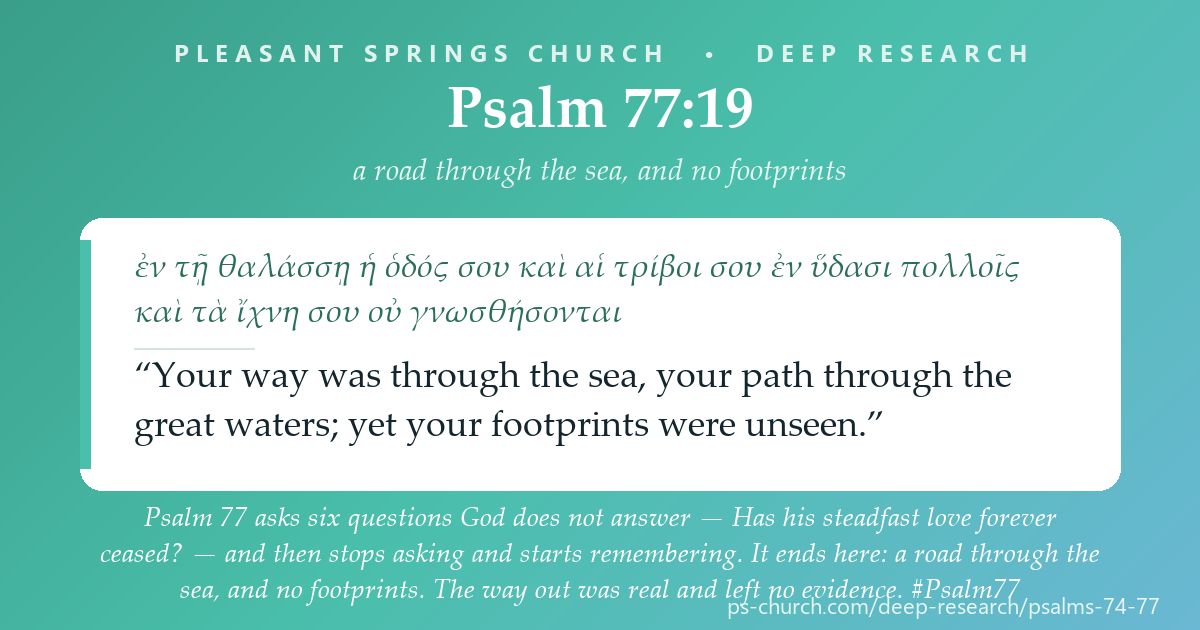
Psalm 77:19 · to share
Hebrew + Greek (Rahlfs) + ESVEvery Deep Research page traces its passage across the whole sweep — the Old Testament, the Second-Temple world between the testaments (historical witnesses, not Scripture), and the New Testament. Follow the thread:
Pleasant Springs Church — Deep Research
Research method after Michael S. Heiser’s Bible Research Method (examine dictionaries → ancient literature → important words → textual connections → academic publications → share), with the Pleasant Springs “Author & Audience” foundation. Scripture set in the Hebrew, the Greek editions named on each page and the ESV (Old Testament), and the Greek New Testament and the ESV (New Testament), per the practice of Pleasant Springs Church. Psalms 74–77 research grounded in Goldingay (Psalms 42–89) and Alter, with Pritchard’s Ancient Near Eastern Texts for the Ugaritic material. Text: Hebrew from the Masoretic text as printed in the editions consulted — Sefaria’s Miqra according to the Masorah; no critical apparatus was consulted for the Hebrew, the paseq is not reproduced in the codex lines, and where the Masoretic text carries a ketiv/qere the codex prints the qere — in these four psalms that is Hebrew 74:6, 74:11, 77:1, 77:12 and 77:20. Greek from Rahlfs’ Greek Psalter (CATSS digitization); Greek New Testament from the SBL edition. The standing caution for this shelf applies: these pages say “Rahlfs’ Greek Psalter reads…” and never call a Greek reading early or late. ⚠️ The divine-name counts, stated so they can be repeated. Hebrew words were split on whitespace, maqqef and paseq, with Masoretic section markers dropped, the parenthesised ketiv dropped, and a token required to carry at least one Hebrew letter. The Tetragrammaton was matched with prefixes allowed (ב ל כ ו מ ה ש) — without that the occurrence at Hebrew 76:12, לַיהֹוָה, is missed and Psalm 76 wrongly reads as having none. Result: one each in Psalms 74, 75 and 76, none in Psalm 77; forms of אֱלֹהִים fourteen in all. אֵל was hand-screened against אַל and אֶל, which share its consonants and would otherwise inflate the count fourfold. ⚠️ The Greek count is by lemma across Rahlfs 73–76, and each κύριος was then read against its facing Hebrew verse individually. ⚠️ The structure claim rests on a null test, not on raw counts. Psalm 74 was cut into 74:1–11, 74:12–17 and 74:18–23; the hymn shares one content word with each flanking block, against a reshuffle baseline of roughly six and four, while the two flanking blocks’ six shared words are within what the same reshuffle predicts by chance. The page therefore prints the hymn’s isolation and declines to print the frame. ⚠️ Comparisons were normalised for length — a raw shared-word count ranks the longest chapters first and is meaningless; Psalm 44 is named as Psalm 74’s closest relative on that normalised basis. ⚠️ Absolute negatives are scoped to what is on disk. Hebrew claims cover Psalms 1–150, the only Hebrew this library holds; Greek claims now cover the complete Greek Old Testament as CATSS holds it — 64 files, 30,637 verse units, with no gaps in it. ⚠️ THAT WAS NOT TRUE WHEN THIS PAGE WAS WRITTEN, AND ONE ENTRY IN STAGE 3 WAS WRONG BECAUSE OF IT. This line used to read “Greek claims cover the twenty-three Greek Old Testament books available here, and Isaiah, Jeremiah, Ezekiel, Zechariah and Exodus are not among them” — and on that corpus the ἄκρατος entry’s once was correct. Isaiah, Jeremiah, Lamentations, Ezekiel and both Greek Daniels landed on 19 August 2026 (35 files → 44) and the entry became wrong without anyone noticing; the remaining twenty — Exodus, Leviticus, Numbers, both Joshuas and the deuterocanonical books, which this shelf treats as witnesses, not Scripture and labels so every time — landed on 30 August 2026 (44 → 64). The count is now four, and Stage 3 prints the old figure beside the new one and says which fetch falsified it. Zechariah, named in the old line as absent, had in fact been on the shelf all along; that part of the disclaimer was itself stale. The ANET pages were read in the local copy by their printed folios, and that copy stops at about page 327; the Ugaritic material quoted here falls well inside it. Nothing on this page claims dependence in either direction between the psalms and the Ugaritic texts. Verse counts verified in all three columns for each psalm. Typology is handled per the house position: what the text says, what the New Testament itself draws, and what we see from this side of the cross — with the seeing left to the reader.
Scripture quotations marked ESV are from the ESV® Bible (The Holy Bible, English Standard Version®), © 2001 by Crossway, a publishing ministry of Good News Publishers. ESV Text Edition: 2016. Used by permission. All rights reserved. The ESV text may not be quoted in any publication made available to the public by a Creative Commons license, and the ESV may not be translated in whole or in part into any other language. www.esv.org
|
Did this study bless you today? 💚 Give to Support PS Church100% of gifts go to the General Fund — thank you. |