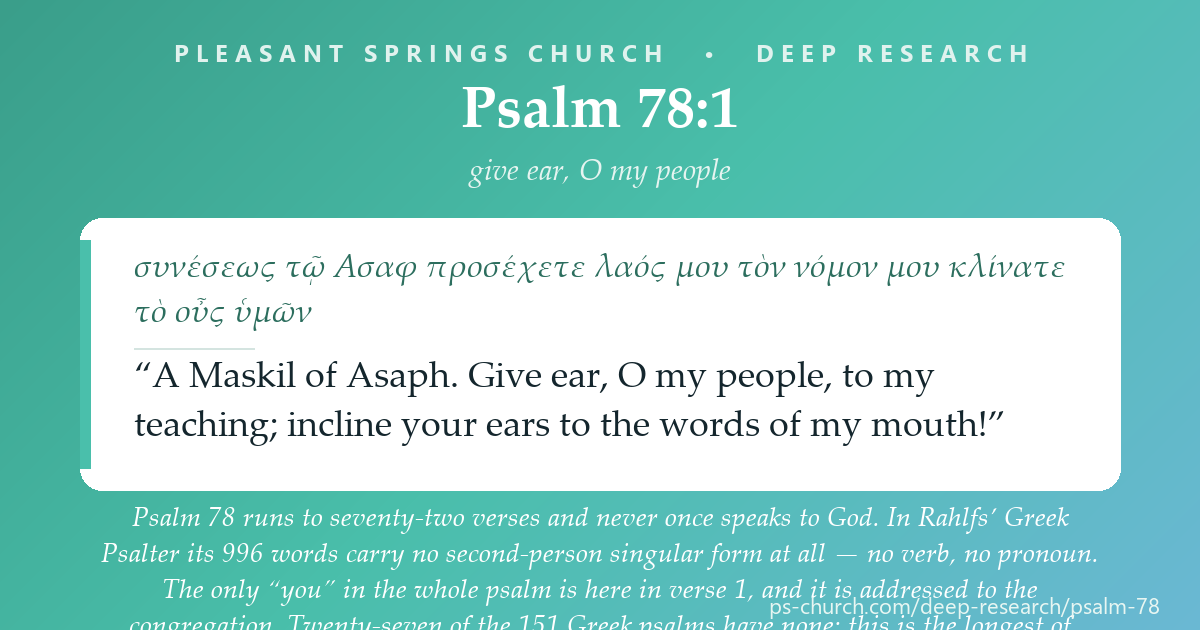
Psalm 78 is the second-longest psalm in the book — seventy-two verses retelling the national story from Egypt to David — and it never once speaks to God. In Rahlfs' Greek Psalter its 996 words contain no second-person singular form of any kind: no verb, no pronoun. The psalm's only second-person forms are three plurals in verse 1, and they are addressed to the congregation. The Hebrew and the ESV agree. Twenty-seven of the 151 Greek psalms have none, and this is the longest of them by twenty-nine verses — while its twin, the only other psalm headed both maskil and of Asaph, carries fifty-five such forms in twenty-three verses. Along the way, where the Hebrew has nine nouns for God's anger the Greek has nine, in the same five verses; where the Hebrew has three verbs of anger the Greek has none; ESV prints the Greek's bread of the angels without a footnote and supplies a word for heavens that no text has; and the familiar claim that the psalm tells its story twice does not survive a null test. See the method →
Psalm 78:1–72 (selections)
Hebrew · Greek (Rahlfs’ Psalter) · ESVThe measurement is cleanest in Greek, because Greek marks person on the verb as well as the pronoun. Rahlfs 77 runs to 996 words, and not one of them is a second-person singular form of any kind — no verb, no pronoun, nothing. The psalm carries exactly three second-person forms in total, and all three stand in verse 1: προσέχετε, κλίνατε, ὑμῶν — all plural, and all spoken to the congregation.
The Hebrew agrees, and so does the English. The psalm never uses אַתָּה; every word in it ending in a final kaf is a root consonant rather than a your; and in all 72 verses of the ESV the only you or your is incline your ears in verse 1.
⚠️ Measured against the whole book, this is not a small thing. Twenty-seven of the 151 psalms in Rahlfs’ Psalter contain no second-person singular form. Psalm 77 is the longest of them by twenty-nine verses — 72 against 43 for the next (Rahlfs 106, our Psalm 107). The book’s second-longest psalm is also the longest psalm in it that never addresses God.
⚠️ And its twin does the opposite. Two psalms in the whole Psalter carry both מַשְׂכִּיל and לְאָסָף in the heading: Psalm 74 and Psalm 78. Rahlfs 73, which is Psalm 74, carries fifty-five second-person singular forms in twenty-three verses — second-densest per word of any psalm of ten verses or more in the book. Same heading, same collection, four psalms apart, and at opposite ends of the measurement. See Psalms 74–77. This page reports the distribution. It does not infer an author, a date, a setting or a purpose from it, and it does not treat either psalm as a correction of the other.This page reports the count. Why the psalm never turns to address God — genre, setting, design, or none of these — is not decidable from the count, and no explanation is offered here.
The Shape of the Passage
Sequence — a lesson, two movements, and a choiceIt does not hold. The two blocks share 21 content-word types. Against 20,000 reshuffles of the psalm’s own verses into blocks of the same two sizes, the expected number is 23.4, with a spread of about 3. The observed overlap is below chance, not above it — and sweeping every possible dividing line from verse 20 to verse 57 shows the traditional cut at 39/40 sitting on a flat plateau rather than on a peak. So the two movements cover similar ground with markedly different vocabulary, and the page calls the shape a sequence rather than a repetition.
What is grounded is the frame around them. Ephraim is named at 78:9 and at 78:67 and nowhere else in the psalm; Joseph, Judah, Zion and David are named once each and all four fall inside 78:67–70; and Zoan, which stands in only two verses of the whole Psalter, stands once in each movement, at 78:12 and 78:43.What this page does and does not say about the last six verses. The psalm ends by rejecting Ephraim and the tent of Joseph and naming Judah, Zion and David. This page reports where those names stand and how often — Ephraim at 78:9 and 78:67 and nowhere else, and Joseph, Judah, Zion and David once each inside 78:67–70. It does not date the psalm, does not assign it to a party or a programme, and does not read the rejection as a verdict on the people of the northern tribes. The same canon prints Jeremiah 31:20, Hosea 11:8, and Ezekiel 37:19, where the stick of Joseph and the stick of Judah are made one. This page reports how the words line up. It does not lend the rejection to anyone.
Psalm 78 stands sixth in the eleven consecutive Asaph psalms of Book III — Psalms 73–83, with Psalm 50 standing on its own earlier, twelve in all. Its heading is מַשְׂכִּיל לְאָסָף, and Rahlfs 77:1 answers it with συνέσεως τῷ Ασαφ — two elements against two, with no Greek word the Hebrew has no counterpart for — which is worth saying, because three of its neighbours in the same collection do carry Greek headings with no Hebrew counterpart.
Author
A singer of the Asaph guild, by the heading. A Maskil of Asaph. Only two psalms in the book carry both of those words — this one and Psalm 74.
Someone teaching, not praying. Give ear, O my people, to my teaching. The psalm opens the way a wisdom teacher opens — with an imperative to an audience, a promise of a parable, and a claim to be handing on what he received: things that we have heard and known, that our fathers have told us.
And a prophet, by Matthew’s word and by Chronicles’ — though this page does not join the two. Matthew 13:35 introduces this psalm’s second verse with what was spoken by the prophet, naming no name. Chronicles calls Asaph a prophet in Hebrew and in Greek at 1 Chronicles 25:2 — 1 Chronicles 25:2 has אָסָף הַנִּבָּא, Asaph who prophesies, and the Greek there reads Ασαφ τοῦ προφήτου.
Audience
A generation addressed on behalf of the next one. that the next generation might know them, the children yet unborn, and arise and tell them to their children. The psalm names its purpose in its first eight verses and then spends sixty-four telling the story it wants passed on.
People who could repeat their fathers’ record. that they should not be like their fathers, a stubborn and rebellious generation. The warning is not that the story will be forgotten but that it will be re-enacted.
And people for whom the last six verses are not neutral. He rejected the tent of Joseph; he did not choose the tribe of Ephraim, but he chose the tribe of Judah, Mount Zion, which he loves. A psalm that has spoken of Israel throughout ends by distinguishing between two parts of it.
Orient on the historical psalms, on Asaph, and on Ephraim and Shiloh.
Search by topic: historical psalms; Asaph; Book III of the Psalter; Shiloh; Ephraim; the plagues of Egypt in later retelling.
Which articles are relevant?
- Anchor Bible Dictionary — “Asaph,” “Psalms, Book of,” “Shiloh,” “Ephraim.”
- Dictionary of the OT: Wisdom, Poetry & Writings (IVP) — “Historical Psalms,” “Asaph,” “Wisdom and Psalms,” “Psalms: Book of.”
- NIDOTTE / TDOT — מָשָׁל (māšāl, parable or proverb), חִידָה (ḥîdāh, riddle), אַבִּיר (ʾabbîr, mighty one), and the hithpael of עבר (to be enraged).
- On the Greek — the NETS Psalms introduction, with Rahlfs 77 read beside the Hebrew at 78:13, 78:25, 78:35 and 78:69.
- On Book III — Gerald H. Wilson, The Editing of the Hebrew Psalter, for the Asaph collection and the book seams.
Bibliography surfaced:
- John Goldingay, Psalms 42–89; Robert Alter, The Book of Psalms.
- Frank-Lothar Hossfeld and Erich Zenger, Psalms 2 (Hermeneia) — covers Psalms 51–100, so this psalm falls inside the volume.
- Gerald H. Wilson, The Editing of the Hebrew Psalter.
- James B. Pritchard, ed., Ancient Near Eastern Texts — see the scope note at the foot of this page.
The psalm’s nearest relatives, measured rather than assumed.
Read Psalm 105 and Psalm 106 beside this one, and read Deuteronomy 32 after the measurement below rather than before it.
Which parallels shed light on this psalm?
Psalm 105 and Psalm 106 are the two nearest chapters to Psalm 78 in the entire Hebrew Bible, and that was measured rather than assumed. This library compared Psalm 78 against all 929 chapters of the Hebrew Bible on weighted shared vocabulary, with rarer words counting for more. Psalm 105 ranks first and Psalm 106 second, ahead of Lamentations 2, Jeremiah 50 and everything else.
Three controls were run, because a raw similarity score usually just finds long chapters. Restricting the field to chapters of comparable length leaves Psalms 105 and 106 first and second. Running the same measure from Psalm 105 returns 1 Chronicles 16 as its nearest chapter — the chapter that carries fifteen of Psalm 105’s verses, four of them word for word in Hebrew — so the method recovers a known relationship it was not told about. Which of those two texts stood first is not decidable from a count of shared words, and this page does not decide it; the overlap is measured on Psalm 105. And it is not simply finding psalms: Psalm 89 ranks 51st and Psalm 119 ranks 518th.
⚠️ Psalms 78 and 105 tell overlapping stories with different sets of plagues. Psalm 78:44–51 names blood, flies, frogs, locusts, hail and pestilence, and the firstborn. Psalm 105:28–36 names darkness, blood, frogs, flies and gnats, hail and fire, locusts, and the firstborn. Psalm 78 runs to seven items and Psalm 105 to eight, and neither list is the other’s — Psalm 78 has pestilence and no darkness and no gnats; Psalm 105 has darkness and gnats and no pestilence; and neither follows the order of Exodus. Boils is named in neither. Psalm 78 also names hail twice, at 78:47 and 78:48, which is worth knowing before anyone counts occurrences instead of plagues.
⚠️ And one thing Psalm 78 does not have that both of the others do: a human being. Moses, Aaron, Sinai and Horeb are absent from all 72 verses. Psalm 105 names Moses and Aaron together at 105:26, immediately before its plague list; Psalm 106 names Moses three times and Aaron once. Psalm 78 tells the exodus with no human mediator on stage — its own hinge, 78:43, has God alone as the subject: when he performed his signs in Egypt.
- Psalm 105 and Psalm 106 → Psalm 78. First and second of 929 chapters on weighted shared vocabulary, with three controls.
- 1 Chronicles 16 → Psalm 105. The control that validated the measure — it returns the chapter that quotes Psalm 105.
- Deuteronomy 32:1 → Psalm 78:1. A shared opening verb and a shared two-word phrase — and see the panel below before making more of it.
- Jeremiah 7:12–14; 26:6 → Psalm 78:60. Shiloh forsaken. The place-name is shared and the governing verbs are not — the psalm has נטש and Jeremiah has different verbs entirely, so this is a shared motif and not a quotation in either direction. ★ This line used to end “the Greek of Jeremiah is not held by this library and nothing is claimed about it.” It is held now, and the claim has been run. Greek Jeremiah arrived 19 August 2026. LXX Psalm 77:60 against every Shiloh verse in Greek Jeremiah — 7:12, 7:13, 7:14, and LXX 33:6 and 33:9 (MT 26:6, 26:9) — measures a run of 1 in every case, and the one shared word is καί. The psalm has ἀπώσατο τὴν σκηνὴν Σηλωμ; Jeremiah has ὥσπερ Σηλωμ and ἐν Σηλωμ οὗ κατεσκήνωσα. The Greek says exactly what the Hebrew said: the place-name is shared and nothing else contiguous is. Psalm 77:60’s own deepest partner anywhere in the 30,637 verse units is Jeremiah 7:29 at 3, tie band one — καὶ ἀπώσατο τήν — and 7:29 is not a Shiloh verse at all.
- Joshua (B) 18:1; 18:10; 21:2; 22:9, 12; 24:1, 25 → Psalm 78:60. ★ Newly measurable 30 August 2026: Greek Joshua came onto the shelf that day. Joshua B 18:1 is where the tent is pitched at Shiloh — εἰς Σηλω καὶ ἔπηξαν ἐκεῖ τὴν σκηνὴν τοῦ μαρτυρίου — and the psalm is where it is forsaken. The two share a run of 2: τὴν σκηνήν. The other six Joshua Shiloh verses reach 1. So even the verse that is the psalm’s exact narrative counterpart shares two words with it, which is what a shared subject looks like and not what a quotation looks like.
- 1 Chronicles 25:2; 2 Chronicles 29:30; 35:15 → Matthew 13:35. Asaph called a prophet in Greek at all three. In Hebrew only at 1 Chronicles 25:2, הַנִבָּא; 2 Chronicles 29:30 has הַחֹזֶה, seer; and at 35:15 the singular חוֹזֵה הַמֶּלֶךְ stands after four names, and this page does not settle whom it governs.
Psalm 78:1 and Deuteronomy 32:1 do open alike, and the resemblance is real. Both begin with the verb האזינ, give ear, and both carry the two-word phrase אִמְרֵי־פִי, the words of my mouth. Psalm 78:3–4 and Deuteronomy 32:7 both appeal to what the fathers told.
But the phrase is not distinctive to Deuteronomy. It stands in nine places in the Hebrew Bible, prefixes allowed — Deuteronomy 32:1, Hosea 6:5, Psalm 19:14, Psalm 54:2, Psalm 78:1, and Proverbs 4:5, 5:7, 7:24 and 8:8 · Hebrew 19:15 and 54:4 for the two psalms. Unprefixed it stands in three: Deuteronomy 32:1, Psalm 19:14 and Proverbs 8:8. And Psalm 54:2 carries both of the two elements Psalm 78:1 shares with Deuteronomy 32:1 — the verb and the phrase, הַאֲזִינָה לְאִמְרֵי־פִי, and carries them side by side, where Psalm 78:1 has one at the head of the line and the other at the end of the verse. So the pairing is shared psalm to psalm as readily as psalm to Deuteronomy.
⚠️ And beyond those two verses the vocabulary does not follow. On the same whole-Bible measure that put Psalms 105 and 106 first and second, Deuteronomy 32 ranks 13th; run the other way, Psalm 78 ranks 43rd from Deuteronomy 32, whose nearest neighbours are all other chapters of Deuteronomy and Joshua.
The honest statement is the narrow one: two verses resemble each other, and nothing wider does. Which text stood first, and whether either knew the other, is not decidable from what is on this page, and no claim about it is made here.
A verb, a heap, a mighty one, and a word nobody can read.
Every count below was made on the texts named at the foot of this page, and every one can be repeated.
Counted here, not assumed:
- Verse counts. Hebrew 72, Rahlfs 72, English 72 — the heading sits inside verse 1, so there is no offset in this psalm. In Greek numbering this is Psalm 77.
- Psalm 78 carries no Greek title-plus. Hebrew מַשְׂכִּיל לְאָסָף; Rahlfs συνέσεως τῷ Ασαφ. Two elements, two elements, and no Greek word without a Hebrew counterpart — against three of its neighbours in the same collection, where the Greek heading carries words the Hebrew has no counterpart for (Rahlfs 75:1, 79:1 and 80:1 — our Psalms 76, 80 and 81).
- No second-person singular form anywhere in Rahlfs 77. 996 Greek words, scanned by morphology rather than by pronoun, so verbs are included. The psalm’s only second-person forms are three plurals in verse 1.
- Twenty-seven of the 151 psalms in Rahlfs’ Psalter have none. Psalm 77 is the longest by twenty-nine verses; the next is Rahlfs 106 at 43.
- Second-longest psalm on four separate counts. By verses 176 / 72 / 53 / 51; by words 1,064 / 530 / 397 / 384; by words again with maqqef read as a joiner 945 / 473; and by consonants 4,459 / 2,250 · reading the qere, as the word counts do; counting both members gives 4,477. Only Psalm 119 is longer, on every one. Third place is a tie on one of the four, so this page does not order it.
- Psalm 78:36 is the middle verse of the Masoretic Psalter. 2,527 verses; 1,228 stand before Psalm 78; 1,228 + 36 = 1,264, with 1,263 on each side.
- Two occurrences of the divine name in 72 verses — 78:4 and 78:21, scanned with prefixes allowed. Against them: אלהים eight times, אֵל seven, עליון three, אדני once. The expected profile inside the Elohistic Psalter, Psalms 42–83.
- No Selah at all. Selah stands 71 times in 39 of the 150 psalms. Only Psalm 119 is a longer psalm without one.
- The hithpael of עבר: four times in the Psalter, three of them here. Eight times in the whole Hebrew Bible.
- ἐκπειράζω once in the Greek Psalter (77:18); ἀσκός three times; μονόκερως four times; παραπικρ- thirteen.
- Longest repeated word-sequence inside Psalm 78: two words. The psalm’s strongest internal echo is 78:21 and 78:59: three shared word types in the same order, inside a three-slot opening frame whose middle slot is the divine name. The longest unbroken run between the two verses is one word.
“To be enraged, to overflow with fury.” The psalm’s one verb that makes God the subject of anger, and it stands three times. Four occurrences in all 150 psalms — these three and Psalm 89:38 · Hebrew 89:39. Rahlfs answers with ἀνεβάλετο once and ὑπερεῖδεν twice — he deferred, he overlooked. ESV reads he was full of wrath at 78:21 and 78:59 and vented his wrath at 78:62 — the Hebrew verb at all three.
“Mighty ones.” Rahlfs reads ἀγγέλων, angels — and the same Greek Psalter renders the same Hebrew word ταῦροι, bulls, at three other places, including a food context at Psalm 50:13. Of the five plural occurrences in the Psalter, three are bulls, one is the senseless at Psalm 76:5 · Hebrew 76:6, and one is angels.
“A heap” — of water standing up. Rahlfs reads ἀσκόν, a wineskin. Not a slip: ἀσκός stands three times in the Greek Psalter, and at the third, Rahlfs 118:83, the Hebrew genuinely is נֹאד, a skin bottle. The two Hebrew words differ by one letter.
“Heights.” The same consonants, pointed differently, mean wild oxen — which is how they are read at Psalm 22:21 · Hebrew 22:22, and how Rahlfs 77:69 reads them here (μονοκερώτων). ESV supplies heavens, which is in neither text, and does not footnote it; KJV supplies palaces and prints the word in italics to mark that it is supplied.
“Unknown.” These consonants stand at one place in the whole Hebrew Bible — this verse, checked across all thirty-nine books. Rahlfs reads πάχνη, frost; ESV reads frost. Every English rendering of the word is a reconstruction.
“To embitter, to provoke.” The Greek Psalter’s word for the wilderness rebellion — the word group thirteen times in the book — twelve of the verb and one of the noun — and four of the verb here, the highest concentration in any single psalm. Beneath all four the Hebrew has one root, מרה, in four different forms. Hebrews 3 uses the word group — but the verse Hebrews quotes is Rahlfs 94:8, our Psalm 95, and there it is the noun.
What the New Testament does with the second-longest psalm in the book.
Every measurement below was made against the SBL Greek New Testament, token by token, with accents normalised and punctuation excluded — and under one rule applied to both sides, final sigma folded and the movable nu, elision and the spellings of the negative (ou / ouk / ouch) resolved. Applying a normalisation to one side of a comparison and not to the other invents a difference that is not in the texts, and this shelf has made that mistake.
Which cross-references matter?
Matthew 13:35 shares six words with Rahlfs 77:2, and the six are unique on both sides. ἀνοίξω ἐν παραβολαῖς τὸ στόμα μου occurs once in the whole SBL Greek New Testament and once in the whole Greek Psalter. The second half of the verse is a different matter — Matthew has ἐρεύξομαι κεκρυμμένα ἀπὸ καταβολῆς and Rahlfs has φθέγξομαι προβλήματα ἀπ’ ἀρχῆς, and the two share no content word at all. Nor does Matthew simply follow the Hebrew there: his verb is the one the Greek Psalter uses elsewhere for the Hebrew verb of 78:2, but his κεκρυμμένα stands against the Hebrew’s riddles, which is what Rahlfs’ προβλήματα renders. Half the verse agrees with the Greek exactly; the other half agrees with neither text. The SBL edition prints ἀπὸ καταβολῆς with no κόσμου, and introduces the quotation with διὰ τοῦ προφήτου, naming no prophet. Editions differ on both points; this page quotes the SBL text and says so.
⚠️ John 6:31 is not a quotation of this psalm, and the page will not call it one. John reads ἄρτον ἐκ τοῦ οὐρανοῦ ἔδωκεν αὐτοῖς φαγεῖν; Rahlfs 77:24 reads καὶ ἔβρεξεν αὐτοῖς μαννα φαγεῖν καὶ ἄρτον οὐρανοῦ ἔδωκεν αὐτοῖς. The longest unbroken run they share is three words. What can be shown is narrower and more interesting. The Hebrew of 78:24 says grain of heaven, דָּגָן, not bread. That noun stands three times in the Psalter, and the Greek Psalter renders it σῖτος at Psalm 4:7 · Hebrew 4:8 and τροφή at Psalm 65:9 · Hebrew 65:10 — 77:24 is the one place where ἄρτος stands opposite it. And ἄρτος is the word the whole discourse of John 6:32–35 turns on.
★ And the question this page had to leave open has been answered. The note here used to read: “Scoped to the Greek Psalter. The Greek of Exodus is not held by this library, so nothing is claimed about whether John stands nearer this verse than the manna narrative of Exodus 16.” Greek Exodus arrived on this shelf on 30 August 2026. Here is the measurement the page could not make.
| John 6:31’s citation formula against… | longest shared run | the shared words |
|---|---|---|
| LXX Psalm 77:24 · MT 78:24 | 3 | οὐρανοῦ ἔδωκεν αὐτοῖς |
| LXX Exodus 16:4 | 3 | ἐκ τοῦ οὐρανοῦ |
| LXX Exodus 16:8, 12, 13, 14, 15, 31, 35 | 0–1 | nothing but a stray article |
Neither is nearer. They are level at three — and they are level on different words. John writes ἄρτον ἐκ τοῦ οὐρανοῦ ἔδωκεν αὐτοῖς φαγεῖν. The Psalter row supplies οὐρανοῦ ἔδωκεν αὐτοῖς and has no ἐκ τοῦ: it reads ἄρτον οὐρανοῦ, bread of heaven. Exodus 16:4 supplies ἐκ τοῦ οὐρανοῦ and has no ἔδωκεν αὐτοῖς: God does not give there, he ὕω, rains. John’s six words take three from each, and the two threes do not overlap. Whether that is because he is conflating two texts, quoting a third form of the line held by neither of these files, or writing from memory, a run-length screen cannot say and this page does not guess.
And the honest ceiling on all of it. Screened against the whole 30,637-unit Greek Old Testament, John 6:31’s deepest contact is a run of 3 in a tie band of 212 — and the three words are οἱ πατέρες ἡμῶν, our fathers, which is common stock. Neither Psalm 77:24 nor Exodus 16:4 is even a distinctive three. The page prints that beside the table rather than under it.
- Matthew 13:35 → Psalm 78:2 · Rahlfs 77:2. Six words, unique on both sides; the second colon shares nothing.
- John 6:31 → Psalm 78:24 · Rahlfs 77:24. A three-word run — and the noun that discourse turns on.
- 1 Corinthians 10:9 → Psalm 78:18 · Rahlfs 77:18. An allusion sharing a distinctive verb, and no more: ἐκπειράζω stands once in the Greek Psalter but four times in Greek Deuteronomy — re-run 30 August 2026 against all 64 CATSS files, 30,637 verse units, and unchanged: still five occurrences in the whole Greek Old Testament, four in Deuteronomy (6:16 twice, 8:2, 8:16) and one in the Psalter (77:18), and none anywhere in the twenty books newly on the shelf — and Deuteronomy 6:16 is the closer match in construction.
- Hebrews 3:7–11, 3:15 → Psalm 95 · Rahlfs 94:7–11, not Psalm 78. The block Hebrews quotes matches Rahlfs 94 almost token for token. Psalm 78 shares the word group and a three-word run, ἐν τῇ ἐρήμῳ, and no more — 28 unbroken tokens stand between Hebrews 3:7–11 and Rahlfs 94, three between it and Rahlfs 77.
- Acts 8:21 → Psalm 78:37 · Rahlfs 77:37. Six words in common by type and only two of them content words — καρδία and εὐθεῖα — and none of them consecutive: the longest unbroken run is one. And it is not the closest New Testament contact with that verse: Matthew 15:8 and Mark 7:6, quoting Isaiah, reproduce its first four words unbroken.
Psalm 78 is a psalm about God being angry, and the Greek treats the nouns and the verb completely differently.
The nouns: nine for nine. The Hebrew has nine anger-nouns, in five verses — 78:21, 78:31, 78:38 twice, 78:49 four times, and 78:50. Rahlfs 77 has exactly nine ὀργή and θυμός tokens, in exactly those five verses, in matching numbers. Not one Hebrew anger-noun lacks a Greek counterpart in the same verse, and not one Greek anger-noun lacks a Hebrew one.
The verb: none for three. The psalm has one verb that makes God the subject of anger — the hithpael of עבר — and it stands three times:
78:21 — שָׁמַע יְהֹוָה וַיִּתְעַבָּר → ἤκουσεν κύριος καὶ ἀνεβάλετο, he deferred.
78:59 — שָׁמַע אֱלֹהִים וַיִּתְעַבָּר → ἤκουσεν ὁ θεὸς καὶ ὑπερεῖδεν, he overlooked.
78:62 — וּבְנַחֲלָתוֹ הִתְעַבָּר → τὴν κληρονομίαν αὐτοῦ ὑπερεῖδεν.
Neither Greek verb belongs to the anger vocabulary of the Greek Psalter. Elsewhere in the Greek Psalter they stand over Hebrew words for wrapping and for hiding, never over a word for anger.
⚠️ Three things had to be checked before this could be stated, and all three hold.
It is not a Greek Psalter without anger verbs for God. Across all 150 psalms ten finite Hebrew verbs make God the subject of anger. Opposite six of them stands a Greek verb of anger — Psalm 2:12, 18:7, 60:1, 79:5, 85:5 and 106:40 · Hebrew 18:8, 60:3, 85:6 for three of those. Opposite the other four stands a verb that is not an anger word — Psalm 78:21, Psalm 78:59, Psalm 78:62 and Psalm 89:38 · Hebrew 89:39 — and all four of those are this same Hebrew verb.
It is not a psalm short of Greek anger verbs. Rahlfs 77 has three from the ὀργή group — at 77:40, 77:41 and 77:58 — counted apart from the four occurrences of παραπικραίνω listed under Important Words. In every one of them Israel is the subject and God is the object.
And 78:21 holds both halves in one line. Aligned word by word, the Hebrew verb answers ἀνεβάλετο and the Hebrew noun four words later answers ὀργή — the same verse with a non-anger verb opposite the one and an anger-noun opposite the other.
ESV reads he was full of wrath at 78:21 and 78:59 and vented his wrath at 78:62 — with the Hebrew verb at all three. Stated as a measurement, and scoped. The Hebrew particle meaning also and the noun meaning anger share their consonants, so the nine-token count was screened by pointing and confirmed against the Greek’s own reading rather than taken off a consonantal search. Outside the Psalter this verb stands four times in the Hebrew Bible — Deuteronomy 3:26 and Proverbs 14:16, 20:2 and 26:17 — and both books are held here in Greek. Greek Deuteronomy 3:26 has ὑπερεῖδεν, as at 77:59 and 77:62; Greek Proverbs 14:16 has nothing corresponding; Greek Proverbs 20:2 has παροξύνων; and Greek Proverbs 26:17 is not present at that verse address in the digitization held here. Nothing here is offered as an explanation of why the Greek reads as it does.
Length and citation turn out to have almost nothing to do with each other. Rahlfs 77 is the second-longest psalm in the Greek Psalter at 996 words, behind only Rahlfs 118, our Psalm 119. Ranked against all 151 psalms by the longest unbroken run of words each shares with the SBL Greek New Testament, it comes joint 28th of 151, in a seven-way tie at six words — Rahlfs 17, 23, 55, 71, 77, 82 and 139 — and only 27 psalms share a longer unbroken run. ⚠️ The tie band on this line has been corrected, and the history is printed rather than the number quietly swapped. This page first published a six-way tie alongside the rank of 28th. Re-measured, the band at six words holds seven psalms — and the two published figures did not come from the same state of the tooling, because under the older measure the band held eight psalms and the rank was 26th. So the rank now reproduces and the band never did: it was wrong by two before and by one now, and it is the counting of the band, not of the rank, that was at fault. What moved underneath it is a defect in the shelf’s own tooling, now fixed: MorphGNT folds οὐ / οὐκ / οὐχ, ἐκ / ἐξ and the movable nu into one spelling and the CATSS Greek Old Testament does not, so a shared run used to stop dead at any such word whenever the two corpora were compared. That fold could only break a run, never invent one, so every figure it touched was too low. Undoing it lifts Rahlfs 35 from six words to seven and Rahlfs 52 from four to seven, which moves both of them out of this band and above it — and the rank of 28th, with 27 psalms deeper, is what the corrected measure returns. Rahlfs 77’s own deepest run is unchanged at six words, and so is everything this insight argues.
Its single best contact is the six words of Matthew 13:35. Psalm 69, a little over half its length, stands word for word behind a whole verse of fourteen words at Romans 11:10 — see Psalm 69. Seventy-two verses of the national story, and its longest verbatim contact with the Greek New Testament is six words.
Five things this page reports as unsettled.
Goldingay and Alter for the Hebrew; Wilson for Book III; the ESV footnotes for where the versions themselves hesitate.
Commentaries & studies:
- John Goldingay, Psalms 42–89; Robert Alter, The Book of Psalms.
- Frank-Lothar Hossfeld and Erich Zenger, Psalms 2 (Hermeneia).
- Gerald H. Wilson, The Editing of the Hebrew Psalter.
- NETS Psalms, with Rahlfs.
Five things reported as unsettled:
- What חֲנָמַל is at 78:47. One occurrence in the Hebrew Bible and no comparanda. Frost is a reconstruction; Rahlfs reads πάχνη, frost, and every English version this page checked reads with it. Where that sense came from is not settled by anything this library holds.
- What הִתְווּ means at 78:41. The form stands at one place in the whole Hebrew Bible. Its root’s only other appearances — 1 Samuel 21:13 · Hebrew 21:14 and Ezekiel 9:4 — mean to make a mark, which does not help here. KJV reads limited the Holy One of Israel; ESV reads provoked, with Rahlfs’ παρώξυναν, and footnotes nothing.
- What רָמִים is at 78:69. Heights or wild oxen, on the same consonants. This page adopts neither, and notes that ESV supplies a third thing — heavens — that is in no text.
- Which defeat 78:9 refers to. No battle is named, and the psalm’s own explanation at 78:67–68 is theological rather than annalistic. ESV footnotes the Hebrew of the verse itself — Hebrew armed and shooting — and Rahlfs 77:9 reads two participles, matching the footnote rather than the text above it.
- Whether Matthew 13:35 ended with κόσμου. The SBL edition does not print it; other editions do. This library holds one Greek New Testament and cannot weigh them.
A psalm that never turns round.
Name what you learned, why it matters, and one concrete response.
What should we carry away — and do?
- Seventy-two verses about God, and not one word said to him. The only person addressed in the whole psalm is the congregation, in verse 1. This is not a prayer. It is a lesson, and the Psalter keeps it.
- Its stated purpose is a generation that does not exist yet. that the next generation might know them, the children yet unborn. The word generation occurs four times, all in the first eight verses, and never again — the rest is the story itself, which is the answer to the purpose.
- The story it hands on is mostly a record of failure. In spite of all this, they still sinned; despite his wonders, they did not believe. The psalm keeps the parts a national history would leave out, and it names no human hero at all — no Moses, no Aaron.
- One concrete response. things that we have heard and known, that our fathers have told us. We will not hide them from their children. Tell one of them this week to someone younger than you — including a part that does not flatter anybody.
Psalm 78:1 · to share
Hebrew + Greek (Rahlfs) + ESVEvery Deep Research page traces its passage across the whole sweep — the Old Testament, the Second-Temple world between the testaments (historical witnesses, not Scripture), and the New Testament. Follow the thread:
Pleasant Springs Church — Deep Research
Research method after Michael S. Heiser’s Bible Research Method (examine dictionaries → ancient literature → important words → textual connections → academic publications → share), with the Pleasant Springs “Author & Audience” foundation. Scripture set in the Hebrew, the Greek editions named on each page and the ESV (Old Testament), and the Greek New Testament and the ESV (New Testament), per the practice of Pleasant Springs Church. Psalm 78 research grounded in Goldingay (Psalms 42–89) and Alter, with Wilson (The Editing of the Hebrew Psalter) for Book III and the Asaph collection. Text: Hebrew from the Masoretic text as printed in the editions consulted — Sefaria’s Miqra according to the Masorah; no critical apparatus was consulted for the Hebrew, and the paseq is not reproduced in the codex lines — Psalm 78 carries eleven of them. The psalm has no ketiv/qere anywhere in its 72 verses. Greek from Rahlfs’ Greek Psalter, Deuteronomy, Proverbs and 1–2 Chronicles (CATSS digitizations); Greek New Testament from the SBL edition. The standing caution for this shelf applies: these pages say “Rahlfs’ Greek Psalter reads…” and never call a Greek reading early or late. ⚠️ The second-person measurement, stated so it can be repeated. Every word of Rahlfs 77 was read from the CATSS morphology and tested for a second-person singular parse or a form of σύ — verbs included, which is why the count is made on the Greek. The same test was run over all 151 psalms. On the Hebrew side the psalm has no אַתָּה and no second-masculine-singular suffix; every word ending in a final kaf is a root consonant. The ESV check is simply every occurrence of you and your in the chapter. ⚠️ Hebrew word counts on this page split on whitespace, maqqef and paseq, exclude Masoretic section markers, count a ketiv/qere pair once, and require a token to carry at least one Hebrew letter (Psalm 78 = 530 words; the Psalter = 19,586) — the same rule used on every Psalms page in this library. Reading maqqef as a joiner instead gives 473 and 17,118, and under that convention Psalms 18 and 89 tie for third, which is why no third place is named. Selah is counted on the same maqqef-splitting rule, giving 71 occurrences in 39 psalms. ⚠️ The two structural claims tested with a null. The double-recital reading was tested by counting content-word types shared between 78:12–39 and 78:40–64 and comparing that against 20,000 reshuffles of the psalm’s own verses into blocks of the same sizes; the observed overlap fell below the expected value, so the structure block does not draw it. The chapter-similarity ranking behind Psalms 105 and 106 is a weighted shared-vocabulary measure over all 929 chapters of the Hebrew Bible, controlled for length and validated by recovering 1 Chronicles 16 as the nearest chapter to Psalm 105. Both measures are stated here so they can be repeated. The chapter measure reduces every word to its consonantal skeleton, splits on whitespace, maqqef and paseq, discards forms shorter than three consonants and a stop-list of about forty common words and divine names, keeps only chapters of 120 tokens or more, and scores a pair by the summed inverse-document-frequency of the forms they share divided by the geometric mean of each chapter’s own IDF mass. The double-recital null uses the same skeletons with up to two prefix letters stripped, the same stop-list and the same three-consonant floor, counts TYPES rather than tokens, and compares the observed overlap against 20,000 reshuffles of the psalm’s own verses into two blocks of 28 and 25 verses. ⚠️ Claims this page declines to make. A rare-word concentration in the plague catalogue was measured and then withdrawn: the window that produced it was chosen after seeing the data, and once every window is tested the result is ordinary. Nothing links the psalm’s 72 verses to seventy-two of anything. And “Psalm 78:38 has thirteen words, for the thirteen attributes of mercy” is left off: the thirteen attributes are a real tradition rooted in Exodus 34:6–7, but the link to this verse is a medieval liturgical observation rather than a Talmudic one. ⚠️ Absolute negatives on this page are scoped to what is on disk. Hebrew claims about single occurrences were checked across all thirty-nine books through Sefaria; Greek claims are scoped to the twenty-two Greek Old Testament books available here — in twenty-five CATSS files, Genesis, Psalms and Judges each standing in two — and Exodus, Isaiah, Jeremiah and Zechariah are not among them. ⚠️ What was not consulted. No Qumran Psalms scroll, no Cairo Geniza fragment, no Syriac, no Vulgate or Gallican Psalter, no Aquila, Symmachus or Theodotion, and no critical apparatus for either text. Every “unsettled” verdict on this page is only as strong as that list. Verse counts verified in all three columns (72 throughout). Typology is handled per the house position: what the text says, what the New Testament itself draws, and what we see from this side of the cross — with the seeing left to the reader.
Scripture quotations marked ESV are from the ESV® Bible (The Holy Bible, English Standard Version®), © 2001 by Crossway, a publishing ministry of Good News Publishers. ESV Text Edition: 2016. Used by permission. All rights reserved. The ESV text may not be quoted in any publication made available to the public by a Creative Commons license, and the ESV may not be translated in whole or in part into any other language. www.esv.org
|
Did this study bless you today? 💚 Give to Support PS Church100% of gifts go to the General Fund — thank you. |