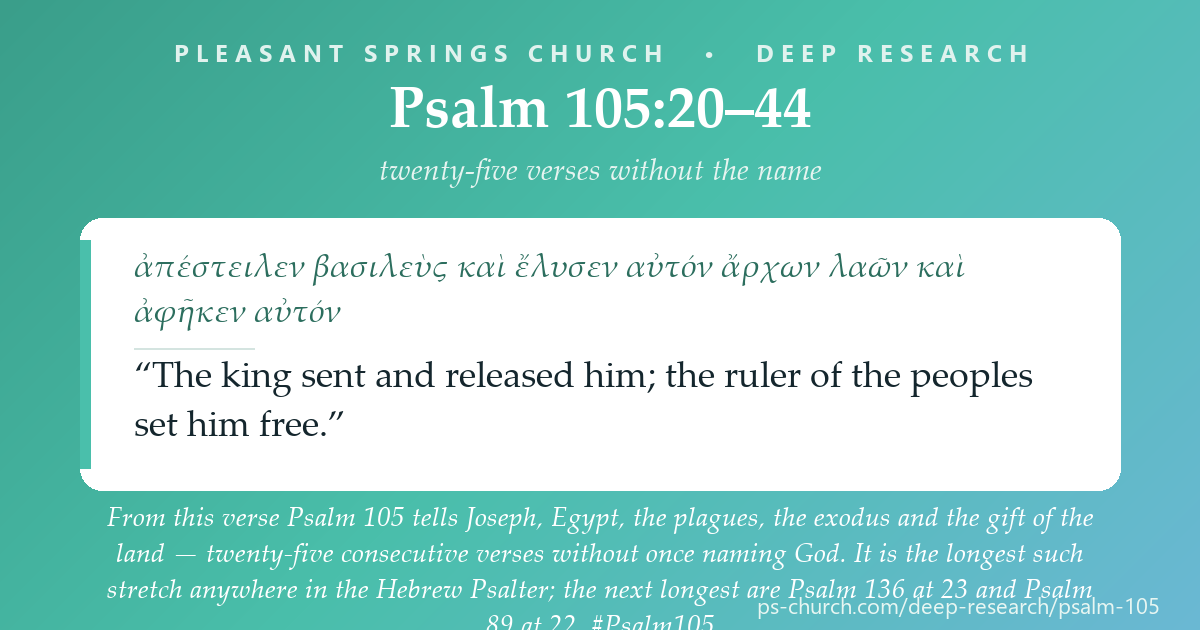
Psalm 105 tells the story of Joseph, Egypt, the plagues, the exodus and the gift of the land — and across those twenty-five verses it never once names God. Psalm 105:20–44 is the longest run of consecutive verses anywhere in the Hebrew Psalter with no divine name in it. The next longest are Psalm 136 at 23 verses, Psalm 89 at 22 and Psalm 78 at 20. The name stands in six verses of this psalm — five of them in the opening call to worship, and the sixth in the last two words. Along the way: the fifteen verses this psalm shares with 1 Chronicles 16, where four are identical in Hebrew and only two in Greek; why touch not my anointed ones has no New Testament contact at all, the plural noun it turns on occurring zero times in the whole Greek New Testament; and the one place Isaac is named in the entire Psalter. See the method →
Psalm 105
Hebrew · Greek (Rahlfs’ Psalter) · ESVAll 150 psalms were marked verse by verse for the divine name, for any form of the Elohim family, for Adonai and for the short form Yah, with the ordinary prefixes allowed. Then the longest unbroken name-free run in each psalm was taken:
• Psalm 105 — 25 verses (20–44)
• Psalm 136 — 23 verses (4–26)
• Psalm 89 — 22 verses (20–41)
• Psalm 78 — 20 verses (36–55)
• Psalm 119 — 18 verses (13–30), out of 176
Psalm 105 names God in six of its forty-five verses: 1, 3, 4, 7, 19 and 45. Five of the six are in the opening call to worship and the sixth is the last two words of the psalm.
⚠️ What falls inside the gap. Joseph in prison, Joseph released, Israel in Egypt, the turning of Egyptian hearts, Moses and Aaron, eight plagues, the plundering of Egypt, the cloud, the fire, the quail, the water from the rock, and the gift of the land. Twenty-five verses of what God did, told without saying who did it. The subject is unambiguous from verse 19 onward, and the psalm never changes it. This is an observation about where the name stands, not a claim that the psalm is being coy or that anything is hidden. It also runs the other way and the page says so: a psalm can go a long way without a proper noun for the same reason any Hebrew narrative can, because the verb carries the subject. What makes the figure worth printing is that no other psalm in the book goes this far.
The Shape of the Passage
Structure — one frame survives, and it does not clear a correctionThis library only draws a structure it can score, so the obvious divisions of Psalm 105 were scored by shared distinctive vocabulary against size-matched reshuffles of the psalm’s own verses. Every block pairing failed.
The two best results are frame pairings, and they still do not clear. The Abraham frame — verse 6 against verse 42, where the psalm calls Israel the offspring of Abraham his servant and then remembers his holy promise and Abraham his servant — returns p = 0.0058 and p = 0.0073 on two measures. Ten pairings were tested, and against ten tests neither clears the correction. A page that reported the best of ten tests as a finding would be showing you a filtered result. What is printed instead is the observation that the frame is there, together with the fact that it did not survive its own test.
What is solid is the name distribution — and that is a count, not a structure.
No Hebrew heading, and one Greek word that has no Hebrew counterpart here. Rahlfs 104:1 opens αλληλουια. The Hebrew psalm carries that word too — as its last two words, at 105:45.
Author
Anonymous, and undated by anything in the psalm. No heading in Hebrew, no name, no occasion.
Fifteen of its verses also stand in 1 Chronicles 16. Psalm 105:1–15 and 1 Chronicles 16:8–22 correspond verse for verse, in strict order, and four of the fifteen are word for word identical in Hebrew. Which text stood first is not decidable from a count of shared words, and this page does not decide it. The shelf’s Psalm 78 page says 1 Chronicles 16 quotes this psalm outright; that overstates what the measurement supports, and the correction belongs here.
The Greek agreement is a different figure from the Hebrew one. Of the same fifteen verses, only two are word for word identical in Greek, and the token agreement is 124 of 171. The same overlap, measured in two languages, gives two different pictures — which is exactly what Psalms 93–96 found for Psalm 96 and the same chapter.
And the psalm never names its own centre. No Sinai, no Horeb, no David, no Zion, no Jerusalem, no Red Sea. Moses and Aaron are named once each, in one verse, and Abraham three times.
Audience
People asked to remember. Remember the wondrous works that he has done, his miracles, and the judgments he uttered. The psalm is an instruction to hold on to a story.
People who are few and unsettled. When they were few in number, of little account, and sojourners in it, wandering from nation to nation. The verse about touching the anointed is about them — the psalm says so two verses earlier.
People who will be given something they did not build. He gave them the lands of the nations, and they took possession of the fruit of the peoples’ toil.
And people expected to do something in return. That they might keep his statutes and observe his laws. Forty-four verses of gift, and one verse of purpose.
Orient on the history psalms, on the Chronicler, and on the plague traditions.
Search by topic: historical psalms; Heilsgeschichte; 1 Chronicles 16; the plague narratives; patriarchs in the Psalms.
Which articles are relevant?
- Anchor Bible Dictionary — “History, Israelite,” “Plagues, The,” “Joseph,” “Chronicles, Books of.”
- Dictionary of the OT: Wisdom, Poetry & Writings (IVP) — “Historical Psalms,” “Exodus Imagery,” “Torah.”
- NIDOTTE / TDOT — בִמְשִׁיחָ֑י (bimšîḥāy, my anointed ones), חֻ֭קָּיו (ḥuqqāyw, his statutes).
- On the Greek — the NETS Psalms introduction, with Rahlfs 104:1–15 read beside the Greek of 1 Chronicles 16 rather than beside the Hebrew of either.
- On the plagues — any treatment that lists the order in Exodus, Psalm 78 and Psalm 105 side by side rather than assuming they agree.
Bibliography surfaced:
- John Goldingay, Psalms 90–150; Robert Alter, The Book of Psalms.
- Frank-Lothar Hossfeld and Erich Zenger, Psalms 3 (Hermeneia).
- Gerald H. Wilson, The Editing of the Hebrew Psalter — for the 105/106 pairing at the close of Book IV.
One chapter of Chronicles, one list of plagues, and three claims that fail.
Every overlap below was measured in both languages before it was described.
Which parallels shed light on this psalm?
Fifteen verses of this psalm stand in 1 Chronicles 16, and the two languages do not agree about how close they are. In Hebrew, Psalm 105:1–15 and 1 Chronicles 16:8–22 correspond verse for verse and four of the fifteen are identical word for word. In Greek, only two are, and the token agreement across the block is 124 of 171. Queried from Psalm 105, 1 Chronicles 16 is the nearest of all 929 chapters in the Hebrew Bible. This page reports the overlap and does not say which way it ran. It also states the limit plainly: the overlap is the psalm’s first third and no more — Psalm 105:16–45 has no counterpart in that chapter at all.
The plague list is the psalm’s own, and it is not Exodus’s. Psalm 105:28–36 names eight plagues, and their order against the Exodus sequence is 9–1–2–4–3–7–8–10. Psalm 78 has a different set again, and neither psalm has all ten.
⚠️ And that sentence can now be measured in Greek, which it could not be when this page was written. The CATSS Greek of Exodus was not on this shelf; it arrived on 30 August 2026 with nineteen other files, taking the Greek Old Testament from 44 files to 64 and from 23,061 verse units to 30,637 held — 30,348 of them screened, the Odes being held and not screened; see the note in stage 4. Rahlfs’ Psalm 104 has now been screened, verse by verse, against the whole of Greek Exodus by the contiguous-run method used everywhere on this shelf. Across all 45 verses of the psalm the deepest run against the whole book is four words, and it is reached in five verses. Only one of the five is a plague verse.
| Rahlfs Psalm 104 | deepest partner in Greek Exodus | run | band |
|---|---|---|---|
| 104:36 — the death of the firstborn | Exodus 12:29 — ἐπάταξεν πᾶν πρωτότοκον ἐν | 4 | 1 |
| 104:31 — the flies and gnats | Exodus 13:7 — unleavened bread, not a plague at all | 4 | 1 |
| 104:7 · 104:43 · 104:45 — not plague verses | Exodus 9:14, 17:13, 18:16 | 4 | 3 · 1 · 2 |
| the other seven plague verses, 104:28–35 | whatever they touch | 2 or 3 | 5–39 |
The psalm tells the plagues without repeating Exodus’s sentences. Confined to Exodus 7–12, the plague narrative itself, the nine plague verses of the psalm reach a maximum of four — once, at the firstborn — and otherwise three, two and one. The one place the two books say the same four words is he struck every firstborn in…, which is the single event both accounts describe with the same verb. Everything else about the plagues, this psalm says in its own words. The finding this paragraph asserted from the ORDER is now confirmed from the WORDING, and it was not measurable before 30 August 2026.
- 1 Chronicles 16:8–22 ↔ Psalm 105:1–15. Verse for verse; four Hebrew identities, two Greek ones.
- Exodus 7–12 → Psalm 105:28–36. Eight plagues, reordered. Compare Psalm 78, which has a different set.
- Genesis 37–41 → Psalm 105:16–22. The Joseph story in seven verses.
- Psalm 105 ↔ Psalm 106. The pair that closes Book IV — and the contrast between them holds lexically, not just thematically.
“Touch not my anointed ones is taken up in the New Testament.” It is not, at any length. The plural of χριστός occurs zero times in the whole Greek New Testament, and the two-word phrase μὴ ἅπτεσθε stands once — at 2 Corinthians 6:17, where the object is something unclean and the verse is quoting Isaiah.
“Hebrews 3:16 picks up Psalm 105:28.” Hebrews 3:16 has παρεπίκραναν — the identical aorist third-plural form that stands in Rahlfs 104:28. And Hebrews 3 is quoting Psalm 95, not this psalm. A form-match is not a citation, and this is the sharpest trap in the unit.
“Psalm 105 is full of rare vocabulary.” It is below the Psalter median: 7.1% of its distinct Hebrew forms occur nowhere else in the thirty-nine books. For a psalm this long, that is unremarkable, and the page says so.
A plural nobody quotes, a name used once, and a verb that traps the unwary.
Every count below was run on this library’s own texts and is stated with its scope, so a reader can repeat it and get the same number or show that it is wrong.
“Against my anointed ones” — plural. This form stands in exactly two verses of the whole Hebrew Bible, and they are the same sentence in two books. On the psalm’s own showing the referent is the patriarchs — three verses earlier it says they were few in number, of little account, and sojourners, wandering from nation to nation.
“To Isaac.” Isaac is named once in the whole Psalter, and this is the verse. The Hebrew here spells the name with a sin rather than the usual tsade — a spelling the Hebrew Bible uses in only a handful of places.
“They rebelled, they provoked” — aorist, third plural. Where the Hebrew of 105:28 has and they did not rebel, Rahlfs 104:28 has this verb with no negative. Hebrews 3:16 has the identical form — and Hebrews 3 is quoting Psalm 95. Two texts can share a verb form without either pointing at the other. This page reports the coincidence precisely so that it stops being mistaken for a citation.
“Praise the Lord.” In the Hebrew it is the last two words of Psalm 105. In Rahlfs it is the first word of the psalm, and Rahlfs 104:45 has no counterpart to the Hebrew ending. The Hebrew Psalter has four of these across Psalms 104–106; Rahlfs has two, both at the head of a psalm.
“To bind.” Where the Hebrew has this infinitive, Rahlfs has τοῦ παιδεῦσαι, to instruct. Three of the verse’s five Hebrew words are involved — the highest share of any verse in the psalm.
The rule. A verse counts as naming God if it carries the divine name, any form of the Elohim family, Adonai, or the short form Yah, with the prefixes lamed, vav, bet, kaf, mem, he and shin allowed.
Why one word is deliberately excluded. The two-letter form אַֽל is a homograph — it is the word for God, the preposition to and the negative do not, all spelled alike. In Psalm 105 every instance of it is the preposition or the negative — twice at verse 13 and twice at verse 15 — so the psalm’s own figure is the same either way.
The result. Psalm 105 names God at verses 1, 3, 4, 7, 19 and 45. Between 19 and 45 there are twenty-five verses, and none of them does.
What was not done. No null test was run on this figure and none is needed: it is a census of all 150 psalms, not a sample, and the ranking is simply the ranking.
A psalm with no New Testament quotation, and the traps that look like one.
The New Testament sweep is exhaustive: all 517 Greek tokens of this psalm against all 7,927 verses of the SBL edition, at every run length from three words up.
Where does the New Testament take up this psalm?
Nowhere. The longest unbroken run this psalm shares with any verse of the Greek New Testament is four words, and its tie band is six — Matthew 2:16, Mark 12:29, Luke 2:6, John 5:43, Acts 2:39 and Romans 9:17 all reach it and nothing goes past it. Every one of the six is a formula or a stock phrase: two are κύριος ὁ θεὸς ἡμῶν, three are strings of function words, and the sixth is a prepositional phrase about territory.
This paragraph has been corrected, and the old number is printed rather than replaced. It used to read five verses and name Mark 12:29, Luke 2:6, John 5:43, Acts 2:39 and Romans 9:17. Matthew 2:16 was missing, and it was missing because of a defect in this shelf’s own measuring tool, not because of anything in the texts. The two Greek editions compared here spell some words two ways depending on the next word’s first letter — the movable nu among them — and MorphGNT folds those pairs together in the column this shelf measures on while CATSS does not. So a shared run that ran through such a word was cut at it. Rahlfs 104:31 sends the flies and the gnats ἐν πᾶσι τοῖς ὁρίοις αὐτῶν in all their territory; Matthew 2:16 has Herod killing the children ἐν πᾶσι(ν) τοῖς ὁρίοις αὐτῆς in all its territory. CATSS writes πᾶσι; MorphGNT marks the movable letter πᾶσι(ν) and this shelf resolves it to πᾶσιν — so the two forms failed to match and the run measured two instead of four. It still stops at four, because the psalm has their territory and Matthew has its. The defect could only ever cut a run, never invent one, so every figure it touched was too low and none was too high. What it changes here is one line of the census. What it does not change is the finding. Matthew 2:16 is Herod at Bethlehem and Rahlfs 104:31 is a plague in Egypt; a four-word prepositional phrase is not a quotation, and this psalm still has no New Testament citation at any length.
The two verses everyone expects to find quoted are not. The line about the anointed ones reaches two words with 2 Corinthians 6:17, and the plural noun it turns on occurs nowhere in the Greek New Testament at all. Stephen’s speech on Joseph and Egypt reaches three.
The one place this psalm’s Greek reaches deep is not in the New Testament. Measured against all 30,348 verse units the 64 CATSS Greek Old Testament files are screened on, the longest run is twelve words — a whole verse standing in two places. That sentence used to be scoped to ‘the twenty-three Greek Old Testament books this library holds’; the shelf has since gone to 44 files, then on 30 August 2026 to 64 files and 30,637 units, and then the same day back down to 30,348 screened when the Odes came out — and the twelve has been re-run at every stage without moving. It is Rahlfs’ Psalm 104:7 against 1 Chronicles 16:14, tie band 1.
⚠️ Why the corpus shrank again on the day it grew, and what it did to this psalm. The Odes are the liturgical canticles bound after the Greek Psalter, and they arrived with the last twenty CATSS files. They stay on this disk; they are out of the screening corpus. Two of them are New Testament text — Ode 9 is Luke 1, the Magnificat and the Benedictus, and Ode 13 is Luke 2, the Nunc Dimittis — and screened as Old Testament, Ode 9:48 matches Luke 1:48 at eighteen consecutive words, which is Luke matching Luke under a Septuagint shelfmark. Ten more are second copies of passages already in the corpus (Ode 1 = Exodus 15, Ode 2 = Deuteronomy 32, Ode 4 = Habakkuk 3, Ode 11 = Isaiah 38, and so on), which doubles any tie band touching a canticle. The shelf HOLDS 30,637 units and SCREENS 30,348; the difference is exactly the 289 units of the Odes.
★ Not one figure on this page moved. Rahlfs’ Psalm 104 was re-screened verse by verse against both corpora and the two results are identical, top to bottom: 104:7 against 1 Chronicles 16:14 at twelve with a band of one, 104:15 against 1 Chronicles 16:22 at ten, 104:11 against 1 Chronicles 16:18 at nine, and the whole distribution unchanged. No verse of this psalm ever had a canticle as its deepest partner, and no hit on this page was ever in Ode 9 or Ode 13. That is worth printing rather than assuming: a psalm of the exodus sits closer to Ode 1 — which is Exodus 15 — than most texts on this shelf, and it still never reached one.
- Psalm 105 → Matthew 2:16 · Mark 12:29 · Luke 2:6 · John 5:43 · Acts 2:39 · Romans 9:17. 4 words each, tie band 6, and formulaic in every case. The psalm’s deepest New Testament contact, and its ceiling. Matthew 2:16 was added on 30 August 2026 when a fold in the measuring tool was fixed; the correction and the number it replaces are printed above.
- Psalm 105:15 → 2 Corinthians 6:17. 2 words. And 2 Corinthians is quoting Isaiah.
- Psalm 105:28 → Hebrews 3:16. An identical verb form, and no relationship. Hebrews 3 is quoting Psalm 95.
- Psalm 105:16–25 → Acts 7:9–22. 3 words. Shared story, not shared wording.
- Psalm 105:8, 9, 42 → Luke 1:55, 72–73. A real vocabulary cluster — remember, covenant, holy, oath, to Abraham — and no run worth calling a quotation.
- Psalm 105:29 → Revelation 11:6. 3 words. Shared motif.
What is settled, what is contested, and what this page refuses to decide.
What is the state of the discussion?
Settled: that Psalm 105:1–15 and 1 Chronicles 16:8–22 are the same fifteen verses. The correspondence is verse for verse and can be checked in minutes.
Contested, and left contested: which stood first. A count of shared words cannot decide it, this library holds no apparatus for either text, and the page reports the overlap without a direction.
Contested, and left contested: what stood in the Hebrew behind Rahlfs 104:28, where the Hebrew has a negative and the Greek has none. The Masoretic text carries a ketiv/qere in that very verse as well — the written form is plural, the read form singular. The page prints the read form and notes the written one, and adjudicates neither.
- Hossfeld and Zenger, Psalms 3 (Hermeneia) — on Psalms 105–106 as the close of Book IV.
- Goldingay, Psalms 90–150 — on the plague list and its order.
- The NETS Psalms volume — for 104:28 and 104:22 read as translation.
Where this lands.
What is worth carrying out of Psalm 105?
Twenty-five verses without the name. Joseph in irons, the plagues, the exodus, the cloud, the water, the land — and the psalm never once stops to say who is doing it. It does not need to. It said so at verse 19 and never changed the subject.
It ends on a purpose, not on a gift. Forty-four verses of what was given, and then: that they might keep his statutes and observe his laws. The last verse is the only one that asks for anything.
One concrete response. Read verses 20 to 44 aloud and notice how long you go without hearing the name. Then read verse 45.
Every Deep Research page traces its passage across the whole sweep — the Old Testament, the Second-Temple world between the testaments (historical witnesses, not Scripture), and the New Testament. Follow the thread:
Pleasant Springs Church — Deep Research
Research method after Michael S. Heiser’s Bible Research Method (examine dictionaries → ancient literature → important words → textual connections → academic publications → share), with the Pleasant Springs “Author & Audience” foundation. Scripture set in the Hebrew, the Greek editions named on each page and the ESV (Old Testament), and the Greek New Testament and the ESV (New Testament), per the practice of Pleasant Springs Church. Psalm 105 research grounded in Goldingay (Psalms 90–150), Hossfeld and Zenger (Psalms 3) and Alter. Text: Hebrew from the Masoretic text as printed in the editions consulted — Sefaria’s Miqra according to the Masorah; no critical apparatus was consulted for the Hebrew, the paseq is not reproduced in the codex lines, and where the Masoretic text carries a ketiv/qere the codex prints the qere — in this psalm that is 105:18 and 105:28, with a third, trivial qere at 105:40. Greek from Rahlfs’ Greek Psalter (CATSS digitization); Greek New Testament from the SBL edition. The standing caution for this shelf applies: these pages say “Rahlfs’ Greek Psalter reads…” and never call a Greek reading early or late. ⚠️ The name count, stated so it can be repeated. All 150 psalms were tokenised under the shelf rule and each verse marked for the divine name, any Elohim-family form, Adonai or Yah, with the prefixes lamed, vav, bet, kaf, mem, he and shin allowed. The two-letter El was excluded because it is a homograph of the preposition and the negative; in Psalm 105 all four instances of that spelling are the preposition or the negative, so this psalm’s figure is unaffected either way. Longest name-free run per psalm: Ps 105 = 25 (vv 20–44), Ps 136 = 23 (4–26), Ps 89 = 22 (20–41), Ps 78 = 20 (36–55), Ps 119 = 18 (13–30). This is a census of the whole book, not a sample, so no significance test applies. ⚠️ The structure tests. Ten pairings were scored by shared distinctive vocabulary against size-matched reshuffles of this psalm’s own verses. Every block pairing failed. The two best results are the Abraham frame at verses 6 and 42, p = 0.0058 and p = 0.0073 — which do not clear a correction for ten tests. No structure is drawn and the failures are printed. ⚠️ Hebrew word counts on this page split on whitespace, maqqef and paseq, exclude Masoretic section markers, count a ketiv/qere pair once by taking the read form, and require a token to carry at least one Hebrew letter. That rule reproduces a Psalter total of exactly 19,586 words, and it was re-run on this page to confirm it. Psalm 105 = 294 words in 45 verses; Rahlfs 104 = 517 tokens. ⚠️ The New Testament sweep was re-run on 30 August 2026, and one figure moved. The two Greek editions compared here differ on the movable nu and on the other spellings that depend on the next word’s first letter — οὐ / οὐκ / οὐχ, ἐκ / ἐξ, πᾶσι / πᾶσιν. MorphGNT folds each pair in the normalised column this shelf measures on; CATSS does not. Until the comparison layer was taught the edition’s own equivalences, a shared run that reached such a word was cut there. The sweep now applies them to both sides. On this page the ceiling is unchanged at four words; the tie band went from five verses to six, and Matthew 2:16 joined the list. The old number and the reason for the change are printed in Stage 4 rather than swapped in silence. The fold could only shorten a run, never lengthen one, so no figure on this page was ever too high. ⚠️ Absolute negatives are scoped, and the scope has widened twice since this page was published. Hebrew claims of the form nowhere else are scoped to the thirty-nine book Hebrew corpus in Sefaria’s MAM. Greek Old Testament claims used to be scoped to ‘the twenty-three books held here’, and this note used to add that the Greek of Isaiah and of Exodus are not among them, which is why this page says nothing about how either reads. Both statements are now false and both have been acted on: the Greek Isaiah reached this shelf on 19 August 2026 and the Greek Exodus on 30 August 2026, and Greek claims on this page are now scoped to 64 CATSS files, 30,637 verse units held and 30,348 screened. The 289 units of the Odes are held and not screened: two of the canticles are New Testament text (Ode 9 is Luke 1, Ode 13 is Luke 2) and ten are second copies of passages already in the corpus, so screening them lets a Gospel match itself and doubles any tie band that touches one. Every Greek figure on this page has been re-run at 30,348 and none of them moved. The Exodus comparison the old note declined is run in stage 2 and printed there. Twenty of the sixty-four files are deuterocanonical — Judith, Tobit, Wisdom, Baruch, the books of Maccabees, Odes, the Psalms of Solomon, Bel and Susanna; they are measurement witnesses, not Scripture, and this shelf labels them so wherever one is named. ⚠️ What was not consulted. No Qumran manuscript of this psalm, no Cairo Geniza fragment, no Syriac, no Vulgate or Gallican Psalter, no Aquila, Symmachus or Theodotion, and no critical apparatus for any text compared. Verse counts verified in all three columns (Hebrew 45, Rahlfs 45, ESV 45 — the English offset for this psalm is zero). Typology is handled per the house position: what the text says, what the New Testament itself draws, and what we see from this side of the cross — with the seeing left to the reader.
Scripture quotations marked ESV are from the ESV® Bible (The Holy Bible, English Standard Version®), © 2001 by Crossway, a publishing ministry of Good News Publishers. ESV Text Edition: 2016. Used by permission. All rights reserved. The ESV text may not be quoted in any publication made available to the public by a Creative Commons license, and the ESV may not be translated in whole or in part into any other language. www.esv.org
|
Did this study bless you today? 💚 Give to Support PS Church100% of gifts go to the General Fund — thank you. |