Psalm 96 stands almost whole inside 1 Chronicles 16, and everyone says so. What nobody says is what happens when you look at the two in Greek. Aligned word by word, the two Hebrew texts agree in just under four fifths of the Chronicles passage’s words — and the two Greek texts at just under three fifths. The divergence sits on the same words, one after another: where both Hebrew texts say ascribe, the psalm's Greek has one verb and the Chronicles Greek another; where both say worthless idols, one has demons and the other images; where both say the Lord reigns, one has an aorist and the other a participle. Two texts that nearly agree in one language are rendered by two different hands in the other. Along the way: four psalms with no Hebrew heading and full Greek ones, two place-names in the Hebrew that are two events in the Greek, one Greek word that the argument of Hebrews 3–4 runs on, five citations of one short psalm, and five familiar cross-references that measurement sends elsewhere. See the method →
Psalms 93–96 (selections)
Hebrew · Greek (Rahlfs’ Psalter) · ESVAligned word by word over the material they share, the Hebrew of Psalm 96 and the Hebrew of 1 Chronicles 16:23–33 agree in 76 of the Chronicles passage’s 96 words — just under four fifths of the Chronicles passage’s words. Run the same alignment on the two Greek texts and the agreement falls to 80 of 138 — just under three fifths.
The divergence is not scattered; it sits on the same words, one after another. Where both Hebrew texts have הָבוּ, ascribe, the Greek of the psalm has ἐνέγκατε and the Greek of Chronicles has δότε. Where both have אֱלִילִים, the psalm has δαιμόνια and Chronicles has εἴδωλα. Where both have splendour and majesty, the psalm has ἐξομολόγησις καὶ ὡραιότης and Chronicles has δόξα καὶ ἔπαινος. And where both have יהוה מלך, the psalm has an aorist indicative and Chronicles has a participle.
Two texts that nearly agree in one language are rendered by two different hands in the other. This page claims no direction anywhere in this comparison. It does not say which text stood first, whether either knew the other, or who rendered what. The correct form throughout is: where Psalm 96 has X, the Chronicles passage has Y. And one further fact belongs with the figures — the Greek 1 Chronicles held by this library has no verse 16:24 at all, which is the line answering Psalm 96:3, so the Greek comparison is over slightly less material than the Hebrew one.
The Shape of the Passage
Sequence — four psalms with no Hebrew headingsOne link in this unit needs no null test, because it is exact repetition. Psalm 93:1 and Psalm 96:10 share a clause of five Hebrew words, in the same order and identical in consonants and vowel points: אַף־תִּכּוֹן תֵּבֵל בַּל־תִּמּוֹט — yes, the world is established; it shall never be moved. The two psalms sit three apart, and each carries the same two-word declaration that God reigns. The cantillation is the one thing that differs, and it has to: in Psalm 93 the clause closes the verse and in Psalm 96 it stands in the middle of one, so the accents marking those positions are not the same. Compare Psalms 79–83, where a five-word run shared by two psalms is identical down to the accents as well — because there it stands in the same position in both verses.
None of these four psalms has a Hebrew heading, and all four carry Greek heading elements with no Hebrew counterpart. Two of them name a day of the week, and one gives a reason for the day. The shelf matched the Greek day-notes against the Mishnah’s list of the daily Temple psalms on Psalms 47–48.
Author
Nobody, in Hebrew. All four psalms open straight into the poem. David’s name stands in all four Greek headings, with no Hebrew counterpart in any of the four.
And two of the four Greek headings carry an occasion with no Hebrew counterpart. Rahlfs 92:1 — for the day before the sabbath, when the earth was settled; Rahlfs 95:1 — when the house was being built after the captivity. Neither has any Hebrew counterpart.
Psalm 96 also stands, nearly whole, inside a narrative. 1 Chronicles 16:23–33 sets much of it in David’s mouth at the bringing up of the ark. Which text stood first is not decidable from either, and this page does not decide it.
Audience
People being told to sing something new. Oh sing to the Lord a new song; sing to the Lord, all the earth!
People who needed the complaint kept in. O Lord, God of vengeance, shine forth… How long shall the wicked exult? Psalm 94 sits inside the group that celebrates God reigning, and it is a protest.
And people warned by a place-name. as at Meribah, as on the day at Massah in the wilderness. Where the Hebrew names two places, Rahlfs names two things that happened there.
Orient on the enthronement psalms, on Massah and Meribah, and on 1 Chronicles 16.
Search by topic: enthronement psalms; the LORD reigns; Massah and Meribah; 1 Chronicles 16 and the ark; the rest of God in Hebrews.
Which articles are relevant?
- Anchor Bible Dictionary — “Enthronement Festival,” “Kingship of God,” “Massah,” “Meribah,” “Rest.”
- Dictionary of the OT: Wisdom, Poetry & Writings (IVP) — “Kingship Psalms,” “Divine Kingship,” “Chronicler’s Use of the Psalms.”
- NIDOTTE / TDOT — מָלַךְ (mālaḵ, to reign), אֱלִיל (ʾəlîl, worthless thing), מְנוּחָה (mənûḥāh, rest).
- On the Greek — the NETS Psalms introduction, with Rahlfs 95 read beside the Greek of 1 Chronicles 16.
- On Hebrews — any commentary on Hebrews 3–4 that sets the citation beside Rahlfs 94 rather than beside an English psalm.
Bibliography surfaced:
- John Goldingay, Psalms 90–150; Robert Alter, The Book of Psalms.
- Frank-Lothar Hossfeld and Erich Zenger, Psalms 2 (Hermeneia) — covers Psalms 51–100.
- Gerald H. Wilson, The Editing of the Hebrew Psalter.
The psalm inside a narrative, and a famous reading that is not in either text.
Read Psalm 96 and 1 Chronicles 16:23–33 side by side in English first; then look at what the two Greek texts do with the same Hebrew.
Which parallels shed light on these psalms?
Psalm 96 is not quoted verbatim in 1 Chronicles 16, and the difference matters. Aligned word by word, the two Hebrew texts agree in just under four fifths of the Chronicles passage’s words — close, but not identical. The Chronicles passage runs shorter, and thirty-six of the psalm’s 112 words have no identical counterpart in it — spread over eleven of its thirteen verses, most heavily at 96:13 (nine words), 96:10 (seven) and 96:2 (five). It does not carry Psalm 96:1a or the whole of 96:10. A page that says quoted verbatim is describing an impression, not a measurement.
⚠️ Psalm 29:1–2 stands, nearly whole, inside Psalm 96:7–9. Aligned word by word on consonantal forms, 14 of the 16 words of Psalm 29:1–2 — its two-word heading aside — also stand in Psalm 96:7–9, in the same order, and eight further words of Psalm 96:7–9 have no counterpart there at all. The two that stand differently are at the head: where Psalm 29:1 addresses the sons of God, Psalm 96:7 addresses the families of the peoples. So this psalm shares material in two directions at once.
- 1 Chronicles 16:23–33 → Psalm 96. Four fifths shared in Hebrew, three fifths in Greek.
- Psalm 29:1–2 → Psalm 96:7–9. Fourteen of Psalm 29:1–2’s sixteen words stand in Psalm 96:7–9, in order, on consonantal forms; two stand differently at the head, and eight words of Psalm 96:7–9 have no counterpart there at all.
- Exodus 17:1–7; Numbers 20:1–13 → Psalm 95:8. Massah and Meribah. ✅ This page used to say “Greek Exodus and Numbers are not held by this library, so nothing is said here about how they render the names.” They are held now — both arrived on 30 August 2026 — and the measurement that could not be made has been made. The result is worth the wait: neither name is ever transliterated anywhere in the 64 Greek Old Testament files. Both are translated, and Meribah is translated three different ways. Greek Exodus 17:7 names the place πειρασμὸς καὶ λοιδόρησις — Testing and Reviling — and λοιδόρησις stands exactly once in the whole Greek Old Testament, in that verse. Greek Numbers 20:13 has a different word: ὕδωρ ἀντιλογίας, water of contradiction, which is how Numbers 27:14, Deuteronomy 32:51 and 33:8 and Rahlfs 80:8 and 105:32 all render it too. And the Greek Psalter at Rahlfs 94:8 uses neither. It reads ἐν τῷ παραπικρασμῷ, in the embittering — a noun that stands once in all 30,348 screened verse units, here, and twice in the Greek New Testament, at Hebrews 3:8 and 3:15, both times quoting this psalm. So the word Hebrews argues from exists in Greek Scripture only for this psalm and its own citation of it.
- Psalm 93:1 → Psalm 96:10. Five Hebrew words, identical and in order.
The claim is old and it is repeated confidently, and neither text on this page supports it. The Hebrew of Psalm 96:10 reads יְהֹוָה מָלָךְ, the Lord reigns, and goes straight on to yes, the world is established. Rahlfs 95:10 reads ὁ κύριος ἐβασίλευσεν, and stops. Neither the Hebrew held here nor the Greek held here contains any word for wood or tree in this verse.
The phrase is attested in some Old Latin witnesses and is discussed by early Christian writers; this library holds no Latin text and no apparatus for either the Hebrew or the Greek, so it can report only what the two texts on this page read. It takes no position on where the longer reading came from, and it should not be described as something removed from anything.
A formula in four places, two place-names in the Hebrew and two events in the Greek, and one word Hebrews builds on.
Every count below was made on the texts named at the foot of this page, and every one can be repeated.
Counted here, not assumed:
- Verse counts, identical in both texts across all four. 5 / 23 / 11 / 13, and the English offset is zero for all four. In Greek numbering these are Psalms 92–95.
- None of the four has a Hebrew heading; all four carry Greek heading elements with no Hebrew counterpart. Two of them name a day of the week.
- The formula יְהֹוָה מָלָךְ, counted on the pointed spelling in the Masoretic text held here, stands in exactly four psalms, on consonants alone the search returns six — Psalm 10:16 and Psalm 29:10 read מֶלֶךְ, the noun, and the vowel points screen them out. And the Greek has its counterpart at exactly those four.
- Psalm 96 and 1 Chronicles 16:23–33 agree at 76 of 96 words in Hebrew and 80 of 138 in Greek. Measured by global alignment over the shared material.
- Psalm 93:1 and Psalm 96:10 share five Hebrew words exactly.
- Hebrews sets down Psalm 95 in five separate citations across two chapters. 3:7–11, 3:15, 4:3, 4:5 and 4:7 — and Hebrews 3:8 reproduces all seventeen words of Rahlfs 94:8 unbroken, inside a single identical stretch of twenty-eight tokens running from 3:7 to 3:9.
- Hebrews 3:7–11 and Rahlfs 94:7c–11 agree at 59 of 65 tokens. Nine points of difference in all.
- 1 Corinthians 3:20 and Rahlfs 93:11 stand at eight of nine tokens identical. Eight of nine tokens identical.
- ⚠️ No verse of Psalm 93 reaches a five-word run anywhere in the New Testament held here. Its longest run against any of the 7,927 verses of the SBL Greek New Testament is four words — and that one falls inside the Greek heading, not the psalm.
- Where the Hebrew of 93:3 has three cola, Rahlfs 92:3 has two.
- Where the Hebrew of 94:15 has no Selah, Rahlfs 93:15 has διάψαλμα.
“The Lord reigns.” This two-word formula stands in exactly four psalms — 93:1, 96:10, 97:1 and 99:1 — and Rahlfs has ὁ κύριος ἐβασίλευσεν at exactly those four places. In the Greek of 1 Chronicles 16:31 the same Hebrew clause is a participle, not an aorist indicative.
“Worthless things, idols.” Rahlfs 95:5 reads δαιμόνια, demons. The Greek of 1 Chronicles 16:26 has εἴδωλα for the same Hebrew word. Two Greek texts, one Hebrew word, two different renderings.
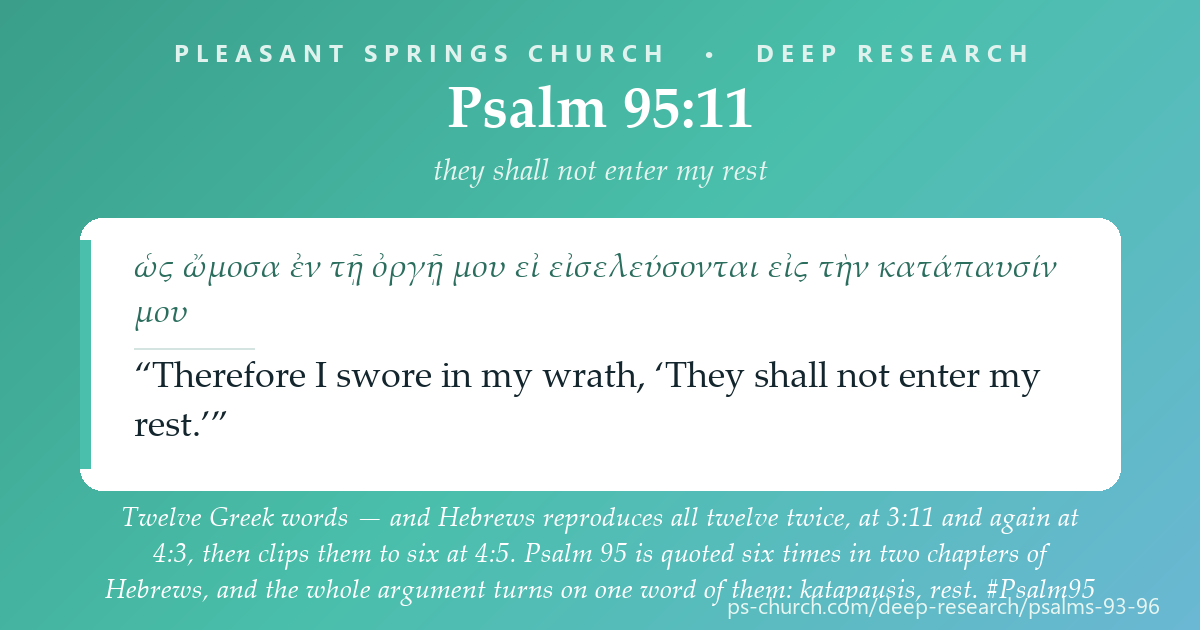
“Rest.” The single word the argument of Hebrews 3–4 runs on. The form κατάπαυσιν stands in Rahlfs 94:11, and that same form stands at Hebrews 3:11, 4:3 and 4:5. All twelve Greek words of this verse stand twice over in Hebrews, and six of them a third time.
“Meribah” — a place-name in the Hebrew. Rahlfs 94:8 reads ἐν τῷ παραπικρασμῷ, in the embittering, and does the same with Massah, reading ὁ πειρασμός, the testing. Two names in one text; two things that happened in the other. ✅ And now that Greek Exodus and Numbers are held here (30 August 2026), the Psalter can be set beside them: they do not agree. Greek Exodus 17:7 renders Meribah λοιδόρησις — a noun that stands once in the 64 files, and once in the 30,348 rows screened out of them. Greek Numbers 20:13 renders it ἀντιλογίας, and so do Numbers 27:14, Deuteronomy 32:51, Deuteronomy 33:8, Rahlfs 80:8 and Rahlfs 105:32. Rahlfs 94:8 uses neither. Three Greek words for one Hebrew place-name, and the one the Psalter chose is the one Hebrews quotes.
“Rest.” The single word Hebrews 3–4 argues from. It stands in Rahlfs 94:11, and the same word stands at Hebrews 3:11, 4:3 and 4:5.
“The Lord reigns.” Four places in Rahlfs’ Psalter, answering the four Hebrew places exactly — and, re-run again on 30 August 2026 across all sixty-four Greek Old Testament files now held — 30,348 screened verse units of the 30,637 on disk — four places in the whole Greek Old Testament. It was four at 44 files and 23,061 units, and it is still four now that Exodus, Leviticus, Numbers, Joshua and the deuterocanon have been added — and still four when the Odes were taken back out of the screen on 2026-08-30, since no canticle carries the formula. The CATSS text held here prints the article; some printed editions of the Greek Psalter do not. The page states what the text on disk reads.
Five citations of one psalm, and five cross-references that route elsewhere.
Every measurement below was made against the SBL Greek New Testament, token by token, with accents normalised and punctuation excluded.
Which cross-references matter?
Hebrews sets down Psalm 95 in five separate citations across two chapters, and the argument rests on the Greek wording. Hebrews 3:7–11 sets down the psalm at length: aligned against Rahlfs 94:7c–11, 59 of 65 tokens are identical, and Hebrews 3:8 reproduces all seventeen words of Rahlfs 94:8 unbroken, inside a single identical stretch of twenty-eight tokens running from 3:7 to 3:9.
Two of those words are place-names in the Hebrew and are not place-names in the Greek. Where the Hebrew of 95:8 has Meribah and Massah, Rahlfs 94:8 has the embittering and the testing — and the word the argument of Hebrews 3–4 runs on is κατάπαυσις at 94:11: the form κατάπαυσιν stands eight times in Hebrews 3–4, and the verb κατέπαυσεν three times more. Of the two renderings at 94:8, it is the first that also stands outside the quoted lines — Hebrews 3:16 reads παρεπίκραναν in the author’s own sentence — while every πειρα- word in Hebrews 3–4 stands inside them. An English reader working from the Hebrew sees two places in a desert; the argument in Hebrews is built on two words that name what happened there. Reported as a measurement of what stands in which text. This page does not say Hebrews used one text rather than another, does not call either reading correct, and does not date anything.
- Hebrews 3:7–11, 3:15; 4:3, 4:5, 4:7 → Psalm 95:7c–11 · Rahlfs 94:7c–11. 59 of 65 tokens; longest unbroken run twenty-eight words.
- 1 Corinthians 3:20 → Psalm 94:11 · Rahlfs 93:11. Eight of nine tokens; where Rahlfs 93:11 has τῶν ἀνθρώπων, of men, 1 Corinthians 3:20 has of the wise.
- ⚠️ Acts 17:31 cannot be assigned to Psalm 96:13. Its four-word run is shared identically with two other Greek psalms, so it points at none of the three.
- ⚠️ 1 Corinthians 10:26 routes through Psalm 24:1, not Psalm 96:11. Six words there against four here.
- ⚠️ 1 Corinthians 10:20 routes through Greek Deuteronomy 32:17, not Psalm 96:5 — even though Rahlfs 95:5 does read δαιμόνια.
- ⚠️ Hebrews 10:30 cannot be assigned to Psalm 94:14 · Rahlfs 93:14, which shares four words. Its five-word run κρινεῖ κύριος τὸν λαὸν αὐτοῦ stands identically in Greek Deuteronomy 32:36 and in Rahlfs 134:14 (Hebrew 135:14), so it points at neither alone.
- ⚠️ Revelation 19:6 is a shared motif, not a citation. Its word order is the reverse of the Greek enthronement formula, and κύριος stands there without the article.
Four things this page reports as unsettled.
Goldingay and Alter for the Hebrew; the ESV footnotes for where the versions themselves hesitate; and Rahlfs read beside the Greek of Chronicles rather than beside an English psalm.
Commentaries & studies:
- John Goldingay, Psalms 90–150; Robert Alter, The Book of Psalms.
- Frank-Lothar Hossfeld and Erich Zenger, Psalms 2 (Hermeneia).
- Gerald H. Wilson, The Editing of the Hebrew Psalter.
- NETS Psalms, with Rahlfs.
Four things reported as unsettled:
- How Psalm 96 and 1 Chronicles 16 came to agree in four fifths of the Chronicles passage’s words. The overlap is measurable and the direction is not. Nothing on this page bears on which stood first or whether either knew the other.
- Why the two Greek texts differ where the two Hebrew texts agree. The figures are given; no account of them is offered.
- What the third colon of Psalm 93:3 is doing. The Hebrew has it and Rahlfs 92:3 does not. No apparatus for either text is held here, so the page reports the difference and stops.
- What lies behind the longer reading at Psalm 96:10. Neither text on this page has it. This library holds no Latin witness and no apparatus, and takes no position.
Two hands on the same words.
Name what you learned, why it matters, and one concrete response.
What should we carry away — and do?
- Two texts can be near-twins in one language and much less alike in another. Psalm 96 and 1 Chronicles 16 agree in four fifths of the Chronicles passage’s words in Hebrew, and three fifths of its Greek ones. Translation is not a transparent window; the same sentence rendered twice comes out twice.
- An argument can rest on a word that is in one text and not the other. Hebrews 3–4 turns on the testing and rest, where the Hebrew of Psalm 95:8 has the place-name Meribah, Rahlfs 94:8 has the embittering — and Hebrews 3:16 reads παρεπίκραναν in its own sentence, outside the quoted lines. The page reports which words stand where and leaves the weighing to the reader.
- The complaint stands inside the celebration. Psalm 94 sits between three psalms about God reigning, and it asks how long the wicked will exult. The editors did not sort the psalms by mood.
- One concrete response. Today, if you hear his voice, do not harden your hearts. Hebrews sets down this line three separate times in two chapters — 3:7, 3:15 and 4:7 — and the word today stands in all three. Whatever else the argument does, it will not let the hearing be postponed.
Psalm 95:11 · to share
Hebrew + Greek (Rahlfs) + ESVEvery Deep Research page traces its passage across the whole sweep — the Old Testament, the Second-Temple world between the testaments (historical witnesses, not Scripture), and the New Testament. Follow the thread:
Pleasant Springs Church — Deep Research
Research method after Michael S. Heiser’s Bible Research Method (examine dictionaries → ancient literature → important words → textual connections → academic publications → share), with the Pleasant Springs “Author & Audience” foundation. Scripture set in the Hebrew, the Greek editions named on each page and the ESV (Old Testament), and the Greek New Testament and the ESV (New Testament), per the practice of Pleasant Springs Church. Psalms 93–96 research grounded in Goldingay (Psalms 90–150) and Alter. Text: Hebrew from the Masoretic text as printed in the editions consulted — Sefaria’s Miqra according to the Masorah; no critical apparatus was consulted for the Hebrew, and the paseq is not reproduced in the codex lines. Greek from Rahlfs’ Greek Psalter, 1 Chronicles and Deuteronomy (CATSS digitizations); Greek New Testament from the SBL edition. The standing caution for this shelf applies: these pages say “Rahlfs’ Greek Psalter reads…” and never call a Greek reading early or late. ⚠️ The Psalm 96 / 1 Chronicles 16 measurement, stated so it can be repeated. The two texts were aligned globally, word against word, over the material they share — on consonantal forms for the Hebrew and on accent-stripped tokens for the Greek. Hebrew: 76 identical of the Chronicles passage’s 96 words. Greek: 80 identical of its 138. The alignment is global, word against word, on accent-stripped tokens; the scoring is a match +1, a mismatch −1 and a gap −1 — the same on both languages, the Hebrew key is consonantal, and stripping the Hebrew of cantillation alone returns the same 76. The same scoring was used on both languages. The Greek comparison covers slightly less material, because the Greek 1 Chronicles held here has no verse 16:24. ⚠️ No direction is claimed anywhere in that comparison, and none of the figures bears on which text stood first. ⚠️ The Hebrews measurement. Hebrews 3:7–11 was aligned against Rahlfs 94:7c–11 on the SBL edition’s punctuation-free field with accents stripped: 59 of 65 tokens identical, nine points of difference, longest unbroken run twenty-eight tokens, running from Hebrews 3:7 to 3:9 — with all seventeen words of Rahlfs 94:8 inside it. Each re-citation was measured separately. ⚠️ Six structures looked at and none printed. Six proposed block-pairings across these four psalms were considered and none is drawn. No statistical result is claimed for them: this page does not publish the score that was used, the unit that was permuted or the seed it was drawn with, so nothing about them should be read as a measured finding, and the structure block prints a sequence instead. The one link it does draw — the five-word clause shared by 93:1 and 96:10 — is exact repetition and needs no null. ⚠️ Absolute negatives are scoped to what is on disk. Greek claims are scoped to the thirty-nine Greek Old Testament books available here — 64 files — 30,637 verse units on disk, 30,348 screened, the 289-row gap being the Odes, which stay on disk but are out of every count on this page because Ode 9 is Luke 1, Ode 13 is Luke 2, and ten more are second copies of passages already in the corpus. Isaiah, Jeremiah, Lamentations, Ezekiel and both Greek Daniels reached this shelf on 19 August 2026 (44 files, 23,061 units); Exodus, Leviticus, Numbers, both Joshua recensions and the deuterocanon on 30 August 2026, taking it to 64 files and 30,637 units held. This page previously said “Greek Exodus and Numbers are not held here, so nothing is said about how they render the names.” Both are held now and the names have been measured: Greek Exodus 17:7 translates the pair as πειρασμὸς καὶ λοιδόρησις, Greek Numbers 20:13 reads ὕδωρ ἀντιλογίας, and Greek Deuteronomy reads τῷ Πειρασμῷ at 6:16 and 9:22 and ὕδατος ἀντιλογίας at 33:8. Neither place-name is transliterated anywhere in the 64 files. The Psalter agrees with none of them: παραπικρασμός stands once in all 30,348 screened verse units, at Rahlfs 94:8. ⚠️ Both Greek-wide uniqueness claims were re-run on 30 August 2026 against 64 files — and then re-run a second time the same day, because the screening corpus changed under them. The page prints all three readings of the number rather than swapping it. κρινεῖ κύριος τὸν λαὸν αὐτοῦ was published here as standing at exactly two places in the whole Greek Old Testament, Deuteronomy 32:36 and Rahlfs 134:14. That was true on 44 files. When the Odes landed it read three — the third being Ode 2:36 — and the page said at the time that the third was not an independent witness, because Ode 2 is the Song of Moses, Deuteronomy 32, copied out again as a canticle in the appendix Greek Psalters carry. ⚠️ That gloss was right, and the shelf has now acted on it instead of annotating around it. The Odes came out of the screening corpus on 2026-08-30 — they stay on disk, and this shelf still reads them as a text-form WITNESS and not as Scripture — precisely because ten of the fourteen canticles are second copies like this one, and a doublet inflates every band it touches. Re-run over the 30,348 screened verse units, the count is TWO again: Deuteronomy 32:36 and Rahlfs 134:14 — exactly the figure this page published on 44 files. Two places in Scripture; two rows in the screen; three rows on the disk. The reader now has all three numbers and knows which question each one answers, which is better than having the middle one alone. τὴν οἰκουμένην ἐν δικαιοσύνῃ stands at exactly three, Rahlfs 9:9, 95:13 and 97:9 (Hebrew 9:8, 96:13 and 98:9) — still exactly three at 30,348 screened verse units, and three on the full 30,637 too. Isaiah, Jeremiah, Lamentations, Ezekiel and Daniel added nothing to either claim in August; Exodus, Leviticus, Numbers and Joshua added nothing to either; the deuterocanon added one row to the first, and that row has now been taken back out. ⚠️ What was not consulted. No Qumran Psalms scroll, no Cairo Geniza fragment, no Syriac, no Old Latin, no Vulgate or Gallican Psalter, no Aquila, Symmachus or Theodotion, and no critical apparatus for either text — which is why the longer reading at 96:10 is reported as absent from the two texts here and not adjudicated. One edition note: the CATSS text prints the article in the enthronement formula, and some printed editions of the Greek Psalter do not. Verse counts verified in both columns (5, 23, 11, 13). Typology is handled per the house position: what the text says, what the New Testament itself draws, and what we see from this side of the cross — with the seeing left to the reader.
Scripture quotations marked ESV are from the ESV® Bible (The Holy Bible, English Standard Version®), © 2001 by Crossway, a publishing ministry of Good News Publishers. ESV Text Edition: 2016. Used by permission. All rights reserved. The ESV text may not be quoted in any publication made available to the public by a Creative Commons license, and the ESV may not be translated in whole or in part into any other language. www.esv.org
|
Did this study bless you today? 💚 Give to Support PS Church100% of gifts go to the General Fund — thank you. |