Psalm 89 closes Book III with the Davidic covenant quoted at length and then contradicted by events. It is built out of two Hebrew words. One of them — ʾĕmûnāh, God's faithfulness — occurs seven times here, out of twenty-two occurrences in all 150 psalms: nearly a third of the Psalter's whole supply, in a psalm that is two per cent of its words. The pair steadfast love and faithfulness stands in one verse eleven times in the book, and five of the eleven are here. Then, right after God’s own promise at verse 33, both words stop — and neither appears again for fifteen verses, until the psalm's last question asks where they went. A reader in Greek is reading about something else: Rahlfs answers all seven with alētheia, truth. Along the way: a sea-monster the Greek does not name, four Selahs, an oracle that shares more rare vocabulary with 2 Samuel 7 than any other stretch of the Psalter without quoting a phrase of it, and a cross-reference to Hebrews 1:5 that should stop being printed. See the method →
Psalm 89 (selections)
Hebrew · Greek (Rahlfs’ Psalter) · ESVThe word is אֱמוּנָה, God’s faithfulness or reliability. Across all 150 psalms it occurs 22 times in 12 psalms. Seven of the 22 are in this one psalm — at 89:1, 89:2, 89:5, 89:8, 89:24, 89:33 and 89:49 — which is nearly a third of the Psalter’s whole supply, in a psalm that is two per cent of the Psalter’s words.
⚠️ And it never stands alone. The pair חֶסֶד and אֱמוּנָה — steadfast love and faithfulness — stands in the same verse eleven times in the Psalter, and five of the eleven are here. The psalm’s argument is built out of two words used together.
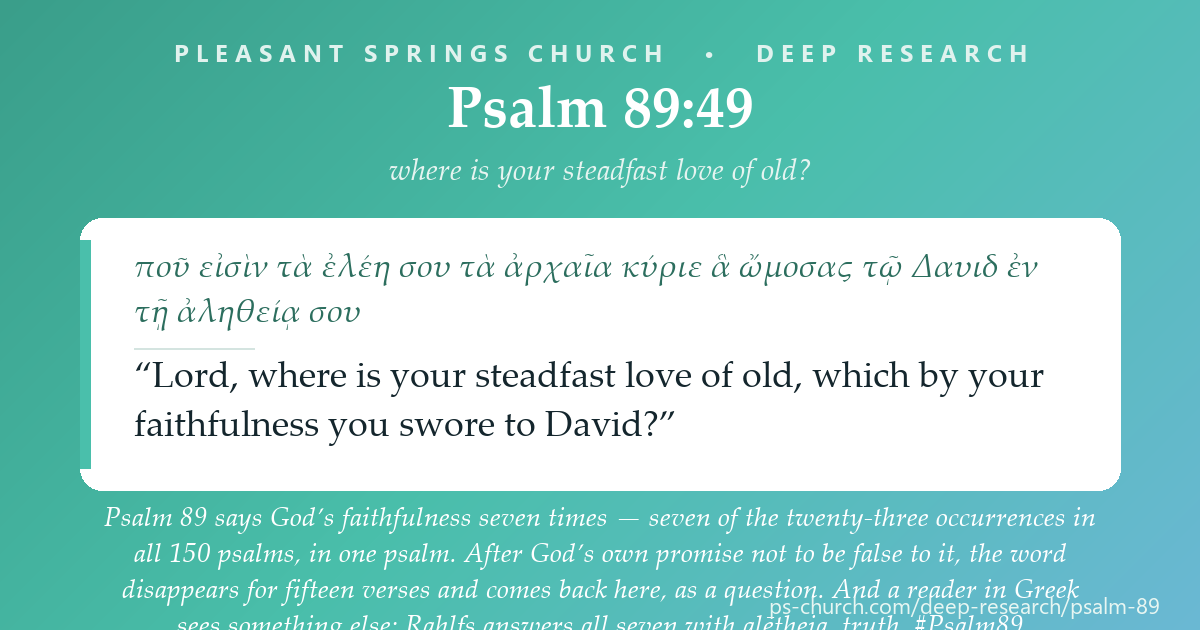
⚠️ Then, after verse 33, both stop. After God’s own promise at 89:33 — I will not remove from him my steadfast love or be false to my faithfulness — neither word appears again for fifteen verses. They come back together only at 89:49, and there they are a question: Lord, where is your steadfast love of old, which by your faithfulness you swore to David?
⚠️ A reader in Greek is reading about something else. Rahlfs answers all seven occurrences with ἀλήθεια — truth — seven for seven, with no exception. Where the Hebrew psalm turns on whether God will keep faith, the Greek psalm turns on truth: a related idea, and not the same one. This page reports the correspondence and its consistency. It does not treat either word as the correct rendering of the other, and it offers no account of why the two texts read as they do.
The Shape of the Passage
Two halves, and a hinge at verse 38It does not hold as a system. The psalm’s 52 verses (Hebrew 89:2–53) were reduced to their distinct consonantal word-forms, and the oracle block (Hebrew 89:20–38) was scored against the lament block (Hebrew 89:39–52) on the number of forms standing in both. The observed score is nine. Against 20,000 random reorderings of the same 52 verse-sets under
random.Random(89), 19,927 scored nine or more — p = 0.996: the two blocks share less vocabulary than reshuffling produces, not more. What is real is smaller and can be pointed at individually — a handful of the oracle’s words do come back in the lament with the subject reversed, and the sharpest of them is the pair אֲחַלֵּל and חִלַּלְתָּ, two different forms built on the same three consonants: God says I will not violate my covenant at 89:34, and the lament says you have defiled his crown in the dust at 89:39.What the page does draw is the hinge, and that rests on a count. The two words the psalm is built from — steadfast love and faithfulness — occur twelve times between them in the first thirty-three verses, and then not once for fifteen verses, and then both together in a question at 89:49. The turn is at 89:38, and it falls at seventy-one per cent of the psalm by word count.
Psalm 89 closes Book III, and its heading is unusual for the book — three Hebrew words, with no לַמְנַצֵּח and no לְדָוִד, in a psalm that is about David from beginning to end. Psalm 89 carries no Greek heading element without a Hebrew counterpart.
Author
Ethan the Ezrahite, by the heading. The word Ezrahite occurs three times in the whole Hebrew Bible — 1 Kings 4:31, and the headings of Psalms 88 and 89. Where the Hebrew has it, Rahlfs reads the Israelite.
Named alongside Heman, who heads the psalm before this one. 1 Kings 4:31 lists Ethan, Heman, Calcol and Darda together as the wise men Solomon surpassed. Psalms 88 and 89 stand side by side and carry the only two Ezrahite headings in the book.
Someone who knew the covenant oracle very well and quotes none of it. Psalm 89:19–37 and 2 Samuel 7 share no run of more than two Hebrew words — and yet no other stretch of the Psalter shares as much of its rare vocabulary with that chapter. See Stage 4.
Audience
People who had been taught the promise as unconditional. I will not remove from him my steadfast love or be false to my faithfulness… his throne as long as the sun before me. The psalm quotes God at length before it complains.
People who could see that it had not held. You have renounced the covenant with your servant; you have defiled his crown in the dust.
And people who sang the doxology anyway. Blessed be the Lord forever! Amen and Amen. Five words, and they do not answer the question the psalm has just asked.
Orient on the Davidic covenant, on Ethan, and on the seams of the Psalter.
Search by topic: Davidic covenant; Ethan the Ezrahite; royal psalms; Book III of the Psalter; Rahab and the chaos-monster; the doxologies.
Which articles are relevant?
- Anchor Bible Dictionary — “David, Covenant with,” “Ethan,” “Rahab (dragon),” “Psalms, Book of.”
- Dictionary of the OT: Wisdom, Poetry & Writings (IVP) — “Royal Psalms,” “Chaoskampf,” “Lament, Psalms of,” “Book of the Psalms: Structure.”
- NIDOTTE / TDOT — אֱמוּנָה (ʾĕmûnāh, faithfulness), חֶסֶד (ḥeseḏ, steadfast love), בְּרִית (bərîṯ, covenant).
- On the Greek — the NETS Psalms introduction, and Rahlfs 88 read for ἀλήθεια at all seven places.
- On Book III — Gerald H. Wilson, The Editing of the Hebrew Psalter, for the book seams and the placement of this psalm.
Bibliography surfaced:
- John Goldingay, Psalms 42–89; Robert Alter, The Book of Psalms.
- Frank-Lothar Hossfeld and Erich Zenger, Psalms 2 (Hermeneia) — covers Psalms 51–100.
- Gerald H. Wilson, The Editing of the Hebrew Psalter.
A sea-monster the Greek does not name, and two claims that fail.
Read Psalm 89 straight through in one sitting before reading anything about it; the hinge is impossible to miss and impossible to prepare for.
Which parallels shed light on this psalm?
Psalm 89:10 names Rahab, and Rahlfs does not. The Hebrew רָהַב is a proper name for a sea-monster of the older creation language, the same figure Psalm 74 calls Leviathan. Rahlfs 88:11 reads ὑπερήφανον, the proud one — a common adjective. This is the same pattern the shelf found at Psalm 74, where the Hebrew has the plural heads of Leviathan and the Greek has a single dragon — see Psalms 74–77. ★ This note used to read: “The Greek of Isaiah is not held by this library, so nothing is said here about how Rahab is handled at Isaiah 30:7 or 51:9.” Greek Isaiah is on the disk now, and the question has been run.
| where the Hebrew names Rahab | what the Greek on this disk reads |
|---|---|
| Psalm 89:10 Heb 89:11 · Rahlfs 88:11 — you crushed Rahab like a carcass | ὑπερήφανον, the proud one — a common adjective. The name is gone. |
| Isaiah 30:7 — Rahab who sits still | Αἰγύπτιοι μάταια καὶ κενὰ ὦφελήσουσιν ὑμᾶς — the Egyptians will help you in vain and emptily. The name is not there in any form. |
| Isaiah 51:9 — was it not you who cut Rahab in pieces, who pierced the dragon? | ἐξεγείρου ἐξεγείρου Ἰερουσαλημ — awake, awake, Jerusalem, and the verse runs on to ἡ ἐρημοῦσα θάλασσαν at 51:10, you who made the sea desolate. The sea is there and the sea-monster’s name is not. |
| Psalm 87:4 Rahlfs 86:4 — I will mention Rahab and Babylon, where Rahab is Egypt | μνησθήσομαι Ρααβ — the name is transliterated, and it is in the Greek Psalter. |
So the honest result is sharper than either “the Greek drops Rahab” or “nothing can be said.” The Greek Old Testament on this disk transliterates Ρααβ freely where Rahab is a place or a person — Psalm 86:4 in the Psalter itself, two psalms before this one; Joshua (B) 2:1, 2:3, 6:17, 6:23 and 6:25 for the woman of Jericho; 2 Kingdoms 8:3 and 8:12; Numbers 13:21 for Rehob — and it does not transliterate it once where Rahab is the sea-monster. Three for three: Psalm 88:11 answers with an adjective, Isaiah 30:7 and 51:9 do not answer at all. Whether that is one translator’s habit, two translators’ shared habit, or a Hebrew text that already read differently, the shelf does not say — no apparatus, no Qumran, no direction of influence. Greek Joshua is on the disk too, so the word note below can now say what it could not: the Greek spells the Rahab of Joshua exactly as it spells the Rahab of Psalm 86:4, and spells the sea-monster nothing at all.
- 2 Samuel 7:4–17 → Psalm 89:19–37. Measured in Stage 4, and the result is not the expected one.
- Psalm 74:13–14 → Psalm 89:10. The same creation language, and the same kind of divergence between the two texts.
- 1 Kings 4:31 · Hebrew 1 Kings 5:11; 1 Chronicles 2:6 → the heading. Ethan and Heman named together.
- Bava Batra 15a. Reads Ethan the Ezrahite as Abraham and Heman as Moses. Reported as a rabbinic identification, not adopted.
“Psalm 89 has unusually rare vocabulary.” Tested three ways against every psalm in the book, and it does not. Tested two ways. Its rate of Psalter-unique forms is 35.7% against a book mean of 27.0% — just over one standard deviation above the mean, and 24th of 150. Its rate of forms unique in the whole Hebrew Bible is 15.8% against a mean of 12.3%. Ordinary, on every measure. What is true is narrower: forty-six of the psalm’s 291 distinct forms occur exactly once in the thirty-nine books — which is the 15.8% quoted two sentences above.
“Psalm 89 is the longest psalm in Book III.” It is not. At 53 verses and 384 words it is the second-longest in Book III on both measures — Psalm 78, also in Book III, runs to 72 verses and 530 words. The defensible claim is that it is the fourth-longest psalm in the Psalter by word count, and the third-longest by verse count.
“Psalm 89:27 is the only place anyone is called God’s firstborn.” It is not the only place in the Old Testament, and the page does not say so. What survives is the narrower version: this is the only place in the Psalter.
Two words, seven times and five times together, and then a gap.
Every count below was made on the texts named at the foot of this page, and every one can be repeated.
Counted here, not assumed:
- Verse counts. Hebrew 53, Rahlfs 53, English 52 with an unnumbered superscription — the offset is one throughout the psalm. In Greek numbering this is Psalm 88.
- Psalm 89 carries no Greek heading element without a Hebrew counterpart. Every element answers, one for one, in the same order. The one difference is lexical: where the Hebrew has the Ezrahite, Rahlfs has the Israelite.
- אֱמוּנָה seven times here; 22 times across all 150 psalms, in 12 psalms. Scanned with prefixes allowed. The next highest is five.
- The pair steadfast love + faithfulness in one verse: eleven times in the Psalter, five of them here.
- Neither word occurs between 89:33 and 89:49. Fifteen verses.
- Rahlfs reads ἀλήθεια at all seven. Checked verse by verse.
- Four Selahs — more than any other psalm. And Rahlfs has διάψαλμα at exactly those four verses.
- Two ketiv/qere pairs, at 89:17 and 89:28. The first changes person and voice; the second is orthographic. The codex prints the qere.
- 384 words in 53 verses — the fourth-longest psalm in the Psalter by word count, and the third-longest by verse count.
- Thirteen divine-name tokens in the Hebrew, counted as יהוה with prefixes (ten), אֲדֹנָי (two) and יָהּ (one, at Hebrew 89:9, screened on the mappiq — without that screen the same three-letter test also matches forms of היה), and thirteen κύριος-forms in the Greek, verse for verse.
- ⚠️ Six psalms carry no closing section marker on their last verse in the edition used here — 41, 72, 89, 106, 114 and 150. The other 144 all do. Psalms 41, 72, 114 or 150 in the edition used here. Four of those six close Books I to IV. This is one printed edition’s representation of the Masorah and manuscripts differ.
- Nothing in Psalm 89 reaches quotation length in the New Testament held here. The longest unbroken run its Greek shares with any New Testament verse is five words, and there are four of them.
“Faithfulness, reliability.” Seven times in this psalm — 22 times in all 150 psalms, in 12 psalms. The next highest is Psalm 119 with five. Rahlfs answers every one of the seven with ἀλήθεια, truth — seven for seven.
“Steadfast love.” The word this psalm pairs with the one above. The two stand in the same verse eleven times in the whole Psalter, and five of the eleven are in Psalm 89 — at 89:1, 89:2, 89:24, 89:33 and 89:49. Rahlfs answers with ἔλεος.
“Rahab” — a proper name for the sea-monster, not the Rahab of Joshua. Rahlfs 88:11 reads ὑπερήφανον, the proud one, an ordinary adjective. Where one text names a creature, the other describes a quality. ★ Greek Joshua is now on this disk and the distinction can be measured rather than asserted: Joshua (B) spells the woman of Jericho Ρααβ at 2:1, 2:3, 6:17, 6:23 and 6:25, and the Greek Psalter spells the Egypt-Rahab of Psalm 86:4 the same way. The one Rahab the Greek never spells is this one.
“Rock” — here a title for God. Rahlfs reads ἀντιλήμπτωρ, helper. Across all 150 psalms, in no verse where this Hebrew word stands as a title for God does the Greek Psalter have πέτρα; where the Hebrew has a literal rock, πέτρα stands freely — see Psalms 61–64.
“Selah.” Four times — more than any other psalm in the Hebrew Psalter. Rahlfs 88 has διάψαλμα at exactly those four verses and nowhere else in the psalm. One of them, at 89:37, stands immediately before the turn.
“Truth.” What stands in Rahlfs at all seven places where the Hebrew has faithfulness. It stands once more in the psalm, at Rahlfs 88:15, where the Hebrew has וֶאֱמֶת (Heb 89:15) — so the seven-for-seven runs one way only: the Greek word stands eight times here, and it answers two different Hebrew words. The page reports it and does not treat either word as the correct rendering of the other.
The covenant oracle measured against 2 Samuel 7, and a cross-reference to stop printing.
Every measurement below was made token by token, with accents normalised and punctuation excluded.
Which cross-references matter?
Psalm 89’s oracle and 2 Samuel 7 do not quote each other, and the relationship is real anyway. Aligned token by token, the longest unbroken run shared between Psalm 89:19–37 and 2 Samuel 7:4–17 is two words in Hebrew. There is no quotation in either direction, and this page does not print one.
What survives is a measurement of rare shared vocabulary, and it is striking. The oracle block shares eight consonantal Hebrew forms with 2 Samuel 7:4–17 that occur ten times or fewer in the whole Psalter. Scored the same way against every nineteen-verse window in the Psalter — 615 of them — that is first. No other stretch of the book stands as close to that chapter, and it gets there without reproducing a single phrase. Which text stood first, and whether either knew the other, is not decidable from what is on this page, and no claim about it is made.
⚠️ And one cross-reference printed in many margins should not be. Hebrews 1:5 is regularly referred to Psalm 89:26–27. It is not quoting this psalm. Both of its quoted clauses come from elsewhere and match those sources far more closely — an eleven-word run with 2 Kingdoms 7:14 and an eight-word run with Psalm 2:7. Against Rahlfs 88:27 it shares three words, and the word immediately before them differs: Hebrews has son where the psalm has father.
- 2 Samuel 7:4–17 → Psalm 89:19–37. Top of 615 windows on rare shared vocabulary; longest shared run two words.
- ⚠️ Hebrews 1:5 is not Psalm 89:26–27. It is 2 Samuel 7:14 and Psalm 2:7.
- ⚠️ Hebrews 11:26 is not Psalm 89:50–51. Both words of the reproach of Christ stand in those two verses, and never next to each other.
- Acts 13:22 → Psalm 89:20 · Hebrew 89:21. An allusion at most: three words shared, and the rest of the verse routes through 1 Samuel 13:14.
- Revelation 1:5 · 3:14 → Psalm 89:36–37. A shared motif — the faithful witness — and two shared words. In Rahlfs 88:38 two words stand between witness and faithful, so the phrase itself is not there.
- Matthew 16:26 · Mark 8:37 · Psalm 89:51 · Hebrew 89:52 · Rahlfs 88:52. A vocabulary curiosity, reported and not pressed: ἀντάλλαγμα stands exactly twice in the Greek Psalter and exactly twice in the Greek New Testament.
Four things this page reports as unsettled.
Goldingay and Alter for the Hebrew; Wilson for the book seams; the ESV footnotes for where the versions themselves hesitate.
Commentaries & studies:
- John Goldingay, Psalms 42–89; Robert Alter, The Book of Psalms.
- Frank-Lothar Hossfeld and Erich Zenger, Psalms 2 (Hermeneia).
- Gerald H. Wilson, The Editing of the Hebrew Psalter.
- NETS Psalms, with Rahlfs.
Four things reported as unsettled:
- What Psalm 89:47 says. The Hebrew of the verse is broken and the versions differ; Rahlfs 88:48 has a clean rhetorical question built on ὑπόστασις. This page adopts neither.
- Whether the doxology at 89:52 belongs to the psalm. Both texts number it as a verse and neither marks it off; it is also the shortest of the four book-closing doxologies — five Hebrew words — and the only one that does not name the God of Israel. The page reports the numbering and leaves the question open.
- Who Ethan the Ezrahite is. Three occurrences of the word in the Hebrew Bible, a Greek heading that reads Israelite instead, and a rabbinic tradition that reads the name as Abraham.
- What ESV’s note at 89:19 rests on. ESV prints Some Hebrew manuscripts godly ones. No Hebrew apparatus is held by this library, so the note is reported as ESV’s own and not evaluated.
The word that stops.
Name what you learned, why it matters, and one concrete response.
What should we carry away — and do?
- The psalm is built out of two words, and it counts them. Steadfast love and faithfulness — twelve occurrences between them in the first thirty-three verses. Seven of the Psalter’s twenty-two faithfulness words are in this one psalm.
- Then they stop for fifteen verses. God’s own promise not to be false to his faithfulness is the last time the word is used as a statement. The next time it appears it is a question.
- The psalm does not resolve it, and the book keeps it anyway. Blessed be the Lord forever! Amen and Amen. The doxology closes the book without answering the psalm.
- One concrete response. Lord, where is your steadfast love of old? The psalm models asking the question inside the covenant rather than outside it — it quotes the promise at length first, and then asks. That order is the whole argument.
Psalm 89:49 · to share
Hebrew + Greek (Rahlfs) + ESVEvery Deep Research page traces its passage across the whole sweep — the Old Testament, the Second-Temple world between the testaments (historical witnesses, not Scripture), and the New Testament. Follow the thread:
Pleasant Springs Church — Deep Research
Research method after Michael S. Heiser’s Bible Research Method (examine dictionaries → ancient literature → important words → textual connections → academic publications → share), with the Pleasant Springs “Author & Audience” foundation. Scripture set in the Hebrew, the Greek editions named on each page and the ESV (Old Testament), and the Greek New Testament and the ESV (New Testament), per the practice of Pleasant Springs Church. Psalm 89 research grounded in Goldingay (Psalms 42–89) and Alter, with Wilson (The Editing of the Hebrew Psalter) for the book seams. Text: Hebrew from the Masoretic text as printed in the editions consulted — Sefaria’s Miqra according to the Masorah; no critical apparatus was consulted for the Hebrew, the paseq is not reproduced in the codex lines, and where the Masoretic text carries a ketiv/qere the codex prints the qere — in this psalm that is 89:17 and 89:28. Greek from Rahlfs’ Greek Psalter (CATSS digitization); Greek New Testament from the SBL edition; 2 Kingdoms and 3 Kingdoms for the covenant oracle and the heading. The standing caution for this shelf applies: these pages say “Rahlfs’ Greek Psalter reads…” and never call a Greek reading early or late. ⚠️ The rare-vocabulary block. A form here is a token stripped to its Hebrew consonants on the tokenisation below; Psalm 89 has 291 distinct forms. Psalter-unique means the form stands exactly once in the 19,586-word Psalter — 104 of the 291, or 35.7%, which ranks 24th of 150 against a book mean of 27.0%. Unique in the Hebrew Bible means exactly once in the 305,579-word thirty-nine-book corpus — 46 of the 291, or 15.8%. These are form counts, not lemma counts; no Hebrew lemmatiser is held here. ⚠️ The word counts, stated so they can be repeated. Both words were scanned across all 150 psalms on the shelf’s standard tokenisation (split on whitespace, maqqef and paseq; Masoretic section markers excluded; a ketiv/qere pair counted once; a token must carry a Hebrew letter). That rule reproduces the Psalter total of 19,586 words. אֱמוּנָה was counted as a consonantal form — the plene אמונ- or the defective אמנת-, with prefixes and pronominal suffixes allowed. That returns 27 tokens, and the screen removes the five spellings it wrongly catches: אֱמוּנִים at Psalms 12:2 and 31:24, and הֶאֱמַנְתִּי at Psalms 27:13, 116:10 and 119:66. What is left is 22 occurrences in 12 psalms, 7 of them here. The prefix set must be anchored: an unanchored search also catches נֶאֱמֶנֶת at Hebrew 89:29, which is a different word. The co-occurrence with חֶסֶד in one verse = 11 verses, 5 of them here. Each of the seven Greek counterparts was then read off Rahlfs 88 verse by verse. ⚠️ The structure test. The claim that the lament undoes the oracle word by word was scored by shared content-word types between 89:19–37 and 89:38–51 and compared against 20,000 reshuffles of the psalm’s own verses, at word-form level and at root level. Neither rose above chance, so the block prints the hinge — which rests on a count — and not the system. ⚠️ The 2 Samuel 7 measurement. Rare shared forms were counted between Psalm 89:19–37 and 2 Samuel 7:4–17 and the same window was scored against all 615 nineteen-verse windows of the Psalter — the count is the sum over the 150 psalms of max(0, verses − 18). The top score of eight is reached by three windows and all three are inside Psalm 89, beginning at Hebrew 89:15, 89:19 and 89:20; the best window in any other psalm scores five, in Psalm 51. The longest unbroken shared run was measured separately and is two words in Hebrew. ⚠️ Absolute negatives are scoped to what is on disk. Claims that a form occurs a given number of times were checked as consonantal forms against all thirty-nine books of the same edition. ★ THE GREEK SCOPE CHANGED, AND THIS NOTE USED TO SAY THE OPPOSITE. This sentence read: “Greek claims are scoped to the twenty-two Greek Old Testament books available here, and Isaiah, Jeremiah and Ezekiel are not among them — so nothing is said about how Rahab is rendered outside the Psalter.” The shelf now holds 64 CATSS files and 30,637 verse units — Isaiah, Jeremiah, Ezekiel, Daniel, Exodus, Leviticus, Numbers, Joshua and the deuterocanon among them — and the Rahab question has been run and is printed in stage 2. The deuterocanonical books on this shelf are witnesses, not Scripture, and are labelled so wherever one supplies a result; none does on this page. Older pages on this shelf print smaller corpus figures, and they were correct when they were made. ⚠️ What was not consulted. No Qumran Psalms scroll, no Cairo Geniza fragment, no Syriac, no Vulgate or Gallican Psalter, no Aquila, Symmachus or Theodotion, and no critical apparatus for either text. The CATSS morphological parses are automated and this psalm contains at least one that is ambiguous in context; the readings above rest on the text, not on the parse. Verse counts verified in all three columns (53 / 53 / 52 with an unnumbered heading). Typology is handled per the house position: what the text says, what the New Testament itself draws, and what we see from this side of the cross — with the seeing left to the reader.
Scripture quotations marked ESV are from the ESV® Bible (The Holy Bible, English Standard Version®), © 2001 by Crossway, a publishing ministry of Good News Publishers. ESV Text Edition: 2016. Used by permission. All rights reserved. The ESV text may not be quoted in any publication made available to the public by a Creative Commons license, and the ESV may not be translated in whole or in part into any other language. www.esv.org
|
Did this study bless you today? 💚 Give to Support PS Church100% of gifts go to the General Fund — thank you. |