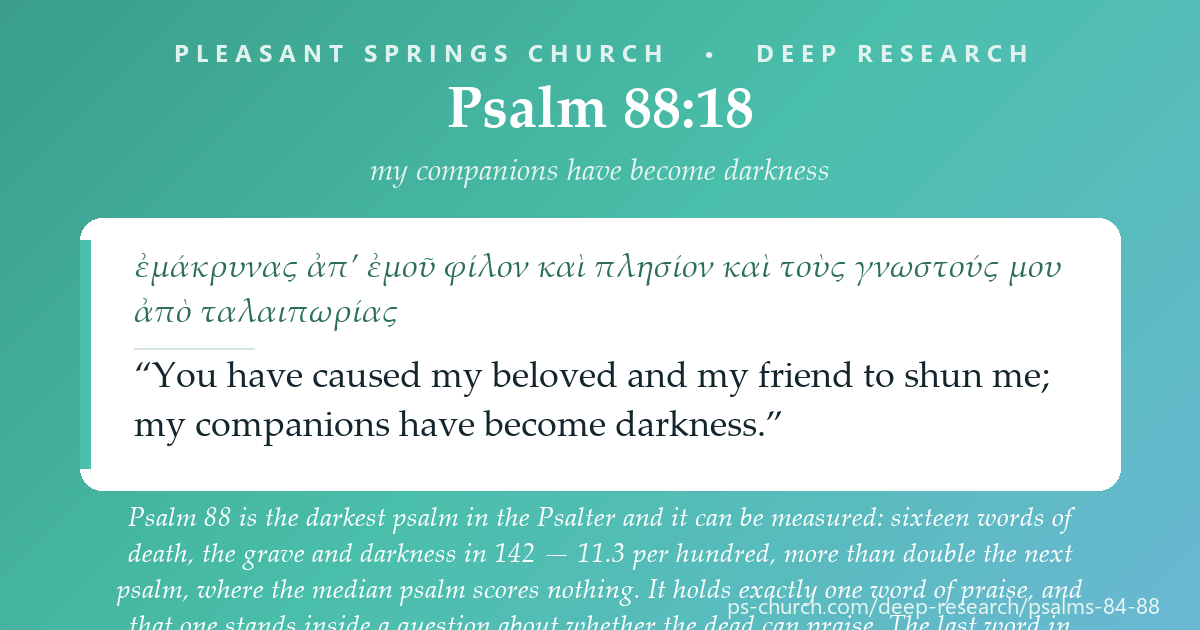
The sons of Korah return here, in the psalm immediately after the Asaph collection ends, and the set they open with How lovely is your dwelling place closes in the dark. Psalm 88's reputation as the darkest psalm in the book survives measurement, and by a wide margin: sixteen words of death, the grave and darkness in its 142 — 11.3 per hundred, more than double the next psalm, where 101 of the 150 psalms score nothing at all. And it holds exactly one word of praise, at 88:10, standing inside a question about whether the dead can perform it. The psalm's last word in Hebrew is darkness, in a clause with no verb; Rahlfs ends the same verse on misery, with no darkness in it. Along the way: the only psalm of David in the whole of Book III, a sun and a shield the Greek does not have, a word found whose unprefixed spelling stands nowhere else in the thirty-nine books on disk holding the psalm's one frame together, and twelve proposed structures that all failed their tests. See the method →
Psalms 84–88 (selections)
Hebrew · Greek (Rahlfs’ Psalter) · ESVCounting words of death, the grave, the pit, destruction, the shades, darkness, the lowest places and the land of forgetting across every psalm: Psalm 88 carries sixteen in its 142 words — 11.3 per hundred. That is more than double the next psalm on the list, and the median psalm in the book scores zero.
⚠️ And the second measurement is sharper than the first. Outside its heading, Psalm 88 carries exactly one word of praise. Two of its words are spelled from the Psalter’s praise, thanks, blessing, song, playing and rejoicing field; the second, לְרִנָּתִי at Hebrew 88:3, stands there for a plea and is screened out by sense. It is יוֹדוּךָ at 88:10 — and it stands inside a rhetorical question about dead bodies: do the departed rise up to praise you? The one act of praise in the psalm is something the psalmist doubts the dead can perform.
⚠️ The psalm closes on a frame, and the word it is built from is unique. Psalm 88:8 and 88:18 share exactly three words — you have put far from me, from me, and my companions — and the third of them, מְיֻדָּעַי, stands without a prefix nowhere else in the thirty-nine books — with a conjunction or a preposition it stands at Psalm 31:12, Psalm 55:14 and Job 19:14. The last word of the psalm, in Hebrew, is darkness, and it stands in a clause with no verb at all. Rahlfs 87:19 ends on ἀπὸ ταλαιπωρίας, from misery, with no word for darkness in the verse. This page reports the counts. It does not claim Psalm 88 is the only psalm that ends without hope — that is a claim about a word this library could not define across 150 psalms in any way that survived scrutiny, and it is not made here.
The Shape of the Passage
Sequence — the Korah collection resumes, and ends in the darkTwelve standard partitions — the three-panel readings and the chiasms these psalms are usually given — were tested across all five, each scored by content-word types shared between its blocks and compared against 20,000 reshuffles of that psalm’s own verses, drawn with Python’s
random.Random(20250804).shuffle and read one-sided at α = 0.05. Not one of the twelve reached significance, and several scored below chance. This library requires a literary structure to rest on shared words rather than shared themes, and to beat a size-matched null; none of these does. So the block above is a sequence — five psalms in the order the book has them — and nothing is drawn that the vocabulary will not carry.What is grounded is the frame inside Psalm 88. Verses 8 and 18 share three words and no other verse-pair in the psalm shares more than one content word, the divine name and the prepositions excluded; the shared word מְיֻדָּעַי stands without a prefix nowhere else in the thirty-nine books — prefixed, it stands at Psalm 31:12, Psalm 55:14 and Job 19:14 — and the two verses stand ten apart in a psalm of eighteen.
Eleven psalms carry לִבְנֵי־קֹרַח, the sons of Korah — Psalms 42, 44, 45, 46, 47, 48, 49, 84, 85, 87 and 88, derived by scanning every heading in the book. Four of the five psalms here are theirs; the fifth is David’s. No psalm in this unit carries a Greek heading element without a Hebrew counterpart.
Author
The Korah singers, by four of the five headings. The collection was interrupted after Psalm 49 by the Asaph block, and it resumes here.
And David, once, in the middle of them. A Prayer of David. Psalm 86 is the only psalm in Book III with his name on it — every other heading in Psalms 73 to 89 names Asaph, the sons of Korah, Heman or Ethan.
Psalm 88 is credited to two parties at once. A Psalm of the Sons of Korah… A Maskil of Heman the Ezrahite. Seven elements in one heading, and the Greek answers every one of them.
Audience
Pilgrims, in the first of the five. Blessed are those whose strength is in you, in whose heart are the highways to Zion. ESV footnotes that phrase itself — the Hebrew has no word for Zion there, and neither does the Greek.
People who could hear their enemies listed as fellow citizens. Rahab and Babylon… Philistia and Tyre, with Cush: “This one was born there.”
And someone with nothing left to say at the end. my companions have become darkness. The collection that opened on the courts of the Lord closes on a verbless clause with one word in it.
Orient on the Korah collection, Sheol, and the lament that does not resolve.
Search by topic: sons of Korah; Heman the Ezrahite; Sheol and the shades; individual lament; Zion as birthplace; the pilgrimage psalms.
Which articles are relevant?
- Anchor Bible Dictionary — “Korah, Sons of,” “Heman,” “Sheol,” “Rephaim,” “Zion.”
- Dictionary of the OT: Wisdom, Poetry & Writings (IVP) — “Lament, Psalms of,” “Death,” “Zion,” “Korah.”
- NIDOTTE / TDOT — רְפָאִים (rəpāʾîm, the shades), מַחְשָׁךְ (maḥšāḵ, darkness), אַשְׁרֵי (ʾašrê, blessed).
- On the Greek — the NETS Psalms introduction, with Rahlfs 83:12 and 87:11 read beside the Hebrew.
- On Book III — Gerald H. Wilson, The Editing of the Hebrew Psalter.
Bibliography surfaced:
- John Goldingay, Psalms 42–89; Robert Alter, The Book of Psalms.
- Frank-Lothar Hossfeld and Erich Zenger, Psalms 2 (Hermeneia) — covers Psalms 51–100.
- Gerald H. Wilson, The Editing of the Hebrew Psalter.
The measurement behind “the darkest psalm”, and three claims that fail.
Read Psalm 88 straight through before reading anything written about it, and notice where the turn would normally come.
What can actually be established about Psalm 88?
The reputation is measurable and it holds. Counting every word from the roots this library uses for death, the grave, the pit, destruction, the shades and darkness, across all 150 psalms and normalised for length: Psalm 88 scores 11.3 per hundred words, the highest in the book, and more than double the runner-up. The median psalm scores nothing at all.
⚠️ And the psalm has one word of praise in it. Outside the heading — which calls it a song — only one word of Psalm 88 is a word of praise, once the roots are screened by sense. The noun רִנָּה at Hebrew 88:3 is from the Psalter’s song root and is not counted, because it stands there for a plea. That one is at 88:10, and it is governed by a question: Do the departed rise up to praise you? The psalm’s only act of praise is one the psalmist is asking whether the dead can perform.
- Psalm 88:8 and 88:18 · Hebrew 88:9, 88:19. A three-word frame, and the shared noun stands unprefixed nowhere else in the thirty-nine books of this edition.
- Psalm 88:10 · Hebrew 88:11 · Rahlfs 87:11. Where the Hebrew has the shades, Rahlfs has physicians; both texts then ask whether they will rise and give thanks.
- Psalm 84:11 · Hebrew 84:12 · Rahlfs 83:12. One of the unit’s sharpest single-verse divergences — a sun and a shield in one text, mercy and truth in the other. This page defines no measure that ranks the seventy verses, so no rank is claimed — Rahlfs 86:5 and 87:11 are of the same order.
- Psalm 87:5 · Rahlfs 86:5. A preposition and a passive verb against a nominative subject and an active one. Both readings are before the reader and this page adopts neither.
“Psalm 88 has the longest heading in the Psalter.” It has seven elements and eleven Hebrew words — and it is tied at eleven with Psalms 56 and 59. Five superscriptions in the book are longer: Psalm 60’s runs to twenty-four words across two verses, Psalm 18’s to twenty, Psalm 52’s to fifteen, and Psalms 51 and 54 to twelve each. What is true is narrower: seven distinct elements, and two different parties named as author in one heading.
“Psalm 86 is a mosaic of quotations from other psalms.” Tested in Hebrew, as consonantal forms, against every three-word run in all 150 psalms: twelve of Psalm 86’s seventeen verses share no three-word run with any other psalm at all. Only one verse shares a four-word run, and no verse shares a five-word run. But the opposite overstatement fails too — against psalms of its own length Psalm 86 ranks third among the nineteen psalms of fifteen to nineteen verses on that measure, with nothing tied at that rank, so the echo is real. It is diffuse, not quoted. And its vocabulary is the most ordinary in the unit: only 15% of its words occur once in the Psalter, against a book median of 22.5%.
“Psalm 86 uses אֲדֹנָי more than any other psalm.” Seven times — and Psalm 68 also has seven. Tied, not ahead.
A word that stands twice in one psalm and unprefixed nowhere else, a company of shades, and one verb of praise.
Every count below was made on the texts named at the foot of this page, and every one on consonantal forms, and every one can be repeated from the rules and word lists printed there.
Counted here, not assumed:
- Verse counts, identical in both texts across all five. 13 / 14 / 17 / 7 / 19 in Hebrew and in Rahlfs. In Greek numbering these are Psalms 83–87.
- ⚠️ The English offset is not uniform within this unit. Psalms 84, 85 and 88 run one behind the Hebrew; Psalms 86 and 87 run level. Every citation on this page was checked against the right one.
- No psalm in this unit has a Greek heading element without a Hebrew counterpart. All five headings answer element for element. This library has not computed how unusual that is across the whole book, so nothing is made of it.
- Psalm 88 scores 11.3 words of death, grave and darkness per hundred — sixteen in 142 — the highest in the Psalter and more than double the next.
- One word of praise in Psalm 88’s body, at 88:10, inside a question. Counted on spellings alone without a sense screen the figure is two, the second being לְרִנָּתִי at Hebrew 88:3. רִנָּה at Hebrew 88:3.
- Psalm 88:8 and 88:18 share three words; no other verse-pair in the psalm shares more than one content word. The divine name and the prepositions are excluded, as in the structure test. The shared noun stands without a prefix nowhere else in the thirty-nine books.
- Psalm 84 says blessed three times — more than any psalm in the book.
- Psalm 86 is the only psalm in Book III headed with David’s name. Every heading from Psalm 73 to Psalm 89 was read.
- Psalm 86 uses אֲדֹנָי seven times, tied with Psalm 68 for the highest in the book.
- Eleven psalms carry the sons of Korah in the heading. 42, 44, 45, 46, 47, 48, 49, 84, 85, 87, 88.
- ⚠️ The Greek is longer than the Hebrew in all seventy verses of this unit — median six words longer, the Greek split on whitespace and the Hebrew on the shelf’s standard rule. No argument on this page rests on a raw word-count difference, because in this unit such a difference means nothing.
- No verse of these five psalms shares an unbroken run of six words or more with any verse of the SBL Greek New Testament. The longest unbroken run the unit shares with any New Testament verse is five.
“My companions” or “those who know me.” Without a prefix this form stands nowhere else in the thirty-nine books — checked as a consonantal form against the whole Hebrew Bible; with a conjunction or a preposition it stands at Psalm 31:12, Psalm 55:14 and Job 19:14. It stands twice in Psalm 88, at the two ends of the psalm’s only verbal frame. Rahlfs answers both with τοὺς γνωστούς μου.
“The shades” — the dead, in the Hebrew Bible’s underworld sense. Rahlfs 87:11 reads ἰατροί, physicians — the same consonants read as a form of the root for healing. Both texts then ask the same thing of them: will they rise, and will they give thanks?
“Darkness.” The last word of the psalm in Hebrew, in a clause with no verb. ESV prints my companions have become darkness and footnotes an alternative, darkness has become my only companion — the Hebrew supplies no verb to settle it. Rahlfs 87:19 has no word for darkness in the verse at all, and ends on ἀπὸ ταλαιπωρίας, from misery.
“Blessed” — literally the plural of a word for happiness. Psalm 84 says it three times, and no other psalm in the book says it three times. The word that opens the whole Psalter at 1:1 stands three times here — at Hebrew 84:5, 84:6 and 84:13, twice in consecutive verses and once at the close. No partition of the psalm is drawn from it.
“Lord” — the divine title, seven times in Psalm 86’s seventeen verses. That is the joint highest in the Psalter, tied with Psalm 68. The Korah psalms around it sit outside the Elohistic stretch: across Psalms 42–83 the book carries 245 words spelled with the consonants אלהי against 44 spelled with יהוה; across Psalms 84–89 that runs the other way — the divine name 31 times, the other 16. Both are counts of consonantal forms with every prefix and suffix included; the shorter string אלה is not used as the test, because in that stretch it also catches אֵלֶּה three times, וּמֵאָלָה at Hebrew 59:13 and גְאָלָהּ at Hebrew 69:19.
“Physician.” What Rahlfs 87:11 has where the Hebrew has the shades. The two Hebrew words share their consonants; the roots differ. The page reports the pair and offers no account of why the two texts read differently.
A five-word run, and two cross-references that route somewhere else.
Every measurement below was made against the SBL Greek New Testament, token by token, with accents normalised and punctuation excluded.
Which cross-references matter?
The unit’s strongest New Testament contact is Psalm 86:9 and Revelation 15:4. Rahlfs 85:9 reads ἥξουσιν καὶ προσκυνήσουσιν ἐνώπιόν σου, and Revelation 15:4 carries the same five words unbroken. Revelation 3:9 carries four of them — and the run breaks at exactly the point where Revelation 3:9 turns towards your feet, which the psalm does not have.
⚠️ The question this page could not answer has now been answered, and it answers in the psalm’s favour. When this page was written Greek Isaiah was not on this shelf, and the page said in terms that whether Revelation is drawing on Isaiah 49:23 or 60:14 rather than on this psalm could not be tested here, and no claim about it is made. Greek Isaiah has been on the shelf since 19 August 2026 and the screen was re-run on 30 August 2026 over all 30,637 verse units. Here is the answer:
| comparison | run | the shared words |
|---|---|---|
| Rev 15:4 vs Rahlfs 85:9 (Ps 86:9) | 5 | ἥξουσιν καὶ προσκυνήσουσιν ἐνώπιόν σου |
| Rev 15:4 vs Greek Isaiah 49:23 | 1 | καὶ |
| Rev 15:4 vs Greek Isaiah 60:14 | 1 | καὶ |
| Rev 15:4 vs Greek Isaiah 45:14 | 2 | καὶ προσκυνήσουσιν |
Screened against the whole Greek Old Testament held here, Revelation 15:4 reaches five with a tie band of ONE, and the single row that reaches it is Rahlfs 85:9. Not one verse in Greek Isaiah comes near. The phrase ἥξουσιν καὶ προσκυνήσουσιν ἐνώπιόν σου occurs in exactly one of the 30,637 verse units, and it is this psalm.
⚠️ And Revelation 3:9 turns out to be the more interesting row of the two. This page observed that its run against the psalm breaks at the point where it turns towards your feet, and could not say where the feet came from. Greek Isaiah 49:23 is where: Rev 3:9 shares three consecutive words with it, τῶν ποδῶν σου, and Isaiah 49:23 is the verse that has kings licking the dust of your feet. Revelation 3:9 is four words of the psalm with three words of Isaiah spliced in at exactly the seam. Neither text alone accounts for the verse; both together do.
One warning that belongs beside that, because this shelf prints its coincidences. Revelation 3:9’s deepest raw run against the whole Greek Old Testament is 4, tie band 2, and one of the two rows reaching it is Greek Isaiah 20:2 — τῶν ποδῶν σου καὶ, where the Lord tells Isaiah to take the sandal off his foot. That is an accident of a common phrase, and it is deeper than the Isaiah 49:23 contact that actually matters. The number does not make the judgement.
⚠️ Two cross-references that a word-run sweep flags and that belong to other psalms. Psalm 84:2 shares four words with Acts 2:26 — but Acts 2:26 stands word for word in Rahlfs 15:9, that is Psalm 16, and both shared runs sit there. Psalm 85:1 shares three words with Hebrews 1:10 — but Hebrews 1:10 stands almost word for word in Rahlfs 101:26, that is Psalm 102, and the shared run sits there. A raw run-length sweep will find both, and both are formula collisions.
- Revelation 15:4 → Psalm 86:9 · Rahlfs 85:9. Five words unbroken — tied for the longest in the unit, with John 20:28 and with a liturgical formula at Rahlfs 83:5 that stands in eighteen New Testament verses.
- Revelation 3:9 → Psalm 86:9. Four of the same five.
- Romans 14:17 → Psalm 85:10 · Hebrew 85:11 · Rahlfs 84:11. Three words, δικαιοσύνη καὶ εἰρήνη — and that pair stands in exactly one verse of the Greek New Testament.
- James 5:18 → Psalm 85:12 · Hebrew 85:13. An instructive near-miss: the longest unbroken run is three words, but eight words of the psalm stand in James in the same order. Run length and shared content are not the same measurement, and this page prints both.
- ⚠️ Acts 2:26 and Hebrews 1:10 are traps. They route through Psalm 16 and Psalm 102.
- John 20:28 · Psalm 84:3 · Hebrew 84:4 · Rahlfs 83:4. A five-word run — μου καὶ ὁ θεός μου — that is not a use of this psalm: the psalm has my king where Thomas has my Lord, and the rest is a possessive formula.
Four things this page reports as unsettled.
Goldingay and Alter for the Hebrew; Wilson for Book III; the ESV footnotes for where the versions themselves hesitate.
Commentaries & studies:
- John Goldingay, Psalms 42–89; Robert Alter, The Book of Psalms.
- Frank-Lothar Hossfeld and Erich Zenger, Psalms 2 (Hermeneia).
- Gerald H. Wilson, The Editing of the Hebrew Psalter.
- NETS Psalms, with Rahlfs.
Four things reported as unsettled:
- How Psalm 88:18 ends. The Hebrew is a clause of two words with no verb. ESV prints my companions have become darkness and footnotes darkness has become my only companion. Nothing in the Hebrew decides between them, and this page adopts neither.
- What Psalm 84:6’s valley is. The Hebrew word occurs nowhere else in the thirty-nine books; Rahlfs 83:7 reads τοῦ κλαυθμῶνος, of weeping; a related plural stands in the David narrative at 2 Samuel 5 and 1 Chronicles 14. All three readings are reported and none adopted.
- Who speaks at Psalm 87:5, and about what. A preposition and a passive in one text, a nominative subject and an active verb in the other.
- What Psalm 88:15’s word for the psalmist’s state means. ESV footnotes it directly: the meaning of the Hebrew word is uncertain. The form occurs nowhere else in the thirty-nine books.
A psalm the book keeps anyway.
Name what you learned, why it matters, and one concrete response.
What should we carry away — and do?
- The darkness is not an impression; it is a count. Sixteen words of death, the grave and darkness in 142 — more than double the next psalm in the book. Psalm 88 is not dark by reputation only. On the count of death, grave and darkness words it stands first in the Psalter by more than double — a measure of vocabulary, not of mood.
- It has one word of praise, and it is a question. Do the departed rise up to praise you? The psalm is not withholding praise out of anger. It is asking whether praise is still possible from where it is.
- The book kept it anyway. It carries a heading, a tune, a choirmaster and two named authors. Psalm 88 was not tolerated at the edge of the collection; it was given a place in it and set to music.
- One concrete response. my companions have become darkness. Somebody near you is in Psalm 88 this week and has been told, gently, to be in Psalm 84. Do not move them along. The Psalter did not.
Psalm 88:18 · to share
Hebrew + Greek (Rahlfs) + ESVEvery Deep Research page traces its passage across the whole sweep — the Old Testament, the Second-Temple world between the testaments (historical witnesses, not Scripture), and the New Testament. Follow the thread:
Pleasant Springs Church — Deep Research
Research method after Michael S. Heiser’s Bible Research Method (examine dictionaries → ancient literature → important words → textual connections → academic publications → share), with the Pleasant Springs “Author & Audience” foundation. Scripture set in the Hebrew, the Greek editions named on each page and the ESV (Old Testament), and the Greek New Testament and the ESV (New Testament), per the practice of Pleasant Springs Church. Psalms 84–88 research grounded in Goldingay (Psalms 42–89) and Alter, with Wilson (The Editing of the Hebrew Psalter) for Book III. Text: Hebrew from the Masoretic text as printed in the editions consulted — Sefaria’s Miqra according to the Masorah; no critical apparatus was consulted for the Hebrew, and the paseq is not reproduced in the codex lines. Greek from Rahlfs’ Greek Psalter (CATSS digitization); Greek New Testament from the SBL edition. The standing caution for this shelf applies: these pages say “Rahlfs’ Greek Psalter reads…” and never call a Greek reading early or late. ⚠️ The darkness measurement, stated so it can be repeated. Every psalm was tokenised on the shelf’s standard rule and scanned against a hand-built list of consonantal forms this library groups by sense as death, the grave, the pit, destruction, the shades, darkness, the lowest places and the land of forgetting; there is no Hebrew lemmatiser in this library, so this is a screened form list and not a root scan. The score is occurrences per hundred words. Psalm 88 = 16 in 142; the next psalm is Psalm 49 at 7 in 167, and 101 of the 150 psalms score nothing at all. The look-alikes the screen removes are מָתָי (“when”) and מְתֵי (“men of”), the name שָׁאוּל in the headings of Psalms 18, 52, 54, 57 and 59, the verb חֲשֹׂךְ (“spare”) at Hebrew 19:14 and 78:50, and כַּבְּהֵמוֹת and בִשְׁמוֹתָם in Psalm 49. Without that screen the median psalm does not score zero. The praise test scanned the same psalms for any word from the roots for praise, thanks, blessing, song, playing and rejoicing, excluded the superscription, and then screened by sense: the one root-hit not counted is רִנָּה at Hebrew 88:3, which stands for an entreaty. Counted without that screen the figure is two. ⚠️ Both are counts of vocabulary, not of mood, and the page does not claim Psalm 88 is the only psalm ending without hope — that test could not be built in any form that survived scrutiny across 150 psalms, and it is not made here. ⚠️ Twelve structures tested and none printed. Each proposed partition was scored by content-word types shared between its blocks and compared against 20,000 reshuffles of that psalm’s own verses. None reached significance and several fell below chance, so the structure block prints a sequence and the failed tests are reported rather than hidden. ⚠️ Hebrew word counts on this page split on whitespace, maqqef and paseq, exclude Masoretic section markers, count a ketiv/qere pair once, and require a token to carry at least one Hebrew letter — the same rule used on every Psalms page in this library. ⚠️ A tokenisation note that matters in this unit: the Masoretic source marks an enlarged qoph inside a word at Psalm 84:3, and deleting that markup without inserting a space is necessary or the word splits into two. ⚠️ Absolute negatives are scoped to what is on disk. Claims that a form occurs nowhere else were checked as consonantal forms against all thirty-nine books of the same edition. Greek claims are scoped to the 64 CATSS Greek Old Testament files, 30,637 verse units, held here as of 30 August 2026. ⚠️ This sentence used to read the opposite way, and the correction is the point. It said Greek claims were scoped to “the twenty-two Greek Old Testament books available here” and that Isaiah, Jeremiah, Ezekiel and Exodus are not among them — which directly limits the Revelation findings above. All four are now held. Isaiah, Jeremiah and Ezekiel arrived 19 August 2026; Exodus, Leviticus, Numbers, Joshua and the deuterocanonical books arrived 30 August 2026. The Revelation findings were re-run against Greek Isaiah and they got stronger, not weaker: Revelation 15:4 reaches five words with a tie band of ONE and the one row is the psalm, while Isaiah 49:23 and 60:14 measure 1 apiece — and Revelation 3:9 turns out to splice three words of Isaiah 49:23 into four words of the psalm. The result is printed in stage 4 with the old caveat quoted beside it. Where a hit lands in a deuterocanonical book this shelf names the book and calls it a witness, not Scripture. ⚠️ What was not consulted. No Qumran Psalms scroll, no Cairo Geniza fragment, no Syriac, no Vulgate or Gallican Psalter, no Aquila, Symmachus or Theodotion, and no critical apparatus for either text. Verse counts verified in both columns (13, 14, 17, 7, 19). Typology is handled per the house position: what the text says, what the New Testament itself draws, and what we see from this side of the cross — with the seeing left to the reader.
Scripture quotations marked ESV are from the ESV® Bible (The Holy Bible, English Standard Version®), © 2001 by Crossway, a publishing ministry of Good News Publishers. ESV Text Edition: 2016. Used by permission. All rights reserved. The ESV text may not be quoted in any publication made available to the public by a Creative Commons license, and the ESV may not be translated in whole or in part into any other language. www.esv.org
|
Did this study bless you today? 💚 Give to Support PS Church100% of gifts go to the General Fund — thank you. |