Book IV opens immediately after Psalm 89 has said the covenant with David appears to have failed — and it opens with the only psalm in the book headed by Moses, reaching back past David altogether. One verse in these three psalms is reproduced whole in the New Testament. Rahlfs 90:12 — our Psalm 91:12 — runs to eleven Greek words, and Matthew 4:6 and Luke 4:11 each carry all eleven, unbroken and in order. The verse before it is carried ten words deep, and the five that are not in the citation are in all your ways — four English words and five Greek. And one of the replies is quoted to the same depth — measured the same way, Matthew 4:4 reaches eleven consecutive words of Greek Deuteronomy 8:3, the same depth, while the other two reach six and four. Nobody in the scene quotes loosely. Along the way: a psalm with no Hebrew heading and a full Greek one, a noonday demon where the Hebrew has a destruction, the only Hebrew heading in the book that names a day, and two familiar cross-references that measurement will not support. See the method →
Psalms 90–92 (selections)
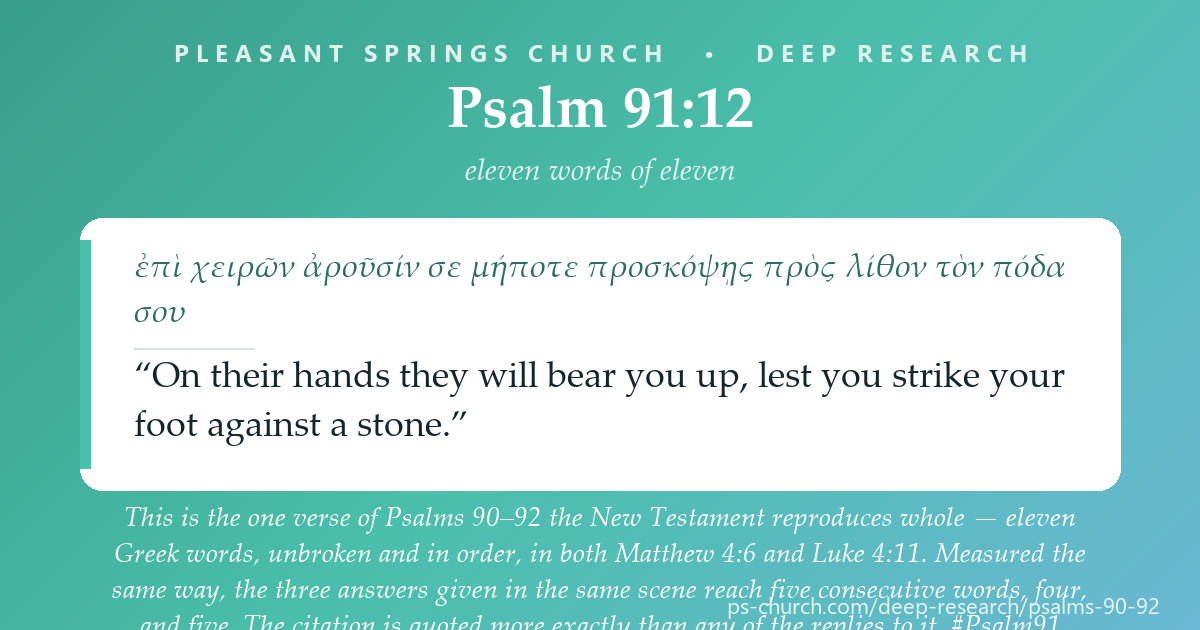
Hebrew · Greek (Rahlfs’ Psalter) · ESVRahlfs 90:12 — our Psalm 91:12 — runs to eleven Greek words: ἐπὶ χειρῶν ἀροῦσίν σε μήποτε προσκόψῃς πρὸς λίθον τὸν πόδα σου. Matthew 4:6 and Luke 4:11 each carry all eleven, unbroken and in order. Aligned token by token with accents normalised, the run is eleven of eleven in both Gospels.
⚠️ The verse before it is quoted nearly as exactly, and five words of it are not in the citation. Rahlfs 90:11 has fifteen words. Luke 4:10 reproduces ten of them unbroken and stops. The five that do not appear are ἐν πάσαις ταῖς ὁδοῖς σου — in all your ways, four English words and five Greek. That is a measurement of two texts, not an account of anyone’s motives. This page reports which words stand in which text and does not narrate the omission or assign a purpose to it.
⚠️ And one of the answers in the same scene is quoted to the same depth. Three replies are given, all from Deuteronomy. Measured the same way against the Greek Deuteronomy this library holds, Matthew 4:4 reaches eleven consecutive words of Deuteronomy 8:3 — the same depth as the Psalm 91 citation — while Matthew 4:7 reaches six and Matthew 4:10 four; Luke’s three reach eight, four and six. The depth varies, and this page prints it rather than rounding it up. Both sides of the exchange reproduce the Greek texts this library holds, word for word, as far as they go. Every figure here is a longest unbroken run of tokens against the Greek texts held here, measured under one rule applied to both sides — accents stripped, final sigma folded, and both the movable nu and elision resolved. That last step matters: without it Matthew 4:4 reads five rather than eleven, because the Greek Deuteronomy on disk elides where Matthew does not. An earlier version of this page compared the two sides under different rules and reported a gap that does not exist.
The Shape of the Passage
Sequence — Book IV opensWhat is real about Psalm 92’s middle is of a different kind, and it is worth printing. Hebrew 92:9 — But you, O Lord, are on high forever — is simultaneously the psalm’s middle line, its shortest line, and the line carrying its central statement about God. That is an observation about one verse, not a symmetry across the psalm, and the page prints it as the first and not the second.
Book IV begins here, immediately after Psalm 89 has said that the covenant with David appears to have failed. Its first psalm is the only one in the book headed by Moses, and it reaches back past David entirely. Psalm 91 has no Hebrew heading; Rahlfs 90:1 carries three heading elements with no Hebrew counterpart.
Author
Moses, by the heading of Psalm 90, and nowhere else in the book. Tested across all 150 openings: his name stands in one. The phrase man of God occurs seventy times in the Hebrew Bible and exactly once in the Psalter — in this heading.
Psalm 91 is anonymous in Hebrew. Rahlfs opens it a praise of a song, of David. The two texts do not agree that this psalm has an author.
Psalm 92 names no author and names a day instead. A Psalm. A Song for the Sabbath. It is the only Hebrew heading in the book that does.
Audience
People who had just heard Book III end unresolved. Lord, you have been our dwelling place in all generations. Book IV addresses God by name and, in the same line, calls him a place to live.
People who needed a promise about danger. You will not fear the terror of the night, nor the arrow that flies by day.
And people who kept a day. It is good to give thanks to the Lord… to declare your steadfast love in the morning, and your faithfulness by night. The two words Psalm 89 ended by asking after are the two words Psalm 92 sets to music.
Orient on Book IV, on Moses in the Psalter, and on Psalm 91 in later use.
Search by topic: Book IV of the Psalter; Moses; the Sabbath psalm; protection psalms; the divine names Elyon and Shaddai.
Which articles are relevant?
- Anchor Bible Dictionary — “Psalms, Book of,” “Moses,” “Sabbath,” “Names of God in the OT.”
- Dictionary of the OT: Wisdom, Poetry & Writings (IVP) — “Book of the Psalms: Structure,” “Protection Psalms,” “Divine Names.”
- NIDOTTE / TDOT — מָעוֹן (māʿōn, dwelling), שַׁדַּי (šadday), קֶטֶב (qeṭeḇ, destruction).
- On the Greek — the NETS Psalms introduction, with Rahlfs 90:1 and 90:6 read beside the Hebrew.
- On Book IV — Gerald H. Wilson, The Editing of the Hebrew Psalter, for the placement of Psalm 90 after Psalm 89.
Bibliography surfaced:
- John Goldingay, Psalms 90–150; Robert Alter, The Book of Psalms.
- Frank-Lothar Hossfeld and Erich Zenger, Psalms 2 (Hermeneia) — covers Psalms 51–100, so these three fall inside it.
- Gerald H. Wilson, The Editing of the Hebrew Psalter.
A noonday demon, a day in a heading, and two claims that fail.
Read Psalm 91 straight through in both columns; the two texts describe different dangers in the same verse.
Which parallels shed light on these psalms?
Psalm 92 is the only psalm whose Hebrew heading names a day, and the Greek names days in six. Scanning the first verse of all 150 psalms, exactly one Hebrew heading names a day: לְיוֹם הַשַּׁבָּת, for the sabbath day. Two other first verses answer a bare consonantal test and name no day — Psalm 18:1, whose heading carries בְּיוֹם in the clause about the day of the deliverance it narrates, and Psalm 133:1, whose שֶׁבֶת, dwelling, matches שבת only unpointed. Rahlfs carries a day-note in six headings — and Psalm 92’s is the only one of the six with a Hebrew counterpart, element for element. The other five are cross-linked on Psalms 47–48, where the shelf matched them against the Mishnah’s list of the daily Temple psalms.
⚠️ At Psalm 91:6 the two texts name different dangers. The Hebrew has קֶטֶב, a destruction that lays waste at noon. Rahlfs 90:6 reads δαιμονίου μεσημβρινοῦ — a noonday demon. This library found no parallel to the figure in the copy of Ancient Near Eastern Texts it holds, and reports the two readings without explaining either.
- Deuteronomy 8:3; 6:13; 6:16 → the wilderness temptation. Measured in the codex note above.
- Mishnah Tamid 7:4 → Psalm 92’s heading. The daily Temple psalms, matched against the Greek day-notes on Psalms 47–48.
- Psalm 89 → Psalm 90. The book that ends asking where God’s steadfast love and faithfulness went is followed by a psalm that calls him a dwelling place — and by Psalm 92, which sets both words to music at 92:2.
“2 Peter 3:8 quotes Psalm 90:4.” Aligned token by token, the two verses share two words: χίλια ἔτη, a thousand years. And two words is the best 2 Peter 3:8 achieves against any of the 2,534 verses of Rahlfs’ Greek Psalter — it ties at two across seven of them, on five different phrases, so it is the depth of the overlap and not its wording that fails to single this psalm out. The two words themselves, χίλια ἔτη, stand at one place only in the Rahlfs Psalter held here, and that place is this verse — but two words is the whole of the run. The idea is shared; the wording is not.
“Luke 10:19 draws on Psalm 91:13.” The longest unbroken run the two share is one word, and two words reach it — καί and, once elision is resolved on both sides, ἐπί. The creatures do not even match between the psalm’s own two texts: the Hebrew has lion, adder, young lion and serpent; Rahlfs 90:13 has asp, basilisk, lion and dragon.
A dwelling place, a demon, and a verse quoted entire.
Every count below was made on the texts named at the foot of this page, and every one can be repeated.
Counted here, not assumed:
- Verse counts. Psalm 90 — 17, 17, 17, offset 0. Psalm 91 — 16, 16, 16, offset 0. Psalm 92 — 16 Hebrew, 16 Rahlfs, 15 English, offset one. In Greek numbering these are Psalms 89–91.
- Psalm 91 has no Hebrew heading, and Rahlfs 90:1 carries three heading elements with no Hebrew counterpart. Psalms 90 and 92 have no such unmatched element: every part of their Greek headings answers a part of the Hebrew.
- Counted on the Masoretic text held here, משה with any prefix stands in exactly one of the 150 psalm first verses. And man of God — counting both spellings, איש האלהים and איש אלהים — stands once in the whole Psalter, in the same heading.
- Psalm 92 is the only psalm whose Hebrew heading names a day. Rahlfs names a day in six headings; this is the only one of the six with a Hebrew counterpart.
- Rahlfs 90:12 is eleven Greek words, and Matthew 4:6 and Luke 4:11 each reproduce all eleven. Aligned token by token with accents normalised and the movable nu resolved.
- Rahlfs 90:11 is fifteen words; Luke 4:10 reproduces ten of them unbroken. The five that are not in the citation are ἐν πάσαις ταῖς ὁδοῖς σου.
- In Matthew the three replies reach eleven, six and four consecutive words against the Greek Deuteronomy held here; in Luke they reach eight, four and six. Matthew 4:4 against Deuteronomy 8:3 is the eleven, and it matches the Psalm 91 citation exactly.
- ⚠️ Psalm 91 ranks first of 150 for the share of its distinct consonantal word-forms that stand exactly once in the whole Psalter — 43.4% against a book mean of 27.0%, with Psalm 68 next at 42.9% and no tie at the top. Counted the other way — forms that stand in no other psalm — Psalm 91 is the same 43.4% but ranks fifth, behind Psalms 114, 68, 119 and 78, against a mean of 28.0%. Stated with the rule and the baseline, because without them the figure means nothing.
- Counted on the consonants סלה in the Masoretic text held here, there is no Selah in Psalms 90, 91 or 92 — and none anywhere in Book IV, Psalms 90–106. Seventy-one stand elsewhere in the Psalter.
- ⚠️ The Greek of these psalms is not unusually full. The Greek-to-Hebrew word ratio for the three is 1.80, 1.81 and 1.74, against 1.79 for the Psalter as a whole — 34,964 Greek words to 19,586 Hebrew — and 1.74 for the unweighted mean of the 148 psalm-by-psalm ratios, sd 0.14. All three sit inside one standard deviation of both figures, so any impression that the Greek expands here is not supported by the counting.
- One full ketiv/qere in the unit, at 92:15, and the codex prints the qere. The edition marks a second and trivial one at 90:8 — a verse the codex does not print.
“Dwelling place.” What Book IV calls God in its first line, straight after addressing him. Rahlfs reads καταφυγή, refuge, both here and at Psalm 91:9. Counted on the spellings מָעוֹן, מְעוֹן, בִּמְעוֹן and מְעוֹנֶךָ in the Masoretic text held here, this noun stands at three other places in the Psalter. At 68:6 and 71:3 Rahlfs has τόπος. At 26:8, where the Hebrew has מְעוֹן בֵּיתֶךָ, Rahlfs 25:8 has εὐπρέπεια, and the τόπος of that verse stands where the Hebrew has וּמְקוֹם. Spellings, not a root — there is no Hebrew lemmatiser here. ESV footnotes its own text here: Some Hebrew manuscripts (compare Septuagint) our refuge.
“Our days” — or, on the same consonants, a form of right hand. The string ימינו stands three times in Psalm 90, and Rahlfs reads it as days twice and as right hand once, at the verse the psalm is best known for.
“Destruction.” Rahlfs reads δαιμόνιον, a demon. Where the Hebrew names a thing that happens, the Greek names a thing that acts.
“Almighty.” Psalm 91:1–2 stacks four divine designations in two lines — Most High, Almighty, Lord, my God. Rahlfs 90:1 has τοῦ θεοῦ τοῦ οὐρανοῦ, the God of heaven, where the Hebrew has this name.
“On their hands they will bear you up.” The opening of the one verse in these three psalms that the New Testament reproduces whole. Eleven Greek words, and both Gospels carry all eleven unbroken.
“A noonday demon.” What stands in Rahlfs where the Hebrew has a destruction that lays waste at noon. The page reports the two readings and offers no account of how either arose.
One verse quoted entire, and four cross-references that route elsewhere.
Every measurement below was made against the SBL Greek New Testament, token by token, with accents normalised and punctuation excluded.
Which cross-references matter?
Psalm 91:11–12 is the only place in these three psalms where the New Testament reproduces a run of more than five words, and it does so twice. Rahlfs 90:12 is carried whole — eleven of eleven — in both Matthew 4:6 and Luke 4:11. Rahlfs 90:11 is carried ten words deep in Luke 4:10. Nothing else in Psalms 90, 91 or 92 reaches six. For scale: sixteen verses of Rahlfs’ Greek Psalter stand entire inside a single New Testament verse, and twenty of its 2,534 verses reach a run of eleven words or more. Rahlfs 90:12 is one of each, and the ninth-longest of the sixteen.
⚠️ Four cross-references that a run-length sweep flags and that belong elsewhere. Matthew 7:23 shares four words with Psalm 92:7 — and the same four, οἱ ἐργαζόμενοι τὴν ἀνομίαν, tie across eight verses of the Greek Psalter, two of them inside Psalm 92 itself, so it points at none of them. Hebrews 1:8 shares five with Psalm 92:7 and ten with Psalm 45:6 — the only Psalter verse it reaches beyond five, and its longest run with any verse in the book. Revelation 15:3 shares four with Psalm 92:5 and ties at four across four Psalter verses in all — Psalms 92:5, 104:24, 107:11 and 35:24 — and Psalm 104:24 opens with the same six Greek words as Psalm 92:5. Acts 7:41 shares five with Psalm 92:4 and ties with Psalm 9:16. All four are formula collisions, and each is quantified rather than dismissed.
- Matthew 4:6 · Luke 4:11 → Psalm 91:12 · Rahlfs 90:12. Eleven words of eleven.
- Luke 4:10 → Psalm 91:11 · Rahlfs 90:11. Ten of fifteen; the five not carried are ἐν πάσαις ταῖς ὁδοῖς σου.
- Deuteronomy 8:3; 6:13; 6:16 → Matthew 4:4, 4:7, 4:10; Luke 4:4, 4:8, 4:12. Against the Greek Deuteronomy held here: eleven, six and four consecutive words in Matthew, and eight, four and six in Luke — Matthew 4:4 against Deuteronomy 8:3 reaching the same eleven as the psalm citation, and Luke’s shorter form of that reply reaching eight.
- ⚠️ 2 Peter 3:8 is not quoting Psalm 90:4. Two words, and two words is its best against any psalm.
- ⚠️ Luke 10:19 is not quoting Psalm 91:13. One word deep — and the only words the two hold in common are καί and ἐπί.
Four things this page reports as unsettled.
Goldingay and Alter for the Hebrew; Wilson for the book seam; the ESV footnotes for where the versions themselves hesitate.
Commentaries & studies:
- John Goldingay, Psalms 90–150; Robert Alter, The Book of Psalms.
- Frank-Lothar Hossfeld and Erich Zenger, Psalms 2 (Hermeneia).
- Gerald H. Wilson, The Editing of the Hebrew Psalter.
- NETS Psalms, with Rahlfs.
Four things reported as unsettled:
- What Psalm 90:12 asks for. The same five consonants ימינו can be pointed our days or as a form of right hand, and the two texts read them differently in this verse while agreeing elsewhere in the same psalm. This page adopts neither.
- What Psalm 91:6 describes. A destruction in one text and a demon in the other.
- Who says what at Psalm 91:2. ESV prints I will say and footnotes Septuagint He will say. The ESV flags the divergence itself, and this page follows it in naming rather than settling it.
- What Psalm 92:10 says. ESV footnotes it directly: Compare Syriac; the meaning of the Hebrew is uncertain.
The verse quoted whole.
Name what you learned, why it matters, and one concrete response.
What should we carry away — and do?
- Book IV opens by reaching back past David. Psalm 89 ends asking where God’s steadfast love went; Psalm 90 is headed by Moses and calls God a dwelling place. The book answers a collapse by going further back, not further forward.
- The one verse here the New Testament carries whole is carried in a temptation. Eleven Greek words, unbroken, in both Gospels. Scripture quoted exactly is not the same thing as Scripture used rightly, and the scene is built on the difference.
- Four words of the verse before it are not in the citation. in all your ways. The page reports which words stand where and does not narrate why.
- One concrete response. It is good to give thanks to the Lord… to declare your steadfast love in the morning, and your faithfulness by night. Psalm 92 sets to music the two words Psalm 89 ended by asking after. Three psalms later, they are back in a song for a fixed day of the week.
Psalm 91:12 · to share
Hebrew + Greek (Rahlfs) + ESVEvery Deep Research page traces its passage across the whole sweep — the Old Testament, the Second-Temple world between the testaments (historical witnesses, not Scripture), and the New Testament. Follow the thread:
Pleasant Springs Church — Deep Research
Research method after Michael S. Heiser’s Bible Research Method (examine dictionaries → ancient literature → important words → textual connections → academic publications → share), with the Pleasant Springs “Author & Audience” foundation. Scripture set in the Hebrew, the Greek editions named on each page and the ESV (Old Testament), and the Greek New Testament and the ESV (New Testament), per the practice of Pleasant Springs Church. Psalms 90–92 research grounded in Goldingay (Psalms 90–150) and Alter, with Wilson (The Editing of the Hebrew Psalter) for the Book III/IV seam. Text: Hebrew from the Masoretic text as printed in the editions consulted — Sefaria’s Miqra according to the Masorah; no critical apparatus was consulted for the Hebrew, the paseq is not reproduced in the codex lines, and where the Masoretic text carries a ketiv/qere the codex prints the qere — in this unit that is 92:15, Hebrew 92:16, ketiv עלתה and qere עַוְלָתָה. The edition also marks a trivial ketiv/qere at Hebrew 90:8, a verse this page does not print. Greek from Rahlfs’ Greek Psalter and Deuteronomy (CATSS digitizations); Greek New Testament from the SBL edition. The standing caution for this shelf applies: these pages say “Rahlfs’ Greek Psalter reads…” and never call a Greek reading early or late. ⚠️ The temptation measurement, stated so it can be repeated. Every figure is a longest unbroken run of tokens, measured on the SBL Greek New Testament’s punctuation-free field against the CATSS text, with accents stripped by Unicode decomposition, final sigma folded, and the editorial marker around a movable nu resolved — without that last step the Luke 4:11 run reads eight instead of eleven. Rahlfs 90:12 = 11 tokens, and Matthew 4:6 and Luke 4:11 each reach 11. Rahlfs 90:11 = 15 tokens, and Luke 4:10 reaches 10. The three replies were measured against Greek Deuteronomy 8:3, 6:13 and 6:16 and reach 11 (Matthew 4:4), 6 (Matthew 4:7 and Luke 4:12) and 4 (Matthew 4:10 and Luke 4:8). Elision is resolved on both sides — the Greek Deuteronomy on disk prints ἐπ’ and ἀλλ’ where the Gospels print the full forms, and without resolving that Matthew 4:4 reads five instead of eleven. Applying the movable-nu rule to one side and not the elision rule to the other produced a difference that is not in the texts, and an earlier version of this page printed it. ⚠️ The page makes no claim about anyone’s intention in either direction, and none of these figures bears on which text anyone had in front of them. ⚠️ The structure tests, stated so they can be repeated. Psalm 92’s fifteen poetic lines are Hebrew 92:2–16, the heading excluded. Each line was reduced to its set of distinct consonantal word-forms and the chiasm was scored as the total number of forms shared between mirrored pairs — line 1 with line 15, 2 with 14, and so on to 7 with 9. The observed score is 3, and it was compared against 25,000 random reorderings of the same fifteen line-sets under random.Random(20260805): 4,677 reorderings scored 3 or better, giving p = 0.19. All three of those shared forms come from one mirrored pair — Hebrew 92:8 with 92:10, which share כל פעלי און — and every other mirrored pair shares nothing at all. The declare inclusio is reported here as what it is, a plain repetition rather than a test result: להגיד stands at Hebrew 92:3 and again at 92:16, and it is the only form those two lines share. It is not a first-and-last frame, because the first poetic line is 92:2. The block claims for Psalms 90 and 91 fail the same way, so no structure is drawn and the failures are reported. ⚠️ The rare-vocabulary figure carries its rule and its baseline. Distinct consonantal word-forms of each psalm, heading included. Under the rule stands exactly once in the whole Psalter, Psalm 91 is 43.4% and ranks first of 150, Psalm 68 next at 42.9%, book mean 27.0%. Under the rule stands in no other psalm it is the same 43.4% but ranks fifth, behind Psalms 114 (50.0%), 68 (45.4%), 119 (44.7%) and 78 (44.5%), book mean 28.0%. The two rules coincide for Psalm 91 because every form unique to it also happens to occur exactly once. The Greek-to-Hebrew word ratio for all three psalms sits within one standard deviation of the Psalter figure, so nothing here supports the impression that the Greek expands. ⚠️ How the Hebrew was counted. Words split on whitespace and maqqef, and a token counts only if it carries a letter in the range א–ת; a ketiv/qere pair counts once, and the qere is the one counted. Under that rule the Psalter is 19,586 words in 2,527 verses and the thirty-nine books held here 305,579 words, and every Hebrew figure on this page is made under it — the heading scans, the man of God count, the Selah negative, the rare-vocabulary share, the structure tests and the word counts at 92:9. These are form counts. No Hebrew lemmatiser is held here, so no root or lemma claim is made anywhere on this page. ⚠️ Absolute negatives are scoped to what is on disk. Greek claims are scoped to the twenty-two Greek Old Testament books available here, and Isaiah, Jeremiah and Ezekiel are not among them. ⚠️ What was not consulted. No Qumran manuscript of Psalm 91 and no claim about its later use as a protective text; no Cairo Geniza fragment, no Syriac, no Vulgate or Gallican Psalter, no Aquila, Symmachus or Theodotion, and no critical apparatus for either text. The copy of Ancient Near Eastern Texts held here yielded no parallel to Psalm 90:4 or to the noonday demon, and the page says so rather than reaching for one. Verse counts verified in all three columns (17/17/17, 16/16/16, 16/16/15). Typology is handled per the house position: what the text says, what the New Testament itself draws, and what we see from this side of the cross — with the seeing left to the reader.
Scripture quotations marked ESV are from the ESV® Bible (The Holy Bible, English Standard Version®), © 2001 by Crossway, a publishing ministry of Good News Publishers. ESV Text Edition: 2016. Used by permission. All rights reserved. The ESV text may not be quoted in any publication made available to the public by a Creative Commons license, and the ESV may not be translated in whole or in part into any other language. www.esv.org
|
Did this study bless you today? 💚 Give to Support PS Church100% of gifts go to the General Fund — thank you. |