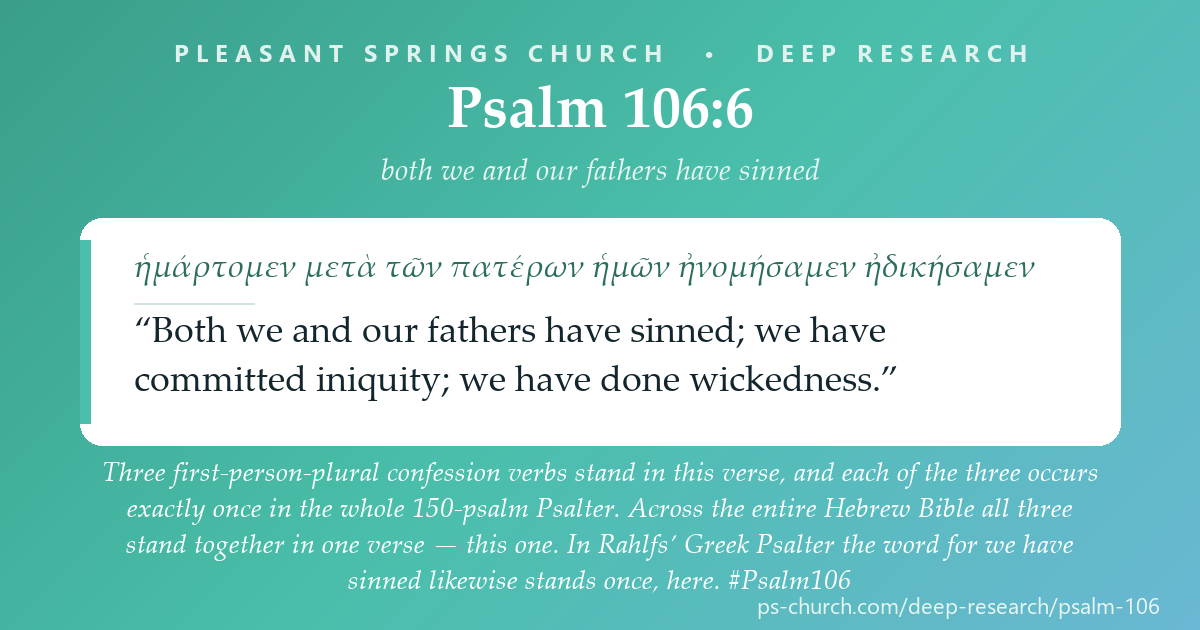
Psalm 106:6 carries three first-person-plural confession verbs — we have sinned, we have committed iniquity, we have done wickedness. Each of the three occurs exactly once in the entire 150-psalm Psalter, and all three are in this one verse. Across the whole Hebrew Bible the three stand together in one verse — this one; the nearest thing to it is Daniel 9:5, which has two of them. In Rahlfs' Greek Psalter the word for we have sinned likewise stands exactly once, at the same verse. Along the way: why the Hebrew frame of this psalm survives its statistical test and the Greek frame does not, why the only psalm that opens and closes with hallelujah is false — eight do — and why Psalm 106:20 does not say what most English Bibles print. See the method →
Psalm 106
Hebrew · Greek (Rahlfs’ Psalter) · ESVThree first-person-plural verbs stand in that verse. Scanned across all 150 psalms as exact consonantal forms, each of the three occurs exactly once, and the one occurrence is this verse:
• we have sinned — once in the Psalter; 23 verses in the whole Hebrew Bible
• we have committed iniquity — once in the Psalter; 2 verses in the whole Hebrew Bible
• we have done wickedness — once in the Psalter; 3 verses in the whole Hebrew Bible
And all three stand together in exactly one verse of the entire Hebrew Bible — this one. The nearest thing to it anywhere else is Daniel 9:5, which has two of the three.
⚠️ The Greek says the same thing about itself. The Greek word for we have sinned, ἡμάρτομεν, stands once in the whole of Rahlfs’ Greek Psalter — at 105:6, the same verse.
⚠️ What the psalm does with it. The confession is the sixth verse of forty-eight. Everything after it is the history that the confession is about — Egypt, the sea, the calf, the spies, Baal of Peor, the waters of Meribah, the nations, the idols, the children. The psalm confesses first and gives its evidence afterwards. These are counts of exact consonantal forms in Sefaria’s MAM and of exact Greek forms in the Rahlfs Psalter this library holds. A root-level count would return larger numbers, and a page that reported a root count as a form count would be reporting something else. The rule is stated here so the figures can be repeated.
The Shape of the Passage
Structure — one frame survives in Hebrew, and it does not survive in GreekOne frame does survive. Verse 1 against verse 48 returns p = 0.0098 on raw shared forms and p = 0.0078 weighted — and the whole of it rests on two words: praise and the short form of the divine name, standing at the head of verse 1 and at the foot of verse 48.
⚠️ And that frame is not closed in the Greek. Rahlfs 105:1 opens αλληλουια. Rahlfs 105:48 ends γένοιτο γένοιτο, and there is no counterpart in it to the Hebrew’s closing two words. The one structural claim this psalm supports is a claim about the Hebrew text and not about both. That is a description of where the words stand in the two texts held here. It is not a claim that anything was moved, in either direction, and this page makes none.
⚠️ A famous claim about that frame, and it is false. “Psalm 106 is the only psalm that both begins and ends with hallelujah.” Eight do — Psalms 106, 113, 135, 146, 147, 148, 149 and 150. What is true of Psalm 106 alone is that it is the only one of the eight that closes a book of the Psalter.
No Hebrew heading at all. Verse 1 opens straight into הַ֥לְלוּ יָ֨הּ, and Rahlfs 105:1 opens with the Greek form of the same word. Psalm 106 is the longest psalm in Book IV — 331 Hebrew words, against 294 for Psalm 105 and 271 for Psalm 104.
Author
Anonymous, and speaking as a nation. Both we and our fathers have sinned. The psalm has one verse of first-person singular — verses 4 and 5, remember me and that I may look — and the rest is we.
Rahlfs 105:4–5 has plural forms where the Hebrew has singular ones. The two texts are describing the same petition with different numbers, and the page reports both.
The last verse is not part of the poem. Psalm 106:48 is a doxology closing Book IV, and it matches the ones at Psalms 41:14, 72:19 and 89:53. In Rahlfs’ Greek Psalter all four of them end with the same two words. In Hebrew the first three end Amen and Amen, and this one ends Amen. Praise the Lord.
And it names Moses more than any psalm does. Three times — verses 16, 23 and 32. Moses is named in eight verses of the whole Psalter, and three of the eight are here.
Audience
People scattered, and asking to be gathered. Save us, O Lord our God, and gather us from among the nations. The psalm ends by asking for something the whole history it just told says they did not earn.
People who already know the stories. Egypt, the sea, the calf, the spies, Baal of Peor, the waters of Meribah. The psalm does not explain a single one of them.
And people expected to answer out loud. And let all the people say, Amen! The last verse of Book IV writes the congregation’s line into the text.
Orient on communal confession, on the book divisions, and on Phinehas.
Search by topic: communal lament; confession of sin; the doxologies of the Psalter; Phinehas; Baal of Peor.
Which articles are relevant?
- Anchor Bible Dictionary — “Confession,” “Phinehas,” “Baal-Peor,” “Psalms, Book of.”
- Dictionary of the OT: Wisdom, Poetry & Writings (IVP) — “Historical Psalms,” “Lament, Communal,” “Book of Psalms IV.”
- NIDOTTE / TDOT — חָטָ֥אנוּ (ḥāṭāʾnû, we have sinned), וַיְפַלֵּ֑ל (waypəallēl, and he interposed).
- On the Greek — the NETS Psalms introduction, with Rahlfs 105:15 and 105:30 read beside the Hebrew before any commentary.
- On the doxologies — any treatment that prints all four book-endings side by side in both languages.
Bibliography surfaced:
- John Goldingay, Psalms 90–150; Robert Alter, The Book of Psalms.
- Frank-Lothar Hossfeld and Erich Zenger, Psalms 3 (Hermeneia).
- Gerald H. Wilson, The Editing of the Hebrew Psalter — for 106:48 as a seam rather than a line.
A confession that has three parallels, a doxology that has three, and three claims that fail.
Every count below is of exact consonantal forms, scanned across the thirty-nine book Hebrew corpus this library holds.
Which parallels shed light on this psalm?
The confession has a family, and Psalm 106:6 is the only member of it in the Psalter. The verb we have sinned stands in twenty-three verses of the Hebrew Bible — in Numbers, in Deuteronomy, in Judges, in Samuel, in Kings, in Jeremiah, in Lamentations and in Daniel. It stands in the Psalter once. And the nearest thing anywhere to this verse’s three-verb sequence is Daniel 9:5, which carries two of the three.
Verse 48 is not the psalm’s ending. It is the book’s. The same formula closes Book I at Psalm 41:14, Book II at 72:19 and Book III at 89:53. In Rahlfs’ Greek Psalter all four end with the identical two words — γένοιτο γένοιτο. In Hebrew the first three end Amen and Amen and this one does not.
- Daniel 9:5 → Psalm 106:6. Two of the three confession verbs, in the same order.
- Genesis 15:6 → Psalm 106:31. The same clause, used of a different man. The New Testament verses that take up that clause take it from Genesis.
- 1 Chronicles 16:34–36 → Psalm 106:1, 47–48. Measured in both languages; compare Psalm 105, whose first fifteen verses stand in the same chapter.
- Numbers 25 → Psalm 106:28–31. Baal of Peor and Phinehas, in four verses.
- Psalms 41:14 · 72:19 · 89:53 → Psalm 106:48. The four book-endings.
“Romans 1:23 quotes Psalm 106:20.” The longest unbroken run the two share is two words. The frame is genuinely shared — a glory exchanged for the likeness of an animal — and the wording is not. This page calls it a shared frame and not a quotation.
“Psalm 106:20 says they exchanged the glory of God.” The Hebrew reads their glory and Rahlfs reads their glory. Both texts agree with each other and neither says of God. The ESVprints the glory of God here, and this page prints the ESV as it stands and notes the difference rather than quietly amending it.
“Psalm 106 lists seven rebellions.” The number depends entirely on where you draw the lines, and this library found no way to derive it that anyone else could repeat. It is a reading, not a measurement, and the page does not print it as one.
The Greek of Numbers arrived, and four rows of this psalm moved
Psalm 106 is a rehearsal of the Pentateuch, and until 30 August 2026 this library could not run a single line of it against the Greek of the books it rehearses. Greek Exodus, Leviticus and Numbers were not on this shelf; the footer of this page said so and said that no claim was being made about how any of them reads. All three are held now — 64 CATSS files, 30,637 verse units held and 30,348 screened — and the psalm was screened verse by verse against every one of them.
Four rows changed their deepest partner, and all four now point into Greek Numbers.
| row | run / band 44 files, 23,061 units | run / band 64 files, 30,348 units screened | the shared words |
|---|---|---|---|
| Rahlfs 105:17 (Ps 106:17 — the earth swallowed Dathan) | 3 / 29 | 5 / 1 — Numbers 16:32 | ἠνοίχθη ἡ γῆ καὶ κατέπιεν |
| Rahlfs 105:28 (Ps 106:28 — Baal of Peor) | 2 / 32 | 3 / 1 — Numbers 25:3 | τῷ Βεελφεγωρ καί |
| Rahlfs 105:30 (Ps 106:30 — Phinehas, and the plague stayed) | 2 / 69 | 4 / 2 — Numbers 17:13 and 17:15 | καὶ ἐκόπασεν ἡ θραῦσις |
| Rahlfs 105:40 (Ps 106:40 — the anger of the Lord) | 5 / 5 | 6 / 1 — Numbers 32:13 | καὶ ὠργίσθη θυμῷ κύριος ἐπὶ τόν |
Across the whole psalm the distribution barely moved and the top of it did not move at all. Over 44 files: 44 of the 48 rows reached three, 32 reached four, 11 reached five, 4 reached six. Over 64: 47 reached three, 34 four, 12 five, 5 six. 105:48 is still 16 with a tie band of 1 against 1 Chronicles 16:36, and 105:1 is still 13 with a band of 2. The psalm’s two deepest contacts are where they were. ⚠️ And the whole table was screened a third time on the same day, with the Odes out of the corpus, at 30,348 units instead of 30,637: every run and every tie band above is identical, and so is the distribution. No verse of this psalm had a canticle as its deepest partner at any depth. The one figure on this page the Odes did touch is the ἡμάρτομεν census below, 41 to 40.
Psalm 106:30 is about Baal of Peor. Its four-word run is not. The psalm reads καὶ ἔστη Φινεες καὶ ἐξιλάσατο καὶ ἐκόπασεν ἡ θραῦσις — and Phinehas stood and made atonement, and the plague was stayed. The last four words stand verbatim in Greek Numbers 17:13 and 17:15, and those two verses are not about Peor at all: they are Aaron with the censer standing between the dead and the living after Korah.
Greek Numbers 25:8, the Peor plague itself, does not read that way. It reads καὶ ἐπαύσατο ἡ πληγή — a different verb and a different noun — and Psalm 105:30 shares exactly one word with it, καί.
So in Greek the psalm tells the Peor story in Korah’s vocabulary. This page reports that and stops there. It does not claim the psalmist conflated the two episodes, and it does not claim the Greek translator did. A run screen sees word forms; it cannot see a memory, a shared formula for plague-language, or a translator reaching for the phrase he had already used four chapters earlier. What it can say is that the measurement was impossible on this shelf until Greek Numbers arrived, and that it is on the page the day it became possible.
“We have sinned” across the whole Greek Old Testament, not just the Psalter
The Hebrew claim on this page is that חָטָ֥אנוּ stands in twenty-three verses of the Hebrew Bible and exactly one of them is a psalm. The Greek claim was smaller, because the Greek corpus was. It said only that ἡμάρτομεν stands once in the whole Rahlfs Psalter, at 105:6. That is still true. But the same form can now be counted across the entire Greek Old Testament held here, which it could not be before.
ἡμάρτομεν stands in 40 of the 30,348 verse units this shelf screens — and exactly one of the 40 is a psalm. Genesis 20:9, Deuteronomy 1:41, Numbers 12:11, 14:40 and 21:7, Judges 10:10 and 10:15 in both the A and B recensions, 1 Kingdoms 12:10, 3 Kingdoms 8:47, 2 Chronicles 6:37, 2 Esdras 11:6, Esther 4:17n, Isaiah 64:4, Jeremiah 3:25, 8:14, 14:7, 14:20 and 16:10, Lamentations 5:16, Daniel 3:29 and 9:5, 9:8, 9:11, 9:15 in the Old Greek and the same verses plus 9:16 in Theodotion — and Rahlfs 105:6. Seven of the 40 are in books this shelf holds as witnesses and not as Scripture: five in Baruch (1:13, 1:17, 2:5, 2:12, 3:2) and two in 1 Esdras (8:89, 9:11).
⚠️ This count read 41 for one day, and the forty-first was an Ode. The old list is printed here rather than quietly shortened. It ended “…and one in the Odes (7:29, which is the Prayer of Azariah repeating Daniel 3:29).” That parenthesis was the confession that the row should not have been counted: the Odes are the liturgical canticles bound after the Greek Psalter, and ten of them are second copies of passages already in the corpus — Ode 1 is Exodus 15, Ode 2 is Deuteronomy 32, Ode 4 is Habakkuk 3, Ode 11 is Isaiah 38, and Odes 7 and 8 are Daniel (Th) 3. So Ode 7:29 was Daniel 3:29 a second time, and this page was counting one occurrence of ἡμάρτομεν twice. The Odes stay on this disk and are out of the screening corpus: 30,637 units held, 30,348 screened, and the difference is exactly the 289 units of the canticles.
⚠️ And the correction fixes an arithmetic slip it also exposes. The old sentence said seven of the 41 stood in witnesses and then listed eight — five in Baruch, two in 1 Esdras, one in the Odes. With the Ode out, the label and the list agree at seven for the first time. The page would rather show that the duplicate was already making its own count fail to add up than present a tidy seven and say nothing.
⚠️ The other half of the Odes problem does not touch this page, and it is the half worth knowing about. Ode 9 is Luke 1 — the Magnificat and the Benedictus — and Ode 13 is Luke 2, the Nunc Dimittis. Screened as Old Testament, Ode 9:48 matches Luke 1:48 at eighteen consecutive words, and a page could print that as a Gospel’s deepest Old Testament contact while measuring Luke against Luke. No hit removed from this page was in Ode 9 or Ode 13 — the one that went was Ode 7:29, the duplication arm. Both arms are caught the same way: by asking which book a hit came out of before believing the number.
The Greek behaves exactly as the Hebrew does. Confession of this form is the language of the narrative books and the prophets, and the Psalter says it once. Three of the 40 are in Greek Numbers, which was not on this shelf when the page was written — and Numbers is the book Psalm 106 is retelling when it says it.
Three verbs that occur once each, and two divergences worth seeing.
Every count below was run on this library’s own texts and is stated with its scope, so a reader can repeat it and get the same number or show that it is wrong.
“We have sinned.” Once in the whole Psalter. Twenty-three verses of the Hebrew Bible carry this exact form, and exactly one of them is a psalm. Rahlfs’ ἡμάρτομεν behaves the same way — once in the whole Greek Psalter, at the same verse.
“We have committed iniquity.” Two verses in the whole Hebrew Bible carry this form. Rahlfs has ἠνομήσαμεν, we have acted lawlessly.
“We have done wickedness.” Three verses in the whole Hebrew Bible carry this form — and one of the other two is Daniel 9:5. Rahlfs has ἠδικήσαμεν, we have done wrong.
“Leanness, wasting.” The widest divergence in the psalm. Where the Hebrew has this word, Rahlfs 105:15 has πλησμονήν — fullness, satiety. The two words point opposite ways. This page reports both readings and adjudicates neither, and calls neither one early or late.
“And he interposed” — ESV intervened; the verb is also read executed judgement and interceded. Where the Hebrew has it, Rahlfs has ἐξιλάσατο, made atonement.
The rule. Exact consonantal forms, matched whole, in the thirty-nine book Hebrew corpus of Sefaria’s Miqra according to the Masorah. No prefixes allowed, because these are finite verbs and a prefix would change the form.
In the Psalter. Each of the three occurs once, and the one occurrence is Psalm 106:6.
In the whole Hebrew Bible. 23 verses, 2 verses and 3 verses respectively — and all three together in one verse, this one.
In Rahlfs’ Greek Psalter. The word for we have sinned occurs once, at 105:6.
What was not done. No null test, because this is a census of the whole corpus rather than a sample. And no root-level count is reported as if it were a form count: at root level the numbers are much larger, and saying so is the difference between a repeatable figure and an impressive one.
A psalm the New Testament does not quote, and five cross-references that fail.
The New Testament sweep is exhaustive: every n-gram of this psalm's Greek at every length from three words up, against all 7,927 verses of the SBL edition.
Where does the New Testament take up this psalm?
Not at quotation strength anywhere. Every candidate that commentaries name was measured, and every one of them either routes through a different text or reaches too few words to be called a citation.
The sharpest of them is worth stating carefully. Hebrews 3:16 has παρεπίκραναν, and the identical form stands three times in Rahlfs’ Psalm 105 — at verses 7, 33 and 43. Hebrews 3 is quoting Psalm 95. A shared inflected form is not a citation, and this trap catches Psalm 105 as well; see Psalm 105.
- Psalm 106:31 → Romans 4:3 · Galatians 3:6 · James 2:23. A trap. All three quote Genesis 15:6, about Abraham. The psalm applies the same clause to Phinehas, and the New Testament does not follow it there.
- Psalm 106:20 → Romans 1:23. 2 words. A shared frame, not a quotation.
- Psalm 106:48 → Luke 1:68. 4 words — and non-discriminating. The identical four-word run stands in more than one psalm, so it cannot point at this one.
- Psalm 106:37 → 1 Corinthians 10:20. 1 word. Paul is working from Deuteronomy 32.
- Psalm 106:19–20 → Acts 7:41. 1 word. Shared story, and Stephen’s verb is a compound of the psalm’s two nouns rather than a quotation of them.
- Psalm 106:7, 33, 43 → Hebrews 3:16. An identical verb form, and no relationship.
What is settled, what is contested, and what this page refuses to decide.
What is the state of the discussion?
Settled: that 106:48 is a book-closing doxology and not the last line of the poem. Three of the four such verses stand at 41:14, 72:19 and 89:53, and the Masoretic section markers in this text treat them the same way.
Contested, and left contested: what stood in the Hebrew behind Rahlfs 105:15, where the Hebrew has a word for wasting and the Greek a word for fullness. This library holds no critical apparatus for either text.
Contested, and left contested: whether Psalms 105 and 106 were composed as a pair. The vocabulary result depends on which null you run. Under one test the pairing clears; under a token-level size-matched test it does not. And Psalm 78 pairs with Psalm 106 more strongly than Psalm 105 does on the same measure. A result that flips with the null is not a finding, and this page reports it as unresolved rather than picking the null that gives the answer everyone expects.
- Hossfeld and Zenger, Psalms 3 (Hermeneia) — on 105/106 and the close of Book IV.
- Wilson, The Editing of the Hebrew Psalter — on the doxologies as seams.
- The NETS Psalms volume — for 105:15 and 105:30 read as translation.
Where this lands.
What is worth carrying out of Psalm 106?
The whole book says it once. A hundred and fifty psalms, and the sentence we have sinned stands in one of them, in one verse. It is not that the Psalter avoids sin — it is full of it. It is that the Psalter almost never says we.
The confession comes before the evidence. Verse 6 admits it; verses 7 to 46 explain what is being admitted. The psalm does not argue its way to the confession. It starts there.
One concrete response. Say verse 6 in the first person plural, out loud, with people — and then read the forty verses that follow it as the reason. That is the psalm’s own order.
Every Deep Research page traces its passage across the whole sweep — the Old Testament, the Second-Temple world between the testaments (historical witnesses, not Scripture), and the New Testament. Follow the thread:
Pleasant Springs Church — Deep Research
Research method after Michael S. Heiser’s Bible Research Method (examine dictionaries → ancient literature → important words → textual connections → academic publications → share), with the Pleasant Springs “Author & Audience” foundation. Scripture set in the Hebrew, the Greek editions named on each page and the ESV (Old Testament), and the Greek New Testament and the ESV (New Testament), per the practice of Pleasant Springs Church. Psalm 106 research grounded in Goldingay (Psalms 90–150), Hossfeld and Zenger (Psalms 3), Wilson and Alter. Text: Hebrew from the Masoretic text as printed in the editions consulted — Sefaria’s Miqra according to the Masorah; no critical apparatus was consulted for the Hebrew, the paseq is not reproduced in the codex lines, and this psalm carries one ketiv/qere, at 106:45, which the edition prints as a single hybrid form. Greek from Rahlfs’ Greek Psalter (CATSS digitization); Greek New Testament from the SBL edition. The standing caution for this shelf applies: these pages say “Rahlfs’ Greek Psalter reads…” and never call a Greek reading early or late. ⚠️ The confession count, stated so it can be repeated. Exact consonantal forms, matched whole, across the thirty-nine book Hebrew corpus. חָטָ֥אנוּ = 23 verses in the Hebrew Bible, 1 in the Psalter; הֶעֱוִ֥ינוּ = 2 verses, 1 in the Psalter; הִרְשָֽׁעְנוּ = 3 verses, 1 in the Psalter; all three in one verse = Psalm 106:6 alone. ἡμάρτομεν = 1 verse in the whole Rahlfs Psalter, at 105:6 — and, now that the whole Greek Old Testament can be searched, 40 verse units in the 30,348 screened, of which that psalm is the only psalm; seven of the 40 stand in Baruch and 1 Esdras, witnesses, not Scripture, and three stand in Greek Numbers, which was not on this shelf when the page was written. ⚠️ This read 41 in 30,637 for one day; the forty-first was Odes 7:29, which is Daniel 3:29 counted a second time, and the correction is set out in stage 2. These are form counts, not root counts, and a root count returns much larger numbers — the distinction is stated because an unpublished rule is how a true measurement becomes an unrepeatable one. ⚠️ The structure tests. Block pairings were scored by shared distinctive vocabulary against 20,000 within-psalm reshuffles with block sizes preserved: vv 6–23 against 24–46 returned p = 0.99, and the outer twelves returned p = 0.78. Only the v 1 / v 48 pairing survived, at p = 0.0098 raw and p = 0.0078 weighted, and it rests on two words. All results are printed and the failures are printed first. ⚠️ Hebrew word counts on this page split on whitespace, maqqef and paseq, exclude Masoretic section markers, count a ketiv/qere pair once by taking the read form, and require a token to carry at least one Hebrew letter. That rule reproduces a Psalter total of exactly 19,586 words. Psalm 106 = 331 words in 48 verses, the longest psalm in Book IV. ⚠️ Absolute negatives are scoped. Hebrew claims of the form nowhere else are scoped to the thirty-nine book Hebrew corpus in Sefaria’s MAM. Greek Old Testament claims are scoped to the 64 CATSS files, 30,637 verse units held and 30,348 screened as of 30 August 2026 — the 289 units of the Odes are held and not screened, because two of the canticles are New Testament text (Ode 9 is Luke 1, Ode 13 is Luke 2) and ten are second copies of passages already in the corpus. ⚠️ This sentence has been corrected, and the old one is quoted because the correction is the interesting part. It read: the Greek of Exodus, Leviticus, Numbers, Isaiah, Jeremiah and Ezekiel are not among them, which is why this page makes no claim about how any of them reads. All six are held now — Isaiah, Jeremiah and Ezekiel from 19 August 2026, and Exodus, Leviticus and Numbers from 30 August 2026 together with Joshua and the deuterocanonical books, which this shelf holds as witnesses, not Scripture and labels as such wherever a hit lands in one. The psalm was re-screened against all of them and four rows moved, every one of them into Greek Numbers — the book Psalm 106 spends most of its length retelling. The result, with the previous numbers printed beside the new ones, is in stage 2. ⚠️ What was not consulted. No Qumran manuscript of this psalm, no Cairo Geniza fragment, no Syriac, no Vulgate or Gallican Psalter, no Aquila, Symmachus or Theodotion, and no critical apparatus for any text compared. ⚠️ One place this page prints the ESV and disagrees with it. At 106:20 the Hebrew and Rahlfs both read their glory; the ESV prints the glory of God. The codex column reproduces the ESV as published and the note beside it states the difference. Verse counts verified in all three columns (Hebrew 48, Rahlfs 48, ESV 48 — the English offset for this psalm is zero). Typology is handled per the house position: what the text says, what the New Testament itself draws, and what we see from this side of the cross — with the seeing left to the reader.
Scripture quotations marked ESV are from the ESV® Bible (The Holy Bible, English Standard Version®), © 2001 by Crossway, a publishing ministry of Good News Publishers. ESV Text Edition: 2016. Used by permission. All rights reserved. The ESV text may not be quoted in any publication made available to the public by a Creative Commons license, and the ESV may not be translated in whole or in part into any other language. www.esv.org
|
Did this study bless you today? 💚 Give to Support PS Church100% of gifts go to the General Fund — thank you. |