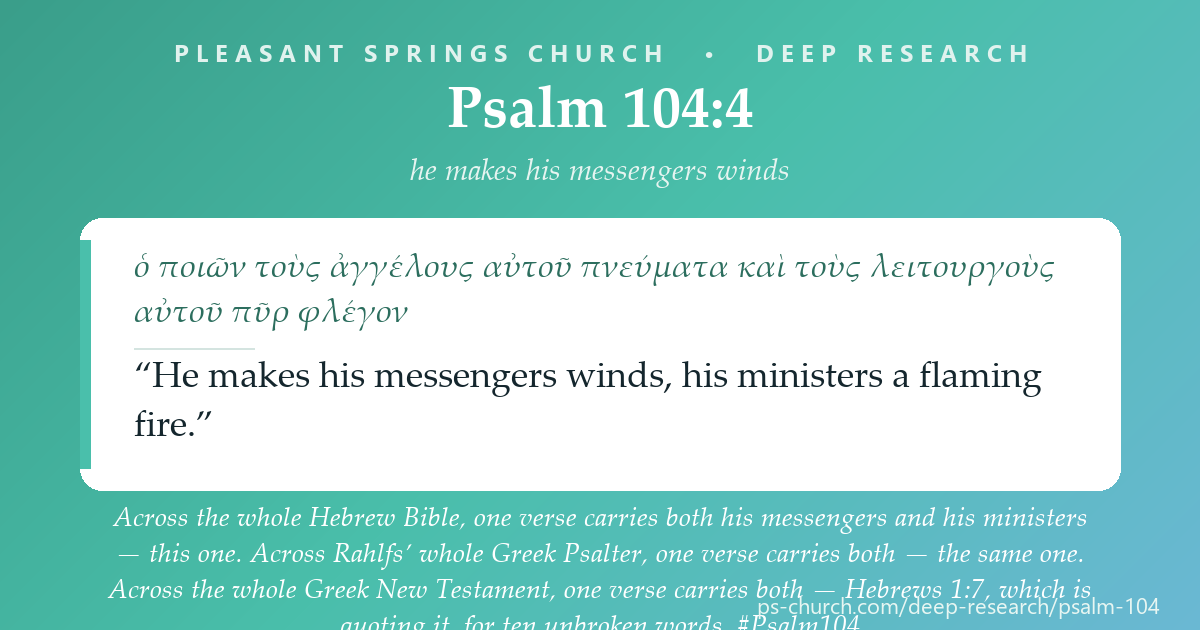
Across the whole Hebrew Bible, one verse carries both his messengers and his ministers. It is Psalm 104:4. Across Rahlfs' whole Greek Psalter, one verse carries both — Rahlfs 103:4, which is the same verse. Across the whole Greek New Testament, one verse carries both — Hebrews 1:7, which is quoting it, for ten unbroken words. The psalm next door has both nouns too, one verse apart, as vocatives; here they stand in a single verse as objects, and that is how Hebrews uses them. Along the way: the first hallelujah in the Bible, a psalm of 271 words with no covenant vocabulary in it at all, and the Genesis-order claim that fails its own test at p = 0.128. See the method →
Psalm 104
Hebrew · Greek (Rahlfs’ Psalter) · ESVScanned across all thirty-nine books: his messengers stands in seven verses — Isaiah 44:26, Ezekiel 17:15, Psalm 91:11, Psalm 103:20, Psalm 104:4, Psalm 148:2 and 2 Chronicles 36:15. His ministers stands in six — Proverbs 29:12, Esther 2:2, Esther 6:3, Psalm 103:21, Psalm 104:4 and 2 Chronicles 9:4. They stand in the same verse exactly once, and this is it.
⚠️ The same thing is true one language later. In Rahlfs’ Greek Psalter, ἄγγελος and its forms stand in thirteen verses and the noun λειτουργός stands in two — Rahlfs 102:21 and Rahlfs 103:4. They stand in the same verse exactly once, and it is this one. Widened to the complete Greek Old Testament as CATSS holds it — all 64 files, 30,637 verse units — the answer does not change: ἀγγελ- stands in 338 verses, the λειτουργ- family in 137, and the two meet in exactly one verse, and it is still Rahlfs 103:4.
⚠️ THE SCOPE OF THAT SCREEN WIDENED ON 30 AUGUST 2026, AND BOTH SETS OF NUMBERS ARE PRINTED RATHER THAN ONE QUIETLY REPLACING THE OTHER. When this page was written the shelf held 44 CATSS files, 23,061 verse units, and the figures read 263 and 86. The remaining twenty files — Exodus, Leviticus, Numbers, both Joshua recensions, and the deuterocanonical books, which this shelf treats as witnesses, not Scripture, and labels so every time — were fetched on 30 August 2026, taking the corpus to 64 files and 30,637 units. Re-run over the whole of it, ἀγγελ- rises from 263 verses to 338 and the λειτουργ- family from 86 to 137 — and Greek Exodus, Leviticus and Numbers are exactly the books a λειτουργ- count should have been expected to move, because they are where the Greek Old Testament does most of its talking about priestly service. The two families still meet in one verse and it is still Rahlfs 103:4. The finding survived a corpus one third larger, which is more than it had been asked to survive before.
⚠️ And it is true one book later still. In the Greek New Testament, ἄγγελος and its forms stand in 174 verses and the λειτουργ- family in fifteen. They stand in the same verse exactly once — Hebrews 1:7 — and Hebrews 1:7 is quoting this verse.
ὁ ποιῶν τοὺς ἀγγέλους αὐτοῦ πνεύματα καὶ τοὺς λειτουργοὺς αὐτοῦ
Ten unbroken words. Rahlfs 103:4 is twelve tokens and Hebrews 1:7 is eighteen; the run covers ten of them and breaks only at the close, where Rahlfs has πῦρ φλέγον and Hebrews has πυρὸς φλόγα.
⚠️ And the psalm next door has both nouns too — one verse apart. Psalm 103:20 has the first and Psalm 103:21 has the second, and they are vocatives: two groups being told to bless. Here they are objects: two things being made. Hebrews 1:7 uses them as objects. See Psalm 103, which shares this psalm’s opening and closing line and is not quoted in the New Testament at any length. This page reports where the words stand. It does not say what anyone had in front of them, does not call any reading early or late, and makes no claim about anyone’s reasons for choosing one verse over another. The convergence is a fact about three vocabularies; what to make of it is left to the reader.
The Shape of the Passage
Structure — the frame is real, and it is the only test that passedPsalm 104’s first verse and last verse share an unbroken run of four Hebrew words: bless, O my soul, the Lord. Swept across all 150 psalms, only four open and close with an unbroken shared run of three words or more: Psalm 118 at seven, Psalm 104 at four, Psalm 103 at four, and Psalm 136 at three. Two of the four are these two psalms.
⚠️ Two things commonly built on that frame do not survive.
“Psalms 103 and 104 are twin psalms.” As a claim about shared vocabulary it fails. The two share twenty-one distinct forms against a size-matched control mean of fifteen — a difference that does not clear 0.05. What is verified is the repeated formula and the shared noun pair, and this page claims exactly that and nothing more.
“Psalm 104 follows the order of the days of Genesis 1.” Tested by correlating the position of every content stem shared between Genesis 1:1–2:3 and this psalm, against 20,000 reshuffles: τ = 0.148, p = 0.128. A second, cruder version of the same test also failed. The two texts share a great deal of vocabulary. They do not share a sequence, and the page will not draw one.
The Hebrew psalm has no heading at all. Verse 1 begins straight into בָּרְכִ֥י נַפְשִׁ֗י. Rahlfs 103:1 opens with τῷ Δαυιδ — two words with no Hebrew counterpart.
Author
Anonymous in Hebrew; David in Greek. The Hebrew carries no superscription; Rahlfs carries a Davidic one. The page reports both and says nothing about how either came to stand where it stands.
And the psalm never mentions Israel. Two hundred and seventy-one Hebrew words, and not one of them is Israel, Jacob, covenant, law, Zion or David. Psalm 104 has no covenant vocabulary at all.
What it has instead is a world. Light, waters, mountains, springs, wild donkeys, birds, grass, wine, oil, bread, cedars, storks, goats, badgers, the moon, the sun, lions, ships, Leviathan. The list is the argument.
Audience
A soul, again. Bless the Lord, O my soul. The same two words that open and close Psalm 103 open and close this one — five occurrences in the whole Hebrew Bible, all of them in these two psalms.
And anyone who has looked at the sea. Here is the sea, great and wide, which teems with creatures innumerable, living things both small and great. The psalm expects a reader who has been outdoors.
Readers who have been told this is Genesis in verse. The two texts do share a great deal of vocabulary. They do not share a sequence — the order test fails, and this page reports the failure rather than repeating the claim.
And a congregation that will say one word back. The last two words of Psalm 104 are the first hallelujah in the Bible. The expression stands twenty-four times in the whole Hebrew Bible, and every one of them is in the Psalter.
Orient on creation hymns, on Egyptian parallels, and on the catena of Hebrews 1.
Search by topic: creation psalms; Hymn to the Aten; Leviathan; angels; Hebrews 1 catena; hallelujah.
Which articles are relevant?
- Anchor Bible Dictionary — “Creation,” “Leviathan,” “Angels,” “Akhenaten.”
- Dictionary of the OT: Wisdom, Poetry & Writings (IVP) — “Creation Theology,” “Chaos,” “Hymns.”
- NIDOTTE / TDOT — מַלְאָכָ֣יו (malʾākāyw), מְ֝שָׁרְתָ֗יו (məšārətāyw), לִ֝וְיָתָ֗ן (liwyātān).
- On the Greek — the NETS Psalms introduction, with Rahlfs 103:4 read beside Rahlfs 102:20–21 before Hebrews 1 is opened.
- On Hebrews 1 — any treatment that prints the Greek of Psalm 103:4 in full beside Hebrews 1:7 rather than an English psalm beside an English epistle.
Bibliography surfaced:
- John Goldingay, Psalms 90–150; Robert Alter, The Book of Psalms.
- Frank-Lothar Hossfeld and Erich Zenger, Psalms 3 (Hermeneia).
- James B. Pritchard, Ancient Near Eastern Texts — the Hymn to the Aten is at ANET 369.
Genesis, Egypt, and three claims that do not survive the counting.
Every parallel below was measured before it was described, and the failures are printed alongside the successes.
Which parallels shed light on this psalm?
The Egyptian hymn is the parallel everyone names, and this library could not read the copy it holds. Our Ancient Near Eastern Texts volume places the Hymn to the Aten at page 369, in a division our copy does not carry. Rather than repeat a comparison it could not check, this page measured one from a public-domain translation instead — and what came back was mostly contrast. The shared material is the obvious material: a sun, a night when animals come out, ships, a world full of creatures. What the Egyptian hymn does not have is the thing this psalm is built on — a maker who is not the sun. The page names its translation, does not pretend to a critical edition, and asserts no direction of influence in either direction. Two texts describing the same sky will share a sky.
- Psalm 104:4 → Hebrews 1:7. Ten unbroken Greek words. The one verse in each of three books that carries both nouns.
- Psalm 103 ↔ Psalm 104. The same two-word formula opens and closes both, and it stands nowhere else in the Hebrew Bible. See Psalm 103.
- Genesis 1 → Psalm 104. Vocabulary, yes. Sequence, no. The archaic construct for beast of at 104:11 and 104:20 stands eight times in the Hebrew Bible and links the two texts lexically; the order test fails at p = 0.128.
- Psalm 74:14 → Psalm 104:26. The two Leviathan psalms. Psalm 74 has the heads of Leviathan, plural, against a singular name; see Psalms 74–77.
“Psalm 104:30 is the Old Testament text behind Pentecost.” The longest run shared between Rahlfs 103:30 and any of the forty-seven verses of Acts 2 is two words, and both are function pairs. The link is thematic, and the page says so.
“Revelation 15:3 takes up Psalm 104:24.” The shared run is four words — τὰ ἔργα σου κύριε — and the identical four-word run stands at Rahlfs 91:6 as well. A phrase that appears in more than one psalm cannot point at one of them.
“Psalm 104 is full of rare vocabulary.” Thirty-nine of its 228 distinct forms occur nowhere else in the thirty-nine books — 17.1%, and that figure is at the form level. Most of the thirty-nine are ordinary words in an inflection that happens to occur once. The genuine lexeme-level rarities are few, and two of them are in the first three verses: the word for chariot at 104:3, which occurs once in the Hebrew Bible, and the word for foliage at 104:12.
Two nouns, a wind that may be a spirit, and the first hallelujah.
Every count below was run on this library’s own texts and is stated with its scope, so a reader can repeat it and get the same number or show that it is wrong.
“His messengers, his angels.” Seven verses in the Hebrew Bible carry this form — Isaiah 44:26, Ezekiel 17:15, Psalm 91:11, Psalm 103:20, Psalm 104:4, Psalm 148:2 and 2 Chronicles 36:15. Only one of the seven also carries his ministers, and it is this verse.
“His ministers, his servants.” Six verses in the Hebrew Bible carry this form — Proverbs 29:12, Esther 2:2, Esther 6:3, Psalm 103:21, Psalm 104:4 and 2 Chronicles 9:4. Three of the six are about a human king’s staff.
“Winds” — or spirits. The Hebrew noun carries both senses and the verse can be read either way. Rahlfs has πνεύματα, which carries both too. The previous verse has the same Hebrew noun in the singular, and there Rahlfs uses a different Greek word for it — ἀνέμων, winds. That is a fact about two consecutive verses. It does not settle how anyone read 104:4, and this page does not settle it either.
“Leviathan.” The name stands six times in five verses of the Hebrew Bible. Where the Hebrew has the name here, Rahlfs has δράκων, a common noun. The Greek of Isaiah is held here now, and it does the same thing. LXX Isaiah 27:1 carries no name either — it reads τὸν δράκοντα three times over. A screen for a transliterated Leviathan across the complete Greek Old Testament as CATSS holds it — all 64 files, 30,637 verse units — returns nothing at all. Every Greek column on this shelf answers the Hebrew name with a common noun: δράκων at Rahlfs 103:26, Rahlfs 73:14, Greek Job 40:25 and LXX Isaiah 27:1, and κῆτος at Greek Job 3:8. ⚠️ That negative was published over a 44-file corpus and has now been re-run over 64. It is the harder test, because the twenty files added on 30 August 2026 include the whole deuterocanon — witnesses, not Scripture — and Second-Temple Greek writing is where a transliterated monster-name would be likeliest to surface. It does not surface. The Greek column never once lets Leviathan keep his name.
“Praise the Lord” — the first occurrence in the Bible. The expression stands twenty-four times in the whole Hebrew Bible and every one of them is in the Psalter; this is the earliest. Rahlfs 103:35 has no counterpart to it — the Greek word stands at the head of the following psalm instead.
In the Hebrew Bible. Seven verses have his messengers. Six have his ministers. One has both: Psalm 104:4.
In Rahlfs’ Greek Psalter. Thirteen verses have a form of ἄγγελος. Two have the noun λειτουργός — 102:21 and 103:4. One has both: Rahlfs 103:4.
In the Greek New Testament. 174 verses have a form of ἄγγελος. Fifteen have a word of the λειτουργ- family. One has both: Hebrews 1:7 — and Hebrews 1:7 is quoting Rahlfs 103:4.
What the page does not say. It does not call this a design, and it runs no null on it — the third of the three is a quotation of the second, so the three are not independent and a significance test would be meaningless. What is worth printing is that the pairing is this rare in all three vocabularies, and that the one verse in each is the same verse.
One quotation, and four cross-references that fail measurement.
Runs are longest unbroken sequences of tokens measured on the SBL edition against the CATSS texts, under one normalisation applied to both sides.
Where does the New Testament take up this psalm?
Once, and cleanly. Hebrews 1:7 reproduces ten unbroken words of Rahlfs 103:4. Rahlfs 103:4 is twelve tokens; Hebrews 1:7 is eighteen, of which the first six are the epistle’s own introduction. The run breaks only at the last two words.
What the Greek settles, and what it does not. In both Rahlfs 103:4 and Hebrews 1:7 the word for winds is neuter plural, and it can be read as the object of the verb or as its complement. The Greek does not disambiguate it either, and this page reports the two readings without choosing.
- Psalm 104:4 → Hebrews 1:7. 10 unbroken words.
- Psalm 104:5 → Hebrews 1:8. A trap, and a near one. Hebrews 1:8 sits one verse after the quotation and shares five words with Rahlfs 103:5 — but it is quoting Psalm 45, and the five words are a stock liturgical phrase.
- Psalm 104:1 · 104:35 → Luke 1:46. 5 words — and the same five stand in six verses of the Greek Psalter. Not a pointer to this one.
- Psalm 104:24 → Revelation 15:3. 4 words, and the same four stand at Rahlfs 91:6.
- Psalm 104:30 → Acts 2. 2 words. The Pentecost link is thematic, not verbal.
- Psalm 104:12 → eight New Testament verses. 4 words — τὰ πετεινὰ τοῦ οὐρανοῦ, the standard creation formula. Shared stock, not a citation.
What is settled, what is contested, and what this page refuses to decide.
What is the state of the discussion?
Settled: that Hebrews 1:7 quotes the Greek of this verse, and quotes it closely. The measurement can be repeated by anyone with the two texts.
Contested for centuries, and left contested here: whether 104:4 says God makes his messengers into winds, or makes winds into his messengers. The Hebrew permits both and the Greek permits both. The page reports the ambiguity and does not resolve it, in either language.
Contested, and left contested: the relation between this psalm and the Egyptian hymn to the sun. The volume this library holds does not contain the hymn, and the comparison run from a public-domain translation returned mostly contrast. No direction of influence is asserted, in either direction.
- Hossfeld and Zenger, Psalms 3 (Hermeneia) — on Psalm 104 and the 103/104 pairing.
- Goldingay, Psalms 90–150 — on the creation sequence and the Genesis question.
- The NETS Psalms volume — for the Greek read as a translation, including 104:16 and 104:17.
Where this lands.
What is worth carrying out of Psalm 104?
It is a psalm with no covenant in it. 271 words, and not one of them is Israel, Jacob, covenant, law, Zion or David. What it has instead is badgers, storks, wine, ships and the moon, and it treats all of that as reason enough to bless God.
The verse the New Testament took is about angels being made. The psalm mentions them once, in a list, between the clouds and the foundations of the earth. Hebrews 1 builds a whole argument on where they stand in that list.
One concrete response. Go outside and find five things in Psalm 104 that are actually there where you are. That is the psalm’s own method, and it ends by telling its own soul what to do about it.
Every Deep Research page traces its passage across the whole sweep — the Old Testament, the Second-Temple world between the testaments (historical witnesses, not Scripture), and the New Testament. Follow the thread:
Pleasant Springs Church — Deep Research
Research method after Michael S. Heiser’s Bible Research Method (examine dictionaries → ancient literature → important words → textual connections → academic publications → share), with the Pleasant Springs “Author & Audience” foundation. Scripture set in the Hebrew, the Greek editions named on each page and the ESV (Old Testament), and the Greek New Testament and the ESV (New Testament), per the practice of Pleasant Springs Church. Psalm 104 research grounded in Goldingay (Psalms 90–150), Hossfeld and Zenger (Psalms 3) and Alter. Text: Hebrew from the Masoretic text as printed in the editions consulted — Sefaria’s Miqra according to the Masorah; no critical apparatus was consulted for the Hebrew, the paseq is not reproduced in the codex lines, and this psalm carries no ketiv/qere. Greek from Rahlfs’ Greek Psalter (CATSS digitization); Greek New Testament from the SBL edition. The standing caution for this shelf applies: these pages say “Rahlfs’ Greek Psalter reads…” and never call a Greek reading early or late. ⚠️ The convergence, stated so it can be repeated. Hebrew: מַלְאָכָ֣יו in 7 verses, מְ֝שָׁרְתָ֗יו in 6, intersection 1 (Ps 104:4) — scanned across all thirty-nine books of Sefaria’s MAM on exact consonantal form. Greek Psalter: a form of ἄγγελος in 13 verses, the noun λειτουργός in 2 (102:21, 103:4), intersection 1. Rahlfs 100:6 carries the verb ἐλειτούργει, not the noun, and is not counted — a page that counted verb forms would report three. SBL New Testament: a form of ἄγγελος in 174 verses, a λειτουργ- word in 15, intersection 1 (Hebrews 1:7). No null test is run on the convergence and none would mean anything, because the third member quotes the second. ⚠️ The Hebrews 1:7 measurement. Rahlfs 103:4 = 12 tokens; Hebrews 1:7 = 18; longest unbroken run 10. Every figure is measured under one rule applied to both sides — accents stripped by Unicode decomposition, final sigma folded, and both the movable nu and elision resolved. Applying a normalisation to one side of a comparison and not the other will invent a difference that is not in the texts, and this shelf has made that mistake once. ⚠️ The structure tests. The first-verse/last-verse sweep was run over all 150 psalms on unbroken consonantal runs and returns exactly four psalms at three words or more: 118 (7), 104 (4), 103 (4), 136 (3). The Genesis-order test correlated the positions of shared content stems between Genesis 1:1–2:3 and this psalm against 20,000 reshuffles and returned τ = 0.148, p = 0.128, confirmed under two independent stem rules; a second, cruder version also failed. The 103/104 vocabulary test returned 21 shared distinct forms against a size-matched control mean of 15 and does not clear 0.05. All three results are printed, and the two failures are printed as failures. ⚠️ Hebrew word counts on this page split on whitespace, maqqef and paseq, exclude Masoretic section markers, count a ketiv/qere pair once, and require a token to carry at least one Hebrew letter — the same rule used on every Psalms page in this library, which reproduces a Psalter total of 19,586 words. Psalm 104 = 271 words in 35 verses. ⚠️ Absolute negatives are scoped. Hebrew claims of the form nowhere else are scoped to the thirty-nine book Hebrew corpus in Sefaria’s MAM. The Greek of Isaiah was added to this library on 19 August 2026, and the sentence that stood here — that nothing could be said about how Isaiah 27:1's Leviathan reads in Greek — has been replaced by the measurement, which is printed in Stage 3: LXX Isaiah 27:1 reads τὸν δράκοντα three times and carries no transliterated name, and a screen for a transliterated Leviathan across all 30,348 screened Greek Old Testament verse units returns zero. The whole-Greek-Old-Testament version of the ἄγγελος/λειτουργ- count in the codex panel — 263 verses, 86 verses, one overlap on the 44 files of that fetch; 338, 137 and still one across the 64 files held since 30 August — was only measurable after that fetch. The Leviathan screen read ‘across all 44 Greek Old Testament files’ until 2026-09-24; re-run that day over the 64 files now held, it is still zero. ⚠️ The Egyptian comparison. The Ancient Near Eastern Texts volume held here does not contain the Hymn to the Aten; its own contents page locates the hymn at ANET 369. The comparison reported on this page was measured from E. A. Wallis Budge's 1923 public-domain translation, which is named because it is not a critical edition, and no direction of influence is asserted in either direction. ⚠️ What was not consulted. No Qumran manuscript of this psalm, no Cairo Geniza fragment, no Syriac, no Vulgate or Gallican Psalter, no Aquila, Symmachus or Theodotion, and no critical apparatus for any text compared. Verse counts verified in all three columns (Hebrew 35, Rahlfs 35, ESV 35 — the English offset for this psalm is zero). Typology is handled per the house position: what the text says, what the New Testament itself draws, and what we see from this side of the cross — with the seeing left to the reader.
Scripture quotations marked ESV are from the ESV® Bible (The Holy Bible, English Standard Version®), © 2001 by Crossway, a publishing ministry of Good News Publishers. ESV Text Edition: 2016. Used by permission. All rights reserved. The ESV text may not be quoted in any publication made available to the public by a Creative Commons license, and the ESV may not be translated in whole or in part into any other language. www.esv.org
|
Did this study bless you today? 💚 Give to Support PS Church100% of gifts go to the General Fund — thank you. |