Psalm 103 is one of the best known psalms in the book, and the New Testament never quotes it. Swept token by token against all 7,927 verses of the Greek New Testament, its longest unbroken shared run is five words — and both fives are strings of function words, one of them inside a citation of Amos. The psalm next door reaches ten. Psalm 104 carries the same opening formula, and Hebrews 1:7 quotes it for ten unbroken words. The two nouns Hebrews uses — his angels and his ministers — stand together in exactly two places in the whole Hebrew Bible: here, one verse apart, as two groups being told to worship; and at Psalm 104:4, in a single verse, as two things being made. Along the way: five hapax forms in three verses, the one bare father in the entire Psalter, why Psalm 86:15 is twice as close to Exodus 34:6 as this psalm is, and four structural divisions that all failed their test. See the method →
Psalm 103
Hebrew · Greek (Rahlfs’ Psalter) · ESVRahlfs’ Greek of this psalm is 300 tokens. Swept against all 7,927 verses of the Greek New Testament at every run length from three words up, its longest unbroken shared run is five words. Only two verses in the whole New Testament reach five, and both fives are strings of function words:
• Luke 1:46 — ἡ ψυχή μου τὸν κύριον, my soul the Lord. The Magnificat opens Μεγαλύνει where Rahlfs 102:1 has εὐλόγει; the five words that match are the object and the subject, not the verb.
• Acts 15:17 — τὸν κύριον καὶ πάντα τὰ. That verse sits inside James’s citation of Amos and has nothing to do with this psalm.
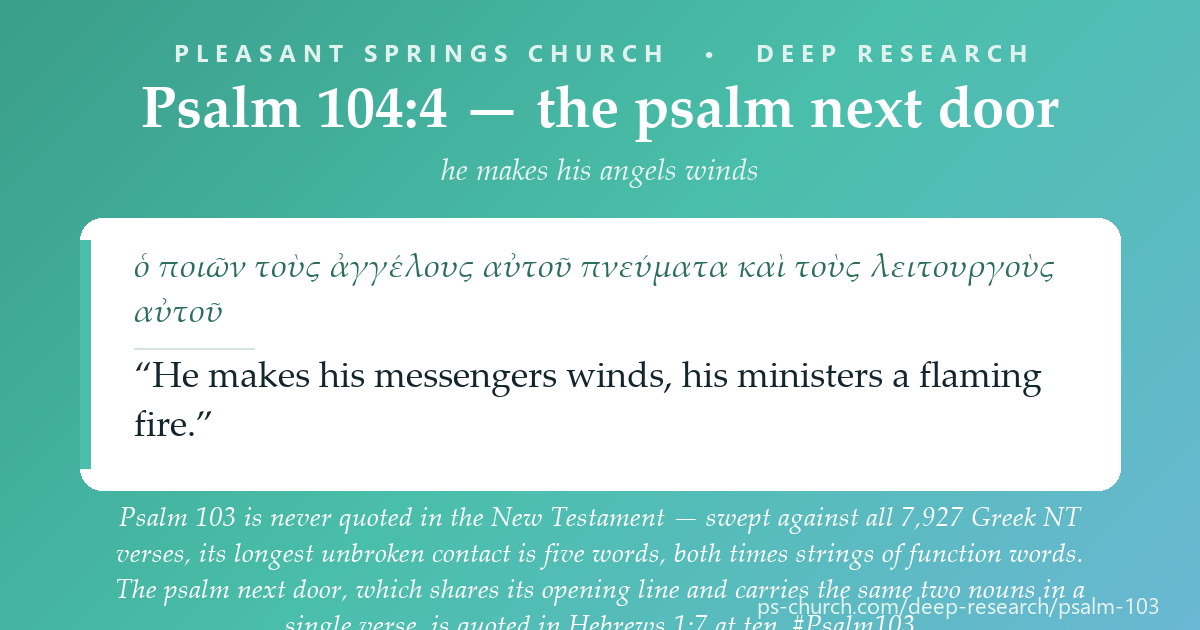
⚠️ And now the comparison. The psalm immediately after this one carries the same opening formula — it begins and ends with bless the Lord, O my soul — and it is quoted in Hebrews 1:7 at ten unbroken words:
ὁ ποιῶν τοὺς ἀγγέλους αὐτοῦ πνεύματα καὶ τοὺς λειτουργοὺς αὐτοῦ — he who makes his angels winds, and his ministers…
The run breaks only at the last two words — Rahlfs 103:4 has πῦρ φλέγον and Hebrews 1:7 has πυρὸς φλόγα.
⚠️ The two nouns Hebrews needs are in Psalm 103 as well. Across the whole Hebrew Bible, his angels and his ministers stand together in exactly two places: Psalm 103:20–21, spread over two verses, and Psalm 104:4, inside one. In Psalm 103 they are two separate calls to worship, addressed to the beings themselves. In Psalm 104 they are one sentence about what God makes. Hebrews 1:7 uses them the second way. That is a description of the two psalms and of what the measurement returns. It is not a claim about anyone’s reasons, and this page makes none. It also does not say the New Testament avoided Psalm 103 — a psalm can go unquoted for a hundred reasons, and an absence of shared wording is evidence of nothing beyond itself.
The Shape of the Passage
Structure — every division tested here failedThis library only draws a structure it can score, and the score here is shared distinctive vocabulary against 20,000 reshuffles of the psalm’s own verses. Four divisions were tested:
• the opening block against the closing block — p = 0.329
• the opening block against the middle — p = 0.965
• the middle against the closing block — p = 0.993
• a straight two-half split — p = 0.882
Not one clears 0.05, and three of the four run the wrong way — the middle of Psalm 103 shares fewer words with its outer blocks than chance predicts.
One tighter test did clear: the first two verses against the last two, at p = 0.027. It is reported and not used. It is one result out of five tests on the same psalm, and correcting for that it does not clear. A page that printed the one significant test and not the four failures would be showing you a filtered result.
What is actually there is not a shape but a formula. Seven imperatives in the Hebrew, and every one of them is bless or its negation: three to the psalmist’s own soul, one telling it not to forget, and three to the heavenly host. There is no petition anywhere in Psalm 103, and in the Hebrew nothing is said to God at all.
The heading is one word, and the Greek answers it element for element. The Hebrew has לְדָוִ֨ד followed by a paseq; Rahlfs has τῷ Δαυιδ. Only two psalms in Book IV carry a Davidic heading at all — Psalm 101 and this one.
Author
To David, and nothing else. One word, where the psalms on either side of it in Book IV carry no heading at all.
The psalm never addresses God. Not once in the Hebrew. Every imperative and jussive in Psalm 103 is a form of bless or its negation, and all seven are aimed either at the speaker’s own soul or at the heavenly host. There is no petition, no complaint, and no second person singular directed at God in the whole psalm.
Rahlfs has one imperative the Hebrew does not. At 102:14, where the Hebrew has a passive participle — it is remembered that we are dust — the Greek has μνήσθητι, remember. The Greek does not mark who is being addressed there, and the first-person plural in the same clause leaves it open. This page reports the two forms and says nothing about the addressee.
And it names God one way only. Eleven times, always the divine name — no Elohim, no El, no Adonai, no Yah, no Elyon, no Shaddai. Thirty of the 150 psalms have that profile; this one is the ninth densest of the eighty-one psalms of a hundred words or more.
Audience
A soul, addressed by its owner. Bless the Lord, O my soul, and all that is within me. The psalm opens by talking to itself and closes the same way.
Then a second person, feminine, singular. Who forgives all your iniquity, who heals all your diseases… so that your youth is renewed. Five forms in verses 3–5 carry an archaic feminine ending, and every one of the five occurs once in the whole Hebrew Bible.
Then people who know a story. He made known his ways to Moses, his acts to the people of Israel. The psalm assumes Exodus without retelling it.
Then everything that exists. Bless the Lord, O you his angels… all his hosts… all his works, in all places of his dominion. And then, in the last four words, one soul again.
Orient on the blessing formula, on Exodus 34, and on the catena of Hebrews 1.
Search by topic: hymn of praise; barak; the divine attribute formula of Exodus 34:6; angels and ministers; Hebrews 1 catena.
Which articles are relevant?
- Anchor Bible Dictionary — “Blessing,” “Hymns,” “Angels,” “Attributes of God.”
- Dictionary of the OT: Wisdom, Poetry & Writings (IVP) — “Hymns,” “Blessing,” “Book of Psalms IV.”
- NIDOTTE / TDOT — בָּרְכִ֣י (bārəkî, bless), מַלְאָ֫כָ֥יו (malʾākāyw, his messengers), מְ֝שָׁרְתָ֗יו (məšārətāyw, his ministers).
- On the Greek — the NETS Psalms introduction, with Rahlfs 102:20–21 read beside Rahlfs 103:4 before Hebrews 1 is opened.
- On Exodus 34:6 — any treatment of the attribute formula that lists all its occurrences rather than naming one.
Bibliography surfaced:
- John Goldingay, Psalms 90–150; Robert Alter, The Book of Psalms.
- Frank-Lothar Hossfeld and Erich Zenger, Psalms 3 (Hermeneia).
- Gerald H. Wilson, The Editing of the Hebrew Psalter — for Book IV as a book.
The Exodus formula, the psalm next door, and four claims that do not survive.
Runs are longest unbroken sequences of consonantal tokens, measured against the thirty-nine book Hebrew corpus and against every verse of the Greek New Testament.
Which parallels shed light on this psalm?
The Exodus formula is here, and it is not the closest the Psalter comes to it. Psalm 103:8 shares four unbroken Hebrew words with Exodus 34:6. Psalm 86:15 shares eight — twice the run, and it carries the God and the and truth that Psalm 103:8 does not. Across all 150 psalms the ranking is 86:15 at eight, 103:8 at four, and every other verse in the book at two or fewer.
★ And the Greek side, which this page could not measure until 2026-08-30, says the same thing harder. Until that date this paragraph closed with a confession: “This comparison is Hebrew only. The Greek of Exodus is not held by this library, so nothing whatever is said here about how the Greek of Exodus 34:6 reads or about any Greek relationship between the two verses.” Greek Exodus is now on this disk — 1,165 verse units of it — and the comparison has been run.
| against Greek Exodus 34:6 | Hebrew run | Greek run | the shared Greek |
|---|---|---|---|
| Rahlfs 102:8 · our Psalm 103:8 | 4 | 3 | οἰκτίρμων καὶ ἐλεήμων |
| Rahlfs 85:15 · our Psalm 86:15 | 8 | 10 | ὁ θεὸς οἰκτίρμων καὶ ἐλεήμων μακρόθυμος καὶ πολυέλεος καὶ ἀληθινός |
Screened against the whole Greek Psalter — all 2,534 units of Rahlfs’ Psalms — Greek Exodus 34:6 has exactly one deepest partner, and it is not this psalm. It is Rahlfs 85:15, at ten unbroken words, in a tie band of one. The Hebrew said 86:15 was twice as close as 103:8; the Greek says it is more than three times as close, and it says so with the whole book screened rather than four verses compared. Two independent columns, the same answer, and the page no longer has to leave half the question open. What is still not claimed: nothing here says which text is prior, that any writer had Exodus in front of him, or why any reading stands as it does. Two columns agreeing about a distance is not an account of how the distance came to be.
- Psalm 104:4 → Hebrews 1:7. Ten unbroken Greek words, breaking only at the close. The psalm next door, sharing this one’s opening formula.
- Exodus 34:6 → Psalm 103:8. Four unbroken Hebrew words, and three Greek — while Psalm 86:15 reaches eight Hebrew and ten Greek, the deepest partner Greek Exodus 34:6 has in the entire Greek Psalter; see Psalms 84–88.
- Job 7:10 → Psalm 103:16. The same four-word clause about a place that will not know a man again, differing only in spelling.
- Isaiah 59:19 → Psalm 103:12. The only other place this form of the west-word stands in the Hebrew Bible.
“Psalm 103:15–16 is quoted in 1 Peter 1:24.” The two share one word — χόρτος, grass. Joining both psalm verses and both Peter verses and sweeping again still returns one. The Greek of Isaiah is held here now, so the other side can be measured, and it settles the attribution. LXX Isaiah 40:7 and 1 Peter 1:24 share seven unbroken Greek words — ἐξηράνθη ὁ χόρτος καὶ τὸ ἄνθος ἐξέπεσεν — and Isaiah 40:6–8 read as one block against 1 Peter 1:24–25 reaches thirteen. The same block against Rahlfs 102:15–16 reaches one. The Greek 1 Peter has in common is Isaiah’s, not this psalm’s, and the negative about Psalm 103 now stands beside a measured positive rather than beside a gap.
“The Magnificat opens with Psalm 103.” Luke 1:46 and Rahlfs 102:1 share five words — and the verb is not among them. Luke has magnifies where the psalm has bless. The five that match are ἡ ψυχή μου τὸν κύριον, which is the subject and the object of a sentence and not a quotation.
“Psalm 103 is the only psalm in Book IV to name Moses.” Moses is named in eight verses of the Psalter, and seven of them are in Book IV — Psalms 90:1, 99:6, 103:7, 105:26 and three times in Psalm 106. Psalm 103 is one of seven, not one of one.
“The Greek of Psalm 103 is expansive.” Its Greek-to-Hebrew token ratio is 1.796 against a Psalter mean of 1.780 — 51st of 150. It is exactly average, and the page says so rather than leaving a false impression standing.
A formula, an archaic ending, and the two nouns Hebrews needed.
Every count below was run on this library’s own texts and is stated with its scope, so a reader can repeat it and get the same number or show that it is wrong.
“Bless” — feminine singular imperative, addressed to the speaker’s own soul. With my soul following it, the pair stands five times in the Psalter and nowhere else in it: three times in this psalm and twice in the next. A sixth spelling of the same consonants stands at Psalm 109:24, pointed differently: there it is my knees.
“Your diseases” — one of five forms in verses 3 to 5 carrying an archaic second-feminine-singular ending, every one of which occurs once in the whole Hebrew Bible. The Psalter has ten instances of that ending in total, and half of them are in these three verses. The lexeme is not rare — the plural stands in Jeremiah and Chronicles. It is this suffixed form that is unique.
“His messengers, his angels.” With his ministers, this noun stands together in exactly two places in the Hebrew Bible — here across two verses, and at Psalm 104:4 inside one. Hebrews 1:7 quotes the one-verse version.
“Remembered” — a passive participle. Where the Hebrew has this form, Rahlfs 102:14 has μνήσθητι, an aorist imperative. That is the eighth imperative in the Greek psalm, and the only one that is not a form of bless.
“A father.” The bare singular noun occurs exactly once in the whole Psalter — in this verse. The book has my father three times and our fathers four times, and the plain word once.
No Selah. Seventy-one Selah tokens stand in thirty-nine psalms of this Hebrew text, and not one of them is in Book IV. Psalms 90 to 106 carry none at all.
No ketiv/qere, no acrostic, no enlarged or suspended letters. Three paseq marks and a closing section marker are the whole of its scribal apparatus.
No divine designation except the name. Eleven occurrences, all of them the same word. On the Greek side κύριος stands twelve times and θεός not once — the twelfth is at Rahlfs 102:11, where the corresponding Hebrew colon carries no divine name.
And no petition. Twenty-two verses, 167 Hebrew words, and nothing asked for.
A psalm the New Testament does not quote, and the one beside it that it does.
The New Testament sweep is exhaustive: all 300 Greek tokens of this psalm against all 7,927 verses of the SBL edition, at every run length from three words up.
Where does the New Testament take up this psalm?
Nowhere, at any length worth the word. One hundred and forty-four New Testament verses reach three shared words or more; five reach four or more; two reach five; nothing reaches six. And both of the fives are function words.
The psalm next door reaches ten. Psalm 104:4, in Rahlfs’ Greek, stands in Hebrews 1:7 for ten unbroken words, breaking only where Rahlfs has πῦρ φλέγον and Hebrews has πυρὸς φλόγα.
And Psalm 103 has the same two nouns. They stand at 103:20 and 103:21, one verse apart, as vocatives — two groups being told to bless. At 104:4 they stand in one verse as objects — two things being made. Hebrews 1:7 uses them as objects.
- Psalm 104:4 → Hebrews 1:7. 10 unbroken words.
- Psalm 103:1 · 103:2 · 103:22 → Luke 1:46. 5 words, and the verb differs. A shared formula, not a quotation.
- Psalm 103:1 → Acts 15:17. A trap. 5 words, entirely function words, inside a citation of Amos.
- Psalm 103:11 → Luke 1:58. 4 words — κύριος τὸ ἔλεος αὐτοῦ. Stock phrasing.
- Psalm 103:19 → Revelation 13:2. 4 words. Stock phrasing.
- Psalm 103:15–16 → 1 Peter 1:24–25. 1 word. The cross-reference does not survive measurement.
- Psalm 104:5 → Hebrews 1:8. A second trap. A five-word run stands in both, but Hebrews 1:8 is quoting Psalm 45. A length-only sweep would have caught it.
What is settled, what is contested, and what this page refuses to decide.
What is the state of the discussion?
Settled: that Psalms 103 and 104 are joined by the formula that opens and closes both. Five occurrences in the Psalter, all of them in these two psalms.
Not settled, and not asserted here: that the two are a deliberately composed lexical pair. As a vocabulary claim it fails. The two share twenty-one distinct forms, and against a length-matched null that returns p = 0.154 — ordinary for two psalms of that size. What is verified is the repeated formula and the shared noun pair, and the page claims exactly that and no more.
Contested, and left contested: what stood in the Hebrew behind Rahlfs’ imperative at 102:14. This library holds no critical apparatus for either text and reports the two forms side by side.
- Hossfeld and Zenger, Psalms 3 (Hermeneia) — on the 103/104 pairing.
- Goldingay, Psalms 90–150 — on the participial chain of vv. 3–5.
- The NETS Psalms volume — for the Greek read as a translation.
Where this lands.
What is worth carrying out of Psalm 103?
It asks for nothing. Twenty-two verses and 167 Hebrew words, and there is not one petition in it. Every command in the psalm is the speaker telling himself, and then everything else that exists, to bless.
It talks to a soul, not to God. In the Hebrew nothing in Psalm 103 is addressed to God at all. The psalm is a man giving his own interior an instruction and then widening the instruction until it covers the universe.
One concrete response. Learn verses 1 to 5 — the five participles, one after another — and say them to yourself on a day when you do not feel them. That is what the psalm is doing.
Every Deep Research page traces its passage across the whole sweep — the Old Testament, the Second-Temple world between the testaments (historical witnesses, not Scripture), and the New Testament. Follow the thread:
Pleasant Springs Church — Deep Research
Research method after Michael S. Heiser’s Bible Research Method (examine dictionaries → ancient literature → important words → textual connections → academic publications → share), with the Pleasant Springs “Author & Audience” foundation. Scripture set in the Hebrew, the Greek editions named on each page and the ESV (Old Testament), and the Greek New Testament and the ESV (New Testament), per the practice of Pleasant Springs Church. Psalm 103 research grounded in Goldingay (Psalms 90–150), Hossfeld and Zenger (Psalms 3) and Alter. Text: Hebrew from the Masoretic text as printed in the editions consulted — Sefaria’s Miqra according to the Masorah; no critical apparatus was consulted for the Hebrew, the paseq is not reproduced in the codex lines, and this psalm carries no ketiv/qere. Greek from Rahlfs’ Greek Psalter (CATSS digitization); Greek New Testament from the SBL edition. The standing caution for this shelf applies: these pages say “Rahlfs’ Greek Psalter reads…” and never call a Greek reading early or late. ⚠️ The New Testament sweep, stated so it can be repeated. All 300 Greek tokens of Rahlfs’ Psalm 102 were compared against all 7,927 verses of the SBL edition at every run length from three words up, under one rule applied to both sides — accents stripped by Unicode decomposition, final sigma folded, and both the movable nu and elision resolved. Maximum unbroken run: 5. 144 verses reach 3 or more, five reach 4 or more, two reach 5, none reaches 6. The same sweep on Rahlfs’ Psalm 103 returns Hebrews 1:7 at 10. Applying a normalisation to one side of a comparison and not the other will invent a difference that is not in the texts, and this shelf has made that mistake once. ⚠️ The structure tests. Four block divisions were scored by shared distinctive vocabulary against 20,000 reshuffles of this psalm’s own verses and returned p = 0.329, 0.965, 0.993 and 0.882. A fifth and tighter test — the first two verses against the last two — returned p = 0.027, which does not survive correction for five tests on one psalm. No structure is drawn, all five results are printed, and the failures are printed first. ⚠️ Hebrew word counts on this page split on whitespace, maqqef and paseq, exclude Masoretic section markers, count a ketiv/qere pair once, and require a token to carry at least one Hebrew letter — the same rule used on every Psalms page in this library, which reproduces a Psalter total of 19,586 words. Psalm 103 = 167 words in 22 verses. ⚠️ Absolute negatives are scoped. Hebrew claims of the form nowhere else are scoped to the thirty-nine book Hebrew corpus in Sefaria’s MAM, matched on consonantal form. ⚠️ This caveat used to say “the Greek of Exodus is not held here”, and that is why the Exodus 34:6 comparison on this page was stated as Hebrew only. It is no longer true. On 30 August 2026 the Greek Old Testament on this shelf grew from 44 files and 23,061 verse units to 64 files and 30,637 held, of which 30,348 are screened — Exodus, Leviticus, Numbers, Joshua (A and B) and the deuterocanon (Judith, Tobit, Wisdom, Baruch, the Letter of Jeremiah, 2–4 Maccabees, Susanna, Bel, Odes, Psalms of Solomon), the last of which are held as measurement witnesses and not as Scripture. Greek Exodus 34:6 has now been read and screened, and the result is printed in Stage 2: against Rahlfs 102:8 it runs three words, against Rahlfs 85:15 it runs ten, and across the whole Greek Psalter Rahlfs 85:15 is its single deepest partner in a tie band of one. The Greek confirms the Hebrew finding and widens the gap. Nothing else on this page depended on the gap, and nothing else moved. ⚠️ One of those twenty files came back out the same day, and the scope sentence above is written accordingly. The Odes are the liturgical canticles bound after the Greek Psalter. They stay on this disk and they are no longer part of anything this shelf calls the Greek Old Testament, for two reasons that are not about canon. Two of them are New Testament text — Ode 9 is Luke 1, the Magnificat and the Benedictus, and Ode 13 is Luke 2, the Nunc Dimittis — and screened as Old Testament, Ode 9:48 matches Luke 1:48 at eighteen consecutive words, so a Gospel can be reported as quoting itself. Ten more are second copies of passages already in the corpus — Ode 1 is Exodus 15, Ode 2 is Deuteronomy 32, Ode 4 is Habakkuk 3, Ode 11 is Isaiah 38 — which doubles any tie band that touches a canticle. So the shelf HOLDS 30,637 verse units in 64 files and SCREENS 30,348; the difference is exactly the 289 units of the Odes, and a page should use whichever of the two its sentence actually means. ★ Nothing on this page moved. The Exodus 34:6 comparison is run against Rahlfs’ Psalms, 2,534 units, which never included the canticles; re-run over the whole screened corpus it gives the same answer — Rahlfs 85:15 at ten words, tie band one, unrivalled. This page carries no figure that was ever measured against an Ode, and it prints that rather than leaving the reader to assume it. The Greek of Isaiah was added to this library on 19 August 2026, and the 1 Peter 1:24 comparison — which this page could previously report only as a negative about Psalm 103 — has now been measured on the Isaiah side and the result is printed in Stage 2: LXX Isaiah 40:7 against 1 Peter 1:24 returns seven unbroken words, Isaiah 40:6–8 against 1 Peter 1:24–25 returns thirteen, and the same block against Rahlfs 102:15–16 returns one. ⚠️ What was not consulted. No Qumran manuscript of this psalm, no Cairo Geniza fragment, no Syriac, no Vulgate or Gallican Psalter, no Aquila, Symmachus or Theodotion, and no critical apparatus for any text compared. Every “unsettled” verdict on this page is only as strong as that list. Verse counts verified in all three columns (Hebrew 22, Rahlfs 22, ESV 22 — the English offset for this psalm is zero). Typology is handled per the house position: what the text says, what the New Testament itself draws, and what we see from this side of the cross — with the seeing left to the reader.
Scripture quotations marked ESV are from the ESV® Bible (The Holy Bible, English Standard Version®), © 2001 by Crossway, a publishing ministry of Good News Publishers. ESV Text Edition: 2016. Used by permission. All rights reserved. The ESV text may not be quoted in any publication made available to the public by a Creative Commons license, and the ESV may not be translated in whole or in part into any other language. www.esv.org
|
Did this study bless you today? 💚 Give to Support PS Church100% of gifts go to the General Fund — thank you. |