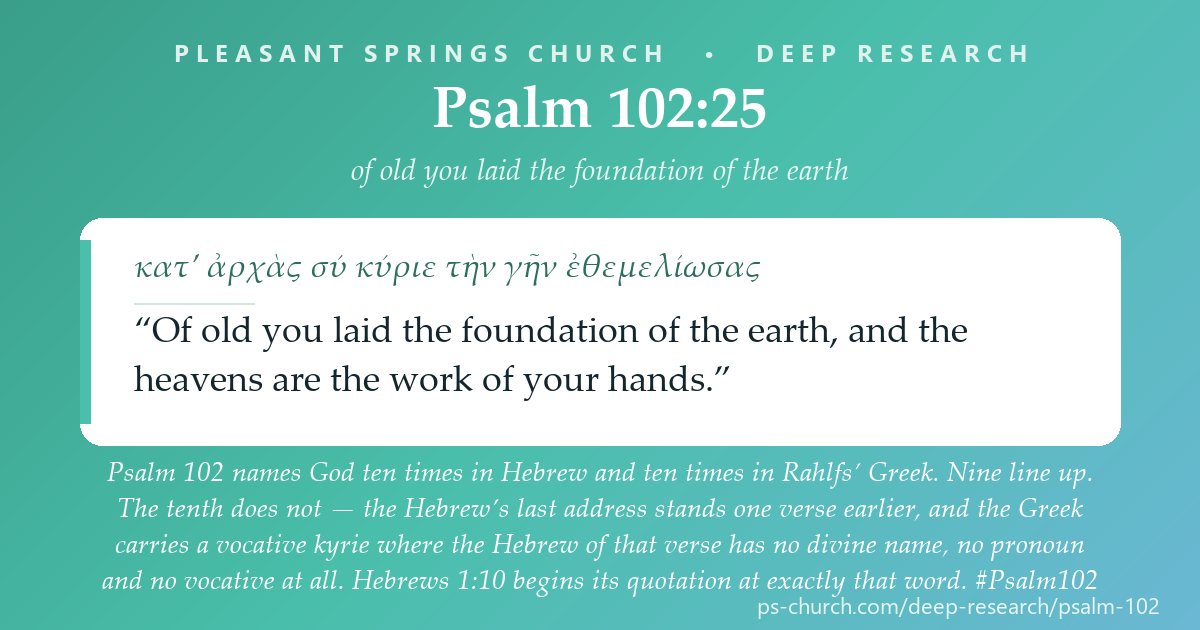
Psalm 102 names God ten times, and Rahlfs' Greek Psalter names him ten times. Nine of the ten line up. The tenth does not. The Hebrew's last address — my God — stands at Hebrew 102:25, and the Greek has nothing opposite it. The Greek's last address — the vocative κύριε — stands one verse later, and the Hebrew of that verse carries no divine name, no pronoun and no vocative at all. Hebrews 1:10 begins its quotation at exactly that word, and runs on for twenty-five consecutive words with five points of difference in the whole block. Along the way: eleven verses in which a dying man never once says I — and that absence beats a size-matched null at p = 0.0009 — the psalm's one true hapax, which is not a bird, and the couplet it shares with Lamentations 5. See the method →
Psalm 102
Hebrew · Greek (Rahlfs’ Psalter) · ESVIn the Hebrew, the divine name stands nine times — at 102:1, 2, 13, 16, 17, 20, 22 and 23, and once in its short form at 102:19 — and there is one further address, אֵלִ֗י, my God, at 102:25. That is ten.
In Rahlfs’ Greek Psalter, κύριος stands ten times — at 101:1, 2, 13, 16, 17, 19, 20, 22 and 23, and then once more, as a vocative κύριε, at 101:26. That is also ten.
Nine of the ten line up. The tenth does not. The Hebrew’s last address stands at 102:25 and Rahlfs 101:25 has nothing opposite it. The Greek’s last address stands one verse later, at 101:26, and Hebrew 102:26 has nothing opposite it — that verse carries no divine name, no independent pronoun and no vocative:
לְ֭פָנִים הָאָ֣רֶץ יָסַ֑דְתָּ וּֽמַעֲשֵׂ֖ה יָדֶ֣יךָ שָׁמָֽיִם׃ — six words
κατ’ ἀρχὰς σύ κύριε τὴν γῆν ἐθεμελίωσας καὶ ἔργα τῶν χειρῶν σού εἰσιν οἱ οὐρανοί — fifteen words
⚠️ And that is the verse Hebrews quotes. Hebrews 1:10 opens Σὺ κατ’ ἀρχάς, κύριε, τὴν γῆν ἐθεμελίωσας and runs on through the next two verses. Measured against Rahlfs 101:26–28, the block Hebrews quotes runs twenty-five consecutive words unbroken, and has five points of difference in all — four of them visible in the letters, and one visible only in the accents:
• Hebrews opens with καί, which has no counterpart in Rahlfs 101:26.
• Hebrews has Σὺ κατ’ ἀρχάς where Rahlfs has κατ’ ἀρχὰς σύ — word order only.
• Hebrews 1:11 has διαμένεις, parsed present; Rahlfs has διαμενεῖς, parsed future. The two are spelled with identical letters and identical vowels — the whole difference is one accent, and it is invisible to the measurement rule this page uses everywhere else.
• Hebrews 1:12 has ἑλίξεις; Rahlfs has ἀλλάξεις.
• Hebrews 1:12 has a further ὡς ἱμάτιον that Rahlfs 101:27 does not carry — and the SBL edition itself brackets those two words, marking a place where printed editions differ.
Everything else is word for word. Forty-one of the forty-six words of Hebrews 1:10–12 stand in the same order in Rahlfs 101:26–28, and twenty-five of them run unbroken, from κύριε to περιβόλαιον. This page reports where the words stand. It does not say which text anyone had in front of them, does not call any reading early or late, and does not adjudicate between the Hebrew and the Greek. What a reader should weigh is stated plainly: the vocative Hebrews addresses is in the Greek of this verse and is not in the Hebrew of it, and no page in this library will tell you which way that ran. The seeing is left to the reader.
The Shape of the Passage
Structure — and the one test that survivesA different test on the same seam survives, and survives hard. Count first-person forms. In Rahlfs’ Greek the outer blocks carry 20 in 147 tokens and 4 in 83; the middle block carries 0 in 143. Scored against 20,000 size-matched reshuffles of the psalm’s own verses, an eleven-verse block with zero first-person forms lands at p = 0.0009 against a null expecting about nine.
The Hebrew says the same thing independently. 28 of 78 words in the first block, 0 of 85 in the middle, 5 of 41 in the last — p = 0.0001. Two kinds of look-alike had to be screened out of the Hebrew before that zero was true, and the page states the rule rather than leaving it unpublished. First: the construct plurals מַלְכֵ֥י and בְּנֵ֣י, which end in -ê and are not first-person forms. Second: the conjunction כִּֽי, for, which ends in the same letter and vowel as a first-person suffix and stands five times inside the middle block. Without both screens the claim would be false, and an unpublished screen is how a true measurement becomes an unrepeatable one.
So the structure this page draws is one the counting can defend: eighty-five Hebrew words and one hundred and forty-three Greek tokens in which the man who is speaking never once says I.
The Greek heading here carries no element without a Hebrew counterpart. Its twelve tokens map onto the Hebrew’s eight; the extra Greek words are articles and a preposition that Greek syntax requires. That is unusual on this shelf — most of Book IV has Greek heading material the Hebrew does not carry.
Author
Nobody is named, and that is the point of the heading. A Prayer of one afflicted, when he is faint and pours out his complaint before the Lord. Eleven headings in the Psalter give a circumstance — Psalms 3, 34, 51, 52, 56, 57, 59, 60, 63, 102 and 142. Ten of the eleven attach that circumstance to a named man, and in every one of the ten the man is David. This one attaches it to an afflicted one.
Eight words, and not one of them a name. In three of the other ten — Psalms 51, 52 and 60 — the circumstance runs on into a second verse; here it is all in one.
What that does to the psalm. Every other circumstantial heading tells you whose trouble you are reading. This one describes a condition and leaves the chair empty.
Headings are part of the received Hebrew text and are counted here as verse 1, which is why the Hebrew and English verse numbers differ by one all the way through this psalm. This page makes no claim about when any heading was attached.
Audience
A man dying, and a city being rebuilt. My days pass away like smoke… but you, O Lord, are enthroned forever… you will arise and have pity on Zion. The psalm turns from one body to one city and back.
And a generation that does not exist yet. Let this be recorded for a generation to come, so that a people yet to be created may praise the Lord. The psalm names its own future readers.
Prisoners under sentence. to hear the groans of the prisoners, to set free those who were doomed to die. Two phrases that stand in exactly one other place in the Hebrew Bible — Psalm 79:11, in the Asaph block this shelf covered three studies ago.
Readers who have been told this is a psalm of confession. Psalm 102 is one of the seven the Western church counts as penitential. It contains no word for sin, iniquity, transgression or guilt — not one, in 212 words.
Orient on the penitential collection, on Zion’s rebuilding, and on the catena of Hebrews 1.
Search by topic: penitential psalms; individual lament; Zion; Hebrews 1 catena; creation and the wearing out of the heavens.
Which articles are relevant?
- Anchor Bible Dictionary — “Lament, Psalms of,” “Zion,” “Penitential Psalms,” “Hebrews, Epistle to the.”
- Dictionary of the OT: Wisdom, Poetry & Writings (IVP) — “Lament,” “Zion,” “Creation Theology.”
- NIDOTTE / TDOT — לְעָנִ֣י (ləʿānî, for an afflicted one), תְמוּתָֽה (təmûtāh, death), כְּמוֹקֵ֥ד (kəmōqēڛ, like a furnace).
- On the Greek — the NETS Psalms introduction, with Rahlfs 101:26 read beside the Hebrew of 102:26 before any commentary on Hebrews 1 is opened.
- On Hebrews 1 — any treatment that prints the Greek of Psalm 101:26–28 in full beside Hebrews 1:10–12 rather than an English psalm beside an English epistle.
Bibliography surfaced:
- John Goldingay, Psalms 90–150; Robert Alter, The Book of Psalms.
- Frank-Lothar Hossfeld and Erich Zenger, Psalms 3 (Hermeneia) — covers Psalms 101–150.
- Erich Zenger, A God of Vengeance? — for the penitential collection as a collection.
One couplet shared with Lamentations, one pair of phrases shared with Psalm 79, and three claims that do not survive.
Every shared run below was found by sweeping Psalm 102 against the whole thirty-nine book Hebrew corpus, with Psalm 102 itself excluded, and extending each match to its maximum.
Which parallels shed light on this psalm?
The couplet at the psalm’s hinge is all but a second copy of Lamentations 5:19. Psalm 102:12 and Lamentations 5:19 are both seven words. Six of the seven slots hold the same word — three of them consonant for consonant, one differing only by a prefixed and, two differing only in spelling. The seventh slot is where they part: the psalm has your remembrance, Lamentations has your throne. The three-word run the Lord forever is enthroned stands at exactly these two places in the Hebrew Bible. Which way the borrowing ran, or whether either borrowed, is not decidable from a count of shared words, and this page does not decide it.
- Psalm 79:11 → Psalm 102:20. Two consecutive two-word phrases, and the rarest word in each stands at these two verses and nowhere else in the Hebrew Bible. See Psalms 79–83.
- Lamentations 5:19 → Psalm 102:12. Six of seven slots shared.
- Psalm 27:9 · Psalm 143:7 → Psalm 102:2. A four-word petition at exactly three loci, all of them Psalms — and two of the three are among the seven penitential psalms.
- Psalm 102:25–27 → Hebrews 1:10–12. Twenty-five consecutive words against Rahlfs’ Greek, with five points of difference in the whole block.
“Psalm 102 is the psalmist confessing his sin.” Scanned for the four Hebrew roots for sin, iniquity, transgression and guilt, with prefixes allowed, Psalm 102 returns zero in 212 words. The correction is worth printing; the uniqueness claim is not. Psalms 6 and 143 are also clean, so three of the seven penitential psalms carry no sin vocabulary at all. What is true of Psalm 102 alone in that group is its length — 212 words, against 168 for the next longest.
“The bird similes are rare and obscure Hebrew.” The rarity is in the birds, not the words. Psalm 102 is a below-average psalm for rare vocabulary: 8.5% of its forms occur once in the Hebrew Bible, against a Psalter mean above that. It has exactly one word that occurs nowhere else — and it is not a bird. It is כְּמוֹקֵ֥ד, the furnace at verse 3.
“Hebrews 1:10–12 is the longest quotation of the Psalms in the New Testament.” It is the longest in Hebrews 1 — 25 words, against 24 for the quotation of Psalm 45 two verses earlier. It is not the longest anywhere. Measured the same way against the Greek Psalter held here, Romans 3:11–18 reaches 63 consecutive words, Acts 2:25–28 reaches 60, Hebrews 3:7–9 reaches 28 and Acts 4:25–26 reaches 26. Hebrews 1:10–12 comes after all four. The Romans figure carries its own caveat and is not a clean comparison: that run passes through Rahlfs 13:3, which carries a long stretch of text the Hebrew of Psalm 14:3 does not.
The word that is in one text and not the other, and four more.
Every count below was run on this library’s own texts and is stated with its scope, so that a reader can repeat it and get the same number or show that it is wrong.
“O Lord” — vocative. CATSS parses it N2 VSM. It stands as the fourth word of Rahlfs 101:26 and as the third word of Hebrews 1:10. Hebrew 102:26 has no divine name, no independent pronoun and no vocative anywhere in the verse. Where the Hebrew has one thing and the Greek another, this page says so and stops. It does not say the Greek supplies it or the Hebrew loses it.
“My God.” The tenth and last divine address in the Hebrew psalm, and Rahlfs 101:25 has nothing opposite it. It sits three letters from its own opposite: the same verse carries אַֽל, the negative do not, and the two differ by a single vowel point. The psalm’s last cry and its last refusal are spelled almost identically.
“Death” — in the phrase ESV renders those who were doomed to die, literally the sons of death. The word stands at exactly two places in the whole Hebrew Bible: here, and Psalm 79:11. So does אֶנְקַ֣ת, the groaning in the line before it.
“Like a burning, like a hearth” — the form carries a prefixed like; the noun under it is the one word in this psalm that occurs nowhere else in the Hebrew Bible. A feminine form of the same stem stands twice in Leviticus 6:2; this masculine form stands once, here. Rahlfs has ὡσεὶ φρύγιον συνεφρύγησαν — a noun and a verb from the same Greek stem, answering a Hebrew noun and a verb that are not from the same stem.
“A prayer.” The first word of the psalm and the first word of the heading. Rahlfs opens προσευχὴ τῷ πτωχῷ, a prayer for the poor one, taking the Hebrew’s lamed as a dative. Five psalms carry this word in their heading: 17, 86, 90, 102 and 142.
It is a count of forms, not of ideas. Ten divine designations in the Hebrew, ten in Rahlfs, nine of them in the same verses.
The Hebrew’s ten: the divine name at 102:1, 2, 13, 16, 17, 20, 22 and 23; its short form at 102:19; and אֵלִ֗י at 102:25.
The Greek’s ten: κύριος at 101:1, 2, 13, 16, 17, 19, 20, 22 and 23; and the vocative κύριε at 101:26.
What the page does not say. It does not say the totals matching is significant. Two texts of the same psalm landing on the same total is exactly what you would expect, and no null was run on it because none would mean anything. What is worth printing is the displacement — that the one address the two texts do not share sits in the verse the New Testament quotes, and that the New Testament quotes the text that has it.
Hebrews 1:10–12, and four cross-references that do not survive measurement.
Runs are longest unbroken sequences of tokens measured on the SBL edition against the CATSS texts, under one normalisation applied to both sides.
Where does the New Testament take up this psalm?
Once, at length, and exactly. Hebrews 1:10–12 is forty-six words; forty-one of them stand in the same order in Rahlfs 101:26–28, and twenty-five run unbroken. Five points of difference in the whole block — a conjunction Rahlfs does not have, one inversion, one verb, two words the SBL edition itself brackets, and a fifth that is spelled identically and shows only in the accents.
The verb that differs is worth a line of its own. Rahlfs has ἀλλάξεις, you will change them; Hebrews 1:12 has ἑλίξεις, you will roll them up. That verb occurs twice in the whole Greek New Testament — here, and at Revelation 6:14, where the sky is rolled up like a scroll.
Who is being addressed. Hebrews 1:8 opens πρὸς δὲ τὸν υἱόν, but of the Son, and the next address marker in the chapter does not come until 1:13. The quotation at 1:10–12 falls between them. That is a statement about where the syntax puts it, and this page stops there. What follows from it is left to the reader.
- Psalm 102:25–27 → Hebrews 1:10–12. 25 consecutive words. The longest run in Hebrews 1 — the quotation of Psalm 45 two verses earlier reaches 24 — and behind four longer runs elsewhere in the New Testament.
- Psalm 102:15 → Revelation 6:15 and six other loci. The phrase the kings of the earth is common New Testament stock. Shared motif only; not a quotation and not worth naming as an allusion.
- Psalm 102:17 → Luke 1:48. A cross-reference that routes through a different text. Rahlfs 101:18 has God looking on the prayer of the humble; Luke 1:48 has God looking on the humiliation of his servant. The shared word is the verb, and the Magnificat’s wording tracks 1 Samuel 1:11 and 2:1–10 far more closely.
- Psalm 102:25–27 → 2 Peter 3:7–13. Fails as a quotation and as an allusion. The pairing rests on the shared idea of heavens that perish, not on shared wording; measured, nothing survives.
- Psalm 102:12 → Hebrews 13:8 or Revelation 1:8. Recorded as a negative because commentaries sometimes route them here. Nothing measurable survives.
What is settled, what is contested, and what this page refuses to decide.
What is the state of the discussion?
Settled: that Hebrews 1:10–12 quotes the Greek of this psalm, and quotes it closely. The measurement above is not in dispute and can be repeated by anyone with the two texts.
Contested, and left contested here: what stood in the Hebrew behind Rahlfs 101:26 — whether a vocative was read there, or supplied, or lost. This library holds no critical apparatus for either text and consulted no Qumran manuscript of this psalm, so it reports the two readings side by side and adjudicates neither.
Contested, and also left contested: the ketiv/qere at Hebrew 102:24, where the written form is his strength and the read form is my strength, and Rahlfs stands with the written form. The ESV prints the read form without a footnote. Its only footnote in this psalm is on the two birds at verse 6.
- Hossfeld and Zenger, Psalms 3 (Hermeneia) — on Psalm 102 in the penitential collection and at the head of Book IV’s second half.
- Goldingay, Psalms 90–150 — on the lament/hymn seam this page tested.
- The NETS Psalms volume — for the Greek as a translation, read before any argument about what the New Testament had.
Where this lands.
What is worth carrying out of Psalm 102?
The psalm knows it is being read later. Let this be recorded for a generation to come, so that a people yet to be created may praise the Lord. Psalm 102 is one of the few places in the book where the text names its own future audience.
Eleven verses with no I in them. The man who opens the psalm dying of his own days goes eighty-five Hebrew words without once saying I, me or my, and spends every one of them on Zion, on the nations, and on prisoners under sentence. Then the first person comes back, and the psalm ends.
One concrete response. Take the middle block on its own — verses 12 to 22 in your English Bible — and pray it for somebody else this week, without adding a word about yourself. That is the shape the psalm already has.
Every Deep Research page traces its passage across the whole sweep — the Old Testament, the Second-Temple world between the testaments (historical witnesses, not Scripture), and the New Testament. Follow the thread:
Pleasant Springs Church — Deep Research
Research method after Michael S. Heiser’s Bible Research Method (examine dictionaries → ancient literature → important words → textual connections → academic publications → share), with the Pleasant Springs “Author & Audience” foundation. Scripture set in the Hebrew, the Greek editions named on each page and the ESV (Old Testament), and the Greek New Testament and the ESV (New Testament), per the practice of Pleasant Springs Church. Psalm 102 research grounded in Goldingay (Psalms 90–150), Hossfeld and Zenger (Psalms 3) and Alter. Text: Hebrew from the Masoretic text as printed in the editions consulted — Sefaria’s Miqra according to the Masorah; no critical apparatus was consulted for the Hebrew, the paseq is not reproduced in the codex lines, and where the Masoretic text carries a ketiv/qere the codex prints the qere — in this psalm that is Hebrew 102:24, the one such place. Greek from Rahlfs’ Greek Psalter (CATSS digitization); Greek New Testament from the SBL edition. The standing caution for this shelf applies: these pages say “Rahlfs’ Greek Psalter reads…” and never call a Greek reading early or late. ⚠️ The ten-and-ten count, stated so it can be repeated. Hebrew: the divine name at 102:1, 2, 13, 16, 17, 20, 22, 23, its short form at 102:19, and אֵלִ֗י at 102:25 — ten. Greek: κύριος at 101:1, 2, 13, 16, 17, 19, 20, 22, 23 and the vocative at 101:26 — ten. Nine verses carry a designation in both texts; Hebrew 102:25 carries one the Greek does not, and Rahlfs 101:26 carries one the Hebrew does not. ⚠️ The Hebrews 1:10–12 measurement. Hebrews 1:10–12 = 46 tokens; Rahlfs 101:26–28 = 43; longest unbroken run 25; total matched in order 41. Every figure is a longest unbroken run of tokens, measured on the SBL edition’s punctuation-free field against the CATSS text, under one rule applied to both sides — accents stripped by Unicode decomposition, final sigma folded, and both the movable nu and elision resolved. Applying a normalisation to one side of a comparison and not the other will invent a difference that is not in the texts, and this shelf has made that mistake once. The two bracketed words at Hebrews 1:12 are counted as a difference and flagged as an edition question rather than silently dropped. ⚠️ The structure tests. Both were scored against 20,000 size-matched reshuffles of this psalm’s own verses. The vocabulary test on the two outer blocks failed and is reported as failed. The first-person-absence test returned p = 0.0009 on the Greek and p = 0.0001 on the Hebrew; both are Monte-Carlo estimates, so the last digit moves a little between runs. The Hebrew figure depends on screening two construct plurals in -ê and the conjunction kî out of the count, and that screen is stated in full on the page because without it the claim would be false. The Greek figure needs no screen: it counts a closed list of seven forms. ⚠️ Hebrew word counts on this page split on whitespace, maqqef and paseq, exclude Masoretic section markers, count a ketiv/qere pair once, and require a token to carry at least one Hebrew letter — the same rule used on every Psalms page in this library, which reproduces a Psalter total of 19,586 words. ⚠️ Absolute negatives are scoped. Hebrew claims of the form nowhere else are scoped to the thirty-nine book Hebrew corpus in Sefaria’s MAM, matched on consonants with prefixes allowed. Greek claims are scoped to the corpus named with each: Rahlfs’ Greek Psalter (CATSS) for the psalm itself and for every Psalms-to-New-Testament run, and the SBL Greek New Testament for New Testament counts. No Greek figure on this page is a count across the rest of the Greek Old Testament. Isaiah 51:6 and 34:4 — the two verses most often brought to Hebrews 1:11–12 — were measured on 2026-09-24, each against Hebrews 1:10, 1:11 and 1:12 verse by verse under the same rule: Isaiah 51:6 reaches 2 (τὴν γῆν at 1:10, ὡς ἱμάτιον at 1:11 and 1:12) and Isaiah 34:4 reaches 1 — single words, never two consecutive — against 25 for Rahlfs 101:26–28. Isaiah 34:4’s ἑλιγήσεται is a form of the same verb as Hebrews 1:12’s ἑλίξεις (CATSS and MorphGNT both lemmatise it helissō); a word-form run does not register that, and this page records it and draws nothing from it. Until 2026-09-24 this read: Greek claims are scoped to the Greek Psalter and the twenty-two Greek Old Testament books held here. The Greek of Isaiah is not among them, which is why this page says nothing about Isaiah 51:6 or Isaiah 34:4 — the two verses most often brought to Hebrews 1:11–12 — in either direction. Greek Isaiah has been held since 19 August 2026. ⚠️ What was not consulted. No Qumran manuscript of this psalm, no Cairo Geniza fragment, no Syriac, no Vulgate or Gallican Psalter, no Aquila, Symmachus or Theodotion, and no critical apparatus for any of the three texts compared. Every “unsettled” verdict on this page is only as strong as that list. Verse counts verified in all three columns (Hebrew 29, Rahlfs 29, ESV 28). Typology is handled per the house position: what the text says, what the New Testament itself draws, and what we see from this side of the cross — with the seeing left to the reader.
Scripture quotations marked ESV are from the ESV® Bible (The Holy Bible, English Standard Version®), © 2001 by Crossway, a publishing ministry of Good News Publishers. ESV Text Edition: 2016. Used by permission. All rights reserved. The ESV text may not be quoted in any publication made available to the public by a Creative Commons license, and the ESV may not be translated in whole or in part into any other language. www.esv.org
|
Did this study bless you today? 💚 Give to Support PS Church100% of gifts go to the General Fund — thank you. |