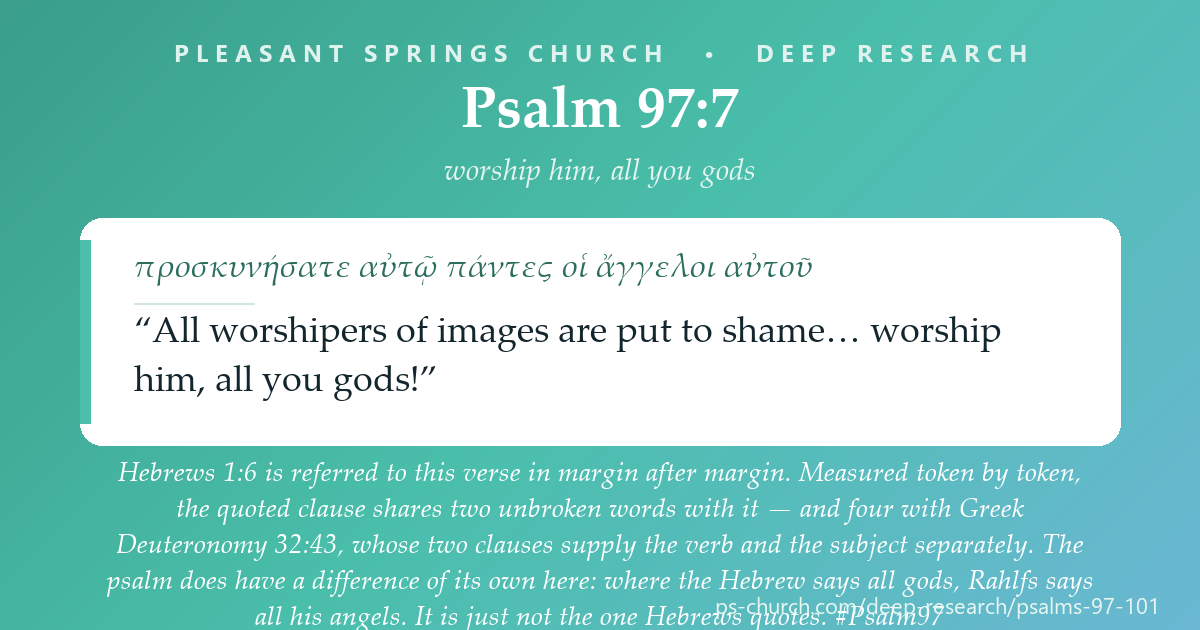
Hebrews 1:6 is referred to Psalm 97:7 in margin after margin. Measured token by token, the quoted clause shares two unbroken words with the psalm and four with Greek Deuteronomy 32:43 — and that Deuteronomy verse carries the rest of the line as well, in a second clause: let all the sons of God worship him, and let all the angels of God be strong for him. Hebrews has the verb of the first and the subject of the second, and differs from each by exactly one word. The psalm does have a divergence of its own here — where the Hebrew says all gods, Rahlfs says all his angels — but it is not the one Hebrews is quoting. Along the way: the longest run these five psalms share with any New Testament verse is four words, Psalm 99's three celebrated stanzas get no support from its own vocabulary, and the name that really is unique to Psalm 99:6 is not Moses. See the method →
Psalms 97–101 (selections)
Hebrew · Greek (Rahlfs’ Psalter) · ESVThe clause Hebrews quotes is six words: καὶ προσκυνησάτωσαν αὐτῷ πάντες ἄγγελοι θεοῦ. Rahlfs 96:7 — our Psalm 97:7 — ends προσκυνήσατε αὐτῷ πάντες οἱ ἄγγελοι αὐτοῦ. Aligned token by token, the longest unbroken run the two share is two words — the imperative is second person in the psalm and third person in Hebrews, the psalm has the article and Hebrews does not, and the psalm ends his where Hebrews ends of God.
⚠️ The same six words run four deep against a verse of Greek Deuteronomy. Greek Deuteronomy 32:43 carries καὶ προσκυνησάτωσαν αὐτῷ πάντες — four words unbroken, and the same third-person imperative Hebrews has.
And it carries the rest of the line too, in a second clause. Greek Deuteronomy 32:43 has both of these:
καὶ προσκυνησάτωσαν αὐτῷ πάντες υἱοὶ θεοῦ — and let all the sons of God worship him
καὶ ἐνισχυσάτωσαν αὐτῷ πάντες ἄγγελοι θεοῦ — and let all the angels of God be strong for him
Hebrews 1:6 has the verb of the first and the subject of the second, and differs from each of them by exactly one word. This page reports where the words stand. It does not say what anyone had in front of them, does not call any reading early or late, and does not adjudicate between the two Old Testament texts. It also notes what a reader should weigh: the Greek Deuteronomy 32:43 held here runs to forty-eight words where the Hebrew of that verse runs to thirteen, and neither of the two clauses above has a counterpart in the Hebrew.
⚠️ What the psalm does have is a divergence of its own. Where Hebrew 97:7 ends כָּל־אֱלֹהִים, all gods, Rahlfs 96:7 ends all his angels. That is a real difference between the two texts, and it is not the one Hebrews is quoting.
The Shape of the Passage
Sequence — the enthronement group closesIt gets no support at all. Scored against 20,000 reshuffles of the psalm’s own verses, the vocabulary shared within the proposed stanzas is indistinguishable from chance — p = 0.596. The refrain is really there; what is not there is any lexical seam at the places it falls.
So the block above is a sequence. What holds it together is a formula in two of its members and the order the book has them in, and the page claims nothing more.
Three of these five psalms carry Greek heading elements with no Hebrew counterpart, and two do not. Psalms 97, 98 and 99 do; Psalms 100 and 101 answer element for element. Only Psalm 101 has David’s name in both.
Author
Anonymous, in Hebrew, for four of the five. Psalm 97 has no heading at all; Psalms 98 and 100 have one word each; Psalm 99 has none. Rahlfs carries David’s name in the headings of Psalms 97, 98 and 99, where the Hebrew does not.
And Rahlfs carries an occasion for one of them. Rahlfs 96:1 — of David, when his land is being restored. Nothing in the Hebrew of Psalm 97 says any of this.
Psalm 101 is the exception, and it is a king speaking. I will walk with integrity of heart within my house… morning by morning I will destroy all the wicked in the land.
Audience
Everyone, repeatedly. let the many coastlands be glad… all the ends of the earth have seen the salvation of our God… make a joyful noise to the Lord, all the earth. Four of the five address the whole world before they address Israel.
People who knew three names. Moses and Aaron were among his priests, Samuel also was among those who called upon his name. Psalm 99 is the only psalm in the book that names Samuel.
And a household. I will not set before my eyes anything that is worthless… no one who practices deceit shall dwell in my house. Psalm 101 turns from the whole earth to one man’s staff.
Orient on the enthronement group, on Deuteronomy 32, and on the royal resolve.
Search by topic: enthronement psalms; the Song of Moses; Hebrews 1 and the catena; Samuel; royal psalms.
Which articles are relevant?
- Anchor Bible Dictionary — “Kingship of God,” “Song of Moses,” “Angels,” “Samuel.”
- Dictionary of the OT: Wisdom, Poetry & Writings (IVP) — “Kingship Psalms,” “Royal Psalms,” “Divine Council.”
- NIDOTTE / TDOT — אֱלֹהִים at Psalm 97:7, תּוֹדָה (tōḏāh, thanksgiving), תָּמִים (tāmîm, blameless).
- On the Greek — the NETS Psalms and Deuteronomion introductions, with Rahlfs 96:7 read beside Greek Deuteronomy 32:43.
- On Hebrews 1 — any commentary that sets Hebrews 1:6 beside the Greek of Deuteronomy 32:43 rather than beside an English psalm.
Bibliography surfaced:
- John Goldingay, Psalms 90–150; Robert Alter, The Book of Psalms.
- Frank-Lothar Hossfeld and Erich Zenger, Psalms 2 (Hermeneia) — covers Psalms 51–100; Psalm 101 falls in Psalms 3.
- Gerald H. Wilson, The Editing of the Hebrew Psalter.
A Deuteronomy verse of two sizes, and three claims that fail.
Read Greek Deuteronomy 32:43 beside the Hebrew of the same verse before reading anything about Hebrews 1.
Which parallels shed light on these psalms?
The verse behind Hebrews 1:6 is a different length in the two texts. The Greek Deuteronomy 32:43 held by this library runs to forty-eight words; the Hebrew of the same verse runs to thirteen. Neither the clause about the sons of God nor the clause about the angels of God has a counterpart in the Hebrew. This page reports the two sizes and stops. It does not say which is prior, does not call either early or late, and holds no apparatus for either text. The Qumran evidence usually cited in this discussion was not consulted here.
- Deuteronomy 32:43 → Hebrews 1:6 · Psalm 97:7 · Rahlfs 96:7. Four words against two.
- Psalm 96 → Psalm 98. The two open with the same line and share an eight-word run found in no other psalm — measured on Psalms 93–96.
- 1 Samuel → Psalm 99:6. The one psalm in the book that names Samuel.
- Numbers 6:24–26 → Psalm 100. The thanksgiving psalm and the blessing share the language of a congregation being sent out; cross-linked to Psalms 65–67.
“Psalm 99:6 is the only place Moses appears in the Psalms.” Moses is named in six psalms, eight times. What is true is the other name in the same verse: Samuel is named in Psalm 99:6 and nowhere else in the 150 psalms.
“Psalm 97 is a mosaic of quotations from elsewhere.” Measured for material shared with the rest of the Psalter, Psalm 97 ranks 45th of 150 — close to the middle of the book. If an anthology psalm is wanted in this neighbourhood it is Psalm 98, not Psalm 97.
“These psalms are full of rare vocabulary.” Against a Psalter mean of 0.280 for the share of a psalm’s word-types occurring nowhere else in the book, four of these five sit below the mean. There is no rare-word cluster here, and the page says so rather than leaving the impression standing.
A person, a pointing, and a name that appears once.
Every count below was made on the texts named at the foot of this page, and every one can be repeated.
Counted here, not assumed:
- Verse counts, identical in both texts across all five. 12 / 9 / 9 / 5 / 8, and the English offset is zero for all five. In Greek numbering these are Psalms 96–100.
- Three of the five carry Greek heading elements with no Hebrew counterpart — Psalms 97, 98 and 99. Psalms 100 and 101 carry none.
- Hebrews 1:6 shares two unbroken words with Rahlfs 96:7 and four with Greek Deuteronomy 32:43. Aligned token by token with accents normalised.
- Greek Deuteronomy 32:43 is forty-eight words; the Hebrew of that verse is thirteen.
- ⚠️ The longest unbroken run any verse of these five psalms shares with any of the 7,927 verses of the SBL Greek New Testament is four words. Nothing in this unit is quoted.
- The one four-word run that is unique on both sides. τοῖς ἐπικαλουμένοις τὸ ὄνομα at Rahlfs 98:6 and 1 Corinthians 1:2 — once in the Greek Psalter and once in the Greek New Testament.
- Psalms 100 and 101 share nothing above three words with any New Testament verse at all.
- Samuel is named in one psalm; Moses in six, eight times.
- The formula יְהֹוָה מָלָךְ stands in exactly four psalms — 93:1, 96:10, 97:1 and 99:1. Two of the four are here.
- Two ketiv/qere in the unit, and no Selah anywhere.
- ⚠️ None of the five has a rare-word cluster. Four of the five sit below the Psalter mean for the share of word-types occurring nowhere else in the book.
“Gods.” ESV prints all you gods; Rahlfs 96:7 has πάντες οἱ ἄγγελοι αὐτοῦ, all his angels. Across the Greek Psalter that phrase stands three times, and this is the one place where the Hebrew opposite it does not say angels. The page reports the pair and adjudicates neither.
“Let them worship” — third-person plural imperative. Hebrews 1:6 has this form; Rahlfs 96:7 has the second-person προσκυνήσατε, worship, you. The difference is a whole person, and it is the first word of the quoted clause.
“Samuel.” Named once in all 150 psalms. Moses, in the same verse, is named in six psalms; Aaron in four. The four Greek words around the name — τοῖς ἐπικαλουμένοις τὸ ὄνομα — stand once in the Greek Psalter and once in the Greek New Testament, at 1 Corinthians 1:2.
“His” — or, on the same consonants pointed differently, not. Psalm 100:3 is written לא and read לוֹ: ESV prints and we are his and Rahlfs 99:3 has καὶ οὐχ ἡμεῖς, and not we. The two texts take the two readings.
“Thanksgiving” — and also the thank offering of Leviticus 7. Rahlfs reads ἐξομολόγησις. The Psalter’s only heading built on this word.
“I was walking.” Where the Hebrew of Psalm 101 states a resolve about the future, Rahlfs has a past tense. The same shift runs through the psalm: the king’s programme in one text reads largely as a report in the other.
Four words is the ceiling, and four cross-references route elsewhere.
Every measurement below was made against the SBL Greek New Testament, token by token, with accents normalised and punctuation excluded — and, since 2026-08-30, against the Greek Old Testament held here: 64 CATSS files, 30,637 verse units on disk, of which 30,348 are screened. ⚠️ Those two numbers are different on purpose and this page uses the right one in each sentence. The 289 rows of the Odes — the liturgical canticles appended to the Greek Psalter — stay on disk but were taken out of the screening corpus on 2026-08-30, because two of them are New Testament text (Ode 9 is Luke 1, Ode 13 is Luke 2) and ten are second copies of passages already counted. The deuterocanonical books are included and labelled as witnesses, not Scripture.
Which cross-references matter?
Nothing in these five psalms is quoted in the New Testament, and the ceiling is four words. Swept exhaustively at every run length from three words up, against all 7,927 verses of the SBL Greek New Testament, the longest unbroken run any verse of Rahlfs 96–100 shares with any New Testament verse is four. Psalms 100 and 101 do not reach even that.
⚠️ And four of the standard cross-references for this unit point elsewhere when they are measured.
- ⚠️ Hebrews 1:6 is not quoting Psalm 97:7. Two words against four for Greek Deuteronomy 32:43, and one of six positions against four of six.
- ⚠️ Acts 17:31 cannot be assigned to Psalm 98:9. Its four-word run stands identically at three separate places in the Greek Psalter — Rahlfs 9:9, 95:13 and 97:9 — so it points at none of the three.
- ⚠️ 1 Corinthians 10:26 routes through Psalm 24:1, not Psalm 98:7. Six unbroken words there against four here.
- ⚠️ Luke 3:6 and Acts 28:28 are not tied to Psalm 98:3 — and this is now settled, not left open. The four-word run stands twice in the Greek Psalter and twice in the New Testament. This page used to stop there, saying that Greek Isaiah — the usual source for Luke 3:6 — “is not held by this library, so nothing here can settle it.” That sentence was wrong about the shelf even when it was written: Greek Isaiah arrived on 2026-08-19, and the claim went uncorrected until the corpus audit of 2026-08-30. Measured now, Luke 3:6 shares eight consecutive words with Isaiah 40:5 — καὶ ὄψεται πᾶσα σὰρξ τὸ σωτήριον τοῦ θεοῦ — in a tie band of one across all 30,348 screened verse units, against four words for the psalm. Eight against four, band one: Luke 3:6 is quoting Isaiah 40:5, and the psalm is not in the running.
- 1 Corinthians 1:2 → Psalm 99:6 · Rahlfs 98:6. The unit’s one four-word run that is unique on both sides. Reported as a shared phrase; no citation formula stands with it.
- Revelation 4:8 and Psalm 99:9 — no longer left open, and the answer is a three-way result. The four-word run ἅγιος κύριος ὁ θεός is unique in the Greek Psalter at this verse. This page used to say it could not weigh that against Isaiah 6:3 because “Greek Isaiah is not on disk here.” Isaiah has been on disk since 2026-08-19; the claim was stale, and the 2026-08-30 audit caught it. Weighed now: Revelation 4:8 reaches four against Isaiah 6:3 and four against Rahlfs Psalm 98:9 — an exact tie, so the run test cannot separate the two candidates. And it settles the question a third way: Revelation 4:8’s deepest partner in all 30,348 screened verse units is neither of them, but Amos 9:5 at six — κύριος ὁ θεὸς ὁ παντοκράτωρ ὁ, in a band of one. The trisagion’s wording sits closest to the Twelve, not to Isaiah or the Psalter.
Four things this page reports as unsettled.
Goldingay and Alter for the Hebrew; the ESV footnotes for where the versions themselves hesitate; and Rahlfs read beside Greek Deuteronomy rather than beside an English psalm.
Commentaries & studies:
- John Goldingay, Psalms 90–150; Robert Alter, The Book of Psalms.
- Frank-Lothar Hossfeld and Erich Zenger, Psalms 2 and Psalms 3 (Hermeneia).
- Gerald H. Wilson, The Editing of the Hebrew Psalter.
- NETS Psalms and Deuteronomion, with Rahlfs.
Four things reported as unsettled:
- Where Hebrews 1:6 got its line — the Odes answer half of it, and the half they do not answer is printed below too. The measurement still points away from Psalm 97:7 (two words) and towards Greek Deuteronomy 32:43 (four). This page used to add that “Hebrews matches neither clause exactly.” That was true of the 44-file shelf and is not true of the 64-file one. The Odes — the liturgical canticles appended to the Greek Psalter, a witness, not Scripture — reached this shelf on 2026-08-30, and Odes 2 is the Song of Moses, Deuteronomy 32 over again in a second text-form. The two forms disagree on precisely the word Hebrews needs. Rahlfs’s Deuteronomy 32:43 has προσκυνησάτωσαν αὐτῷ πάντες υἱοὶ θεοῦ — let all the sons of God worship him — and puts angels in the next clause, strengthening him. Odes 2:43 swaps them: προσκυνησάτωσαν αὐτῷ πάντες οἱ ἄγγελοι θεοῦ — let all the angels of God worship him. Hebrews 1:6 reads ‘let all God’s angels worship him,’ which is the Odes clause, not the Deuteronomy one. The contiguous run scores four against both, because Odes carries an article (οἱ) that Hebrews does not; drop that one article and the run against Odes 2:43 is six. No apparatus is held for any of these texts, and that limit stands.
⚠️ A SENTENCE STOOD HERE FOR ONE DAY AND IS WITHDRAWN, AND THE PAGE PRINTS IT RATHER THAN DELETING IT. It read: “So the tie band on Hebrews 1:6 moves from 1 to 2, and the shelf can now name the text-form Hebrews used.” The second half of that is still true. The first half was a counting error, and it is the exact error the Odes were removed from the screening corpus to stop. Ode 2 is Deuteronomy 32. It is the Song of Moses copied out a second time as a canticle — not a second place where the words stand, but the same place bound twice. Counting Deuteronomy 32:43 and Ode 2:43 as two members of a tie band doubles one verse and calls it corroboration. Re-run on 2026-08-30 over the 30,348 screened verse units, Hebrews 1:6’s deepest Greek Old Testament partner is Deuteronomy 32:43 at four words, tie band ONE — exactly what this page published before the Odes arrived. The band never moved. Only the shelf did.
✅ And the finding the Odes actually supplied survives untouched, because it was never a count. Ode 2:43 is a real manuscript reading and it really does put προσκυνησάτωσαν and ἄγγελοι in one clause where Rahlfs’s Deuteronomy 32:43 does not. That is a text-form observation, and a second copy is a perfectly good witness to a text-form even when it is a useless second member of a tie band. The two claims fail and succeed separately, and this page keeps them apart: band of one, and a text-form in which ‘worship’ and ‘angels’ were never in different clauses. - Why Greek Deuteronomy 32:43 is forty-eight words and the Hebrew thirteen. Reported; not explained, and no Qumran evidence was consulted.
- What Psalm 100:3 says. Written and not we ourselves, read and we are his; ESV prints the read form and Rahlfs has the written one. This page adopts neither.
- Whether Revelation 4:8 has anything to do with Psalm 99:9 — answered above, and removed from this list. The run is unique in the Psalter, but Isaiah 6:3 ties it at four and Amos 9:5 beats both at six. The reason this sat here as “unsettled” was a stale claim that Greek Isaiah was not on disk; it was, and the 2026-08-30 audit corrected it.
A cross-reference worth checking.
Name what you learned, why it matters, and one concrete response.
What should we carry away — and do?
- A cross-reference printed in a million margins does not survive counting. Hebrews 1:6 shares two words with Psalm 97:7 and four with Greek Deuteronomy 32:43. The psalm and the quotation look alike in English; in Greek they are two words apart.
- The verse Hebrews looks like has two clauses — and a second witness puts both of Hebrews’ words in the same one. Read against Rahlfs’s Deuteronomy 32:43 alone, the quotation appears to take the verb of the first clause and the subject of the second. Read against Odes 2:43 — the same Song of Moses in the Greek Psalter’s liturgical form, on this shelf since 2026-08-30, a witness and not Scripture — ‘worship’ and ‘angels’ already stand together in one clause. The simpler explanation is not that Hebrews combined two clauses, but that it followed a text-form in which they were never apart. That is what a witness is for, and it is why this page prints the deuterocanon without ever calling it Scripture.
- The psalm has its own difference, and it is not the famous one. Where the Hebrew says all gods, the Greek says all his angels.
- One concrete response. Make a joyful noise to the Lord, all the earth! Psalm 100 is five verses long, is quoted nowhere in the New Testament, and is probably the most-sung psalm in English. Being un-quoted is not the same as being unimportant, and this page is a reminder that measurement answers one question and not every question.
Psalm 97:7 · to share
Hebrew + Greek (Rahlfs) + ESVEvery Deep Research page traces its passage across the whole sweep — the Old Testament, the Second-Temple world between the testaments (historical witnesses, not Scripture), and the New Testament. Follow the thread:
Pleasant Springs Church — Deep Research
Research method after Michael S. Heiser’s Bible Research Method (examine dictionaries → ancient literature → important words → textual connections → academic publications → share), with the Pleasant Springs “Author & Audience” foundation. Scripture set in the Hebrew, the Greek editions named on each page and the ESV (Old Testament), and the Greek New Testament and the ESV (New Testament), per the practice of Pleasant Springs Church. Psalms 97–101 research grounded in Goldingay (Psalms 90–150) and Alter. Text: Hebrew from the Masoretic text as printed in the editions consulted — Sefaria’s Miqra according to the Masorah; no critical apparatus was consulted for the Hebrew, the paseq is not reproduced in the codex lines, and where the Masoretic text carries a ketiv/qere the codex prints the qere — in this unit that is Psalm 100:3 and one further place. Greek from Rahlfs’ Greek Psalter and Deuteronomy (CATSS digitizations); Greek New Testament from the SBL edition. The standing caution for this shelf applies: these pages say “Rahlfs’ Greek Psalter reads…” and never call a Greek reading early or late. ⚠️ The Hebrews 1:6 measurement, stated so it can be repeated. Every figure is a longest unbroken run of tokens, measured on the SBL edition’s punctuation-free field against the CATSS texts, under one rule applied to every side — accents stripped by Unicode decomposition, final sigma folded, and both the movable nu and elision resolved. Applying a normalisation to one side of a comparison and not the other will invent a difference that is not in the texts, and this shelf has made that mistake once. Hebrews 1:6's quoted clause = 6 tokens; against Rahlfs 96:7 the longest run is 2 and against Greek Deuteronomy 32:43 it is 4. ⚠️ The structure test. Psalm 99's three-stanza division on the refrain was scored by vocabulary shared within the proposed stanzas and compared against 20,000 reshuffles of the psalm's own verses; it returned p = 0.596, so no structure is drawn and the failed test is reported. ⚠️ Hebrew word counts on this page split on whitespace, maqqef and paseq, exclude Masoretic section markers, count a ketiv/qere pair once, and require a token to carry at least one Hebrew letter — the same rule used on every Psalms page in this library, which reproduces a Psalter total of 19,586 words. ⚠️ Absolute negatives are scoped to what is on disk. ⚠️ This scope sentence was obsolete and the page prints the old wording rather than replacing it silently. It read: “Greek claims are scoped to the twenty-two Greek Old Testament books available here (in twenty-five CATSS files, Genesis, Psalms and Judges each standing in two). Exodus, Leviticus, Numbers, Isaiah, Jeremiah, Ezekiel, Zechariah, Joel, Micah and Wisdom of Solomon are not among them — which is why this page leaves Revelation 4:8 and Luke 3:6 open rather than deciding them.” All ten of those books are on this shelf, and Revelation 4:8 and Luke 3:6 are decided in stage 4 above; the sentence was contradicting its own page. Isaiah, Jeremiah, Ezekiel and both Greek Daniels arrived 19 August 2026; Exodus, Leviticus, Numbers, both Joshua recensions and the deuterocanon on 30 August 2026. Greek claims on this page are now scoped to 64 CATSS files — 30,637 verse units held, 30,348 screened. The 289-row gap is the Odes, which stay on disk and are read for their text-forms (see Hebrews 1:6 above) but are out of every count, because Ode 9 is Luke 1, Ode 13 is Luke 2, and ten more are second copies of passages already in the corpus — Ode 2, the one this page cares about, being Deuteronomy 32. The deuterocanonical files are witnesses, not Scripture, and are named as such wherever one supplies a result. ⚠️ What was not consulted. No Qumran manuscript of Deuteronomy 32 — which is the evidence usually brought to the Hebrews 1:6 question — no Cairo Geniza fragment, no Syriac, no Vulgate or Gallican Psalter, no Aquila, Symmachus or Theodotion, and no critical apparatus for any of the three texts compared. Every “unsettled” verdict on this page is only as strong as that list. Verse counts verified in all three columns (12, 9, 9, 5, 8). Typology is handled per the house position: what the text says, what the New Testament itself draws, and what we see from this side of the cross — with the seeing left to the reader.
Scripture quotations marked ESV are from the ESV® Bible (The Holy Bible, English Standard Version®), © 2001 by Crossway, a publishing ministry of Good News Publishers. ESV Text Edition: 2016. Used by permission. All rights reserved. The ESV text may not be quoted in any publication made available to the public by a Creative Commons license, and the ESV may not be translated in whole or in part into any other language. www.esv.org
|
Did this study bless you today? 💚 Give to Support PS Church100% of gifts go to the General Fund — thank you. |