The New Testament opens with a list. Forty-one names, one verb repeated thirty-nine times, four women who do not belong in a royal pedigree, and then a passive that breaks the chain at the last link. This study measured every verse of Matthew 1 against the whole Greek Old Testament held on our machine, and the result was not what we expected: one verse stands three words clear of every other in the chapter — 1:23, at ten consecutive words with Isaiah 7:14, at a tie band of one. And the run breaks at a single word, which Matthew had already spent, two verses earlier, on Joseph. See the method →
Matthew 1:1–25 — selected
Greek NT · ESVVersification. Matthew is a Greek New Testament book: chapter and verse are the same in the Greek and in the ESV, and there is no offset to state for the passage itself. Two offsets do matter for texts this page cites. Psalms: the Septuagint runs one behind the Hebrew and English from Psalm 9/10 through 147, so the psalm often paired with Matthew 1:21 is Psalm 130 in English, Psalm 129 in the Septuagint — we give both. Every other book cited: the verses cited here (Isaiah 7:14; 8:8; Genesis 2:4; 5:1; 16:11; 17:19; 38:3–5; 1 Chronicles 3:10–19 and 7:23; 1 Samuel 1:20 and 9:16; 2 Samuel 12:24) carry the same numbers in the Hebrew, in the Greek edition on our disk, and in the ESV. Where the Greek names a book differently we give its Greek name: 1 Samuel is 1 Kingdoms (Βασιλειῶν Αʹ), 2 Samuel is 2 Kingdoms, and Ezra–Nehemiah is 2 Esdras.
The Shape of the Passage
Two panels in sequence, with a threefold naming at the closeMatthew opens his Gospel with a genealogy because he is answering a question about legitimacy: by what right does this man from Nazareth claim David’s throne and Abraham’s promise? The list is the answer, and the second half of the chapter tells you why the list ends the way it does.
Author
Matthew writes for readers who know the Scriptures of Israel in Greek and who will recognise a heading when they see one. His first two words, Βίβλος γενέσεως (biblos geneseōs), are not a general phrase for “family record.” In the whole 30,637-verse Greek Old Testament held here they occur twice — Genesis 2:4 and Genesis 5:1 — and in the whole Greek New Testament they occur once: here. Both Genesis occurrences head a toledot, one of the ten “these are the generations of” hinges on which the book of Genesis turns. Matthew begins the New Testament with the formula that structures the Old.
The verb that carries the list. ἐγέννησεν (egennēsen, “fathered”) appears 42 times in the entire Greek New Testament, and 39 of the 42 are in Matthew 1. The other three are Luke 1:57, Acts 7:8 and Acts 7:29. That is a stylistic decision you can count: Matthew has chosen a word almost nobody else in the New Testament uses and hammered it thirty-nine times, so that when it stops the silence is loud. At 1:16 he does not write “Joseph fathered Jesus.” He writes ἐξ ἧς ἐγεννήθη Ἰησοῦς — a passive, and a feminine relative pronoun: of whom Jesus was born. Thirty-nine active verbs, and then a passive.
Audience
A congregation that could check him. Matthew’s readers had 1 Chronicles. They could see that his line runs Joram → Uzziah (1:8) where 1 Chronicles 3:11–12 puts three kings in between — Ahaziah, Joash, Amaziah — and that his “Josiah fathered Jechoniah” (1:11) skips Jehoiakim, whom 1 Chronicles 3:15–16 places between them. We checked both against the Greek text on our own disk and both gaps are there. Matthew is not hiding this; he tells you in 1:17 that he is counting in fourteens, and a scheme of fourteens is not a census. Ancient genealogies routinely selected. He is claiming descent, not completeness.
Four women, and then a fifth. Into a list of fathers Matthew inserts Tamar (who played the prostitute to get an heir out of Judah), Rahab (the prostitute of Jericho), Ruth (a Moabitess), and a woman he refuses to name — “ἐκ τῆς τοῦ Οὐρίου,” her of Uriah, so that you cannot read David’s son without reading David’s sin. Then Mary, and with her the whole grammar changes. Whatever else these four are — and readers have proposed foreignness, scandal, and initiative as the common thread — they are placed there on purpose, and they make the fifth woman look less like an anomaly and more like the pattern reaching its point.
Orient on genealogy, the virgin birth, betrothal, and the name Emmanuel.
Search by topic: genealogy of Jesus, toledot, betrothal and Jewish marriage law, virgin birth, Immanuel, fulfilment formula.
Which articles are relevant?
- Anchor Bible Dictionary — “Genealogy (NT),” “Virgin Birth,” “Immanuel,” “Marriage (NT),” “Joseph (husband of Mary).”
- Dictionary of Jesus and the Gospels — “Genealogy,” “Birth of Jesus,” “Son of David,” “Old Testament in the Gospels.”
- NIDNTTE / TDNT — γένεσις (genesis), γεννάω (gennaō), παρθένος (parthenos), μνηστεύω (mnēsteuō, betroth), δίκαιος (dikaios).
- Hebrew side — עַלְמָה (ʿalmah) and בְּתוּלָה (bəthulah): the two Hebrew words the Isaiah 7:14 debate turns on.
Bibliography surfaced:
- W. D. Davies & Dale Allison (ICC), R. T. France (NICNT), Ulrich Luz (Hermeneia), Craig Keener, John Nolland (NIGTC) on Matthew.
- Raymond E. Brown, The Birth of the Messiah; Richard Bauckham, Gospel Women.
- G. K. Beale & D. A. Carson, eds., Commentary on the New Testament Use of the Old Testament (Matthew).
Toledot headings, selective royal lines, and betrothal that was already marriage.
Read Matthew’s opening against the Genesis headings it echoes, the 1 Chronicles line it edits, and the marriage law that makes Joseph’s dilemma a legal one.
Which parallels shed light on religion and worldview?
A Genesis heading. The Greek Old Testament we hold uses βίβλος γενέσεως at Genesis 2:4 (“this is the book of the generations of heaven and earth”) and Genesis 5:1 (“this is the book of the generations of men”). Both are hinges: the first turns from creation to the human story, the second from Adam to the line that survives the flood. Matthew’s readers, hearing the phrase a third time at the head of a scroll, were being told what kind of document they were holding. We report the verbal contact and stop there: a two-word overlap is contact, not proof of intent, and nine verses in the Greek Old Testament share two consecutive words with Matthew 1:1 — the other seven do so on “son of David” or “son of Abraham” (Genesis 25:12; 25:19; 28:9; 2 Chronicles 11:18; 30:26; Proverbs 1:1; Ecclesiastes 1:1). Six of those nine are either a Genesis heading or the title line of a book. That is suggestive; it is not a citation.
An edited royal line. Set Matthew 1:7–11 beside the Greek of 1 Chronicles 3 and the seams show. 1 Chronicles 3:11–12 runs Ιωραμ — Οχοζια — Ιωας — Αμασιας — Αζαρια; Matthew 1:8 runs Joram straight to Uzziah, passing three kings. 1 Chronicles 3:15–16 puts Ιωακιμ (Jehoiakim) between Josiah and Jechoniah; Matthew 1:11 has Josiah father Jechoniah directly. In ancient genealogical practice this is unremarkable — father of covers ancestry, and lists were shaped for the point being made. What it does mean is that Matthew’s three fourteens are a designed figure, and he says so out loud at 1:17.
Betrothal was already marriage. μνηστευθείσης (1:18) is not an engagement in the modern sense. Under Jewish law a betrothed woman was legally her husband’s; the union was dissolved only by divorce or death, and unfaithfulness during betrothal was adultery. This is why 1:19 uses ἀπολῦσαι, the ordinary verb for divorce, and why Joseph’s two options are public exposure or a quiet writ. Matthew calls him δίκαιος, “righteous” — and then shows that righteousness choosing mercy before it knows the truth, and obedience after it does.
- Genesis 2:4; 5:1 — the two βίβλος γενέσεως headings in the Greek Old Testament held here (see Genesis 2, Genesis 5).
- 1 Chronicles 3:10–19 — the royal line Matthew abridges, and the one verse where the Hebrew and Greek disagree about Zerubbabel’s father (see the Chronicler’s genealogies).
- Genesis 38; Joshua 2; Ruth 4; 2 Samuel 11–12 — the four women’s own stories (see Tamar, Rahab, Ruth, Bathsheba).
- Deuteronomy 22:23–27 — the betrothed woman treated as a wife: the law standing behind Joseph’s dilemma.
There is a reason the church has always read this genealogy aloud at Christmas rather than skipping to verse 18. A list of names is a claim about ownership. It says: this person belongs to this people, under these promises, answerable for these ancestors. Matthew builds his list with absolute confidence for thirty-nine links — Abraham fathered, Isaac fathered, Jacob fathered — and he builds it out of people you would not have chosen. A patriarch who slept with his daughter-in-law believing her a prostitute. A prostitute of a doomed city. A Moabitess, from a nation Deuteronomy barred from the assembly. A woman Matthew will not dignify with a name because the point is the man who took her. Kings who burned their children in fire. An exile that ends the whole enterprise. If you were forging a messianic pedigree you would not write this one.
And then the chain that has held for forty-two generations will not close. Joseph is in the list; Joseph is the last name in it; and Joseph did not father the child. Matthew has spent seventeen verses establishing a legal title and then tells you, in the grammar of a single verb, that the title is conferred rather than transmitted. Jesus is son of David because Joseph named him — and in the law of Israel, naming was how a father acknowledged a son. That is what 1:25 is doing. The genealogy gives him the throne; the birth gives him the name; and the name, Matthew says, is what he came to do: he will save his people from their sins.
The heading, the verb, the spelling, and the three forms of one act of naming.
Every figure below was counted on the corpora held on this machine: 30,637 verse units of Greek Old Testament, 23,204 of Masoretic Hebrew, 7,927 of Greek New Testament. Both Greek sides are lowercased, accents and breathings dropped, final sigma folded, then filtered to Greek letters — the same filter on each side.
“The book of the genealogy.” Measured: twice in the 30,637 verse units of Greek Old Testament held here — Genesis 2:4 and 5:1, both toledot headings — and once in the 7,927 verses of the Greek New Testament: here. The noun γένεσις alone occurs 5 times in the Greek New Testament; two of the five are Matthew 1:1 and 1:18.
“Fathered.” Measured: 42 occurrences in the whole Greek New Testament; 39 of them in Matthew 1, the other three at Luke 1:57, Acts 7:8 and Acts 7:29. Then at 1:16 the active stops and a passive takes its place: ἐγεννήθη, “was born” — of Mary, not of Joseph.
Rahab — and Matthew spells her with a chi. Measured: the Greek New Testament spells this name three times: Ῥαχάβ here, Ῥαάβ at Hebrews 11:31 and James 2:25. In the Greek Old Testament held here Ῥαχάβ occurs zero times; the harlot of Jericho is Ρααβ at Joshua 2:1, 2:3, 6:17, 6:23 and 6:25 — every time (that is the B-text of Joshua; the A-text file on our disk begins only at Joshua 15:21). Matthew’s spelling is unique in the Greek Bible we hold, and it is the spelling that preserves the Hebrew רָחָב’s middle consonant.
“Having been betrothed.” A legally binding union short of cohabitation: the woman was already the man’s wife in law, and only a divorce — ἀπολῦσαι (1:19) — could end it. Joseph’s problem is not a broken engagement; it is a legal charge he must either bring or bury.
“Virgin.” The word Matthew takes over from the Greek of Isaiah 7:14, where it stands for Hebrew הָעַלְמָה (ha-ʿalmah). Measured, and against ourselves: the definite singular הָעַלְמָה occurs three times in the Hebrew Bible — Genesis 24:43, Exodus 2:8, Isaiah 7:14. The Greek renders it ἡ παρθένος at Genesis 24:43 and Isaiah 7:14, but ἡ νεᾶνις, “the young woman,” at Exodus 2:8. So παρθένος was a choice at Isaiah 7:14, not a reflex — two out of three, not three out of three.
“You shall call · they shall call · he called.” One verb, three persons, three tenses, each followed by the same three words τὸ ὄνομα αὐτοῦ. And the middle form is the point of this whole study: the Greek of Isaiah 7:14 reads καλέσεις — the form Matthew has already used, two verses earlier, in the angel’s mouth.
“God with us.” Measured: the name occurs once in the Greek Old Testament held here (Isaiah 7:14) and once in the Greek New Testament (Matthew 1:23). Matthew’s four-word gloss, μεθ’ ἡμῶν ὁ θεός, is verbatim the four Greek words that close Isaiah 8:8 — two verses on from the one he quotes.
Where the New Testament picks these up:
- Luke 3:23–38 — the other genealogy: Luke runs backwards, from Jesus to Adam to God, and through a different son of David. Measured against the SBLGNT on disk: the two lists cover the same stretch from Abraham to David but do not match even there — where Matthew 1:4 has one link, Ἀράμ, Luke 3:33 has two, Ἀδμίν and Ἀρνί, and Matthew’s Σαλμών and Ἰωβήδ stand as Luke’s Σαλά and Ἰωβήλ. After David they diverge outright.
- Matthew 1:22; 2:15, 17, 23; 4:14; 8:17; 12:17; 13:35; 21:4; 27:9 — the fulfilment formula, introduced here and used ten times in the Gospel. Measured: the exact wording of 1:22, ἵνα πληρωθῇ τὸ ῥηθέν, accounts for five of the ten (1:22; 2:15; 4:14; 12:17; 21:4); three read ὅπως πληρωθῇ τὸ ῥηθέν (2:23; 8:17; 13:35) and two τότε ἐπληρώθη τὸ ῥηθέν (2:17; 27:9).
- Matthew 28:20 — “And behold, I am with you always”: the Gospel ends on the meaning of the name it opens with (see the Great Commission).
- Isaiah 9:6–7 — the child given and the throne of David: the promise the genealogy is claiming (see Isaiah 9).
One run of ten, and every other seam in the chapter that only looks like a quotation.
Every verse of Matthew 1 screened against all 30,637 verse units of the Greek Old Testament held here, counting the longest run of consecutive matching normalised word forms, and reporting beside each run the tie band — how many other verses reach that same depth. A run without its band is misleading.
The chapter, measured:
| verse | deepest run | tie band | where |
|---|---|---|---|
| 1:23 | 10 | 1 | Isaiah 7:14 |
| 1:25 | 7 | 6 | Gen 38:3, 38:4, 38:5; 1 Sam 1:20; 2 Sam 12:24; 1 Chr 7:23 |
| 1:21 | 6 | 3 | Gen 16:11; Gen 17:19; Isaiah 7:14 |
| 1:2 | 5 | 3 | 1 Maccabees 5:10; 7:10; 7:27 (“Judas and his brothers”) |
| 1:3 | 5 | 1 | 1 Chronicles 2:4 |
| 1:24 | 5 | 1 | Judges (B) 6:12 |
| 1:11 | 4 | 13 | — |
| 1:17 | 3 | 45 | — |
| 1:18 | 3 | 25 | — |
| 1:20 | 3 | 7 | — |
| 1:1 | 2 | 9 | Gen 2:4; 5:1 (and seven on “son of David / of Abraham”) |
| the other 14 | 3 or fewer | 8 and up | — 1:4–10, 1:12–16 and 1:19 at three, all on δὲ ἐγέννησεν τόν; 1:22 at two |
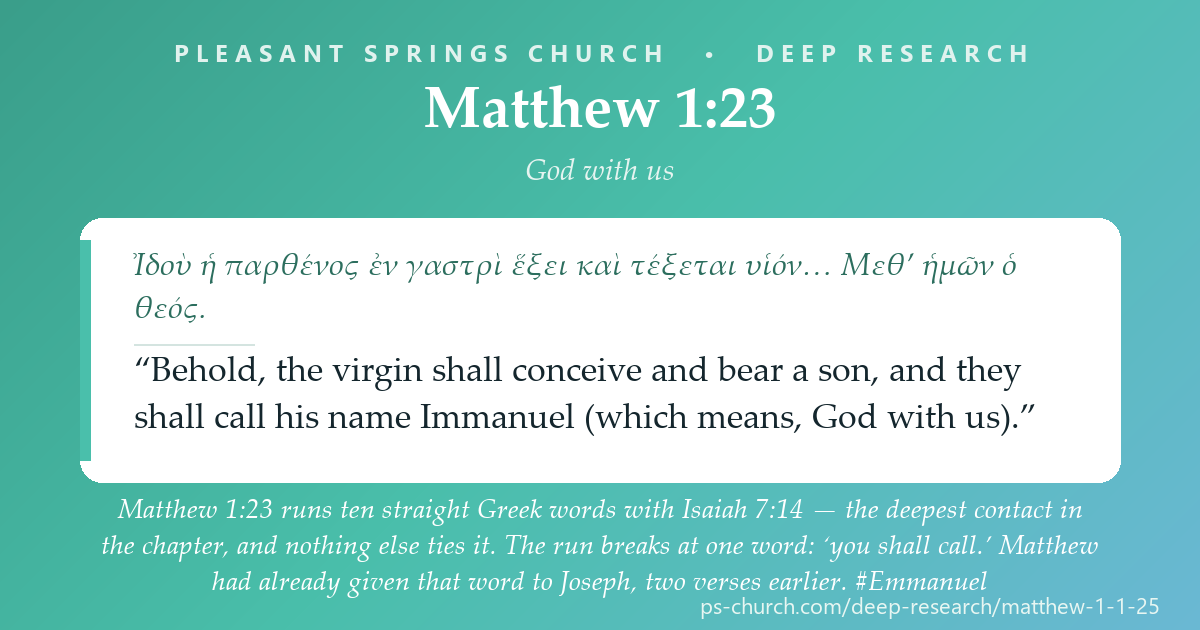
One verse in the chapter is a citation, and the measurement says which. Matthew 1:23 shares ten consecutive words with the Greek of Isaiah 7:14 — ἰδοὺ ἡ παρθένος ἐν γαστρὶ ἕξει καὶ τέξεται υἱὸν καί — and the tie band is one. The next-deepest contact anywhere in the whole Greek Old Testament held here reaches four — Isaiah 8:8 and Judith 13:11, and both of those are on the gloss rather than on the sign. Screening the 25 verses of Greek Isaiah 7 against the 7,927 verses of the Greek New Testament: all 25 reach two, eighteen reach three, nine reach four, two reach five, one reaches ten, and nothing reaches eleven.
And the run breaks at exactly one word. The Greek of Isaiah 7:14 continues καὶ καλέσεις τὸ ὄνομα αὐτοῦ Εμμανουηλ — “and you shall call his name.” Matthew writes καὶ καλέσουσιν — “and they shall call.” One word differs; the run stops; and then it resumes for four more, τὸ ὄνομα αὐτοῦ Ἐμμανουήλ. Ten, a gap of one, and four. The single divergent word is a second-person singular future changed to a third-person plural future — and Matthew has already used the Septuagint’s own καλέσεις, two verses earlier, when the angel tells Joseph “you shall call his name Jesus” (1:21). The singular goes to Joseph; the plural goes to everyone. We report the distribution; we do not claim to know how it came about, and we do not say Matthew “changed” anything — the Greek Isaiah tradition itself is not uniform at this word, and we have one edition on disk.
Now the counter-example, printed against ourselves. Matthew 1:21 looks like a quotation of Isaiah 7:14 too: it shares six consecutive words with it, υἱὸν καὶ καλέσεις τὸ ὄνομα αὐτοῦ. But the tie band is three. The same six words, at the same depth, come from Genesis 16:11 — the angel to Hagar about Ishmael — and Genesis 17:19 — God to Abraham about Isaac. Six words shared with three separate verses is a birth-announcement formula, not a citation. Read alone it would be a strong result; read with its band it is the standard way Greek scripture announces a son.
And the deepest formula in the chapter is not a quotation at all. Matthew 1:25 measures seven — deeper than 1:21 — on ἔτεκεν υἱὸν καὶ ἐκάλεσεν τὸ ὄνομα αὐτοῦ, “she bore a son and he called his name.” Its band is six: 1 Chronicles 7:23, 1 Samuel 1:20, 2 Samuel 12:24, and Genesis 38:3, 4 and 5. Nobody thinks Matthew 1:25 quotes any of them. If you took the run-length alone and ignored the band you would publish a discovery here; the band is what stops you. (A curiosity we note and do not build on: three of those six are Genesis 38, the Tamar chapter Matthew named at 1:3. On these numbers that is a coincidence of a common formula, and we will not dress it as more.)
Two more runs with a band of one — and neither is a citation. Depth is not the only thing that matters; a band of one at a shallow depth is still only a shallow depth. Matthew 1:3 shares five consecutive words with exactly one verse in the whole Greek Old Testament held here — τὸν Φαρὲς καὶ τὸν Ζάρα, at 1 Chronicles 2:4, the Chronicler’s own list of Judah’s sons by Tamar. Matthew 1:24 shares five with exactly one verse too — αὐτῷ ὁ ἄγγελος κυρίου καί, at Judges (B) 6:12, the call of Gideon. Both are unique in the corpus and neither announces itself as a quotation; two proper names in a shared genealogy and four words of an angel’s arrival are not enough to build on. We print them because the table would be dishonest without them.
A negative, honestly reported. “He will save his people from their sins” (1:21b) is often glossed with Psalm 130:8 — Psalm 129:8 in Septuagint numbering, “he will redeem Israel from all his iniquities.” Measured, that pairing shares a run of one word with Matthew 1:21: καί. The one place in the Greek Old Testament held here where σώσει τὸν λαόν occurs at all is 1 Kingdoms (1 Samuel) 9:16, of Saul: “he shall save my people out of the hand of the Philistines” — a run of three. There is no verbatim source for the sentence. Matthew is expounding the name, not quoting a text.
One more contact, outside the verse cited. Ἐμμανουήλ occurs once in the Greek Old Testament held here and once in the Greek New Testament. Matthew’s gloss of it — μεθ’ ἡμῶν ὁ θεός, “God with us” — is, word for word, the four Greek words that end Isaiah 8:8. That phrase occurs twice in the Greek Old Testament held here (Isaiah 8:8 and Judith 13:11) and once in the Greek New Testament (Matthew 1:23). Matthew’s translation of the name is the Greek Isaiah’s own wording, two verses further into the same oracle.
- Isaiah 7:14 — the sign to the house of David: the one verse in this chapter that measures as a citation (see Isaiah 7:14).
- Isaiah 8:8, 8:10 — “God with us” twice more in the same oracle; 8:8 supplies Matthew’s four-word gloss verbatim.
- Genesis 16:11; 17:19 — the annunciations to Hagar and to Abraham, which tie Matthew 1:21 at six (see Genesis 16, Genesis 17).
- Genesis 38:3–5; 1 Samuel 1:20; 2 Samuel 12:24 — the naming formula that ties Matthew 1:25 at seven (see Genesis 38, Hannah).
- Isaiah 9:6–7; 11:1–10 — the child, the throne, the shoot from Jesse’s stump: what a son of David was expected to be (see Isaiah 9).
The scholarship, the divergences we found, and what this page could not check.
Name the commentators, disclose every text-critical and Hebrew/Greek divergence we can see from here, and say plainly where the page is weakest.
Commentaries & studies:
- W. D. Davies & Dale C. Allison (ICC), R. T. France (NICNT), Ulrich Luz (Hermeneia), John Nolland (NIGTC), Craig Keener on Matthew.
- Raymond E. Brown, The Birth of the Messiah — still the standard treatment of Matthew 1–2 and of the genealogy’s women.
- Richard Bauckham, Gospel Women; Marshall Johnson, The Purpose of the Biblical Genealogies.
- G. K. Beale & D. A. Carson, eds., Commentary on the NT Use of the OT, on Matthew 1:23.
Hebrew and Greek divergences we can see from here — disclosed, not smoothed:
- Isaiah 7:14, the noun. The Hebrew reads הָעַלְמָה (ha-ʿalmah), “the young woman”; the Greek reads ἡ παρθένος, “the virgin.” Matthew quotes the Greek. We checked the other two definite-singular occurrences of the Hebrew noun: Genesis 24:43 is also ἡ παρθένος, but Exodus 2:8 is ἡ νεᾶνις. The Greek translators were not on a reflex. That cuts both ways and we print it both ways.
- Isaiah 7:14, the verb. Hebrew וְקָרָאת is itself ambiguous in person; the Greek edition on our disk reads καλέσεις (second singular); Matthew 1:23 reads καλέσουσιν (third plural). The Greek Isaiah tradition is not uniform here and we hold one edition. We do not assert who changed what.
- 1 Chronicles 3:19 — Hebrew and Greek disagree about Zerubbabel’s father. The Hebrew reads “the sons of Pedaiah: Zerubbabel and Shimei”; the Greek reads “the sons of Salathiel: Zorobabel and Semei.” Matthew 1:12 has Shealtiel father Zerubbabel — which is the Greek reading here, and also the reading of both Hebrew and Greek at Ezra 3:2 and 5:2 and Haggai 1:1. We verified all five verses on disk. We do not conclude that Matthew used the Greek Chronicles; we report that the traditions differ at exactly one verse and that Matthew stands with the majority.
- Matthew 1:7–8 and 1:10 — the Gospel’s own manuscripts differ. The critical text prints Ἀσάφ (the psalmist’s spelling) for King Asa and Ἀμώς (the prophet’s) for King Amon; other manuscripts read Ἀσά and Ἀμών. The Greek of 1 Chronicles 3:10, 14 has Ασα and Αμων. Those four verses are not printed in the codex above; the ESV reads Asaph and Amos, and readers of other translations will see the other spelling.
- Matthew 1:25 — a variant with doctrinal weight. The critical text reads simply “until she bore a son”; a large body of manuscripts reads “until she bore her firstborn son,” which is the wording of Luke 2:7. Neither reading settles the question people bring to this verse. The Greek ἕως οὗ marks the end of one state; it does not by itself report what followed.
- Matthew 1:18 — two more. Manuscripts vary between Ἰησοῦ χριστοῦ and χριστοῦ Ἰησοῦ, and between γένεσις (“origin, genesis”) and γέννησις (“birth”). The A/A′ link we draw in the structure diagram above — two panels headed by one noun, not an inclusio — depends on the first of those, γένεσις — the critical reading. If γέννησις were original, the verbal link to 1:1 weakens. We flag it because our own diagram rests on it.
What this page did NOT check — its limits:
- We hold one Greek Old Testament edition. Every count above is against the CATSS/Rahlfs files on this machine. Origen’s columns, the Lucianic recension, Aquila, Symmachus and Theodotion were not consulted — and Aquila and Symmachus are precisely where the Isaiah 7:14 noun question is usually argued, since both are reported to have read νεᾶνις there. That check is not on this page.
- We hold one Greek New Testament edition. The SBLGNT. The variant readings named above are known from its apparatus markers and from standard critical editions, not from collating manuscripts ourselves. Manuscript numbers, dates and distributions are not asserted here because we cannot verify them from local corpora.
- Our Joshua is partial. The Rahab spelling result above is measured against the B-text of Joshua; the A-text file on this machine holds only Joshua 15:21–19:45, so Joshua 2 and 6 in the A-text were not searched. Exodus, Leviticus, Numbers, Joshua, Judith and the other files outside the 39 mapped books are searched by the raw-file tools but not by the book-name tools, and we have said which of the two produced each number.
- The gematria of fourteen was not tested. The proposal that fourteen is the numerical value of דוד (D-V-D = 4+6+4) is old and widely repeated; it is an arithmetic claim about Hebrew letters, not a corpus measurement, and nothing on this page confirms or refutes it. Treat it as a suggestion.
- Second Temple sources were read in translation, not measured. No Qumran, pseudepigraphal or rabbinic text was screened for these runs; our Greek corpus is the Old Testament and the New. Where we mention Judith 13:11 it is because Judith is in the Greek files we hold, not because we are making a claim about its relation to Matthew.
- Luke’s genealogy was not run against Matthew’s. The two lists diverge after David and the harmonisations proposed (levirate marriage; Mary’s line) are historical arguments, not measurable ones. We have not tested them and do not endorse one here.
- The direction of influence is never asserted. A shared run of ten is contact. It is not evidence about who read whom, in what order, or in what edition. Where 1:23 announces itself as a citation — “that what the Lord had spoken by the prophet might be fulfilled” — we take the text at its word; everywhere else we report distributions only.
A list you would not have written, and a name you did not choose.
Name what you learned, why it matters, and one concrete response.
What should we carry away — and do?
- God writes the genealogy he wants. Tamar, Rahab, Ruth, the wife of Uriah — the line to the Messiah runs straight through scandal, foreignness and failure. Nobody in that list earned their place. If you have been assuming your history disqualifies you, read verse 3 again.
- The chain breaks on purpose. Thirty-nine times “fathered,” and then, once, “was born.” The throne is inherited; the Saviour is given. Matthew builds a legal case for forty-two generations and then tells you the last step was not ours to take.
- The name says the job. “You shall call his name Jesus, for he will save his people from their sins.” Not from Rome, not from poverty, not from difficulty. From sins. That is the announced purpose, before he has done a single thing.
- And the other name says the result. Emmanuel — God with us. Matthew opens on it and closes on it: “And behold, I am with you always, to the end of the age” (28:20). The whole Gospel is bracketed by the presence of God.
Step in response: read Matthew 1:1–17 out loud, slowly, all forty-one names. It is tedious, and that is the point — it is a real family, over real centuries, most of them forgotten. Then read 1:21 and ask what it would mean to be saved from your sins rather than from your circumstances. Then do what Joseph did: not understanding everything, obey the next thing.
Matthew 1:23 · to share
Greek NT + ESVEvery Deep Research page traces its passage across the whole sweep — the Old Testament, the Second-Temple world between the testaments (historical witnesses, not Scripture), and the New Testament. Follow the thread:
Pleasant Springs Church — Deep Research
Research method after Michael S. Heiser’s Bible Research Method (examine dictionaries → ancient literature → important words → textual connections → academic publications → share), with the Pleasant Springs “Author & Audience” foundation. Scripture set in the Hebrew, the Greek editions named on each page and the ESV (Old Testament), and the Greek New Testament and the ESV (New Testament), per the practice of Pleasant Springs Church. Matthew 1:1–25 research grounded in Davies & Allison, France, Luz, Nolland and Keener, with Raymond Brown on the birth narratives and Bauckham on the genealogy’s women. All run lengths, tie bands and word counts were measured here against 30,637 verse units of Greek Old Testament, 23,204 of Masoretic Hebrew and 7,927 of Greek New Testament; the tie band is printed beside every run, and the chapter’s own counter-examples (1:21 at six with a band of three, 1:25 at seven with a band of six) are printed against the headline result. The Hebrew/Greek divergences at Isaiah 7:14 and 1 Chronicles 3:19, and the Gospel’s own variants at 1:7–8, 1:10, 1:18 and 1:25, are disclosed rather than smoothed. No direction of influence is asserted anywhere on this page except at 1:23, where Matthew’s own fulfilment formula announces the citation.
Scripture quotations marked ESV are from the ESV® Bible (The Holy Bible, English Standard Version®), © 2001 by Crossway, a publishing ministry of Good News Publishers. ESV Text Edition: 2016. Used by permission. All rights reserved. The ESV text may not be quoted in any publication made available to the public by a Creative Commons license, and the ESV may not be translated in whole or in part into any other language. www.esv.org
|
Did this study bless you today? 💚 Give to Support PS Church100% of gifts go to the General Fund — thank you. |