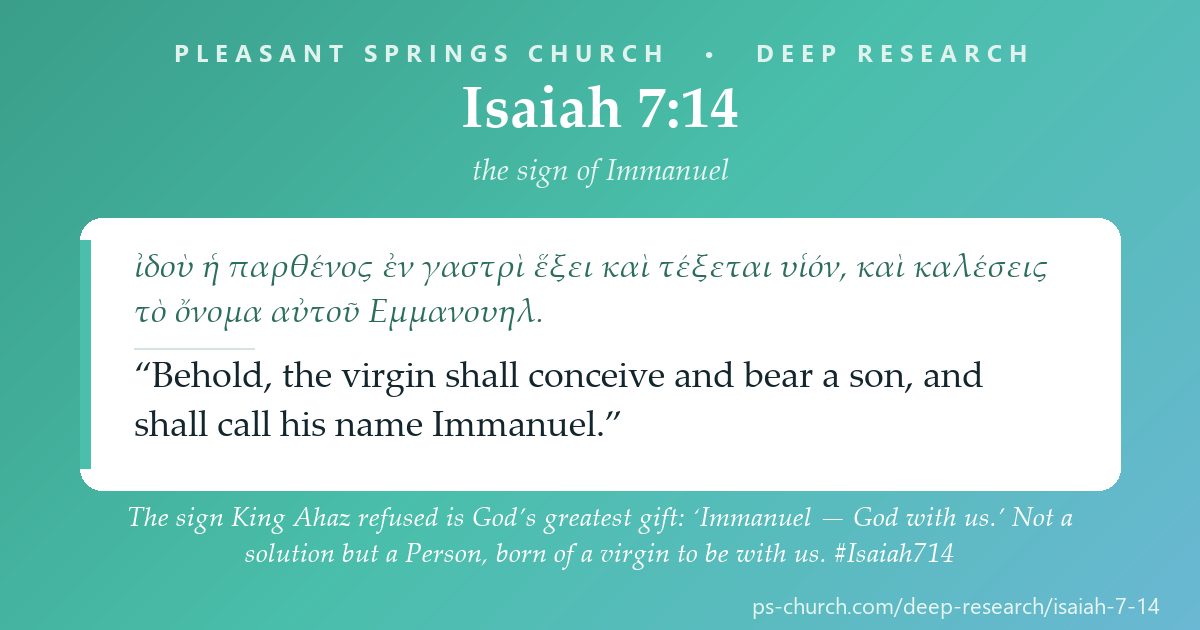
With enemies at the gate, God offers King Ahaz any sign he wants. Ahaz refuses — so God gives a sign of his own: “Behold, the virgin shall conceive and bear a son, and shall call his name Immanuel” — “God with us.” The Hebrew word, the Greek “virgin” the Jewish translators chose two centuries before Christ, and the near-and-far horizon of the sign all converge in one child. Matthew opens his Gospel with this verse, fulfilled in the virgin birth of Jesus. This study works Isaiah 7:14 from the sign to Ahaz to the God who is with us forever. See the method →
Isaiah 7:14, 16 (selections)
Hebrew · LXX · ESVThe Shape of the Passage
ConcentricIsaiah confronts King Ahaz (c. 734 BC) as Syria and Israel besiege Jerusalem. God offers Ahaz a sign; he refuses; God gives one anyway — the sign of Immanuel. See the companion child-king oracle in Isaiah 9:6-7.
Author
The prophet Isaiah speaks into a political panic: the kings of Syria (Rezin) and Israel (Pekah) have come up against Judah, and Ahaz’s heart shakes “as the trees of the forest shake before the wind” (7:2). God offers Ahaz any sign he asks; Ahaz, feigning piety, refuses (7:11–12). So the Lord gives a sign of his own choosing: a child, Immanuel, and a timetable — before the boy is old enough to tell right from wrong, the two dreaded kings will be gone (7:16).
Near and far. In its first horizon the sign speaks to Ahaz’s own day: a child soon born whose infancy measures the fall of Judah’s enemies. But the name — “God with us” — and Isaiah’s widening vision of a coming child (8:8; 9:6) stretch the oracle forward. Matthew hears its fullest meaning in the virgin birth of Jesus: God truly with us.
Audience
Ahaz and the house of David — and every reader tempted, like Ahaz, to trust in political alliances rather than in God. The sign is a rebuke and a mercy: whatever the king does, God’s purpose for David’s house stands, and his presence — “God with us” — is the true security Ahaz will not ask for.
How they heard it. The Immanuel sign became part of Israel’s messianic hope, read alongside 9:6–7 and 11:1–10. The Greek translators, two centuries before Christ, rendered the mother a “virgin” (parthenos) — a pre-Christian Jewish reading Matthew inherits and applies to Mary, framing his whole Gospel by “God with us” (1:23) and “I am with you always” (28:20).
Orient on the sign, Immanuel, the virgin, and messianic prophecy.
Search by topic: Immanuel, sign, virgin birth, Ahaz, messianic prophecy.
Which articles are relevant?
- Anchor Bible Dictionary — “Immanuel,” “Virgin Birth,” “Isaiah,” “Ahaz.”
- Dictionary of the OT: Prophets — “Immanuel,” “Signs,” “Messiah,” “Isaiah, Book of.”
- NIDOTTE / TDOT — עַלְמָה (ʿalmâ, young woman), בְּתוּלָה (bəṯûlâ, virgin), אוֹת (ʾôṯ, sign), עִמָּנוּ אֵל (ʿimmānû ʾēl, God with us).
Bibliography surfaced:
- John Oswalt (NICOT), Alec Motyer (The Prophecy of Isaiah), Brevard Childs (OTL), H. G. M. Williamson (ICC) on Isaiah.
- Studies of the almah/parthenos question and Matthew’s use of Isaiah 7:14; the near/far fulfillment.
- Beale & Carson, Commentary on the NT Use of the OT (Matthew).
The word almah, the Greek parthenos, and the near-and-far sign.
Weigh the almah/parthenos question honestly, then follow the Immanuel sign to its fulfillment in Christ.
Which parallels shed light on religion and worldview?
‘Young woman’ and ‘virgin.’ The Hebrew עַלְמָה (almah) means a young woman of marriageable age — young and, by cultural presumption, unmarried and a virgin — but it is not the technical Hebrew word for virgin, which is bethulah. The debate is old and honest: had Isaiah wanted to stress virginity unambiguously, bethulah was available. Yet the pre-Christian Jewish translators of the Septuagint (2nd c. BC) chose παρθένος, “virgin” — narrowing the sense — and it is that reading, centuries before the church, that Matthew takes up. The Great Isaiah Scroll from Qumran confirms the Hebrew read almah: the church’s Old Testament is the ancient text, and the virgin-reading is not a Christian invention but a Jewish one Matthew inherits.
A sign near and far. Isaiah’s sign functions first in Ahaz’s day — a child whose infancy times the collapse of Judah’s enemies (7:16). This is how many of Isaiah’s sign-names work (7:3; 8:1–4). But the name “God with us,” the definite “the young woman,” and Isaiah’s swelling child-king vision (8:8; 9:6–7; 11:1) reach past Ahaz. The New Testament reads the oracle as fulfilled fully and finally when God himself is born of a virgin. A near sign, a far horizon, and one meaning made complete in Christ.
- Isaiah 8:8, 10; 9:6–7; 11:1–10 — “O Immanuel”; “God is with us”; the child born on David’s throne (see Isaiah 9:6-7).
- The Great Isaiah Scroll (1QIsaᵃ), c. 125 BC (Dead Sea Scrolls — a manuscript witness) — reads העלמה (the young woman) at 7:14, confirming the Hebrew text long before the Christian debate.
- The Septuagint of Isaiah (2nd c. BC) — a pre-Christian Jewish translation reading παρθένος (virgin): the Greek Matthew quotes.
- ANE royal ‘sign-birth’ and naming custom — symbolic child-names announcing a message: the idiom Isaiah’s sign-names use.
Matthew opens the story of Jesus with this verse as his first fulfillment-quotation: “All this took place to fulfill what the Lord had spoken by the prophet: ‘Behold, the virgin shall conceive and bear a son, and they shall call his name Immanuel’ (which means, God with us)” (Matt 1:22–23). He quotes the Greek parthenos, grounding the virgin birth of Jesus, and adds the translation of the name — because that name is the whole point. In Jesus, God is not merely for us or over us but with us, born into our flesh and our crisis. Matthew changes “you shall call” to “they shall call,” widening the confession to all who would name him. And he frames his entire Gospel by Immanuel: it opens with “God with us” (1:23) and closes with the risen Christ’s promise, “I am with you always, to the end of the age” (28:20). The sign Ahaz would not ask for is God’s greatest gift: himself, with us.
The vocabulary of the young woman, the virgin, and God-with-us.
Watch the almah/parthenos pair and the name that is the whole message.
“Young woman” — a girl of marriageable age (presumed unmarried and a virgin), but not the technical word for virgin (bethulah). The LXX rendered it παρθένος, “virgin.”
“Virgin” — the ordinary Greek word for a virgin, the pre-Christian Jewish translators’ choice for almah; the word Matthew quotes of the virgin birth.
“Immanuel” — “God with us” (immanu, with us; ʾEl, God). A symbolic name, fulfilled in the one who is God present with his people (Matt 1:23; 28:20).
“Sign” — a God-given token. Ahaz was invited to ask for one and refused; the Immanuel sign is given anyway, both near confirmation and far promise.
How the New Testament reuses Immanuel:
- Matthew 1:22–23 — “the virgin shall conceive… Immanuel (which means, God with us)”: Isaiah 7:14 fulfilled in the virgin birth of Jesus.
- Matthew 28:20 — “I am with you always, to the end of the age”: the Immanuel promise closing the Gospel it opened.
- Luke 1:31–35 — the annunciation: “you will conceive… and bear a son”; the child “will be called holy — the Son of God.”
- John 1:14; Revelation 21:3 — the Word “dwelt among us”; “the dwelling place of God is with man”: God with us, begun and consummated (see the glory that fills the tabernacle).
From the sign to Ahaz to the God who is with us forever.
Trace Immanuel through Isaiah’s child-king oracles into the Gospel and the new creation.
Which cross-references matter?
- Isaiah 7:1–17; 8:1–10 — the Ahaz crisis, the sign-names, “God is with us”: the near horizon of Immanuel.
- Isaiah 9:6–7; 11:1–10 — the child born, the shoot from Jesse: the widening messianic vision (see Isaiah 9:6-7).
- Micah 5:2–5; 2 Samuel 7:12–16 — the ruler from Bethlehem, the Davidic throne (see Micah 5).
- Matthew 1:22–23; Luke 1:31–35; John 1:14 — the virgin birth and the Word made flesh: Immanuel fulfilled.
- Matthew 28:20; Revelation 21:3 — “I am with you always”; God’s dwelling with man forever.
Matthew reads Isaiah 7:14 as fulfilled in Jesus, and does so with care. He quotes the Septuagint’s parthenos because the virgin conception is the point, and he supplies the meaning of the name because “God with us” is his thesis. Scholars debate how the near sign to Ahaz relates to the far fulfillment; the most satisfying reading honors both — a sign genuinely operative in Ahaz’s day whose language (“God with us,” a coming child on David’s throne) was always straining toward more, and reached its fullness when God was born of a virgin. Matthew does not flatten the original setting into a bare prediction; he sees a pattern God built into Isaiah’s prophecy that only Christ completes. And he frames his whole Gospel by it: the book that opens by naming Jesus “God with us” ends with the risen Lord’s pledge never to leave his people — the Immanuel sign made permanent.
The scholarship on Isaiah 7:14.
The commentators on Isaiah; the studies of the almah/parthenos question and Matthew’s use.
Commentaries & studies:
- John N. Oswalt (NICOT), J. Alec Motyer (The Prophecy of Isaiah), Brevard S. Childs (OTL), H. G. M. Williamson (ICC) on Isaiah.
- Studies of almah/parthenos, the Immanuel sign, and Matthew’s fulfillment quotations.
- G. K. Beale & D. A. Carson, eds., Commentary on the New Testament Use of the Old Testament.
Interpretation notes worth keeping:
- The word honestly. ʿalmah means “young woman”; it is not the technical “virgin” word, though a young woman was presumed a virgin. The virgin sense is explicit in the LXX’s parthenos, which Matthew quotes — a pre-Christian Jewish reading, not a Christian retrojection.
- Near and far. The sign has a real horizon in Ahaz’s crisis (7:16) and a fuller one in Christ; honor both rather than choosing between “only about Ahaz’s day” and “only about Jesus.”
- The name is the message. “God with us” is the interpretive key; Matthew glosses it and frames his Gospel by it (1:23; 28:20).
From the sign Ahaz refused to the God who is with you.
Name what you learned, why it matters, and one concrete response.
What should we carry away — and do?
- God’s greatest gift is himself. Ahaz wanted an alliance; God offered his presence. The deepest answer to our fears is not a solution but a Person: “God with us.”
- The virgin birth is God stepping in. Immanuel is not a good man who points to God but God come as a child — entering our flesh to save us from the inside.
- He is with you to the end. The name that opened Matthew’s Gospel is sealed by its last words: “I am with you always.” Whatever you face, you do not face it alone.
Step in response: in the crisis where you are tempted, like Ahaz, to trust your own arrangements, stop and receive the sign instead — “God with us.” Name one fear and hand it to the Immanuel who came to be with you, and live this week in the confidence of his promise, “I am with you always.”
Matthew 1:23 · to share
Greek + ESVEvery Deep Research page traces its passage across the whole sweep — the Old Testament, the Second-Temple world between the testaments (historical witnesses, not Scripture), and the New Testament. Follow the thread:
Pleasant Springs Church — Deep Research
Research method after Michael S. Heiser’s Bible Research Method (examine dictionaries → ancient literature → important words → textual connections → academic publications → share), with the Pleasant Springs “Author & Audience” foundation. Scripture set in the Hebrew, the Greek editions named on each page and the ESV (Old Testament), and the Greek New Testament and the ESV (New Testament), per the practice of Pleasant Springs Church. Isaiah 7:14 research grounded in Oswalt, Motyer, Childs, and Williamson, with Beale & Carson on Matthew’s use; the almah/parthenos scholarship; the Great Isaiah Scroll and the Septuagint as manuscript/translation witnesses.
Scripture quotations marked ESV are from the ESV® Bible (The Holy Bible, English Standard Version®), © 2001 by Crossway, a publishing ministry of Good News Publishers. ESV Text Edition: 2016. Used by permission. All rights reserved. The ESV text may not be quoted in any publication made available to the public by a Creative Commons license, and the ESV may not be translated in whole or in part into any other language. www.esv.org
|
Did this study bless you today? 💚 Give to Support PS Church100% of gifts go to the General Fund — thank you. |