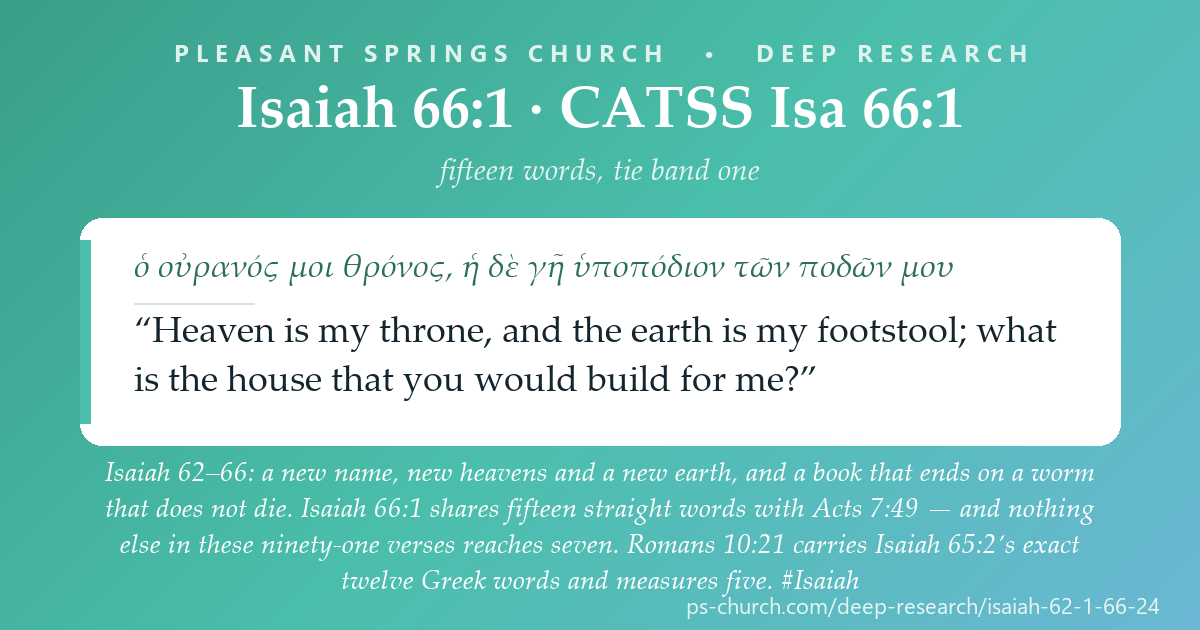
Five chapters, ninety-one verses, and the end of the longest prophetic book in the Bible. A city is promised a new name; a God announces new heavens and a new earth; and then the book stops on a sentence about corpses and a worm that does not die. Run the whole passage against the 7,927 verses of the Greek New Testament and the deepest verbatim contact anywhere in it is FIFTEEN consecutive words — Isaiah 66:1 into Acts 7:49, tie band one — and nothing else in these ninety-one verses reaches seven. The run is cut at exactly the point where Stephen puts back, in the middle of the sentence, the words he took off the front of it. Then the reversal, and it is the reason this page exists: Isaiah 65:2 and Romans 10:21 carry exactly the same twelve Greek words — every one, no substitutions — and measure five, because Paul moved three of them. Mark 9:48, quoting Isaiah’s last verse, measures three. Revelation 21:1, on new heavens and a new earth, measures two. And the rarest word in the passage joins Isaiah 66:24 to Daniel 12:2 while the run screen between them returns zero. See the method →
Isaiah 62:1–66:24 — sixteen rows across all five chapters (⚠️ the numbering diverges inside this passage: ESV 64:1 is the second half of Hebrew and Greek 63:19, and ESV 64:2–12 = Hebrew and Greek 64:1–11 — every row below carries all three numbers)
Hebrew (Masoretic) · Greek (CATSS/Rahlfs) · ESVThe Shape of the Passage
Sequence — thirteen scribal sections, and one verb that answers itselfNothing on this page bears on the authorship of the book of Isaiah. These are the chapters most often assigned to a third hand, and the two files on this disk cannot settle that and were not asked to. What follows reports who the text says is speaking, who it says is listening, and where the speaker changes without warning — and stops there.
Author
These five chapters carry no superscription and name no prophet. The book’s one heading stands at 1:1, sixty-one chapters earlier. Nothing between 62:1 and 66:24 gives a regnal year, a king, a place of writing or a name. The only proper nouns are Zion, Jerusalem, Edom, Bozrah, Abraham, Israel, Jacob, Judah, Moses, Sharon, Achor, Tarshish, Pul, Lud, Tubal and Javan, plus the two names the city is given at 62:4 (Hephzibah, Beulah) — and at 65:11 two more that may or may not be names at all.
The speaker changes at least six times and the text labels almost none of them. 62:1 is a first-person “I” who will not keep silent for Zion — and the text does not say whether that is the prophet or the Lord. 62:6 is somebody who has set watchmen on the walls. 63:1–6 is a dialogue: a question is asked of a figure coming from Edom and the figure answers. 63:7–64:11 is a congregation praying in the first person plural — we, our, us — for twenty-four verses. 65:1 answers that prayer in the first person singular without a word of introduction. 66:5 quotes what the enemies of the hearers say. At 62:1 and at 63:1 the text will not tell you who is talking, and this page does not fill the gap.
What the Greek column adds, and what it does not. The CATSS file for Isaiah runs 1,289 rows against the Masoretic 1,291 verses. The whole difference is two rows: there is no row for Isaiah 2:22 and none for Isaiah 56:12. Neither is in this passage — chapters 62 to 66 hold 12, 19, 11, 25 and 24 verses in BOTH ancient files. Whether those two omissions belong to the Greek tradition or only to this edition is a question about manuscripts, and no manuscript evidence was consulted for this page.
The Greek column is used here as a witness to a second ancient text, never as evidence about who wrote the Hebrew one. Where the two disagree — and on this page they disagree at 62:4, 63:9, 63:19, 64:3, 65:4, 65:11, 65:15, 65:17, 66:23 and 66:24 — the page prints both and names neither prior.
Audience
The addressee changes four times and every change is visible in the grammar. 62:1–12 speaks to a city, addressed as a woman throughout — your righteousness, your glory, your land, your sons. 63:1–6 speaks to a single figure in the masculine singular. 63:7–64:11 (ESV 64:12) is not addressed to the audience at all: it is the audience speaking to God. Then 65:1–66:24 turns and speaks to two groups at once, and keeps them apart sentence by sentence: my servants shall eat, but you shall be hungry; my servants shall drink, but you shall be thirsty (65:13). The last two chapters are addressed to a divided congregation, not to a nation.
The audience is a people arguing about the temple. The question at 66:1 — what is the house that you would build for me? — is not a rhetorical flourish in a vacuum. 66:3 lines up four acts of worship with four abominations and treats them as equivalents; 66:5 quotes people who say let the Lord be glorified and are hated by their own brothers for saying it; 66:20–21 imagines foreigners bringing the offering and God taking priests and Levites from among them. Whatever else these chapters are, they are addressed to people for whom the shape of worship was a live and bitter question.
How it has been carried. 66:1 is read in Acts 7 as an argument against a building, 65:17 and 66:22 are read everywhere as the promise the last two chapters of the Bible take up, and 66:24 is read as the sharpest sentence about final judgment in the Hebrew prophets. All three readings are older than any of us and none of them is invented here. What this page adds is only the measurement, and the measurements do not line up with the reputations: 66:1 reaches fifteen consecutive words into Acts 7:49; 65:17 reaches two into Revelation 21:1; 66:24 reaches three into Mark 9:48. The page does not claim the measurements are the meaning.
What a reference work would send you to look up before you read a line of Isaiah 62–66 — and the one thing about these chapters that a dictionary article will get right and a commentary outline will not: the verse numbers do not agree.
Stage one is orientation, not argument. It names the entries worth opening and it settles the reference frame, so that everything measured afterwards is measured against the right verse.
Which articles are relevant?
On the passage itself: Third Isaiah (or Trito-Isaiah) — the standard entry for chapters 56–66; New heavens and new earth; Zion; Name; Sabbath; Gehenna and Hinnom, Valley of, both of which are attached to 66:24 in every dictionary that has them and neither of which is named in the verse.
On the ancient background: Gad (deity) and Meni, the two figures at 65:11; Necromancy and Incubation, for 65:4; Edom and Bozrah, for 63:1; Temple, for 66:1–2.
On the New Testament use: Stephen and Acts 7; Romans 9–11; Revelation, Old Testament in. ⚠️ None of these articles was consulted for this page. They are listed because a reader following the method should open them, and because saying which articles WOULD bear on the passage is not the same as saying that they were read. Stage 5 keeps that distinction all the way through.
The verse numbers — and here there IS an offset
Most Deep Research pages say “there is no offset in this passage.” This one cannot.
Both ancient files on this disk give Isaiah 63 nineteen verses and Isaiah 64 eleven. Every printed English Bible gives Isaiah 64 twelve. The reason is a single long verse: Hebrew and Greek 63:19 contains the words English Bibles print as 64:1 — Oh that you would rend the heavens and come down. So:
- ESV 63:19 = the first half of Hebrew / CATSS 63:19
- ESV 64:1 = the second half of Hebrew / CATSS 63:19
- ESV 64:2–12 = Hebrew / CATSS 64:1–11
- Everywhere else in these five chapters the three columns agree exactly: 62, 63, 65 and 66 hold 12, 19, 25 and 24 verses in all three.
This was derived, not copied. The chapter shapes were read off the Masoretic and CATSS files on this disk on 31 August 2026 and the seam was then checked by CONTENT: the words the ESV prints as 64:1 are inside Hebrew 63:19 in the file held here. A table would have told us the same thing; the point of deriving it is that the table might have been wrong and the file cannot be.
Practical consequence: three rows of the codex above carry English numbers one higher than their Hebrew and Greek ones (ESV 64:1, 64:4, 64:12 = Hebrew 63:19b, 64:3, 64:11), and a reader comparing this page with a commentary that cites Hebrew numbers must hold that in mind for exactly eleven verses.
What the reference frame is, in numbers
- Masoretic Hebrew — 23,204 verse units, 39 books (Sefaria, Miqra according to the Masorah). This passage is 91 of them; the screen ran against the other 23,113.
- Greek Old Testament — 64 CATSS files, 30,637 verse units HELD, 30,348 SCREENED. The difference is the Odes, which are excluded from every screen on this page. That matters more on an Isaiah page than anywhere else: three of the Odes are second copies of Isaiah (5:1–9, 26:9–20 and 38:10–20), and two more are New Testament text copied into a Greek Old Testament manuscript — Ode 9 is Luke 1 and Ode 13 is Luke 2. Counting them would double Isaiah phrase counts and would let a page report Luke matching Luke as an Old Testament parallel.
- Greek New Testament — 7,927 verses, SBLGNT as digitized by MorphGNT.
- ESV — not held on this disk for Isaiah. The English column above was typed and its alignment rests on verse counts, chapter openings and the seam check described above. This is stated again in the footer because it is the page’s weakest column.
Bibliography surfaced:
- Oswalt, The Book of Isaiah 40–66 (NICOT)
- Childs, Isaiah (OTL)
- Blenkinsopp, Isaiah 56–66 (Anchor Yale)
- Westermann, Isaiah 40–66 (OTL)
- Goldingay, Isaiah 56–66 (ICC)
- Smith, Rhetoric and Redaction in Trito-Isaiah
- Troxel, LXX-Isaiah as Translation and Interpretation
- van der Kooij, on the Greek Isaiah translator
- Beale & Carson, Commentary on the New Testament Use of the Old Testament
- Pritchard (ed.), ANET, 3rd ed. — the standard primary-source collection
⚠️ NONE of these was consulted while this page was built. The list is what a reader should go to next, not a claim about what was read. Every measured statement on this page comes from the files named above and can be reproduced from them. Stage 5 says the same thing at greater length and with the specific questions this page could not answer.
Two gods with a table set for them, a rite performed in tombs, and a question about temples that the ancient world asked of every god — what can actually be checked from here, and what cannot.
Stage two is where a page is most tempted to borrow. The discipline is to say what the text itself says, to measure what is measurable in the corpora on this disk, and to name the secondary literature that WOULD answer the rest as unread.
Gad and Meni, and what the Greek did with them
Isaiah 65:11 accuses the hearers of setting a table (שֻׁלְחָן) for one figure and filling mixed wine (מִמְסָךְ) for another. The two figures are גַּד and מְנִי.
What is measurable here:
- The consonantal form לַגַּד occurs in two verses of the Masoretic corpus: Isaiah 65:11 and Numbers 1:14 — and in Numbers it is the tribe of Gad, an ordinary personal name. The screen cannot tell a god from a tribe, and this page will not pretend that it can.
- The consonantal form לַמְנִי occurs in two verses: Isaiah 65:11 and Micah 7:12 — where it is not a name at all but an ordinary preposition. Same three letters, different word.
- In Greek, τῷ δαίμονι — the dative singular of δαίμων — stands in exactly one verse of the 30,348 screened Greek Old Testament units: Isaiah 65:11. The diminutive δαιμόνιον is common; the plain singular is a hapax in this corpus.
- The CATSS Greek renders the pair τῷ δαίμονι and τῇ τύχῃ — the daemon and Chance.
- And the cross-check that makes it interesting. At Genesis 30:11 Leah names a son Γαδ and the Greek Genesis renders her exclamation ἐν τύχῃ. So the Greek word that Genesis uses for גד is the Greek word that Isaiah uses for מני. The two renderings cross over.
What this page does NOT claim: that Gad and Meni are the Fortune and Destiny of any particular pantheon; that the Greek translators knew each other’s work; or that either rendering is early or late. Those are questions for the dictionary articles named in stage 1 and for the epigraphic evidence, and no epigraphic evidence was consulted for this page. The ANET volume held locally has no entry for these two figures.
Sleeping in tombs — and the motive only one column supplies
Isaiah 65:4 describes people who sit in tombs and spend the night in נְצוּרִים — a word the ESV renders secret places and which elsewhere means guarded or besieged. The Hebrew says where they are. It does not say why.
The CATSS Greek supplies a reason: ἐν τοῖς μνήμασιν καὶ ἐν τοῖς σπηλαίοις κοιμῶνται δι’ ἐνύπνια — in the tombs and in the caves they sleep FOR DREAMS. Two words, δι’ ἐνύπνια, turn a description of a place into a description of a rite: sleeping at a grave in order to be given a dream.
The house rule holds. The Greek column is one ancient reading of the Hebrew; it is not a commentary on it, and the page does not say the practice existed because the Greek names it, nor that the Greek invented it. It says: here are two ancient texts, and one of them tells you what the other only implies.
The same accusation returns at 66:17, with the same pig’s flesh and the same gardens — and there the Hebrew adds mice. 66:17 stands in the passage’s last chapter and last unit, so the accusation that opened at 65:3–4 is still running at the end of the book.
“What house will you build for me?” — the question and its limits
Isaiah 66:1 asks a question that the ancient world put to gods constantly, usually in the opposite direction: temple-building texts from Mesopotamia to Egypt exist in quantity, and the standard collection held locally — Pritchard’s ANET — carries several (the Gudea temple hymns, the ritual for the repair of a temple, the Babylonian New Year rites).
⚠️ None of them was read for this page, and one specific reason is worth stating: the ritual texts most relevant here sit at ANET pages 331–348, and the local scan of that volume runs out at about ANET 327. A page that quoted them would be quoting from memory. It will not.
What CAN be said from the corpora:
- הֲדֹם רַגְלָי, the footstool of my feet, occurs in one verse of the whole Masoretic corpus — this one. Psalm 110:1 has the noun with a different suffix.
- מְנוּחָתִי, my resting place, occurs in three verses: Isaiah 66:1, Psalm 95:11 and Psalm 132:14. Isaiah 66:1 asks where it is; Psalm 132:14 answers this is my resting place forever; Psalm 95:11 says they shall not enter my rest. The measured run between Isaiah 66:1 and either Psalm is ONE — the shared word and nothing adjacent to it.
- 2 Samuel 7:5, where God asks David would you build me a house to dwell in?, measures three against Isaiah 66:1 — and the three are the messenger formula כֹּה אָמַר יְהוָה, which is not a link at all.
The last verse and how it has been read aloud
Isaiah 66:24 is the last verse of the book and it is about unburied bodies. In synagogue practice, when the passage is read as a haftarah, 66:23 is repeated after 66:24 so that the reading does not end on the corpses — the same courtesy given to the last verses of Malachi, Lamentations and Ecclesiastes.
⚠️ That is a statement about a reading tradition and it is NOT derivable from the files on this disk. It is included because it is relevant and widely attested, and it is flagged because nothing verifies it here. What the file DOES show is the negative half of it: the Masoretic text held here carries no section marker after 66:24 at all. Twelve markers stand in these ninety-one verses and the last of them is at 66:14. The book simply stops.
What was NOT read for this page
No commentary. No dictionary article. No monograph on Trito-Isaiah, on Greek Isaiah, or on the New Testament use of Isaiah. No epigraphic corpus, no Ugaritic text, no Qumran scroll — which on this passage is a real cost, because 1QIsaa carries all five of these chapters complete and was not collated. No manuscript apparatus for either the Hebrew or the Greek. No rabbinic source for the reading practice named above.
What WAS used: four text files and one frozen normaliser. Every number on this page can be reproduced from them, and no number on this page depends on anything else.
Five words, and each one of them is countable. A verb of silence that answers itself across the passage; a two-word phrase that occurs once on each side of the Testaments; a resting place; a worm; and a word so rare that it joins Isaiah to Daniel and to nothing else.
Stage three counts. Every figure below is an exhaustive count over a named corpus, and every count says which corpus — because a negative is only a negative on the corpus searched.
Four occurrences in these ninety-one verses, and three of the four forms are all but unique in the Hebrew Bible. אֶחֱשֶׁה (I will keep silent) stands in TWO verses of the whole Masoretic corpus and both are here: 62:1 and 65:6, and both are negated. יֶחֱשׁוּ (they shall be silent) stands in ONE verse of the whole Hebrew Bible: 62:6, the watchmen. תֶּחֱשֶׁה (will you keep silent) stands in TWO: 64:11 (ESV 64:12) and Psalm 28:1.
One verse in the whole Masoretic corpus: Isaiah 62:2. Its Greek is τὸ ὄνομά σου τὸ καινόν, also one verse in 30,348. At 65:15 the Hebrew has something different — שֵׁם אַחֵר, another name — where the Greek has ὄνομα καινόν, one verse in 30,348 again.
One verse in the 30,348 screened Greek Old Testament units (Isaiah 65:15) and one verse in the 7,927-verse Greek New Testament (Revelation 2:17). The articular form τὸ ὄνομά … τὸ καινόν is likewise one and one: Isaiah 62:2 (your) and Revelation 3:12 (my).
The suffixed form מְנוּחָתִי stands in three verses: Isaiah 66:1, Psalm 95:11, Psalm 132:14. In Greek, καταπαύσεώς μου is one verse (Isaiah 66:1) and κατάπαυσίν μου is one verse (Psalm 94:11 LXX = 95:11). Isaiah’s form reaches exactly one New Testament verse, Acts 7:49; the Psalm’s reaches three, Hebrews 3:11, 4:3 and 4:5.
Two verses in the whole Hebrew Bible: Isaiah 66:24 and Daniel 12:2. Both are pictures of the dead being looked at. The CATSS Greek at 66:24 has εἰς ὅρασιν, for a spectacle, from the verb to see; the page reports the difference and does not explain it.
The one verb, and the shape it makes
Read the four occurrences in order and the passage has a spine that no outline supplied:
- 62:1 — לְמַעַן צִיּוֹן לֹא אֶחֱשֶׁה, for Zion’s sake I will not keep silent.
- 62:6 — the watchmen on the walls לֹא יֶחֱשׁוּ, shall never be silent. This form occurs in no other verse of the Hebrew Bible.
- 64:11 (ESV 64:12) — at the very end of the long prayer, תֶּחֱשֶׁה וּתְעַנֵּנוּ עַד מְאֹד, will you keep silent, and afflict us so terribly? The prayer’s last word before an OPEN scribal section.
- 65:6 — seven verses later, לֹא אֶחֱשֶׁה כִּי אִם־שִׁלַּמְתִּי, I will not keep silent, but I will repay.
The passage opens with God refusing to be silent, the people end their prayer by asking whether he will be silent after all, and he answers in the same two words he opened with. That is a measured feature of the Hebrew text, not an outline: the form אֶחֱשֶׁה occurs twice in the whole Hebrew Bible and both are these two verses.
⚠️ What the Greek column does with it. The Greek does not preserve the pattern. 62:1 is οὐ σιωπήσομαι, 64:11 is ἐσιώπησας (a past tense, not a question), 62:6 is οὐ σιωπήσονται and 65:6 is οὐ σιωπήσω. The verb is the same in Greek, but the Greek turns the question into a statement about the past, so a reader working from the Greek alone would not see the call and answer as a question and an answer. This diagram is a Hebrew-side finding and the page says so.
The new name, laid out
Four verses in two Testaments, and each phrase is a hapax in its own corpus:
| phrase | in 30,348 Greek OT units | in 7,927 Greek NT verses |
|---|---|---|
| τὸ ὄνομά σου τὸ καινόν | 1 — Isaiah 62:2 | 0 |
| τὸ ὄνομά μου τὸ καινόν | 0 | 1 — Revelation 3:12 |
| ὄνομα καινόν (bare) | 1 — Isaiah 65:15 | 1 — Revelation 2:17 |
And the measured run between each Isaiah verse and its Revelation partner is TWO. Two, because the phrase is only two or four words long and the word that differs (σου against μου) sits in the middle. This is the clearest case on the shelf of a run figure being true and useless at the same time. The right report is both numbers together: the run is two, AND the phrase occurs twice in a corpus of 38,275 verse units, and here are both occurrences.
The Hebrew adds a further wrinkle that no Greek-side count can see. At 62:2 the Hebrew genuinely says a NEW name. At 65:15 it says ANOTHER name. It is the Greek column, not the Hebrew, that gives Revelation’s exact wording at 65:15 — and the page records that without saying anything at all about which text John had in front of him.
Two words that count the theme rather than a phrase
ὄνομα (name). Fourteen occurrences in twelve of these ninety-one verses — 62:2, 63:12, 63:14, 63:16, 63:19, 64:1, 64:6, 65:1, 65:15, 66:5, 66:19, 66:22. Across the whole of CATSS Isaiah the word stands in 57 verses. So these five chapters are 7% of the book and carry 21% of the book’s ‘name’ verses.
καιν- (new). Thirteen occurrences in eleven verses of CATSS Isaiah, and four of the eleven are here: 62:2, 65:15, 65:17, 66:22 — a new name, another name called new, new heavens and a new earth, and the new heavens and the new earth again.
Both counts are Greek-side deliberately. The Hebrew שֵׁם (name) and שָׁם (there) are the same two consonants, so a consonantal screen cannot separate them and the Hebrew figure would be worthless. This is the kind of limit that decides which column a count is run on, and it is stated rather than hidden.
Ninety-one CATSS rows against all 7,927 verses of the Greek New Testament, and ninety-one Hebrew verses against the other 23,113 in the Masoretic corpus. One run of fifteen, a gap, and then a set of numbers that do not respect any reputation.
The screen finds the longest CONTIGUOUS run of identical word forms between one verse and every verse of a target corpus, and reports the TIE BAND — how many target verses reach the same maximum. A run of 15 with a band of 1 is a signal; a run of 4 with a band of 21 is a formula. It finds verbatim contact. It does not find allusion, and this page proves that in both directions.
The whole Greek New Testament against these 91 verses
Every one of the 91 CATSS rows reaches two. Sixty-eight reach three. Fifteen reach four. Seven reach five. Three reach six. One reaches fifteen. Nothing reaches sixteen.
⚠️ Look at the gap. There is no run of seven, eight, nine, ten, eleven, twelve, thirteen or fourteen anywhere in these five chapters. The list goes 6, 6, 6 — and then straight to 15. Isaiah 66:1 is not the top of a slope; it is alone.
| Isaiah | run | tie band | deepest partner | is it a citation? |
|---|---|---|---|---|
| 66:1 | 15 | 1 | Acts 7:49 | yes — Stephen says so |
| 65:4 | 6 | 1 | Mark 5:5 | no — an accident |
| 66:14 | 6 | 1 | John 16:22 | unmarked; judge for yourself |
| 62:11 | 5 | 1 | Matthew 21:5 | yes, half of one |
| 64:3 (ESV 64:4) | 5 | 1 | Revelation 2:19 | no — an accident |
| 65:1 | 5 | 1 | Romans 10:20 | yes — Paul names Isaiah |
| 65:2 | 5 | 1 | Romans 10:21 | yes |
| 63:10 | 4 | 20 | — τὸ πνεῦμα τὸ ἅγιον | no — a formula |
| 63:11 | 4 | 21 | Hebrews 13:20 and 20 others | no — a formula |
| 65:22 | 4 | 2 | Revelation 2:7, 22:19 | the tree of life; judge for yourself |
| 66:20 | 4 | 2 | Matthew 4:5, 27:53 | no — εἰς τὴν ἁγίαν πόλιν |
Read the last column and then read the run column again. The two deepest figures after fifteen are a six that is certainly not a citation and a six that probably is. The two Pauline quotations that name Isaiah out loud sit BELOW the accident at Mark 5:5. That is the whole argument for reporting the band and the identification separately, and never letting a number do the work of a judgment.
The fifteen, opened up
Isaiah 66:1 (CATSS):
οὕτως λέγει κύριος · ὁ οὐρανός μοι θρόνος ἡ δὲ γῆ ὑποπόδιον τῶν ποδῶν μου ποῖον οἶκον οἰκοδομήσετέ μοι · ἢ ποῖος τόπος τῆς καταπαύσεώς μου
Acts 7:49 (SBLGNT):
ὁ οὐρανός μοι θρόνος ἡ δὲ γῆ ὑποπόδιον τῶν ποδῶν μου ποῖον οἶκον οἰκοδομήσετέ μοι · λέγει κύριος · ἢ τίς τόπος τῆς καταπαύσεώς μου
- Fifteen consecutive word forms, tie band one. No other verse in the Greek New Testament comes close to Isaiah 66:1.
- The run is cut by the attribution. Isaiah opens thus says the Lord (three words). Acts drops all three from the front and puts two of them back after οἰκοδομήσετέ μοι. That insertion, and nothing else, is where the fifteen stops.
- Then it resumes. The tail τόπος τῆς καταπαύσεως μου is four more shared words. So nineteen of the twenty-three words in Acts 7:49 stand in Isaiah 66:1, in two blocks, and the only substantive difference in the whole verse is ποῖος for τίς.
- Three phrases in this one verse are unique on both sides. ὁ οὐρανός μοι θρόνος, ὑποπόδιον τῶν ποδῶν μου and τόπος τῆς καταπαύσεώς μου each stand in exactly one verse of the 30,348 screened Greek Old Testament units and exactly one verse of the 7,927-verse Greek New Testament — and in every case the pair is Isaiah 66:1 and Acts 7:49.
- The near miss. ὑποπόδιον τῶν ποδῶν WITHOUT my stands in two Greek Old Testament verses (Isaiah 66:1 and Psalm 109:1 LXX) and five Greek New Testament ones. It is the possessive that makes the phrase unique, and Acts keeps it.
- And the sentence Jesus builds on the same verse does not measure. Matthew 5:34–35 — do not swear by heaven, for it is the throne of God, or by the earth, for it is his footstool — measures one and two against Isaiah 66:1. Same image, same verse behind it, no shared sequence at all.
Direction is not asserted here and cannot be measured. What can be said is what Acts itself says: Stephen introduces the words as a prophet’s and quotes them. That is the text’s own signal, and it is the only kind of signal this shelf accepts as evidence of citation.
Romans 10:20–21: the same twelve words, and a run of five
This is the measurement that should be read beside the fifteen, because the two of them together are the method.
Isaiah 65:2 (CATSS), first twelve words:
ἐξεπέτασα τὰς χεῖράς μου ὅλην τὴν ἡμέραν πρὸς λαὸν ἀπειθοῦντα καὶ ἀντιλέγοντα
Romans 10:21, after and concerning Israel he says:
ὅλην τὴν ἡμέραν ἐξεπέτασα τὰς χεῖρας μου πρὸς λαὸν ἀπειθοῦντα καὶ ἀντιλέγοντα
The same twelve words. Every one. No substitution, no addition, no omission — only a reordering, and only of three words. The run engine measures contiguous sequence, so it reports the longest unbroken stretch, πρὸς λαὸν ἀπειθοῦντα καὶ ἀντιλέγοντα: five.
At 65:1 Paul does something different and gets the same figure. The Greek Isaiah reads manifest I became to those not seeking me; I was found by those not asking. Paul reads I was found by those not seeking me; manifest I became to those not asking — he swaps the two verbs, so that found now goes with seeking. The five-word run (ἐμφανὴς ἐγενόμην τοῖς ἐμὲ μή) falls across the swap: it matches Isaiah’s FIRST clause against Paul’s SECOND.
So the two clearest, most explicitly signalled quotations of Isaiah on this page measure five and five, while the accident in Mark 5:5 measures six. Nothing is wrong with the screen. It is doing exactly what it says it does. This is what “the measurement finds verbatim contact, not allusion” means in practice.
The counter-examples, printed rather than buried
Every one of these is a connection a reader will arrive expecting, and every one of them measures small. They are printed here so that the sixes and fives above are not read as more than they are.
- Isaiah 66:24 → Mark 9:48 — THREE. Jesus quotes the last verse of Isaiah almost word for word in English, and the Greek measures three (σκώληξ αὐτῶν οὐ). Mark has present-tense τελευτᾷ and σβέννυται; CATSS Isaiah has futures τελευτήσει and σβεσθήσεται. Two tense endings cost four words of run — normalise them and the run is seven, and it then stops at Isaiah’s second αὐτῶν, which Mark has not got. Note also that Mark 9:44 and 9:46, which repeat the line in later manuscripts, are not in the SBL edition held here, so the screen sees one Markan verse and not three.
- Isaiah 65:17 and 66:22 → Revelation 21:1 — TWO. And → 2 Peter 3:13 — ONE. Isaiah has the phrase in the nominative (ὁ οὐρανὸς καινὸς καὶ ἡ γῆ καινή); John and Peter have it in the accusative. Case endings are word forms.
- Isaiah 62:2 → Revelation 3:12 — TWO, and Isaiah 65:15 → Revelation 2:17 — TWO. See stage 3 for why these two figures are true and misleading at once.
- Isaiah 64:3 (ESV 64:4) → 1 Corinthians 2:9 — ONE. Paul’s what no eye has seen, nor ear heard shares one word form with the verse everyone hears behind it.
- Isaiah 63:1–3 → Revelation 19:13, 19:15 — ONE and TWO. The garments dipped in blood and the winepress of the wrath of God.
- Isaiah 66:7–8 → Revelation 12:5 — TWO. The woman who gives birth before her labour.
- Isaiah 63:16 → Matthew 6:9 — THREE. You, O Lord, are our Father… your name, against our Father… hallowed be your name.
- Isaiah 66:1 → 2 Samuel 7:5, in Hebrew — THREE, and all three are the messenger formula.
- Isaiah 63:10 and 63:11 → twenty and twenty-one New Testament verses at FOUR. The shared four words are τὸ πνεῦμα τὸ ἅγιον. A tie band of twenty-one is the signature of a formula, and no page should print a four from these two verses without it.
The Hebrew screen: these 91 verses against the rest of the Hebrew Bible
Ninety-one source verses against the other 23,113 verse units of the Masoretic corpus, with the unigram fallback OFF — so a row reported as 0 shares NO TWO CONSECUTIVE WORDS with any other verse in the Hebrew Bible. It does not mean the verse shares no words.
The distribution: 14 rows at zero, 51 at two, 17 at three, 5 at four, 2 at five, 1 at six, 1 at seven.
- The deepest is SEVEN, tie band one: Isaiah 65:25 → Isaiah 11:9. לֹא יָרֵעוּ וְלֹא יַשְׁחִיתוּ בְּכָל הַר קָדְשִׁי. The book’s deepest internal link is the same seven words standing twice, fifty-four chapters apart, and the page’s deepest Hebrew number is not a link to anything outside Isaiah at all.
- Second is SIX, tie band one: Isaiah 65:13 → Jeremiah 7:20 — and it is לָכֵן כֹּה אָמַר אֲדֹנָי יְהוִה הִנֵּה, a messenger formula. Six words, band one, and no connection whatever. The tie band does not save you here; only reading does.
- Third is FIVE, tie band one: Isaiah 62:11 → Isaiah 40:10. Isaiah beside Isaiah again.
- Fourth is FIVE, tie band two: Isaiah 66:12 → Jeremiah 10:18 and 20:4 — another formula.
- Fourteen verses return ZERO: 63:2, 63:6, 63:17, 63:18, 64:1 (ESV 64:2), 64:5, 64:10, 65:4, 65:9, 65:10, 65:14, 65:16, 66:7, 66:11. Fifteen per cent of this passage shares no adjacent word pair with anything else in the Hebrew Bible.
- And the zero that matters most. Isaiah 66:24 against Daniel 12:2 measures zero — while דֵּרָאוֹן, the rarest word in the passage, joins those two verses and no others in the whole Hebrew Bible. The screen cannot see the strongest lexical link on the page, and the page says so on the page.
Three caveats that change specific numbers, run both ways
1. The section markers are tokenised. The Sefaria file carries ס and פ inside the verse text at the end of twelve of these ninety-one verses, and the frozen normaliser counts them as words. The screen was run both ways. Exactly ONE row moves: Isaiah 64:11 (ESV 64:12) drops from three to two, because its “three” was עַד מְאֹד פ — two real words and a paragraph mark. Every Hebrew figure on this page is the marker-stripped one. normalize.py is frozen and was not edited.
2. Five ketiv/qere pairs stand in this passage — at 62:3, 63:9, 65:4, 65:7 and 66:17. Four of them change a letter and nothing else. The fifth, at 63:9, changes the sense: ketiv לֹא (not), qere לוֹ (to him). The Hebrew screens on this page were run reading the QERE throughout, which is the shelf’s convention; a ketiv pass would change 63:9’s tokens and no reported figure on this page depends on that verse.
3. Cross-corpus runs apply MorphGNT’s own spelling equivalences. οὐ/οὐκ/οὐχ, ἐκ/ἐξ and the movable nu are folded, so a run is not cut at a word the two editions merely spell differently. Every Greek figure on this page was re-measured on 31 August 2026 under that rule and nothing was copied from a sibling page. Figures published on this shelf before 30 August 2026 are lower for that reason.
What was screened and returned nothing
The acrostic screen was run on all five chapters and all five came back negative. Isaiah 62, 63, 64, 65 and 66 do not run down the Hebrew alphabet, singly or in stanzas, and none of them has the right verse count for one. That is a negative result and it is reported because the shelf reports negatives.
The letter screens were not run on this passage, because nothing in it suggested a pangram and running a screen until something turns up is not a method.
The section that says what this page could not check. It is the longest honest part of any Deep Research page and it is not thinned when the findings are good.
A page is trustworthy in proportion to the precision of what it admits. Below: what was not consulted, what was checked and withdrawn, and where this page is weakest.
What was NOT consulted — the honest list
- No commentary of any kind. Oswalt, Childs, Blenkinsopp, Westermann, Goldingay, Motyer, Shalom Paul — none opened. Where this page describes a unit of the text it is describing a scribal section marker, not a commentator’s paragraph.
- No dictionary or encyclopedia article, including the ones stage 1 says you should read.
- No Dead Sea Scroll. 1QIsaa carries all five of these chapters complete and was not collated. On this passage that is the sharpest limit on the page. The Great Isaiah Scroll differs from the Masoretic text at points inside these chapters, and this page cannot tell you where or how.
- No critical apparatus for either the Hebrew or the Greek. Where the CATSS text differs from the Hebrew — and on this page it differs at ten places named in the Author panel — the page reports the difference between two printed editions and says nothing about manuscripts.
- No epigraphic or ANE primary source. The relevant temple-building and ritual texts sit past the end of the local ANET scan, and the Gad/Meni evidence is epigraphic. Stage 2 says this in place.
- No rabbinic source for the haftarah reading practice at 66:23–24, which is the one statement in stage 2 that is not derived from a file on this disk and is flagged where it stands.
- No ESV text file. The English column was typed. See below.
Claims that were checked and withdrawn while this page was built
1. “דֵּרָאוֹן occurs once in the Hebrew Bible.” Withdrawn. The first screen anchored the regular expression at both ends and missed Daniel 12:2, where the word carries a prefixed preposition. The correct figure is two, and the second one is the interesting one. The page would have printed a false hapax.
2. “Isaiah 65:15 says a new name.” Withdrawn as stated. The Hebrew says שֵׁם אַחֵר, ANOTHER name. It is the Greek column that says new. The page now prints both and says which is which, because a study whose scripture rule is LXX + ESV must not quietly let one column speak for the other.
3. “These chapters speak of God’s SERVANTS in the plural, against the singular servant of chapters 40–53.” Withdrawn as unmeasurable here. עַבְדִּי (my servant) and עֲבָדַי (my servants) are the SAME FOUR CONSONANTS. The consonantal screen cannot count them apart, and a figure it cannot produce is not printed. The observation may well be right; it is not this page’s to make.
4. “Isaiah 66:24 is about Gehenna.” Not made. The Valley of Hinnom is not named in the verse, in the chapter, or anywhere in these five chapters. Every dictionary article on Gehenna cites this verse; the verse does not cite Gehenna. The page reports the vocabulary and leaves the identification to the literature it did not read.
Where this page is weakest
- The ESV column. No ESV file for Isaiah exists on this disk and no Crossway API key exists in this project. The English was typed from a printed text and its verse alignment rests on verse counts, chapter openings and the 63:19/64:1 content check. If a word of the English is wrong, nothing on this page would catch it. The Hebrew and Greek columns were pulled programmatically and are reproducible.
- The structure diagram is a Hebrew-side artefact twice over. The thirteen units come from ONE edition’s scribal markers, and the call-and-answer the depths encode does not survive into the Greek, which turns the people’s question at 64:11 into a statement about the past. A reader working from the Greek would not draw this diagram.
- The run of fifteen is the page’s headline and it is also the page’s least surprising finding. Acts 7:49 announces itself as a quotation. Measuring it confirms what the text already says. The genuinely new things on this page are the small numbers, and a reader who takes away only the fifteen has taken away the wrong half.
- “A phrase occurs once in 30,348 units” is a fact about a CORPUS, not about a language. The 64 CATSS files are not the whole of Greek literature and not even the whole Septuagint tradition; they are what is held here. Every such count on this page carries its denominator for that reason.
- Direction of influence is never asserted and cannot be measured. Where a New Testament verse says it is quoting, the page says so; everywhere else it reports two texts and a number.
- Chapters 56–61 are not on this page. Isaiah 61:1–3 has its own study; 56–60 are covered elsewhere on the shelf or not yet. A reader wanting the whole of so-called Third Isaiah should read this page together with those.
Sources actually used:
- Masoretic Hebrew — Sefaria, Miqra according to the Masorah; 23,204 verse units, 39 books. Read with the qere.
- Greek Old Testament — Rahlfs’ Septuaginta as digitized by CATSS; 64 files, 30,637 verse units held, 30,348 screened with the Odes excluded.
- Greek New Testament — SBLGNT as digitized by MorphGNT; 7,927 verses.
- ESV — quoted under Crossway’s standing permission; NOT held as a file for Isaiah and not machine-checked.
- dr_tools — the run engine, the frozen normaliser, and the screens named at each figure. Every number above is reproducible from the four corpora.
What to do with a page whose biggest number is its least interesting one.
The last stage of the method is not decoration. A finding that is not handed on is a finding that was not understood.
The thing worth sitting with
Two facts from this page, side by side.
One. Stephen, on trial for his life and accused of speaking against the temple, answers with fifteen consecutive words of Isaiah 66:1 — heaven is my throne, and the earth is my footstool; what house will you build for me? He does not argue. He recites, and he moves says the Lord into the middle of the sentence so that nobody in the room can miss whose words they are.
Two. Paul, writing to Rome about a people who would not listen, takes Isaiah 65:2 and repeats it exactly — the same twelve Greek words, not one changed — and moves three of them to the front so that the sentence begins with all day long. All day long I held out my hands. He changed nothing and he changed the emphasis completely.
Between them these two men show you what it looks like to know a text well enough to use it. One quotes it whole and repositions the attribution; the other quotes it whole and repositions the ache. Neither adds a word.
And then the book they were both quoting ends the way it ends: not on the new heavens, which come two verses earlier, but on bodies outside the city and a worm that does not die. Isaiah will not let you have the new creation without the sentence that follows it, and the synagogue’s answer to that — go back and read verse 23 again — is not a way of avoiding the last verse. It is a way of refusing to let it be the last word.
Three things to carry into a conversation
- A run of six can be nothing and a run of three can be everything. Mark 5:5 shares six straight words with Isaiah 65:4 and means nothing by it; Mark 9:48 shares three with Isaiah 66:24 and is quoting it deliberately. Numbers locate; they do not decide.
- The two columns are not always saying the same thing, and the honest thing is to print both. At 63:9 the Hebrew has an angel saving Israel and the Greek expressly denies that an angel did it. At 65:15 the Hebrew says another name and the Greek says a new name. Neither page nor preacher should pick the column that suits the point.
- The book ends on a sentence it has already said. The deepest Hebrew link in these ninety-one verses runs from 65:25 back to 11:9 — seven words, tie band one, they shall not hurt or destroy in all my holy mountain. Fifty-four chapters apart the same sentence stands twice — and here a serpent eating dust stands with it.
Take it further
Read Acts 7:44–53 with Isaiah 66:1–2 open beside it and watch where Stephen stops quoting. Read Romans 10:16–21 with Isaiah 65:1–2 open and watch what he does with the word order. Then read Isaiah 66:22–24 aloud, all three verses, and decide for yourself whether you want to go back and read verse 23 again.
The measurements on this page are all reproducible from four text files. If you find one of them wrong, that is the most useful thing you could tell us.
Every Deep Research page traces its passage across the whole sweep — the Old Testament, the Second-Temple world between the testaments (historical witnesses, not Scripture), and the New Testament. Follow the thread:
Pleasant Springs Church — Deep Research
Research method after Michael S. Heiser’s Bible Research Method (examine dictionaries → ancient literature → important words → textual connections → academic publications → share), with the Pleasant Springs “Author & Audience” foundation. Scripture set in the Hebrew, the Greek editions named on each page and the ESV (Old Testament), and the Greek New Testament and the ESV (New Testament), per the practice of Pleasant Springs Church. Isaiah research grounded in Oswalt (NICOT), Childs (OTL), Blenkinsopp (Anchor Yale), Westermann (OTL), Goldingay (ICC) and Shalom Paul; on Greek Isaiah in Troxel and van der Kooij; on the New Testament use in Beale and Carson. NONE of that literature was consulted while this page was built, and stage 5 lists it as unread rather than implying otherwise. Text: Hebrew from the Masoretic text as printed in the edition consulted — Sefaria’s Miqra according to the Masorah, read with the qere; no critical apparatus was consulted for the Hebrew and no Dead Sea Scroll was collated, 1QIsaᵃ included — which on this passage is the sharpest limit on the page, since that scroll carries all five of these chapters complete. Greek from Rahlfs’ Septuaginta as digitized by CATSS; Greek New Testament from the SBL edition as digitized by MorphGNT. The standing caution for this shelf applies: these pages say “the CATSS Greek text reads…” and never call a Greek reading early or late, and never say which text acted on which. ⚠️ Verse numbering — and this passage HAS an offset. Both ancient files on this disk give Isaiah 63 nineteen verses and Isaiah 64 eleven; every English Bible gives Isaiah 64 twelve. ESV 64:1 is the second half of Hebrew and CATSS 63:19, and ESV 64:2–12 = Hebrew and CATSS 64:1–11. Chapters 62, 63, 65 and 66 agree exactly in all three columns at 12, 19, 25 and 24 verses. The chapter shapes were re-derived from the files on this disk on 31 August 2026 and the seam was checked by content: the words the ESV prints as 64:1 stand inside Hebrew 63:19 in the file held here. Across the whole book the CATSS file holds 1,289 rows where the Hebrew holds 1,291 verses — it has no row for Isaiah 2:22 and none for Isaiah 56:12, and the chapter maxima agree in all sixty-six chapters otherwise. ⚠️ The ESV column was NOT verified against a held ESV text. No ESV file for Isaiah exists on this disk and no Crossway API key exists in this project; the English was typed and its verse alignment rests on verse counts, chapter openings and the seam check above. The Hebrew and Greek columns were pulled programmatically from the corpus files. The ESV is quoted here under Crossway’s standing permission; this codex prints twenty-five numbered ESV verses of Isaiah under twenty-four Hebrew ones (the row at 63:19 carries two English verses under one Hebrew one), taking the whole shelf’s Isaiah quotation to 237 of the book’s 1,292 verses — 18.3%, well under the permitted half, measured on 31 August 2026. ⚠️ Every cross-corpus run figure on this page was measured on 31 August 2026 and applies MorphGNT’s own spelling equivalences — οὐ/οὐκ/οὐχ, ἐκ/ἐξ and the movable nu — so that a shared run is not cut at a word the two editions merely spell differently. Figures published on this shelf before 30 August 2026 are lower for that reason; nothing was copied from a sibling page and every number above was re-measured. ⚠️ A run of zero on the Hebrew screen means NO TWO CONSECUTIVE WORDS. The Hebrew-side screen runs with the unigram fallback off, so max = 0 means the verse shares no adjacent word pair with any verse outside Isaiah 62–66 — it does not mean the verse shares no words. All fourteen zeros on this page share individual words freely. The Greek-side screen runs with the fallback ON, so a 1 reported there means an isolated shared word and no adjacent pair at all. ⚠️ The Masoretic text held here counts the scribal section markers as words. ס and פ stand inside the verse text of the Sefaria file at the end of twelve of this passage’s ninety-one verses, and the frozen normaliser tokenises them. Stage 4 prints the screen both ways: exactly ONE row moves (64:11, ESV 64:12, drops from three to two). The Hebrew tables on this page are the marker-stripped figures. normalize.py is frozen and was not edited. ⚠️ Greek Old Testament figures are scoped to the 64 CATSS files held here, 30,637 verse units, screened to 30,348 with the Odes excluded — which matters on an Isaiah page in particular, because three of the Odes are second copies of Isaiah, at 5:1–9, 26:9–20 and 38:10–20, and two more are New Testament text (Ode 9 is Luke 1, Ode 13 is Luke 2). Counting them would double every Isaiah phrase count on this page. ⚠️ Four claims were checked and withdrawn while this page was built and all four are named in stage 5. Typology is handled per the house position: what the text says, what the New Testament itself draws, and what we see from this side of the cross — with the seeing left to the reader.
Scripture quotations marked ESV are from the ESV® Bible (The Holy Bible, English Standard Version®), © 2001 by Crossway, a publishing ministry of Good News Publishers. ESV Text Edition: 2016. Used by permission. All rights reserved. The ESV text may not be quoted in any publication made available to the public by a Creative Commons license, and the ESV may not be translated in whole or in part into any other language. www.esv.org
|
Did this study bless you today? 💚 Give to Support PS Church100% of gifts go to the General Fund — thank you. |