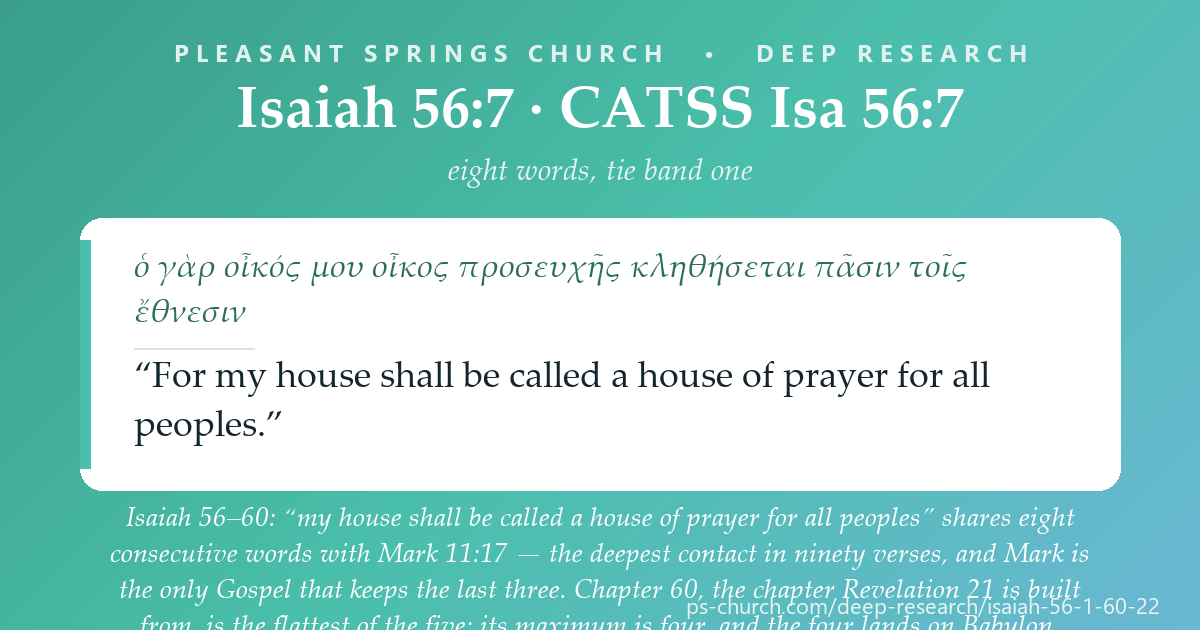
Ninety verses that open the last quarter of Isaiah, and the two ends of them measure in opposite directions. Isaiah 56:7 — my house shall be called a house of prayer for all peoples — shares EIGHT consecutive words with Mark 11:17, tie band one, and that is the deepest verbatim contact in the passage. Mark is the only Gospel that keeps the whole clause: Matthew measures five, Luke four, John one. Then chapter 60 — arise, shine, for your light has come, the chapter Revelation 21 is visibly rebuilt out of — turns out to be all but invisible against the entire Greek New Testament. Its maximum is four — only chapter 57, at three, is flatter — and the four lands on Babylon. Against the Hebrew Bible the same chapter is the deepest on the page: eight words at 60:4, seven at 60:16, six at 60:9, and every one of them points back inside Isaiah. And the armour of Isaiah 59:17, which everyone reads into Ephesians 6, measures ONE against Ephesians 6:14 and ONE against Ephesians 6:17. This page prints all of it, counter-examples first. See the method →
Isaiah 56:1–60:22 — sixteen rows across all five chapters (the chapter and verse numbers agree in the Hebrew, the Greek and the ESV throughout — with ONE exception, and it falls inside this passage: the CATSS file has no row for 56:12, so Greek Isaiah 56 runs to eleven verses where the Hebrew and the ESV run to twelve. Because the missing verse is the last of its chapter nothing downstream shifts, and 57:1 through 60:22 are the same verse in every column)
Hebrew (Masoretic) · Greek (CATSS/Rahlfs) · ESVThe Shape of the Passage
Sequence — eleven scribal sections, one of which crosses a chapter breakNothing on this page bears on the authorship of the book of Isaiah. These five chapters sit at the head of what scholarship since Duhm has called Third Isaiah, and the question of how many hands stand behind the sixty-six chapters is real, old, and not answerable from the three files on this disk. What follows reports who the text says is speaking and who it says is listening, and stops there.
Author
These five chapters carry no superscription and name no prophet, no king and no year. The book’s one heading stands at 1:1 — the vision of Isaiah the son of Amoz — and nothing between 56:1 and 60:22 attaches a date to anything. The last dated event in the book is Hezekiah’s illness at 38:1; the last named foreign king is Cyrus at 45:1. Between 56:1 and 60:22 not one living individual is named. The eleven proper names in the CATSS Greek of these ninety verses are Jacob, Israel, Zion, Jerusalem, Lebanon, Midian, Ephah, Sheba, Kedar, Nebaioth and Tarshish — every one a people, a place or an eponym. And one of the eleven is not in the Hebrew at all. Jerusalem does not stand anywhere in the Masoretic text of Isaiah 56–60; Ιερουσαλημ stands once in the Greek, at 60:1, where the Hebrew has no noun to translate. צִיּוֹן stands twice in both columns, at 59:20 and 60:14, and those are the only two.
The speaker changes eight times in ninety verses and only three of the changes are announced. 56:1 opens thus says the Lord; 56:8 is a separate oracle formula, the Lord God, who gathers the outcasts of Israel, declares; 57:15 opens for thus says the One who is high and lifted up. Those are the three. The others simply turn: 56:9 addresses wild animals; 57:3 addresses sons of the sorceress; 58:1 addresses a single person and tells him to shout; 59:9 shifts into the first person plural — therefore justice is far from US — and stays there for six verses; 60:1 turns to a feminine singular you who is never named in the Hebrew. The CATSS Greek names her. It supplies Ιερουσαλημ at 60:1 where the Hebrew has no noun at all.
What the Greek column adds, and what it does not. The CATSS file for Isaiah runs 1,289 rows against the Masoretic 1,291 verses; the whole difference is that there is no row for Isaiah 2:22 and none for Isaiah 56:12, and one of the two is in this passage. Verse for verse otherwise, 56–60 run 12/11, 21, 14, 21 and 22. Whether that omission belongs to the Greek tradition or only to this edition is a question about manuscripts, and no manuscript evidence was consulted.
Audience
The first named audience of these chapters is people the law of Moses excludes from the assembly. 56:3 names בֶּן־הַנֵּכָר, the son of the foreigner, and הַסָּרִיס, the eunuch. Deuteronomy 23:2 in the Hebrew and Greek numbering (English 23:1) bars פְּצוּעַ־דַּכָּא וּכְרוּת שָׁפְכָה from קְהַל יְהוָה, and 23:4 bars the Ammonite and the Moabite to the tenth generation. Isaiah 56 addresses exactly those people and promises them a name inside the house. The measurement finds no verbal reuse whatever between the two passages: the deepest run is two, in Greek, on function words. The connection is real to a reader and invisible to this screen, and the page says both.
Then the audience turns, and turns again. 56:9 addresses כֹּל חַיְתוֹ שָׂדָי, all you beasts of the field, and tells them to come and eat. 57:3 addresses children of an adulteress. 58:1 addresses one man and tells him to lift his voice like a trumpet. 58:3 quotes the audience back at itself — why have we fasted, and you see it not? The audience is quoted protesting twice in these ninety verses — the foreigner and the eunuch at 56:3, and the fasting congregation at 58:3. And chapter 60 addresses a woman who is a city.
The nations are the other audience, and the text cannot decide what they are. גּוֹיִם stands in chapter 60 at verses 3, 5, 11, 12 and 16. At 60:3 they walk to her light; at 60:5 their wealth comes to her; at 60:11 their kings are led in; at 60:16 she nurses at their breast. And at 60:12 the nation that will not serve her perishes. That verse — the only one in chapter 60 to reach four against the Greek New Testament — shares ἔθνη καὶ οἱ βασιλεῖς with Revelation 18:3, tie band one, and Revelation 18 is the fall of Babylon.
Orient on the eunuch and the foreigner in Israelite law, the temple as a house of prayer, the prophetic critique of fasting, the divine warrior, and the pilgrimage of the nations to Zion.
Which articles are relevant?
- Anchor Bible Dictionary — “Isaiah, Book of” (esp. the Third Isaiah section), “Eunuch,” “Sojourner,” “Temple, Jerusalem,” “Fasting,” “Sabbath,” “Zion Traditions,” “Divine Warrior.”
- Dictionary of the Old Testament: Prophets (IVP) — “Israel,” “Justice, Righteousness,” “Nations,” “Zion,” “Worship and Cult,” “Isaiah: Book of.”
- Theological Dictionary of the Old Testament (TDOT) — סָרִיס saris, נֵכָר nekhar, תְּפִלָּה tefillah, צוֹם tsom, שַׁבָּת shabbat.
- Theological Dictionary of the New Testament (TDNT) — προσευχή, εὐνοῦχος, ἀλλογενής, πανοπλία.
What the dictionaries settle, and what they do not
They settle the legal background and they do not settle the measurement. Every reference work on Isaiah 56 points to Deuteronomy 23 and to the exclusion of the emasculated and the foreigner from the assembly. That is right, and this page says so. What no dictionary says, because no dictionary counts, is that the two passages share no pair of adjacent words in Hebrew and only two function words in Greek. The reversal is thematic. It is not verbal, and a page that quotes a dictionary and then implies a quotation has moved from one to the other without saying so.
One term the dictionaries handle better than the screen can. סָרִיס is not always a castrated man; in several Hebrew Bible passages it is a court official, and Potiphar — who has a wife — is called one at Genesis 39:1, where the Greek is εὐνοῦχος. The screen cannot tell the two senses apart, because it compares forms and not meanings. Isaiah 56:3 makes its own sense plain by having the man call himself a dry tree, and that is a reading, not a measurement.
The stone that barred foreigners from the temple courts, the Second Temple book that rewrites the eunuch oracle, and the armour of God before Ephesians.
Two of the three items below are IN the corpus on this disk and were measured. One is not, and is quoted in English only and labelled as unmeasured. The page keeps the two kinds of evidence apart.
The soreg inscription — the word Greek Isaiah uses, carved on the barrier
Herod’s temple carried a low stone barrier, the סורג / δρύφακτος, with warning notices set into it in Greek. Two survive. Their opening word is the word Greek Isaiah uses for the person 56:3 comforts.
“No foreigner is to enter within the balustrade and enclosure around the sanctuary. Whoever is caught will himself be responsible for his death, which will follow.”The Jerusalem temple warning inscription (OGIS 598; the complete stone found by Clermont-Ganneau in 1871). Quoted here in English translation only. The inscription is NOT on this disk, nothing was measured against it, and the Greek text was not collated.
What can be measured, and what is only observed. Measured: ἀλλογενής stands in 47 places in the Greek Old Testament files held here, spread across eighteen books, and four of the 47 are in Isaiah — 56:3, 56:6, 60:10 and 61:5. Three of the four are on this page. Measured: the word occurs once in the whole Greek New Testament, at Luke 17:18, where it is the Samaritan leper who came back. Observed, not measured: that the barrier notice and Greek Isaiah 56 use the same word for the same class of person. That observation rests on a published transcription this project does not hold, and it is offered as context, not as a finding.
Josephus describes the barrier and its notices twice (Antiquities 15.417; Jewish War 5.194). Named, not consulted — there is no Josephus corpus on this disk.
Wisdom of Solomon 3:14 — the eunuch oracle rewritten, and a run of ONE
The Wisdom of Solomon takes up Isaiah 56 directly. It is in the CATSS corpus on this disk, so the connection could be measured rather than asserted. It measures one.
| Greek | |
|---|---|
| Wisdom 3:14 | καὶ εὐνοῦχος ὁ μὴ ἐργασάμενος ἐν χειρὶ ἀνόμημα … δοθήσεται γὰρ αὐτῷ τῆς πίστεως χάρις ἐκλεκτὴ καὶ κλῆρος ἐν ναῷ κυρίου θυμηρέστερος |
| Isaiah 56:2 | … καὶ διατηρῶν τὰς χεῖρας αὐτοῦ μὴ ποιεῖν ἀδίκημα |
| Isaiah 56:5 | δώσω αὐτοῖς ἐν τῷ οἴκῳ μου … ὄνομα αἰώνιον |
Wisdom has a blessed eunuch, hands that worked no lawless deed, and a portion in the temple of the Lord. Isaiah 56 has a eunuch who is not a dry tree, a man who keeps his hands from doing evil, and a place in God’s house. Measured against Isaiah 56:3, 56:4 and 56:5, the deepest contiguous run in Wisdom 3:13–14 and 4:1 is ONE. The words are ὅτι, μή, καί and ἐν. A book that is obviously reworking a passage can share nothing measurable with it, and this is a clean example inside a single language and a single corpus.
The armour before Ephesians — Wisdom 5:17–20
Isaiah 59:17, Wisdom 5:17–20 and Ephesians 6 are read as one tradition by practically everyone. All three are on this disk. Every pairwise run between them is ONE or ZERO.
Wisdom 5:18: ἐνδύσεται θώρακα δικαιοσύνην καὶ περιθήσεται κόρυθα κρίσιν ἀνυπόκριτον — he will put on righteousness as a breastplate and set on unfeigned judgement as a helmet. Isaiah 59:17 has ἐνεδύσατο δικαιοσύνην ὡς θώρακα; Ephesians 6:14 has ἐνδυσάμενοι τὸν θώρακα τῆς δικαιοσύνης. Three sentences about the same breastplate, and the deepest contiguous run between any two of them is one word. The full grid is in stage 4.
Cultural background this page relies on and did not measure
The Persian-period restoration setting usually assigned to Isaiah 56–66; the practice of court eunuchs across the Neo-Assyrian, Neo-Babylonian and Persian administrations; Nehemiah 13:15–22 on Sabbath trade and Zechariah 7:1–7 on fasting in the fifth and seventh months as the nearest datable parallels to Isaiah 58; and the caravan trade of Midian, Ephah, Sheba, Kedar and Nebaioth named in Isaiah 60:6–7. All of this is standard background. None of it was measured, and no Akkadian, Persian or epigraphic corpus exists on this disk to measure it against. The one Second Temple text this page does measure is the Wisdom of Solomon, because CATSS supplies it.
Six words, each with a count taken from the files rather than from a lexicon.
Every count below is over a named corpus and is exhaustive. Where a count is a count of CONSONANTS rather than of a word, the page says so and gives the reason.
One verse in the Hebrew Bible. Isaiah 56:5, and nowhere else in the 23,204 verse units held here. Literally a hand and a name. What the eunuch is promised is not offspring but a memorial inside the house. The CATSS Greek does not carry the image: τόπον ὀνομαστόν, a place of renown.
One verse in the Hebrew Bible, and one verse in the Greek Old Testament held here. Both are Isaiah 56:7. The Greek οἶκος προσευχῆς occurs in exactly one of 30,348 screened verse units. The temple is called many things in the Hebrew Bible; it is called a house of prayer once.
47 in the Greek Old Testament held here, across eighteen books; 4 of them in Isaiah (56:3, 56:6, 60:10, 61:5); 1 in the whole Greek New Testament, at Luke 17:18. The Hebrew behind Isaiah 56:3 is בֶּן־הַנֵּכָר, son of the foreign.
38 in the Greek Old Testament held here; only 2 of them in Isaiah, both in this passage (56:3, 56:4). In the Greek New Testament it stands 10 times and in only two places: five times in Matthew 19:12, and five times in Acts 8, where the man is reading Isaiah.
The NOUN stands in six verses of Isaiah — 1:13, 56:2, 56:4, 56:6, 58:13, 66:23 — and four of the six are here. The Greek σάββατ- forms fall at the same six places, so both columns agree. A warning about counting. The bare consonant string שבת stands in fourteen verses of Isaiah, but most of those are not the Sabbath at all — they are שָׁבַת ceased (14:4, 24:8, 33:8) and לָשֶׁבֶת to dwell (40:22, 44:13, 45:18, 47:14, 58:12). Three different words share three consonants and the normaliser cannot tell them apart.
The noun and its verb stand in four verses of Isaiah, and all four are in chapter 58 — 58:3 (twice), 58:4 (twice), 58:5 (twice), 58:6. The Greek νηστ- stem stands at Isaiah 1:13, 58:3, 58:4 (twice), 58:5 (twice) and 58:6. Isaiah is a book that mentions fasting almost nowhere except here.
Righteousness and salvation: the pair that opens the passage and arms the warrior
The root צדק stands in ten verses of these five chapters and the noun יְשׁוּעָה in four. They stand together in exactly TWO.
| verse | what it says |
|---|---|
| 56:1 | my salvation (יְשׁוּעָתִי) is near to come and my righteousness (וְצִדְקָתִי) to be revealed — the first sentence of the passage |
| 59:17 | he put on righteousness (צְדָקָה) as a breastplate, and a helmet of salvation (יְשׁוּעָה) on his head — the warrior |
| 60:17–18 | the pair splits: righteousness at 60:17, salvation at 60:18, one verse apart, as the names of the city’s government and walls |
One word had to be thrown out of this count. A first pass matched תְּשַׁוַּע at 58:9 as a ישע form. It is not: it is from שׁוע, to cry for help, and it was removed by hand. A consonant screen will do that to you, and the way to keep it honest is to look at every hit. Isaiah 59:11 carries לִישׁוּעָה and is the fourth genuine occurrence.
Two words the Greek supplies that the Hebrew does not have
| verse | Hebrew | CATSS Greek |
|---|---|---|
| 58:13 | and speaking a word (וְדַבֵּר דָּבָר) | οὐδὲ λαλήσεις λόγον ἐν ὀργῇ — nor speak a word IN ANGER |
| 60:1 | an unnamed feminine you | φωτίζου φωτίζου Ιερουσαλημ — the city is named |
| 58:6 | no speech formula | λέγει κύριος inserted mid-verse |
| 60:19 | nor shall the moon give light to you | φωτιεῖ σοι τὴν νύκτα — BY NIGHT |
And one the Greek does not have: at 59:17 the Hebrew ends and he wrapped himself in zeal (קִנְאָה) as a cloak; the CATSS row ends καὶ τὸ περιβόλαιον and stops. These are reported as differences between two files. No claim is made about which reading is older or which text moved.
Every run on this page, with its tie band, including — especially — the ones that do not support the connection a reader expects.
Two screens, run on 31 August 2026. Greek side: all 89 CATSS rows of Isaiah 56–60 against all 7,927 verses of the Greek New Testament, contiguous runs of whole normalised word forms, never lemmas, with MorphGNT’s own spelling equivalences applied on both sides (οὐ/οὐκ/οὐχ, ἐκ/ἐξ, the movable nu). Hebrew side: the same passage’s 90 verses against the other 23,114 verse units of the 39-book Masoretic corpus, consonantal forms, the qere read, with the unigram fallback OFF — so a Hebrew zero means no two consecutive words, not no shared words. Both exhaustive and deterministic; nothing sampled.
The whole Greek screen in one table
Across the 89 CATSS rows against 7,927 verses of the Greek New Testament: 87 reach two, 66 reach three, 15 reach four, 5 reach five, 3 reach seven, 1 reaches eight, and nothing reaches nine. NOTHING REACHES SIX — the distribution jumps from five straight to seven.
| run | rows | which, and the tie band |
|---|---|---|
| 8 | 1 | 56:7 — Mark 11:17, band 1 |
| 7 | 2 | 59:7 — Romans 3:16, band 1 · 59:21 — Romans 11:27, band 1 |
| 6 | 0 | — |
| 5 | 2 | 56:5 (Acts 10:30, band 1) · 59:6 (Revelation 14:13, band 1) |
| 4 | 10 | 56:11 (Ro 3:16, band 1) · 58:3 (Heb 13:24, band 1) · 58:7 (band 5) · 58:13 (band 4) · 59:2 (band 3) · 59:8 (Ro 3:17, band 2) · 59:9 (Lk 18:34, band 1) · 59:14 (Ro 3:16, band 1) · 59:20 (Ro 11:26, band 1) · 60:12 (Revelation 18:3, band 1) |
| 3 | 51 | the bulk of the passage |
| 2 | 21 | |
| 1 | 2 | 59:4, band 6,000 · 59:18, band 943 |
Read the bands, not the runs. Six of the ten rows that stop at four have a tie band of one — 56:11, 58:3, 59:9, 59:14, 59:20 and 60:12 — and only one of the six is a quotation. 59:20 is Paul. 56:11 and 59:14 both carry the same four words as Romans 3:16, ἐν ταῖς ὁδοῖς αὐτῶν, without being quoted, 58:3 lands on the closing greetings of Hebrews, 59:9 on a sentence about the disciples not understanding, and 60:12 on the fall of Babylon. A low band tells you a run is rare. It does not tell you it is a quotation.
The house of prayer across three Gospels: the run tracks the clause
Isaiah 56:7 is quoted in all three Synoptic temple-cleansing scenes, and the three runs are 8, 5 and 4 — exactly in proportion to how much of the sentence each evangelist keeps.
| verse | run | the shared string | what it drops |
|---|---|---|---|
| Mark 11:17 | 8 | οἶκός μου οἶκος προσευχῆς κληθήσεται πᾶσιν τοῖς ἔθνεσιν | nothing |
| Matthew 21:13 | 5 | οἶκός μου οἶκος προσευχῆς κληθήσεται | πᾶσιν τοῖς ἔθνεσιν — for all the nations |
| Luke 19:46 | 4 | οἶκός μου οἶκος προσευχῆς | the nations clause, and κληθήσεται becomes ἔσται |
| John 2:16 | 1 | μου | everything — John’s temple scene does not quote the verse |
This is one of the few places on this shelf where the arithmetic and the argument agree with each other. It is worth saying plainly that they usually do not. The tie band on the run of eight is one: Mark 11:17 is the only verse in the entire Greek New Testament that shares eight consecutive words with any row of Isaiah 56–60.
The links a reader expects, measured — and most of them collapse
Every one of these is a connection commentaries make. Here is what the screen says about each.
| Isaiah | New Testament | run | what is shared, and why it stops |
|---|---|---|---|
| 56:7 | Mark 11:17 | 8 | the whole clause |
| 59:7 | Romans 3:16 | 7 | Paul’s catena, band 1 |
| 59:21 | Romans 11:27 | 7 | band 1 |
| 59:20 | Romans 11:26 | 4 | band 1; but Isaiah reads ἕνεκεν Σιων and Romans ἐκ Σιών, so the run cannot begin until after the preposition |
| 59:8 | Romans 3:17 | 4 | band 2 |
| 57:19 | Ephesians 2:17 | 3 | τοῖς μακρὰν καί, band 1 — Ephesians repeats εἰρήνην where Isaiah does not |
| 58:6 | Luke 4:18 | 3 | τεθραυσμένους ἐν ἀφέσει, band 1 — the clause Isaiah 61:1 does not contain |
| 60:21 | Matthew 5:5 | 3 | κληρονομήσουσιν τὴν γῆν, band 1 — see the next panel |
| 60:19 | Revelation 21:23 | 2 | καὶ ὁ |
| 60:19 | Revelation 22:5 | 2 | καὶ οὐ |
| 60:11 | Revelation 21:25 | 1 | καί — Isaiah has πύλαι, Revelation πυλῶνες |
| 60:3 | Revelation 21:24 | 1 | καί |
| 60:5 | Revelation 21:26 | 1 | καί |
| 59:17 | Ephesians 6:14 | 1 | καί — the breastplate |
| 59:17 | Ephesians 6:17 | 1 | καί — the helmet, split by two articles |
| 59:17 | 1 Thessalonians 5:8 | 1 | καί |
| 58:8 | Luke 1:78 | 1 | θεοῦ |
| 60:1 | Ephesians 5:14 | 1 | γάρ |
This table is the page. Eighteen expected connections. Three of them are deep, all three are explicit citations, and all three are in chapters 56 and 59. Everything the reader most wants to be a quotation — Revelation 21 out of Isaiah 60, Ephesians 6 out of Isaiah 59:17 — measures ONE or TWO. Not one of these connections is being denied. Revelation 21 is plainly built out of Isaiah 60; Ephesians 6 is plainly built out of Isaiah 59:17. What the table says is that this screen — contiguous identical word forms — cannot see them, because the New Testament writers reused the images and the vocabulary without reusing the strings. A measurement that finds nothing has found something about the measurement.
Matthew 5:5, Isaiah 60:21 and Psalm 37:11: two articles decide it
The third beatitude — blessed are the meek, for they shall inherit the earth — is traced by every commentary to Psalm 37:11. On the Greek screen it is three words closer to Isaiah 60:21.
| Greek | run against Matthew 5:5 | |
|---|---|---|
| Matthew 5:5 | μακάριοι οἱ πραεῖς ὅτι αὐτοὶ κληρονομήσουσιν τὴν γῆν | — |
| Isaiah 60:21 | … καὶ δι’ αἰῶνος κληρονομήσουσιν τὴν γῆν … | 3, tie band 1 |
| Psalm 36:11 LXX (= English 37:11) | οἱ δὲ πραεῖς κληρονομήσουσιν γῆν | 1 |
| Psalm 36:29 LXX | δίκαιοι δὲ κληρονομήσουσι γῆν | 1 |
The string κληρονομήσουσιν τὴν γῆν occurs in exactly THREE of the 30,348 Greek Old Testament verse units screened here: Isaiah 60:21, Isaiah 61:7 and Numbers 14:31. It does not occur anywhere in the Greek Psalter.
And now the correction, which matters more than the finding. The entire difference between Isaiah’s three and the psalm’s one is two function words: the postpositive δέ, which any writer quoting the psalm would drop, and the article τήν. Psalm 37 shares πραεῖς with Matthew 5:5 and Isaiah 60:21 does not. On the Hebrew side the result reverses completely: יירשו ארץ stands in five verses of the Hebrew Bible — Isaiah 60:21 and Psalm 37:9, 11, 22 and 29 — and the Hebrew screen’s own maximum for Isaiah 60:21 is two, with a tie band of fifteen, of which those four psalm verses are four. So in Hebrew Isaiah stands beside the psalm, and in Greek it stands apart from it, and the whole reversal is one definite article. This page reports the measurement and explicitly refuses the argument it invites. Nothing here says Matthew was reading Isaiah 60 rather than Psalm 37.
The armour of God, measured pair by pair: a grid of ones
Five texts everyone reads as one tradition. Every pairwise contiguous run between them is ONE or ZERO.
| Wis 5:17 | Wis 5:18 | Eph 6:14 | Eph 6:17 | 1 Th 5:8 | |
|---|---|---|---|---|---|
| Isaiah 59:17 | 1 | 1 | 1 | 1 | 1 |
| Wisdom 5:18 | — | — | 1 | 1 | 1 |
| Wisdom 5:19 | — | — | 0 | 0 | 0 |
| Ephesians 6:14 | — | — | — | 1 | 1 |
The shared words are real and they are isolated: θώρακα (Isaiah 59:17, Wisdom 5:18, Ephesians 6:14, 1 Thess 5:8), περικεφαλαίαν (Isaiah 59:17, Ephesians 6:17), σωτηρίου (Isaiah 59:17, Ephesians 6:17). Never two in a row. Isaiah has περικεφαλαίαν σωτηρίου adjacent; Ephesians has τὴν περικεφαλαίαν τοῦ σωτηρίου, and the two articles cut the run from two to one. This is the same mechanism as the Matthew 5:5 result on the other side of the page, and it is why nothing on this shelf should ever be argued from a run alone.
Greek-side runs use the unigram fallback ON, so the ones above mean shares isolated words and no adjacent pair. The single zero — Wisdom 5:19 against Ephesians — means shares no word at all.
The Hebrew screen: twelve zeros, and chapter 60 on top
Twelve of the ninety verses share no two consecutive Hebrew words with any verse outside chapters 56–60.
56:12; 57:12, 57:17, 57:18; 58:1, 58:3; 59:5, 59:10, 59:11, 59:17; 60:6, 60:17. Two of the twelve are worth naming. 58:1 is cry aloud, do not hold back, lift up your voice like a trumpet. 59:17 is the armour. Both are among the best-known sentences in these chapters, and neither shares an adjacent word pair with anything else in the Hebrew Bible.
And the deepest Hebrew runs on the page — four of the six in chapter 60:
| verse | run | band | the other end |
|---|---|---|---|
| 60:4 | 8 | 1 | Isaiah 49:18 — שאי סביב עיניך וראי כלם נקבצו באו לך |
| 60:16 | 7 | 1 | Isaiah 49:26 — כי אני יהוה מושיעך וגאלך אביר יעקב |
| 60:9 | 6 | 1 | Isaiah 55:5 — יהוה אלהיך ולקדוש ישראל כי פארך |
| 58:14 | 5 | 2 | Isaiah 1:20, Isaiah 40:5 — כי פי יהוה דבר (four words of text; the fifth token of the run is the closing section marker פ, which the frozen normaliser counts as a word) |
| 57:1 | 4 | 1 | Jeremiah 12:11 — איש שם על לב |
| 60:13 | 4 | 1 | Isaiah 41:19 — ברוש תדהר ותאשור יחדו |
Five of those six point back inside Isaiah, and four of the six are in chapter 60 alone. Only 57:1 leaves the book.
Chapter 60 against Isaiah 49: two spikes and a flat field
Chapter 60 and Isaiah 49 are the closest pair of chapters this page found, and the closeness is two verses, not a texture.
| Isaiah 60 | deepest run against any verse of Isaiah 49 |
|---|---|
| v1 | 1 |
| v2 | 1 |
| v3 | 1 |
| v4 | 8 — against 49:18 |
| v5–v11 | 1 each |
| v12 | 2 |
| v13 | 0 |
| v14 | 1 |
| v15 | 0 |
| v16 | 7 — against 49:26 |
| v17–v21 | 1 each |
| v22 | 2 |
Note the convention in this one table. It runs with the unigram fallback ON, the Greek-side convention, so a 1 means shares isolated words and no adjacent pair, and the two zeros — 60:13 and 60:15 — mean shares no word at all with any verse of Isaiah 49. That is the opposite of what a zero means in the twelve-zero list above.
Twenty of the twenty-two verses stop at nought, one or two. Two verses are almost identical to a verse of chapter 49. That is an edge, not a fade — the same profile the Obadiah page found against Jeremiah 49, and the page says so rather than letting two verses recommend a whole chapter. Which way it travelled is not measurable here and is not asserted.
Isaiah 56 against Deuteronomy 23: the reversal that shares no words
Isaiah 56:3–7 admits precisely the people Deuteronomy 23 shuts out. Measured against each other, the deepest contiguous run is TWO, and both twos are function words.
| pair | run | shared |
|---|---|---|
| Isaiah 56:3 — Deuteronomy 23:1 (Greek) | 2 | αὐτοῦ καί |
| Isaiah 56:5 — Deuteronomy 23:1 (Greek) | 2 | καὶ οὐ |
| Isaiah 56:5 — Deuteronomy 23:5 (Hebrew) | 2 | אשר לא — which not |
| all 45 pairs, both languages | maximum 2 | every one of them a pair of function words |
The Greek does not even share the noun. LXX Deuteronomy 23:2 bars θλαδίας καὶ ἀποκεκομμένος, the crushed and the cut off; Greek Isaiah 56:3 comforts ὁ εὐνοῦχος. Two different words for the same man. Note the versification: Deuteronomy 23 in the Hebrew and the Greek is one verse ahead of the English, so Hebrew/Greek 23:2 is English 23:1. The offset is real, it was derived from the files, and it is stated here so the references above can be checked.
What the 30 August spelling fold changed here
Every figure on this page was measured after MorphGNT’s spelling equivalences were applied on both sides of the Greek screen. Nothing was copied from a sibling page.
The fold folds οὐ/οὐκ/οὐχ, ἐκ/ἐξ and the movable nu, so that a shared run is not cut at a word the two editions merely spell differently. It matters here because CATSS writes οὐκ where MorphGNT normalises to οὐ, and several rows in chapter 59 turn on a negative. Pages published on this shelf before 30 August 2026 report lower cross-corpus figures for this reason, and any figure on this page that is compared with one of theirs must be compared with care. The headline does not move either way: 56:7 measures eight before the fold and eight after it, because every word in that run is spelled identically in both editions.
The acrostic screen: nothing, in all five chapters
All five chapters were run through the alphabetic screen and none of them is an acrostic. Chapter 56 matches three letters of the twenty-two, chapter 57 three, chapter 58 one, chapter 59 four and chapter 60 three — which is what random verse openings look like in Hebrew. Chapter 60 is the only one that even has the right number of verses, twenty-two, and it is not an acrostic: it opens ק, כ, ו, ש, א… A null result is a result, and it is printed because twenty-two verses is exactly the coincidence that invites a claim. The screen is verse-initial only and strips no prefixes, both on purpose: stripping conjunctions is the move that manufactures acrostics that are not there.
Two real patterns in the verse openings that the acrostic screen does NOT report, because neither is an acrostic. First: 60:18, 60:19 and 60:20 all open with לֹא — three consecutive verses of no more — and the CATSS Greek keeps a negative at the head of all three (καὶ οὐκ, καὶ οὐκ, οὐ γάρ), so this feature survives translation. Second: 60:15 and 60:17 both open with תַּחַת, instead of, and 60:17 carries it four times inside one verse — and this feature does not survive: the Greek opens 60:15 with διά and moves its ἀντί off the head of 60:17. Two Hebrew patterns, one kept and one lost, and the page reports both rather than only the one that travels.
Where the argument is, where this page stands, and — at length — where it is weakest.
What is actually argued about here
Isaiah 56–66 is one of the standing composition problems of the Bible. Duhm separated it as Trito-Isaiah in 1892; Elliger argued for a single later author; Westermann for a core in 60–62 with later framing; Hanson read it as the literature of a marginalised visionary party against a Zadokite establishment; Sekine and Steck for layered redaction; Blenkinsopp, Childs and Sweeney for reading it as the deliberate close of a single sixty-six-chapter book, with 56:1–8 and 66:18–24 as an inclusio around the whole of it. Nothing measurable on this shelf settles any of it. The eight-word agreement between 60:4 and 49:18 and the seven between 60:16 and 49:26 are exactly the kind of datum cited in that argument, and they are equally consistent with every position in it, because a run says nothing about direction. This page takes no side, and says so rather than letting a silence read as agreement.
Greek Isaiah is itself a scholarly subject. Seeligmann, Ziegler, van der Kooij and Troxel have argued at length about how free its translator is and whether he reads his own period into the text. Several divergences printed on this page — τὸ ἔλεός μου for my righteousness at 56:1, τόπον ὀνομαστόν for יָד וָשֵׁם at 56:5, the inserted Ιερουσαλημ at 60:1, ἐν ὀργῇ added at 58:13, the missing zeal-cloak at 59:17 — are precisely the sort of thing that literature is about. This page reports them and does not explain them, because explaining them means asserting a direction, and the house rule forbids it.
And one argument this page deliberately does not enter. Whether Isaiah 56:3–7 abrogates, qualifies or presupposes Deuteronomy 23 is a live theological question with a long history in both Jewish and Christian reading. The page measures the verbal contact between the two passages, finds it to be almost nothing, and stops. The absence of shared wording is not an argument that Isaiah is unaware of the law, and it must not be read as one.
What this page did NOT check
No manuscript evidence of any kind was consulted. Not the Great Isaiah Scroll (1QIsaᵃ), which carries all five of these chapters in full and is the single most obvious thing to check against a page about Isaiah; not 1QIsaᵇ or any 4QIsa fragment; not Codex Vaticanus, Sinaiticus or Marchalianus for the Greek; not Ziegler’s Göttingen apparatus. The Hebrew is Sefaria’s Miqra according to the Masorah as this project holds it, and the Greek is Rahlfs as digitized by CATSS. Where this page says the two texts differ, it means these two files differ.
The missing row at 56:12 was NOT checked against any other edition. The CATSS file on this disk runs Isaiah 56:1–11 and passes straight to 57:1. That is a fact about this file. Whether Ziegler’s Göttingen Isaiah or a particular Rahlfs printing carries a verse 12, and on what manuscript authority, was not checked and could not be checked here. This is the single most checkable claim on the page that this page did not check, and it is named first for that reason.
The ESV column was not verified against a held ESV text. No ESV file for Isaiah exists in this project and no Crossway API key has ever been issued to it. The English above was typed, and its verse alignment rests on the verse counts and chapter openings, which do agree across all three columns here except at 56:12. The Hebrew and Greek columns were pulled programmatically out of the corpus files and were not typed.
The temple warning inscription was not measured. It is quoted in English translation only, from the standard publication (OGIS 598). The Greek text is not on this disk, no epigraphic corpus is, and the observation that it shares ἀλλογενής with Greek Isaiah 56 rests on a transcription this project does not hold. It is context, not evidence.
Josephus, Philo, the Mishnah and the Qumran sectarian texts were not consulted. 1QSa 2:3–9 and 4QMMT bear directly on who may enter the assembly and are the closest Second Temple counterweight to Isaiah 56; 11QTᵃ (the Temple Scroll) legislates on the same question. None of them is on this disk. The one Second Temple witness this page does measure is the Wisdom of Solomon, and only because CATSS supplies it.
Rabbinic and patristic reception was not surveyed. Isaiah 58 on fasting and Isaiah 60 on the light of the nations both have long histories in synagogue and church reading — Isaiah 60 is the Epiphany lection in the Western tradition and Isaiah 56–60 supply four of the seven haftarot of consolation. None of that was read for this page, and none of it is a measurement.
The Targum, the Peshitta and the Vulgate were not consulted for any verse. Targum Jonathan on 56:5 and on 60:1 would bear directly on two of the divergences printed above.
Where this page is weakest
1. The headline is a comparison of two numbers taken from different screens. ‘Chapter 60 all but disappears against the Greek New Testament and deepest against the Hebrew Bible’ sets a Greek-side figure beside a Hebrew-side one, and the two screens do not mean the same thing by a run: the Greek screen runs with the unigram fallback ON and the Hebrew screen with it OFF, and they search corpora of 7,927 and 23,114 units respectively. The comparison is real but it is not like-for-like, and a reader is entitled to know that before being impressed by it.
2. The Matthew 5:5 result is a two-article artefact and the page says so twice, which may still not be enough. A run of three against Isaiah 60:21 and a run of one against Psalm 36:11 LXX is a true statement about strings and a near-worthless statement about sources. If any sentence on this page is likely to be quoted out of context, it is that one. It is printed because refusing to print a measured result because it might be misused is its own kind of dishonesty; it is fenced because the fence is the finding.
3. The structure diagram rests on one edition’s paragraph marks. The eleven sections are the {פ} and {ס} of the Sefaria file. Those markers are a real feature of the Masoretic tradition, but manuscripts differ over them and none was collated. The one-verse section at 56:3 and the paragraph that crosses the 56/57 chapter break are exactly the sort of division that varies between editions, and both are load-bearing in the diagram above.
4. The passage boundary is administrative at the front and literary at the back. 56:1 does open something — nearly every commentator marks a major break there — but 60:22 closes a chapter, not a unit: chapters 60, 61 and 62 are read together by most, and Isaiah 61:1–3 already has its own page on this shelf. The back edge of this study is where the next page starts, and that is a coverage decision, not a literary judgement.
5. The Hebrew screen excludes all five chapters from its own target. So when 59:17 is reported as 0, that means outside Isaiah 56–60. Inside them it may share freely. Both numbers are true and they answer different questions.
6. Two claims were withdrawn while this page was built. (a) A draft reported that the pair righteousness / salvation stands in three verses of these chapters, including 58:9. It does not: the word at 58:9 is תְּשַׁוַּע, from שׁוע to cry for help, and a consonant screen had folded it in with ישע. The count was corrected to two by hand. (b) A draft said the Sabbath is named fourteen times in Isaiah. It is not: fourteen is the count of verses carrying the consonant string שבת, most of which are ceased or to dwell. The Sabbath noun stands in six verses, and that is the figure printed.
7. Nothing here settles what the house of prayer is for. Whether Isaiah 56:7 envisages Gentile sacrifice at a rebuilt altar, proselyte incorporation into Israel, or something eschatological, is a question the count of eight words does not touch. The measurement says Mark quoted the sentence whole. It does not say what the sentence means.
Bibliography, and what was and was not read
- Oswalt (NICOT), Childs (OTL), Blenkinsopp (Anchor Yale, vol. 3), Westermann (OTL), Goldingay (ICC), Motyer, Watts — consulted as the standing frame for Isaiah 56–66; no commentary supplied a number printed on this page.
- Duhm, Das Buch Jesaia; Elliger, Die Einheit des Tritojesaja; Hanson, The Dawn of Apocalyptic; Steck, Studien zu Tritojesaja; Sekine — on the composition of chapters 56–66. Named as the shape of the argument; none was read for this page.
- Seeligmann, The Septuagint Version of Isaiah; Ziegler, Untersuchungen zur Septuaginta des Buches Isaias; van der Kooij; Troxel, LXX-Isaiah as Translation and Interpretation — named, not consulted, and Ziegler’s critical text is the specific thing this page could not check at 56:12.
- Olyan, Rites and Rank; Schüle and others on Isaiah 56 and the law of the assembly — named, not consulted.
- OGIS 598 — the Jerusalem temple warning inscription. Quoted in English translation only; not held, not measured.
- Text: Sefaria, Miqra according to the Masorah; Rahlfs’ Septuaginta as digitized by CATSS (64 files, 30,637 verse units held, 30,348 screened with the Odes excluded); SBLGNT as digitized by MorphGNT (7,927 verses). These three corpora are the only evidence behind every number on this page.
What the measurements leave you holding.
The thing worth sitting with
The deepest verbatim contact these ninety verses make with the New Testament is a sentence about people who were told they did not belong. Eight consecutive words, tie band one: my house shall be called a house of prayer for all the nations. Isaiah says it to a eunuch and a foreigner. Mark records Jesus saying it in a temple that had a stone barrier with a Greek notice on it using the very word Greek Isaiah uses for the foreigner. And Mark is the only evangelist who keeps the last three words. Matthew stops at house of prayer. Luke stops earlier still. The clause that measures the difference — πᾶσιν τοῖς ἔθνεσιν — is the clause about everybody else.
And the chapter everybody loves is the one the measurement cannot see. Isaiah 60 — arise, shine, for your light has come; gates that are never shut; no more sun, no more moon, the Lord an everlasting light — is the quarry Revelation 21 was cut from, and against the whole Greek New Testament its maximum run is four, and the four is about Babylon. Every deep run chapter 60 has points backwards, into Isaiah 49 and Isaiah 55. The light chapter faces the past, on the numbers. What John did with it was not quotation. It was something harder to measure and better than measuring.
Two definite articles decide two of the results on this page. Ephesians 6:17 says τὴν περικεφαλαίαν τοῦ σωτηρίου where Isaiah 59:17 says περικεφαλαίαν σωτηρίου, and a run of two becomes a run of one. Matthew 5:5 says τὴν γῆν where the Greek psalm says γῆν, and a psalm everyone cites falls to one while a verse of Isaiah nobody cites rises to three. This is what it looks like when a method reaches the end of what it can do. The right response is not to trust the method less. It is to say out loud, every time, what the number is a number of.
What the numbers are for. Not to prove the connections. Fifteen of the eighteen connections a reader expects on these chapters measure between one and four, and every one of them is still there in the New Testament. The numbers are for keeping the page honest about which claims rest on the text and which rest on the reader. Eight words with a band of one at Isaiah 56:7 is the text. Revelation 21 answering Isaiah 60 is the reader — a right reading, and this page has said which is which.
Every Deep Research page traces its passage across the whole sweep — the Old Testament, the Second-Temple world between the testaments (historical witnesses, not Scripture), and the New Testament. Follow the thread:
Pleasant Springs Church — Deep Research
Research method after Michael S. Heiser’s Bible Research Method (examine dictionaries → ancient literature → important words → textual connections → academic publications → share), with the Pleasant Springs “Author & Audience” foundation. Scripture set in the Hebrew, the Greek editions named on each page and the ESV (Old Testament), and the Greek New Testament and the ESV (New Testament), per the practice of Pleasant Springs Church. Isaiah research grounded in Oswalt (NICOT), Childs (OTL), Blenkinsopp (Anchor Yale), Westermann (OTL), Goldingay (ICC), Motyer and Watts; on the composition of chapters 56–66 in Duhm, Elliger, Westermann, Hanson and Steck; on Greek Isaiah in Seeligmann, Ziegler, van der Kooij and Troxel. Text: Hebrew from the Masoretic text as printed in the edition consulted — Sefaria’s Miqra according to the Masorah; no critical apparatus was consulted for the Hebrew and no Dead Sea Scroll was collated, 1QIsaᵃ included. Greek from Rahlfs’ Septuaginta as digitized by CATSS; Greek New Testament from the SBL edition as digitized by MorphGNT. The standing caution for this shelf applies: these pages say “the CATSS Greek text reads…” and never call a Greek reading early or late, and never say which text acted on which. ⚠️ Verse numbering. There IS an offset in this passage, and it was derived from the files rather than assumed. Masoretic Isaiah 56 has twelve verses and the CATSS Greek file has eleven: there is no row for Isaiah 56:12, and the file passes straight from 56:11 to 57:1. Because the missing verse is the last of its chapter, nothing downstream shifts — Isaiah 57, 58, 59 and 60 run 21, 14, 21 and 22 verses in the Masoretic text, in the CATSS Greek and in the ESV alike, in the same order and with the chapter breaks in the same places, so every reference on this page from 57:1 onward means the same verse in every column. Across the whole book the CATSS file holds 1,289 rows where the Hebrew holds 1,291 verses — it has no row for Isaiah 2:22 and none for Isaiah 56:12, and those two are the only chapters in the book where the verse counts disagree. Whether those omissions belong to the Greek tradition or only to this edition is a question about manuscripts, and no manuscript evidence was consulted. A second offset is stated where it is used: Deuteronomy 23 in the Hebrew and the Greek is one verse ahead of the English, so Hebrew/Greek 23:2 is English 23:1. ⚠️ The ESV column was NOT verified against a held ESV text. No ESV file for Isaiah exists on this disk and no Crossway API key exists in this project; the English was typed and its verse alignment rests on verse counts and chapter openings. The Hebrew and Greek columns were pulled programmatically from the corpus files. ⚠️ Every cross-corpus run figure on this page was measured on 31 August 2026 and applies MorphGNT’s own spelling equivalences — οὐ/οὐκ/οὐχ, ἐκ/ἐξ and the movable nu — so that a shared run is not cut at a word the two editions merely spell differently. Figures published on this shelf before 30 August 2026 are lower for this reason; nothing was copied from a sibling page and every number above was re-measured. ⚠️ A run of zero on the Hebrew screen means NO TWO CONSECUTIVE WORDS. The Hebrew-side screen runs with the unigram fallback off, so max = 0 means the verse shares no adjacent word pair with any verse outside Isaiah 56–60 — it does not mean the verse shares no words. All twelve zeros in that list share individual words freely; the two zeros in the chapter-60-against-Isaiah-49 table run the other convention, and that table says so. The Greek-side screen runs with the fallback ON, so the 1 reported for Isaiah 59:4 means it shares isolated words with the New Testament and no adjacent pair at all. ⚠️ The Masoretic text held here counts the scribal section markers as words. {ס} and {פ} stand inside the verse text of the Sefaria file and the frozen normaliser tokenises them — at the end of 11 of this passage’s 90 verses, and of 3,446 of the 23,204 verses in the Masoretic corpus held here. They are stripped from the printed Hebrew column above. normalize.py is frozen and was not edited. ⚠️ Greek Old Testament figures are scoped to the 64 CATSS files held here, 30,637 verse units, screened to 30,348 with the Odes excluded — the Odes are second copies of material that already stands elsewhere in the corpus, including Isaiah 5, Isaiah 26 and Isaiah 38, and two of them (Ode 9 and Ode 13) are Luke 1 and Luke 2. Counting them would double-count Isaiah against itself and let a Gospel match itself. ⚠️ Two claims were withdrawn while this page was built and both are named in stage 5. Typology is handled per the house position: what the text says, what the New Testament itself draws, and what we see from this side of the cross — with the seeing left to the reader.
Scripture quotations marked ESV are from the ESV® Bible (The Holy Bible, English Standard Version®), © 2001 by Crossway, a publishing ministry of Good News Publishers. ESV Text Edition: 2016. Used by permission. All rights reserved. The ESV text may not be quoted in any publication made available to the public by a Creative Commons license, and the ESV may not be translated in whole or in part into any other language. www.esv.org
|
Did this study bless you today? 💚 Give to Support PS Church100% of gifts go to the General Fund — thank you. |