Two chapters stand on either side of the Servant Song, and both of them are famous. Isaiah 52 has the feet of the herald on the mountains. Isaiah 54 has the barren woman told to sing. Run all twenty-nine verses against the 7,927 verses of the Greek New Testament and the result is lopsided past believing. One verse reaches twenty-three consecutive word forms — Isaiah 54:1 into Galatians 4:27, tie band one, the whole verse but its last three words — and nothing else on the page reaches five. Meanwhile the two quotations everybody knows measure one apiece. Romans 10:15 quotes Isaiah 52:7 with “as it is written” and shares no two adjacent Greek words with it. John 6:45 quotes Isaiah 54:13 with “it is written in the Prophets” and does the same. And the herald’s feet, nearly invisible in Greek, share six consecutive words with Nahum 2:1 in Hebrew, tie band one. This page prints the spike and the counter-examples together, because neither one is honest on its own. See the method →
Isaiah 52:1–12 and 54:1–17 — sixteen rows (the chapter and verse numbers agree in the Hebrew, the Greek and the ESV throughout these chapters; there is no offset here. The Servant Song at 52:13–53:12 has its own page and is not quoted again on this one)
Hebrew (Masoretic) · Greek (CATSS/Rahlfs) · ESVThe Shape of the Passage
Sequence — ten scribal sections in nine units, with one measured inclusio inside the first halfNothing on this page bears on the authorship of the book of Isaiah. How many hands stand behind these sixty-six chapters is a real and old question and it is not answerable from the files on this disk. What follows reports who the text says is speaking, who it says is listening, and how the two ancient columns differ. It stops there.
Author
Neither chapter carries a superscription. The book’s one heading stands at 1:1 — the vision of Isaiah the son of Amoz… in the days of Uzziah, Jotham, Ahaz and Hezekiah — and nothing between 52:1 and 54:17 names a prophet, a king or a year. There is no date in the passage at all. The only proper names in it are Zion, Jerusalem, Egypt, Assyria, Israel and Noah.
The speaker changes six times and only three of the changes are labelled. 52:1–2 is an unnamed voice commanding a city. 52:3 is quoted divine speech, introduced thus says the Lord. 52:4 has the same formula again. 52:5 has נְאֻם־יְהוָה twice inside one verse. 52:7–10 is a narrator watching a herald and then watchmen. 52:11–12 commands a departure. 54:1 is command again and ends says the Lord. From 54:4 the divine I speaks continuously to the end of the chapter. Not one of these transitions is announced before it happens; they are only visible afterwards, in the formula that closes them.
What the Greek column adds, and what it does not. The CATSS file for Isaiah runs 1,289 rows against the Masoretic 1,291 verses; the whole difference in the book is that there is no row for Isaiah 2:22 and none for Isaiah 56:12. Neither gap is anywhere near this passage, and chapters 52, 53 and 54 hold fifteen, twelve and seventeen units in both. Whether those two omissions belong to the Greek tradition or only to this edition is a question about manuscripts, and no manuscript evidence was consulted for this page.
The Greek is used here as a witness to a second ancient text, never as evidence about who wrote the Hebrew one. On this page the two columns disagree at 52:5, 52:7, 52:9, 54:5, 54:9, 54:11 and 54:17. Every one of those is printed above, and none of them is called a correction, a mistake or a change.
Audience
The addressee is a woman, grammatically, from the first word to the last. Every imperative in 52:1–2 and 54:1–4 is feminine singular: עוּרִי, לִבְשִׁי, הִתְנַעֲרִי, קוּמִי, רָנִּי, פִּצְחִי, צַהֲלִי, הַרְחִיבִי. The city is addressed as a person and the person is addressed as a wife. The one place the grammar breaks is 52:11–12, where the imperatives go masculine plural — סוּרוּ, צְאוּ, הִבָּרוּ — because there the addressee is not the city but the men carrying the temple vessels out of it.
And then, in the last line of chapter 54, the audience becomes plural and stays plural. This is the measured finding at the centre of the page. In Isaiah 40–66 the noun עֶבֶד occurs twenty times in the singular (41:8 through 53:11) and eleven times in the plural (54:17 through 66:14), and there is no overlap: not one plural before 54:17, not one singular after it. The word turns over exactly once in twenty-seven chapters, and it turns over in the last verse of this passage.
How it has been carried. Isaiah 52:7 has been the preacher’s verse for as long as there have been preachers, on the strength of Romans 10:15; Isaiah 54:1 is read as the church’s verse on the strength of Galatians 4:27; Isaiah 54:17 is one of the most quoted single lines in modern English-speaking Christianity. All three readings are older than any of us. What this page adds is only the measurement — and the measurement ranks them in an order almost nobody would predict: 54:1 at twenty-three, 54:17 at four, 52:7 at one.
Before anything is measured, find out what the words in the passage are already known to mean, and where the reference works disagree with each other.
A dictionary tells you the range of a word and the consensus about a place. It does not tell you what this text does with either. Stage 1 collects the questions; stages 3 and 4 test them against the files.
Who or what is the מְבַשֵּׂר of 52:7?
The standard lexica give בָּשַׂר in the piel as to bear news — news of any kind, though in practice almost always news from a battle. The Greek Old Testament confirms the setting better than any dictionary entry does. A word from the εὐαγγελ- family stands in twenty-three verses of the 30,348 units screened here. Thirteen of the twenty-three are in Samuel, Kings and Chronicles, and seven of those thirteen are in one chapter, 2 Samuel 18 — the running of the news of Absalom’s death to David. Four are in Isaiah: 40:9, 52:7, 60:6 and 61:1. The rest are Jeremiah 20:15, Joel 3:5 (ESV 2:32), Nahum 2:1 (ESV 1:15), Psalm 67:12 (ESV 68:11), Psalm 95:2 (ESV 96:2) and Psalms of Solomon 11:1 — which is not Scripture, and is counted here only because it sits in the same file set.
So the word the New Testament turns into gospel is, in the Greek Old Testament, overwhelmingly the word for a runner arriving from a battlefield — and seven of its twenty-three verses describe one afternoon’s running in 2 Samuel 18, where the news is a king’s son dead. That is measured, not asserted.
What is עֲקָרָה, and who else is called it?
Barren, of a woman or an animal. The word stands in exactly ten verses of the Hebrew Bible: Genesis 11:30 (Sarai), Genesis 25:21 (Rebekah), Genesis 29:31 (Rachel), Exodus 23:26, Deuteronomy 7:14, Judges 13:2 and 13:3 (Manoah’s wife), 1 Samuel 2:5 (Hannah’s song), Job 24:21 and Isaiah 54:1. Of the whole of the Latter Prophets — Isaiah, Jeremiah, Ezekiel and the Twelve — Isaiah 54:1 is the only verse that uses it.
The Greek στεῖρα stands in sixteen verses of the CATSS files, which is the same list plus Sirach 42:10, Wisdom 3:13, Psalm 112:9 (ESV 113:9) and Isaiah 66:9, and with Judges counted twice because two Greek Judges are held. In the Greek New Testament it stands in exactly four verses: Luke 1:7, Luke 1:36, Luke 23:29 and Galatians 4:27. Three Lukes and one quotation of this verse.
Is בְּרִית שְׁלוֹם at 54:10 a standing phrase?
Barely, and not in the shape a dictionary entry implies. The two words stand side by side in exactly four verses of the Hebrew Bible, spelled in only three different ways.
- Numbers 25:12 — בְּרִיתִי שָׁלוֹם, to Phinehas.
- Isaiah 54:10 — וּבְרִית שְׁלוֹמִי, with the possessive on peace instead.
- Ezekiel 34:25 and Ezekiel 37:26 — בְּרִית שָׁלוֹם, the bare construct.
Screened as an exact two-word sequence, ברית שלום returns only the two Ezekiel verses — the one spelling the four share. The phrase is given to a priest, to a city and to a restored nation, and the grammar differs at each of the three. The screen finds four occurrences and no formula. That is a result, and this page prints it as one.
What does פּוּךְ mean at 54:11?
Black eye-paint — stibium or antimony — used in 2 Kings 9:30 by Jezebel and in Jeremiah 4:30 by a woman making herself up. Reference works split over what it is doing in a building foundation: mortar of that colour, or a bed of dark cement to set gems in. The CATSS Greek does not translate it at all; it gives ἄνθραξ, a burning coal or a dark-red stone. The two columns describe different construction. This page prints both and picks neither.
Put the passage next to the world it came out of — and be exact about which of those witnesses are on this disk and which are not.
Everything named in this stage as a measurement was run against files held locally. Everything named as background reading was NOT collated here, and is labelled as such where it appears.
The herald was a real job.
The runner who arrives ahead of the army with the outcome of the battle is one of the most concrete figures in the Hebrew Bible, and the Greek Old Testament vocabulary tracks him. In 2 Samuel 18 Ahimaaz begs three times to be allowed to run, is told you shall not carry news today, because the king’s son is dead, runs anyway, and arrives unable to say what he came to say. Seven verses of that one chapter carry a εὐαγγελ- word in the Greek; the whole 30,348-unit Greek screen holds twenty-three.
Isaiah 52:7 takes that figure and puts him on a mountain ridge above a ruined city, and the news he is carrying is one sentence: your God reigns. The verse does not describe a preacher. It describes a man out of breath.
Barrenness, in a world where a household was a survival strategy.
The list at stage 1 is not a theological list; it is a list of household emergencies. Sarai, Rebekah, Rachel, Manoah’s wife and Hannah are all women whose childlessness is narrated as a crisis with legal and economic teeth, and in every one of those stories the barrenness ends. Isaiah 54:1 is the only place in the Hebrew Bible where the word is used of a city.
The image works because the audience knew what it cost. What the text does with it — the children of the desolate one will be more than the children of her who is married — is an inversion of the household economics, not an abstraction from them.
Carrying the temple vessels out of Babylon.
52:11 does not tell an anonymous crowd to leave; it addresses נֹשְׂאֵי כְּלֵי יְהוָה, the bearers of the vessels of the Lord. Those vessels have a history inside the Hebrew Bible: taken to Babylon in 2 Kings 25:14–15 and Jeremiah 52:18–19, inventoried and returned in Ezra 1:7–11. The command in 52:11 is a purity instruction to a specific professional group on a specific journey.
And the words it uses are the words shouted at a leper. סוּרוּ סוּרוּ stands in exactly two verses of the Hebrew Bible — this one and Lamentations 4:15, where the cry is ‘Unclean! Depart!’… ‘Depart, depart, do not touch!’ Both verses also carry טָמֵא and אַל־תִּגָּעוּ. The measured run between them is only two, because the shared material is in two separate pieces. Which text is prior is not decidable from these files and this page does not decide it.
What was NOT consulted.
The Great Isaiah Scroll (1QIsaᵃ) was not collated for this page. It is the single most relevant ancient witness to these two chapters and it is not on this disk. Any claim here about what “the Hebrew reads” means the Masoretic text as printed in the edition consulted, and nothing more.
Also not consulted: the Targum of Isaiah, the Peshitta, the Vulgate of Isaiah, any critical apparatus, and the Priene calendar inscription of 9 BC that is usually cited beside εὐαγγέλιον in imperial contexts. The Priene text is real and it is relevant; it was not read in a critical edition for this page, so no claim is built on it.
Six words, each one counted across the corpora held here rather than described.
Every count below is a form-level count over the files named in the footer: the Masoretic corpus (23,204 verse units), the 64 CATSS Greek files (30,637 units, screened to 30,348 with the Odes excluded) and the Greek New Testament (7,927 verses). Forms, never lemmas — EXCEPT in three counts below, where the figure is of a word together with its prefixed forms, or of a whole word family, and there every verse is listed so a reader can check it: טָמֵא (52:1 carries a prefixed וְ and 64:5 a prefixed כַ), עֲקָרָה (Exodus 23:26 and Deuteronomy 7:14 carry a prefixed וַ) and the εὐαγγελ- family.
The piel participle of בָּשַׂר. Twice in 52:7, once as publishing peace and once as bringing good. Its Greek partner εὐαγγελιζόμενος stands in two verses of Isaiah (40:9 and 52:7); the whole εὐαγγελ- family stands in four verses of Isaiah and twenty-three of the 30,348 units screened here.
The word the CATSS Greek puts where the Hebrew has how beautiful. The noun itself stands in exactly one verse of the whole Greek Isaiah, which is 52:7. The adjective built from it, ὡραῖος, stands in one other verse of Greek Isaiah (63:1), and the abstract noun ὡραιότης in one more (44:13); the adjective stands in four verses of the Greek New Testament — Matthew 23:27, Acts 3:2, Acts 3:10 and Romans 10:15. Paul’s word for the herald’s feet is used elsewhere in the New Testament of a whitewashed tomb and a temple gate.
Five verses in the whole book of Isaiah: 6:5 (twice), 35:8, 52:1, 52:11 and 64:5 (ESV 64:6, prefixed כַטָּמֵא). Two of the five frame this passage’s first half. The first of the five is the prophet saying it of himself, twice in one verse.
Ten verses in the Hebrew Bible; the only one in the Latter Prophets is Isaiah 54:1. Its Greek partner στεῖρα stands in four verses of the Greek New Testament, three of them in Luke.
Twenty-two occurrences in Isaiah 40–66, counting the redeem-root only. Four of the twenty-two sit at 52:3, 52:9, 54:5 and 54:8 — two on each side of the Servant Song. The Greek does not use one word for them: 52:3 is λυτρωθήσεσθε, 52:9 is ἐρρύσατο, 54:5 and 54:8 are ὁ ῥυσάμενος.
The verb stands in exactly one verse in the whole of Greek Isaiah: 54:17. It stands where the Hebrew has עַבְדֵי יְהוָה, the servants of the Lord. The Greek column therefore does not mark the singular-to-plural turn that the Hebrew makes here at all. The only other θεραπ- word in the book is a different lemma: θεράπαινα, a maidservant, at 24:2.
The one word that turns over, and where.
In Isaiah 40–66 the noun עֶבֶד is singular twenty times and plural eleven times, and the two lists do not overlap.
Singular, all twenty: 41:8, 41:9, 42:1, 42:19 (twice), 43:10, 44:1, 44:2, 44:21 (twice), 44:26, 45:4, 48:20, 49:3, 49:5, 49:6, 49:7, 50:10, 52:13, 53:11.
Plural, all eleven: 54:17, 56:6, 63:17, 65:8, 65:9, 65:13 (three times), 65:14, 65:15, 66:14.
Not one plural before Isaiah 54:17. Not one singular after it. The word turns over exactly once in twenty-seven chapters, and it turns over in the last line of this passage. Whether that is a deliberate literary hinge or an artefact of how the book was assembled is not decidable from a word count, and this page does not decide it. It reports the distribution.
Counted on the pointed Masoretic text with maqqef treated as a word separator, distinguishing עַבְדִּי and עַבְדּוֹ and עֶבֶד from עֲבָדַי and עַבְדֵי by their vowels — the consonantal screen used elsewhere on this page cannot tell them apart, and would report a single undifferentiated list.
The measurements. Every run below is a run of whole word FORMS, with its tie band beside it, and every one of them was re-measured on 31 August 2026.
Two screens. The Hebrew screen runs the passage against the rest of the 23,204-unit Masoretic corpus — every verse outside the source chapter — with the unigram fallback OFF, so a reported 0 means no two consecutive words anywhere. The Greek screen runs the CATSS text against all 7,927 verses of the Greek New Testament with the fallback ON, so a reported 1 means isolated shared words and no adjacent pair. The tie band is how many other verses reach the same depth; a band of 1 means the run lands on exactly one verse, a band of 300 means it is a formula.
The whole passage against the Greek New Testament.
Twenty-nine CATSS rows — Isaiah 52:1–12 and 54:1–17 — against 7,927 verses.
| depth | rows |
|---|---|
| 2 | 9 |
| 3 | 15 |
| 4 | 4 |
| 23 | 1 |
There is nothing between four and twenty-three. The distribution is not a slope; it is a floor and one spike.
The four rows that reach four:
- Isaiah 52:5 → Romans 2:24 — run 4, band 1. βλασφημεῖται ἐν τοῖς ἔθνεσιν. Paul writes as it is written.
- Isaiah 52:11 → 2 Corinthians 6:17 — run 4, band 1. καὶ ἀκαθάρτου μὴ ἅπτεσθε, a phrase that stands in exactly one verse of the whole 64-file Greek Old Testament.
- Isaiah 54:17 → 2 Corinthians 6:18 — run 4, band 1. καὶ ὑμεῖς ἔσεσθέ μοι. See the counter-example below; this one is not what it looks like.
- Isaiah 52:6 → Matthew 13:1, Luke 10:12, Acts 2:41, 2 Thessalonians 1:10 and two others — run 4, band 6. ἐν τῇ ἡμέρᾳ ἐκείνῃ in four of the six; the other two are Romans 9:17 (τὸ ὄνομά μου ἐν) and Luke 24:39. A formula, printed here so the three band-one fours above are not read as the same kind of thing as the band-six four.
The spike: Isaiah 54:1 into Galatians 4:27.
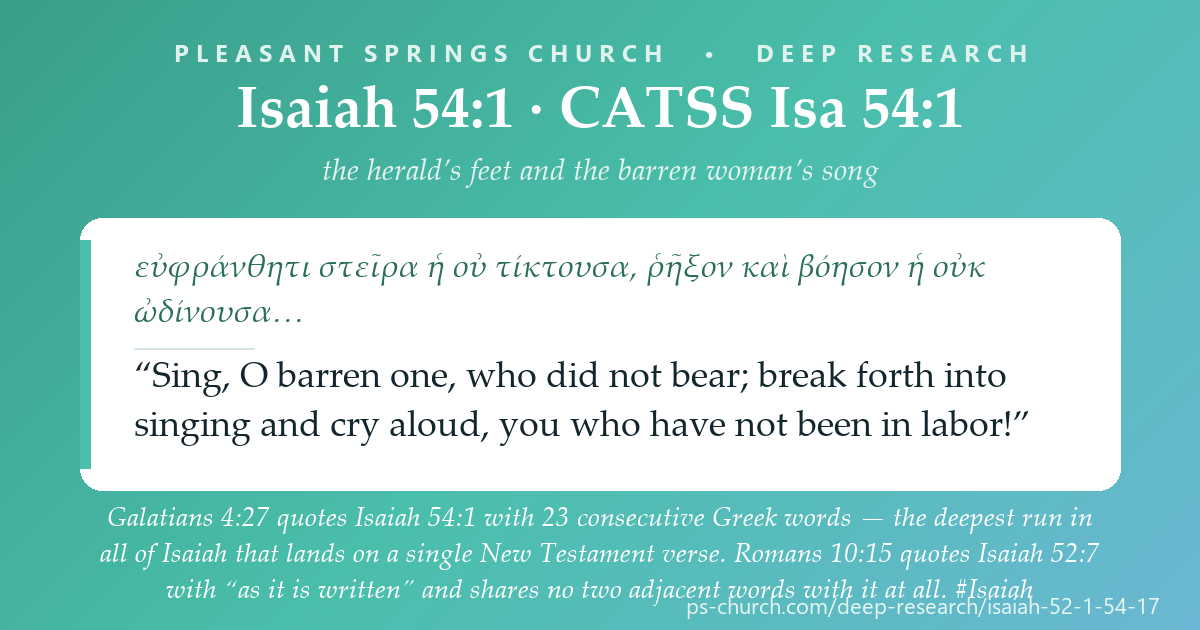
Twenty-three consecutive word forms. Tie band one.
εὐφράνθητι στεῖρα ἡ οὐ τίκτουσα ῥῆξον καὶ βόησον ἡ οὐ ὠδίνουσα ὅτι πολλὰ τὰ τέκνα τῆς ἐρήμου μᾶλλον ἢ τῆς ἐχούσης τὸν ἄνδρα
That is the whole of Isaiah 54:1 except its closing εἶπεν γὰρ κύριος, and the whole of Galatians 4:27 except its opening γέγραπται γάρ. In the entire 1,289-row CATSS file for Isaiah, only one verse reaches deeper into the Greek New Testament — Isaiah 6:10, at twenty-four, and that run has a tie band of two because it lands on Matthew 13:15 and Acts 28:27 together. Isaiah 54:1 into Galatians 4:27 is therefore the deepest run in the whole book of Isaiah that lands on exactly one New Testament verse.
One caution about the twenty-three. The run survives the word οὐκ/οὐ at its tenth word only because the cross-corpus screen applies MorphGNT’s own spelling equivalences — the CATSS text reads οὐκ ὠδίνουσα and the SBL New Testament reads οὐ ὠδίνουσα. Without that fold the run would break in two at word ten and report as nine and thirteen. The fold is applied to both sides and it is declared in the footer; a figure published on this shelf before 30 August 2026 did not have it.
The counter-examples. Two famous citations that measure ONE.
This is the part of the page that keeps the twenty-three honest.
Romans 10:15 → Isaiah 52:7. Pair run: 1. The shared word is ὡς. Paul quotes with as it is written and his eight quoted forms are ὡς ὡραῖοι οἱ πόδες τῶν εὐαγγελιζομένων τὰ ἀγαθά. Four of the eight — ὡς, πόδες, τῶν, ἀγαθά — appear in the CATSS verse. No two of them are adjacent in the same order in both — the CATSS verse reads ὡς πόδες against Paul’s οἱ πόδες, and Paul reads πόδες τῶν against the CATSS πόδες εὐαγγελιζομένου. Isaiah 52:7’s own deepest New Testament run is three with a tie band of two, into Acts 7:32 and Hebrews 1:8, which is an accident of the phrase σου ὁ θεός.
John 6:45 → Isaiah 54:13. Pair run: 1. The shared word is καί. John writes it is written in the Prophets, ‘and they will all be taught by God’. The Greek Isaiah has πάντας… διδακτούς, John has πάντες… διδακτοί: one letter each, and one letter is enough. Isaiah 54:13’s own deepest New Testament run is three with a tie band of nine.
What this means, said plainly. A verbatim screen measures surface. It does not measure citation, and on this page it gets the citations in the wrong order. Galatians quotes Isaiah 54:1 and measures twenty-three; Romans quotes Isaiah 52:7 and measures one; both are quotations and both say so. Anyone using these numbers to rank how much the New Testament depends on a verse is using them for something they cannot do.
A second counter-example: 2 Corinthians 6:18 does not belong to Isaiah 54:17.
The table above lists Isaiah 54:17 → 2 Corinthians 6:18 at four words with a tie band of one, and it sits three rows under a genuine quotation of Isaiah 52:11 in the verse immediately before it. It would be very easy to write that up as a second Isaiah citation in Paul’s catena. Measure the alternatives and the ranking comes out backwards from the commentaries and backwards from the temptation:
| pair | run | shared |
|---|---|---|
| Jeremiah 7:23 → 2 Corinthians 6:18 | 5 | καὶ ὑμεῖς ἔσεσθέ μοι εἰς |
| Isaiah 54:17 → 2 Corinthians 6:18 | 4 | καὶ ὑμεῖς ἔσεσθέ μοι |
| 2 Samuel 7:14 → 2 Corinthians 6:18 | 3 | εἰς πατέρα καί |
The phrase καὶ ὑμεῖς ἔσεσθέ μοι stands in exactly two verses of the 64 CATSS files — Isaiah 54:17 and Jeremiah 7:23 — and in exactly one verse of the Greek New Testament, 2 Corinthians 6:18. And the continuation Paul actually writes, as sons and daughters, is in none of the three.
The screen cannot tell you which text Paul had in mind, and the deepest run is not the answer. It offers three candidates in an order nobody would have chosen and stops. This page prints the table and draws no conclusion from it.
Note also where the Isaiah four-word run comes from. The Hebrew of 54:17 ends in the third person — וְצִדְקָתָם מֵאִתִּי, and their vindication is from me. The Greek ends in the second — καὶ ὑμεῖς ἔσεσθέ μοι δίκαιοι. The four words shared with Paul exist only in the Greek column. No direction of influence is asserted; the difference between the columns is reported.
The Hebrew screen: chapter 52.
Fifteen rows against the 23,189 Masoretic verse units outside the source chapter.
- 52:7 → Nahum 2:1 (ESV Nahum 1:15) — six words, band 1. על ההרים רגלי מבשר משמיע שלום. Two verses of the Hebrew Bible put a herald’s feet on mountains and both use the same six words in the same order. In Greek the same pair measures two — πόδες εὐαγγελιζομένου — because the Greek Isaiah and the Greek Twelve rendered the identical Hebrew clause differently. Which of the two Hebrew verses is prior is not decidable from these files.
- 52:10 → Psalm 98:3 — six words, band 1. כל אפסי ארץ את ישועת אלהינו. In Greek the same pair measures two (Isaiah 52:10 against LXX Psalm 97:3).
- 52:9 → Isaiah 49:13 — four words, band 1. כי נחם יהוה עמו.
- 52:4 — five words, band 12. כי כה אמר אדני יהוה: a messenger formula, thirteen verses deep.
- 52:3 — four words, band 45. כי כה אמר יהוה. A run of four with a band of forty-five is what a formula looks like.
- 52:15 — two words, band 292. גוים רבים. The verse that reaches eleven in Greek reaches two in Hebrew, in a band of 292.
Chapter maximum: six. One row measures 0 — 52:13, the opening of the Servant Song, which is on the sibling page.
The Hebrew screen: chapter 54, and what it costs the chapter.
Seventeen rows against 23,187 units. The chapter maximum is three, and every three has a band of five or more:
- 54:4 — three, band 5. אל תיראי כי.
- 54:5 — three, band 12. יהוה צבאות שמו.
- 54:17 — three, band 22. מאתי נאם יהוה.
- 54:1 — two, band 376. לא ילדה, shared with Genesis 16:1, Genesis 30:1 and hundreds more.
- 54:2, 54:7, 54:12 and 54:15 — zero. Four of the chapter’s seventeen verses share no two consecutive words with any verse in the Masoretic corpus outside this chapter.
Is that unusual? Partly. Across Isaiah 40–66 — 525 verses — 75 verses measure zero, which is 14.3%. Chapter 54’s four out of seventeen is 23.5%, above the rate but not extraordinary; Isaiah 40 has eight zeros and Isaiah 42 has seven. What is unusual is the chapter maximum. Only four chapters in the whole of Isaiah 40–66 have a maximum Hebrew run of three or fewer: chapters 46, 53, 54 and 61. Two of the four are next to each other, and they are the Servant Song and the barren woman’s song.
Put the two screens together and the shape of the page appears. Isaiah 54 is among the most lexically isolated chapters in Isaiah 40–66 when measured against the Hebrew Bible — and its opening verse is the deepest single-target verbatim quotation the New Testament makes anywhere in the book. The two facts are not in tension; they are the same fact seen from two sides. A verse with no Hebrew neighbours is a verse a later writer can quote whole without any other verse getting in the way.
The negative results.
Isaiah 54 is not an acrostic. Screened verse-initial against the twenty-two-letter Hebrew alphabet, not one of the chapter’s seventeen initials is the letter its position requires: verse 1 opens on ר, the twentieth letter, where an acrostic would need א, and twenty-one of the twenty-two letters never appear in the right place at all. The verse count, seventeen, is not twenty-two either. That is a negative result on the verse-initial screen over the Masoretic text as printed here; it is printed because the screen was run, not because anyone had claimed otherwise.
Isaiah 52:1 does not measurably touch Revelation 21:2. The holy city putting on her garments and the new Jerusalem adorned as a bride are read together constantly; the pair run between them is one (τήν). The connection may be entirely real. It is not verbatim, and this page does not pretend the screen found it.
Isaiah 52:10 does not measurably touch Luke 3:6. Luke’s all flesh shall see the salvation of God is Isaiah 40:5, which measures eight with a band of one; against 52:10, which says something very close in different words, the pair run is two.
Isaiah 54:11–12 does not measurably touch Revelation 21:18–21. The jewelled foundations are the standard cross-reference; 54:11’s deepest New Testament run is three, band one, and it lands on Revelation 2:19 (σου καὶ τά), which is meaningless. 54:12’s deepest is three, band one, on Acts 9:24 (καὶ τὰς πύλας), also meaningless. Two accidents, printed as accidents.
What the specialists have argued about this passage — and, at length, what this page could not check, did not consult, and is weakest on.
This stage is where the page states its limits. If a claim above is not supported by a file on this disk, it is named here. A page that only lists its findings is not trustworthy.
The live scholarly questions this page does not settle.
Who the Servant is, and whether 52:13–53:12 was composed with 52 and 54 or inserted between them. This is the central critical question about the passage and nothing on this page bears on it. The measurement of section markers shows that the Masoretic tradition treats 53:1–12 as one unbroken block between two heavily divided neighbours; that is a fact about a medieval scribal convention, not evidence about composition, and it must not be read as such.
Whether the עַבְדֵי יְהוָה of 54:17 is a deliberate hinge. The distribution reported in stage 3 is exact and it is striking. Whether it is design, or a seam between blocks of material, or an accident of a word that happens to be scarce, cannot be settled by counting. This page reports the count and stops, and readers should be suspicious of anyone — including this page — who makes the count carry more than that.
Why the Greek of 52:7 differs from the Hebrew as sharply as it does. ὡς ὥρα ἐπὶ τῶν ὀρέων against מַה־נָּאווּ עַל־הֶהָרִים is a substantial difference and there are several standard explanations for it. This page has not evaluated any of them.
What was NOT consulted. Named, one by one.
- 1QIsaᵃ, the Great Isaiah Scroll. Not on this disk, not collated. It is the most important single omission on this page, because it is a complete Hebrew Isaiah a thousand years older than the edition used here and it differs from that edition in this very passage.
- Any critical apparatus, for either the Hebrew or the Greek. No BHS/BHQ apparatus, no Göttingen Isaiah. The Greek used here is Rahlfs as digitized by CATSS — a single edition, treated as a witness and never as the Septuagint.
- The Targum of Isaiah, the Peshitta and the Vulgate. None held, none consulted. The Targum matters here in particular because its rendering of the Servant material is a much-discussed text.
- Commentaries. None was open while this page was written. The names in the footer describe where the standing research on Isaiah lives; they are not citations for any specific sentence above.
- The Priene calendar inscription and the imperial εὐαγγέλιον material. Genuinely relevant to stage 2, not read in a critical edition here, so nothing above rests on it.
- The Odes. Excluded from every Greek run screen on this page. That matters on an Isaiah page: three of the Odes are second copies of Isaiah material (Isaiah 5, Isaiah 26 and Isaiah 38), and leaving them in would have manufactured spurious self-matches.
Where this page is weakest.
1. The ESV column was not verified against a held ESV text. There is no ESV file for Isaiah on this disk and no Crossway API key in this project. The English above was typed; its verse alignment rests on verse counts and chapter openings. The Hebrew and Greek columns were pulled programmatically from the corpus files and are reliable in a way the English column is not.
2. The whole method is form-level, and that is a real limitation, not a footnote. Every run on this page counts identical word FORMS. Romans 10:15 measures one against Isaiah 52:7 because ὡραῖοι is not ὥρα and εὐαγγελιζομένων is not εὐαγγελιζομένου. On a lemma screen — matching dictionary words rather than inflected forms — that same pair would score high, and so would John 6:45 against Isaiah 54:13. The form-level screen was chosen because it is unambiguous and reproducible, not because it is the best model of how quotation works. Readers who want the one-word runs on this page to mean “Paul was barely using Isaiah” are reading them wrongly, and the page says so in three places on purpose.
3. The tie bands on the pair measurements are missing. The Jeremiah/Isaiah/2 Samuel table in stage 4 gives three pair runs without bands, because a pair run has no band by construction. Those three numbers are therefore weaker evidence than the banded runs elsewhere on the page, and should not be weighed the same.
4. The section-marker structure is one edition’s. The claim that Isaiah 52 is the second most heavily divided chapter in the book is exactly true of the Sefaria Miqra according to the Masorah text held here and was not checked against any other printed Masoretic edition, let alone against manuscripts. Section markers vary between manuscripts. Treat the ranking as a fact about this file.
5. The Hebrew corpus counts scribal section markers as words. {ס} and {פ} stand inside the verse text of the Sefaria file and the frozen normaliser tokenises them — at the end of eight of this passage’s twenty-nine verses. Every Hebrew figure on this page was checked against the marker-stripped text; none of the reported runs crosses a marker, because every one of them sits mid-verse or ends before the marker does. normalize.py is frozen and was not edited.
6. One claim was withdrawn while this page was built. An earlier draft said that the four zero rows in Isaiah 54 made it the most lexically isolated chapter in Isaiah 40–66. Measuring all twenty-seven chapters showed that to be false — Isaiah 40 has eight zeros and Isaiah 42 has seven, and the book-wide rate is 14.3%. The sentence was replaced with the claim that survived the measurement, which is about the chapter maximum and not the zero count.
Where the standing research on this passage lives.
Named so a reader can go further. None of these was open while this page was written and no sentence above depends on any of them.
- Oswalt, The Book of Isaiah 40–66 (NICOT).
- Childs, Isaiah (Old Testament Library).
- Blenkinsopp, Isaiah 40–55 and Isaiah 56–66 (Anchor Yale).
- Goldingay and Payne, Isaiah 40–55 (ICC).
- Westermann, Isaiah 40–66 (OTL).
- Ottley and Ziegler on the Greek Isaiah; Troxel, LXX-Isaiah as Translation and Interpretation.
- Ulrich and Flint, Qumran Cave 1.II: The Isaiah Scrolls — the edition that would settle several of the questions this page had to leave open.
- On Galatians 4:21–31: Martyn (Anchor), de Boer (NTL), Moo (BECNT).
What the twenty-nine verses turned out to be about, once the numbers were in.
How beautiful upon the mountains are the feet of him who brings good news, who publishes peace.Isaiah 52:7
The page did not end up where it started.
It began as a page about the herald’s feet. That verse is why anybody opens Isaiah 52. And the herald’s feet turned out to be the weakest thing on the page by every Greek measurement: a run of one against the epistle that quotes it, a deepest New Testament contact of three that is an accident of σου ὁ θεός.
Then the Hebrew screen ran, and the herald came back. Six consecutive words with Nahum 2:1, tie band one. The same feet, the same mountains, the same peace. The link was there the whole time; it was simply in the other language. And the same thing happened at 52:10 and Psalm 98:3 — six in Hebrew, two in Greek.
And the verse that carried the page was one nobody would have named. Isaiah 54:1, the barren woman, twenty-three consecutive words into Galatians 4:27, tie band one, deeper than anything in Isaiah except 6:10 and the only run that deep in the book to land on a single New Testament verse. A verse with almost no Hebrew neighbours — two words, tie band 376 — became the deepest single-target quotation in the book.
The one sentence worth carrying away.
Every strong link in this passage is strong in exactly one language. The herald’s feet are a six-word Hebrew run and a two-word Greek one. The barren woman is a two-word Hebrew run with a band of 376 and a twenty-three-word Greek one with a band of one. The ends of the earth seeing salvation are six in Hebrew and two in Greek. Not one connection on this page is deep in both columns.
That is not a fact about Isaiah. It is a fact about translation. Two Hebrew verses that share six words can be rendered by two different Greek translators into sentences that share two; one Hebrew verse with no neighbours at all can be rendered into a Greek sentence a New Testament writer can lift entire. The screen measures the surface of whichever text you point it at, and the surfaces are not the same.
And the servants.
The passage’s last sentence opens נַחֲלַת עַבְדֵי יְהוָה — the heritage of the servants of the Lord. It is the first plural in twenty-seven chapters, and after it there is never a singular again.
One Servant, from 41:8 to 53:11. Then, in the last line of chapter 54, servants. What the singular did, the plural inherits — that is what the word נַחֲלָה means. The count is exact and the reading is a reading; this page has been careful to keep the two apart, and leaves the second to you.
Every Deep Research page traces its passage across the whole sweep — the Old Testament, the Second-Temple world between the testaments (historical witnesses, not Scripture), and the New Testament. Follow the thread:
Pleasant Springs Church — Deep Research
Research method after Michael S. Heiser’s Bible Research Method (examine dictionaries → ancient literature → important words → textual connections → academic publications → share), with the Pleasant Springs “Author & Audience” foundation. Scripture set in the Hebrew, the Greek editions named on each page and the ESV (Old Testament), and the Greek New Testament and the ESV (New Testament), per the practice of Pleasant Springs Church. Isaiah research grounded in Oswalt (NICOT), Childs (OTL), Blenkinsopp (Anchor Yale), Goldingay and Payne (ICC) and Westermann (OTL); on the Greek Isaiah in Ottley, Ziegler and Troxel; on Galatians 4:21–31 in Martyn, de Boer and Moo. Text: Hebrew from the Masoretic text as printed in the edition consulted — Sefaria’s Miqra according to the Masorah; no critical apparatus was consulted for the Hebrew and no Dead Sea Scroll was collated, 1QIsaᵃ included. Greek from Rahlfs’ Septuaginta as digitized by CATSS; Greek New Testament from the SBL edition as digitized by MorphGNT. The standing caution for this shelf applies: these pages say “the CATSS Greek text reads…” and never call a Greek reading early or late, and never say which text acted on which. ⚠️ Verse numbering. There is no offset in this passage. Masoretic, CATSS and ESV all give Isaiah 52, 53 and 54 as fifteen, twelve and seventeen verses, in the same order, with the chapter breaks in the same places, so every reference on this page means the same verse in every column. Across the whole book the two ancient corpora disagree on only two chapters — Isaiah 2 (Masoretic 22, CATSS 21) and Isaiah 56 (Masoretic 12, CATSS 11) — and neither is in scope; a third seam, where English 64:2–12 answers Masoretic 64:1–11, is also outside this passage. Two cross-references on this page DO carry an offset and both are printed with it: Nahum 2:1 in the Hebrew and Greek is Nahum 1:15 in the ESV, and LXX Psalm 97:3 is ESV Psalm 98:3. ⚠️ The ESV column was NOT verified against a held ESV text. No ESV file for Isaiah exists on this disk and no Crossway API key exists in this project; the English was typed and its verse alignment rests on verse counts and chapter openings. The Hebrew and Greek columns were pulled programmatically from the corpus files. ⚠️ Every cross-corpus run figure on this page was measured on 31 August 2026 and applies MorphGNT’s own spelling equivalences — οὐ/οὐκ/οὐχ, ἐκ/ἐξ and the movable nu — so that a shared run is not cut at a word the two editions merely spell differently. The twenty-three-word run at Isaiah 54:1 depends on that fold: the CATSS text reads οὐκ ὠδίνουσα and the SBL New Testament reads οὐ ὠδίνουσα, and without the fold the run would report as nine and thirteen. Figures published on this shelf before 30 August 2026 are lower for that reason; nothing was copied from a sibling page and every number above was re-measured. ⚠️ A run of zero on the Hebrew screen means NO TWO CONSECUTIVE WORDS. The Hebrew-side screen runs with the unigram fallback off, so max = 0 at Isaiah 54:2, 54:7, 54:12 and 54:15 means those verses share no adjacent word pair with any verse outside the chapter — not that they share no words. The Greek-side screen runs with the fallback ON, so the 1 reported for Romans 10:15 against Isaiah 52:7 means they share isolated words and no adjacent pair at all. ⚠️ The Masoretic text held here counts the scribal section markers as words. {ס} and {פ} stand inside the verse text of the Sefaria file and the frozen normaliser tokenises them — at the end of eight of this passage’s twenty-nine verses, and of 3,446 verses — about one in seven — across the whole Masoretic corpus held here. No run reported on this page crosses a marker. normalize.py is frozen and was not edited. ⚠️ Greek Old Testament figures are scoped to the 64 CATSS files held here, 30,637 verse units, screened to 30,348 with the Odes excluded — which matters on an Isaiah page in particular, because three of the Odes are second copies of Isaiah material (Isaiah 5, Isaiah 26 and Isaiah 38) and would have produced spurious self-matches. ⚠️ One claim was withdrawn while this page was built and it is named in stage 5. Typology is handled per the house position: what the text says, what the New Testament itself draws, and what we see from this side of the cross — with the seeing left to the reader.
Scripture quotations marked ESV are from the ESV® Bible (The Holy Bible, English Standard Version®), © 2001 by Crossway, a publishing ministry of Good News Publishers. ESV Text Edition: 2016. Used by permission. All rights reserved. The ESV text may not be quoted in any publication made available to the public by a Creative Commons license, and the ESV may not be translated in whole or in part into any other language. www.esv.org
|
Did this study bless you today? 💚 Give to Support PS Church100% of gifts go to the General Fund — thank you. |