Judas Maccabeus dies in the first battle of chapter 9, and the book buries him in words that sound like the books of Samuel and Kings. Measured, they match them almost everywhere except at the two lines that sound most like them: the lament how is the mighty fallen shares one word with David’s, and the closing formula uses a word for the rest that no other screened Greek Old Testament verse uses in it. His brother Jonathan takes his place, and within two chapters four Seleucid kings have written to him or his people, one of them making him high priest. Screen all 236 verses against all 7,927 verses of the Greek New Testament and the deepest contact is none of that. It is nine words in 11:1 — an Egyptian king’s army as the sand by the lip of the sea — shared with Hebrews 11:12, where the sand is Abraham’s descendants. Screen Hebrews 11:12 against the whole Greek Old Testament held here and its closest match is this verse, not Genesis 22:17. The page shows that the uniqueness completes at one Greek article, and why the run alone cannot show that anyone read anyone. 1 Maccabees is not Scripture for us: it is filed with the Apocrypha and read as a witness, and there is no Hebrew and no ESV of it on this disk. See the method →
1 Maccabees is a Second-Temple Jewish history of the revolt against the Seleucid kings and of the family that led it, from Mattathias to his grandson John. It is canonical in the Roman Catholic and Orthodox churches, was printed among the Apocrypha in the Protestant Bibles of the Reformation era — the 1611 King James included it — and is absent from the Hebrew Bible. It is not Scripture for us. We read it as a witness to the generation before the New Testament: its wars are the usual historical account of why a feast of dedication was kept in Jerusalem (John 10:22), and the high priesthood whose Hasmonean line begins in these chapters is, on the usual historical reading, the office the Gospels meet, much changed, in Annas and Caiaphas. We read it critically, gratefully for the light it throws, and test everything by the canon. These chapters contain a revenge killing at a wedding (9:37–42), the burning of a temple with the people who had fled into it (10:84–85), and a massacre through a city (11:47); the page reports them as the text does, without comment beyond the measurement.
⚠️ What this page can and cannot measure — read this first.
HELD: the CATSS Greek 1 Maccabees (924 rows, every label parsing) and the rest of the CATSS Greek Old Testament — 30,348 verse units screened, of 30,637 held (the Odes are left out by house convention, because two of them are Luke 1–2 and ten repeat other books); the Greek New Testament (SBLGNT via MorphGNT, 7,927 verses); the King James Apocrypha (1769); the Clementine Vulgate; and, acquired for this page, the Greek of Josephus’s Jewish Antiquities in Niese’s edition (Perseus Digital Library, CC BY-SA 4.0), of which the 178 sections that retell these chapters (Ant. 12.420–13.163) are measured in Stage 2.
NOT HELD: a Hebrew 1 Maccabees (none survives); an ESV 1 Maccabees we may print; the Göttingen critical edition and its apparatus (the CATSS text is Rahlfs’s, a hand edition); the Old Latin; any English Josephus newer than Whiston (and Whiston is not used).
CONSEQUENCE: the Hebrew-side screens cannot run on this book at all; every contact reported below is Greek against Greek, contiguous whole word forms, with its tie band. The screens find verbatim contact. They do not find allusion, and they cannot tell who read whom.
1 Maccabees 9:1–11:74 — thirteen verses, three witnesses each
Greek: CATSS / Rahlfs, named on every line · English: King James Apocrypha (1769 standard text, public domain) · Latin: Clementine VulgateThe fall. Ιουδας ἔπεσεν, Judas fell. The verb marks the turns of these chapters: in all 236 rows the third-person singular he fell stands four times — of Nicanor (9:1, ἔπεσεν Νικάνωρ), of Judas twice (9:18, 9:21), and of King Demetrius I (10:50, ἔπεσεν ὁ Δημήτριος). Counted, not chosen: see the structure diagram.
VULGATE 9:18 Et Judas cecidit, et ceteri fugerunt.
Seven words used three times, and only in this book. καὶ ἐκόψαντο αὐτὸν πᾶς Ισραηλ κοπετὸν μέγαν — and all Israel beat the breast for him with a great lamentation — stands in exactly three of the 30,348 screened Greek Old Testament units: the deaths of the father Mattathias (2:70), of Judas (9:20) and of Jonathan (13:26). Its first five words stand in one verse outside the book: the death of Samuel, 1 Kingdoms 28:3 — καὶ Σαμουηλ ἀπέθανεν καὶ ἐκόψαντο αὐτὸν πᾶς Ισραηλ.
VULGATE 9:20 Et fleverunt eum omnis populus Israël planctu magno, et lugebant dies multos,
The line that sounds like David — and measures one word. David’s lament has the plural three times, πῶς ἔπεσαν δυνατοί (2 Kingdoms 1:19, 25, 27); this line has the singular, and the contiguous run between them is one word, how. Its last three words, σῴζων τὸν Ισραηλ, occur in the 30,348 screened units twice: here, and 4:11, where Judas tells his men that the nations will know ὁ λυτρούμενος καὶ σῴζων τὸν Ισραηλ — that there is one who ransoms and saves Israel — having just said βοήσωμεν εἰς οὐρανόν, let us cry to heaven (4:10).
VULGATE 9:21 et dixerunt : Quomodo cecidit potens, qui salvum faciebat populum Israël !
The closing formula of a king — with a word no king is given. The books of Kingdoms close a reign with καὶ τὰ λοιπὰ τῶν λόγων Εζεκιου… οὐχὶ ταῦτα γεγραμμένα ἐπὶ βιβλίῳ λόγων τῶν ἡμερῶν — and the rest of the words of Hezekiah… are they not written in the book of the words of the days? (4 Kingdoms 20:20). 1 Maccabees 9:22 opens with καὶ τὰ περισσὰ τῶν λόγων and ends οὐ κατεγράφη πολλὰ γὰρ ἦν σφόδρα — they were not written, for they were very many. Its word for ‘the rest’, τὰ περισσὰ, makes a phrase found in no other of the 30,348 screened units; the Kingdoms word, τὰ λοιπὰ, stands in the five-word formula in 35 units (32 in 3–4 Kingdoms, 2 in 2 Chronicles, 1 in 1 Maccabees 16:23). See Stage 4.
VULGATE 9:22 Et cetera verba bellorum Judæ, et virtutum, quas fecit, et magnitudinis ejus, non sunt descripta : multa enim erant valde.
A transition shared with the start of Joshua and Judges. καὶ ἐγένετο μετὰ τὴν τελευτὴν Ιουδου — the same five opening words stand in Joshua 1:1 (καὶ ἐγένετο μετὰ τὴν τελευτὴν Μωυσῆ) and Judges 1:1 (καὶ ἐγένετο μετὰ τὴν τελευτὴν Ἰησοῦ), and in 2 Chronicles 24:17: five units in all, this one included.
VULGATE 9:23 Et factum est : post obitum Judæ emerserunt iniqui in omnibus finibus Israël, et exorti sunt omnes qui operabantur iniquitatem.
The sword ceased, and a man began to judge. κατέπαυσεν ῥομφαία ἐξ Ισραηλ occurs in no other screened unit, and neither does ἤρξατο Ιωναθαν κρίνειν τὸν λαὸν. Its last three words stand in five units, this one included: to judge the people is what Moses sat down to do in Exodus 18:13 (κρίνειν τὸν λαόν) and what Solomon asked to be able to do (3 Kingdoms 3:9); the other two are Psalm 71(72):2 and Sirach 45:26.
VULGATE 9:73 Et cessavit gladius ex Israël : et habitavit Jonathas in Machmas, et cœpit Jonathas ibi judicare populum, et exterminavit impios ex Israël.
The first time 1 Maccabees confers the title high priest on anyone — and a Seleucid king does it. καθεστάκαμέν σε σήμερον ἀρχιερέα τοῦ ἔθνους σου. The word group ‘high priest’ stands 26 times in the book; it is never used of Judas. Before this verse it occurs once, at 7:21, of Alcimus striving for the office. A king had installed a priest before: Demetrius I set Alcimus in the priesthood, ἔστησεν αὐτῷ τὴν ἱερωσύνην (7:9); the book uses the same three words when Demetrius II installs Jonathan, with the higher noun, ἔστησεν αὐτῷ τὴν ἀρχιερωσύνην (11:27).
VULGATE 10:20 et nunc constituimus te hodie summum sacerdotem gentis tuæ, et ut amicus voceris regis (et misit ei purpuram, et coronam auream) et quæ nostra sunt sentias nobiscum, et conserves amicitias ad nos.
Robe, feast and year all named. ἐνεδύσατο Ιωναθαν τὴν ἁγίαν στολὴν — the seventh month of the year 160, at the feast of booths. Exodus 28:2 has the same two words the other way round (στολὴν ἁγίαν Ααρων τῷ ἀδελφῷ σου), so the measured run between them is one. The three words ἐν ἑορτῇ σκηνοπηγίας stand in two screened units: this one and Deuteronomy 31:10.
VULGATE 10:21 Et induit se Jonathas stola sancta septimo mense, anno centesimo sexagesimo, in die solemni scenopegiæ : et congregavit exercitum, et fecit arma copiosa.
The longest document in these three chapters begins here. Demetrius I’s letter runs from 10:25 to 10:45 — 514 Greek words, 28.6% of chapter 10 — against the 50 words of Alexander’s letter that it answers (10:18–20). It is refused (10:46).
VULGATE 10:25 Et scripsit eis in hæc verba : Rex Demetrius genti Judæorum salutem.
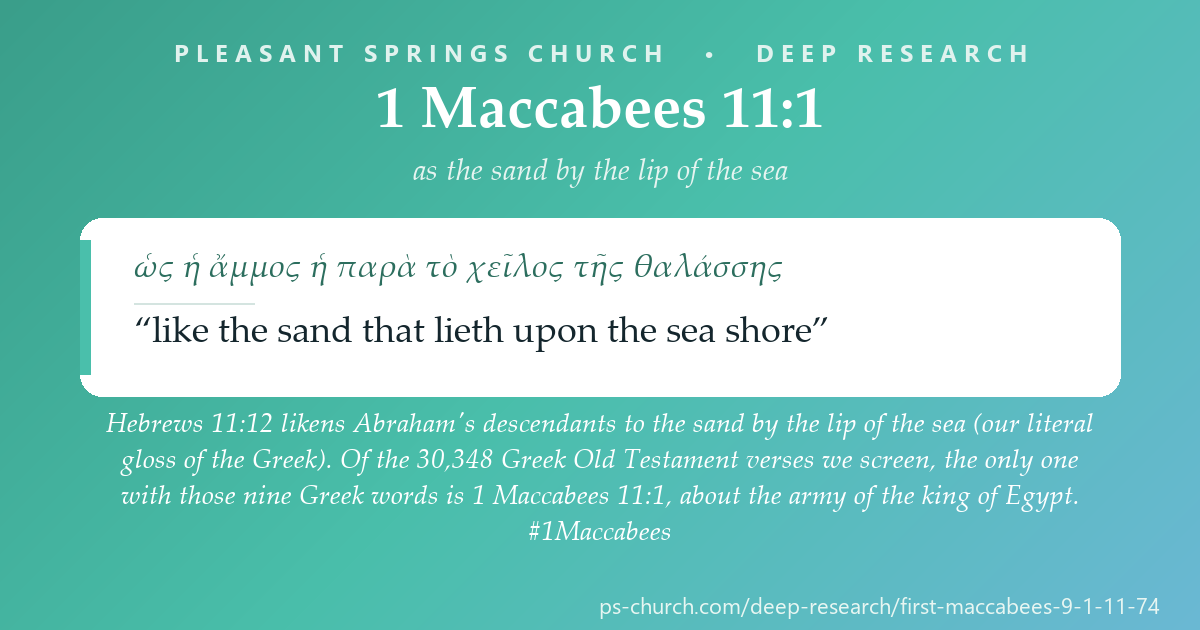
⚠️ The deepest verbatim contact these 236 verses make with the New Testament. ὡς ἡ ἄμμος ἡ παρὰ τὸ χεῖλος τῆς θαλάσσης — nine words, shared with Hebrews 11:12 and with no other verse of the 7,927 screened; and from Hebrews’ side, shared with no other unit of the 30,348 screened Greek Old Testament units. Genesis 22:17 has the simile in another case and shares five. Stage 4 shows where the uniqueness completes — at one Greek article — and prints the nominative similes that do not carry the nine.
VULGATE 11:1 Et rex Ægypti congregavit exercitum, sicut arena quæ est circa oram maris, et naves multas : et quærebat obtinere regnum Alexandri dolo, et addere illud regno suo.
The English names another country. The Greek row reads εἰς Συρίαν (into Syria), the Latin reads in Syriam; the King James text on this disk reads “Spain”. The page reports the three readings and does not explain the third.
VULGATE 11:2 Et exiit in Syriam verbis pacificis, et aperiebant ei civitates, et occurrebant ei : quia mandaverat Alexander rex exire ei obviam, eo quod socer suus esset.
He prays, and the text does not say to whom. In all 236 rows the one word that can be read as naming the God of Israel stands once, and it is heaven: κεκράξατε εἰς τὸν οὐρανόν (9:46). The words for God and Lord are never used of him anywhere in the CATSS 1 Maccabees. Josephus, after telling the same battle, has Jonathan return to Jerusalem and then, ὁρῶν οὖν, ὅτι πάντʼ αὐτῷ κατὰ νοῦν προνοίᾳ θεοῦ χωρεῖ — seeing that everything was going as he wished by the providence of God — send envoys to Rome (Ant. 13.163; our gloss). At that point 1 Maccabees 12:1 has ὁ καιρὸς αὐτῷ συνεργεῖ, the time was working with him.
VULGATE 11:71 Et scidit Jonathas vestimenta sua, et posuit terram in capite suo, et oravit.
The refrain that closes the passage. And Jonathan returned to Jerusalem: a return to Jerusalem closes an episode six times in these chapters (9:50, 10:66, 10:87, 11:7, 11:51, 11:74). The number of the dead is a witness question: the Greek and the Latin say three thousand; Josephus has Jonathan δισχιλίους τῶν ἐχθρῶν ἀποκτείνας, killing two thousand of the enemy (Ant. 13.163).
VULGATE 11:74 et ceciderunt de alienigenis in die illa tria millia virorum : et reversus est Jonathas in Jerusalem.
Versification — stated, as on every page here, and here it is a third state: no Masoretic text exists for this book, and no ESV of it is held or licensed here, so there is no MT/LXX/ESV offset to report. What exists is four witnesses, and every count below was made on the files.
• Greek (CATSS 1 Maccabees): 924 verse rows in 16 chapters; this passage is 236 rows — 73 / 89 / 74 — and 4,792 Greek words. Every label is a plain chapter:verse; no lettered rows, no ranges, no unnumbered rows.
• English (KJV Apocrypha, 1769): 924 verses, and the same verse count as the Greek in all sixteen chapters; 73 / 89 / 74 here.
• Latin (Clementine Vulgate): 929 verses; it differs from the Greek count in chapters 1 (67 against 64), 12 (54 against 53) and 13 (54 against 53) — all outside this passage; 73 / 89 / 74 here.
⚠️ Equal counts are not equal divisions. Aligned by content, the KJV puts a clause on the other side of a verse boundary from the Greek in seven places in these chapters: 9:7/8 (the Greek 9:8 opens and he grew faint; the KJV’s nearest words, “and much distressed”, stand inside its 9:7, and KJV 9:8 opens “Nevertheless”), 9:11/12 (“As for Bacchides, he was in the right wing” ends Greek 9:11, begins KJV 9:12), 9:12/13 (Judas’s trumpeters), 9:54/55 (“And as he began to pull down”), 9:66/67 (“And when he began to smite them”), 10:75/76 (“Jonathan laid siege unto it”) and 11:69/70 (“all that were of Jonathan’s side fled”). The Latin divides with the KJV at the first three and with the Greek at the other four. No KJV line printed in the codex above sits on one of those seven boundaries.
⚠️ The Latin also divides on its own, against both the Greek and the KJV, at ten boundaries in these chapters (found by reading every boundary of the three files side by side): 9:20/21, 9:46/47, 9:49/50, 10:29/30, 10:36/37, 10:62/63, 10:69/70, 10:77/78, 11:35/36 and 11:47/48. One of them is in the codex: the Latin 9:21 opens et dixerunt, which closes the Greek and KJV 9:20 — so the Latin 9:21 line printed above carries one clause the Greek 9:21 does not, and the Latin 9:20 line lacks it. Another moves part of the measured refrain: the Latin 9:49 ends with the return to Jerusalem that opens the Greek 9:50.
Canonical verses cited on this page are given in the Greek numbering, with the English where it differs: Psalm 144(145):3 and 71(72):2; 3 Kingdoms 5:9 is 1 Kings 4:29 in English Bibles (the Masoretic 1 Kings 4 has 20 verses, and its 5:1 is the English 4:21); Jeremiah 42:3 in the Greek is 35:3 in the Hebrew and English (the Rechabites); and Daniel 3:36, 3 Kingdoms 2:35a and 2:46a exist only in the Greek — Daniel 3:36 is verse 13 of the KJV’s Prayer of Azariah.
Dates inside the text: seven rows carry a year of the Seleucid era — 152 (9:3), 153 (9:54), 160 (10:1, 10:21), 162 (10:57), 165 (10:67) and 167 (11:19). The usual conversion puts 152 in 161/160 BC; the page reports the text’s own numbers and leaves the conversion to the commentaries.
The Shape of the Passage
A sequence with a measured refrain — not a chiasm⚠️ Where this page sits. Filed under Apocrypha / Deuterocanon. Nothing taught at Pleasant Springs rests on it.
Author
Anonymous, and the chronicler of one family. The book never names its author. Its last verses refer to a book of the days of the high priesthood of John, Simon’s son (16:24), which is why it is commonly dated to the late second century BC. That date is reported from the commentaries, not measured here.
He writes like a chronicler of Judah and never names God as God. Measured on the CATSS text: the noun god occurs once in the whole book, and it is the plural gods of Azotus (5:68, θεῶν); lord occurs twice, both of men (2:53, Joseph made κύριος of Egypt; 9:25, the ungodly made κυρίους of the land). The word heaven stands fourteen times in the book, and in most of them it stands where another book would say God — cry to heaven, help from heaven (that is a reading, not a count). In these three chapters it stands once (9:46).
And he keeps the archive. Of the 4,792 Greek words in these chapters, 760 — 15.9% — stand in the verses that carry four quoted royal letters (Alexander’s, Demetrius I’s, Demetrius II’s and Antiochus VI’s), set out in full with their greetings and their tax schedules; with the other quoted messages the share passes a fifth.
Audience
Judeans living under the line of high priests that begins in this section. The office that Jonathan receives from Alexander in 10:20 is the office his brother Simon and Simon’s son John go on to hold; if the usual date is right, a reader of the book was reading the founding papers of the government he lived under.
Readers who know Joshua, Judges, Samuel and Kings. The burial, the mourning, the after the death of and the land was quiet each share a run of three to six Greek words with those books — measured in Stages 3 and 4. The measurement does not say which Greek text had them first.
And a people being bargained for. In chapter 10 two kings bid for Jonathan in writing. The text has the people refuse the larger offer because they remembered what the man making it had done (10:46).
Orient on the book, on the brothers, and on the Seleucid kings who wrote to them.
Search by topic: Maccabees, Books of; Judas Maccabeus; Jonathan (Maccabee); Hasmoneans; Alexander Balas; Demetrius I Soter; Demetrius II Nicator; Antiochus VI; Tryphon; Bacchides; Alcimus; high priest; Seleucid era.
Which articles are relevant?
- Anchor Bible Dictionary — articles on Maccabees, Books of, the Hasmoneans, Jonathan, Judas Maccabeus, Alcimus and the Seleucids.
- Eerdmans Dictionary of Early Judaism — 1 Maccabees, Hasmoneans, High Priests.
- Dictionary of New Testament Background (IVP) — Maccabean literature, Hasmoneans, priests and priesthood.
- On the kings — any reference article on the Seleucid succession after 162 BC. Read with the text open: 1 Maccabees introduces Alexander as the son of Antiochus, Epiphanes (10:1, our gloss) and lets the claim stand; whether it was true is a question for the historians, and this page does not settle it.
Bibliography surfaced:
- Jonathan A. Goldstein, I Maccabees (Anchor Bible 41, 1976).
- John R. Bartlett, The First and Second Books of the Maccabees (Cambridge Bible Commentary, 1973).
- Bezalel Bar-Kochva, Judas Maccabaeus: The Jewish Struggle Against the Seleucids (Cambridge, 1989) — the military history, including the last battle.
- F.-M. Abel, Les livres des Maccabées (Études bibliques, 1949).
- Werner Kappler (ed.), Maccabaeorum liber I (Göttingen Septuagint IX/1) — the critical text. Not held here.
- NETS, 1 Makkabees — the New English Translation of the Septuagint. Named as the obvious next English for a reader; not quoted.
Josephus tells the same story; the royal chanceries supply the letters; 2 Maccabees stops at Nicanor’s fall, the news this passage opens on.
Three bodies of ancient material stand beside these chapters. One of them — Josephus — is now on this disk in Greek and is measured; the other two are described from the files that are held.
Josephus, measured as a fourth witness:
Josephus retells these chapters in Jewish Antiquities 12.420–13.163 — 178 sections, 6,877 Greek words in Niese’s edition. That he worked from 1 Maccabees here is the common scholarly view; this page tests only how much of the wording he shares, by the same run engine, every row of 1 Maccabees 9–11 against every one of those sections.
| Longest shared run with Josephus | rows of 1 Macc 9–11 | where |
|---|---|---|
| 8 words | 2 | 10:43 (Ant. 13.56) and 11:34 (Ant. 13.127) — both inside quoted letters |
| 7 | 1 | 11:36 (Ant. 13.50) — inside a letter |
| 6 | 1 | 11:32 (Ant. 13.127) — a letter’s greeting |
| 5 | 2 | 10:25, 11:31 — a greeting and a covering note |
| 4 | 15 | narrative and letters |
| 3 | 63 | |
| 2 | 132 | |
| 1 | 20 | including the lament, 9:21 |
Every row that reaches five words or more with Josephus stands inside a quoted royal document. Where Josephus is telling the story, the deepest he comes to 1 Maccabees’ wording is four words; where he gives a king’s letter, he comes to eight. And the lament for Judas (9:21) reaches one word; the closing formula (9:22) reaches two. Josephus has neither. In their place he gives his own verdict: ἄνδρα γενναῖον καὶ μεγαλοπόλεμον — a noble man and a great warrior (Ant. 12.433; our gloss).
The order of two deaths. 1 Maccabees has Judas fall at Elasa (9:18) in or after the first month of year 152 (9:3), and Alcimus pull down the inner wall of the sanctuary and die in year 153 (9:54–56) — after Judas. Josephus has Alcimus die first, ἀπέθανεν ἀρχιερατεύσας ἔτη τέσσαρα. (Ant. 12.413, having been high priest four years), and then: τὴν ἀρχιερωσύνην ὁ λαὸς τῷ Ἰούδᾳ δίδωσιν, — the people give the high priesthood to Judas (12.414).
Whether Judas was high priest. Josephus closes Judas’s life with τὴν δʼ ἀρχιερωσύνην ἔτος τρίτον κατασχὼν ἀπέθανεν. — and he died having held the high priesthood into a third year (12.434; our gloss). In 1 Maccabees the word group ‘high priest’ stands 26 times and is never used of Judas.
The interval. Josephus dates Jonathan’s investiture μετὰ ἔτη τέσσαρα ἢ τὸν ἀδελφὸν αὐτοῦ Ἰούδαν ἀποθανεῖν· — four years after his brother Judas died (13.46). The year-numbers 1 Maccabees itself prints are 152 for the camp before Judas’s last battle (9:3) and 160 for the robe (10:21).
Hazor. 1 Maccabees: not one of them was left except two captains (11:70), and three thousand of the enemy fell (11:74). Josephus: ὡς περὶ πεντήκοντα — about fifty stayed (13.161), and δισχιλίους τῶν ἐχθρῶν ἀποκτείνας — killing two thousand of the enemy (13.163).
Two ancient witnesses, measured on two files. The page does not decide between them, and it has not measured what Josephus says on these points elsewhere in his works.
The royal letters, and the formula they share with other books:
A Hellenistic letter opens X to Y, greeting, with the infinitive χαίρειν. Measured across the 30,348 screened units, that infinitive stands in 25: 1 Maccabees 10, 2 Maccabees 7, 1 Esdras 2, 3 Maccabees 2, Esther (an Addition) 1 — and three that do not open a letter: Isaiah 48:22 and 57:21, there is no rejoicing for the wicked, and Tobit S 5:10, a greeting spoken face to face. 1 Maccabees carries more of them than any other book, four of them in these chapters. In the 7,927 New Testament verses it stands in seven, and three of those open a letter (Acts 15:23, Acts 23:26, James 1:1).
Alexander: βασιλεὺς Ἀλέξανδρος τῷ ἀδελφῷ Ιωναθαν χαίρειν (10:18). Demetrius II: βασιλεὺς Δημήτριος Ιωναθαν τῷ ἀδελφῷ χαίρειν καὶ ἔθνει Ιουδαίων (11:30), and to his own official, βασιλεὺς Δημήτριος Λασθένει τῷ πατρὶ χαίρειν (11:32) — to Lasthenes his father. Two rival kings call Jonathan brother. Josephus gives Alexander’s greeting as βασιλεὺς Ἀλέξανδρος Ἰωνάθῃ τῷ ἀδελφῷ χαίρειν. (Ant. 13.45) — the same words with the name moved and spelt another way, so the measured run between the two is two.
Measured against every verse unit of 1 Esdras, Esther, 3 Maccabees, 2 Maccabees and Ezra–Nehemiah, the four greeting verses in these chapters (10:18, 10:25, 11:30, 11:32) never share more than three consecutive words with any of them — and the three are of the Jews, greeting or these words. The closest thing to a shared formula is 2 Maccabees 11:22, βασιλεὺς Ἀντίοχος τῷ ἀδελφῷ Λυσίᾳ χαίρειν, where another king calls another subordinate brother: two words in a row, to the brother. The formula is a frame, not a phrase — the same slots, filled with different names — and a run screen sees only the filler.
And 2 Maccabees stops at Nicanor’s fall, the news chapter 9 opens on:
Measured: 2 Maccabees names Nicanor for the last time at 15:37, two verses from its end, where the epitomator says that since Nicanor’s affairs turned out so, he will stop his story there; the last time it names a Jonathan is 8:22. 1 Maccabees tells that fall at 7:43–50, and its chapter 8, on the Romans, stands between. 1 Maccabees 9:1 opens on the news of Nicanor’s fall. From here on, 1 Maccabees is the only narrative of the two, and Josephus is the only other telling this disk holds.
Heaven, the high priesthood, a Judges sentence, the vocabulary of the court.
Every count is over the CATSS files held on this disk — 30,348 Greek Old Testament verse units screened, the Odes excluded — and the 7,927 verses of the SBLGNT. It is not a count over the Septuagint, and each figure says which unit it counts: words, or verse units.
9:46, Jonathan at the Jordan: κεκράξατε εἰς τὸν οὐρανόν, cry out to heaven. Read as a name for God, it is the only one in these 236 rows. Across the whole CATSS book the word for heaven stands fourteen times, and the words for God and Lord are never used of him. A reader who expects a prayer at 11:71 gets one — and he prayed — with no addressee at all.
26 occurrences of the word group in 1 Maccabees; six in these chapters (10:20, 10:32, 10:38, 10:69, 11:27, 11:57). Conferred by a letter (10:20, Alexander), confirmed by another king (11:27, Demetrius II) and again by a third (11:57, Antiochus VI). Never of Judas — Josephus says otherwise (Stage 2).
The three words the land was quiet stand in 15 of the 30,348 screened units: eight in Judges (four in each Greek text), one in 2 Chronicles, and six in 1 Maccabees. In these chapters, three: once of Judah, ἡσύχασεν ἡ γῆ Ιουδα ἔτη δύο (9:57), and twice of the Seleucid king’s realm, ἡσύχασεν ἡ γῆ ἐνώπιον αὐτοῦ (11:38, 11:52). The book had used it of Alexander the Great at 1:3. The Judges sentence is not reserved for Israel.
Seventeen words of the friend/friendship group in these 236 rows: four in chapter 9, thirteen in chapters 10–11. In chapter 9 the friends are Judas’s, the Nabataeans and a bridegroom’s. From 10:16 they are the king’s: friend of the king (10:20), the first friends (10:65, 11:27), friendship as a treaty term (10:20, 10:23, 10:26, 10:54). The vocabulary of the court arrives with the letters.
Four times in these chapters (10:20, 10:62, 10:64, 11:58) of eight in the book. Sent with the high priesthood (10:20), put on Jonathan in front of his accusers (10:62–64), granted again by a later king with the right to drink from gold (11:58). The gold buckle that goes with it (10:89, 11:58) is a word the screened Greek Old Testament uses only in 1 Maccabees — three times.
Counted here, not assumed:
- 236 rows, 4,792 Greek words: chapter 9 has 1,467, chapter 10 has 1,795, chapter 11 has 1,530.
- The quoted letters: Alexander to Jonathan, 50 words (10:18–20); Demetrius I to the Jews, 514 words (10:25–45); Demetrius II, 171 words (11:30–37); Antiochus VI, one verse of 25 words (11:57). The verses carrying those four come to 760 words — 15.9% of the passage; add the other quoted messages (Alexander to Ptolemy and his reply, 10:52–56; Apollonius’s challenge, 10:70–73; Ptolemy to Demetrius, 11:9–10; Demetrius to Jonathan, 11:42–43) and it is 1,056 words, 22.0%.
- ‘He fell’ (singular): four times — 9:1, 9:18, 9:21, 10:50.
- ‘Returned to Jerusalem’: six times — 9:50, 10:66, 10:87, 11:7, 11:51, 11:74.
- Seven dated rows — 9:3, 9:54, 10:1, 10:21, 10:57, 10:67, 11:19.
- The mourning formula: the seven words of 9:20 in three units of 30,348 — 2:70, 9:20, 13:26. Mattathias, Judas, Jonathan. The book has no such sentence for Simon (16:16–17).
Nine words with Hebrews, and where they become unique; one word with David.
Every one of the 236 rows screened against all 7,927 verses of the Greek New Testament, and against the 30,348 screened Greek Old Testament units. Contiguous runs of whole word forms after normalisation, never lemmas; the tie band — how many verses reach the same depth — printed beside every run, from both sides. Across corpora (CATSS against SBLGNT) the comparison uses the shelf’s cross-edition normaliser; within the Greek Old Testament it uses the plain one. A row reaching 1 shares at least one word; nothing here reaches 0.
The distribution against the New Testament, all 236 rows:
234 reach two, 171 reach three, 49 reach four, 10 reach five — and then nothing until nine. No row reaches six, seven or eight. Two rows (10:79, 11:19) share single words only.
| Longest run with any NT verse | rows (exactly) | rows reaching at least |
|---|---|---|
| 9 | 1 | 1 |
| 6, 7, 8 | 0 | 1 |
| 5 | 9 | 10 |
| 4 | 39 | 49 |
| 3 | 122 | 171 |
| 2 | 63 | 234 |
| 1 | 2 | 236 |
Nine of the ten rows that reach five share strings of the commonest words — articles, pronouns, prepositions, and — mostly around one ordinary noun, a name or a common verb — and his brothers and, in that day and, upon his head and. The tenth is a figure of speech. Read the right-hand column too: it is the same run measured from the New Testament verse’s side, against the whole Greek Old Testament.
| 1 Macc row | run | band among NT verses | NT verse | the shared words | that NT verse against the Greek OT: run / band |
|---|---|---|---|---|---|
| 11:1 | 9 | 1 | Heb 11:12 | as the sand by the lip of the sea | 9 / 1 (this verse) |
| 9:62 | 5 | 1 | Mk 1:36 | Simon and those with him | 5 / 2 (9:62, 9:67) |
| 9:67 | 5 | 2 | Mk 1:36; Jn 4:30 | Simon and those with him; went out of the city and | 5 / 2; 5 / 2 |
| 9:65 | 5 | 1 | 1 Jn 2:11 | his brother in the | 5 / 1 (this verse) |
| 9:39 | 5 | 1 | Mk 3:31 | …his, and his brothers… | 6 / 1 (1 Macc 16:21) |
| 10:15 | 5 | 2 | Mk 3:31; Lk 8:19 | and his brothers and | 6 / 1; 5 / 11 |
| 9:60 | 5 | 1 | Mk 5:40 | and those with him and | 5 / 2 |
| 10:43 | 5 | 1 | Mt 2:16 | and in all the borders | 5 / 2 |
| 11:48 | 5 | 2 | Lk 6:23; 2 Tim 1:18 | in that day and | 5 / 3; 5 / 5 |
| 11:71 | 5 | 1 | Rev 10:1 | upon his head and | 5 / 12 |
⚠️ The deepest run — Hebrews 11:12 and an Egyptian army:
1 Maccabees 11:1: the king of Egypt gathers forces ὡς ἡ ἄμμος ἡ παρὰ τὸ χεῖλος τῆς θαλάσσης — as the sand which is by the lip of the sea.
Hebrews 11:12 (SBLGNT): διὸ καὶ ἀφ’ ἑνὸς ἐγεννήθησαν καὶ ταῦτα νενεκρωμένου καθὼς τὰ ἄστρα τοῦ οὐρανοῦ τῷ πλήθει καὶ ὡς ἡ ἄμμος ἡ παρὰ τὸ χεῖλος τῆς θαλάσσης ἡ ἀναρίθμητος — from one man, and him as good as dead, were born descendants as the stars of heaven in multitude and as the sand which is by the lip of the sea, innumerable (our literal gloss; the ESV of Hebrews is not held on this disk).
Measured from 1 Maccabees’ side: a run of nine, tie band 1 among the 7,927 NT verses. Measured from Hebrews’ side: against the 30,348 screened Greek Old Testament units, Hebrews 11:12’s deepest run is the same nine words with the same verse, tie band 1.
| Greek OT unit | run with Hebrews 11:12 | what is shared |
|---|---|---|
| 1 Maccabees 11:1 | 9 | the sand clause, whole |
| Exodus 32:13 | 7 | the stars clause: the stars of heaven in multitude, and |
| Deuteronomy 1:10, 10:22, 28:62 | 6 | the stars clause |
| Genesis 22:17, Exodus 14:30, Daniel 3:36 (OG and Th; Greek Daniel only — the KJV’s Prayer of Azariah 13) | 5 | by the lip of the sea |
| 1 Kingdoms 13:5, 3 Kingdoms 2:35a (Greek only), 3 Kingdoms 5:9 (1 Kings 4:29 in English Bibles) | 5 | as the sand which by — nominative, but by the sea, not by the lip |
| Counter-examples, below five: Judges 7:12 (both Greek texts), 2 Kingdoms 17:11, 3 Kingdoms 2:46a (Greek only) | 4 | the simile in the nominative, but with upon where Hebrews has by |
Genesis 22:17 — the promise to Abraham, which Hebrews 11:12 is commonly read as recalling — shares five. It has the simile in the accusative, as the object of I will multiply: ὡς τὴν ἄμμον τὴν παρὰ τὸ χεῖλος τῆς θαλάσσης. Hebrews needs the nominative, because the descendants are the subject of were born: ὡς ἡ ἄμμος ἡ παρὰ τὸ χεῖλος τῆς θαλάσσης. And the place where the nine-word sequence becomes unique is three words long: ἡ παρὰ τὸ — the nominative article which followed by Genesis’s by the lip. The nominative simile with by stands in 1 Kingdoms 13:5 and 3 Kingdoms 2:35a and 5:9 (ὡς ἡ ἄμμος ἡ παρὰ τὴν θάλασσαν, as the sand which is by the sea); Genesis has by the lip of the sea. The nominative alone does not produce the nine words. Judges 7:12 has the sand upon the lip of the sea in the nominative in both Greek texts — ὥσπερ ἡ ἄμμος ἡ ἐπὶ τὸ χεῖλος τῆς θαλάσσης (A), ὡς ἡ ἄμμος ἡ ἐπὶ χείλους τῆς θαλάσσης (B) — with upon where Hebrews has by, and so do 2 Kingdoms 17:11 and 3 Kingdoms 2:46a without the lip; each reaches four with Hebrews, not nine. In the corpora held here, two texts carry all nine; the screen does not say how either came to have them.
So the deepest verbatim contact in these three chapters is real and does not by itself show dependence. It does not show that the writer to the Hebrews read 1 Maccabees, nor the reverse; it shows that on a word-form screen one article can make a nine-word run unique while the promise Hebrews is commonly read as recalling scores five. The stars half of the same verse makes the same point: its deepest Greek Old Testament match is not Genesis but Exodus 32:13, where Moses repeats the promise — τὰ ἄστρα τοῦ οὐρανοῦ τῷ πλήθει καὶ, seven words, against two with Genesis 22:17’s stars. Direction of influence is not measurable and is not asserted.
The page’s own counter-examples — runs of five with a band of one:
9:62 → Mark 1:36, five words, tie band 1. Σιμων καὶ οἱ μετ' αὐτοῦ — Simon and those with him. In 1 Maccabees it is Jonathan and Simon withdrawing to Bethbasi; in Mark it is Simon Peter hunting for Jesus at dawn. Measured from Mark’s side, its deepest Greek Old Testament contact is this phrase, band 2 — 9:62 and 9:67, both 1 Maccabees. A shared name and four of the commonest words in Greek narrative.
11:71 → Revelation 10:1, five words, tie band 1 — and band 12 the other way. Jonathan throws earth upon his head and prays; the angel has a rainbow upon his head and a face like the sun. From Revelation’s side the same five words reach twelve Greek Old Testament units, from the turban set on Aaron’s head in Exodus 29:6 to the oil poured on Saul’s in 1 Kingdoms 10:1. A band of one on one side and twelve on the other is the clearest sign on this page that a band must be read from both ends.
The epitaph, verse by verse, against the rest of the Greek Old Testament:
The death notice of Judas is five verses. Screened against the 29,424 Greek Old Testament units outside 1 Maccabees, each of them reaches a different part of the older books — except the two that sound most like them.
| verse | what it does | deepest run, Greek OT outside 1 Macc | band | where |
|---|---|---|---|---|
| 9:19 | burial | 6 | 4 | 4 Kingdoms 9:28, 21:26, 23:30 — and they buried him in the tomb; 2 Chronicles 24:25 — a different six words, inside they did not bury him in the tomb of the kings |
| 9:20 | mourning | 5 | 1 | 1 Kingdoms 28:3 — Samuel |
| 9:21 | lament | 2 | 185 | Israel with its article — anywhere |
| 9:22 | closing formula | 4 | 1 | Psalm 144:3 (145:3) — and of his greatness |
| 9:23 | transition | 5 | 4 | Joshua 1:1, Judges 1:1 (both Greek texts), 2 Chronicles 24:17 |
The burial, καὶ ἔθαψαν αὐτὸν ἐν τῷ τάφῳ τῶν πατέρων αὐτοῦ, begins with six words that bury three kings of Judah — Ahaziah, Amon and Josiah (4 Kingdoms 9:28, 21:26, 23:30) — and ends with of his fathers, which makes the whole phrase stand nowhere else. The fourth unit in the band is a counter-example: 2 Chronicles 24:25 reaches six with a different stretch, and inside a denial — καὶ οὐκ ἔθαψαν αὐτὸν ἐν τῷ τάφῳ τῶν βασιλέων, and they did not bury him in the tomb of the kings, said of Joash. The mourning has its first five words in Samuel’s death notice (1 Kingdoms 28:3), and the book carries all seven for Mattathias, Judas and Jonathan and for nobody else. The transition shares its first five words with the first sentence of Joshua and of Judges: καὶ ἐγένετο μετὰ τὴν τελευτὴν Ιουδου.
The lament. πῶς ἔπεσεν δυνατὸς σῴζων τὸν Ισραηλ — how has he fallen, the mighty one, saving Israel. David’s lament over Saul and Jonathan in the Greek of 2 Kingdoms 1 has πῶς ἔπεσαν δυνατοί three times, plural; the Masoretic Hebrew of 2 Samuel 1:19 is plural too, אֵ֖יךְ נָפְל֥וּ גִבּוֹרִֽים. The longest contiguous run between 9:21 and any of the three is one word: how. The phrase how he fell stands nowhere else in the screened Greek Old Testament. A reader may hear 2 Samuel 1 here, and the English of the KJV — “How is the valiant man fallen” — makes it easier to hear; the Greek keeps a single man, and the hearing is the reader’s, not the run’s.
The closing formula. The books of Kingdoms end a reign with καὶ τὰ λοιπὰ τῶν λόγων Εζεκιου… οὐχὶ ταῦτα γεγραμμένα ἐπὶ βιβλίῳ λόγων τῶν ἡμερῶν — and the rest of the words of Hezekiah… are they not written in the book of the words of the days? (4 Kingdoms 20:20). The five words and the rest of the words in that form stand in 35 screened units: 32 in 3–4 Kingdoms, 2 in 2 Chronicles — and one in 1 Maccabees, at 16:23, for John: καὶ τὰ λοιπὰ τῶν λόγων Ιωαννου… ἰδοὺ ταῦτα γέγραπται ἐπὶ βιβλίῳ ἡμερῶν ἀρχιερωσύνης αὐτοῦ, behold, these are written in the book of the days of his high priesthood. For Judas the same book writes καὶ τὰ περισσὰ τῶν λόγων… οὐ κατεγράφη πολλὰ γὰρ ἦν σφόδρα. A different word for the rest, found in this phrase nowhere else in the 30,348 screened units, and the verb turned round: not are they not written? but they were not written, for they were very many. Its deepest run anywhere in the Greek Old Testament is four words with Psalm 144(145):3 — καὶ τῆς μεγαλωσύνης αὐτοῦ οὐκ ἔστιν πέρας, and of his greatness there is no end.
Whether the Greek τὰ περισσὰ stands for the same Hebrew word as the Kingdoms formula cannot be tested: no Hebrew 1 Maccabees exists. The page reports the two Greek wordings and the one book that uses both.
⚠️ Connections a reader may hear — measured, and they measure little:
- 9:22 → John 20:30 and 21:25 — run of ONE each. Many deeds left unwritten, in 1 Maccabees and at the end of John. The idea is shared; the measured contact is single words — many, did, and — never two in a row.
- 9:27 → Matthew 24:21 — run of TWO. θλῖψις μεγάλη, great tribulation, such as there had not been since the day no prophet was seen among them. Matthew has the same two words; they stand in no other screened Greek Old Testament unit, and in one other New Testament verse (Acts 7:11). Two words, and the rest of each sentence differs.
- 9:41 → Amos 8:10 — run of THREE; → James 4:9 — run of TWO. καὶ μετεστράφη ὁ γάμος εἰς πένθος καὶ φωνὴ μουσικῶν αὐτῶν εἰς θρῆνον — and the wedding was turned into mourning, and the voice of their music into lamentation. Amos 8:10: καὶ μεταστρέψω τὰς ἑορτὰς ὑμῶν εἰς πένθος καὶ πάσας τὰς ᾠδὰς ὑμῶν εἰς θρῆνον; ESV: “I will turn your feasts into mourning and all your songs into lamentation; I will bring sackcloth on every waist and baldness on every head; I will make it like the mourning for an only son and the end of it like a bitter day.” Amos 8:10 has the same pattern — turn X into mourning and Y into lamentation — and the contiguous run is three words, into mourning and, which Amos 5:16 and both Greek Tobits (2:6) also carry.
- 9:10 → Paul — run of TWO, and a formula. Judas refuses to flee: μὴ γένοιτο ποιῆσαι τὸ πρᾶγμα τοῦτο. May it not be is Paul’s word (Romans 3:4 and thirteen more), and Luke 20:16: fifteen New Testament verses; in the screened Greek Old Testament it stands four times. A formula, measured as one.
- 11:71 → Matthew 26:65 — run of THREE. Jonathan tears his clothes; the high priest διέρρηξεν τὰ ἱμάτια αὐτοῦ. Matthew’s four words stand as one sequence in ten screened Greek Old Testament units, from Reuben (Genesis 37:29) to Job (1:20); 1 Maccabees puts Jonathan’s name between the verb and the garments, which is why the run is three. A gesture of grief with a long history, measured as one. The page draws no line between the two high priests; the text does not.
- 10:21 → Exodus 28:2 — run of ONE. The holy robe, with the two words in the other order. Contact by content, invisible to a run screen.
- 11:29 → Acts 23:25 — run of ONE. A king in 1 Maccabees and a tribune in Acts each write a letter having this manner / form: 1 Maccabees has τρόπον, Acts has τύπον, two different nouns, and the difference breaks what would otherwise be a run of three.
It settles that, word for word, none of the 7,927 SBLGNT verses carries a citation of these chapters. The deepest contact is a simile in the nominative, the next nine are strings of the commonest words, and every connection a reader might hear measures three words or fewer. It cannot settle allusion.
It does not settle that the New Testament’s world was untouched by them. The feast of dedication in John 10:22 is commonly identified with the feast whose origin 1 Maccabees 4 tells; the high priesthood that Annas and Caiaphas hold is commonly traced to the office conferred in 10:20. Those are historical readings, not measurements here, and a word-form screen will never register them.
The rest of the Greek Old Testament, all 236 rows:
Against the 29,424 screened units outside 1 Maccabees: all 236 reach two, 221 reach three, 134 reach four, 48 reach five, 12 reach six, 2 reach seven, and nothing reaches eight. The two sevens are narrative: 9:39 with 4 Kingdoms 6:20 (lifted their eyes and saw, and behold) and 9:66 with Jeremiah 42:3 in the Greek numbering — 35:3 in the Hebrew and English Bibles (and his brothers and his sons). So the deepest contact these chapters make with the rest of the Greek Old Testament is seven words — shallower than their deepest contact with Josephus (eight) and with Hebrews (nine). Depth measures shared wording, not kinship.
What this page could not check, what it acquired to check more, and where it is weakest.
The section that makes the shelf trustworthy. It names what was not consulted, and it says where a reader should push hardest.
⚠️ What this page could NOT check:
- Anything in Hebrew for this book. No Hebrew 1 Maccabees survives and none is on this disk; the Hebrew-side screens cannot run. Jerome’s sentence is held; the book he describes is not. His preface to Samuel and Kings (the Prologus Galeatus, in The Latin Library’s transcription, not a critical edition, fetched for this shelf’s study of 1 Maccabees 1:1–4:61) reads: Macchabeorum primum librum hebraicum repperi, secundus graecus est, quod et ex ipsa frasin probari potest. — I found the first book of Maccabees in Hebrew; the second is Greek, as can be shown from its very style (our gloss). The Hebrew book he says he found is not held, and nothing about it can be checked here; the wider view that the book was composed in Hebrew is reported from the commentaries and not tested.
- The critical Greek text. CATSS prints Rahlfs. The Göttingen edition (Kappler) and its apparatus are not held, so no variant reading in the Greek manuscripts is reported here — including any that might bear on the nine-word run at 11:1 or the wording of 9:21–22.
- Why the KJV reads “Spain” at 11:2. The Greek and the Latin on this disk both read Syria. The English edition the 1611 translators worked from is not held, and the page offers no explanation.
- Josephus’s other figures. Only the 178 sections that retell these chapters were measured. Statements Josephus makes elsewhere about the high-priestly succession were not consulted, so the page does not say whether he is consistent with himself.
- The Dead Sea Scrolls. A common proposal identifies the Wicked Priest of the Qumran Habakkuk commentary with Jonathan; others name his successors. No Qumran text is held and the proposal is not tested here.
- Dates. The Seleucid-era years are the text’s own; their conversion to BC, and the date of the book, are taken from the commentaries and are not measured.
⚠️ Where this page is weakest:
- The English column is quotation. The KJV Apocrypha is printed verbatim and checked, but it was not made from the Greek printed beside it, and it puts a clause across seven verse boundaries differently. Every English line in the codex sits clear of those seven boundaries; the reader should still treat the English as a second witness, not a gloss. The Latin is less tidy: it divides on its own at ten more boundaries, and one of them (9:20/21) falls inside the codex.
- The Josephus comparison crosses editions. Niese’s Josephus and Rahlfs’s 1 Maccabees are different editions with different spellings of the same names (Josephus’s Ἰωνάθης and 1 Maccabees’ Ιωναθαν do not match as forms). A run cut by a spelling difference is reported short, never long, so the Josephus figures are lower bounds.
- The two normalisers. Cross-corpus runs (1 Maccabees against the SBLGNT or Josephus) use the shelf’s cross-edition normaliser, which treats οὐ and οὐκ as one word; runs inside the Greek Old Testament use the plain one. Run 9:22 against Psalm 144:3 with the cross-edition one and it reaches five, not four — the extra word is not. The page prints the plain figure.
- The Hebrews result has explanations the page cannot test. One proposed account is that two writers independently joined the nominative simile to Genesis’s by the lip of the sea; it is an account, not a measurement. Judges 7:12 shows that the nominative alone does not force the nine words, and the run itself is silent on how either text came to have them.
- The division differences were found by reading. The seven KJV shifts and the ten places where the Clementine divides on its own were located by reading the ends and openings of all 233 verse boundaries in the three files side by side, not by a program; the self-check confirms each one listed, but a missed boundary would not show up in it.
- The structure diagram labels a sequence. Its panels are ours; what is measured is the refrain, the four singular fells and the three conferrals of the high priesthood.
Commentaries & studies:
- Jonathan A. Goldstein, I Maccabees (Anchor Bible 41, 1976).
- John R. Bartlett, The First and Second Books of the Maccabees (CBC, 1973).
- Bezalel Bar-Kochva, Judas Maccabaeus (Cambridge, 1989).
- F.-M. Abel, Les livres des Maccabées (1949).
- Josephus, Jewish Antiquities 12–13 — Greek text of B. Niese (1885–1890), Perseus Digital Library digitisation, CC BY-SA 4.0: held and measured. The Loeb translation of these books (Ralph Marcus, 1943) is not held.
- Werner Kappler, Maccabaeorum liber I (Göttingen) — not held.
A brother buried in sentences Kings and Samuel also carry, a brother courted by kings.
Name what you learned, why it matters, and one concrete response.
What should we carry away — and do?
- The deepest match is not always the closest relative. Hebrews 11:12 shares nine words with an Egyptian army and five with the promise to Abraham in Genesis 22:17. Count, then think — and never let the count do the thinking.
- Hearing an echo is not the same as finding one. How is the mighty fallen sounds like David; measured, it shares the word how. Both facts are true, and a careful reader holds both.
- The book grieves in sentences the older books also carry. The burial of kings, the mourning for Samuel, the first line of Joshua: in a time when, 9:27 says, no prophet was seen, Judas is mourned in words a reader of Kings, Samuel and Joshua would know.
- Offers from power come with a price written in. Two kings bid for Jonathan; the larger offer was refused because the people remembered what its author had done (10:46). The third king, the text says, lied in all that he had said (11:53).
- One concrete response. Read 2 Samuel 1:17–27 and 1 Maccabees 9:19–22 side by side this week, aloud, and name one person whose death you are still carrying. Lament is a thing God’s people have always been given words for.
1 Maccabees 11:1 · to share
Greek (CATSS) · KJV Apocrypha · VulgateVULGATE 11:1 Et rex Ægypti congregavit exercitum, sicut arena quæ est circa oram maris, et naves multas : et quærebat obtinere regnum Alexandri dolo, et addere illud regno suo.
Every Deep Research page traces its passage across the whole sweep — the Old Testament, the Second-Temple world between the testaments (historical witnesses, not Scripture), and the New Testament. Follow the thread:
Pleasant Springs Church — Deep Research
Research method after Michael S. Heiser’s Bible Research Method (examine dictionaries → ancient literature → important words → textual connections → academic publications → share), with the Pleasant Springs “Author & Audience” foundation. Scripture set in the Hebrew, the Greek editions named on each page and the ESV (Old Testament), and the Greek New Testament and the ESV (New Testament), per the practice of Pleasant Springs Church. ⚠️ Status: 1 Maccabees is not part of the Protestant canon. It is canonical in the Roman Catholic and Orthodox churches, was printed among the Apocrypha in the Reformation-era Protestant Bibles, and is absent from the Hebrew Bible. This study is filed under Apocrypha / Deuterocanon and nothing taught at Pleasant Springs rests on it. Greek text: the CATSS morphologically analysed Septuagint (Rahlfs), quoted at verse level with attribution; rows, word counts, run depths and tie bands were re-derived from it for this study. Greek New Testament: SBLGNT via MorphGNT. English: the King James Apocrypha, standardised 1769 text, public domain (the verse-per-line edition from eBible.org, held here with its provenance), quoted verbatim and re-checked by the page’s self-check. There is no ESV 1 Maccabees held or licensed here; the ESV is quoted once, for Amos 8:10, from the shelf’s cached text. Where a canonical verse is quoted in Greek or Hebrew without ESV text on this disk, the English beside it is our literal gloss, marked as such. Latin: the Clementine Vulgate (public domain), printed as a witness. Josephus: Greek of B. Niese (1885–1890), Perseus Digital Library digitisation, CC BY-SA 4.0, acquired for this page and measured on the same engine; glosses ours. Jerome: one sentence of the Prologus Galeatus, The Latin Library transcription (public domain), gloss ours. Hebrew: one phrase of 2 Samuel 1:19 from the Masoretic text (Miqra according to the Masorah). ⚠️ NOT HELD: no Hebrew 1 Maccabees, no Göttingen apparatus, no Old Latin, no Qumran text. Direction of influence is nowhere asserted. Scholarship after Goldstein, Bartlett, Bar-Kochva and Abel.
Scripture quotations marked ESV are from the ESV® Bible (The Holy Bible, English Standard Version®), © 2001 by Crossway, a publishing ministry of Good News Publishers. ESV Text Edition: 2016. Used by permission. All rights reserved. The ESV text may not be quoted in any publication made available to the public by a Creative Commons license, and the ESV may not be translated in whole or in part into any other language. www.esv.org
|
Did this study bless you today? 💚 Give to Support PS Church100% of gifts go to the General Fund — thank you. |