Two disciples walk home to Emmaus with a buried hope: “we had hoped that he was the one to redeem Israel.” The risen Jesus joins them unrecognized and teaches them to read their own Bible whole: “Was it not necessary that the Christ should suffer… and enter into his glory?” Then, “beginning with Moses and all the Prophets,” he opens all the Scriptures as “the things concerning himself” — and their hearts burn. This study works Luke 24:13–35 — the road to Emmaus — the charter of every Christ-centered Bible study. See the method →
Luke 24:25–27, 31–32
Greek NT · ESVThe Shape of the Passage
Parallel panelsOn Easter afternoon, the risen Christ walks seven miles with two disconsolate disciples and teaches them how to read their own Bible — the whole of it, as concerning himself. Emmaus is the charter of every faithful Bible study: the suffering-and-risen Christ is the key to all the Scriptures.
Author
Luke writes the resurrection as a lesson in reading Scripture. The two disciples know the facts — the crucifixion, the empty tomb, the women’s report — but they cannot make sense of them, because they had hoped for a Messiah who would “redeem Israel” without suffering. Jesus calls that a failure to read the prophets whole: “O foolish ones, and slow of heart to believe all that the prophets have spoken!” The problem was never a lack of Scripture but a truncated reading of it — hoping for the glory while skipping the cross. So he supplies the missing grammar: “Was it not necessary that the Christ should suffer… and enter into his glory?” Suffering, then glory. That is the shape of the Old Testament, from the Servant of Isaiah (52:13–53:12) to the vindicated Son of Man of Daniel 7.
The risen Interpreter. “Beginning with Moses and all the Prophets, he interpreted… the things concerning himself” (24:27) — and later, “everything written about me in the Law of Moses and the Prophets and the Psalms” (24:44). The verb is diermēneusen, the root of our word “hermeneutics”: the risen Christ himself is the authoritative interpreter of the whole canon. This is not fanciful allegory imposed on the text; it is the fulfillment the Scriptures were always moving toward, taught by the Lord they were about.
Audience
Two ordinary disciples — one named Cleopas, one unnamed (a place any reader can fill) — on the long walk home from a buried hope. Luke wants every disconsolate believer to recognize themselves on that road, and to learn what turned their sorrow to fire: not new information, but the old Scriptures opened by the risen Christ.
Known in the breaking of bread. Recognition comes at the table, when Jesus “took the bread and blessed and broke it and gave it to them” (24:30) — the very words of the feeding and the Last Supper (Luke 9:16; 22:19). “Their eyes were opened, and they recognized him.” Word and table together disclose him: their hearts had already burned as he opened the Scriptures, and now their eyes are opened as he breaks the bread. Luke names the Eucharistic echo without settling how it works; the point is that the living Christ makes himself known where his word is opened and his people gather at his table.
Orient on the resurrection, Messiah, the suffering-then-glory pattern, and Scripture-fulfillment.
Search by topic: resurrection, Messiah / Christ, suffering of the Messiah, fulfillment of Scripture, breaking of bread.
Which articles are relevant?
- Anchor Bible Dictionary — “Resurrection,” “Messiah,” “Emmaus,” “Lord’s Supper.”
- Dictionary of Jesus and the Gospels — “Resurrection,” “Death of Jesus,” “Old Testament in the Gospels,” “Table Fellowship.”
- NIDNTT / TDNT — δεῖ (dei, it is necessary), διερμηνεύω (diermēneuō, interpret), διανοίγω (dianoigō, open).
Bibliography surfaced:
- Darrell Bock (BECNT), I. Howard Marshall (NIGTC), Joseph Fitzmyer (Anchor Yale), Joel Green (NICNT), John Nolland (WBC) on Luke.
- N. T. Wright, The Resurrection of the Son of God; studies of the suffering-then-glory Christology.
- Beale & Carson, Commentary on the NT Use of the OT (Luke).
Suffering then glory, and the whole Old Testament read as concerning Christ.
Read the suffering-then-glory pattern the disciples missed, then the Christ-centered hermeneutic the risen Lord teaches — and see why it is fulfillment, not allegory.
Which parallels shed light on religion and worldview?
A suffering they did not expect. The disciples’ despair (“we had hoped that he was the one to redeem Israel”) reflects a real feature of the times: Second-Temple Judaism largely did not expect a suffering Messiah. The Aramaic paraphrase of Isaiah 53 (Targum Jonathan) even applies “my servant the Messiah” to the exaltation while shifting the suffering onto Israel and the nations — a documented instance of the very reading Jesus corrects. That is why he calls them “slow of heart to believe all that the prophets have spoken”: the suffering was there in the text (Isa 52:13–53:12; Ps 22; Ps 118:22), but they had read past it toward the glory.
The divine ‘must.’ “Was it not necessary (edei)…?” This is one of Luke’s favorite words, the divine “must” of God’s saving plan (Luke 9:22; 24:7, 44; Acts 17:3). The cross was no accident and no defeat; it was scripted in Scripture and willed by God. Yet Luke holds this together with real human guilt: the same cross is “the definite plan and foreknowledge of God” and the deed of “lawless men” who are responsible for it (Acts 2:23; 4:27–28). God ordains the end through free and accountable human agents — sovereignty and responsibility together.
Christ in all the Scriptures. The risen Jesus reads the whole Old Testament — “Moses and all the Prophets… the Law, the Prophets, and the Psalms” (24:27, 44), the entire Hebrew canon — as “the things concerning himself.” This is the pattern the apostles then preach everywhere (“explaining and proving that it was necessary for the Christ to suffer,” Acts 17:3; “in accordance with the Scriptures,” 1 Cor 15:3–4). It is not free-association allegory that ignores what the human authors meant; it is promise-and-fulfillment along the canon’s own trajectory — the Servant, the Son of Man, the Davidic king, the Passover lamb — brought to their goal in him. Emmaus is the reason a “deep research” Bible study reads every passage with Christ in view.
- Isaiah 52:13–53:12; Psalm 22; Psalm 118:22 — the Servant pierced then satisfied; the sufferer vindicated; the rejected stone become cornerstone: the suffering-then-glory the disciples missed (see the Suffering Servant, Psalm 22).
- Daniel 7:13–14; Hosea 6:2 — the Son of Man given dominion and glory; “on the third day he will raise us up”: the glory and the third-day pattern (see the Son of Man).
- Luke 24:44–47; Acts 2:23; 17:2–3; 1 Cor 15:3–4 — “everything written about me… must be fulfilled”; the apostolic “it was necessary”; “according to the Scriptures”: the Emmaus hermeneutic continued.
The genius of the Emmaus story is that it makes the resurrection a lesson in reading. The two disciples are not skeptics; they are believers whose hope has collapsed, and it has collapsed because they read the Scriptures in half. They wanted a Messiah who would go straight to glory — redeem Israel, throw off Rome, vindicate the righteous — and a crucified Messiah simply did not fit. Jesus does not give them new predictions; he gives them the old ones, rightly ordered: suffering first, then glory. “Was it not necessary?” — the cross was not the ruin of the plan but its heart, written into Moses and the Prophets and the Psalms all along. And notice how recognition comes. Their hearts burn as he opens the Scriptures (24:32); their eyes are opened as he breaks the bread (24:31). Word and table together, and both are his gift — “their eyes were opened,” a divine passive. This is how the risen Christ still makes himself known: not by bypassing the Bible for private visions, but by opening the Scriptures that are, from Genesis to the Psalms, about him. To study Scripture well is to walk the Emmaus road — and to find, at the end of it, that our hearts were burning because he was there all along.
The vocabulary of divine necessity, interpretation, and burning hearts.
Watch the divine “must,” the suffering-then-glory order, the “opening” of text and eyes and mind, and the bread broken.
“It was necessary” — Luke’s signature word for the divine “must” of God’s plan (Luke 9:22; 24:7, 44; Acts 17:3). In 24:26 it governs both “suffer” and “enter into his glory”: the cross and the crown are one divinely scripted plan.
“To suffer… to enter into glory” — the suffering-then-glory sequence (cf. 1 Pet 1:11) that the disciples had reversed. Isaiah’s Servant and Daniel’s Son of Man hold both; a truncated reading kept only the glory.
“He interpreted / expounded” — the root of “hermeneutics.” The risen Christ is the authoritative interpreter who unlocks “the things concerning himself” (ta peri heautou) across the whole canon, “beginning with Moses and all the Prophets.”
“To open thoroughly” — the chapter’s thread: he “opened” the Scriptures (24:32), their eyes “were opened” (24:31, divine passive), and he “opened their minds” (24:45). One divine act opens text, eyes, and mind together.
“Burning, ablaze” — “was not our heart burning…?” The heart set aflame is the response to Christ-centered exposition of Scripture, recognized only in hindsight as the Lord’s presence.
“The breaking of the bread” — the fourfold took-blessed-broke-gave (24:30) echoes the feeding (9:16) and the Last Supper (22:19). Table-fellowship and Eucharistic resonance, with the mode of presence left un-adjudicated.
How the New Testament fills out the Emmaus hermeneutic:
- Luke 24:44–47 — “the Law of Moses and the Prophets and the Psalms”; “he opened their minds”; suffer, rise on the third day, and repentance proclaimed to all nations: Emmaus made programmatic.
- Acts 2:23–24; 3:18; 8:32–35; 26:22–23 — the apostolic preaching that the Christ must suffer, grounded in “all the prophets” and beginning from Isaiah 53.
- 1 Corinthians 15:3–4; 1 Peter 1:10–12 — “according to the Scriptures”; the prophets foresaw “the sufferings of Christ and the subsequent glories”: the Old Testament’s own predictive intent.
- Luke 24:36–43; John 20:19–20 — the risen Jesus shows his hands and feet and eats: the same bodily-yet-transformed Lord who walked the road (see the empty tomb).
From Moses and the Prophets to the risen Christ who opens them.
Trace the suffering-then-glory pattern through the Scriptures, into the Emmaus exposition, and out into the church’s preaching.
Which cross-references matter?
- Isaiah 52:13–53:12; Psalm 22; Daniel 7:13–14 — the Servant, the righteous sufferer, the Son of Man: the suffering and the glory (see the Servant, Psalm 22, the Son of Man).
- Genesis 3:15; Numbers 24:17; 2 Samuel 7:12–16; Psalm 16:10 — the seed, the star, the everlasting throne, the Holy One not left to corruption: strands of the whole-canon witness to Christ.
- Luke 24:44–47; John 5:39, 46 — “everything written about me… must be fulfilled”; “Moses… wrote of me”: Christ the key to the Scriptures.
- Luke 9:16; 22:19; 24:30–35 — took-blessed-broke-gave: the table where the risen Lord is known.
- John 19:16–30; 20:1–18 — the cross and the empty tomb: the events the Scriptures were about (see It is finished, the empty tomb).
“We had hoped that he was the one to redeem Israel” (24:21) is one of the saddest and most instructive lines in the Gospels. The disciples were not wrong to hope for the redemption of Israel; the prophets promised it, and Luke’s own opening songs sang of it (1:68, “he has visited and redeemed his people”). What was wrong was their sense of its timing and mode. They expected redemption without a cross — deliverance that skipped the suffering and went straight to the throne. Jesus does not deny the hope; he corrects its shape. Redemption comes, but through the suffering of the Christ first, and then his glory; and its reach widens beyond Israel to “all nations” (24:47), without cancelling God’s promises to his ancient people. The kingdom they longed for is truly inaugurated in the resurrection they cannot yet believe — and it will be consummated when the risen King returns. So their despair was premature, born of impatience and a half-read Bible. The tomb they thought was the end of the story was in fact the turning of its page. And the risen Lord, walking beside them unrecognized, was the redemption of Israel — on his way, through them, to redeem the world.
The scholarship on Luke 24:13-35.
The commentators on the Emmaus road; the studies of Lukan divine necessity and the Christ-centered reading of Scripture.
Commentaries & studies:
- Darrell L. Bock (BECNT), I. Howard Marshall (NIGTC), Joseph A. Fitzmyer (Anchor Yale), Joel B. Green (NICNT), John Nolland (WBC) on Luke.
- N. T. Wright, The Resurrection of the Son of God; studies of the suffering-then-glory Christology and the apostolic use of the OT.
- Bruce Metzger on the Luke 24:32 variants and the “Western non-interpolations” of Luke 24.
Interpretation notes worth keeping:
- Suffering, then glory. The disciples’ error was a truncated canon — hoping for glory while skipping the cross. Jesus supplies the sequence written into “all that the prophets have spoken” (Isa 53; Ps 22; Dan 7).
- Divine ‘must,’ not fatalism. The dei is God’s saving plan held together with real human responsibility (Acts 2:23; 4:27–28) — sovereignty and accountability together, not coercion.
- Fulfillment, not allegory. “The things concerning himself” in all the Scriptures is promise-fulfillment along the canon’s own trajectory (Servant, Son of Man, Davidic king), governed by authorial-canonical intent — not fanciful free-association.
- Redemption redefined, not denied. The hope to “redeem Israel” is corrected in timing and mode, and widened to all nations (24:47), without cancelling God’s promises — the kingdom inaugurated now, consummated at his return.
- The breaking of bread, un-adjudicated. Note the Last-Supper echo (took-blessed-broke-gave) and the Eucharistic resonance, but do not over-claim; recognition is a sovereign gift tied to the risen Christ’s presence and his opening of Scripture.
From a buried hope to a burning heart.
Name what you learned, why it matters, and one concrete response.
What should we carry away — and do?
- Read the whole Bible as about Christ. The risen Lord read Moses, the Prophets, and the Psalms as “the things concerning himself.” Every passage you study has him as its goal — that is what makes it “deep research.”
- The cross was necessary, not a defeat. When your own hopes seem buried, remember the pattern: suffering first, then glory. The road that looks like the end of the story may be the turning of its page.
- He is known in word and table. Hearts burn when the Scriptures are opened; eyes are opened at the breaking of bread. The risen Christ still makes himself known where his word is taught and his people gather.
Step in response: take one passage this week — from Moses, a Prophet, or a Psalm — and ask the Emmaus question: how does this concern Christ? Let the Scriptures set your heart burning, and then, like the two disciples, “rise that same hour” and go tell someone: the Lord has risen indeed.
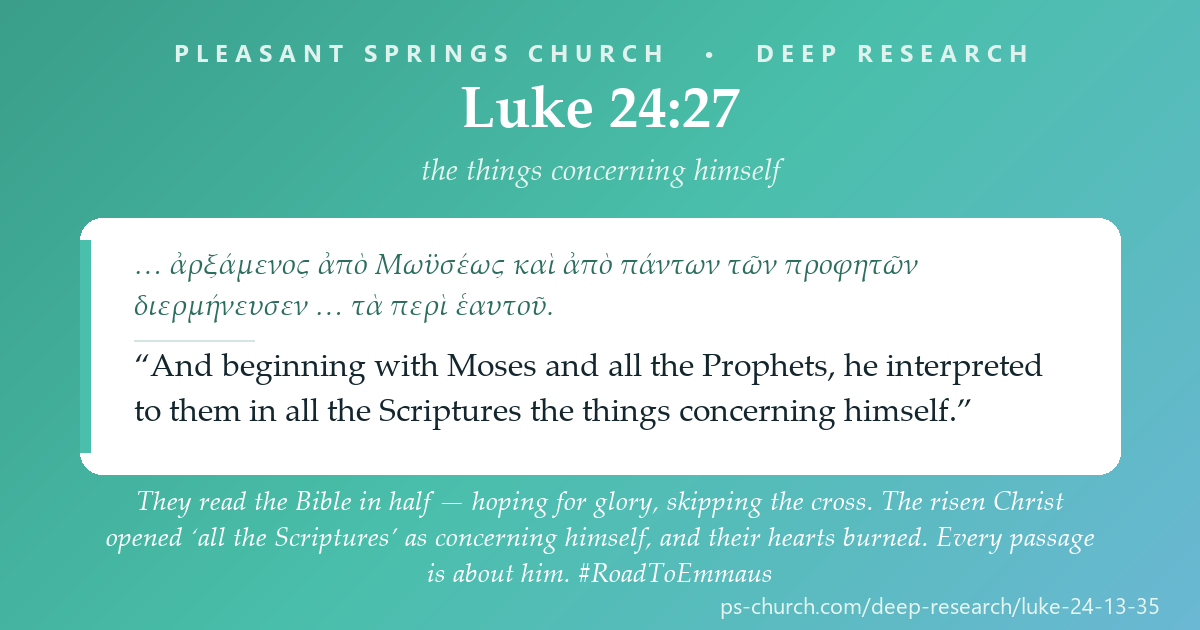
Luke 24:27 · to share
Greek NT + ESVEvery Deep Research page traces its passage across the whole sweep — the Old Testament, the Second-Temple world between the testaments (historical witnesses, not Scripture), and the New Testament. Follow the thread:
Pleasant Springs Church — Deep Research
Research method after Michael S. Heiser’s Bible Research Method (examine dictionaries → ancient literature → important words → textual connections → academic publications → share), with the Pleasant Springs “Author & Audience” foundation. Scripture set in the Hebrew, the Greek editions named on each page and the ESV (Old Testament), and the Greek New Testament and the ESV (New Testament), per the practice of Pleasant Springs Church. Luke 24:13–35 research grounded in Bock, Marshall, Fitzmyer, Green, and Nolland, with Beale & Carson on the OT-in-Luke and N. T. Wright on the resurrection; the divine dei held with human responsibility (Molinist-compatible); the Christ-centered reading of all Scripture as fulfillment (not allegory) along the canon’s trajectory; “redeem Israel” corrected in timing/mode and widened to all nations without cancelling God’s promises; the breaking of bread noted with its Eucharistic resonance left un-adjudicated.
Scripture quotations marked ESV are from the ESV® Bible (The Holy Bible, English Standard Version®), © 2001 by Crossway, a publishing ministry of Good News Publishers. ESV Text Edition: 2016. Used by permission. All rights reserved. The ESV text may not be quoted in any publication made available to the public by a Creative Commons license, and the ESV may not be translated in whole or in part into any other language. www.esv.org
|
Did this study bless you today? 💚 Give to Support PS Church100% of gifts go to the General Fund — thank you. |