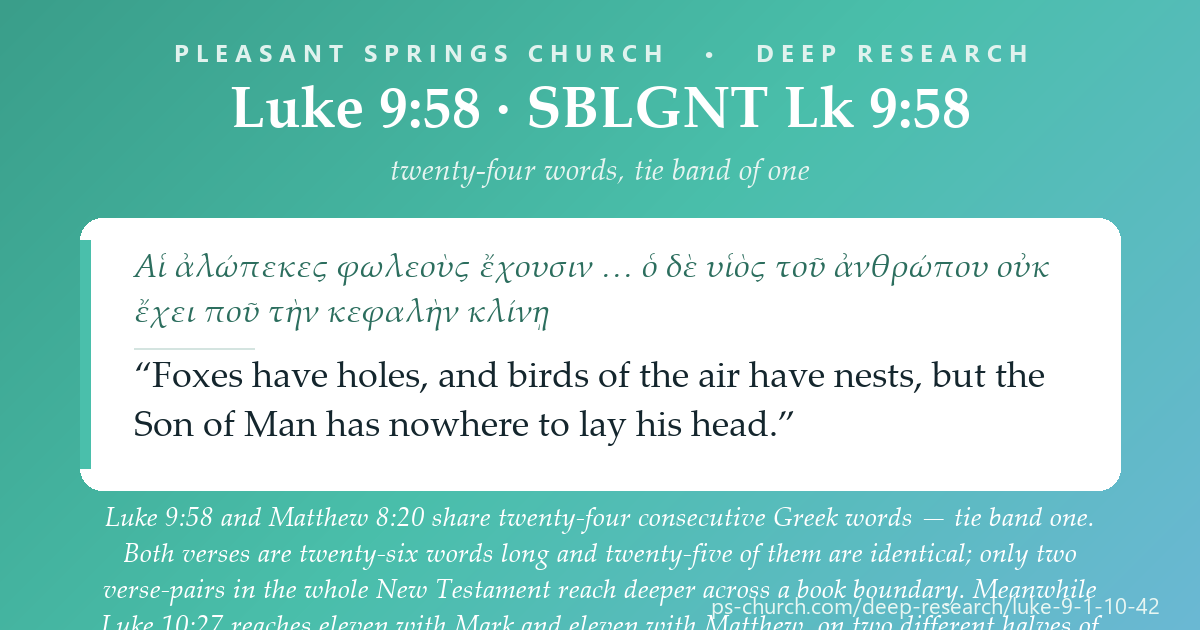
Luke 9:58 and Matthew 8:20 share twenty-four consecutive Greek words, identical after normalisation, with a tie band of one. Both verses are twenty-six words long, twenty-five of the twenty-six are the same, and the one that differs sits in position two — which is why the run is twenty-four rather than twenty-five. Screened across all 7,927 verses of the Greek New Testament, only two verse-pairs anywhere reach deeper across a book boundary, and no pair anywhere measures twenty-five. Two chapters later stands a verse that does something stranger. Luke 10:27 — the lawyer’s answer — reaches eleven consecutive words with Mark 12:30 and eleven with Matthew 22:37, and they are two different elevens: the first half of the sentence and the second. Mark and Matthew reach five with each other. Luke opens in Mark’s preposition (ἐξ ὅλης) and closes in Matthew’s (ἐν ὅλῃ), and the two runs are the two halves of the switch. And in the other direction the passage is nearly silent: against the 30,637 verse units of the Greek Old Testament held here, not one of the 104 rows reaches six on raw word forms — including the row that is quoting Deuteronomy. None of this says who read whom, and neither does this page. See the method →
Luke 9:1–10:42 (selections)
Greek New Testament (SBLGNT, via MorphGNT) · ESV★ And the two headline numbers, stated up front. Luke 9:58 shares twenty-four consecutive words with Matthew 8:20 at a tie band of one — only two verse-pairs in the whole Greek New Testament reach deeper across a book boundary. Against the 30,637 verse units of the Greek Old Testament held here, not one of the 104 rows reaches six on raw word forms. Stage 4 gives both distributions, the tie bands, and the four places where the numbers mislead.
The Shape of the Passage
A sequence in two panels — and the panels are marked by the same two verbs, not by a chiasmThis book does name a reader, and it does not name its author. Luke 1:3 addresses κράτιστε Θεόφιλε, and Acts 1:1 addresses ὦ Θεόφιλε and refers back to the first book. The title ΚΑΤΑ ΛΟΥΚΑΝ is a manuscript heading, not a line of the text, and no manuscript on this disk was consulted for it. What these two chapters carry, measurably, is a set of habits.
Author
Whoever wrote these chapters also wrote Acts, on the evidence of a number. The word ἑβδομήκοντα — seventy — stands five times in the whole Greek New Testament: Luke 10:1, Luke 10:17, Acts 7:14, Acts 23:23 and Acts 27:37. All five are in the two books addressed to Theophilus. That is not proof of common authorship, which rests on far more than a numeral; it is one countable habit, and it is the kind this page can check.
A second habit: this writer prefers rare words, and the preference is measurable in the wrong direction too. Luke 10:34 carries four New Testament hapax legomena in a single verse — only 26 of 7,927 verses do. But screened honestly, the whole passage carries 26 hapaxes across 104 verses, and the New Testament average for 104 verses is 25.8. The famous inn is dense; the chapters around it are exactly ordinary. A page that printed only the first figure would be selling something.
And a habit of quiet difference. At 9:35 the voice from the cloud says ὁ ἐκλελεγμένος where Matthew 17:5 and Mark 9:7 say ὁ ἀγαπητός; the ten-word run between Luke and Matthew stops at exactly that word. At 9:23 the cross is taken up καθ’ ἡμέραν, daily, which neither of the others has, and that run stops there too. Twice in one chapter, the measurement locates a Lukan word by finding where the agreement ends.
Audience
Readers for whom Samaritans needed no explaining, and for whom the point was that they were Samaritans. Σαμαρίτης stands nine times in the Greek New Testament — and these two chapters contain two of the nine, on opposite sides. At 9:52–53 a Samaritan village will not receive him; at 10:33 a Samaritan is the one who stops. The text never says what a Samaritan is.
Readers who knew the Law well enough to be asked how they read it. 10:26 asks ἐν τῷ νόμῳ τί γέγραπται; πῶς ἀναγινώσκεις; and the lawyer answers with Deuteronomy 6:5 and Leviticus 19:18 welded into one sentence, with no source named for either. The scene assumes a reader who can hear a citation without being told it is one.
Readers who travelled, paid for lodging, and understood a day wage. The Samaritan produces δύο δηνάρια at 10:35 and promises the πανδοχεύς whatever more is spent; the seventy-two are told at 10:7 that ἄξιος ὁ ἐργάτης τοῦ μισθοῦ αὐτοῦ. None of that is explained either.
Orient on the two sendings, on the transfiguration, on Samaritans, on the Shema and on the denarius — before touching a number.
Search by topic: Luke, Gospel of; Theophilus; apostle; the Seventy; transfiguration; Elijah and Moses; Son of Man; Samaritans; travel narrative / journey to Jerusalem; Shema; neighbour; denarius; inn (pandocheion); hospitality.
Which articles are relevant?
- Anchor Bible Dictionary — “Luke, Gospel of,” “Transfiguration,” “Samaritans,” “Seventy, The,” “Shema,” “Inn.”
- Dictionary of Jesus and the Gospels (IVP) — “Discipleship,” “Mission,” “Transfiguration,” “Samaritans,” “Travel Narrative,” “Neighbor.”
- New International Dictionary of NT Theology & Exegesis — ἀποστέλλω, ἐκλέγομαι, ἔξοδος, ἀνάλημψις, πλησίον, σπλαγχνίζομαι.
- Commentary on the New Testament Use of the Old Testament, ed. G. K. Beale and D. A. Carson (Baker, 2007) — the Luke chapter, where the Shema citation at 10:27 and the transfiguration voice are treated at length.
- None of these were consulted for the measurements below. The measurements were run on the text files named in the footer.
Settle the numbering first — and note what is different about a New Testament page
Every page on this shelf states its versification offset, including where the answer is that there is none. On a New Testament book the answer is stronger than that: there is no second column to be offset from.
| Luke 9 | Luke 10 | this passage | |
|---|---|---|---|
| SBLGNT (MorphGNT) | 62 | 42 | 104 |
| Modern English versification, counted off disk | 62 | 42 | 104 |
| ESV | 62 | 42 | 104 |
The SBLGNT row and the modern-English row were counted off disk; the ESV row is the printed edition’s shape, because no ESV Luke file is held here to count. There is no Masoretic Luke and no Septuagint Luke, so the columns on this page are Greek New Testament and English, and every chapter-and-verse number means the same verse in all of them.
What does differ between editions is not the numbering but the wording, in two places this page has to name. At 10:1 and 10:17 the column printed here reads ἑβδομήκοντα δύο and the King James tradition reads seventy; the ESV prints seventy-two with a footnote. At 9:55–56 the column here has nine words, counted off disk, where a longer tradition adds a rebuke and a saying about saving lives; the length of the longer reading was not counted here, because no edition carrying it is held on this disk. Both places are printed in the codex rows rather than smoothed over, and in neither case does this page say which reading is older — no critical apparatus is held on this disk and none was consulted.
The offset does reach the page sideways, once. Luke 10:27 quotes Deuteronomy 6:5 and Leviticus 19:18, and both of those verses carry the numbering this shelf usually has to convert. Here they do not diverge: the Masoretic and CATSS texts of Deuteronomy 6 and Leviticus 19 agree verse for verse, so Deuteronomy 6:5 on this page means the same verse in either column. Stated because the shelf states it everywhere, including where there is nothing to convert.
Seventy or seventy-two, a road with a reputation, an inn, and two denarii — what the page can measure and what it can only report.
Seventy, seventy-two, and the numbers behind them
The Greek column printed here reads seventy-two, twice, and marks both places as contested.
| edition | Luke 10:1 | Luke 10:17 |
|---|---|---|
| SBLGNT (MorphGNT), the column counted here | seventy-two | seventy-two |
| ESV | seventy-two, footnoting seventy | seventy-two, footnoting seventy |
| King James tradition | seventy | seventy |
Both numbers have an Old Testament history that reference works connect to this verse: the seventy elders of Numbers 11:16–25 (where two more, Eldad and Medad, prophesy at 11:26–27 in the camp rather than at the tent, and make seventy-two), and the table of nations in Genesis 10, which the Masoretic text counts as seventy and the Greek as seventy-two. ⚠️ Neither connection is measurable here. Screened against the whole Greek Old Testament held on this disk, Luke 10:1 reaches a run of 3 and Luke 10:17 a run of 4, both in wide tie bands. The numerical link is a claim about counting, not about wording, and this page’s instrument cannot see it. It is reported here as background from the reference works and is not evidence produced by this study.
What was checked. Only the word count: ἑβδομήκοντα stands five times in the Greek New Testament and all five are in Luke and Acts. No manuscript, papyrus or apparatus was consulted for the variant itself.
The road down from Jerusalem, and the inn
The parable prices and places itself, and the page can count its vocabulary without being able to verify a single fact about the road.
10:30 puts a man κατέβαινεν ἀπὸ Ἰερουσαλὴμ εἰς Ἰεριχώ — the verb is going down, which is geographically correct and which the text does not explain. He is left ἡμιθανῆ, half dead, a word that stands once in the Greek New Testament. A priest and a Levite ἀντιπαρῆλθεν — passed by on the other side — a verb that stands twice in the New Testament, at 10:31 and 10:32 and nowhere else at all. The Samaritan pays two denarii to a πανδοχεύς and undertakes to προσδαπανήσῃς, spend more — both hapax legomena.
⚠️ What was not checked. That the Jerusalem–Jericho road had a reputation for banditry is reported from the reference works and from Josephus, and no text of Josephus is held on this disk. Nothing about priestly corpse-impurity under Leviticus 21 — the standard explanation for the priest’s conduct — was verified here; the Hebrew and Greek Leviticus are both on disk, but the parable does not quote them, and a screen for verbatim contact cannot test a motive. No papyri, ostraca, inscriptions or archaeological reports were consulted, so the price of a night’s lodging is not a measured figure on this page.
The Shema as the Greek Old Testament on this disk actually has it
Luke 10:27 is the one row in these two chapters with any real contact with the Greek Old Testament. Here is what it is contacting.
| text | the clause |
|---|---|
| CATSS Deuteronomy 6:5 | καὶ ἀγαπήσεις κύριον τὸν θεόν σου ἐξ ὅλης τῆς καρδίας σου καὶ ἐξ ὅλης τῆς ψυχῆς σου καὶ ἐξ ὅλης τῆς δυνάμεώς σου — three faculties, and the third is strength/power |
| CATSS Leviticus 19:18 | καὶ ἀγαπήσεις τὸν πλησίον σου ὡς σεαυτόν |
| Luke 10:27 | four faculties — heart, soul, strength, mind — and Leviticus 19:18 welded onto the end of the same sentence |
| Mark 12:30 | four faculties — heart, soul, mind, strength — in the other order; Leviticus follows in 12:31 |
| Matthew 22:37 | three faculties — heart, soul, mind; Leviticus follows in 22:39 |
The Greek Deuteronomy on this disk has three faculties and does not have διάνοια, mind, at all. All three Gospel citations do. διάνοια stands twelve times in the Greek New Testament, and three of the twelve are these three verses. The page reports the divergence and does not resolve it — a variant Greek Deuteronomy, a different Hebrew, a settled liturgical form and a Gospel expansion are all live explanations, and no manuscript evidence is held here to choose between them.
⚠️ What was not checked. No Qumran or Cairo Geniza phylactery texts, no Nash Papyrus, no Mishnah Berakhot, and no Greek Deuteronomy apparatus. The claim that the Shema was recited twice daily in the first century is background from the reference works and was not verified here.
Six words that carry the two chapters, how rare each one actually is, and one density claim the page checks against a baseline and then withdraws.
Luke 9:51, and nowhere else in the Greek New Testament. The verb ἀναλαμβάνω is used of the ascension at Acts 1:2, 1:11 and 1:22; this noun is used once, of the days drawing near. It stands at the hinge verse of the Gospel and the row measures 4.
Luke 9:35, where Matthew 17:5 and Mark 9:7 have ὁ ἀγαπητός. The lemma ἐκλέγομαι stands 22 times in the Greek New Testament and four times in Luke: 6:13, 9:35, 10:42 and 14:7 — two of the four inside this passage, at its highest point and at its last sentence.
Three occurrences in the Greek New Testament: Luke 9:31, Hebrews 11:22, 2 Peter 1:15. Here Moses and Elijah speak of it at Jerusalem; in Hebrews it is Israel’s exodus; in 2 Peter it is the writer’s death — and 2 Peter 1:16–18 is the only account of the transfiguration outside the Synoptic Gospels. That is where the word stands. The run engine finds no contact between the two passages: 2 Peter 1:15 measures 1 against Luke 9:31.
Luke 10:34, once in the New Testament; the innkeeper πανδοχεύς at 10:35, once more. They join καταδέω, τραῦμα, ἐπιχέω, ἡμιθανής, συγκυρία, ὁδεύω and προσδαπανάω — nine hapax legomena in the parable itself, and twelve in the thirteen verses 10:30–42, the other three belonging to Martha and Mary.
Eleven occurrences in the Greek New Testament, every one of them in the Synoptic Gospels. Three are in Luke — 7:13, 10:33 and 15:20 — and the three subjects are Jesus at the gate of Nain, the Samaritan, and the father of the prodigal. Luke never uses the word of anyone else.
Twelve occurrences in the Greek New Testament, and three of the twelve are the three Gospel citations of the Shema — Luke 10:27, Mark 12:30, Matthew 22:37. The Greek Deuteronomy 6:5 held on this disk does not have the word. All three Gospels have it and the Greek Deuteronomy held here does not. The page reports that and does not explain it.
The two chapters counted, word by word
104 verses; 26 New Testament hapax legomena.
| word | in the whole Greek NT | here |
|---|---|---|
| ἀνάλημψις | 1 | 9:51 — a hapax |
| ἄροτρον | 1 | 9:62 — a hapax |
| ἡμιθανής | 1 | 10:30 — a hapax |
| πανδοχεῖον · πανδοχεύς | 1 each | 10:34, 10:35 — both hapaxes |
| ἀντιπαρέρχομαι | 2 | 10:31 and 10:32 — both |
| ἐπιμελέομαι | 3 | 10:34, 10:35 — the third is 1 Timothy 3:5 |
| ἔξοδος | 3 | 9:31 — the others are Hebrews 11:22, 2 Peter 1:15 |
| ἑβδομήκοντα | 5 | 10:1, 10:17 — all five are in Luke–Acts |
| Σαμαρίτης | 9 | 9:52, 10:33 — one refuses him, one stops for a stranger |
| σπλαγχνίζομαι | 11 | 10:33 — all eleven are Synoptic; three are Luke’s |
| ὑποστρέφω | 35 | 9:10 and 10:17 — the head of each return |
| πλησίον | 17 | 10:27, 10:29, 10:36 — three of the seventeen in ten verses |
⚠️ And the density claim, checked and then cut back. Luke 10:34 really does carry four New Testament hapax legomena, and only 26 of 7,927 verses do. The thirteen verses 10:30–42 carry twelve hapaxes between them, which places that window 223rd of the 7,603 thirteen-verse windows in the New Testament — the top three per cent, and a long way behind Luke’s own genealogy (Luke 3:25–37 carries 37) and the shipwreck of Acts 27. But the whole 104-verse passage carries 26 hapaxes, and the New Testament average for 104 verses is 25.8. The inn is a lexical spike inside a passage of entirely ordinary vocabulary, and it would have been easy and wrong to write that Luke 9-10 is unusually rich in rare words.
A twenty-four-word row, two elevens on two halves of one sentence, a wall at five, and four results in the same tables that show why none of them can be read on its own.
The measurement
All 104 verses of Luke 9–10 were screened twice: once against the 6,778 non-Lukan verses of the Greek New Testament, once against the 30,637 verse units of the Greek Old Testament held on this disk. Contiguous runs of whole word forms, never lemmas, with the tie band beside every run.
Against the non-Lukan New Testament, across the 104 rows: all 104 reach two, 91 reach three, 59 reach four, 33 reach five, 25 reach six, 19 reach seven, 16 reach eight, 14 reach ten, 12 reach eleven, 7 reach twelve, 4 reach thirteen, 3 reach fourteen, 2 reach sixteen, 1 reaches twenty-four, and nothing reaches twenty-five. Against the Greek Old Testament: 103 reach two, 88 reach three, 38 reach four, 7 reach five, 1 reaches eleven, and nothing reaches twelve.
| row | deepest partner outside Luke | run | band | deepest partner in the Greek OT held here | run | band |
|---|---|---|---|---|---|---|
| Luke 9:58 | Matthew 8:20 | 24 | 1 | Ezek 38:20 · Gen 40:17 · Hos 2:14 (Eng 2:12) · … | 5 | 5 |
| Luke 9:24 | Matthew 16:25 | 16 | 1 | nothing above three | 3 | — |
| Luke 9:22 | Matthew 16:21 | 14 | 1 | nothing above three | 3 | — |
| Luke 9:49 | Mark 9:38 | 13 | 1 | 2 Kgdms 22:50 · Dan(Th) 9:6 · Ps 43:6 (MT 44:6 · Eng 44:5) | 4 | 8 |
| Luke 9:16 | Matthew 14:19 · Mark 6:41 | 12 | 2 | Deuteronomy 4:19 · Job 22:26 | 4 | 2 |
| Luke 9:41 | Matthew 17:17 | 12 | 1 | Dan 2:5 · Dan 2:26 · … | 3 | 31 |
| Luke 10:13 | Matthew 11:21 | 12 | 1 | 2 Macc 4:18 · Judith 2:28 · … | 3 | 6 |
| Luke 10:27 | Mark 12:30 · Matthew 22:37 | 11 | 2 | Deuteronomy 6:5 | 11 | 1 |
| Luke 9:27 | Mark 9:1 | 11 | 1 | nothing above three | 3 | — |
| Luke 10:21 · 10:22 · 10:24 | Matthew 11:25 · 11:27 · 13:17 | 11 | 1 | various | 5 / 4 / 3 | 4 / 28 / 16 |
| Luke 10:18 | Mt 16:1 · Mk 13:25 · Jn 3:13 · … | 3 | 35 | Gen 29:4 · Gen 29:5 · … | 3 | 63 |
| Luke 9:51 | Acts 19:1 | 4 | 1 | Gen 21:22 · Gen 24:52 · … | 4 | 10 |
| Luke 10:42 | Mk 10:43 · Jn 3:19 · Jn 6:39 · … | 2 | 22 | 2 Macc 6:17 · … | 2 | 72 |
| Luke 9:21 | Mt 2:14 · Mt 2:21 · Mt 3:11 · … | 2 | 257 | 1 Esdras 2:9 · … | 2 | 326 |
Sixty-four of the 104 rows find a deepest partner in Matthew and 56 in Mark (the sets overlap, because a row can tie). But the two chapters do not behave the same way: in chapter 9 the deepest-partner hits fall to Matthew and Mark 240 to 201; in chapter 10 they fall 66 to 43, and the ranking is dominated by Matthew 11 rather than by Mark at all.
Twenty-four words, and where that sits in the New Testament
Every verse of the Greek New Testament was screened against every verse outside its own book. Of 7,927 verses, 244 reach a cross-book run of ten or more, 36 reach sixteen, 16 reach twenty, 14 reach twenty-two, and 8 reach twenty-four — four pairs. No pair anywhere measures twenty-five: the next steps up are twenty-six and thirty-four.
| run | the pair |
|---|---|
| 34 | Matthew 13:15 ↔ Acts 28:27 — both quoting Isaiah 6:9–10 |
| 26 | Matthew 6:24 ↔ Luke 16:13 |
| 24 | Matthew 8:20 ↔ Luke 9:58 · Matthew 12:41 ↔ Luke 11:32 |
| 23 | Matthew 8:9 ↔ Luke 7:8 · Matthew 26:24 ↔ Mark 14:21 |
| 22 | Matthew 3:9 ↔ Luke 3:8 |
| 20 | Matthew 3:10 ↔ Luke 3:9 |
| 19 | Matthew 22:44 ↔ Mark 12:36 |
| 18 | Mark 10:15 ↔ Luke 18:17 |
| 17 | Matthew 20:28 ↔ Mark 10:45 · Matthew 24:50 ↔ Luke 12:46 · Mark 1:24 ↔ Luke 4:34 · Ephesians 6:22 ↔ Colossians 4:8 |
⚠️ Read the top row before reading the others. The deepest cross-book agreement in the New Testament, at 34 words, is two books quoting the same Old Testament passage. Depth of run does not tell you what kind of relationship you are looking at. Six of the eight pairs at twenty or more are Matthew–Luke pairs, which is a fact the reader will recognise and which this page draws no conclusion from. This table also ignores everything inside a book: Luke’s own doublets are excluded by construction.
Eleven and eleven, on two halves of the same sentence
Luke 10:27 reaches eleven consecutive words with Mark 12:30 and eleven with Matthew 22:37. They are two different elevens, and Mark and Matthew reach five with each other.
| pair | run | the shared words |
|---|---|---|
| Luke 10:27 ↔ Mark 12:30 | 11 | ἀγαπήσεις κύριον τὸν θεόν σου ἐξ ὅλης τῆς καρδίας σου καί — the front |
| Luke 10:27 ↔ Matthew 22:37 | 11 | σου καὶ ἐν ὅλῃ τῇ ψυχῇ σου καὶ ἐν ὅλῃ τῇ — the middle |
| Mark 12:30 ↔ Matthew 22:37 | 5 | ἀγαπήσεις κύριον τὸν θεόν σου |
| Mark 12:30 ↔ CATSS Deuteronomy 6:5 | 21 | the whole first three clauses |
| Luke 10:27 ↔ CATSS Deuteronomy 6:5 | 11 (5 raw — see below) | the front clause |
| Matthew 22:37 ↔ CATSS Deuteronomy 6:5 | 5 | the opening formula only |
| Luke 10:27 ↔ CATSS Leviticus 19:18 | 5 | τὸν πλησίον σου ὡς σεαυτόν |
The mechanism is visible in the prepositions. Mark writes ἐκ/ἐξ ὅλης four times. Matthew writes ἐν ὅλῃ three times. Luke writes ἐξ ὅλης once and then ἐν ὅλῃ three times — the only one of the three that changes preposition inside the verse. The run with Mark runs out at the switch; the run with Matthew begins two words before it. Luke also has four faculties where Matthew has three, in a different order from Mark’s, and is the only one of the three to put Leviticus 19:18 inside the same verse — and the only one in whom the words are spoken by the questioner rather than by Jesus.
⚠️ One of those elevens is softer than the others, and the page will not hide it. The eleven between Luke 10:27 and the Greek Deuteronomy depends on the normalisation. MorphGNT spells the preposition ἐκ in its normalised column where the printed text has ἐξ; CATSS has ἐξ. The cross-corpus screen folds that pair, as it was built to. On raw surface forms, Luke 10:27 against Deuteronomy 6:5 is a run of 5, tied with ten other verses — seven more in Deuteronomy, two in Tobit, and Leviticus 19:18 — and Mark 12:30 against Deuteronomy 6:5 falls from 21 to 6. The two elevens against Mark and Matthew do not depend on the fold at all: they measure eleven raw. The figure that carries this page’s argument survives the fold; the figure that would have made the best headline does not.
A wall at five — the Greek Old Testament screen
Screened on raw word forms against all 30,637 verse units of the Greek Old Testament held here, not one of the 104 rows of Luke 9–10 reaches six.
| run | rows reaching it, raw forms | rows reaching it, with the spelling fold |
|---|---|---|
| 2 | 103 | 103 |
| 3 | 87 | 88 |
| 4 | 37 | 38 |
| 5 | 7 | 7 |
| 6 or more | 0 | 1 — Luke 10:27 at eleven |
The seven rows that reach five are 9:18, 9:28, 9:32, 9:50, 9:58, 10:21 and 10:27, and not one of them is a quotation. They are Septuagintal furniture: καὶ ἐγένετο ἐν τῷ εἶναι, εἶπεν δὲ πρὸς αὐτὸν ὁ, τοῦ οὐρανοῦ καὶ τῆς γῆς, and — at 9:58 — καὶ τὰ πετεινὰ τοῦ οὐρανοῦ, and the birds of heaven, which is shared with Ezekiel 38:20, Genesis 40:17, Hosea 2:14 (English 2:12) and two others at a tie band of five.
This is the page’s quietest and most solid result, and it needs a caution attached. These two chapters carry the transfiguration, in which Moses and Elijah appear; a voice that reference works read against Psalm 2:7, Isaiah 42:1 and Deuteronomy 18:15; a mission charge shaped like Numbers 11; Satan falling like the star of Isaiah 14:12; and woes on cities in the manner of Isaiah 23 and Ezekiel 26–28. The screen sees none of it, because none of it is verbatim. A wall at five does not mean the passage is not saturated with the Greek Old Testament. It means Luke is not quoting it here — which, in two chapters that turn on Moses, Elijah and the Law, is worth measuring and saying out loud.
The counter-examples, printed in the same section
1. Luke 9:35 — the connection everyone sees, and the engine cannot.
The voice calls the Son ὁ ἐκλελεγμένος, and Greek Isaiah 42:1 reads Ισραηλ ὁ ἐκλεκτός μου. Same root, different form, and this row measures 1 against that verse. The screen counts word forms, never lemmas and never roots, and here that costs it the single connection the commentaries care about most.
2. Luke 10:18 measures 3 in a tie band of 35.
I saw Satan fall like lightning from heaven is one of the most-quoted sentences in the Gospels and one of the least-connected verses on this page. Fame and verbatim contact are unrelated quantities, and this page reports the second one only.
3. Luke’s two sending speeches share four consecutive words.
Luke 9:1–6 sends the Twelve and Luke 10:1–12 sends the seventy-two, eleven verses apart, with the same instructions: take nothing, stay in one house, shake off the dust. Screened verse against verse, the two speeches reach a maximum of four (9:4 against 10:8). The Twelve and the seventy-two are further apart, word for word, than Luke 9:58 is from Matthew. A page arguing that Luke repeats himself here would be right about the content and wrong about every number.
4. The tie band of 257.
Luke 9:21 — he strictly charged and commanded them to tell this to no one — reaches a run of 2 against the non-Lukan New Testament, and 257 verses tie at it. That is what a number looks like when it means nothing whatever, and it is printed here so that the twenty-four at 9:58 is read against something.
Where this page is weakest, what it could not reach, and what would break it.
The largest hole: the page measures word-runs and the questions here are not about words
Luke 9–10 carries several of the most argued-over questions in Gospel study, and this method touches none of them.
What the transfiguration is; whether ἀνάλημψις at 9:51 means the ascension, the passion, or both together; whether the seventy-two are a symbol of the nations; what Jesus means by seeing Satan fall; whether the good Samaritan is an answer to the lawyer’s question or a refusal of it; and what the good portion at 10:42 is — none of these is a question about how many consecutive words two verses share, and nothing on this page settles any part of one. The measurement is a floor for those arguments to stand on, not a verdict in them.
And the Synoptic question is untouched. Twenty-four identical words between Luke 9:58 and Matthew 8:20 is a fact about two printed texts. It is compatible with Luke using Matthew, with Matthew using Luke, with both using a third thing, and with a fixed oral form behind both. This page names none of those, and the top row of its own table — 34 words between Matthew 13:15 and Acts 28:27, where the explanation is simply that both are quoting Isaiah — is there to show why depth alone decides nothing. The same restraint applies to Luke 10:7 and 1 Timothy 5:18: five shared words and the phrase the Scripture says is a striking pairing, and this page does not claim that 1 Timothy is quoting this Gospel, or that it is calling it Scripture.
What the headline numbers depend on, and how they could be wrong
One printed edition on each side, with no apparatus. The New Testament figures are the SBL Greek New Testament as digitised by MorphGNT; the Greek Old Testament figures are Rahlfs’ Septuaginta as digitised by CATSS. Neither carries a critical apparatus on this disk, and no papyrus, uncial or minuscule was consulted for any figure here. Luke 9–10 has well-known variation: the number at 10:1 and 10:17, the longer form of 9:55–56, and the shape of 10:41–42. The column printed here reads seventy-two and the short 9:55, and the page says which column it is counting rather than which reading is older. A different edition would move some of these figures.
One published number on this page rests on a spelling fold, and is flagged wherever it appears. Luke 10:27 against Greek Deuteronomy 6:5 measures 11 with the ἐκ/ἐξ equivalence applied and 5 without it. That is the largest gap between a folded and a raw figure anywhere on this page. The twenty-four at 9:58 and both elevens against Mark and Matthew measure the same raw and folded, and were checked that way before publication.
The runs depend on a decision about what a ‘word’ is. Both sides are lowercased, accents and breathings dropped, final sigma folded, then filtered to Greek letters; the comparison is of word forms, never lemmas, and the cross-corpus screen folds the editions’ own spelling equivalences (οὐ/οὐκ/οὐχ, ἐκ/ἐξ, the movable nu). A lemma-based screen would move every figure on this page — and would in particular turn the 1 at Luke 9:35 against Isaiah 42:1 into something quite different.
The hapax figures depend on MorphGNT’s lemmatisation, which is a judgement. “Four hapax legomena in Luke 10:34” means four lemmas that the MorphGNT lemma column assigns exactly one occurrence. A different lemmatiser would produce a different count, and the baseline of 25.8 per 104 verses was computed on the same column, so the comparison is at least internally consistent.
What could not be checked at all
No Greek critical apparatus, no papyri, no uncials, no patristic citations, no Syriac, Latin or Coptic versions. No Josephus, which matters here, because the reputation of the Jerusalem–Jericho road and most of what is usually said about first-century Samaritans comes from him and this page could not verify a word of it. No rabbinic material — no Mishnah Berakhot on the recitation of the Shema, and nothing on the priestly purity rules usually invoked to explain the priest at 10:31. No Qumran texts, no phylacteries, no Nash Papyrus, which is where an argument about the Greek Deuteronomy’s missing διάνοια would have to be settled. No Samaritan Pentateuch. No archaeology on inns or roads. No commentary on Luke was read for any figure on this page.
Three claims on this page are more fragile than they look.
(a) “A wall at five against the Greek Old Testament” is a statement about verbatim contact inside one corpus, and it reports only each row’s maximum. A real contact is invisible in that table whenever the same row reaches further somewhere else — which is exactly what happens at Luke 10:27, whose five shared words with Greek Leviticus 19:18 never appear in the screen at all, because the same row reaches eleven with Deuteronomy 6:5. That Leviticus figure was taken by direct pair comparison and is marked as such. The wall at five says how deep the passage goes; it does not say that nothing shallower is there. The screened corpus is all 64 CATSS files on this disk, 30,637 verse units, including the deuterocanonical books and both Daniel texts; Isaiah, Jeremiah, Lamentations, Ezekiel and Daniel were added to this disk only in 2026 and are included here.
(b) “Only two verse-pairs reach deeper” counts each verse’s best partner in a different book, over the SBLGNT alone. It ignores within-book repetition entirely and cannot distinguish a citation from a parallel from an accident.
(c) The lexical density of the good Samaritan is real and small. It was tested against a baseline and the page cut its own claim in half — twelve hapaxes in thirteen verses is the top three per cent of New Testament windows, and the surrounding 104 verses are dead average. Any page that reported the first figure without the second would be overstating it.
Reading list
- Joseph A. Fitzmyer, The Gospel According to Luke, 2 vols. (Anchor Bible, 1981–85) — the standard technical treatment of the travel narrative.
- John Nolland, Luke 9:21–18:34 (Word Biblical Commentary, 1993).
- François Bovon, Luke 1 and Luke 2 (Hermeneia, 2002–2013).
- Kenneth E. Bailey, Through Peasant Eyes (1980) — on the good Samaritan and the Martha and Mary scene.
- Bruce M. Metzger, A Textual Commentary on the Greek New Testament (2nd edn, 1994) — on the seventy / seventy-two and on Luke 9:55–56; not held on this disk and not consulted for any figure here.
- David Instone-Brewer and others on the first-century recitation of the Shema — the material this page could not reach.
- None of these were consulted for the measurements on this page, which were run on the text files named in the footer.
A saying about homelessness, a lawyer standing between two Gospels, and two sendings that do not repeat each other.
Twenty-four, eleven and eleven, and four
Luke 9:58 says what Matthew 8:20 says, in the same twenty-four words, in the same order, with one verb changed. Only two verse-pairs in the whole New Testament agree more deeply than that across a book boundary, and no pair anywhere measures twenty-five. The sentence is about having nowhere to lay your head, and it is one of the most fixed sentences in the New Testament.
Two chapters later a lawyer is asked how do you read? and answers with Deuteronomy and Leviticus welded into a single line. His answer runs eleven words with Mark and eleven with Matthew — and they are two different elevens, the front of the sentence and the middle. Mark and Matthew reach five with each other. Luke begins in Mark’s preposition and finishes in Matthew’s, and the two runs are the two halves of that turn. He is the only one of the three who switches, the only one who names four faculties and puts love your neighbour in the same verse, and the only one in whom the words are spoken by the man who was asked.
And the thing the page did not expect. Luke tells the sending twice — the Twelve at 9:1 and the seventy-two at 10:1, eleven verses apart, with the same instructions — and the two speeches share four consecutive words. The Twelve and the seventy-two are further apart, word for word, than Luke 9:58 is from Matthew. Against the whole Greek Old Testament, in two chapters that turn on Moses and Elijah and the Law, not one of the 104 rows reaches six. Luke is not quoting here. He is telling it again, in other words, twice.
The chapters begin with twelve men given authority over demons and end with one woman sitting still. In between, a voice says this is my Son, my Chosen, and the last sentence says that Mary chose. The run engine sees no connection between those two words at all — and the page says so, because the shelf reports what it measured and not what it hoped for.
Every Deep Research page traces its passage across the whole sweep — the Old Testament, the Second-Temple world between the testaments (historical witnesses, not Scripture), and the New Testament. Follow the thread:
Pleasant Springs Church — Deep Research
Research method after Michael S. Heiser’s Bible Research Method (examine dictionaries → ancient literature → important words → textual connections → academic publications → share), with the Pleasant Springs “Author & Audience” foundation. Scripture set in the Hebrew, the Greek editions named on each page and the ESV (Old Testament), and the Greek New Testament and the ESV (New Testament), per the practice of Pleasant Springs Church. Luke research grounded in Fitzmyer (Anchor), Nolland (WBC), Bovon (Hermeneia) and Bailey — none of which were consulted for any number on this page. Text: Greek New Testament from the SBL edition as digitized by MorphGNT; Greek Old Testament from Rahlfs’ Septuaginta as digitized by CATSS; Hebrew from the Masoretic text as printed in Sefaria’s Miqra according to the Masorah. No critical apparatus was consulted on any side. ⚠️ VERSE NUMBERING — Luke is a New Testament book, so there is no Masoretic or Septuagint column and no offset to state. Counted off disk anyway: SBLGNT Luke runs chapter 9 = 62 verses and chapter 10 = 42 verses; a modern English edition counted off disk runs the same, and the ESV prints the same shape — no ESV Luke file is held here to count. Stated because this shelf states it everywhere, including where there is nothing to convert. Where the editions do part company is wording, not numbering: the column printed here reads seventy-two at 10:1 and 10:17 where the King James tradition reads seventy, and a nine-word 9:55–56 where a longer tradition adds a rebuke. Both are printed in the rows; neither reading is called older here, and the longer reading was not counted because no edition carrying it is held on this disk. The verses Luke 10:27 quotes carry no MT/LXX offset of their own — Deuteronomy 6 and Leviticus 19 are numbered alike in both columns. ⚠️ The measurement, in full. Greek against Greek. MorphGNT field 6, the normalised word (the column that already resolves elision and the movable nu); CATSS FORM column (cols 0–24), beta-code transliterated first. Both sides lowercased, accents and breathings dropped, final sigma folded, then filtered to Greek letters — the same filter applied to both corpora, together with the editions’ own spelling equivalences (οὐ/οὐκ/οὐχ, ἐκ/ἐξ, the movable nu). Contiguous runs of whole word FORMS, never lemmas. Corpus: the 104 MorphGNT rows of Luke 9–10 against the 6,778 non-Lukan verses of the Greek New Testament, and against 30,637 verse units across the CATSS files held here. The cross-book ranking screened all 7,927 Greek New Testament verses, each against every verse outside its own book. Every headline figure was recomputed on RAW surface forms as well as folded, and the one figure that moves — Luke 10:27 against Greek Deuteronomy 6:5, 11 folded and 5 raw — is flagged everywhere it appears. Exhaustive and deterministic; nothing sampled, so no seed applies. The tie band — how many target verses reach the same maximum — is printed beside every run on this page. ⚠️ What was NOT measurable. No Josephus, no rabbinic material, no Qumran or Geniza phylactery texts, no Nash Papyrus, no Samaritan Pentateuch, no versions, no patristic citations, no apparatus, no archaeology. The reputation of the Jerusalem–Jericho road, the priestly purity rules behind 10:31, the price of lodging, and the seventy / seventy-two link to Numbers 11 and Genesis 10 are all reported from the reference works and were not verified here. Allusions that are not verbatim — Isaiah 42:1 behind the voice on the mountain, Isaiah 14:12 behind the falling of Satan, Numbers 11 behind the seventy-two — are invisible to this screen, and their absence from the numbers is not evidence against them. Luke 9:35 measures 1 against Greek Isaiah 42:1, and that is a limitation of the instrument, not a finding about the text. ⚠️ Direction of influence is never asserted. Nothing here says Luke is reading Matthew, that Matthew is reading Luke, that 1 Timothy 5:18 is quoting this Gospel, or that any of them draws on a common source. The page reports the runs, the tie bands, the raw-versus-folded check and the counter-examples, and stops. Typology is handled per the house position: what the text says, what the New Testament itself draws, and what we see from this side of the cross — with the seeing left to the reader.
Scripture quotations marked ESV are from the ESV® Bible (The Holy Bible, English Standard Version®), © 2001 by Crossway, a publishing ministry of Good News Publishers. ESV Text Edition: 2016. Used by permission. All rights reserved. The ESV text may not be quoted in any publication made available to the public by a Creative Commons license, and the ESV may not be translated in whole or in part into any other language. www.esv.org
|
Did this study bless you today? 💚 Give to Support PS Church100% of gifts go to the General Fund — thank you. |