Luke 12:46 is one sentence about a servant whose master comes back early. Screened word for word against every one of the 6,778 Greek New Testament verses outside Luke, it shares seventeen consecutive words with Matthew 24:50, at a tie band of one — and the run does not stop because the two writers part company. It stops because Matthew’s verse ends. Luke 12:46 corresponds to Matthew 24:50 plus the first eleven words of Matthew 24:51. Read across that division, the two sentences agree for twenty-six consecutive words, out of the twenty-eight Luke’s verse contains. The twenty-eighth word is identical too. Exactly one word in the sentence differs, and it is the noun at the end: Luke writes the unbelieving, Matthew writes the hypocrites — and hypocrisy is the word Luke opened this whole block with, at 12:1, in the only place it occurs in his Gospel. Meanwhile, across all 94 verses of these two chapters, the deepest contact with the entire Greek Old Testament is six, and the deepest contact with Mark is six — and Mark’s six are a quotation of the Psalter that all three Gospels carry. The measurement says the agreement is there. It does not say who read whom, and neither does this page. See the method →
Luke 12:1–13:35 (selections)
Greek New Testament (SBLGNT, via MorphGNT) · ESV⚠️ But two numbering problems do reach this page, and both matter to results printed on it. First, the Psalter. Luke 13:35 quotes the verse the Septuagint numbers Psalm 117:26 and the Hebrew and the ESV number Psalm 118:26; Luke 13:27 touches Septuagint Psalm 6:9, which is ESV Psalm 6:8 because the Hebrew counts the superscription as a verse and English does not; and Luke 13:29 brushes Septuagint Psalm 106:3 = ESV Psalm 107:3. Three psalms on one page and three different reasons the numbers move. Second, and more directly: the deepest measured run on this page is cut short by a verse division inside Matthew. Luke 12:46 corresponds to Matthew 24:50 plus the first eleven words of Matthew 24:51. A verse-by-verse screen reports 17; read across the division, the agreement is 26 consecutive words out of Luke’s 28. Stage 4 gives both figures and says which is which.
The Shape of the Passage
A sequence between two counted brackets — and deliberately not a chiasmThe book names no author and names its reader once. Luke 1:3 addresses κράτιστε Θεόφιλε — most excellent Theophilus — and Acts 1:1 addresses him again. Everything else about who wrote this and for whom is inference from the text and from later tradition, and this page keeps the inference separate from the count.
Author
A writer who says he is not an eyewitness. Luke 1:1–4 says many have undertaken to compile a narrative, that these things were handed down καθὼς παρέδοσαν by those who were eyewitnesses from the beginning, and that the writer has followed all things closely in order to write an orderly account. That is a stated method, and it is the one thing the book says about its own composition. The name Luke is not in the book.
What the counting can and cannot say about it. This page measures 94 verses against the 6,778 Greek New Testament verses outside Luke and against 30,348 screened Greek Old Testament verse units. It can tell you that Luke 12:46 and Matthew 24:50–51 agree for 26 consecutive words. It cannot tell you which of them was written first, or whether either writer had the other in front of him, or whether both are copying something now lost. The shelf never asserts direction of influence, and the Synoptic problem is exactly the place where that rule earns its keep.
One measured feature of the writer’s hand, reported without a conclusion. Four of the pericopes in this block have no parallel in Matthew or Mark at all — the rich fool (12:16–21), the Galileans and the tower (13:1–5), the barren fig tree (13:6–9) and the bent woman (13:10–17) — and their measured contact with the rest of the New Testament is correspondingly shallow, nothing above 4. The material that is shared measures deep; the material that is not, does not. That is what the screen is detecting, and it is worth saying out loud rather than dressing it up.
Audience
Inside these two chapters the audience is named eight times — seven changes of hand — and the text marks every one. 12:1 πρὸς τοὺς μαθητὰς αὐτοῦ — with myriads of the crowd pressing in; 12:13 a man out of the crowd; 12:22 the disciples again; 12:41 Peter asking whether the parable is for us or for everyone; 12:54 τοῖς ὄχλοις; 13:14 the synagogue ruler speaking to the crowd; 13:23 an anonymous questioner; 13:31 Pharisees with a warning about Herod. The block is not a sermon to one room.
The readers are being told what to do when they are hauled in. 12:11 — when they bring you before the synagogues and the rulers and the authorities. That sentence assumes a hearer who expects to be arrested, and it sits ten verses after a warning about hypocrisy and eleven verses before a command not to worry about food.
And they are being addressed as people with money. A man with an inheritance dispute (12:13); a farmer with a surplus and barns too small (12:16–18); a command to sell possessions and give alms (12:33); slaves, a steward set over a household, and a master who travels (12:42–46). Three of the five verses in Luke that carry the θησαυρ- word group are 12:21, 12:33 and 12:34.
Orient on Luke’s travel narrative, on the Synoptic question, and on the numbering — before touching a single result.
Search by topic: Luke, Gospel of; travel narrative; Synoptic problem; double tradition; parable; eschatology; Sabbath controversy; Jerusalem in Luke-Acts; Theophilus.
Which articles are relevant?
- Anchor Bible Dictionary — “Luke, Gospel of,” “Synoptic Problem,” “Q,” “Parable,” “Sabbath.”
- Dictionary of Jesus and the Gospels (IVP) — “Travel Narrative,” “Rich and Poor,” “Watchfulness,” “Repentance,” “Herod Antipas.”
- New International Dictionary of NT Theology & Exegesis — ὑπόκρισις, ζύμη, μεριμνάω, ἄφρων, ἀγωνίζομαι, ἄπιστος.
- Commentary on the New Testament Use of the Old Testament, ed. G. K. Beale and D. A. Carson (Baker, 2007) — the Luke chapter, for Micah 7:6 at Luke 12:53 and Psalm 118:26 at Luke 13:35.
- None of these were consulted for any measurement below. The measurements were run on the text files named in the footer.
Settle the numbering first — and notice that a New Testament page still has three numbering problems
Every page on this shelf states its versification offset, including the pages where there is none to state. On a New Testament book there is no Masoretic or Septuagint column to be offset from at all.
| Luke 12 | Luke 13 | this passage | whole book | |
|---|---|---|---|---|
| SBLGNT (MorphGNT) | 59 | 35 | 94 | 1,149 in 24 chapters |
| ESV | 59 | 35 | 94 | 1,149 printed, numbered to 1,151 |
| English text, counted off disk | 59 | 35 | 94 | 1,149 — no 17:36, no 23:17 |
The SBLGNT row and the English row were counted verse by verse off disk; the ESV row is read from the printed text, since no ESV Luke file is held here. All three run 59 and 35, so every chapter-and-verse reference on this page means the same verse in all of them. The book totals differ only in bookkeeping: the SBLGNT and the English file simply have no Luke 17:36 and no Luke 23:17, and the ESV prints both as footnotes while keeping the traditional numbers. Neither verse is in this passage.
Three numbering problems do bear on results printed here, and none of them is the usual one.
| where | the problem |
|---|---|
| Luke 13:35 | quotes the verse the Septuagint numbers Psalm 117:26 and the Hebrew and English number 118:26 — the Psalter’s standing one-behind offset from Psalm 9/10 to 147 |
| Luke 13:27 | touches Septuagint Psalm 6:9, which is ESV Psalm 6:8 — a different mechanism entirely: Psalm 6 has a superscription, the Hebrew counts it as verse 1, English does not, so the psalm is one verse out of step with itself |
| Luke 12:46 | the deepest run on this page is truncated by a verse division inside Matthew. Luke’s verse equals Matthew 24:50 plus the first eleven words of 24:51. A verse-by-verse screen therefore reports 17; the sentences agree for 26 |
A page that printed “Psalm 118:26” without saying which column it meant, or “a run of 17” without saying what stopped it, would be telling the truth in a way that misleads. Both figures are on this page, with their reasons.
A butcher’s verb, a fox, three measures of flour, and a barn that was never the problem.
“Cut him in pieces” — where that verb lives in the Greek Old Testament
διχοτομέω occurs twice in the whole Greek New Testament — Luke 12:46 and Matthew 24:51 — and its family stands in five verses of the Greek Old Testament held here — seven occurrences, because Exodus 29:17 and Ezekiel 24:4 each carry it twice. Four of the five are butchery at an altar or a covenant; the fifth is meat in a cooking pot.
| verse | what is being cut |
|---|---|
| Genesis 15:11 | the birds of prey come down on τὰ διχοτομήματα, the halved animals of the covenant |
| Genesis 15:17 | the smoking oven and the torch pass between τῶν διχοτομημάτων τούτων |
| Exodus 29:17 | καὶ τὸν κριὸν διχοτομήσεις κατὰ μέλη — the ram of ordination, cut limb from limb |
| Leviticus 1:8 | the priests lay τὰ διχοτομήματα on the wood of the burnt offering |
| Ezekiel 24:4 | the pieces thrown into the boiling pot |
⚠️ What this is and is not. It is a lexical fact about where the word lives. It is not a measured connection. Luke 12:46 screened against the whole Greek Old Testament reaches a run of 3, tie band 32 — and against Genesis 15:17, Exodus 29:17 and Ezekiel 24:4 its longest shared run is one word. The page prints the word’s Old Testament home and draws no line from it to this parable.
Three measures of flour, and how much bread that is
Luke 13:21 and Matthew 13:33 both say ἀλεύρου σάτα τρία. Both words occur exactly twice in the Greek New Testament, and both times in these two verses.
σάτον is the Aramaic seah in Greek letters. Three seahs is the quantity Genesis 18:6 has Abraham tell Sarah to knead for the three visitors — the Greek there reads τρία μέτρα σεμιδάλεως, three measures of fine flour, so the quantity matches and the words do not: measured, Luke 13:21 against Greek Genesis 18:6 shares no two consecutive words at all — a zero on the no-fallback convention, in which single shared words are not counted; the one word the two do share is τρία. Reference works put three seahs somewhere near forty to fifty pounds of flour — bread for a hundred people and more, hidden by one woman under a handful of leaven.
The volume conversion is reported from the reference works, not measured here; the ancient dry measures are not on this disk and the modern equivalents vary by several pounds between authorities.
“Go and tell that fox”
ἀλώπηξ occurs three times in the Greek New Testament: Matthew 8:20, Luke 9:58 — foxes have holes — and Luke 13:32, where it is a name for Herod Antipas.
What a fox stands for in first-century speech is a question the reference works answer several ways: cunning in the Greek fable tradition, but in some rabbinic usage a small and worthless creature set against a lion. The page cannot settle it from counting and does not try. What it can report is that the word occurs three times in the corpus, that two of the three are the same saying about homelessness, and that this one is the only time it is used of a person.
The reply that follows is a Lukan signature: σήμερον καὶ αὔριον καὶ τῇ τρίτῃ τελειοῦμαι (13:32), then σήμερον καὶ αὔριον καὶ τῇ ἐχομένῃ (13:33) — the same three-day formula twice, with a different third day. τελειοῦμαι in that form occurs once in the Greek New Testament.
The barn, the surplus, and what the parable does not say
The rich fool is never accused of fraud, theft, or oppressing anyone. The land produced well — εὐφόρησεν ἡ χώρα, a verb that occurs once in the Greek New Testament.
Read the soliloquy for its pronouns: my crops, my barns, my grain, my goods, my soul. In 12:17–19 the first person singular occurs eleven times in three verses. Then God speaks and the pronouns change hands: your soul is being demanded from you, and the things you prepared — τίνι ἔσται; whose will they be?
The pronoun count is a count of first-person forms including verb endings and is a reading aid, not a screen result. The measured figures for this parable are in Stage 4: six rows, nothing above 4 against anything outside Luke.
Six words, and how rare each one actually is.
Luke 12:1, and nowhere else in Luke. The agent noun ὑποκριτής stands three times in the Gospel (6:42; 12:56; 13:15) and two of the three are inside this block. The root is the stage: ὑποκρίνομαι is to answer from under a mask. Hold the word: at 12:46 Matthew has it and Luke does not.
Luke 12:46 — the one word in that 28-word sentence that Matthew 24:51 does not share. Luke uses the adjective twice in the Gospel: 9:41 (O faithless generation) and 12:46; the cognate verb ἀπιστέω stands at 24:11 and 24:41. The adjective can mean unbelieving or untrustworthy, and the parable is about a steward who could not be trusted — so the ESV’s the unfaithful is carrying a decision, not just a word.
Twice in Luke — 12:1 and 13:21 — and nowhere else in the Gospel. Once it is hypocrisy spreading through a crowd; once it is the kingdom of God spreading through fifty pounds of flour. The same image, opposite signs, and Luke does not comment on the reversal. The word occurs thirteen times in the Greek New Testament across eleven verses.
Luke 13:24. Seven occurrences in the Greek New Testament — this one, John 18:36, 1 Corinthians 9:25, Colossians 1:29, Colossians 4:12, 1 Timothy 6:12 and 2 Timothy 4:7 — and John 18:36 is the only other one in any Gospel. Matthew’s version of the saying (7:13) has the plain imperative εἰσέλθατε, enter. Luke has the athletic verb.
Three occurrences in the whole Greek New Testament: Matthew 7:13, Matthew 7:14, and Luke 13:24. And the noun after it is never the same. Matthew has πύλη, a gate; Luke has θύρα, a door — the door of a house, which somebody inside can get up and shut, which is exactly what happens in the next verse.
Luke 13:11, and nowhere else in the Greek New Testament. Beside it stands ἀνακύψαι, to straighten up, which she could not do — εἰς τὸ παντελές, completely, a phrase that occurs twice in the New Testament, here and at Hebrews 7:25.
The passage counted, word by word
1,702 words across 94 verses. Counted off the MorphGNT file: 1,042 words in Luke 12 and 660 in Luke 13.
| word | in these two chapters | elsewhere in Luke |
|---|---|---|
| ὑποκριτής / ὑπόκρισις | 3 (12:1, 12:56, 13:15) | 1 (6:42) |
| ἀποκτείνω | 5 (12:4, 12:5, 13:4, 13:31, 13:34) | 7 (9:22; 11:47; 11:48; 11:49; 18:33; 20:14; 20:15) |
| ζύμη | 2 (12:1, 13:21) | 0 |
| μεριμνάω / μέριμνα (verb and noun) | 4 (12:11, 12:22, 12:25, 12:26) | 3 — the verb at 10:41, the noun at 8:14 and 21:34 |
| θησαυρ- (noun and verb) | 3 (12:21, 12:33, 12:34) | 2 (6:45; 18:22) |
| μακάριος | 3 (12:37, 12:38, 12:43) | 12 |
| μετανοέω / μετάνοια | 2 (13:3, 13:5) | 12 |
| οἰκοδεσπότης | 2 (12:39, 13:25) | 2 (14:21; 22:11) |
| σάββατον | 5 occurrences in 4 verses — 13:10, 13:14 (2×), 13:15, 13:16 | 15 |
| φοβ- (verb and noun) | 6 occurrences in 4 verses — 12:4, 12:5 (3×), 12:7, 12:32, and none at all in chapter 13 | 25 |
Eighteen words in these two chapters occur only once in the whole Greek New Testament — among them συγκύπτω (13:11), εὐφορέω (12:16), μεριστής (12:14), σιτομέτριον (12:42) and νοσσιά (13:34) — and the form τελειοῦμαι (13:32) is unique as well, though its verb is not. The page reports these as counts, not as arguments.
One sentence that agrees for twenty-six words — and five results printed beside it so that it is not read as more than it is.
The measurement
All 94 verses of Luke 12:1–13:35 were screened twice: once against the 6,778 Greek New Testament verses outside Luke, once against 30,348 verse units across the 63 CATSS Greek Old Testament files screened (64 files and 30,637 units are held; the Odes, 289 units, are held and not screened — see the correction below). Contiguous runs of whole word forms, never lemmas, with the tie band beside every run.
Against everything outside Luke: all 94 rows reach two, 76 reach three, 42 reach four, 29 reach five, 18 reach six, 12 reach eight, 6 reach ten, 2 reach fourteen, 1 reaches seventeen, and nothing reaches eighteen. Against the Greek Old Testament: all 94 reach two, 78 reach three, 32 reach four, 9 reach five, 2 reach six, and nothing reaches seven.
| row | deepest partner outside Luke | run | band | deepest partner in the Greek OT | run | band |
|---|---|---|---|---|---|---|
| Luke 12:46 | Matthew 24:50 | 17 | 1 | nothing above three | 3 | 32 |
| Luke 13:34 | Matthew 23:37 | 14 | 1 | nothing above three | 3 | 27 |
| Luke 12:27 | Matthew 6:29 | 11 | 1 | nothing above three | 3 | 74 |
| Luke 12:23 | Matthew 6:25 | 10 | 1 | nothing above three | 3 | 15 |
| Luke 12:43 | Matthew 24:46 | 10 | 1 | nothing above three | 3 | 10 |
| Luke 12:44 | Matthew 24:47 | 10 | 1 | nothing above three | 3 | 12 |
| Luke 13:28 | Mt 8:12 · 13:42 · 13:50 · 22:13 · 24:51 · 25:30 | 9 | 6 | 2 Kings / 4 Kingdoms 13:23 · Exodus 6:8 · 4 Maccabees 16:25 | 6 | 3 |
| Luke 13:21 | Matthew 13:33 | 8 | 1 | nothing above two | 2 | 84 |
| Luke 12:39 | Matthew 24:43 | 8 | 1 | nothing above three | 3 | 71 |
| Luke 13:35 | Matthew 23:39 | 7 | 1 | Psalm 117:26 (ESV 118:26) | 6 | 1 |
| Luke 12:53 | a two-word phrase, 94 verses tied | 2 | 94 | Micah 7:6 | 4 | 1 |
| Luke 13:27 | Matthew 25:12 | 3 | 1 | Psalm 6:9 (ESV 6:8) | 4 | 1 |
Every row in this passage that reaches eight or more — all twelve of them — reaches it in Matthew. Not one reaches eight in Mark, in John, in Acts or in any letter. And rows run the other way too: 24 of the 94 measure deeper against the Greek Old Testament than against the New Testament outside Luke, and four of them open a gap of two: Luke 12:53 (4 against 2), Luke 12:56 (5 against 3), Luke 13:4 (5 against 3) and Luke 13:33 (4 against 2). The passage is not uniformly Matthean, and the page is not claiming it is.
⚠️ The page caught itself measuring Luke against Luke, and this is how
On 30 August 2026 the Odes were removed from this shelf’s Greek Old Testament. Four figures on this page moved, and one of them was a hit that had no business existing on a Luke page at all.
| figure | was | now | the removed hit |
|---|---|---|---|
| rows of the 94 reaching four against the Greek Old Testament | 33 | 32 | Luke 12:52 against Ode 9:48 — and Ode 9:48 IS Luke 1:48 |
| rows measuring deeper against the Greek Old Testament than against the New Testament outside Luke | 25 | 24 | the same row, Luke 12:52 |
| Luke 13:28, tie band at six words | 4 | 3 | Ode 12:1, the Prayer of Manasseh |
| Luke 12:27, tie band at three words | 75 | 74 | Ode 7:37, which is Daniel (Theodotion) 3 again |
| size of the screened corpus | 30,637 | 30,348 | the 289 verse units of the Odes |
⚠️ THE FIRST ROW IS THE ONE TO READ TWICE. Luke 12:52’s deepest contact with the ‘Greek Old Testament’ was four words with a tie band of ONE — a lone, clean, unrepeated partner, which on this shelf is the shape of a real result — and the partner was Luke’s own first chapter.
| text | the words |
|---|---|
| Luke 12:52 | ἔσονται γὰρ ἀπὸ τοῦ νῦν πέντε ἐν ἑνὶ οἴκῳ διαμεμερισμένοι — for from now on five in one house will be divided |
| Ode 9:48 (the ‘Greek Old Testament’ partner) | …ἰδοὺ γὰρ ἀπὸ τοῦ νῦν μακαριοῦσίν με πᾶσαι αἱ γενεαί |
| Luke 1:48 | …ἰδοὺ γὰρ ἀπὸ τοῦ νῦν μακαριοῦσίν με πᾶσαι αἱ γενεαί — the same eighteen words, form for form |
Ode 9 is the Magnificat and the Benedictus — Luke 1 — and Ode 13 is the Nunc Dimittis, Luke 2, gathered into the liturgical appendix bound after the Greek Psalter. Screened as though they were Old Testament, Ode 9:48 matches Luke 1:48 at eighteen consecutive words, which would be by a wide margin the deepest “Old Testament” contact anywhere in this Gospel. It is Luke matching Luke. On this page the damage was smaller and quieter — a four-word run at 12:52, sitting inside two published aggregates and named in neither — but it is the same error, and a smaller one is easier to publish.
What the reader should take from it. A tie band of one is the shelf’s usual signal that a match is not formulaic, and here a band of one was pointing at the page’s own author. The instrument does not know what is in its corpus. It was caught by asking a question the run engine cannot answer — not ‘how deep is this match’ but ‘what IS Ode 9?’ — and the answer removed a file rather than adjusting a number. With the Odes off the screen, Luke 12:52’s deepest Greek Old Testament contact is three words, tie band 31: an ordinary formula, which is what it always was.
Held and screened are now different numbers. The shelf HOLDS 30,637 CATSS verse units in 64 files and SCREENS 30,348 in 63; the difference is exactly the 289 units of the Odes, which stay on disk. Ten of the fourteen canticles are second copies of passages already in the corpus — Ode 1 is Exodus 15, Ode 2 Deuteronomy 32, Ode 3 1 Samuel 2, Ode 4 Habakkuk 3, Ode 5 Isaiah 26, Ode 6 Jonah 2, Odes 7 and 8 Daniel (Theodotion) 3, Ode 10 Isaiah 5, Ode 11 Isaiah 38 — which is why the Luke 13:28 and Luke 12:27 bands were inflated: a verse standing once appeared to stand twice. The two remaining canticles that are neither duplicates nor Luke are Ode 12, the Prayer of Manasseh, and Ode 14, the morning hymn; the whole appendix goes out together because it is one book. Nothing else on this page moved: the 17 at Luke 12:46, the 14 at 13:34, the 6 with a band of 1 at 13:35 against Psalm 117:26, the 4 with a band of 1 at 12:53 against Micah 7:6 and at 13:27 against Psalm 6:9, and the whole New Testament column are unchanged.
The headline row, printed in full
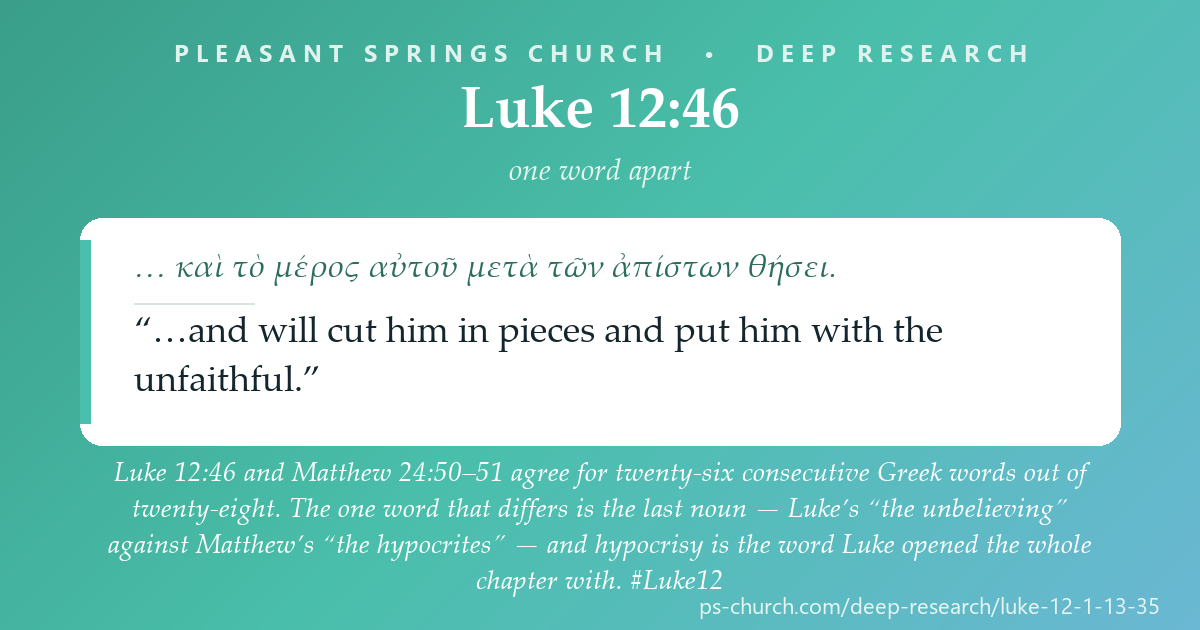
Luke 12:46 has 28 words. Twenty-six of them stand in Matthew, consecutively, in the same order. The twenty-eighth is identical as well. One word differs.
| text | the sentence |
|---|---|
| Luke 12:46 | ἥξει ὁ κύριος τοῦ δούλου ἐκείνου ἐν ἡμέρᾳ ᾗ οὐ προσδοκᾷ καὶ ἐν ὥρᾳ ᾗ οὐ γινώσκει, καὶ διχοτομήσει αὐτὸν καὶ τὸ μέρος αὐτοῦ μετὰ τῶν ἀπίστων θήσει. |
| Matthew 24:50 | ἥξει ὁ κύριος τοῦ δούλου ἐκείνου ἐν ἡμέρᾳ ᾗ οὐ προσδοκᾷ καὶ ἐν ὥρᾳ ᾗ οὐ γινώσκει, — and the verse ends here |
| Matthew 24:51 | καὶ διχοτομήσει αὐτὸν καὶ τὸ μέρος αὐτοῦ μετὰ τῶν ὑποκριτῶν θήσει· …and then Matthew adds a further nine words Luke does not have: ἐκεῖ ἔσται ὁ κλαυθμὸς καὶ ὁ βρυγμὸς τῶν ὀδόντων. |
| comparison | run | band | what stops it |
|---|---|---|---|
| Luke 12:46 vs Matthew 24:50, verse against verse | 17 | 1 | Matthew’s verse division — nothing in either text |
| Luke 12:46 vs Matthew 24:51, verse against verse | 9 | — | the same division, from the other side |
| Luke 12:46 vs Matthew 24:50 + 24:51 read as one stretch | 26 | — | one word: ἀπίστων against ὑποκριτῶν |
⚠️ The 26 is a hand-made comparison and the page says so. The screen that produced every other number here is verse-based; it cannot join two target verses on its own, and it did not. The 26 was obtained by concatenating Matthew 24:50 and 24:51 and running the same engine on the result. It is reported separately from the 17 for that reason, and the 17 is the figure that belongs in the distribution table above.
What the page will not say about it. Not that Luke is using Matthew. Not that Matthew is using Luke. Not that both are drawing on a common written source, and not that they are not. Direction of influence is never asserted on this shelf, and a single sentence — however clean — settles nothing. What is measured is that the agreement runs 26 words, that the one divergence is the final noun, and that hypocrisy is a word Luke had already spent, once, at the head of this very block.
And here is the honest complication, printed rather than hidden. Luke is not avoiding the word. ὑποκριταί stands twice inside these two chapters — at 12:56 and 13:15 — in Luke’s own mouth. So “Luke replaced the hypocrites with the unbelievers” is a story, not a measurement, and it is not one this page will tell. The measurement is the 26 and the one; the reader may do with it what the evidence allows.
Mark, measured across the whole passage
Across all 94 verses, the deepest contact with the Gospel of Mark anywhere is six consecutive words — and those six words are a quotation of the Psalter.
| row | deepest in Mark | run | band | the shared words |
|---|---|---|---|---|
| Luke 13:35 | Mark 11:9 | 6 | 1 | εὐλογημένος ὁ ἐρχόμενος ἐν ὀνόματι κυρίου |
| Luke 12:8 | Mark 8:38 · Mark 10:33 | 5 | 2 | καὶ ὁ υἱὸς τοῦ ἀνθρώπου |
| Luke 13:18 | Mark 4:26 · Mark 10:14 | 5 | 2 | ἐστὶν ἡ βασιλεία τοῦ θεοῦ |
| Luke 13:28 | Mark 14:25 | 5 | 1 | ἐν τῇ βασιλείᾳ τοῦ θεοῦ |
| Luke 13:29 | Mark 14:25 | 5 | 1 | ἐν τῇ βασιλείᾳ τοῦ θεοῦ |
The deepest of the five is the one that is not Markan wording at all. Septuagint Psalm 117:26 reads εὐλογημένος ὁ ἐρχόμενος ἐν ὀνόματι κυρίου, and Mark 11:9, Matthew 21:9 and Luke 13:35 all carry those six words unchanged. Mark’s single deepest measured contact with these two chapters is a psalm all three Gospels quote.
⚠️ The obvious caution, and it is a large one. Mark does not contain most of this material. A screen cannot find agreement in text that is not there. “Luke 12–13 measures shallow against Mark” is therefore in large part a statement about what Mark contains, not about how Luke wrote. The one place where Mark does carry the same parable — the mustard seed, Mark 4:30–32 against Luke 13:18–19 — the measurement against those three verses is 2 and 4. Luke 13:18 reaches 5 elsewhere in Mark, at 4:26 and 10:14, on the formula ἐστὶν ἡ βασιλεία τοῦ θεοῦ, not on the parable. Having the same parable is not the same as having the same sentence, and that is the genuinely informative result in this table.
The counter-examples, printed in the same section
1. Luke 13:28: nine consecutive words, and six verses tied for them.
ἐκεῖ ἔσται ὁ κλαυθμὸς καὶ ὁ βρυγμὸς τῶν ὀδόντων is nine words — deeper than all but six rows in the passage — and it stands identically at Matthew 8:12, 13:42, 13:50, 22:13, 24:51 and 25:30. A run of nine with a tie band of six is a fixed formula and tells you nothing about which text got it from which. Printed here so that the run of 17 at Luke 12:46, whose band is one, is read for what distinguishes it. A run without its band would have made these two look like the same kind of thing.
2. Luke 12:53 and Micah 7:6 — and Matthew, which is supposed to be the closer one.
| text | the sentence | run vs LXX Micah 7:6 |
|---|---|---|
| CATSS Micah 7:6 | …θυγάτηρ ἐπαναστήσεται ἐπὶ τὴν μητέρα αὐτῆς νύμφη ἐπὶ τὴν πενθερὰν αὐτῆς ἐχθροὶ ἀνδρὸς πάντες οἱ ἄνδρες οἱ ἐν τῷ οἴκῳ αὐτοῦ | — |
| Luke 12:53 | …πενθερὰ ἐπὶ τὴν νύμφην αὐτῆς καὶ νύμφη ἐπὶ τὴν πενθεράν. | 4, band 1 |
| Matthew 10:35–36 | …καὶ νύμφην κατὰ τῆς πενθερᾶς αὐτῆς, καὶ ἐχθροὶ τοῦ ἀνθρώπου οἱ οἰκιακοὶ αὐτοῦ. | 1 |
| Masoretic Micah 7:6 | כִּי בֵן מְנַבֵּל אָב בַּת קָמָה בְאִמָּהּ כַּלָּה בַּחֲמֹתָהּ אֹיְבֵי אִישׁ אַנְשֵׁי בֵיתוֹ | — |
Matthew 10:36 says a man’s enemies will be the members of his own household and Micah 7:6 says a man’s enemies are the men of his own house. In sense they could hardly be closer. Measured against the Septuagint their longest shared run is one word — four word forms are shared in all (αὐτοῦ, αὐτῆς, ἐχθροί, οἱ) and no two of them stand together — because Matthew writes οἱ οἰκιακοί where the Greek Micah writes οἱ ἄνδρες οἱ ἐν τῷ οἴκῳ. Luke, whose sentence is a symmetrical list rather than a quotation, happens to hit four of Micah’s words in a row. The screen finds verbatim contact. It does not find allusion, and here it gets the two backwards.
3. Luke 13:27 and Matthew 7:23 quote the same psalm verse, from opposite halves of it.
| text | the sentence | run |
|---|---|---|
| CATSS Psalm 6:9 (ESV 6:8) | ἀπόστητε ἀπ’ ἐμοῦ πάντες οἱ ἐργαζόμενοι τὴν ἀνομίαν | — |
| Luke 13:27 | ἀπόστητε ἀπ’ ἐμοῦ, πάντες ἐργάται ἀδικίας. | 4, band 1 |
| Matthew 7:23 | ἀποχωρεῖτε ἀπ’ ἐμοῦ οἱ ἐργαζόμενοι τὴν ἀνομίαν. | 4 |
| Luke 13:27 vs Matthew 7:23 | the two Gospel sentences against each other | 2 |
Luke keeps the psalm’s first four words and rewrites its last four. Matthew rewrites the first and keeps the last four verbatim. Each agrees with the Septuagint more than either agrees with the other. On a page whose headline is a 26-word agreement with Matthew, this is the row that shows the same two books doing the opposite thing eleven verses later.
4. The mustard seed measures shallower than the leaven standing next to it.
| parable | who else has it | deepest run outside Luke | band |
|---|---|---|---|
| Luke 13:18–19, the mustard seed | Matthew 13:31–32 and Mark 4:30–32 | 5 and 5 | 4 and 3 |
| Luke 13:20–21, the leaven | Matthew 13:33 only | 8 | 1 |
The parable with two parallels measures shallower than the parable with one, and they are consecutive sentences. Luke’s mustard seed is planted εἰς κῆπον ἑαυτοῦ, in his own garden; Mark’s is sown ἐπὶ τῆς γῆς, on the ground; Matthew’s ἐν τῷ ἀγρῷ αὐτοῦ, in his field. Luke’s becomes a tree; Mark’s becomes the greatest of shrubs. Three tellings, one image, and very little shared wording. Having the same story is not the same as having the same sentence.
5. The narrow door: three shared words, and the run stops at the noun.
Luke 13:24 and Matthew 7:13 share διὰ τῆς στενῆς — and then Luke says θύρας and Matthew says πύλης. Three words, band 1. The adjective στενός occurs three times in the entire Greek New Testament and this is one of them; the sentences around it are otherwise unalike, and Luke’s continues into a scene Matthew does not have at all, the householder getting up and shutting the door.
Where this page is weakest, what it could not reach, and what would break it.
The largest hole: this page is standing on the edge of the Synoptic problem and refusing to walk in
Every deep result here is a Luke–Matthew agreement, and there is a two-century literature about what those agreements mean. None of it was consulted, and none of it can be settled by this method.
Two-source theory, Farrer–Goulder–Goodacre, the Griesbach hypothesis, the reconstructions of a sayings source and the arguments that no such source existed — each of them predicts that Luke 12:46 and Matthew 24:50–51 will agree closely, and the 26-word run does not discriminate between them. A page that presented the 26 as evidence for any one of those positions would be misusing its own instrument. This one presents the 26 and stops.
What a determined critic could fairly say against the page. That selecting the deepest runs and calling the pattern “Matthean” is close to circular, since the double-tradition material in this block is by definition the material Matthew shares. That objection is correct, and it is why the counter-examples are in Stage 4 rather than in a footnote: 24 of the 94 rows measure deeper in the Greek Old Testament, Luke 12:53 measures 2 in the whole New Testament outside Luke, and the parable Mark also carries measures shallower than the one he does not.
What the headline depends on, and how it could be wrong
It depends on one printed edition on each side, with no apparatus. The Greek is the SBL Greek New Testament as digitised by MorphGNT. Luke 12:46 and Matthew 24:50–51 carry variants in the manuscript tradition, and no critical apparatus is held on this disk. The 26 is an exact agreement between two printed texts; a different edition could lengthen or shorten it. The same applies to the 14 at Luke 13:34 and the 11 at Luke 12:27.
It depends on a decision about what a word is. Both sides are normalised the same way — lowercased, accents and breathings dropped, final sigma folded — and compared as word forms, not lemmas. That is why Luke 13:34 stops at 14: ἐπισυνάξαι and ἐπισυναγαγεῖν are two aorist infinitives of one verb and the screen treats them as different words. It is also why Luke 12:43 stops at 10, for a transposition of two words that are both present in both verses. A lemma-based or gap-tolerant screen would give different numbers on every line of this page, and would be a different measurement, not a better one.
And the 26 is one sentence. It is the deepest row in this passage and the seventh-deepest of Luke’s 1,149 verses measured against Matthew — Luke 16:13 reaches 26 against Matthew 6:24 within a single verse pair, and Luke 9:58 and 11:32 both reach 24. So the phenomenon this page leads with is real and it is not unique, and saying so is more useful than letting the reader assume it is a one-off.
What could not be checked at all
No Greek critical apparatus. No papyri — P45, P69 and P75 all carry parts of Luke and none was consulted. No patristic citations, no Diatessaron, no Marcionite Luke, no Syriac, Latin or Coptic versions. No Qumran or rabbinic material, so the rabbinic use of fox at 13:32 is reported from reference works and not measured. No documentary evidence for dry measures, so the size of three σάτα is likewise reported, not counted. No commentary on Luke was read for any figure on this page.
Three specific things this page would like to have measured and could not. (1) Whether the SBLGNT’s text of Luke 12:46 is disputed at ἀπίστων — that is exactly the kind of question an apparatus answers and this disk cannot. (2) Whether Luke 13:35’s omission of ἔρημος against Matthew 23:38 is editorial or textual — same problem. (3) What any of these runs measure against the Greek Sirach or Wisdom material as printed in other editions; the CATSS files here are one digitisation of one printed text.
And the questions the counting is simply silent about. Who wrote this Gospel. When. Whether the travel narrative is a deliberate literary construction or a gathering of loose material. What Jesus said in Aramaic before any of it was Greek. Counting shared word-runs decides none of it, and this page does not pretend otherwise. What it offers is the measurement the arguments have to fit.
Reading list
- Joseph A. Fitzmyer, The Gospel According to Luke X–XXIV (Anchor Bible 28A).
- John Nolland, Luke 9:21–18:34 (Word Biblical Commentary 35B).
- François Bovon, Luke 2: A Commentary on the Gospel of Luke 9:51–19:27 (Hermeneia, 2013).
- Mark Goodacre, The Case Against Q (2002) — for the position this page’s measurement is most often taken to support and does not.
- John S. Kloppenborg, Excavating Q (2000) — for the position it is second most often taken to support and also does not.
- None of these were consulted for the measurements on this page, which were run on the text files named in the footer.
Two chapters of warnings, and one word of difference.
One word apart
Luke 12 opens with a crowd so large it is trampling itself, and the first thing said is beware of the leaven of the Pharisees, which is hypocrisy. Ninety-four verses later the block ends outside a city that kills prophets, with a house left empty. Between the two there is a farmer who built bigger barns, a woman bent double for eighteen years, a fig tree given one more year, a door somebody gets up and shuts, and a servant who assumed his master was going to be late.
And in the middle of it stands one sentence that agrees with Matthew for twenty-six consecutive words. Not seventeen — seventeen is only where Matthew’s verse number falls. Twenty-six out of twenty-eight, and the one word that differs is the last noun: Luke puts the servant with the unbelieving, Matthew with the hypocrites.
The page cannot tell you why, and it says so on the same screen where it says the number. It cannot even tell you that Luke was avoiding the word, because he uses it twice in these very chapters, at 12:56 and 13:15. What can be said is what was counted: the run, its band of one, the verse division that truncates it, and the fact that hypocrisy is the word this whole block opens with and occurs nowhere else in Luke.
The two chapters end at a door and a house. The door is narrow, and the one who shuts it says I do not know where you come from. The house is Jerusalem’s, and it is left to them — ἀφίεται ὑμῖν ὁ οἶκος ὑμῶν — until they say the words of a psalm the Septuagint numbers 117 and the ESV numbers 118: Blessed is he who comes in the name of the Lord. Six words. All three Gospels carry them identically, and they are the deepest thing Mark shares with these two chapters.
Every Deep Research page traces its passage across the whole sweep — the Old Testament, the Second-Temple world between the testaments (historical witnesses, not Scripture), and the New Testament. Follow the thread:
Pleasant Springs Church — Deep Research
Research method after Michael S. Heiser’s Bible Research Method (examine dictionaries → ancient literature → important words → textual connections → academic publications → share), with the Pleasant Springs “Author & Audience” foundation. Scripture set in the Hebrew, the Greek editions named on each page and the ESV (Old Testament), and the Greek New Testament and the ESV (New Testament), per the practice of Pleasant Springs Church. Luke research grounded in Fitzmyer (Anchor), Nolland (WBC), Bovon (Hermeneia), Goodacre and Kloppenborg — none of which were consulted for any number on this page. Text: Greek New Testament from the SBL edition as digitized by MorphGNT; Greek Old Testament from Rahlfs’ Septuaginta as digitized by CATSS; Hebrew from the Masoretic text as printed in Sefaria’s Miqra according to the Masorah. No critical apparatus was consulted on any side. ⚠️ VERSE NUMBERING — Luke is a New Testament book, so there is no Masoretic or Septuagint column and no MT/LXX offset to state. Counted anyway, off disk: Luke 12 runs 59 verses and Luke 13 runs 35 in the SBLGNT and in the plain-text English Bible held here — both counted off disk — and in the ESV as printed, which is not held on this disk. 94 verses, and every reference on this page means the same verse in each of them. (The book totals differ only in bookkeeping: the SBLGNT and the English file have no Luke 17:36 and no 23:17, and the ESV prints both as footnotes; neither verse is in this passage.) Three numbering facts do bear on results printed here. Luke 13:35 quotes Septuagint Psalm 117:26 = ESV Psalm 118:26 (the Psalter’s one-behind offset, Psalm 9/10 through 147). Luke 13:27 touches Septuagint Psalm 6:9 = ESV Psalm 6:8 (the Hebrew counts the superscription as a verse and English does not). Luke 13:29 brushes Septuagint Psalm 106:3 = ESV Psalm 107:3. And the deepest run on this page is truncated by a verse division inside Matthew: Luke 12:46 corresponds to Matthew 24:50 plus the first eleven words of Matthew 24:51. ⚠️ The measurement, in full. Greek against Greek. MorphGNT field 6, the normalised word (the column that already resolves elision and the movable nu); CATSS FORM column (cols 0–24), beta-code transliterated first. Both sides lowercased, accents and breathings dropped, final sigma folded, then filtered to Greek letters — the same filter applied to both corpora. Contiguous runs of whole word FORMS, never lemmas. Corpus: the 94 MorphGNT rows of Luke 12–13 against the 6,778 Greek New Testament verses outside Luke, and against 30,348 verse units across the 63 CATSS files screened — 64 files and 30,637 units are held, the Odes held and not screened. Exhaustive and deterministic; nothing sampled, so no seed applies. The tie band — how many target verses reach the same maximum — is printed beside every run on this page. ⚠️ ONE FIGURE ON THIS PAGE IS NOT A VERSE-BASED SCREEN RESULT. The 26-word agreement between Luke 12:46 and Matthew 24:50–51 was obtained by concatenating the two Matthean verses and running the same engine on the result. The verse-based figure is 17, and 17 is what appears in the distribution. Both are printed, and the page says which is which. ⚠️ What was NOT measurable. No critical apparatus, no papyri, no versions, no patristic citations, no Diatessaron, no Marcionite Luke. The rabbinic sense of fox and the volume of three σάτα are reported from reference works and were not counted. Whether Luke 13:35’s lack of ἔρημος is editorial or textual could not be checked. ⚠️ Direction of influence is never asserted. Nothing here says Luke is using Matthew, that Matthew is using Luke, that both are drawing on a common written source, or that they are not. Every reconstruction of the Synoptic relationship predicts a close agreement at Luke 12:46, so the 26 does not discriminate between them, and the page does not pretend it does. Typology is handled per the house position: what the text says, what the New Testament itself draws, and what we see from this side of the cross — with the seeing left to the reader.
Scripture quotations marked ESV are from the ESV® Bible (The Holy Bible, English Standard Version®), © 2001 by Crossway, a publishing ministry of Good News Publishers. ESV Text Edition: 2016. Used by permission. All rights reserved. The ESV text may not be quoted in any publication made available to the public by a Creative Commons license, and the ESV may not be translated in whole or in part into any other language. www.esv.org
|
Did this study bless you today? 💚 Give to Support PS Church100% of gifts go to the General Fund — thank you. |