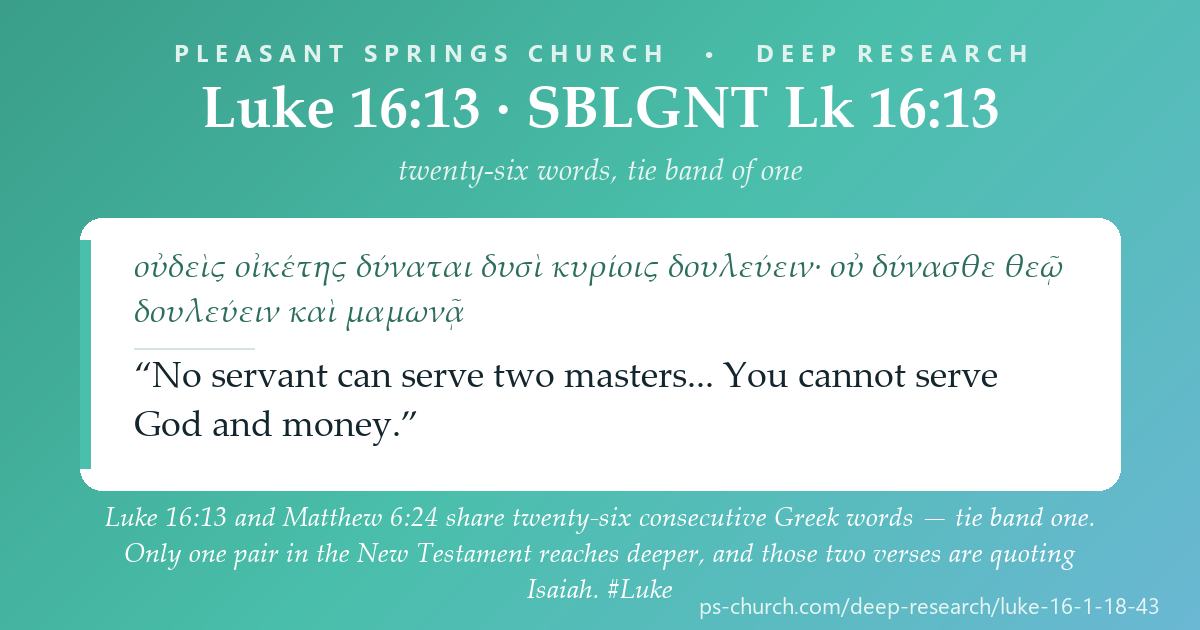
Luke 16:13 and Matthew 6:24 share twenty-six consecutive Greek words, identical after normalisation, with a tie band of one. Screened across all 7,927 verses of the Greek New Testament, exactly one pair anywhere reaches deeper across a book boundary — Matthew 13:15 and Acts 28:27 at thirty-four — and those two verses are simply quoting the same verse of Isaiah, which the screen confirms: each of them shares twenty-four consecutive words with the Greek Isaiah 6:10. Take out the shared quotation and Luke 16:13 holds the deepest verbatim agreement across a book boundary in the New Testament. Luke’s verse is twenty-eight words long and Matthew’s twenty-seven; every one of Matthew’s words stands in Luke’s, in order; the run measures twenty-six rather than twenty-seven only because Luke’s verse carries one word more, οἰκέτης, after the first. Seventy-four verses later, Luke 18:20 lists four commandments and Matthew 19:18 lists the same four in almost the same order, and the two verses share not one word. Not a short run — nothing. Between those two extremes sit six blocks of story — forty-eight verses in all — that never once reach six: the steward, the rich man and Lazarus, the unworthy servants, the ten lepers, the widow who wore a judge down, the Pharisee and the tax collector. And the clearest Old Testament reference in all three chapters — remember Lot’s wife — measures two, in a band of forty-eight. None of this says who read whom, and neither does this page. See the method →
Luke 16:1–18:43 (selections)
Greek New Testament (SBLGNT, via MorphGNT) · ESV★ And seventy-four verses separate the loudest row on this page from the emptiest. Luke 16:13 shares twenty-six consecutive words with Matthew 6:24 at a tie band of one. Luke 18:20 lists the same four commandments as Matthew 19:18 and shares no word at all with it. Stage 4 gives both distributions, the tie bands, and the counter-examples.
The Shape of the Passage
A sequence — with one frame the words really mark, and one seam the numbers find on their ownThe book never names its author. It does, once, name a reader. The title ΚΑΤΑ ΛΟΥΚΑΝ is a manuscript heading, not a line of the text, and no manuscript on this disk was consulted for it. What Luke 1:3 supplies is a vocative — κράτιστε Θεόφιλε — and what these three chapters supply is a set of habits. Habits are what this section reports.
Author
Whoever wrote these chapters wrote Acts. Luke 16:31 ends the story of the rich man with Μωϋσέως καὶ τῶν προφητῶν, and its deepest partner in the whole non-Lukan New Testament is Acts 28:23, at a run of 4 with a tie band of 1 — the last chapter of the second volume, where Paul persuades his hearers ἀπό τε τοῦ νόμου Μωϋσέως καὶ τῶν προφητῶν. That is a four-word run and the page will not call it more than that; it is reported because it is where the screen actually pointed.
A spelling habit the run engine can see. At 18:31 Luke has Jesus say ἰδοὺ ἀναβαίνομεν εἰς Ἰερουσαλήμ. Mark 10:33 and Matthew 20:18 both write εἰς Ἱεροσόλυμα. The run between Luke 18:31 and Mark 10:33 is exactly 3, and it stops at the name of the city. Counted off disk, Luke uses Ἰερουσαλήμ 27 times and Ἱεροσόλυμα 4 times. The habit is strong; it is not absolute; and a page that reported only the strong half would be misleading.
And a taste for the named minor character. Luke 16:20 gives a poor man a name. Λάζαρος occurs fifteen times in the Greek New Testament: four here, and eleven in John 11–12 of a man of Bethany. Luke 16:20 and John 11:1 share a run of 2. The measurement links them not at all, and this page draws no line between them.
Audience
Readers who are expected to know the Law without being told what it is. 18:20 lists four commandments and names no source. 16:29 and 16:31 say Moses and the prophets and expect the phrase to land. 17:32 says four words — remember Lot’s wife — and expects a reader to supply Genesis 19 entire. That last is the clearest evidence on the page that the audience knew the Greek Old Testament, and it is invisible to every number this page prints (run 2, tie band 48).
Readers who handled money and knew what a steward was. 16:1–8 is priced in kind: a hundred βάτους of oil, a hundred κόρους of wheat, bonds rewritten by the debtor’s own hand. οἰκονομία stands nine times in the New Testament and three of them are 16:2, 16:3 and 16:4; the other six are all Pauline and all metaphorical. Luke 16 is the only place in the New Testament where the word means an actual job.
Readers for whom a Samaritan was a category, and a tax collector a slur. 17:16 tells the reader the grateful leper was a Samaritan as though that settles something, and 17:18 calls him ὁ ἀλλογενὴς οὗτος — a word that occurs once in the New Testament and in 46 verses of the Greek Old Testament held here, where it names the foreigner who may not eat the Passover (Exodus 12:43) or enter the sanctuary (Ezekiel 44:7, 44:9). At 18:10 a Pharisee and a τελώνης go up to pray and the text does not explain why that pairing is shocking. None of it needs explaining to this audience.
Orient on the travel narrative, on stewardship and debt, on Hades and the bosom of Abraham, on lepers and Samaritans, and on the widow at law — before touching a number.
Search by topic: Luke, Gospel of; travel narrative; parable; steward (oikonomos); mammon; wealth and poverty in Luke; Hades; Abraham’s bosom; Lazarus; leprosy; Samaritans; kingdom of God; Son of Man; widow; judge; tax collector; justification; Synoptic problem; Q.
Which articles are relevant?
- Anchor Bible Dictionary — “Luke, Gospel of,” “Parable,” “Steward,” “Wealth,” “Dead, Abode of,” “Leprosy,” “Samaritans,” “Widow.”
- Dictionary of Jesus and the Gospels (IVP) — “Rich and Poor,” “Parables,” “Kingdom of God,” “Apocalyptic Teaching,” “Prayer,” “Tax Collectors.”
- New International Dictionary of NT Theology & Exegesis — οἰκονόμος, μαμωνᾶς, ᾅδης, κόλπος, ἀλλογενής, ἐντός, ἐκδικέω, ἱλάσκομαι.
- Commentary on the New Testament Use of the Old Testament, ed. G. K. Beale and D. A. Carson (Baker, 2007) — the Luke chapter, where 16:29–31, 17:26–32 and 18:20 are treated.
- None of these were consulted for the measurements below. The measurements were run on the text files named in the footer.
Settle the numbering first — and note the verse that is not there
Every page on this shelf states its versification offset, including where the answer is that there is none. On a New Testament book there is no second column to be offset from — but on this passage there is still something to say.
| Luke 16 | Luke 17 | Luke 18 | this passage | |
|---|---|---|---|---|
| SBLGNT (MorphGNT) | 31 | 36 | 43 | 110 |
| Full English versification | 31 | 36 | 43 | 110 |
| the printed verse numbers | 1–31 | 1–35, 37 | 1–43 | 111 numbers, 110 verses |
Counted off disk. Neither the Greek nor the English text counted here prints a Luke 17:36 — both run 17:35 and then 17:37 — and the ESV does the same and puts the sentence (Two men will be in the field; one will be taken and the other left) in a footnote. So every reference on this page means the same verse in every column, and one number in the middle of the range means no verse in any of them.
The same thing happens once more in this Gospel. SBLGNT Luke jumps from 23:16 to 23:18, so the book holds 1,149 verses while its printed numbering runs to 1,151. This page reports which printed edition it is counting and does not say which reading is older; no critical apparatus was consulted, on any side.
But the offset problem is in the room anyway, because Luke 18 quotes a book that has one. The Masoretic text carries the sixth to ninth commandments inside a single verse — Exodus 20:13 and Deuteronomy 5:17 — in the order murder, adultery, theft, false witness. The Greek held here splits them into four verses, and the two Greek Decalogues do not agree with each other: CATSS Deuteronomy 5:17–20 runs adultery, murder, theft, false witness; CATSS Exodus 20:13–16 runs adultery, theft, murder, false witness. Luke 18:20 gives the Greek Deuteronomy’s order exactly. A page that wrote ‘Deuteronomy 5:17’ without saying which column it meant would be naming two different commandments at once.
A steward rewriting bonds, a word for the excluded foreigner, and a widow with one legal move left.
“This foreigner” — the one word in these chapters whose weight is lexical rather than verbal
Luke 17:18 calls the Samaritan leper ὁ ἀλλογενὴς οὗτος. That noun occurs once in the Greek New Testament and in 46 verses of the Greek Old Testament held on this disk.
| text | what it says |
|---|---|
| CATSS Exodus 12:43 | no ἀλλογενής shall eat the Passover |
| CATSS Exodus 29:33 · 30:33 | no ἀλλογενής shall eat the holy things, or copy the anointing oil |
| CATSS Ezekiel 44:7 · 44:9 | no ἀλλογενής uncircumcised in heart shall enter the sanctuary |
| CATSS Isaiah 56:3 · 56:6 | let not the ἀλλογενής who joins himself to the Lord say ‘he will separate me’ |
| Luke 17:18 | the one leper of ten who came back |
⚠️ What this is, and what it is not. This is a lexical observation, not a run. Luke 17:18 measures 3 against the non-Lukan New Testament, in a tie band of 16, and nothing above 3 against the whole Greek Old Testament. There is no quotation here and the page does not claim one. What is countable is that the New Testament uses this word exactly once and the Greek Old Testament uses it in 46 verses — 47 occurrences, because Ezekiel 44:9 has two — almost always of somebody kept outside. The famous Jerusalem temple warning inscription is regularly cited at this point — and no inscription was consulted for this page. That reading is reported from the reference works and was not verified here.
The steward, the bonds, and the measures — what the text prices and what it does not explain
Luke 16:5–7 has the steward call in his master’s debtors and have each rewrite his own bond. A hundred βάτους of oil becomes fifty; a hundred κόρους of wheat becomes eighty. Both measures are loanwords from the Hebrew, and neither is explained. Counted off disk: κόρος occurs once in the Greek New Testament, and βάτος occurs six times — this is the only one of the six that is a measure; the other five are the burning bush and a bramble. Nor does it explain why the debtor writes the new figure himself (γράψον, 16:6–7), which is where every reconstruction of the parable’s economics begins.
What could not be checked here. No papyri, no ostraca, no rabbinic material on agency or usury, no Zenon archive, no Judaean Desert loan documents. The standard proposals — that the steward remits his own commission, or the interest concealed in the bond, or simply defrauds his master a second time — are reported from the literature and none of them was verified from a primary document on this disk. The one thing the measurement adds is negative and firm: Luke 16:1–8 tops out at a run of 4 against everything outside Luke, so no other New Testament writer tells this story in these words.
A widow, a judge, and a verb from the boxing ring
Luke 18:5 has the judge give in ἵνα μὴ εἰς τέλος ἐρχομένη ὑπωπιάζῃ με. The verb ὑπωπιάζω is built on ὑπώπιον, the part of the face under the eye; its literal sense is to strike there, to give a black eye. It occurs twice in the Greek New Testament: here, and at 1 Corinthians 9:27, where Paul says he does it to his own body. The ESV renders the judge’s line beat me down by her continual coming; other English versions soften it to wear me out. Two occurrences will not decide between a literal and a figurative reading, and this page does not decide.
What the passage assumes without argument is the widow’s legal position: she has an adversary (ἀντίδικος), she has no advocate, and her only instrument is to keep coming. The Greek Old Testament’s standing pairing of the widow with the orphan and the sojourner is the obvious background and it is not quoted here — 18:1–8 reaches 4 against the whole Greek Old Testament at its deepest. χήρα, widow, occurs 26 times in the Greek New Testament and nine of them are in Luke.
Six words that carry these three chapters, and how rare each one actually is.
Four occurrences in the Greek New Testament. Three are in Luke 16 (16:9, 16:11, 16:13) and the fourth is Matthew 6:24 — the verse that shares twenty-six consecutive words with the third of them. The three Lukan occurrences share almost nothing with each other: 16:9 against 16:11 measures 1, and 16:11 against 16:13 measures 1. Each pair has exactly two word forms in common, and one of the two is the noun itself — μαμωνᾶ at 16:9, μαμωνᾷ at 16:11 and 16:13, which normalise alike.
Once in the Greek New Testament — Luke 16:26, the great chasm fixed between the rich man and Lazarus. A hapax, and so is βύσσος in 16:19, the fine linen the rich man wore.
Once in the Greek New Testament — Luke 16:1, of the steward. It is the verb behind διάβολος, the accuser, which stands 37 times — three of them adjectival, slanderers (1 Timothy 3:11; 2 Timothy 3:3; Titus 2:3). The page notes the shared root and claims nothing about the steward’s master.
Once in the Greek New Testament (Luke 17:18) and in 46 verses of the Greek Old Testament held here — the word for the man who may not eat the Passover (Exodus 12:43) or enter the sanctuary (Ezekiel 44:7, 44:9). Luke gives it to the one leper who returned.
Twice in the Greek New Testament — Luke 17:21 (the kingdom of God is ἐντὸς ὑμῶν) and Matthew 23:26, where it means the inside of a cup. The ESV reads in the midst of you; older versions read within you. Two occurrences cannot settle that, and this page does not pretend they do.
Twice in the Greek New Testament — the tax collector’s ἱλάσθητί μοι τῷ ἁμαρτωλῷ at Luke 18:13, and Hebrews 2:17, of the high priest making propitiation for the sins of the people. The count is reported; the two sentences are not harmonised here.
The three chapters counted, word by word
110 verses; 1,844 words in the MorphGNT text of Luke 16–18.
| word or phrase | in the whole Greek NT | here |
|---|---|---|
| χάσμα | 1 | 16:26 — a hapax |
| βύσσος | 1 | 16:19 — a hapax |
| διαβάλλω | 1 | 16:1 — a hapax |
| παρατήρησις | 1 | 17:20 — a hapax |
| συκάμινος | 1 | 17:6 — a hapax |
| ἀλλογενής | 1 | 17:18 — a hapax (46 verses of the Greek OT) |
| ἐντός | 2 | 17:21 (the other is Matthew 23:26) |
| ὑπωπιάζω | 2 | 18:5 (the other is 1 Corinthians 9:27) |
| ἱλάσκομαι | 2 | 18:13 (the other is Hebrews 2:17) |
| ἀχρεῖος | 2 | 17:10 (the other is Matthew 25:30) |
| μαμωνᾶς | 4 | 16:9, 16:11, 16:13 — three of the four |
| τις ἦν πλούσιος | 2 | 16:1 and 16:19 — both |
| οἰκονομία | 9 | 16:2, 16:3, 16:4 — the only three that are not Pauline |
| ᾅδης | 10 | 16:23 — the other nine are Matthew 11:23, 16:18; Luke 10:15; Acts 2:27, 2:31; Revelation 1:18, 6:8, 20:13, 20:14 |
| ἐκδικέω + ἐκδίκησις | 15 | 18:3, 18:5, 18:7, 18:8 — four in eight verses |
| Λάζαρος | 15 | 16:20, 23, 24, 25 — the other eleven are John 11–12 |
One coincidence, flagged so that nobody reads it as a derivation: the number of words in Luke 16–18 is 1,844, and the tie band on Luke 16:11 against the Greek Old Testament is also 1,844. The two figures have nothing to do with each other. The second means that 1,844 verse units of the Greek Old Testament share a two-word run with that verse, which is another way of saying they share nothing.
A twenty-six-word row, an empty intersection, forty-eight verses that never reach six, and the counter-examples printed in the same tables.
The measurement
All 110 verses of Luke 16:1–18:43 were screened twice: once against the 6,778 non-Lukan verses of the Greek New Testament, once against the 30,637 verse units of the Greek Old Testament held on this disk. Contiguous runs of whole word forms, never lemmas, with the tie band beside every run.
Against the non-Lukan New Testament, across the 110 rows: all 110 reach two, 98 reach three, 57 reach four, 26 reach five, 16 reach six, 12 reach seven, 11 reach eight, 6 reach ten, 5 reach eleven, 2 reach eighteen, 1 reaches twenty-six, and nothing reaches twenty-seven. Against the Greek Old Testament: all 110 reach two, 92 reach three, 43 reach four, 9 reach five, 4 reach six, 1 reaches seven, and nothing reaches eight.
| row | deepest partner outside Luke | run | band | deepest partner in the Greek OT held here | run | band |
|---|---|---|---|---|---|---|
| Luke 16:13 | Matthew 6:24 | 26 | 1 | Daniel(Th) 7:20 | 3 | 1 |
| Luke 18:17 | Mark 10:15 | 18 | 1 | Isaiah 37:33 | 4 | 1 |
| Luke 18:16 | Mark 10:14 | 11 | 1 | Genesis 45:9 · Psalms of Solomon 17:3 | 4 | 2 |
| Luke 18:19 | Mark 10:18 | 11 | 1 | Genesis 20:6 · Genesis 33:13 · … | 4 | 6 |
| Luke 18:24 | Mark 10:23 | 11 | 1 | 1 Esdras 8:21 · Daniel(Th) 11:9 | 4 | 2 |
| Luke 18:22 | Matthew 19:21 | 10 | 1 | Joshua(B) 5:13 | 3 | 1 |
| Luke 17:24 | Matthew 12:40 | 8 | 1 | 2 Maccabees 2:18 | 6 | 1 |
| Luke 17:27 | Matthew 24:38 | 8 | 1 | Genesis 7:9 · 7:15 · Exodus 40:20 | 4 | 3 |
| Luke 18:25 | Matthew 19:24 · Mark 10:25 | 8 | 2 | 1 Esdras 8:21 · Daniel(Th) 11:9 | 4 | 2 |
| Luke 18:30 | Mark 10:30 | 8 | 1 | Deuteronomy 10:10 | 5 | 1 |
| Luke 18:39 | Mark 10:48 | 8 | 1 | 1 Chronicles 2:53 · … | 2 | 1,086 |
| Luke 18:20 | Mark 7:10 · Mark 10:19 · Ephesians 6:2 | 7 | 3 | Deuteronomy 5:16 · Exodus 20:12 | 7 | 2 |
| Luke 16:18 | Matthew 5:32 | 6 | 1 | 1 Chronicles 7:23 · Genesis 2:24 · … | 4 | 20 |
| Luke 16:25 | Matthew 20:21 · Matthew 25:25 · Romans 5:10 | 3 | 4 | Ecclesiastes 9:9 | 6 | 1 |
| Luke 16:24 | Matthew 21:27 · Matthew 27:57 · Mark 4:38 · … | 2 | 356 | Psalm 26:7 · … | 3 | 19 |
| Luke 18:1 | Mark 7:20 · Mark 10:5 · John 6:71 · … | 2 | 110 | Jeremiah 7:16 | 3 | 1 |
| Luke 17:32 | Matthew 19:10 · John 4:39 · Acts 5:2 · … | 2 | 8 | 1 Chronicles 2:29 · 1 Esdras 4:21 · … | 2 | 48 |
| Luke 16:11 | John 7:28 | 3 | 1 | Esther 1:19 · Exodus 33:13 · … | 2 | 1,844 |
Sixteen of the 110 rows reach a run of six against anything outside Luke, and eleven of the sixteen are in the last twenty-nine verses. That is the shape of these three chapters: eighty-one verses in which five rows reach six, and then twenty-nine in which eleven do — the last twenty-nine running almost verbatim beside one chapter of one other book.
Twenty-six words, and where that sits in the New Testament
Every verse of the Greek New Testament was screened against every verse outside its own book. Of 7,927 verses, 244 reach a cross-book run of ten or more, 36 reach sixteen, 28 reach seventeen, 20 reach eighteen, 16 reach twenty, 8 reach twenty-four, 4 reach twenty-six, and 2 reach thirty-four. Those four verses are two pairs: Luke 16:13 with Matthew 6:24 at twenty-six, and the pair above them at thirty-four. No other pair in the New Testament is deeper.
| run | the pair |
|---|---|
| 34 | Matthew 13:15 ↔ Acts 28:27 — and the screen says why: each of the two shares 24 consecutive words with CATSS Isaiah 6:10. They are quoting. |
| 26 | Luke 16:13 ↔ Matthew 6:24 — and its deepest contact with the whole Greek Old Testament is 3. |
| 24 | Matthew 8:20 ↔ Luke 9:58 · Matthew 12:41 ↔ Luke 11:32 |
| 23 | Matthew 8:9 ↔ Luke 7:8 · Matthew 26:24 ↔ Mark 14:21 |
| 22 | Matthew 3:9 ↔ Luke 3:8 |
| 20 | Matthew 3:10 ↔ Luke 3:9 |
| 19 | Matthew 22:44 ↔ Mark 12:36 |
| 18 | Mark 10:15 ↔ Luke 18:17 |
| 17 | Matthew 20:28 ↔ Mark 10:45 · Matthew 24:50 ↔ Luke 12:46 · Mark 1:24 ↔ Luke 4:34 · Ephesians 6:22 ↔ Colossians 4:8 |
⚠️ Read the top row before reading the second. The deepest cross-book agreement in the New Testament, at 34 words, is two books quoting the same Old Testament passage — and that is not an inference, it is a measurement: both verses run 24 words with the Greek Isaiah 6:10. Luke 16:13 has no such explanation available. Its best run against the whole Greek Old Testament is 3, in a tie band of 1. Whatever accounts for the twenty-six, a shared scriptural source is not it. What does account for it is exactly the question this page refuses to answer — Luke using Matthew, Matthew using Luke, both using a common written source, both reproducing a fixed oral form. The measurement is compatible with every one of those and decides none. This table also ignores everything inside a book, so the figures say ‘across a book boundary’ and nothing wider.
Eighteen words, and the fifteen identical verses
Luke 18:17 is eighteen words long. Mark 10:15 is eighteen words long. They are the same eighteen words.
Screened across all 7,927 verses of the Greek New Testament, exactly fifteen groups of verses of five words or more are word-for-word identical across a book boundary (four more groups are identical within a single book, and are excluded). Ranked by length:
| words | the identical verses |
|---|---|
| 34 | Matthew 13:15 = Acts 28:27 |
| 24 | Matthew 12:41 = Luke 11:32 |
| 18 | Mark 10:15 = Luke 18:17 |
| 17 | Ephesians 6:22 = Colossians 4:8 |
| 16 | Matthew 10:22 = Mark 13:13 |
| 15 | Matthew 12:30 = Luke 11:23 |
| 13 | Matthew 7:8 = Luke 11:10 · Matthew 24:19 = Mark 13:17 · Mark 13:31 = Luke 21:33 |
| 12 | 1 Corinthians 1:3 = 2 Corinthians 1:2 = Ephesians 1:2 = Philippians 1:2 = Philemon 3 |
| 10 | Luke 20:43 = Acts 2:35 · Philippians 4:23 = Philemon 25 |
| 9 · 8 | Matthew 11:6 = Luke 7:23 · Matthew 15:9 = Mark 7:7 · Matthew 26:30 = Mark 14:26 |
The twelve-word group is a greeting formula in five letters. The ten-word Luke/Acts pair is a Psalm quotation. Mark 10:15 = Luke 18:17 is the third-longest of the fifteen — behind an Old Testament quotation at thirty-four and, at twenty-four, the Nineveh saying (Matthew 12:41 = Luke 11:32), which is no more a formula or a quotation than this one is. Direction of influence is not asserted.
Forty-eight verses that touch almost nothing
Luke 16:1–18:14 is 81 verses. Five of them reach a run of six against anything outside Luke, and one of those five is the twenty-six.
| block | verses | deepest run outside Luke | at |
|---|---|---|---|
| the dishonest steward | 16:1–8 | 4 | 16:6, band 1 |
| the rich man and Lazarus | 16:19–31 | 5 | 16:21 (Matthew 15:27) and 16:27 (John 2:16), band 1 each |
| the unworthy servants | 17:7–10 | 4 | 17:7 (band 1) and 17:10 (band 2) |
| the ten lepers | 17:11–19 | 5 | 17:17 (band 7) and 17:19 (band 3) |
| the persistent widow | 18:1–8 | 4 | 18:6 and 18:7 (band 1), 18:3 (band 2), 18:8 (band 33) |
| the Pharisee and the tax collector | 18:9–14 | 4 | 18:11 (Revelation 9:20) and 18:14, band 1–2 |
Six blocks, 48 verses, and not one of them reaches six. Their quietest rows are quieter still: 16:24 at 2 in a band of 356, 16:9 at 2 in a band of 226, 18:1 at 2 in a band of 110.
⚠️ And here is the caution that belongs with it. A low run does not mean a passage is unconnected to anything; it means no other verse in the corpus repeats its wording. The rich man and Lazarus is saturated with the Greek Old Testament — Abraham, Hades, Moses and the prophets, the resurrection of one man — and almost none of it is verbatim, so almost none of it is visible to this screen. What the numbers establish is narrower and firmer: nobody else in the New Testament tells these stories in these words.
The counter-examples, printed in the same section
1. Luke 18:20 and Matthew 19:18 share nothing at all.
Both list four commandments; the order differs in one place only; and the intersection of the two normalised verses is the empty set. Luke writes μὴ μοιχεύσῃς, μὴ φονεύσῃς, μὴ κλέψῃς, μὴ ψευδομαρτυρήσῃς — μή with the aorist subjunctive. Matthew writes οὐ φονεύσεις, οὐ μοιχεύσεις, οὐ κλέψεις, οὐ ψευδομαρτυρήσεις — οὐ with the future indicative, which is the form both Greek Decalogues on this disk use. Even the article before the list differs (τάς against τό). Two verses at the same point of the same episode, listing the same four commandments, with no word in common. Meanwhile Luke and Mark 10:19 share seven — all seven from the fifth commandment, which Luke puts last and Matthew puts in the next verse.
And the order is not noise. Luke’s sequence — adultery, murder, theft, false witness — is exactly the order of CATSS Deuteronomy 5:17–20. CATSS Exodus 20:13–16 has adultery, theft, murder; the Masoretic text has murder first and keeps all four inside one verse. Luke follows the Greek Deuteronomy’s order and not its grammar; Matthew follows its grammar and not its order. The run engine scores Luke 18:20 against the Greek Decalogue as nothing, because each commandment is two words long and every run breaks at each one. The seven it does score is the fifth commandment, and that is a different sentence.
2. Luke 17:32 — four words, and the screen is blind to them.
Remember Lot’s wife. Genesis 19 is unmistakably in view. Against the 30,637 verse units of the Greek Old Testament this row reaches 2, tied with 48 of them. A reference by name is not a verbal contact, and this screen only sees verbal contact. Every low number on this page should be read in the light of that one.
3. Luke 17:37 and Matthew 24:28 measure 2 against each other.
The same proverb about a body and birds of prey, in two books, sharing οἱ ἀετοί and nothing else. The two verses that everybody reads together are further apart, word for word, than either is from a dozen verses neither has anything to do with. The same holds for 16:16 against Matthew 11:12 (2) and Matthew 11:13 (2), and 16:17 against Matthew 5:18 (2).
4. The tie band of 1,844.
Luke 16:11 — if then you have not been faithful in the unrighteous wealth — reaches a run of 2 against the Greek Old Testament, and 1,844 verse units tie at it. That is what a number looks like when it means nothing whatever, and it is printed here so that the twenty-six at 16:13 — three verses later, in a band of one — is read against something.
Where this page is weakest, what it could not reach, and what would break it.
The largest hole: the page measures word-runs and the questions here are not about words
Luke 16–18 is one of the most contested stretches in the Gospels for reasons this method cannot touch.
What the master commends the steward for at 16:8; whether the rich man and Lazarus is a parable, a folk tale retold, or a report; whether it teaches anything about the intermediate state or is a story about Moses and the prophets; what ἐντὸς ὑμῶν means at 17:21; whether the unjust judge is an analogy or a contrast; what justified means at 18:14 and how it relates to Paul — none of these is a question about how many consecutive words two verses share, and nothing on this page settles any part of any of them. The measurement is a floor for those arguments to stand on, not a verdict in them.
And the Synoptic question is untouched. Twenty-six identical words between Luke 16:13 and Matthew 6:24 is a fact about two printed texts. It is compatible with Luke using Matthew, with Matthew using Luke, with both drawing on a common written source, and with a fixed oral form behind both. This page names none of those. The top row of its own table — 34 words between Matthew 13:15 and Acts 28:27, where the explanation is simply that both are quoting Isaiah — is printed first to show that depth alone decides nothing about relationship.
What the headline numbers depend on, and how they could be wrong
One printed edition on each side, with no apparatus. The New Testament figures are the SBL Greek New Testament as digitised by MorphGNT; the Greek Old Testament figures are Rahlfs’ Septuaginta as digitised by CATSS. Neither carries a critical apparatus on this disk, and no papyrus, uncial or minuscule was consulted for any figure here. These chapters carry well-known variation: there is no 17:36 in the text printed here, the SBL edition marks variant readings inside 18:24 that this page did not resolve because no apparatus is held here, and the wording of 16:16 and 17:21 has been disputed for centuries. The column printed here is one edition, and the page says which column it is counting rather than which reading is older.
The runs depend on a decision about what a ‘word’ is. Both sides are lowercased, accents and breathings dropped, final sigma folded, then filtered to Greek letters; the comparison is of word forms, never lemmas, and the cross-corpus screen folds the editions’ own spelling equivalences (οὐ/οὐκ/οὐχ, ἐκ/ἐξ, the movable nu). The twenty-six at 16:13 does not depend on that fold — the two verses read identically on the raw surface forms as well. Other figures on this page do rest on the normalisation, and a lemma-based screen would move every number here. It would also change the 18:20 result: Luke and Matthew share no word form, but they share five lemmas — the four verbs and the article. The page prints the form-based figure and says so plainly, because that is what it measured.
The cross-book table is a coarse instrument. “Only one pair is deeper” counts each verse’s best partner in a different book. It therefore ignores within-book repetition entirely, it cannot distinguish a citation from a parallel from an accident, and it is computed over the SBLGNT alone. A different edition would produce a different ranking, probably not a very different one. The identical-verse table has the same limits, and it also excludes verses under five words, where identity is cheap.
What could not be checked at all
No Greek critical apparatus, no papyri, no patristic citations, no versions — no Syriac, Latin or Coptic. No rabbinic material, which matters here because the standard discussions of the steward’s remission, of Abraham’s bosom, and of the widow’s standing at law all run through it. No documentary papyri on agency, loans or measures, so the oil and the wheat are reported and not measured. No inscription — the Jerusalem temple warning is regularly cited beside ἀλλογενής at 17:18 and this page did not see the stone. No Qumran material. No Egyptian or Greek parallels to the reversal story behind 16:19–31, which is a large literature and none of it was read for any figure here.
One claim on this page is more fragile than it looks. “The parables touch nothing” is a statement about verbatim contact inside one corpus. Deuteronomy 24:17, Isaiah 1:17 and the whole Old Testament theme of the widow at law stand behind 18:1–8; Genesis 18–19 stands behind 17:28–32; and none of it is verbatim, so the screen sees none of it — and the page would be misread if its low numbers were taken to mean these chapters stand outside Scripture’s vocabulary. They do not. It means no other verse repeats their words.
And one that is easy to overstate in the other direction. Twenty of the twenty-nine rows in 18:15–43 name a verse of Mark 10 among their deepest partners. That is a striking figure and it is partly an artefact of how the screen works: a row whose best run is a common four-word phrase will still be assigned to whichever verse holds it, and Mark 10 covers the same narrative. The figure is worth reporting; it is not worth building a source theory on — and this page does not build one.
One more limit, named because it cuts against a natural reading of the structure diagram. The seam at 18:15 is real in the numbers. But 18:15–43 runs beside Mark 10 with a hole in it: Luke has nothing here answering to Mark 10:35–45 — the dispute over greatness stands instead at Luke 22:24–27 — and Mark 10:45 — the ransom saying that shares seventeen words with Matthew 20:28 — measures 5 against the whole of Luke, its best Lukan partner being 19:10. Why the saying is absent is not a question the measurement can address, and no answer is offered here.
Reading list
- Joseph A. Fitzmyer, The Gospel according to Luke X–XXIV (Anchor Bible 28A, 1985) — the standard technical treatment of these chapters.
- François Bovon, Luke 2: A Commentary on the Gospel of Luke 9:51–19:27 (Hermeneia, 2013).
- John Nolland, Luke 9:21–18:34 (WBC 35B, 1993).
- Klyne R. Snodgrass, Stories with Intent: A Comprehensive Guide to the Parables of Jesus, 2nd ed. (2018) — the steward, the rich man and Lazarus, and the widow.
- Richard Bauckham, “The Rich Man and Lazarus: The Parable and the Parallels,” NTS 37 (1991) — the comparative material this page could not consult.
- Mark Goodacre, The Case Against Q (2002), and Christopher M. Tuckett, Q and the History of Early Christianity (1996) — the two sides of the question the twenty-six-word run bears on and does not decide.
- None of these were consulted for the measurements on this page, which were run on the text files named in the footer.
Twenty-six words, and not one — seventy-four verses apart.
The loudest verse and the emptiest one
Luke 16:13 says what Matthew 6:24 says, in the same twenty-six words, in the same order, with one word standing in Luke’s that is not in Matthew’s. Nothing in the New Testament agrees with anything else that exactly across a book boundary except two verses that are quoting Isaiah. Seventy-four verses later, Luke 18:20 lists four commandments and Matthew 19:18 lists the same four, and the two verses have no word in common at all. Not a short run — an empty intersection.
Between the two lie six blocks of story, forty-eight verses in all, that never once reach six: a steward who is praised for cheating, a rich man who wants a drop of water, ten lepers of whom one comes back, and a widow who wins by refusing to stop asking. Nobody else in the New Testament tells those stories, and nobody else uses those words. And the plainest Old Testament reference in all three chapters is four words long — remember Lot’s wife — and measures two, tied with forty-eight verses that have nothing to do with it.
Which is the honest summary of what this page is for. The engine found the twenty-six and the empty set and would never have found Lot’s wife; a reader finds Lot’s wife instantly and could not have found the twenty-six. Both are in the text. The page prints the numbers, the tie bands, and the four places where the numbers mislead, and leaves the reading to you.
The chapters begin with a man about to lose his position and end with a man who has nothing asking to see. In between, one rich man wants his brothers warned and is told they have Moses and the prophets, and one tax collector will not lift his eyes and goes home justified. God, be merciful to me, a sinner.
Every Deep Research page traces its passage across the whole sweep — the Old Testament, the Second-Temple world between the testaments (historical witnesses, not Scripture), and the New Testament. Follow the thread:
Pleasant Springs Church — Deep Research
Research method after Michael S. Heiser’s Bible Research Method (examine dictionaries → ancient literature → important words → textual connections → academic publications → share), with the Pleasant Springs “Author & Audience” foundation. Scripture set in the Hebrew, the Greek editions named on each page and the ESV (Old Testament), and the Greek New Testament and the ESV (New Testament), per the practice of Pleasant Springs Church. Luke research grounded in Fitzmyer (Anchor Bible), Bovon (Hermeneia), Nolland (WBC) and Snodgrass on the parables — none of which were consulted for any number on this page. Text: Greek New Testament from the SBL edition as digitized by MorphGNT; Greek Old Testament from Rahlfs’ Septuaginta as digitized by CATSS; Hebrew from the Masoretic text as printed in Sefaria’s Miqra according to the Masorah. No critical apparatus was consulted on any side. ⚠️ VERSE NUMBERING — Luke is a New Testament book, so there is no Masoretic or Septuagint column and no MT/LXX offset to state. Counted off disk anyway, because this shelf states the numbering everywhere: SBLGNT Luke 16 = 31 verses, Luke 17 = 36 verses numbered 1–35 and 37, Luke 18 = 43 verses. There is no Luke 17:36 in the Greek printed here, none in the full English versification counted alongside it, and the ESV puts the sentence in a footnote — so this passage spans 111 verse numbers and 110 verses. The same gap occurs at 23:17, which is why SBLGNT Luke holds 1,149 verses against a printed numbering that runs to 1,151. No ESV Luke file is held here to count; the ESV row is the printed edition’s shape. The offset does bear on one row: the Masoretic text carries the sixth to ninth commandments inside one verse (Exodus 20:13; Deuteronomy 5:17) with murder first, CATSS Deuteronomy splits them into 5:17–20 with adultery first, and CATSS Exodus splits them into 20:13–16 in the order adultery, theft, murder. Luke 18:20 gives the Greek Deuteronomy’s order and not its grammar. ⚠️ The measurement, in full. Greek against Greek. MorphGNT field 6, the normalised word (the column that already resolves elision and the movable nu); CATSS FORM column (cols 0–24), beta-code transliterated first. Both sides lowercased, accents and breathings dropped, final sigma folded, then filtered to Greek letters — the same filter applied to both corpora, together with the editions’ own spelling equivalences (οὐ/οὐκ/οὐχ, ἐκ/ἐξ, the movable nu). Contiguous runs of whole word FORMS, never lemmas. Corpus: the 110 MorphGNT rows of Luke 16–18 against the 6,778 non-Lukan verses of the Greek New Testament, and against 30,637 verse units across the CATSS files held here. The cross-book ranking and the identical-verse table screened all 7,927 Greek New Testament verses, each against every verse outside its own book. Exhaustive and deterministic; nothing sampled, so no seed applies. The tie band — how many target verses reach the same maximum — is printed beside every run on this page. ⚠️ What was NOT measurable. No rabbinic material, no documentary papyri on agency, loans or measures, no inscriptions — including the Jerusalem temple warning regularly cited beside ἀλλογενής at 17:18 — no Qumran text, no versions, no patristic citations, no apparatus. Allusions that are not verbatim — Genesis 19 behind 17:28–32, the widow of Deuteronomy and Isaiah behind 18:1–8 — are invisible to this screen, and their absence from the numbers is not evidence against them. Luke 17:32 is printed in the codex precisely to make that visible. ⚠️ Direction of influence is never asserted. Nothing here says Luke is reading Matthew, that Matthew is reading Luke, that either is reading Mark, or that any of them draws on a common source. The page reports the runs, the tie bands and the counter-examples, and stops. Typology is handled per the house position: what the text says, what the New Testament itself draws, and what we see from this side of the cross — with the seeing left to the reader.
Scripture quotations marked ESV are from the ESV® Bible (The Holy Bible, English Standard Version®), © 2001 by Crossway, a publishing ministry of Good News Publishers. ESV Text Edition: 2016. Used by permission. All rights reserved. The ESV text may not be quoted in any publication made available to the public by a Creative Commons license, and the ESV may not be translated in whole or in part into any other language. www.esv.org
|
Did this study bless you today? 💚 Give to Support PS Church100% of gifts go to the General Fund — thank you. |